Category: Digital

  • Yahoo Cricket revamps offering to reach out to wider audience set

    By A Correspondent


    The Yahoo Cricket app, refreshed in October 2017, has launched new feature upgrades just in time for the T20 action. Alongside fast scores and updated match info, cricket fans can dive deep into player profiles and rankings and other features. In less than four months of the refresh, the Yahoo Cricket app touched 1.5 million downloads on Android.


    The app also offers scores in seven different regional languages including Hindi, Tamil, Telugu, Kannada, Marathi, Bengali and Malayalam. The Yahoo Cricket app is also available in six new countries on Android only, including South Africa, UAE, Sri Lanka, Zimbabwe, Pakistan and Bangladesh.


    Commenting on Yahoo Cricket’s line-up, Gurmit Singh, VP & MD, Yahoo India, said: “We wanted to make this cricketing season memorable for our users. Indians love their smartphones, and cricket even more! We will keep them connected to every second of the action, on the go. Since the excitement extends beyond the stadium, we wanted to step up the fun there too. The Yahoo Cricket anthem, which will air in partnership with BIG FM, perfectly captures the spirit of the game and what it represents for millions of cricket fans.”


    Adde Manish Karnatak, Head, Thwink Big added, “The Yahoo team has taken an interesting creative route for the anthem which perfectly matches with the sensibilities of not just cricket enthusiasts but everyone who is upbeat about music. We at BIG FM too are enhancing the buzz around the cricket season with the launch of India’s first ever radio and digital web series ‘Duck Se Dude’. At the back of this, partnering with Yahoo to play their anthem on our platform establishes a stronger connect thereby delivering it to a larger set of audience through our strong network. We look forward to having more such meaningful and impactful associations.”


  • Pepperfry.com promotes decor & utility offerings

    By A Correspondent


    Pepperfry.com has launched a new marketing campaign to promote its décor and utility portfolio. With this campaign, Pepperfry is extending its brand promise of ‘Happy Furniture to You’ to its other key segments – Décor and Utility.


    The films have been conceptualised by L&K Saatchi and Saatchi. Talking about the commercials, Delna Sethna, Chief Creative Officer, L&K Saatchi and Saatchi said: “When a brand like Pepperfry decides they want to advertise their extended portfolio it’s always happy times for creative people. We get to design a gorgeous set of films and inspire people to shop!!! Like I said, happy times.”


    Added Debarjyo Nandi, Senior Vice-President, L&K Saatchi and Saatchi added: “There are all kinds of people who have all kinds of home décor needs, functional and behavioural. The idea for the campaign was to showcase the interesting range of utility and décor items on Pepperfry, which not only help meet these needs but also give consumers ideas to make things better.”


  • Online video growth ramps up with Internet TV: MPA


    By A Correspondent


    In a landscape still dominated by TV, the Asia Pacific online video industry is on a sure path to more than double its share of video industry revenues ex-China from 9% in 2017 to 20% by 2023, according to analysis released today by Media Partners Asia (MPA).

    The findings will be presented at the ongoing APOS Summit, a leading event for industry leaders in media, telecoms and entertainment.

    The analysis covers 12 markets: Australia, India, Japan, Korea, Hong Kong, Taiwan and six key markets in Southeast Asia, with a focus on consumer and advertiser spend, content costs and market share across key clusters.

    Commenting on the MPA analysis, executive director Vivek Couto said:“The growth of subscription and ad-supported video services from Amazon, Facebook, Netflix and Google will propel these FANG companies to a combined 63% share of Asia Pacific online video revenues ex-China by the end of 2018.

    Google-owned YouTube’s dominance is reflected by its 70-90% slice of a large and fast-growing online video ad pie in Australia, Japan, Southeast Asia and India. In addition, Amazon and Netflix have scaled quickly with subscription video offerings in Australia, India and Japan but have a long way to go in Southeast Asia and Korea. There’s also a long runway for more growth in India.

    Encouragingly, local and regional players with strong entertainment and sports IP together with, in many instances, large TV businesses, have invested in online video platforms to grab a bigger market share. This is espscially true in India, Korea and Japan, although Southeast Asia lags.

    The outlook remains in FANG’s favour however, with its aggregate market share maintained at 62% in 2023. Such scale will dramatically alter growth and investment dynamics across key markets. We see significant upside for local and regional media platforms with attractive IP and strong execution as well as the appetite and patience to invest over the long term across digital video.

    Excluded from MPA analysis are potential all-in premium offerings from Disney, 21st Century Fox and Time Warner, which are likely to start gaining traction at some point over the next five years as global media consolidation accelerates.

    FANG’s share could also be greater once Amazon Prime Video scales up in Australia and key markets across Southeast Asia. This is not yet included in the assumptions underlying MPA’s analysis.”

    Key highlights from the MPA survey include:


    FANG vs The Rest

    The growth of subscription and ad-supported video services from Amazon, Facebook, Netflix and Google will propel the FANG companies to a combined 63% share of Asia Pacific online video revenues ex-China by the end of 2018. Google-owned YouTube’s dominance is reflected by its 70-90% slice of a large and fast growing online video ad pie in Australia, Japan, Southeast Asia and India. Amazon and Netflix have scaled quickly with subscription video offerings in Australia, India and Japan but have a long way to go in Southeast Asia and Korea. There’s also a long runway for more growth in India.

    Encouragingly, local and regional players with strong entertainment and sports IP and, in many instances, large TV businesses, have invested in online video platforms to grab a bigger market share. This is espescially true in India, Korea and Japan although Southeast Asia lags.

    According to MPA, YouTube and Facebook combined will account for 72% of online video advertising in Asia Pacific ex-China by 2023, versus 75% at end-2018. In subscription-based online video, Amazon and Netflix’s combined share of the market should reach 35% in 2018 and grow to 37% by the end of 2023, although local and regional platforms are competing for and winning a share of incremental dollars in Australia, India, Japan, Korea and parts of Southeast Asia.


    Content Investment

    Total content investment in TV and online video across the 12 surveyed markets reached US$23.1 billion in 2017, up 6% Y/Y. MPA’s analysis includes movies, entertainment and sports. Content investment is expected to scale to US$30.1 billion by 2023, a 5% CAGR from 2018. Such growth is largely anchored to new dollars being spent across online video, which will account for 17% of content investment by 2023 versus 10% in 2018. MPA analysis focuses on premium video content creation across TV and OTT but excludes costs associated with the billions of hours being mass produced and uploaded on YouTube.

    Content investment on TV is largely anchored to continued growth in sports rights, across Australia and India in particular, entertainment on free TV across Southeast Asia, albeit expanding at a more moderate pace, and pay-TV in India and Korea. Online video’s contribution to total TV and online video content costs will grow markedly in Southeast Asia, rising from 10% to 20% between 2018 and 2023. A similar growth trajectory is evident over the same period in Australia (13% to 26%) and India (10% to 19%).


    The Overall Video Industry

    Asia Pacific advertising and subscription fees across TV and online video grew 3.9% ex-China in 2017 to reach US$60 billion. TV and online media continue to grow at different speeds, as expected, with TV revenues inching up 1.2% in 2017 while online video revenues expanded by 45% to US$5.2 billion.

    MPA projects that total industry revenues will climb at a 3.8% CAGR over 2018-23 to reach US$77 billion by 2023, with online video scaling up by a 16% CAGR to reach US$15 billion in net terms by 2023 versus US$7.1 billion in 2018. TV will only grow at a 1.8% CAGR over the same period to reach US$62 billion by 2023.

    By 2023, the largest TV and online video markets in Asia Pacific ex-China will be: Japan (US$27 billion), India (US$17 billion), Korea (US$9.2 billion) and Australia (US$8.2 billion). Southeast Asia will contribute US$11.1 billion by 2023. India will remain the fastest-growing video market, growing at an average annual rate of more than 8% over 2018-23, followed by Southeast Asia with 5% and Australia at 4.5%.


    Online Video

    Online video advertising, dominated by YouTube to date, continues to grow at a stellar pace, increasing by 47% in Asia Pacific ex-China to US$3.6 billion in 2017 and projected by MPA to climb at a 17% CAGR between 2018-23 to reach US$10.7 billion by 2022. Online video subscription fees are growing rapidly from a very low base, up 41% year-on-year in 2017 to reach US$1.7 billion, and forecast to grow at a 12% CAGR from 2018 to more than US$4 billion by 2023.

    Japan and Australia will remain the leading markets for online video, contributing more than 55% to Asia Pacific revenues ex-China in 2023. The third-largest market will be India, which willl also be the fastest growing with a 26% CAGR over 2018-23, with Southeast Asia the second-fastest with a 21% CAGR over the same period.


  • Marathi Matrimony appoints a new ambassador in Mrunmayee Deshpande

    By A Correspondent


    Marathi Matrimony has chosen actor Mrunmayee Deshpande as the face of its TV campaign.


    Commenting on her participation, Deshpande said: “I had registered with the assisted services in Marathi Matrimony and found Swapnil (my husband) in less than two months, with the help of an excellent relationship manager. I am happy to be associated with Marathi Matrimony that had given me a great platform to find my husband. I would like to share this wonderful experience with others and wish them the best in their search for a life partner.”


    Said Murugavel Janakiraman, Founder and CEO – Matrimony.com: “Mrunmayee Deshpande was the ideal choice since she found her life partner through us. Besides she’s a popular Marathi celebrity that connects with the audience. Maharashtra is one of the fastest growing markets for us and we are the No. 1 Marathi Matchmaking service. The TVC is part of our marketing efforts to expand our reach,”


  • Social Street creates buzz for Hotstar’s latest feature

    By A Correspondent


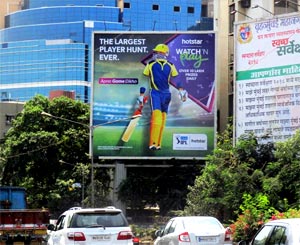
    The Social Street has planned and executed an outdoor campaign for Hotstar’s Watch N’Play game. The campaign consisted of larger-than-life 3D figurines of a batsman’s avatar with the player himself missing. This is said to be symbolic of Hotstar’s search for players and asking users to fill in the missing space by playing the game on its IPL platform.


     

    Said Spencer Noronha, Managing Partner – OOH, The Social Street: “We were very excited to launch this new property for Hotstar. The idea was to create big buzz and drive ample curiosity for audiences to sample and enjoy this real-time gaming experience first-hand. It’s a delight to see the outstanding response that the campaign has received across cities, especially the curiosity we garnered for the 3D creatives.”


  • Havas Media bags integrated media duties of Netmeds.com

    By A Correspondent


    Havas Media India has bagged the integrated media duties of Netmeds.com, the online pharmacy promoted by Dadha & Company. The account size is estimated to be upwards of INR 50 crore and will be handled out of the Bengaluru office led by Saurabh Jain, Vice President – South, Havas Media India.


    Pradeep Dadha

    Said Pradeep Dadha, Founder and CEO, Netmeds.com: “Netmeds has positioned itself as ‘India Ki Pharmacy’ by providing safe, reliable and affordable medicines to its customers at their doorstep with just a few clicks of the mouse. Since E-commerce is a space that’s ever-evolving, agile and digital-first partners will be key to our deliveries. We found Havas to be in-line with our requirements and are confident that together we will drive the brand towards meaningful growth.”


    Anita Nayyar

    Added Anita Nayyar, CEO, Havas Media Group, India and South Asia and CEO – Havas Group, North India said: “Netmeds.com continues a legacy of 100 years of success in the pharmaceutical industry. While we are excited to take on the mandate of yet another pioneer brand, it sure is a challenging win for us, as it operates within a regulated sector plus the online pharmacy space is still at a nascent stage in India. Data analytics will be key in predicting consumer preferences, audience targeting and thus predicting demand with accuracy. Together, with the capabilities of our health & wellness division, Havas Life Sorento, we are positive to create value for the client. We look forward to a long & mutually-fulfilling partnership with Netmeds.”


  • Amazon Prime Video talks about ease of accessing content via latest ad film

    By A Correspondent


    Video-on-demand brand Amazon Prime Video has launched a new quirky campaign created by Leo Burnett India.


    Speaking about the new campaign, Ravi Desai, Amazon India, said: “At Amazon, our focus has always been the customer.  Our new campaign highlights the various benefits linked to Prime Video in India. With a premise of ‘Anytime, Anywhere,’ we have kept customer benefit at the centre of the campaign, which marks the next chapter in the larger story around the popular Prime Video Couple – Rohan and Roshni. We understand the need of consumers to be unshackled from the constraints of their traditional alternatives. With a very wide library of content choice available, Prime Video empowers our consumers to define and dictate what they watch and when they watch it.”


    Speaking about the integrated campaign, Dheeraj Sinha, MD – India & Chief Strategy Officer – South Asia, Leo Burnett India, said:“We are building Amazon Prime Video as an alternate and a better choice for consumers when it comes to entertainment. Amazon Prime Video puts the viewer in command. This is reflected in our positioning – ‘India Ka Naya Primetime’. We started this journey last year by talking about the largest and the latest library, and our exclusive content. The current campaign builds on the role of the liberator further. It amplifies how Amazon Prime Video sets you free, letting you decide where to watch and when to watch your entertainment. The campaign draws from a typical banter between a couple about who is the ‘ghulam’. The phrase also works as a reference to not being a host to your entertainment.”


  • Online ads to touch Rs 9,700 cr by Dec 2017


    By A Correspondent


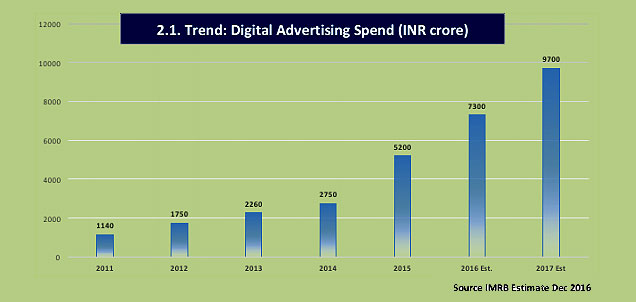
    The digital advertising spend in India was estimated to be around INR 7,300 crore at the end of 2016, growing at a rate of 40% over 2015. The growth in spends on digital advertising is expected to continue at a CAGR of 33% to touch INR 9,700 crore by December 2017. The digital advertising market was pegged at INR 5,200 crore by the end of December 2015. These are the latest findings of the ‘Digital Advertising in India’ report, jointly published by the Internet and Mobile Association of India (IAMAI) and Kantar IMRB Kantar.


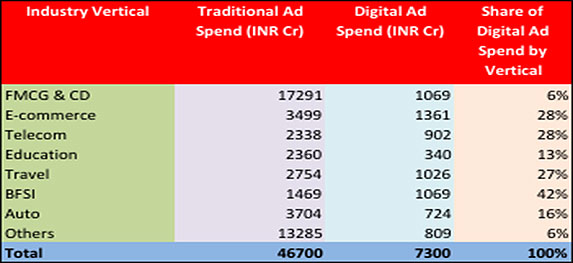
    The report finds that the digital advertising spend is about 14% of the total advertising spends in the country. In terms of volume, E-commerce leads the digital advertising spends with around INR 1,361 crore, followed by FMCG, Consumer Durables and BFSI. However, a comparison of these verticals in terms of share of spends on Traditional vs Digital show that BFSI organisations incurred the highest share on digital advertising spends. 40% of their overall advertising spend was on Digital followed by E-commerce, Telecom and Travel.


    Share: Traditional vs Digital Advertising Spends by Verticals

    Source IMRB Estimate Dec 2016

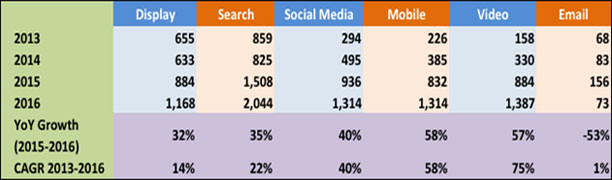
    In 2016, it is estimated that Search ads (close to INR 2,044 crore) constituted 28% of the overall ad spends followed by Video (close to INR 1,387 crore) which contributes to around 19%; Mobile and Social Media (close to INR 1,314 crore) each are at around 18% and Display ads (close to INR 1,168 crore) at 16%. Spends on Video ads have shown a significant increase and accounted for 19% of the overall spends in digital advertising. In all likelihood, this has been driven by new online entertainment (movie, TV series) channel launches, by enhanced monetisation across various platforms and high CPMs on premium content. This category is estimated to witness significant growth till 2020. Spend on mobile advertising (SMS/in-app ads) also recorded high YoY growth of 58% from INR 832 crore in 2015 to around INR 1,313 crore in 2016. Spending on email ads has reduced substantially (-53% YoY) and is now estimated at only INR 73 crore.


    Spend by Ad Avenues & CAGR (INR crore)

    Source IMRB Estimate Dec 2016


  • How Brands Benefit from Synchronisation of Twitter and TV?


    By Sanjeev Kotnala


    Most audiences engage with their mobile phones while watching television. There is always a second screen in play. This viewing pattern was earlier seen as a problem before someone did a deep-dive to understand the impact and use it to advantage.

    Recently after the hugely debated but successful Volkswagen second screen impact, we are seeing brands engaging TV audience with simultaneously or synchronised activity on the second screen.


    Volvo’s “The Greatest Interception Ever” asked its fans to tweet its #VolvoContest, during other car brands’ Super Bowl commercials and nominate a friend or loved one to win a new Volvo XC60 luxury crossover. The brand justified it with  ‘While other car companies are showing you what matters to them… we want to know who inspires you, who loves you, who matters most to you.’ More interaction followed by Volvo asking selective tweets why they nominated someone and finally selecting five winners. It won at Cannes too, and the brand said ‘a nearly 70% sales lift attributable to the effort.’

    Now, we have Goibibo with their GoCash campaign wanting you to keep the app open and  Vodafone wants you to tweet during the breaks of an IPL match telecast. There are 45 breaks. 45 questions. 45 fantastic prizes every match and that may not be the end of it all. Many other brands want you to engage and interact with the two screens simultaneously.

    The Second Screen effect.

    A Nielsen study initiated by Twitter showed a moderate co-relation between people using Twitter while watching television and a higher brand favourability and purchase intent. These audiences pay more attention to the advertisements on TV than people watching only the TV.

    It opens up an opportunity for brands to increase campaign effectiveness by engaging audiences on two screens simultaneously. It suggested that by synchronising TV and social media intervention (Twitter) and getting a second screen effect,  the brand can get better results than running the campaign on both channels independently.

    The second screen enhances the effectiveness of the first Screen.

    Twitter went further with neuro-insight to understand how and what of this second screen impact neurologically. The experiment looked at engagement (the emotional connection between content and viewer) and memory (how information is encoded and stored). The study showed that adding twitter makes the TV experience more engaging and memorable. Twitter users were able to correctly recall slightly more TV ads than those watching TV only. These matched another such study conducted by Neuro-insight in Australia.

    It observed that when the audience engagement with the TV programme dipped at some stage, the brain started looking for options and they switch to the second screen because they got bored or lost interest. They started tweeting about the show and the engagement than peaked while interacting with the personal device. And when they come back to the first screen (TV), they engage more actively- as the second screen has catalysed their mood, and they are interacting at a deeper level.

    It argues that Twitter provides incremental reach and more with the first view as the audience is most engaged when they are start scrolling through the content. It helps to reach to the younger audience primarily in the 18-24 year band. And this guided audience allows for higher on-target reach in comparison to other media with a more broad-based audience.

    Time for the brands to seriously relook at their social and TV campaign alignments and maybe reap enhanced benefits. Till then, happy tweeting!


  • Firstpost.com turns 7; lays out strategic roadmap for next year

    By A Correspondent


    Digital news platform Firstpost.com is celebrating seven years in the industry. Said Azim Lalani, Business Head of the website: “The digital universe is expanding and just like any other sector the digital space too is growing to become highly competitive. So, to have been around for seven years and to have recorded some great growth numbers certainly speaks volumes about the effort put in and the force that Firstpost is today. We look forward to further strengthen our presence and keep our audiences thoroughly engaged year after year.”


    Added Editor BV Rao: “It’s only marriages that wait for the seen-year itch. At Firstpost we itch constantly to break new ground every day. Beginning with the very concept of a breaking views paper to introducing marathon real-time video digicast of elections and budgets, to launching new products such as Firstcricket, Showsha, FirstCulture and Firstpost Hindi the itch to innovate to serve our readers has been a constant companion. And will continue to for several decades more.”


  • Bajaj Allianz launches 3-part web series

    By A Correspondent


    Bajaj Allianz Life Insurance has launched a three-part web series titled #GameOfLifeGoals.  Said Chandramohan Mehra, Chief Marketing Officer, Bajaj Allianz Life Insurance: “Through insight driven consumer stories, we would like to fuel and own conversations around Life Goals in a manner that strikes a chord with Life Maximisers i.e. Millennials, our core target group. #GameofLifeGoals supplements our brand re-orientation efforts towards making Bajaj Allianz Life Insurance synonymous with Life Goals Enabler.”


    Bajaj Allianz Life Insurance has roped in two popular faces from the web comedy world Rahul Subramaniam and Kumar Varun to bring alive the #GameOfLifeGoals. It is a follow-up to a dark (yet funny) take on #LifeGoals called #GraveyardOfLifeGoals that was launched in March 2018. These digital initiatives are a part of the company’s campaign SamjhoHo Gaya, Life Goals. DONE.


  • 10 Trends Shaping Digital Media


    By A Correspondent


    KPMG, in association with NASSCOM, Kalaari Capital and YourStory launched a report titled – ‘India Trends 2018: Trends shaping Digital India’, that delves into the key internet trends that are likely to shape businesses in India in 2018.


    We publish here the 10 trends as listed in the report.

    1. ‘Mobile-first’ consumption for media, gaming, entertainment generating significant avenues for consumer outreach and engagement.

    2. Digital future lies in the Indian language internet users

    3. Rise of social and content-based commerce

    4. Ecosystem creation by internet business players to increase monetisation avenues

    5. Emergence of ‘alternate commerce’

    6. Emerging sectors – Health-tech, Agri-tech and Ed-tech

    7. Emergence of Indian brands accelerated through digital platforms

    8. Robotics pushing boundaries

    9. Digital payments going mainstream

    10. Frontier-tech solutions like AI, ML and blockchain likely to gain precedence


    The report is available at https://assets.kpmg.com/content/dam/kpmg/in/pdf/2018/05/IndiaTrends2018-Trends-shaping-Digital-India-Internet.pdf