Category: MARKETING

  • Anugrah Madison offers Rural Academy for management students

    By A Correspondent


    Anugrah Madison Advertising, the rural division of Madison Communications Group, has launched a rural marketing education service called Anugrah Madison Rural Academy (AMRA) to teach the basics of rural marketing to management students.


    With more and more marketers turning their focus to rural India, AMRA aims at catering to that gap by arming students on the basics of rural marketing. Initially AMRA will offer certificate courses of one / two / three credits. If the management institutes are interested in giving an idea of the basics of rural marketing to all their students, it can also conduct a one-day / two-day seminar on rural marketing at the Management Institute’s premises.


    Announcing the development at the Silver Jubilee celebrations of the company, R V Rajan, Chairman of Anugrah Madison Advertising P Ltd, said, “With the growing importance of rural markets there is a growing demand for skilled / trained human resources willing to work in the rural areas. Many management institutes across the country have started offering rural marketing as an elective course. But there is a dearth of good faculty who have hands-on experience to provide practical knowledge for teaching the subject. AMRA hopes to fill this gap.”


    The faculty from AMRA will be the top management of Anugrah Madison and a few others with several decades of experience in dealing with rural marketing initiatives. Besides, AMRA will conduct the classes at the premises of the Management Institutes over weekends or according to the convenience of the Institute.


    Differentiating itself from other institutes that offer rural management courses like IRMA in Anand or other institutes that offer rural marketing as an elective, AMRA looks at customizing the course. It is not a full-time course but is aimed at building a foundation in rural marketing. AMRA will be responsible for course content, faculty and evaluation of students based on assignments.


    According to R Seshadri, Managing Director, “Mr. R V Rajan, a highly respected Rural Marketing Professional and one of the Founders & Past President of RMAI will be the Course Director. Initially the course will be offered to only Management Institutes located in South India.”

  • UB bets big on ‘unchilled’ Kingfisher Red

    By Tuhina Anand


    Kingfisher Red, marketed as India’s first ‘all season’s beer’, is looking at expanding its footprint in the next 12-18 months and to have a nationwide presence. Currently, Kingfisher Red is available in nine states including Punjab, Chandigarh, Bihar, UP, Rajasthan, Himachal Pradesh, Arunachal Pradesh, Meghalaya and Assam.


    Talking about the roadmap for the product, Samar Singh Sheikhawat, Senior Vice-President Marketing, United Breweries, said, “There was a need to bring in a beer that can be consumed round the year as we have seen that the market swings a low of as much as 40 percent during cold weather as beer is largely seen as a drink for summer months. But I must add that since its launch one and a half year ago, Kingfisher Red comprises 5 percent of our total market share in the strong beer market and so far we are satisfied with the progress of the brand.”


    Kingfisher Red is marketed using the premise ‘Tastes great when chilled and even better when not chilled’. The product is designed to meet the unmet market during cold weather conditions when traditionally there is a drop in beer sales. Hence the communication is built around the season summer, monsoon and winter and how when it’s cold get Red, when it’s hot get Red and when it rains get Red hence a beer that is suitable for consumption irrespective of the season. The collaterals and merchandising is also built around seasons, like its jackets for winters and T-shirts for summer.


    On plans ahead, Mr Sheikhawat said, “We will be looking at being present in 15-20 markets in the next 12-18 months. Also currently the beer is brewed in Ludhiana and Rajasthan and we intend to pinpoint 5-6 more locations where it will be brewed.”


    He also said that the overall strong beer category from UB is growing at a CAGR (Compound Annual Growth Rate) of 15 percent in the last five years which means it is doubling growth yoy. In the case of Kingfisher Red it has been growing at more than 100 percent. In fact, he is bullish on the product and says that by end of March 2015 Kingfisher Red will comprise 10 percent of the total market share in the strong beer category.


    Kingfisher Red is a Premium Gravity beer and is specially brewed to give a distinctive taste with an oaky woody flavour and artistically crafted beer inspired by the traditional brewing practices of medieval European monks. It is so developed following a unique process whereby the beer is golden light oaky brown and can be consumed even at 14 to 17 degree Celsius, without any change in the taste of the beer.

  • Kiranas key to service breadth of Indian consumers, says Kishore Biyani. But big, organized bazaars are cheaper

    By Sarah Jacob & Sagar Malviya


    Ram Agarwal, a kirana store owner at Kolkata’s Salt Lake area, every fortnight walks up to competition in the locality-in his case Big Bazaar and Spencer’s Retail outlets-to spy on their product prices. Without surprise, lower prices greet him at every visit.


    “The kind of deals these retailers provide in some products is impossible to match,” says Mr Agarwal, who has been running his shop, Radhe Shyam, for 24 years now. But he does match the retail goliaths when it comes to small pack sizes, which makes up the core of his sales basket.


    Mr Agarwal knows what opposition parties seem to ignore while opposing the government decision to allow 51% foreign investment in food and grocery retail-that modern retail helps consumers save their precious pennies amidst relentless rise in prices all around. The Economic Times visited popular kirana stores across Kolkata, Gurgaon, Delhi, Mumbai, Bengaluru, Hyderabad and Chennai to compare their prices of day-to-day items with big retail chains in their cities. Modern retail won hands down.


    In branded items such as detergents, wheat flour and edible oil, modern trade prices were 4-20% lower than general trade, which primarily sold them on MRP. And in unbranded staples such as sugar and onions, larger stores were cheaper anywhere between 10-35% in different cities. Take the case of onion.


    In Bengaluru, Aishwarya department store sells it for Rs 20 per kg, while Aditya Birla Retail’s More on the same road charges Rs 16.90. In Chennai, Star Bazaar, a hypermarket chain run by Tata’s Trent in a franchise agreement with UK’s Tesco, sells onion at Rs 18.50/kg, but at Jyothi kirana at T Nagar it costs Rs 24. The reason for this, say big retailers, is that they are able to cut through various levels of middlemen while sourcing. Also, these chains can bargain for lower prices with manufacturers because of their large purchase orders and pass on the savings to the consumer.


    “Modern retail generates up to 10% of the sales for consumer goods companies and can source products at lower prices,” says Mr Kishore Biyani, chairman, Future Group. He says that a big retail outlet, on an average, stocks up to 60,000 stock keeping units across categories, while kiranas store up to 4,000 SKUs.


    Does this mean modern retail will ultimately drive mom-and-pop stores out of business? No. Mr Biyani feels that kiranas are essential to service the breadth of Indian consumers. Analysts agree that consumers need both the formats, to always have an option to choose between the convenience of a neighbourhood store and value deals of a big retailer. They say consumers will always prefer aroundthe-corner kiranas for low-volume purchases.


    “Kiranas deal with consumer goods brands in low volumes. Since these firms do not share good margins, kiranas make it up by charging the MRP without discount,” says Mr Anand Ramanathan, associate director at management consultancy KPMG. Organised retailers, however, have to make it worth the consumer’s while to drive out, brave traffic and parking hassles and shopping queues. This is where their unique selling point of low prices comes in.


    “To draw consumers, retailers squeeze suppliers and ensure efficiency in categories that drive footfalls. They balance it out by enjoying higher margins in categories where impulse buying is high,” says Mr Ramanathan.


    As the table suggests, organised chains retail at lower prices even at a time when food inflation hovers at 9%. “It is all about offering consumers a hedge against rising costs,” says Aditya Birla Retail CEO Mr Thomas Varghese.


    For its Bengaluru stores, More sources half the produce directly from farmers and the remainder from traditional mandis or markets. “When the cost of procurement increases, kiranas raise prices. But we take a hit on margins and put pressure on the procurement channel instead,” says Mr Varghese.


    Experts say big retailers’ ability to offer lower prices will increase when international retailers open hundreds of stores and build backend infrastructure. “FDI in retail can, to some extent, compress the huge difference between the farm or factory gate prices and consumer prices in India, benefiting both producers and final consumers,” says Mr KT Chacko, director at IIFT.


    (With inputs from Writankar Mukherjee, Ratna Bhushan, Madhvi Sally, Jayashree Bhosale, Sangeetha Kandavel, Deepika Amirapu and PK Krishnakumar)


    Source:The Economic Times
    Copyright © 2011, Bennett, Coleman & Co. Ltd. All Rights Reserved

  • Now, the likes of Airtel, Infosys and Wipro help you turn entrepreneur

    By Peerzada Abrar


    When Sanjay Mittal, an employee at Bharti Airtel, decided to take the entrepreneurial plunge this year, his employer was happy to provide him infrastructure, mentoring, funding and even a year’s salary. Bolstered thus, Mr Mittal (not related to Bharti Airtel founder mr Sunil Bharti Mittal) launched UCIT Managed Services, a company that manages video and audio web-conferencing services. His company now employs 35 and Mr Mittal resigned his job as senior vice-president at the telecom company this year.


    “I was surprised when Airtel offered me this kind of partnership,” said Mr Mittal, 44, an alumnus of Delhi College of Engineering and Punjab University. Airtel let Mittal pursue his passion, as the company recognised his contribution of starting this type of unified communication business from scratch, while working at the firm.


    Bharti Airtel, which has 238 million customers globally and revenues of over 65,315 crore for FY2011-2012, owns no stake in the start-up, but Mr Mittal says his company has a mandate to grow the audio and video web services business and manage the complete infrastructure for Airtel.


    He is also in talks with Airtel’s rival telecom operators to provide the service. Six other Airtel employees have also launched their own start-ups, with assistance from their employer, since it came up with a policy seven months ago to nurture entrepreneurial ability among employees. A board comprising Airtel senior management identifies, funds and guides potential business ideas from employees, who want to leave the company and start on their own.


    Apart from this, programmes such as Sparkplug help employees turn their ideas into businesses inside the firm. Other programmes like Zing Labaratory and Start Up Weekend are open for outside entrepreneurs to turn their business ideas into reality.


    According to Mr K Srinivas, president for the consumer business at Bharti Airtel, the initiative’s aim is to encourage business plans from within or outside the organisation to create new product ideas. It is particularly important now as Airtel ventures out to data services and applications. “This is not going to happen only through Airtel’s efforts. Building entrepreneurial spirit is vital,” said Mr Srinivas.


    Observers said that such corporate ‘intrapreneurship’ initiatives could become hothouses of innovation. “Take Google, for instance. Gmail, Google News and Adsense resulted from its Innovation Time Off programme, in which employees are able to devote 20% of their work day to independent endeavours,” said Mr Krishna Tanuku, executive director at Wadhwani Centre for Entrepreneurship Development at the Indian School of Business.


    INSIDER ENTREPRENEURS

    While Mr Mittal left the Airtel fold, another employee, Mr Moloy Kumar Mukherjee, came up with an idea that was turned into a business by a senior team within the telecom company. The product iFasal, which was developed within Airtel, provides real-time access to the prices of crops, seeds, pesticides, weather information and farming advisory to farmers.


    The subscription-based service has spread across states such as Rajasthan, Haryana, Uttaranchal and Jharkhand. Mr Mukherjee, who hails from a farming family, thought about the idea when he saw small farmers suffering supply-chain losses and being exploited by middle-men. “This is because they don’t get the information at the right time,” said Mr Mukherjee.


    OTHER EARLY ADOPTERS

    Other organisations, including IT firms such as Infosys, Wipro and Microland, have also started initiatives to drive innovation.


    “This entrepreneurial culture allows employees to think big and bring new ideas to the table,” said Mr Vishnu Bhat, vice-president and global head for cloud computing at Infosys, India’s second-largest software exporter.


    Wipro, India’s third-biggest software exporter, has opened up various technology challenges at the firm, which involves open invitation for ideas to solve critical problems. “This itself is driving the innovation culture and the entrepreneurial shift in the organisation,” said Mr Anurag Srivastava, chief technology officer and senior vice president for Wipro’s global IT business.


    The intrapreneurs helped Wipro develop a platform made for the Indian garment industry, which will bring down operational costs and help compete effectively with rivals from Bangladesh and China.


    Mr Srivastava said if the business plans of employees do not succeed, they are still valued highly in the organisation because of the risk they have taken.


    Mid-tier firms, like Bangalore-based IT infrastructure services provider Microland, are also following a similar path. In Microland, an executive team headed by chairman and managing director Mr Pradeep Kar selects ideas from employees. VM Kumar, chief marketing officer at Microland, said customers these days do not pay for the resources like manpower and infrastructure. They carry out transactions based on the business outcome. “For that, we have to innovate, which needs an entrepreneurial mind-set,” said Mr Kumar.


    VENTURE CAPITAL MODEL

    Corporate entrepreneurship has been successfully adopted by some of the world’s largest technology corporations such as Intel, Microsoft and IBM. US-based Cognizant Technology Solutions Corp has started an innovation initiative called Cognizant Capital in India. It follows a venture capital model within the company, where it incubates innovative business ideas suggested by employees. The main objective of the model is to create new types of IP-based service offerings that are complementary to their business model.


    There is an internal board that screens business plans and allocates funds in a staged model patterned after Silicon Valley venture capital firms, said Mr Sukumar Rajagopal, SVP and Global Head of Innovation at Cognizant.


    “Innovation in the current context is increasingly important because customers are going through structural shifts in their business,” said Mr Rajagopal.


    CHALLENGES

    Mr Jagdish Kini, former CEO and executive director of Bharti Airtel’s mobile phone operations in India, feels though these are good initiatives to boost the ecosystem, large Indian firms should consider entrepreneurs as partners. “A professional approach is required. They should not portray they are providing some kind of help,” said Mr Kini.


    An entrepreneur, who did not wish to be named, was collaborating with Airtel to provide value-added services for entry-level mobile users. However, he said, he had to close down the start-up due to differences with the management at the telecom major. A spokesman for Airtel said that they are trying their best to grow the ecosystem, but it is not necessary that every business scales up and becomes successful.


    ZING LABORATORY

    Airtel has now also built a ‘Zing Laboratory’ that helps outside developers and entrepreneurs to test, experiment and simulate various mobile technologies revolving around the 3G platform. Started last year, around 21 entrepreneurs and developers have set up applications that they tested prior to the actual deployment of the solutions in the market.


    Last month, Airtel also announced the ‘Start Up Weekend 2011’ in association with SingTel Innov8, a corporate venture capital arm of telecom major SingTel Group. This competition invited individuals to participate and share their new start-up ideas.


    Jobs Bolega, a voice-based social network for blue-collar workers, won the competition. The team will join the SingTel Innov8 2012 boot camp in Singapore and get seed funding as well to make their ideas a reality. Tanuku of ISB believes corporate entrepreneurship, which is still at a nascent stage in Indian companies, needs faster adoption.


    “A few years ago, if you would do what you’ve always done, you’ll get what you’ve always got. But now it is not possible to even keep what you have unless you drive innovation by having entrepreneurial culture inside the firm.”


    Source:The Economic Times

    Copyright © 2011, Bennett, Coleman & Co. Ltd. All Rights Reserved

  • Change is the biggest challenge, says Divya Gupta (now @ Dentsu Media)

    By Tuhina Anand


    Divya Gupta, who has joined Chief Executive Officer, Dentsu Media is back in the media agency side of the business after a gap of almost seven years. She has been away from the agency set up but not really away from the industry as she was gaining experience being on the other side of the fence. First with Reliance ADA Group as Media Advisor to the Chairman’s Office providing strategic advisory on media investments for the group; later at Hindustan Times Media as Business Head – West with the mandate of building the business. Just before joining Dentsu India, Ms Gupta was an independent consultant advising and consulting marketers, media agencies and owners in the media business.


    In seven years, a lot has changed in the media landscape and MxM India deicided to catch up with Ms Gupta and find out what changes in the industry she can outline. She puts it concisely, that the changing environment presents both challenges and opportunities for the industry.


    Ms Gupta says, “First, I think the changing environment allows for having meaningful dialogues with consumers, almost on a one-on-one basis. Media today allows us to actively engage, build and nurture rich relationships with our consumers. And both the message and the medium can be tailored and served to each consumer.” For example she cites that the advertisements that are served to the consumers while accessing mail, search, etc, is basis their past interests and behaviour. Hence, the targeting goes beyond the demographics and makes a marketer’s and media professional’s job much more exciting.


    “Second would be about harnessing collective media synergies, seamlessly, in real time. Media roles are changing and no single medium, even TV, will be self-contained. The opportunity lies in media blending; combining and harnessing each medium in a digital chemistry that delivers across all, paid, owned and earned media,” continued Ms Gupta. “Centered on the brand engagement idea, the focus will be to get better “earned” dividends and the ultimate goal being allowing our consumers themselves to carry forth our crusade.”


    Also she emphasized that today’s landscape allows for realtime, instantaneous consumer feedback. If on the right track, one can march forward or do some quick course correction if need. No more waiting for months to understand the impact of advertising that used to happen some two decades ago, as now the response is instant.


    “Lastly, it is about tightening ROI from computing mere eyeballs to an engagement metric. Reach that is layered with engagement, in both planning and pricing, is a step forward in computing actual ROI. Today, computing eyeballs alone is sub-optimal. Think about it, how often do we check our mobiles while supposedly viewing TV? Dual screens are here to stay. Or how often do we read and register (keep click aside for the time being) all advertisements that get served to us on a search page?” said Ms Gupta.
    Concluding she said, “To encapsulate, it is exciting times, with media posing huge challenges and opportunities in building engaging consumer connections, experiences and nurturing relationships.”


    Talking about her task at Dentsu Media, she shared that it is to first stabilize and deliver to their current clients and then harness their global experience, to the way they work and their suite of media tools to deliver an integrated, multi disciplinary, channel solutions to their clients.

  • Tata AIG focuses on building strong foundation

    By Shubhangi Mehta


    Tata AIG Life Insurance Company Limited (Tata AIG Life) has released the first in its series of a new communication campaign envisaged by Bates, that restates the importance of indoctrinate strong values and foundations by parents amongst their children. The crux of the communication leverages a strong insight that when the foundations are right, the future is protected.


    Tata AIG Life has a long-term brand-building programme, which commenced in 2004 and is supported each year.


    Tata AIG always emphasises on creating a future by nurturing a strong foundation. Whether it’s the way Tata AIG life runs its business, the way it equips its employees or the way it looks at its customers, it makes sure that every relationship stands on solid foundations. For Tata AIG, when the Foundations are right, the Future is protected.


    Vikrant Ramachandra, Vice President, Brand Marketing, Tata AIG Life Insurance Company Limited said, “At Tata AIG Life, we have always believed in creating a future by nurturing a strong foundation. The principle that a strong foundation means a protected future is at the core of the new brand strategy. Our focus on Protection is reflected in the slew of products launched in the recent times, like Tata AIG Life Gyan Kosh, Tata AIG Life InvestAssure Maximizer and the new products about to be launched. The brand communication strategy will reflect this. One of the critical initiatives recently launched by Tata-AIG Life is the launch of the Premier agency. This will foster skills development with a view to creating a professional and productive agency force through mandatory and structured training targeted at ensuring they focus on the customer need.”


    There is a huge and latent need for financial instruments for long-term savings and protection in India. A Swiss Re report on ‘Mortality Protection Gap’ in Asia Pacific indicates a sizeable mortality protection gap in India. The gap which was to the tune of US $ 2045 billion in 2000 had more than tripled to US$ 6676 Billion in the year 2010. This is the third highest amongst countries in Asia Pacific after China and Japan. Tata AIG believes that right now India needs long-term savings and protection products and so their offerings will emphasize these two aspects driving alignment with customer’s needs.


    For their ongoing campaigns, Protection of Life and Health will form the backbone of the Marketing Program. Mass Media Advertising will be extensively supported by intensive Training Program for its Premier Agents at Tata AIG Life. Additionally, Ground Events like Healthy Living Program, which raise awareness on healthy living amongst school students, will make the strategy vivid.


    Its creative mandates are handled by Bates and media mandates by Madison.


    Vijay Sinha, Senior Vice President & Head of Marketing of Tata AIG Life said, “Our core competence is in the area of managing an individual’s financial risks by developing relevant, compelling and differentiated protection-centric products to meet this staggering Protection Gap in India. In line with our core competence, we at Tata AIG Life have always prominently echoed the need to create a sound and steady future by building and nurturing a strong financial foundation. This very principle is at the heart of our latest communication.”


    Commenting on the creative idea, Sonal Dabral, Regional Executive Creative Director & Chairman (India), Bates, said, “If we look at the world around us today, with its rampant consumerism, the thought of the fundamental values passed on to us by our parents getting eroded in the near future is quite scary. The ‘Thank you’ film is relevant in such times not only from a brand point of view but also from a social point of view. Inculcating the right values in our children in today’s fickle times is what will help our nation achieve her true potential. The idea of imparting the right fundamental values, along with the opportunity of engaging the consumers in a relevant manner is what is most exciting about this campaign.”

  • Red Bull, Levi’s, Pepsi etc target young urbans via gigs

    By Rahul Sachitanand


    If the celebrated Woodstock music festival of 1969 was to be held in India today, its billing of “Three Days of Peace and Music” would have to be tweaked to “Three Days of Pepsi and Music.” Live gigs are indeed the flavour with a young nation, and a host of lifestyle and consumer brands from Red Bull to Levi’s and Pepsi are pulling out every trick from the marketing manual to get their attention. The festive season is when live acts crank up the volume. In mid-November the second edition of the Bacardi-led NH7 Weekender in Pune spread over three days and six stages gave audiences a rare dose of multi-genre music, prompting international writers to compare it with the UK’s legendary Glastonbury Festival.


    The pace quickens by the year-end when the Sunburn extravaganza gets going on the beaches of south Goa, with brands like Lenovo and Colgate riding on the electronic dance music festival. “Live music is a great way to build our engagement with our customers,” says Bacardi India’s marketing head Arvind Krishnan. “We today have people willing to listen to new sounds and try new formats, helping the growth of live music. We want to ride this change.” Besides leading the NH7 event and bringing top acts such as electronics artiste Prodigy to India, Bacardi has also supported another event called Together Mix, which looks to push live music into the hinterland.


    Krishnan says, “Live music allows us to give our consumers a holistic brand experience.” Pepsi, for its part, believes it needs to be in every youth destination – live music is one of them. “We believe in constantly encouraging Youngistaan to follow their passions, live their dreams and change the game,” said Sandeep Singh Arora, EVP – marketing, cola, PepsiCo India in a statement.


    Across India, the live music event revolution is gathering steam. NH7 had over 25,000 people attending the festival, double the number a year ago, according to event organisers. There were more bands and larger stages too in keeping with an exponentially larger audience turnout.


    At Sunburn Goa the number of artistes is expected to double to 90 this year, while attendance too is expected to go from around 45,000 to around 100,000. In Bangalore, the cult live music event called Strawberry Fields, which focuses on independent and upcoming performers (it charges a minimal charge to bands and has no entry fee for attendees), is adding 500 to 1,000 people to its audience every year. And at the second edition of the Mahindra Blues Festival to be held in February 2012, thousands are expected to turn up in Mumbai to listen to five top international artistes, attend music workshops, eat blues brunches and browse through thematic displays.


    The world’s largest denim vendor Levi’s is one of the many brands eager to ride the explosive growth of live music in India. Recently it had indie (independent) folk fusion band Swarathma play for a group of blind children, as part of its “Go Forth” initiative to support meaningful causes.


    “We are hoping to raise awareness and support for a diverse range of pioneers around the globe. Swarathma performs free concerts for those who do not have access to live music, using music to raise social consciousness and bring hope to underprivileged people in India,” says a spokesperson for Levi’s in India. Another firm that is allying with live music is energy drink maker Red Bull, which engages with the music scene in two ways.


    All events are properties that are developed, planned and executed by in-house teams. For instance, there is the Red Bull Bedroom Jam, a platform for amateur bands to have a video shot by Red Bull and be a part of a live stage tour. The firm also works with festivals such as NH7 and Sunburn to reach out to its consumer base. “Red Bull strongly believes in working in playgrounds where talent needs support,” says a company representative. “India has a huge pool of live acts. Giving these bands platforms like Red Bull Bedroom Jam, Red Bull Music Academy Bass Camp allows these artists to truly expand their wings.” Red Bull takes pains to point out that these events are owned and operated by internal teams and are not just sponsored events.


    In contrast to the energy of Red Bull, brands are finding new avenues of growth in much more sedate confines. Across the dozens of halls or sabhas that host top Indian (mainly carnatic) music and dance shows during December and January, an increasing number of brands are looking to make their mark. While Chennai-based public sector banks such as Indian Bank and Indian Overseas Bank and the likes of Nallis Silks have been sponsors of events for years, if not decades, newer names such as Axis Bank, Hyundai, Airtel, Aircel and Vodafone have either established their presence-or plan to – during this month long season.


    The growth of live (and independent) music has compelled Sony Music to launch a label called Day 1, which hopes to be a broad platform for independent music in India. Under Day 1, there are two sub-brands, Folktronic (music with Indian influences) and Zomba (urban lifestyle music). “Independent music has reached an inflection point in India,” says Sridhar Subramanium, president, India and Middle East, Sony Music. “The internet and social networks have helped build a pool of talent and make it easy to build a community of listeners for them, in the absence of TV channels and radio stations which would traditionally play their music.” This growth in independent, live music has also made it more appealing to a broader section of brands, beyond the traditional staple of liquor and beverage makers these acts traditionally rely on.


    V G Jairam, a partner with Oranjuice Entertainment, a live music production house in Mumbai, says there has been a sharp growth in independent live music acts across India. “I think the indie space is booming. There is a sense of pride in the consumer to see homegrown bands and this is adding to the growth,” he explains. With growing awareness of emerging live music, music bands are also able to use the web to popularise their music at low or no cost. For instance, a recent show at Mumbai’s Mehboob Studio was almost entirely crowd-sourced. “Music is a powerful tool to connect emotionally with your consumers and get embedded in their minds,” he adds.


    Branding expert Harish Bijoor, who runs an eponymous consulting outfit in Bengaluru, says that any event that is youth-centric will have an umbilical connect with brands. While the mobile phones and services are perhaps the most ubiquitous of these items, several other categories including apparel, accessories, consumer goods and even real estate could leverage live music to make this connect, he says. As live music goes mainstream, brands should consider making select long-term and strategic investments in some of these properties, says Joji George, CEO of Percept Sports and Entertainment, organisers of Sunburn. “These associations are no longer a few hoardings and banners; they need to think beyond and invest in building destination events,” he says. George points to marquee events such as the Glastonbury festival and the Montreux Jazz Festival in Canada as models of live music development.


    Source:The Economic Times

    Copyright © 2011, Bennett, Coleman & Co. Ltd. All Rights Reserved

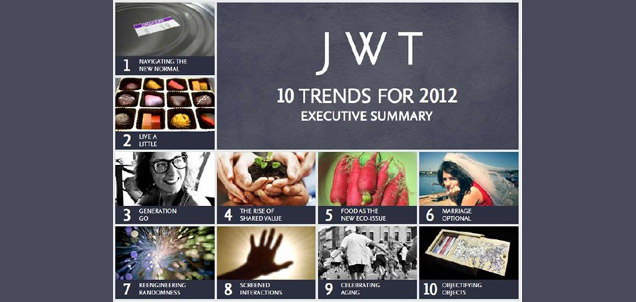
  • The world according to JWT, in 2012


    By A Correspondent


    Ad hotshop JWT feels that in 2012, the economy will push brands into opening up more entry points for cost-sensitive consumers as the “new normal” becomes a prolonged normal in the developed world while at the same time, tough times will generate an unprecedented entrepreneurialism, with the so-called Lost Generation of youth becoming a uniquely resourceful group that creates their own opportunity. The above findings and plenty more, are the result of their annual forecasting exercise – the seventh in the series – of key trends that will drive or significantly impact consumer mindset and behaviour in the year 2012.


    JWT’s ’10 Trends for 2012′ is the result of quantitative, qualitative and desk research conducted throughout the year for the report. It includes inputs from nearly 70 JWT planners across more than two dozen markets and interviews with experts and influencers across sectors including technology, luxury, social responsibility and academia.


    “With our annual trends forecast, we aim to bring the outside in-to help inspire ideas beyond brand, category and consumer conventions-and to identify emerging opportunities so they can be leveraged for business gain,” remarked Ann Mack, director of trendspotting for JWT. “Trends, like any complex and dynamic human phenomenon, are not preordained-once they are spotted, they can be shaped.”


    Previous trends that have been forecasted over the past years include: “De-Teching” in 2011 (more people logging off, at least temporarily, to get a break from technology); “Location-Based Everything” in 2010 (the explosion of location-based or -aware services that leverage data from mobile phones); The Small Movement” in 2009 (the shift away from “bigger is better” in everything from homes to cars to mobile technology); and “Radical Transparency” in 2008 (the “nothing to hide” ethos seen in some online behaviours).


    The top 10 trends that have been predicted for 2012 are as follows:


    1. Navigating the New Normal

    As the new normal becomes a prolonged normal in the hampered developed world, more brands in more categories will open up entry points for extremely cost-sensitive consumers. Marketers will find new opportunities in creating stripped-down offerings, smaller sizes and otherwise more accessible products and services.


    Example: In the US, Heinz is introducing several reduced sizes at a suggested retail price of 99 cents, including a 10-ounce ketchup pouch and a 9-ounce yellow mustard, as well as mini Worcestershire and Heinz 57 sauces.


    2. Live a Little

    Faced with constant reminders about what to do (exercise more, eat better) and what not to do (smoke, overspend), and fatigued from several years of austerity, consumers will look for ways to live a little without giving up a lot. People have been exercising more self-control, and increasingly they are looking to let loose once in a while: indulging in sinful things, splurging on treats and escaping from today’s many worries.


    Example: Whiskey in South Africa, premium beer in the U.K and cheap eclairs in India are small indulgences that consumers with little to spend are enjoying.


    3. Generation Go

    While twenty-somethings in the developed world feel they’ve been dealt an unfair deck, many are finding opportunity in economic adversity. Out of continued joblessness or discontent with the status quo will spring an unprecedented entrepreneurial mindset, enabled by technology that obliterates traditional barriers to entry. A so-called Lost Generation will transform itself into a uniquely resourceful cohort.


    Example: More than half of Millenials in the US agreed that if they lose or have trouble finding a job, they’ll start their own business, according to a JWT survey, up from 25 percent in 2009.


    4. The Rise of Shared Value

    Rather than simply doling out checks to good causes, some corporations are starting to shift their business models, integrating social issues into their core strategies. The aim is to create shared value, a concept that reflects the growing belief that generating a profit and achieving social progress are not mutually exclusive goals.


    Example: Philips is partnering with the Dutch government in a bid to provide affordable, sustainable energy solutions to some 10 million people across 10 sub-Saharan African nations by 2015.


    5. Food as the New Eco-Issue

    The environmental impact of our food choices will become a more prominent concern as stakeholders-brands, governments and activist organizations-drive awareness around the issue and rethink what food is sold and how it’s made. As more regions battle with food shortages and/or spiking costs, smarter practices around food will join the stable of green “best practices”.


    Example: U.K. supermarket Sainsbury’s featured a summer promotion in 2011 offering customers who asked for cod, haddock, salmon, tuna and prawns an alternative, more sustainable species such as herring or mackerel for free.


    6. Marriage Optional

    A growing cohort of women is taking an alternate life route, one that doesn’t include marriage as an essential checkpoint. Both in the West, where this trend is building, and in the East, where it’s gaining momentum, “happily ever after” is being redefined as a household of one, cohabiting or single motherhood.


    Example: In 2010, a third of Japanese women entering their 30s were single, while 37 percent of all Taiwanese women 30-34 were single.


    7. Reengineering Randomness

    As our individual worlds become more personalized and niche-and the types of content, experiences and people we are exposed to become narrower-greater emphasis will be placed on reintroducing randomness, discovery, inspiration and different points of view into our worlds.


    Example: Airtime, due to launch at the end of 2011, is being touted as a random real-time video chat platform where strangers will be “smashed together”.


    8. Screened Interactions

    More flat surfaces are becoming screens, and more screens are becoming interactive. Increasingly, we’ll be touching them, gesturing at them and talking to them – and becoming accustomed to doing so as part of our everyday behaviours. This is opening up novel opportunities to inform, engage and motivate consumers.


    Example: In New York, a restaurant at high-end department store Barney’s features 30 individual screens in a large communal table that’s covered in glass; diners can digitally order their meal, then browse the store’s catalogue while eating.


    9. Celebrating Ageing

    Popular perceptions of ageing are changing, with people of all ages taking a more positive view of growing older. And as demographic and cultural changes, along with medical advances, help to shift attitudes, we’ll redefine when “old age” occurs and what the term means.


    Example: To appeal to Gen Xers and Boomers, Polish beer brand Zywiec launched a campaign with the tagline “The best is ahead of you”. Commercials showed older male celebrities including actors, a boxer and a cartoonist, speaking about their lives, offering insights and advice.


    10. Objectifying Objects

    As objects get replaced by digital/virtual counterparts, people are fetishiZing the physical and the tactile. As a result, we will see more “motivational objects”, items that accompany digital property to increase perceived value, and digital tools that enable creation of physical things.


    Example: Sincerely’s Postagram app allows vacationers and others to turn snapshots into snail-mailed postcards. Similarly, Postcard on the Run reminds potential users that for recipients, a physical card is “a real keepsake they can hold close to their heart, put up on the fridge or display at work”.

  • The Anchor: 5 reasons you know your OOH campaign is working

    By Ishan Raina


    #1 Flexicreation:

    The medium offers an advantage of Flexicreation i.e. creating customized ads and content according to the medium. This can be done by customizing the existing ad for the medium or digitizing an existing ad / leaflet and making it an audio visual ad. Flexicreation for the same medium is impossible in any other audio visual medium. The future will be and has to be the contextualization of the content and advertising messages. For Colgate, we customized the ad for the medium by highlighting the important messages to make it more impactful.


    Example – Colgate Pro-Sensitive Relief:

    Ad Recall: Of the people who had seen the ad 39 % have linked it correctly to Colgate Sensitive Pro – Relief.

    Reach Builder: 32% of the respondents (in the exposed set) were exposed to the ad for the first time through OOH MEDIA screens.


    #2 Flexicasting:

    OOH Media has been the most flexible medium today and gives a chance to slice and dice the message of the campaign as per the kind of audience an advertiser would like to reach. The client can select the locations, cities, frequency and language as per their requirements. Flexicasting provides an advantage of getting as local as possible just like an outdoor but with the power and capability of Audio-Visual. Other mediums are struggling with it and it comes naturally to Digital OOH. For Maruti, we used Flexicasting to advertise different brands in different locations to reach the correct audience.


    Example – Maruti

    Screen Recall: More than 90% of the respondents recall seeing OOH Media screens

    Ad Recall: 65% unaided recall of the ads on OOH Media.

    Reach Builder: 45% of the respondents were exposed to the ad for the first time on OOH Media


    #3 Content Integration:

    Content Integration helps in creating a contextual connect for the brands. The role of content is thus becoming very important in this medium and OOH Media continuously experiments with content to make it more relevant for the audiences and thus attracting more eyeballs. We have always been creating many on-screen properties which are topical, social or based on current happenings. Content Integration is another important area with a huge scope of dynamism and properties like travelogue, home-sweet-home, calorimeter, Green horns etc creating L-Band, Aston Band with the brands which helps them build a perception rather than direct selling. OOH Media customizes in-house content as per the client’s requirement and offering to make it contextual. For GSK- Horlicks Foodles we had created an L-Band on the Content Property called Caloriemeter which was the calorie consumed in the food and Foodles was talking about healthy and tasty eating habits on the LBand.


    Example: GSK Horlicks Foodles:

    Screen Recall: More than 100% recall for OOH Media screens

    Ad Recall: 69% of the respondents recall seeing the Horlicks Foodles ad at a Spontaneous Level

    Reach Builder: More than 24% of the respondents at work and play were exposed to the ad for the first time on OOH Media


    #4 Static Fabrication:

    Static Fabrication is one of the important aspects developed lately. Any brand offering is fabricated around the screens in the static format to create a better impact and creates the visibility for the brand 24 X 7. While the campaign runs on the screens, the static fabrication around the screens adds to the visibility. For Samsung, had advertised for Galaxy Tab in selected screens to reach the target audience and had done static fabrication on these screens to create hype for the brand.


    Example: Samsung Galaxy Tab Campaign:

    Screen Recall: More than 100% recall for OOH Media screens

    Ad Recall: 43% of the respondents recall seeing the Samsung Galaxy Tab ad at an unaided level.

    Reach Builder: More than 26% of the respondents at work and play were exposed to the ad for the first time on OOH Media


    #5 Vicinity Marketing:

    Vicinity Marketing is something that can be used very well by clients in this medium and is ideal for retail. This helps in creating awareness about the brand or the offer in the vicinity to drive footfalls. We have a lot of case studies where the use of vicinity marketing has resulted in the increase of footfalls. Citibank, did Vicinity Marketing for high net worth individuals by selecting limited screens with a very high exposure in Mumbai, Delhi NCR.


    Example – Citibank Reward Points:

    Screen recall: 100% of the respondents recall seeing the OOH Media screens

    Ad recall: 80% recall amongst 157 people who were interviewed of which 52% recall it at a TOM level and 93% recall it at an unaided level


    Reach Builder: OOH MEDIA Reaches Out To MEDIA LIGHT/MEDIA DARK/HIGHLY MEDIA FRAGMENTED AUDIENCES : 35% Respondents Were Exposed To The Ad For The First Time On OOH Media


    Ishan Raina is MD and CEO, OOH Media (I) Pvt. Ltd.

  • As the $ rises, pay more for FMCGs & white goods

    By A Correspondent


    The falling rupee is raising the heckles for consumers already grappling with rising food prices. Over the last few weeks several fast moving consumer goods companies and white goods makers have increased prices, citing the depreciating rupee. And, those left behind are also bracing for a hike.


    If you haven’t noticed it yet, telecom handset makers such as BlackBerry and HTC have already jacked up prices by around 5%. According to retailers, Nokia has also raised the prices by the same amount, but the company declined to comment. Godrej, LG Electronics and Whirlpool have increased prices by around 8%. Samsung is planning to raise smartphone prices by 3-5%, but when it comes to white goods, the Korean giants have already opted for a 2-5% increase for refrigerators, washing machines and microwave ovens. Godrej Consumer Products, Dabur, Panasonic will follow suit, company executives said.


    While demand is not rising significantly, most companies say they can no longer absorb the lower margins on account of higher commodity prices. Although metal prices have declined internationally in recent weeks, the falling rupee has eroded the gains. Since the beginning of August, when the rupee was a little short of the 45-mark against the dollar, the Indian currency fell to a low of 52.73, a decline of nearly 18%. On Monday, the rupee closed 51.42, but even this is 15% lower than the level seen four months ago.


    Source: The Economic Times

    Copyright © 2011, Bennett, Coleman & Co. Ltd. All Rights Reserved

  • India gives voice a case study of Anna Hazare’s PR


    A good product generates its own PR. That, in a nutshell, is the success of Anna Hazare’s anti-corruption movement. The movement seemed to have a life of its own. Yet, it was a very successful PR exercise at the same time, and this is what leading public relations and communications firm Hanmer MSL has examined in this case study, the first of the thought leadership studies that Hanmer MSL’s new content service plans to put together on a regular basis.


    Anna Hazare took up an issue that affects the common man in every aspect of his life  he must bribe officials for even simple things like a driving licence to something major like getting his child admission into school. In his interaction with the government/bureaucracy, absolutely nothing gets done unless he pays a bribe.

    The product

    You can compare the Jan Lokpal Bill to a product that satisfies a crying need  the reduction of corruption, if not its extinction.

    The success of the agitation is astonishing because it had no professional help. Yet, a good product (the Jan Lokpal Bill), clear messaging and use of the right communication tools for this age (it’s been a social media-fuelled stir, which is why you see such a large youth participation), have led it to great success.

    The brand

    If the Jan Lokpal Bill is the product, Anna Hazare is the brand ambassador. Here are a few lessons he taught us about brand-building through the campaign.


    Lesson 1: Have an idea that connects

    Rocked by five major scams over the past year, India was angry at the government, its seeming lack of will to tackle corruption and the time it took to act. A strong, independent Lokpal that could investigate ministers, the bureaucracy, the judiciary and even the prime minister was an idea whose time had come.


    Lesson 2: Create symbols, icons

    Every timeless brand has its symbols Nike and its swoosh, for instance. Most brands also have their icons Steve Jobs for Apple, for example.

    Similarly, every public movement has its symbols and icons  the charkha and non-violence as symbols and Mahatma Gandhi as the icon of the freedom movement.

    Similarly, Hazare and the Gandhi topi became the icon and symbol respectively of the anti-graft fight.


    Lesson 3: Offer a consumer experience

    Each brand has a distinct character. But how do you make the consumer experience it? Hazare chose the Ramlila ground for its size, allowing thousands to throng it and take in the atmosphere. Having experienced their own power, the people began to believe they could change things. There was no looking back.


    Lesson 4: Test market

    All successful products are test marketed before they are launched. Anna’s earlier fast at Jantar Mantar showed that the idea could work. It provided the vindication for a larger movement.


    Lesson 5: Package it right

    Product, pricing, promotion, packaging are the four Ps of marketing. In this case, packaging was paramount. Anna’s white dhoti-kurta and his clean image were the perfect magnets for the jeans and T-shirt generation.


    Lesson 6: Make a media plan

    The campaign was timed perfectly to grab media attention. Launched between the World Cup and IPL, it filled the media vacuum that existed then.

    Team Anna Kiran Bedi, Arvind Kejriwal, Prashant Bhushan  gave innumerable interviews to the media, making sure the campaign was centrestage all the time.

    Hazare himself did not give too many interviews in fact, none during the second round of agitations. He spoke just once to Kiran Bedi from Tihar Jail, which he refused to leave after his arrest. This created a larger impact than any media interview could have had.

    Apart from this, he addressed the public and media several times at the Ramlila Maidan.

    There was another critical aspect to the media communication: the campaign had only the abovementioned people speaking to the media. This was smart thinking. The fewer the voices, the less scope there was for distortion of the message.

    Would any corporation have 15-10 spokespersons? Normally, they’d have one or two. No reason why the anti-corruption movement should have been different.

    The campaign made impressive use of PR tools and techniques ranging from symbolism (fasts and meditation) to social media (Facebook, Twitter, YouTube, apps), FM radio, news media, television and mobile telephony.


    Lesson 7: Out-think the competition

    Anna kept the competition (the government) guessing. Example: The government thought it had preempted the agitation by arresting Hazare. But, his refusal to leave Tihar even when allowed to go, trumped the government’s move and fuelled the movement.


    Lesson 8: Use the right imagery

    The image of Hazare meditating at Rajghat or of him lying down at Ramlila ground and clapping along to the bhajans being sung proved to be iconic. When he broke his fast, he took water from a Dalit girl and a Muslim girl.

    With a giant image of Mahatma Gandhi in the backdrop, the message was not lost on anybody  here was a frail 74-year-old taking on the establishment, much as another frail old man had done in the 1930s and 1940s, and he deserves your support.


    Lesson 9: Use the right tagline

    I am Anna Hazare is a lot more impactful than I am for Anna Hazare. It is far more participative and has a way of internalising the struggle. It grabs you and makes you want to act.

    The social revolution

    The young, some of them fresh graduates, were the ones who created a countrywide buzz about the campaign for a strong Lokpal.

    While Arvind Kejriwal may have headed the media cell, it was the responsibility of over a dozen team leaders, most of them below the age of 30.

    A dedicated team of IT experts from Public Cause Research Foundation (PCRF), which acted as a secretariat for India Against Corruption (IAC), ran IAC’s main website (http://www.indiaagainstcorruption.org/) along with 14 city-centric websites round-the-clock. They also monitored TV channels and posted videos on the internet to create a buzz across the globe.

    Another team ensured that the latest information about Hazare, soon after he was arrested, was posted on social networking sites such as Facebook (http://www.facebook.com/IndiACor) and Twitter (@janlokpal).

    Till August 27, there were 3.64 lakh likes on Facebook and over two lakh followers on Twitter. In contrast, the I Hate Anna Hazare Facebook page roped in only 4,137 members.

    Hazare’s video recorded in Tihar had 1.6 lakh views on YouTube.

    The media impact

    • Large swathes of the television-viewing public switched to the saturation coverage of Hazare and his campaign, especially those in Hindi. For once, real life was more riveting.
    • While viewership increased for most news channels, time spent on them doubled in just a week. It may, in fact, have eaten into the sports market, which dropped 33%; and Hindi movies, which showed a 12% fall (from a 16.37% genre share to 14.44%) in the week ended August 20, according to a study by media servicing agency ZenithOptimedia.
    • The genre share of Hindi news channels rose from 5.9% in the week ended August 13 to 11.02% in the week ended August 20, according to TAM.
    • The genre share of English news channels also rose  to 0.54% from 0.31%.
    • Viewers were hooked since August 16, when Hazare began his fast.
    • The average daily time spent on Hindi news channels rose to 16.9 minutes from 8.5.
    • Viewership of Star News rose 15%. From 26 million viewers, Star News reached out to 31 million.
    • There was a viewership surge across Tier 2 and 3 towns in Punjab, Haryana and Rajasthan in the past week, which shows how mass-based the movement was.
    • While the news genre viewership more than doubled, Times Now reached 12 million viewers, said Sunil Lulla, CEO of Times Global Broadcasting. Times Now continued as the No. 1 English news channel with a share of 37.8%, followed by NDTV 24×7 (22.2%) and CNN IBN (20.7%).
    • Among Hindi channels, Aaj Tak continued to lead with a share of 17.9% share, up from 15.2%. India TV’s share declined to 11.6% from 14.2% to bring it down to the fourth place. THIS IS BECAUSE IT HAS A STRONGER ENTERTAINMENT COMPONENT COMPARED TO NEWS. Star News took over as No 2 with a share of 14.7%.
    • Many news channels decreased their entertainment-related content to make way for Hazare. In fact, some dropped ads to accommodate more of Hazare.
    • Every newspaper covered the agitation.
    • All newspapers took the stance that corruption needs to be tackled; ToI took an aggressive pro-Hazare stand. Every other newspaper gave the issue and the agitation wall-to-wall coverage, but was careful to balance it.
    • Regional newspapers, which have far more experience of covering Anna, were more balanced too.

    Top-viewed news events on TV

    Event % of audience Period
    Anna campaign 12.41 Week 34, 2011
    Babri demolition case 11.54 Week 40, 2010
    YSR chopper crash 12.31 Week 36, 2009
    26/11 17.81 Week 48, 2008
    Mumbai train blasts 11.78 Week 30, 2006
    Mumbai floods 9.71 Week 31, 2005
    Tsunami 10.35 Week 1, 2005
    Lok Sabha polls 2004 10.22 Week 20, 2004
    9/11 7.56 Week 38, 2001

    Source: TAM

    How the UPA got it wrong

    Manmohan Singh used to be known as one of India’s most effective prime ministers. By shaking off the communists hold on his government, pushing through a historic nuclear treaty and winning the last Lok Sabha polls, he was on a high.

    Today, he’s the face of a government that badly misread the public mood and bungled the handling of Anna Hazare’s movement. What’s more, his extended silence gave the impression that he wasn’t really in charge and that he had no idea of how to manage ministers who seemed to get shriller by the minute.

    He finds himself at the receiving end of a nationwide upsurge against corruption, his government with its back to the wall.

    Sending out the wrong messages

    Action Impact
    Refused to accept need for anti-corruption law Government created a perception that it was stonewalling, seeking to stall an effort to cleanse the country of corruption.
    Arresting Hazare If arresting him was ill-advised, taking him to Tihar was a PR disaster. Tihar is where those accused of some of the worst corruption in recent times A Raja, Kanimozhi, Suresh Kalmadi were lodged.Hazare turned his arrest into victory by refusing to leave jail until his demands were met.
    Failure to communicate The top leaders stubbornly refused to engage with the media, secure in their 2009 electoral victory.
    Let anti-graft crusaders drive the debate Government should have seized the initiative by moving aggressively on the unfinished reforms agenda. It did not even celebrate 20 years of reforms in July, as though it disowned them.A publicity blitzkrieg would have done wonders for its reputation, especially with young middle class Indians who benefited most from the reforms. It is these people who heeded Hazare’s call. Instead of regarding Manmohan Singh as a benefactor, they saw him as an obstacle to change.
    No magic wand to curb corruption, said PM He would have been better off declaring that the battle against corruption and a strong Lokpal Bill were an integral part of the reforms process. If RTI brings openness in governance, Lokpal is part of the restructuring.
    Missed opportunity It would have been a PR coup if Singh had asserted that he was on the same side as Hazare. He could have even joined Hazare on a day’s token fast. That would have gone a long way in bridging the communication gulf between the populace and the government, which they see as remote and loath to abandon old habits.


    Timeline

    January 30, 2011: Marches in over 60 cities to demand Lokpal bill. Social reformer Anna Hazare, former top cop Kiran Bedi, activist Swami Agnivesh and lawyer Prashant Bhushan participate in Delhi rally.

    February 26: Hazare announces fast unto death from April 5 if Prime Minister Manmohan Singh does not decide on civil society’s inclusion in drafting the bill.

    April 5: Hazare starts fast at Delhi’s Jantar Mantar.

    April 8: Hazare announces decision to end fast as government agrees to form 10-member panel of civil society members and union ministers to draft a stringent anti-corruption law.

    April 9: Hazare ends fast.

    April 16: Joint committee meets, both sides exchange drafts.

    May 2: Second meet with no difference of opinion.

    May 7: Agreement on independent Lokpal with powers to initiate investigation and prosecution.

    May 23: Agreement on empowering Lokpal to order list of movable and immovable assets of accused in corruption cases when sufficient evidence found to book them.

    May 30: Differences appear as government disagrees on including prime minister, Supreme and High Court judges and MPs conduct in parliament within Lokpal’s ambit.

    June 6: Civil society members boycott meet a day after police crackdown against yoga guru Baba Ramdev’s fast in Delhi’s Ramlila Maidan.

    June 15: No consensus on inclusion of prime minister, Supreme and High Court judges.

    June 20: Some ice melts amid war of words; government calls it major step forward.

    June 21: Last meeting of joint committee ends on sour note. Both sides exchange drafts; Hazare warns of another fast.

    August 15: Hazare denied permission to fast at Delhi’s Jayaprakash Narayan Memorial Park after Team Anna agrees to accept only 16 of police’s 22 conditions.

    August 16: Hazare begins fast, detained and sent to seven-day judicial custody to Tihar jail. Government decides to set him free late night. He refuses to leave.

    August 17: Hazare refuses to leave Tihar till a solution is reached on fast venue. Supporters gather outside prison, Hazare continues fast from jail. Permitted to fast at Ramlila Maidan.

    August 19: Hazare leaves Tihar, continues fast at Ramlila Maidan.

    August 23: Government invites Team Anna for talks.

    August 24: Second round of talks, all-party meeting held. No breakthrough in impasse.

    August 25: After meetings with political parties and Team Anna, government agrees to debate all versions of Lokpal bill in parliament.

    August 27: Both houses of parliament debate Lokpal bill, adjourn after adopting sense of the house and agreeing to Hazare’s three demands that will be sent to standing committee on Lokpal bill.

    August 28: Anna breaks fast on 13th day.


    Copyright: Hanmer MSL

  • S Shriram is Indiaplaza’s SBU Head-Life Style

    By A Correspondent


    Indiaplaza.com, the company that pioneered online shopping in India since 1999, has appointed S Shriram as the SBU Head – Lifestyle.  A retailer by profession and choice, as he terms himself, Mr Shriram is passionate about retail. As SBU Head for Indiaplaza, he is responsible for building the Lifestyle business including men’s, women’s and kids’ apparel and accessories, jewellery, watches, sunglasses, home furnishings and furniture.


    According to K Vaitheeswaran, Founder & CEO, Indiaplaza.com, “We are very happy to have Shriram on board. I am confident his rich experience as a retailer will help position Indiaplaza as the leading online shopping destination for lifestyle also, just like for books and electronics.”


    Online shopping in India is booming across books and electronics. With the Indian internet population crossing 100 million recently, the next wave of growth is expected in the area of lifestyle. With a loyal base of customers and fast growing traffic, Indiaplaza is aiming to quickly establish leadership position in online retailing of lifestyle as well.


    Prior to joining Indiaplaza, Mr Shriram was the National Head of Business Development at Cafe Coffee Day and was responsible for their expansion among Key account partner-locations. Earlier to this, he was leading the Travel Retail and Consumer Businesses at Bangalore International Airport Limited as part of the Core Committee that was involved in selecting the operators across various commercial businesses such as Domestic and International Retail, Duty Free, F&B, Forex, Landside Traffic Management, Ground Transportation, etc.  He also had the privilege of working with United Colors of Benetton, one of the leading fashion brand and some of India’s prominent retail organizations : The Future Group and the RPG Group.