Category: COLUMNS

  • Storytelling Unlimited?!


    By Sanjeev Kotnala


    Who doesn’t love storytelling? I love the stories, where a chapter is closed in duality compounding the ambiguity. It forces the reader to acknowledge the power it wields, and the reader ends up turning the page for more. How many times have I been held captive by such narrative, ending up finishing the it in one seating!

    In marketing, a few adventurous brands have taken the plunge and have braved the risk of storytelling through definitive episodic chapters, revealing the story through a series of films exposed in a  slow pre-determined gaps. They try to  hold the audience, tease a bit, have fun, create that extra bit of engagement and involvement to extend the campaign.

    After the advent of digital and fast buildup of a video addicted audience, I expected brands to create web-alone series. It did not happen. You can’t blame the marketing head, the brand manager or the agencies in isolation for not taking the expected step in natural evolution.

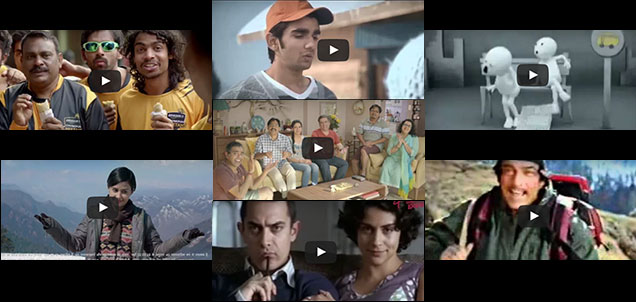
    Few brands ventured into this space of serialised or sequential storytelling campaigns, where each standalone episode (AV*) is part of a larger social reflection or a bigger story. The recent campaign by Amazon ‘Chonkpur Cheetah’ is an example of such thinking. The story of the team getting its supplies, finding a female wicket keeper and a lucky charm has its own share of smiles. There is also a  series Chonkpur ke Chowk se where you find interview with Bret Lee , a Rap face with the coach and the team meeting with the nutrition specialist.


    I think digital will push the creators and the curators towards simplified storytelling format and highly rich video content. Sequential approach of story telling will soon have its glory.

    At this stage, I must differentiate between ‘Sequential Advertising’ and ‘Multiple Execution’. Sequential advertising is when each of the advertising messages (episode**) builds on the last episode and lays the foundation for the next. Like a novel, each episode is part of the same story. Sequential advertising is multiple executions with character and storyline continuity. The characters evolve with the audience and have a continuity in their expression, attitude and behavior.

    The one brand that has experimented with sequential communication is Tata Sky. And they got it largely right with Chotta Recharge. Here is the compilation of ads that slowly revealed the story and naughty innocent playfulness between a shopkeeper’s son and a girl who would come everyday for the eight-rupee recharge.


    If I am right, this was primarily a TV campaign. In a digital space, such communication may seem like slowburner but most likely will get the relevant revenue generating clicks.

    On the other hand, the ZooZoo campaign of Vodafone can be termed sequential because it involved central characters that were same. Even as they were very standalone.


    Here is another very sequential communication from Airtel and the life of the now-famous Airtel Girl. The same ads demonstrate part of her life and interacts to deliver the brand promise of widest network, MyPlan, One app to the fastest network….


    Here is my favourite. Voltas Murthy. The loveable South Indian who is transferred across India. He is exposed to different climatic conditions, but he is not let down by his all weather Voltas AC. Slowly with the episodes (TVCs) you get to know the family, including his in-laws. It is very ‘slice of life’ presentation that makes you love the character, and the message gets delivered.


    He is a character who has survived seasons. This year, he is riding the low-power consumption message. And by the way, he is now president of the housing society.

    There is another Aamir Khan campaign with Gul Panag for Tata Sky, an example of a sequential campaign.

    Multiple Executions is the standard default mode for the agencies. It has been the safest and the easiest way out. Here the same brand proposition or promise is presented in different episodes. These episodes stand alone, and they do not inform, establish or impact the next one. They are conceptually same. The characterisation changes. They are like an anthology; the central theme or proposition remains confined to narrow possibilities but the episode / incident, incident or story celebrates widely different framework.

    Here is a legendary communication that enthralled audience when it was released. The ‘Thanda Matlab Coke’ campaign. Aamir Khan acts as Bengali Babu, Manu Bhabhi episode, Jat and Japanese and others bringing a definitive smile in the face of audience and helping establishing the brand proposition.


    Sequential storytelling in advertising can be effectively used for brand awareness, and perception built up. It can be very effective for action driven or conversion campaigns.

    If crafted rightly it can leverage huge engagement and involvement for a new brand entering the communication and audience-relationship space.

    Today, everyone is a storyteller, a content creator and/or curator. Most of them are conversant or rather addicted to the audio-video format.

    Sequential ads can have more impact. However, to get them right, needs a deep focused understanding of the target audience, prosumers and influencers. The opportunity lies in slowly unveiling multiple layered brand promises in a collective conspiracy with the audience.

    The art lies not allowing a sharp funneling of audiences. You cannot afford for a slice of consumers to drop at every new episode. In fact, new audience must be added to the franchise.

    It is only possible if each episode is complete in itself and yet makes you want to know what happens next. It is like TV soaps that leave you with an ending which pushes you to come and watch their next episode.

    To create this magic, the advertising creative and media agencies and the client need solid in-depth understanding of their audience. Then only will the audience will enjoy and move with the story.

    I am aware that sequential campaigns need smart creative execution and media budgets to back it. I believe that impact of such media and creative constraints can only be softened and not eliminated completely.

    Digital platform gives you multiple advantages in this space of the sequential campaign.

    It allows for a sequential static campaign that could be developed with still frames. The sequential campaign can be targeted geographically and filtered on attitude and physiographic segmentation. Proper execution can profitably prime the audience before reminding them of hard sell on social platforms. You can control the sequence of episode exposure. So, the audience can see the nth episode only if they have watched the n-1 episode. Moreover, you can control the twist in the story as per segments and / or mood of the audience. Is this freedom really a constraint?

    There is no straight answer to the question whether a sequential campaign is better than multiple execution campaigns? Will it work or not? And the risks associated with them are poles apart. In multiple executions, one can control the exposure of the versions according to the audience reaction, whereas in the sequential campaign you are almost committed on the front foot. Hence, the brands with better understanding, kind of self-assured and willingness to experiment will be the first one to use sequential campaign to its fullest advantage.

    There are no set rules and templates available for sequential advertising. One needs to experiment with it. Every brand, and category will have to find the format, storylines and patterns that is engaging the audience. Meanwhile, the brand will have to remain true to its promise. This requires the brand to speak the same language across mediums.


    * I am using a term AV to overlap between TVCs of 30-45 or max 1 minute and Digital Films, which normally are of a longer duration. ** episode represented separate pieces of communication. They may or may not be f the same duration. 

  • Can Republic TV kill Competition?


     By Pradyuman Maheshwari [updated]

    For a television channel that’s determined to fight for the need for transparency in public life and government, its launch date appears to be a closely guarded secret. But now it’s confirmed: Tomorrow, May 6. Why a Saturday, one may ask. Because that’s the first day of the week (Week #19 of 2017) as per BARC measurement. And Goswami, as he must, keeps a close watch on his viewership numbers.

    Before we had  confirmation on the date, we did have word from the Star India Corporate’s PR agency that Republic TV would start streaming on the OTT platform with effect from tomorrow. No time stated.

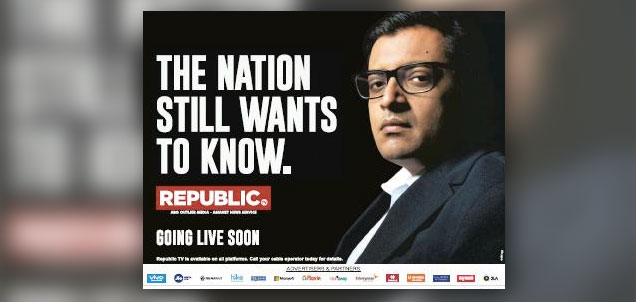
    Having said that, Republic is on a roll in terms of marketing across media. It has a healthy set of advertisers: Vivo, Jio, Renault, Hike, Yes Bank, Microsoft, Ravin, Nestaway, Future Group, Havell’s, Gionee, Lloyd, Raymond and Ola. Star India, we are told by sources, will continue to be an advertiser, though its logo is missing from today’s Mint ad.

    We asked ChromeDM, specialists in research on connectivity to give us a report on the availability of Republic TV, for, distribution along with content and revenues will eventually speak about the success of the channel.

    And this is what Pankaj Krishna, Founder & CEO, Chrome DM said: “Currently, on an average, an English News Channels has an availability of 45.1% among Urban Homes in India. With its soft launch, Republic has 18.4% Urban India availability (as per Chrome OTS or Opportunity to See, 3rd May 2017). In Mega Cities, Republic is currently available in 32% of the Households.”

    Note this is for data as of May 3. A distribution industry expert we spoke with said that the availability will leapfrog once the channel goes on air, as even though the deal is inked, some discerning networks do not like to air test signals. So the expert we spoke with said the ChromeDM data as of now may not be the right measure to look at right now.

    However, MxMIndia is a neutral observer and it’s important that you know facts as they are. Also, according to the ad, distribution deals have been inked with all platforms. Other than Hotstar, Republic will be available on Jio, Ditto and we are sure other platforms too.

    “There’s a buzz around Republic TV, and even if deals aren’t inked, viewers will want to watch it and will ask for it… at least for the first few weeks. Moreover, it’s free-to-air, so the pull factor increases,” said one distribution network owner.

    A media buyer and marketer we spoke with requested to speak on anonymity. Here’s what both echoed.

    1. That the buzz around Arnab Goswami has increased after he quit his previous employer.
    2. The legal notice which Goswami spoke about making an emotional appeal touched a chord, and there is a certain amount of sympathy for him.
    3. The issues with Pakistan are raging, and that’s a topic Goswami is passionate about
    4. There are enough inefficiencies across the country which Goswami will definitely dwell on

    Meanwhile, other channels are also getting their act together. Both India Today and CNN-IBN have launched shows at 7pm and also relooked at the rest of the primetime programming. Extension of primetime to 7pm will expand the viewership in all.

    As per BARC ratings for Week 17 (April 22 to 28), Times Now was the leader followed by India Today, CNN-News18, NDTV 24×7 and BBC World News. NewsX and WION didn’t figure in the Top 5. This data is for urban and rural viewership from amongst males of 22 years and above.

    MxMIndia also spoke to industry captains and while all of them wish Republic TV and Arnab Goswami the very best, they do acknowledge that it’s not going to be an easy ask. There are comparisons made to how CNN-IBN (now CNN-News18) scored a march over NDTV 24×7 when Rajdeep Sardesai started the channel, but those were early in the history of English news television in India. Times Now didn’t exist and Headlines Today (now India Today) was near-inconsequential.

    And what is our view? Well, who doesn’t like a David outwits/ outshines/ kills Goliath story. We all love it. But then we are going to be as neutral as it’s possible. We report on the business regardless who gives us business.

    However, there are issues which are beyond just R&R… in this case ratings and revenues. It’s the kind of journalism we will see on Republic TV. And hence across all channels. Will channels talking about the noise be contributing to the noise in their own way? Will the new style of television journalism – nationalism and raising questions against it – actually damage situation on the ground, even though the viewership of English news channels is limited.

    It’s our third ‘Big Story’ on Republic. Or fourth? We’ve lost count. But, then, it’s possibly one of the biggest media launches in the last decade.

    The last question to ourselves (and as in the headline): Do we see Republic TV killing Competition?

    Our response: We don’t know. Yes, we do care and we will be delighted to report on the numbers. We will await the BARC ratings over the next few weeks quite how in the old Hindi films the old parents would wait for the ‘daakiya’ for an update.

    Our normal end-line would’ve been: May the best channel win.

    But here, we will say: May good (and smart) journalism win.

    Now don’t say who cares!


  • Indrani Sen: Digital India: A Reality Check

    By Indrani Sen

    Last week, GroupM released ‘Interactions_2017’, an insightful and interesting report on global overview of digital marketing.  In the report there is no specific mention of how digital interactions are tracking in India, though along with many other countries of the world, India has also been covered. It is a must-read for Advertisers and Agencies in India, who can use it as a crystal ball for gazing into our digital future.

    The report contains from highlights of countrywise data along with a snapshot of interesting developments of interactions in that country and Appendices with data on E-commerce, Interactions Ad Investment, Adult Internet Users, etc. I have used the data for BRICS countries to do a reality check on Digital India, which shows that we still have a long way to travel to reach the top of the table among the five countries.

    Smartphone penetration as % of phone users

    2014

    2015

    2016

    2017e

    Brazil

    42

    62

    75

    89

    Russia

    42

    45

    50

    58

    India

    21

    26

    30

    33

    China

    45

    56

    71

    77

    South Africa

    85

    85

    85

    90

    Source: Intercations_2017

    In spite of having one of the highest growth rates of mobile penetration, India is still at the bottom of the table with 33% of smartphone penetration as percentage of phone users.

    Adult media usage percentage 2014

    Online

    TV

    Print

    Radio

    Total

    Brazil

    22

    44

    10

    24

    100

    Russia

    31

    38

    4

    27

    100

    India

    23

    59

    6

    11

    100

    China

    45

    33

    8

    14

    100

    South Africa

    32

    31

    10

    27

    100

    Source: Interactions_2017

    The dominance of TV in adult media usage was highest in India in 2014, when comparative data for all five countries were available. ‘Interactions-2017’ has shown the statistics for the other four countries apart from India from 2015 to 2017 (estimated) where figures from India have been shown as not available. Globally, on a population-weighted average, the media day grew by 9 minutes in 2016, riding on a 14 minute rise in online. It is expected that similar changes have also happened in India.

    Total E-Commerce in USD Billion E-Commerce per user USD

    2014

    2015

    2016f

    2017f

    2014

    2015

    2016

    2017e

    Brazil

    12

    13

    14

    16

    120

    114

    116

    115

    Russia

    18

    23

    26

    30

    413

    499

    460

    509

    India

    16

    21

    26

    33

    63

    61

    61

    66

    China

    413

    579

    742

    920

    844

    1107

    1325

    1533

    South Africa

    0.4

    0.4

    1

    1

    26

    26

    33

    33

    Source: Interactions_2017

    The total value of e-commerce has doubled in India from 2014 to 2017 (estimated). However, a comparison of e-commerce per user shows that India is at the bottom of the table among the four original BRIC countries. This is due to the huge rise in the number of adult internet users in India which has almost doubled from 2014 to 2017 (estimated) as shown in the next table.

    Adult internet users

    2014

    2017e Growth%
    Brazil

    102,387

    137,700

    34.4

    Russia (U)

    44,691

    58,347

    30.5

    India

    260,000

    503,000

    93.4

    China

    489,806

    600,000

    22.5

    South Africa

    16,705

    18,400

    10.1

    Source: Interactions_2017

    The huge number of users is pulling down India’s performance when it comes to advertising investments in digital media/ interactions per user and is again pushing India to the bottom of the table with only 3 USD per user against 82 USD per user of China.

    Interaction Ad Invest. USD million Interaction Ad Invest. Per User USD

    2014

    2015

    2016f

    2017f

    2014

    2015

    2016f

    2017f

    Brazil

    847

    1,524

    994

    915

    8

    13

    8

    7

    Russia

    1,359

    1,558

    1,895

    2,210

    30

    34

    33

    38

    India

    510

    742

    1,096

    1,423

    2

    2

    3

    3

    China

    22,787

    31,368

    40,628

    49382

    47

    60

    73

    82

    South Africa

    111

    152

    214

    268

    n/a

    n/a

    n/a

    n/a

    Source: This Year Next Year 2016 / Interactions_2017

    What is encouraging for India is the share of digital interactions of all media investments has doubled from 2014 to 2017 (estimated). We need to invest in an accelerated rate in this area to improve our performance among the BRICS countries as apart from Brazil, all other countries have much higher share of digital interactions in all media investments. China, which leads the table, is estimated to have 57% (estimated) interaction share of all media investments against our share of 14.9% (estimated) in 2017.

    Interaction Share % of All Media Investments

    2014

    2015

    2016f

    2017f

    Brazil

    4.3

    7.3

    4.8

    4.3

    Russia

    24.9

    31.5

    35

    37.2

    India

    7.8

    9.9

    12.9

    14.9

    China

    33.1

    42.3

    50.8

    57.2

    South Africa

    8.7

    11.7

    16.6

    20.7

    Source: Interactions_2017


    To sum up, it is evident from the statistics reported by ‘Interaction_2017’ that demonetisation has not been able to give the desired boost to digitising India. I think we may have to wait for another decade before we can even start dreaming of rising to the top of the digital interaction tables of the BRICS countries.


    Indrani Sen is a veteran media agency and marketing services professional. She is currently an Independent Consultant and Adjunct Professor, Media Management at Symbiosis Institute of Media & Communication, Pune. The views expressed here are her own.


  • Ranjona Banerji: When TV journalists lose all semblance of being observers, reporters & editors

    By Ranjona Banerji

    Coming back to India this week after a month away in the UK, I see that I have Republic TV’s commitment to nationalism to look forward to. Or, in another way of putting it, more of the same but this time, with a great leap backwards to Arnab Goswami.

    Advertising appears to suggest that Goswami and his news channel will be “Pakistan’s migraine” and that the mantle of nationalism that has been lying forgotten will now be won with pride. That India’s borders will defended to the last shout in Indian TV studios. Where else, you may ask, should India’s borders be defended?

    However, given the make-up of Republic TV and much of Indian news television, almost no one is likely to question how and why India’s borders have been breached quite so often in recent times or how terrorists from Pakistan have walked into armed areas with so much apparent ease. Perhaps it is unfair of me to suggest that no one has been questioned. Over and again, India’s first Prime Minister, Jawaharlal Nehru, who died in 1964 has been questioned. His great grandson Rahul Gandhi, who has not held any constitutional administrative post has also been questioned. No one currently in power has been found responsible in any way.

    My fellow columnist Jaisurya Das was asked recently if “decorum was dead in the news media”, after a news anchor told a studio guest from Pakistan to “shut up”. Jaisurya commented: “This is typical of the immature arrogance of anchors who often forget where to draw the line in their effort to build TRPs. Little do they realise that such language and demeanour only turns people off and they stand to lose more in the bargain.”

    That people are writing in to complain about such behaviour is small comfort when you know the immense reach and influence that TV has on the public. Adulation, stardom, hatred, familiarity all allow TV journalists to become bigger than they are. The result is that they lose all semblance of being journalists, of being observers, reporters and editors. Sadly, TV has brought out the worst in us.

    Goswami in his interview to Pradyuman Maheshwari before the launch of Republic TV declared that he was proud of his nationalism and that he held no truck with “Aman ki Asha”, an initiative towards dialogue with Pakistan started by his former employer, the Times of India.

    This makes for an intriguing position – would any attempt at peace with Pakistan be stopped by Goswami? If the current Indian government tried it, would he fight them? Is diplomacy to him a lost cause already? Because Goswami operates only within the confines of one news show, it is hard to grasp his intellectual position on such matters. Is humankind doomed to never make peace in his mind?

    Interestingly and perhaps expectedly, Republic TV’s big “scoop” on launch day was some expose on former Bihar chief minister Lalu Yadav. As anyone with any smattering of political knowledge is aware, Yadav is already debarred from standing for elections because of corruption cases. The target for Goswami and his backers is never likely to be the BJP government or the Prime Minister or indeed any minister in the BJP.

    Once you know that, it makes life and choices much easier. As Maheshwari pointed out in a column here last week, “Or is it that a country which is not too fussed on ethics and corruption, passage of time ensures things are forgotten and condoned. We all know of some entities indulging in unethical practices, but do we really shun them? On the contrary, we embrace them. We allow them to flourish. We read or watch them, we attend or speak at their events, we accept their awards.

    Perhaps we deserve such a media.”

    Do wee?


    Ranjona Banerji is a senior journalist and commentator and Consulting Editor, MxMIndia. The views expressed here are personal

  • Sanjeev Kotnala: Shan, Ikea, Nike… Work you can’t ignore

    By Sanjeev Kotnala


    This week I am taking a detour to share some of the work which I believe must be appreciated. Storytelling is a key pivot for the communication business. And if one can make a static medium like print come alive with a story that involves and engages the reader, the job is done. Unfortunately, such examples are rare.

    In the last few weeks, I have been fortunate to be exposed to some work that has immediately hit the chord. The work for Shan Foods, a big spice and recipe brand in Pakistan executed by Ogilvy India and Ogilvy Pakistan is a good example of simple storytelling. Use of an eastern coupe as the just moved in neighbours is interesting. The basic brand propositions of flavour and taste were delivered on the foundation of ‘ sharing food can break all barriers and start new friendships.

    When two offices from not-so-neighbourly countries come together to create this magic, the flavour gets enhanced. You can feel the audience engagement when you see the consumer enact their own stories and parodies keeping the framework of the campaign intact.

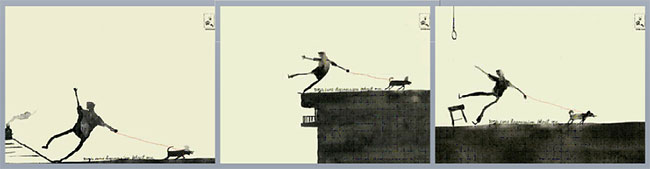
    The next creative I first experienced on Whatsapp when I was sent these images and was asked to zoom in. Wow, initially I just saw them as images that circulate in digital media as no thought or promise or brand name was associated with it. It is later that I realised it was work for ‘World For All’.

    The work was powerful for me to Google for World seeing some more relevant work from 2013 ‘Dogs cure depression, adapt one’. It is a simple thought that has been brilliantly executed.

    Prega, more imprinted as the Shilpa Shetty pregnancy announcement brand, surprised by taking a detour and silently entering the thoughtful world of celebrating approaching motherhood with care. This time, instead of husband or mother-in-law or mother, it moved into the tough office environment.

    The thought of such consideration in an office environment looks too far-fetched in the current reality. Normally, we associate these moments with ‘Who will do her job’, ‘Now she will go on leave’ on one side to ‘there goes my career, will I ever be able to get back’.

    Nevertheless, there is no harm in thinking positively and visualising an idealistic world. It will be great even if one office or one colleague or one boss is inspired by the thought.

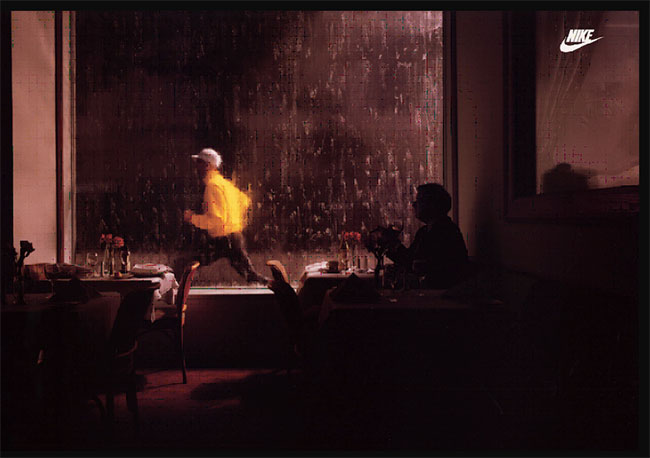
    Then Adweek exposed me to this Nike print ad. Wow. This is where the visual says a lot more than copy could have ever explained. The involvement is so complete. It is an engaging visualisation.

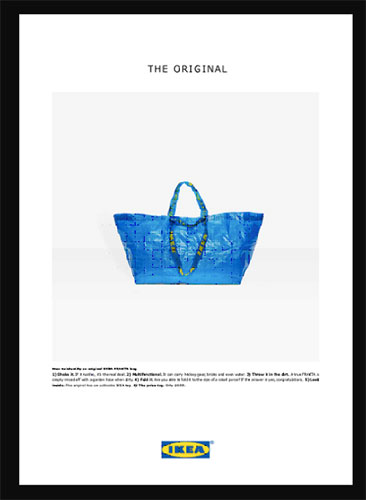
    And then recently what one may call cheeky, and some may call as ‘released in public interest’ stunt. It is Ikea’s reaction to Ballenciga 2154$ bag. This high priced bag seems a replica of Ikea’s 0.99 $ tote bag.

    See the communication released by IKEA. The copy is straightforward and simple. It reads;

    How to identify an original Ikea Frakta bag

    1) Shake it. If it rustles, it’s the real deal. 2) Multifunctional. It can carry hockey gear, bricks, and even water. 3) Throw it in the dirt. A true Frakta is simply rinsed off with a garden hose when dirty. 4) Fold it. Are you able to fold it to the size of a small purse? If the answer is yes, congratulations. 5) Look inside. The original has an authentic Ikea tag. 6) Price tag. Only $0.99.

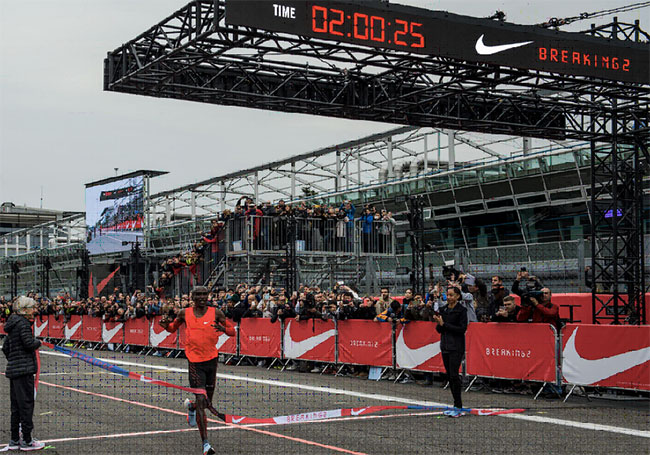
    And then the mother of all BREAKING2 by NIKE fell just a wee bit short of the target when Kipchoge finished the race in 2:00:25 in the Monza F1 Track in Italy. This was the attempt to run a marathon in under two minutes. He did break the official timing of 2:02:57  and it did not matter that this record breaking time was not eligible as a record.

    As a concept and activation, it was an engagement success. It was almost like Sir Roger Banister breaking the 4-minute mile record in 1954.

    Let’s hear it from the  Nike CEO Mark Parker: “I’ve seen the magic of gold shoes and swift suits. I’ve seen iconic athletes leave it all on the track. But I’ve never seen anything like what we saw today,” sound so true and genuine. He further added, “This achievement represents more than a race. It’s a moment of global inspiration that will encourage every athlete, in every community, to push the limits of their potential.” And that is what it was really about ‘Unlocking the Human Potential’. Impossibility is after all an opportunity to envision the future of sports. It allows bringing inspiration and innovation to every athlete on the planet.

    The race was live on Twitter, Facebook and YouTube. It generated enough conversation pre, during and post the event. With 5.3 million views (as I write) on Nike’s BREAKING2 Facebook Page, the experience can be relived for some time. And later in the year National geography will produce a feature-length documentary on it.


    Wonderful reacting and enjoying these good works. Hope you liked this compilation. Do share if there are ads – campaigns that I must cover and share in this platform.


  • Two views on Week 1 of Republic


    Republic TV: Week 1 In Review 

    The stance seems so overpowering that it is beginning to overtake the content itself, writes Shailesh Kapoor


    By Shailesh Kapoor


    He arrived, back into our lives, on Saturday, May 6, 10 AM. There was even a hashtag to mark the occasion. It was called #May6WithArnab. Arnab Goswami’s absence from the small screen may not have changed the politics of India, but it kept us deprived of his unique brand of journalism.

    The channel has been on-air for six days now. Here’s a review of its rather eventful first week:

    The positives first. I liked that opening speech on May 6. Arnab was like he’s in real life: Candid, warm, even smiling. Wish we saw this side of him more often. Pleasantries done, he came all guns blazing at us, with what has been a regular feature on the channel in the first week: Republic Super Exclusive.

    It’s been six days and the channel has covered roughly the same number of stories. There are no headlines, side-news, IPL news, Bollywood news, feature shows etc. Talk about focus, and it’s here to see. This focus makes Republic TV is easily the most unidimensional news brand India has. It’s a differentiator alright. How many Super Exclusives can they find after the launch euphoria is over, will be the key to how well this focus sustains.

    The packaging is good, though derivative of what we have seen before. The channel is well-connected and available. The Hotstar deal, just ahead of the launch, is a huge plus. Early number on Hotstar have been very positive, giving the channel a genuine additional platform, which is far from effective than channel apps and websites.

    But all was not right in the first week. The first problem was a known, expected problem. The channel evidently lacks a strong second line of reporters. Arnab has been propping many in his team over the last six days, but none of them are seasoned names. They are clearly trying to learn from the man and grow. Which means that they will try and become like him. Which doesn’t work, as we have seen in the past on Times Now.

    The second issue for me is a bigger one. Some of these Super Exclusives being “broken” are dated, from a time when Republic TV was not even envisaged, forget being in existence. The most striking example here is the so-called exposé on what Goswami keeps calling the “Sunanda Pushkar murder”.

    The said story is based on taped conversations between journalist Prema Sridevi and Pushkar’s staff. These conversations date back to 2014, from the day before and the day of the “murder”. Sridevi was working for Times Now then. She even mentions Goswami in one of the phone calls, as being the person who asked her to meet Pushkar.

    Both Goswami and Sridevi were with Times Now for almost three years since those calls were made. He would have done at least a dozen (probably a lot more) prime-time debates on this topic on the channel in that period. But the said tapes never made their way on-air. Whatever be the reason, the material, technically, is the property of Times Now, but is being used on a platform that now’s in fierce competition with it. This one point of ethical departure is difficult to justify.

    Many of the Super Exclusives have been based on thin evidence and are more suggested “scams” than real ones. But that’s been the nature of Goswami’s attacks on politicians over years. Not surprisingly, there have been no stings exposing anyone in the BJP so far. It could be a while before that happens.

    But what bothered me the most is that there’s even more aggression in Goswami’s approach on Republic, with his stance being more confrontational, to the point of being forced confrontational at times. It’s as if a rebel has been freed of all the clutches he was being controlled by earlier.

    Goswami’s style was always abrasive, and there was no need to outdo himself. He was already on the edge, and I fear he may have gone too far this time. Being a voice of the nation and the people is good, but here, the stance seems so overpowering that it is beginning to overtake the content itself. It can easily backfire. We will have to wait and watch.

    Early numbers will be good and you can be rest assured Goswami will flash them all over his screen and make it a Super Exclusive too. The first week has been action-packed, but not necessarily rock-solid. Let’s see where this Republic is heading.


    The Republic & The Others 

    The upshot of the launch of Republic TV is that practically every news channel is following Goswami’s example, writes Ranjona Banerji


    By Ranjona Banerji
     

    The funniest thing on Twitter in the past few days is Rahul Kanwal, managing editor of India Today TV, grumbling that Arnab Goswami’s Republic TV is BJP-sponsored. There may be no doubt that there is a strong BJP link to Republic. But there has been little doubt to the average TV viewer that India Today TV, Kanwal and his fellow news anchor Gaurav Sawant, are exceptionally pro-BJP. Sawant’s investigative report into how UP chief minister Yogi Adityanath’s pet cows were so excited to meet him will go down in the annals of Indian journalism as a chamchagiri classic. Now that Karan Thapar’s shows are no longer on India Today TV, there remains RajdeepSardesai to provide a semblance of “neutrality” on that channel.

    Indeed what seems to have happened to most English news television in India – with the possible exception of NDTV – since the launch of Republic TV is a deplorable race to prove which is the most “patriotic”, that is pro-BJP, channel. The immediate focus for most is therefore Pakistan and the armed forces. The death of a soldier in Kashmir by suspected militants has whipped TV journalists into an enormous frenzy of rage and revenge. The second focus is Delhi chief minister Arvind Kejriwal, probably for his unending onslaught on the rigging of electronic voting machines. The third and frankly most idiotic “expose” was Republic TV’s launch – Lalu Yadav. Even a first year journalism student (I don’t hold my breath here) ought to know that the cattle fodder case against the Bihar leader is 20 years old and that he is banned from contesting elections after being convicted. And then there was Republic TV accusing Congress member Shashi Tharoor of murdering his wife. Words fail at the lack of journalistic sense or judgment.

    Running through news channels on Thursday night, this is what I saw:

    NDTV: Triple Talaq
    India Today TV: Kejriwal is a thief
    CNNNews18: A buffalo is under arrest in UP
    NewsX: Forget Doordarshan, we’ll tell you what Modiji inaugurated
    Mirror Now: Don’t drink water in Gurugram
    Times Now: Kashmir is burning, ZakirNaik is a traitor
    Republic TV: The Army should run the world and no one should ask questions.

    What no news channel focused on was the government itself and what it was doing or not doing. Does it bear repeating that the current government at the Centre has been in power for three years now? When Pakistan attacks India, when Kashmir is in turmoil, when there are allegations of election rigging, when there are problems with the Aadhar system, when the country faces drought, when farmers are on strike, when the effects of demonetisation continue, what journalist worth his or her salt puts the opposition under the scanner?

    The composition of panels for our nightly “debates” provides the answers. You are lucky if you can find even one government representative on them amidst the 500 screaming guests. At best, there’s a BJP spokesperson. But a party spokesperson does not speak for the government. Though as we all know, in spite of all the sucking up, this government does not speak to the media. The prime minister limits himself to platitudes on a monthly radio show and that’s the best you are going to get.

    The upshot of the launch of Republic TV is that practically every news channel is following Goswami’s example. All credit to him there. But by allowing Republic TV to set the agenda, his competitors are losing the ground they had captured after Goswami quit Times Now. Goswami’s “attack all Muslims and support the BJP” approach will necessarily have limited scope, no matter committed anyone may be to the Hindutva system. But that is Republic TV’s agenda and Goswami’s own style. It is not possible to do more than mimic him which is pointless when the original is out there. The rest of India’s news channels still have the option to go their own way without falling into Goswami’s trap.

    The next step would be to practise some real journalism.

    Breathe deep.


  • Ranjona Banerji: In a high decibel world, anyone for better journalism?

    By Ranjona Banerji


    Times Now anchor: Don’t you think, Mr Salve, that the Pakistan lawyer’s speech was all rhetoric?

    Mr Salve: I would not like to comment on another lawyer’s speech.

    Times Now anchor: But don’t you think Mr Salve…


    At this point, I put my earplugs back in because I can take high decibel screeching only for short intervals after which my ears need a break.

    The issue being discussed was of course the death sentence against Indian national KulbhushanJadhav by a military court in Pakistan on charges of spying, and the subsequent case being fought at the International Court of Justice between India and Pakistan.

    What I understood from Times Now is that its top anchors Rahul Shivshankar and Navika Kumar had listened to the arguments at The Hague and come to certain conclusions. They then tried to get their guests to corroborate or sanctify those conclusions. Times Now constant Maroof Raza knows how to play the TV news game and agrees with the anchors and then adds his own ideas. Other panellists sometimes fall victim to the absurd idea that the anchors are interested in their personal opinions and up go the decibel levels. Mr Salve, by refusing to play the game, somewhat befuddled our anchors, who constantly interrupted him but did not have the required chutzpah to argue with him. A #BigFail for entire law degrees acquired in one’s own mind, would you say?

    A far better discussion happened on NDTV and NidhiRazdan’s Left Right and Centre. Diplomat KC Singh, lawyer Dushyant Dave, journalist Jyoti Malhotra, party spokespersons SambitPatra and Manish Tiwari and the gentleman from Pakistan all had diverse views and ideas which gave the viewer something to chew on. Razdan did not allow too much hysteria and managed to check the gentleman from Pakistan and Patra from getting into a major battle. There was disagreement but it was civil. What a disappointment for viewers who are used to manufactured hysteria!


    **


    Speaking of which, it was fascinating to try and understand the results of MxMIndia’s poll with MRSS on English language news channels. Republic TV, headed by the inimitable ArnabGoswami, seems to winning hearts and minds, with 41 % of urban Indians giving it a “better than the rest”. What does that say about other news channels and the hopes and expectations of urban Indians?

    The “success” of Republic TV – too early to comment on success is my personal opinion and hence the inverted commas – continues to upset Rahul Kanwal of India Today TV. His latest flurry of tweets is about news reports alleging shady practices by the channel. Apparently it is available on secondary spots on the various platforms, according to a complaint made by the News Broadcasters Association of India to the Telecom Regulatory Authority of India. Obviously unethical trade practices must be reported. But for TV anchors, are there better ways to fight Republic TV, one wonders. By practising better journalism, perhaps? I know. That was a joke.


    **


    On the subject of better journalism, interesting that after all the anger we spent in December 2012 over the brutal gangrape and murder of Jyoti Pandey, now called “Nirbhaya” forever, more recent horrific crimes against women fly completely under the radar. It is TV journalism which sparks and encourages public outrage very often at times like this and strangely, the gruesome details of the latest case in Rohtak, Haryana, do not seem to have created any collective froth amongst our intrepid TV anchors. One understands they are ready to go to war with Pakistan, bullet-proof vests and all, but surely the women of India deserve some attention.

    But perhaps, not when they are from Rohtak and not when Rohtak is in Haryana which is ruled by a BJP government…


    **


    Meanwhile, a week back in this wonderful nation of ours and our village newspaperwallah has not responded to messages that we have returned. Therefore, newspaper journalism will be under the scanner only whenever his scooter arrives at top speed with high-decibel beeps.


  • Sanjeev Kotnala: Return of the Stereotyped Mother

    By Sanjeev Kotnala


    Nothing has changed. Women empowerment and all. The situation is much different than what the advertising fraternity will want us to believe. In some Hindi film, there was a dialogue, ‘Yeh saala itna kameena hai ki apni maa ko baych kayega’. No, we are not that bad, but we still  overtly trigger desired  sentiments and can’t help pushing the guilt lever more often than that of love and care. Mother’s Day be dammed.

    Advertising been scratching guilt wounds more than applying balm to them. It continues to paint the stereotypical socially politically and culturally right picture of a Mother. The one we are comfortable with.  Not surprising that most brands remain in a safe territory. Everyone is cautious of the hypersensitive hawks on social media waiting for that one slip. They can make or break a brand managers day.

    Every year I search out for brands that will prove me wrong. Brands that are more confidence be little bolder. In absence of real tectonic movement, even a simple push like RELIANCE FRESH #JeeLeZARA on Women’s Day or NISSAN helps.

    Annually, in this period, brands feel that extra urge to pay homage to mother. We see some humourous communication on social media and we enjoy it. Take for example the one featuring Nirupa Roy, the mother who lost her kids in every movie or the re-crafted motivational quote ‘Behind every successful kid is a Mother. They make us smile. Meanwhile, the real situation is  a bit different and is best captured in cartoon below.

    The agencies brainstorm in brightly lit halls focusing their energies to re-define the emotional connect and guilt trip levers still available to be exploited. They evaluate and try picking the most  relevant and differentiated one that is in sync with the brand promise and culture. It is not an easy task. Then they put it through the acid test of revenue potential and possible brand impressions. It is what  finally decides if the idea is finally executed and the budget that is  be put behind it. The agency pushes the potential award winning execution with a loud over amplified  promise of it being commented, liked, shared, viewed and reviewed to become a viral. So what you end up seeing is something good. Anyway, every client gets the creative they deserve.

    If there is not much left in stereotypes, then brands like Nivea feebly attempts to strategically expands the group to #JustLikeMAA or reverse the role as GOOGLE does in its First-Day communication. When it remains a bit forced, the audience fails to connect.

    Surprisingly, I find this simple message form MICROMAX ‘What Maa Really Wants’ relevant. Every one of us knows how true it is. And then I am immediately reminded by #MilnaZarooriHai by The mommom on Facebook that roles can be reversed.

    Some brands like WAGHBAKRI do not want to leave things to chance. They very politely and somewhat hesitantly push the product. Something you could buy her on Mother’s Day. Somehow, giving Green Tea on Mother’s Day does not cut ice.

    TANISHQ tells you to express your love with jwellery. Their sales pitch is a bit more softer and emotional and it got nothing to do with the possible price difference.

    Some communication connect well. They make you think and feel the real emotions. The  product is silently weaved in for comfort. It is not intrusive in nature. This time a communication from a real estate business by ZILLOW AD- the sad kid missing his mother, and you remain with the thought for a lot longer.

    INSERT ZILLOW AD visual

    Yes, mothers do swear. However, mostly we have seen male in the house being aggressive and releasing their irritation just by swearing. It is  relaxing. Somehow, moms go through their super-active pressure cooker role without swearing. And  KRAFT asks you to swear like mom,. Definietly an insightful start but the execution is too constipated.

    Why not change the equations. GODREJ EXPERT flipped it differently. It is likeable. And am sure that I many soap writers and Balajee Tele-films would hate to see a world like that. And then IndiaBulls  goes to milk dry the exression #Maa KabhiThaktiNahi

    Oh, by the way, quite a lot of this is on digital. It’s here that the clients with not a strong foundation for the event allow agencies to play. Long format communication is  a basic format here. Activation is suport. Many forget that  audience watch, share or comments when the content is interesting, emotive or humorous. In 2015, CELLO tried defining the sacrifice and thing’s mom done for you. It was a 7 minutes long torture that sincerely fails to deliver. Brands must wake up. Check it out for yourself.

    It is worth noticing that most of these communications comment on a daughter-mother relationship and the father is not in the frame. Maybe, homage will be paid to this less celerated breed on June 18, Father’s Day. Brands you have enough time. I can not resist sharing this real mom in FILTER COPY, fashion conversation with MAA.

    Let me call my old-fashioned MAA and salute her for being herself. Here Hyundai tells you how they behave. Not a great execution but there is a lot of truth in it. Thank you mom.

    At the end. I think agencies will have to work that extra hard in further exploiting such a strong relationships. They will need to be bold and adventurous, to be with the new generation. A large part of the audience ( I hope) have had enough of stereotyped moms, and NO please leave our BUA, TAIJI, MAUSI, while stereotyping these emotions.  And remember even a 10-year-old has a mother and so does a 45 year old. Be bold – Change the recipe- a bit like Tata Sampann


    Sanjeev Kotnala with 29 years of corporate experience is the founder of Intradia World; a Brand, Marketing & Management Advisory. Additionally, he focusses on   Ideation, Innovation, design thinking and BRAND-I, be the brand. Email sanjeev@intradia.in tweet @s_kotnala web: www.intradia.in www.sanjeevkotnala.com.


  • Mediaah!: Is BCCL right in registering a copyright infringement complaint against Arnab Goswami?

    By Pradyuman Maheshwari


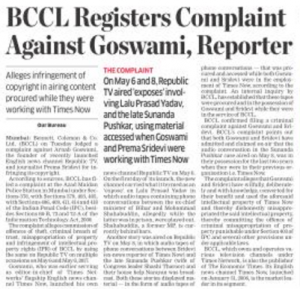
    Is Bennett, Coleman & Company Limited (BCCL) right in registering a copyright infringement complaint against Arnab Goswami? Yes, it is. I am not sure how legally tenable the complaint is, but in my limited view, it was unethical. When the story was first aired on Republic TV on May 8, one couldn’t help sitting up and take notice. But then along with the various questions that Goswami raised in his ‘super exclusive’, there were some questions that I had.


    The Economic Times report (Page 3, May 17, Mumbai edition)

    See report in Economic Times on the complaint: link

    In fact, I tweeted about it (see link).

    The fact that it was only retweeted twice indicates that copyright and editorial ethics aren’t considered very critical and holy to many (or most?) in India. Copyright, it’s often joked, is the right to copy!

    But this isn’t about copyright. That’s something for Times Network owners to take up with the Courts.

    It’s an issue of ethics.

    The recordings of the conversation between Prema Sridevi, the reporter and Shashi Tharoor or Sunanda Pushkar’s Man Friday was done when the reporter reportedly worked with Times Now. Unless her terms expressly stated it, or she was just a freelancer with the channel, the recordings belong to work done when the reporter was an employee.I am not sure what is the legal view on it, but it’s not ethical.

    I am not even raising issues of why Goswami and Sridevi, now Editor-News at Repulic,  didn’t air the recording when they were in Times Now, but that’s not really my concern though it’s a question that must be answered.

    The Nation wants to know…


    **


    All eyes are now on the BARC India numbers that will be out tomorrow (Thursday, May 18). Given all the promotions and distribution via multiple frequencies, it’s quite likely that Republic will be #1, but the question is that it’s not a play over one week. Republic can’t be spending so much monies on distribution as it’s today, so the real story will emerge after a few weeks when it opts of taking multiple frequencies.

    To Goswami’s credit, his equity with viewers is huger than all the other anchors. The MxMIndia-MRSSINDIA poll earlier this week indicated that Rajdeep Sardesai is a close second and not a distant one in the trust factor, but it’s for India Today to use this to their advantage. Possibly promote Sardesai a little more.

    We’re going to see some interesting times over the next few weeks or months. And we aren’t complaining


    Pradyuman Maheshwari is Editor-in-Chief and founder, MxMIndia. The views expressed here are his own.


  • Ranjona Banerji: Times Now v/s Republic TV: A Question of Ethics

    By Ranjona Banerji


    The fight between Times Now and Republic TV is more than just a bloodhound fighting a poodle or, in Arnab Goswami’s more cliched referencing, Goliath versus David. It is about journalistic ethics and indeed the employer-employee covenant. It hurts me to even consider that what Times Now practises – long after Goswami quit – is any form of journalism any more than what Republic TV does but it is what it is.

    Republic TV launched on May 6 with two “big stories: The death of SunandaPushkar, wife of Congress MP Shashi Tharoor and the corruption of RJD leader Lalu Yadav. While he was with Times Now and since he started Republic TV, the court of Goswami and friends had decided that Congress politician Shashi Tharoor was responsible for his wife’s death.

    To recap: Pushkar died in January 2014 in a hotel room in Delhi, just after she had an online fight with Pakistani journalist MehrTarar over an alleged affair between Tharoor and Tarar. BCCL claims the Pushkar and Lalu Yadav tapes are its property since both Goswami (and the reporter who made the tapes) was a BCCL employee at the time the tapes were made. Based on that contention, the company has “registered a police complaint”. A statement from BCCL reads: “…As such the tapes were hidden from BCCL and Times Now management till they were utilised and aired by ArnabGoswami. Suggesting, therefore, that Times Now wilfully did not use these tapes after he left, is a gross misrepresentation. Upon his own admission on Republic TV the tapes were lying with him for the past two years…”

    There are a number of problems here that leap out to any journalist. If indeed the tapes are as explosive as Republic TV claimed, why did Goswami and his team sit on them? Goswami’s power at Times Now was practically absolute. Indeed it was a source of shock  and envy to many who worked with BCCL, especially with its newspapers, to see just how much power Goswami wielded. Ever since Samir Jain took over from his father, the message to editors had been clear: your power comes directly through me. In spite of his blatant non-journalism, Goswami got away with murder on screen.

    BCCL has some other valid points as well, not just the ego battle between an owner and a powerful editor. It is accepted, indeed usually written into contracts, that any work you do as a journalist for any media house belongs to that media house. In which case, Goswami and his reporter PremaSridevi have broken that clear covenant by not using the Pushkar and Lalu tapes on Times Now but for Republic ITV instead.

    When the NiiraRadia tapes became public in 2010-2011, TV anchor BarkhaDutt then with NDTV, made the remarkable claim on television that she did not think that a PR person for telecom companies trying to influence the choice of telecom minister was a good story. There are times when you can forgive an editor for making a bad judgment call. This, by my personal reckoning, was not one of them. Goswami has gone one further than Dutt: he did not use the Pushkar tapes in 2014 but over three years later when he started his own channel.

    This is not just breach of contract by Goswami, this is shoddy practice. Goswami is not the first journalist to do this but he is certainly one of the most high profile. Various questions spring to mind – why did he not use the tapes before if they are so “sensational”, was he working for Republic even as he was taking a salary from BCCL, why did he embroil another employee into this? Indeed, these acts go beyond the usual complaints made against him – that he long stopped practising journalism. This strikes at the basis of integrity and from all accounts, Goswami has prided himself on his integrity.

    What a shame.

    Meanwhile, Republic TV in its first week has trounced every other English news channel in India according to Broadcast Audience Research Council figures.

    Go figure, I would say.


  • Hang your heads in shame, NBA Board!


    By Pradyuman Maheshwari

    The News Broadcasters Association has some really big industry folk on its managing committee… the Board of Directors as they call it.

    At a personal level, they are all achievers, and I respect them. Click here for the list. Now, let me first say very unequivocally: I hold no brief for Republic TV. I must confess I am not really a huge admirer of the Arnab Goswami school of journalism. MxMIndia – with our Consulting Editor Ranjona Banerji chiefly and myself – has damned his shows enough when he was on Times Now.

    But that’s my – or our – personal view. We believe it’s a free world, and if he does transgress – as in, cross the line, there are enough forces – political, business and legal to correct him. For the now, the masses are lapping him up. He’s the voice of the new Indian.

    The fact of the matter is that the Arnab Goswami brand of news television has worked wonders. And this not just in terms of viewership or ratings, but also with those with the monies. Republic TV’s list of benefactors tells the story.

    So when he decided to start his own channel, there were worrylines all over. Here was a man who could rewrite the rules of the business if he has enough staying power – moneywise.

    Remember just having a credible, independent voice is not enough. If that was the case, MxMIndia would’ve been super-super-successful revenue-wise. But that’s not the case, we don’t aggressively solicity advertising. We just nudge. Those who believe in us, back us.

    But this is not our story. This is the story of an industry association leadership that must indeed hang its heads in shame.

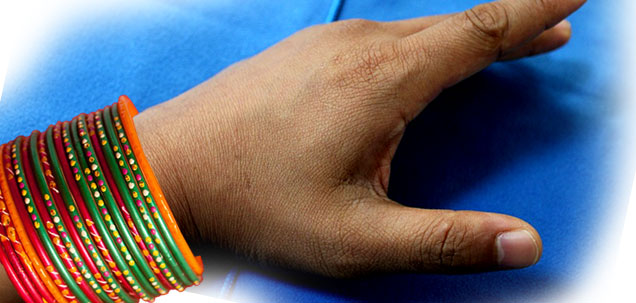
    Or perhaps wear bangles, like this:


    Gosh, have we gone too far… bahut ho gaya?

    Nahin. Nooooo. Do you recall the disrobing of Draupadi in the Mahabharata? What happened on Thursday evening is something as bad as that.

    Or let’s look at another example. We all know that the examination-oriented system of education has major problems. We also know that papers leak. We also know that kids cheat. But do we just exit the system screaming “Screw it!”. Will a school or a parents’ association advise students not to take their exams because the Class 10 or 12 exams are a sham?

    Well, we can exit the education system. It’s possible to flourish without the degree or certificate. But you’ll need to figure how the world will assess you.

    I am not convinced that the News Broadcasters Association – which is headed by some very discerning names – could be buckling under pressure from some members who perceive Republic TV as competition.

    If it genuinely felt aggrieved, there were other things that NBA could do. Like when it realised that BARC was going to go ahead with the release of ratings, if it felt it had a genuine case, it could’ve approached an appropriate Court of law (and not the Courts set up by some of our anchors across various channels) and urged for a stay!

    Why didn’t it do that?

    Why doesn’t the NBA issue a diktat to all its members asking them to not go in for any ratings-boosting activity like dual LCNs, landing pages/slotsetc?

    As I write this, I am aware that some advertisers are reconsidering their advertising on the English news channels. They may threaten a pull-out very soon. And much as I would like every media entity to flourish, the English news channels who have pulled out of BARC ratings need to see reason. Or be shown the stick.


    Here’s what needs to be done:

    1. The NBA must reverse the advisory to its English news channels to pull out of BARC

    2. The English news channels must get the watermarking back

    3. The NBA, ISA and AAAI must convene a special meeting – which may be convened by the CEO of a network/channel who has no skin in the game – like NP Singh of Sony Pictures or any other respected industryperson like, say, Sameer Nair (now CEO of Balaji). Note I have not mentioned the names of Star India Uday Shankar because he is a former news television CEO. Also the Zee and Viacom18 heads have sibling channels in the news business.

    4. All broadcasters must take a joint decision on the issue of dual LCNs, landing slots

    5. The AAAI must be urged to only deal with channels/entities that are affiliated to the IBF or NBA, so that it will ensure that all channels toe the IBF/NBA line

    6. All advertisers on television channels (Patanjali included) should be convinced to become ISA members to ensure that the rules are followed. Similarly, broadcasters should only deal with AAAI-membered agencies.

    7. IBF and NBA must admit members provisionally without any delay, on clearance of cheque/RTGS/NEFT etc

    8. Since NBA has limited number of members, and there can always be charges that all the channels can gang up against a new entity, there should be a recourse available to an aggrieved member to go to a joint committee of the IBF, NBA, AAAI and ISA which may be set up

    9. Meanwhile, BARC must set up a clear deterrent as a rule that if any channel decides to opt out of its ratings, it will not be allowed to return for a period of one year or payment of Rs10-25 crore or some such

    10. IBF and NBA must ensure that the BARC advisory/guideline on channels advertising is followed strictly. Those who are repeated defaulters should be penalised in the form of a lower payout of advertising monies on the channel. And eventual debarring of payment.


    All of the above needs to be actioned before the Week 20 BARC numbers are released.


    Pradyuman Maheshwari is Editor-in-Chief, MxMIndia. The views expressed here are his own


  • Ranjona Banerji: Pakistan! Pakistan! Pakistan! Jharkhand? Where’s that?

    By Ranjona Banerji


    The lynching of seven men accused of being kidnappers by an angry mob in Jharkhand has sent waves of shock and horror through India. Did I just say that? What a lie. Since the horrific story and the heart-rending images of a man’s blood-soaked hands begging for mercy went viral (they killed him anyway), what have our intrepid brave patriotic English news channels concentrated on?


    What a question. Obviously, cricketer Mohammed Kaif’s Twitter take down of a Pakistani after India won first round at the International Court of Justice over the death sentence of Kulbhushan Jadhav. Duh.


    Or perhaps, it was Pakistan in general or more particularly, get a whole lot of former generals and wannabe generals together and encourage them to carry out a proxy screaming match on television.


    But the Jharkhand lynching? Tut tut. How anti-national to expect news channels to show India in a bad light, when they put up those where’s-the-war-with-Pakistan dramas, night after night.


    Newspapers have carried the story, social media has made the photographs go viral but news channels have remained completely patriotic.


    Luckily Nidhi Razdan picked up the subject on mob violence getting out of hand in India on NDTV’s Left, Right and Centre on Monday night. She held her own against the RSS’s Dr Rakesh Sinha and Syed Jaffar Islam of the BJP, who either tried to blame the media for naming communities or going back to some incident in 1968 or, as usual, making sure that the prime minister must not be tainted by anything that happens in BJP-ruled states. The old Sangh Parivar chestnut of “India’s federal structure” was trotted out. Of course, this argument at its logical end, leads one to assume that a national spokesperson for the BJP has no control over the BJP in the states. Jai ho!


    Razdan did not buckle down to the two government spokespersons on her panel and to some extent the others – sociologist Shiv Vishwanathan, Congress member Sachin Pilot and columnist Sadanand Dhume (who has lately taken to criticising the BJP a bit, unlike his earlier stand) were allowed to speak.


    This show will undoubtedly bolster the impression of all Modi Bhakts that NDTV is anti-BJP. However, there was always Vikram Chandra on The Big Fight the other night who told us that the economy is doing wonderfully well under Modi ji and agreed with BJP spokesperson Nalin Kohli’s somewhat fantastical numbers. Jai ho! All kudos to Mohan Guruswamy who asked Modi Toady Sunil Alagh if they were both talking about the same country when Alagh toed the Kohli line.


    But forget NDTV. Let’s look instead at the glorious and brave Bhupendra Chaubey on CNN-News18. Actor Paresh Rawal, now a BJP MP, demonstrated both his serious brain power and great sense of humour when he tweeted that instead of tying a stone pelter to a jeep, the army should have tied writer Arundhati Roy instead. Roy has long been a BJP critic, a government critic and stood up for the rights of anyone affected by state oppression. Obviously she is unpopular amongst nationalists especially nationalists who co-relate the nation with whoever is in power at the time.


    On Monday, Chaubey tweeted the question around which his show would be based, with this soon-to-be a classic for TV brainiacs: “Is Paresh Rawal right in asking for author Arundhati Roy to be tied as a human shield?”


    In a deeply philosophical sense, every question needs to be asked. Why not also ask, “Was the Jharkhand mob right in lynching people it suspected of a crime without any proof?” However, there is philosophy and there is stupidity and I leave you to figure out the difference. It is not that difficult.