Category: COLUMNS

  • Ranjona Banerji: Will a special law for attacks on journalists work?

    By Ranjona Banerji


    Several media organisations and journalists have long negotiated with the state Government of Maharashtra for a special law to deal with attacks on journalists. The Mumbai Press Club announced on April 7 that at last, a special bill has been tabled and approved by the State Legislature.

    There can be no doubt that journalists and media houses bear the brunt of being the messenger. Often, even within the media, there is the feeling that it is small towns which are more dangerous for stringers and reporters. And certainly, there are enough instances of various vested interests attacking journalists. Chhattisgarh is a prime example where anyone who questions the government or the police on the Naxal issue or the plight of tribals is threatened, harassed, beaten up or killed. Criminal mafia associated with mining, lumber, land acquisition or illegal business interests also target journalists.

    But as we also know, it is not all “let’s respect the rule of law” in big cities either and especially not Mumbai when it comes to journalists. Nikhil Wagle has borne the brunt for questioning the Shiv Sena several times. In 1991, freelance journalist Manimala’s skull was cracked by crowbars while returning from a dharna to protect the Shiv Sena’a attacks on the Apla Mahanagar office. The newspaper had dared to criticise the Shiv Sena’s infamous digging up of the cricket pitch at Wankhede stadium.

    In many ways, it was the murder of journalist J Dey in 2011 in a crowded suburb of Mumbai in broad daylight which activated media organisations to push the government for a special law to protect journalists. Dey was then working for Mid-Day. He was a specialist on the underworld. His attackers were part of the Chhota Rajan gang. The case is still going on, after several twists and turns.

    This new law carries a fine of Rs 50,000 and three years in jail for an attack on a journalist and is a cognisable offence. These attacks have to be investigated by officers of the rank of Deputy SP or ACP.

    However, if a media person files a false complaint, he or she is punished under the same law.

    Congratulations are due to the Mumbai Press Club and others for their persistence in getting this law through.

    However, as the Press Club release itself implies, investigating authorities have to make the law work.

    And herein lies the main problem: India already has a plethora of laws, most of which are ignored, forgotten and consigned to the heap of “let’s forget”. Very often cases only progress because of constant pressure of those affected or involved. If any government took attacks on journalists seriously – just as an example, attacks on all citizens are important – there would have been action regardless of special laws.

    In this particular law, the adjunct at the end – that media persons are also liable for filing “false claims” – is bound to be misused and in fact used against journalists. There is a minefield waiting to explode right here.

    Without undermining the efforts of those got this law through, greater discussion is needed throughout the community. Congratulations but with the caveat is my take.


    **

    One of the heart-wrenching stories to come out this week was of the news anchor of IBC-24 who read out the news of her husband’s death in an accident, only realising what had happened as she read it on air. It is testament to her professionalism that she finished the segment without breaking down. All commiserations to her and her family.

    http://indianexpress.com/article/india/chhattisgarh-news-anchor-learns-of-husbands-death-while-reading-live-bulletin-maintains-composure-4605203/


  • Sanjeev Kotnala @ Goafest 2017: 12 Constructive Suggestions ‘coz Perfection is Work in Progress

    By Sanjeev Kotnala


    In my last post, I had said that Goafest 2017 would surpass expectations and I must repeat that I do believe it has. Unfortunately, the expectations with the team of supermen and superwomen organising Goafest were super-high too. Hence, we delegates – personally, individually and collectively – found issues to crib with some of what they did.

    This time around, I decided to be offensively constructive in my suggestions and observations. I decided to check delegate experience. I am thankful to 40 delegates who filled a short digital questionnaire. However, I will still point out things that I must.

    This year, the speaker’s profile was full of promise. We were excited by the list. However, the promises remained partially undelivered. Somewhere, the culprit was too overt a brand plug and many times the presentation did not add much of value. Hence, I was not surprised when delegates appreciated interesting and entertaining conversations with cricketers, Bollywood and a spiritual guru than from industry experts.

    Just for the record, this time, I surprised myself by attending every knowledge session. I only missed the masterclass and the awards on the third night.

    I think it is fair to assume that most of the presentations were neither pre-screened nor curated keeping the event and the delegates in mind. Someone commented that in an industry event like Goafest, we need to be intoxiated with relevant functional gyaan, not booze. (In the survey, everyone is unanimous that we should never tinker with free beer!)

    I loved the session with Acharya Balkrishna, the short informative speech of Maneka Gandhi and the session on Visual Hammer by Laura Ries. Amitabh Kant, retaining the core of his often-delivered presentation, managed to add newness with a few anecdotes and his unique delivery style.

    The session on AR/ VR/ MR had nothing new for people following technological devolvement in the industry. The session with Vivian Richards was entertaining for his style to front fot any conversation. Sanjay Dutt engaged delegates but what did people gain! I am yet to find why Ishita Katiyal, the youngest TED speaker was there. Mandira Bedi added glamour with Babita and Geetha Phogat. It was a session of heartfelt conversation that hovered around Dangal and their lives pre-post the film. Facebook, Mobikwick and ITC presentations were covert brand plug-inns. Gaur Gopal Das delivered a presentation on expected lines. His delivery had nothing new to what one has seen in multiple Whatsapp videos. Nevertheless, his style was so comfortable that many missed the points he made.

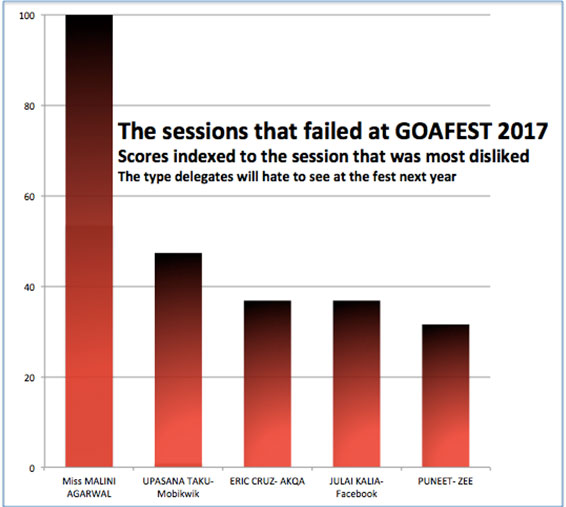
    The delegates, on the other hand (as per survey), found the Vivian Richards, Amitabh Kant, Acharya Balkrishna, Laura Ries, Sanjay Dutt and Julia Kalia sessions the best. Here are the top sessions as per the survey.


    As for the five least relevant or interesting or engaging presentations, keep reading. Topping the list Miss Malini, she had all the promise but surprisingly no intent or content. Session by Upasana, Eric Cruz, Julia kalia and the unscheduled talk by Puneet follows the list. Sorry, it is impossible to pinpoint, if it was the subject, content, person or style that upset the delegates.


    The app-controlled Q&A was a welcome sign. It allowed the moderator to manage the Q&A time. It is different that they were unable to manage the speaker’s time. The app did take away the spontaneity and fun of a delegate-speaker open dialogue and discussions. Few masters of commenting (not questioning), arbit monologues and experts in rephrasing (also applauding) the speaker’s statements and observation found it too much of bother. Overall, it worked. And so did the WiFi within the event area.

    Q&A through the app, was seen as a non-transparent system. A simple flick of the finger on the iPad could decide the fate of your question. You could never be sure if your question will make the moderator cut. Many complained that moderator overlooked their questions, which were better.

    SUGGESTION #1: Maybe create a window for the first 15 questions. Making it easy for the moderator. Bounce back a message to the delegate when 15 questions are over.

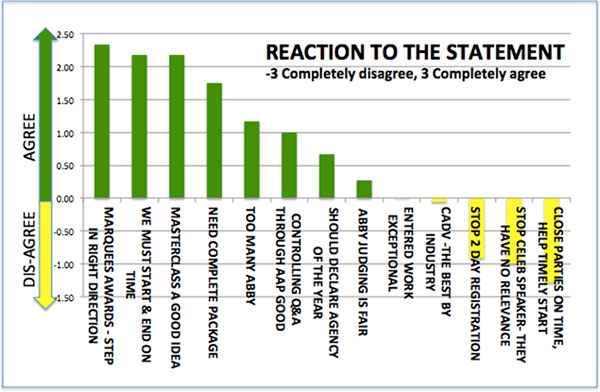
    Nothing started or ended on time: I think it is a statement we make about our own interest and discipline. Everyone blames everyone else for it. No one agrees to an early close to after-parties to help the delegates come on time. These are the same delegates who don’t miss flights and trains. We do have options. We can continue to adapt to a delayed start and end, or we can take some action and get some discipline in.

    SUGGESTION #2: Create rewards and penalties to promote such a behaviour.

    SUGGESTION #3: And this comes from many people: use the huge crowd-drawing performances and celebrity sessions early in the morning and in afternoon to get started on time. Close doors five minutes before start and allow no entry-exit till the end of the session. It sounds impossible and impractical, but so does every problem.

    The start of Masterclass is a good initiative, and we need multiple tracks running parallel. Whosoever attended has only excellent feedback. It is a concept to stay, and we must amplify it.
    There was some ill-feeling among few who registered but failed to make the list for the Masterclass. Where registration was on first-come-first-serve basis, we managed over 300% registration! It surely disappointed many. What made us take 300% more registration for a restricted Masterclass. I heard complaints that organisers never informed the delegates who registered but did not make the cut. I am not sure about it.

    SUGGESTION #4, At the time of registrations, like IRCTC, we should start tagging registration against cancellation and full house signs. Maybe Masterclass should have an additional penalty for not attending. How to implement it is another question.


    Too many awards do not seem to be bothering people. In a fragmented media and multiple touch-points, awards are bound to explode. On the other side, delegates appreciate stringent jury standards. They understand Gold is not guaranteed; it is given for the work that is up to Gold Standard. However, hearing a repeated ‘No Gold In this Category’ is very disheartening. One is not sure, if it is a statement on the jury expectations or the failure of the industry to deliver. Hopefully, I have got it all muddled here.

    SUGGESTION #5, Maybe, we should discontinue the category where there were no awards for two consecutive years, or where there were less than 10 entries.

    It did lead to a heated discussion over cold beer. The point of debate and disagreement was simple. Will it be the case if the non-participating agencies participated? Nevertheless, that does not bother me.

    It is important to note that  the statement ‘ABBY JUDGING IS FAIR’ only scored 0.27 in a -3 ( Completely Disagree) to +3 (Completely Agree ) scale. This is too low. In the pre-survey, the score was equivalent of approximate +2.

    What would have led this change. Is it because of sudden polarised winnings that the delegates did not see coming. Or these were  sporadic instances which have created this impression. Frankly, I did not hear much cribbing about it, some amount of resistance is acceptable.

    If we do not brand, the branding happens by default. The great Advertising Marketing festival somewhere restrains itself from announcing the Creative Agency, Media Agency, The Broadcaster and the Publisher of the Year.  I will go a step ahead to add the Radio Agency of the Year, the Print Agency of the Year, the OOH Agency of the Year. These are coveted positions. When the festival avoids taking this stance, it leads the space open for participants to create their own language. The metal tally without colour discrimination creates the most awarded agency title.

    SUGGESTION #6: I firmly believe the festival can not shy away from its duty of announcing such position. They may use the Olympic tally or code the weights of Gold, Silver and Bronze at 5,3,1 or whatever maybe the transparent algorithm they decide. If there is a case (which I believe exists), they  may disproportionately value wins in integrated or craft.

    The AVs that abruptly stop during award presentation not only looks shabby but insults the awards and the awardees.

    SUGGESTION #7: Ask agencies to submit one slide to be screened in case they won. I am sure they will be able to capture the essence. In case of Radio and TV, play only a 30-second or shorter version for Gold winner (this emerged during a discussion with senior industryperson Sumit Roy). Illusion, reclassify the awards. What about havng only crafts award on Day 1.

    I am not sure, what the Bollywood performances are adding to the event. Why not lexpand the scope of these performances?

    SUGGESTION #8: Next time try magic, mentalist, illusion, etc.

    Front empty seats are no encouragement to any presenter. We must create an algorithm to predict the RESERVED SEATS utilization?

    SUGGESTION #9: Decrease the number of reserved seats or find a digital way for the VIPs to help predict the attendance

    SUGGESTION #10: How about introducing fixed pre-booked maxi seats on premium. A possibility we should consider.

    The delegates finally arrived, and we hit the magical mark. However, there is unfulfilled need and a possible opportunity for a complete package covering registration, travel, lodging and boarding.

    SUGGESTION #11: Try it for under-30. Anyway, the delegates believe that the special, under-30 special registration fee and the option of a 2-day pass should be continued.

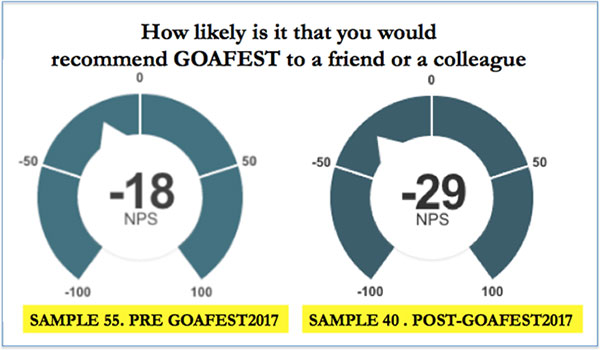
    Now the NET SCORE for the Goafest has decreased from -18 (pre-event) to -29 (post-event). This is a worrying area.

    SUGGESTION #12: the the registration data to widen the scope of experience exploration and connect with the delegate in person for an in-depth understanding.


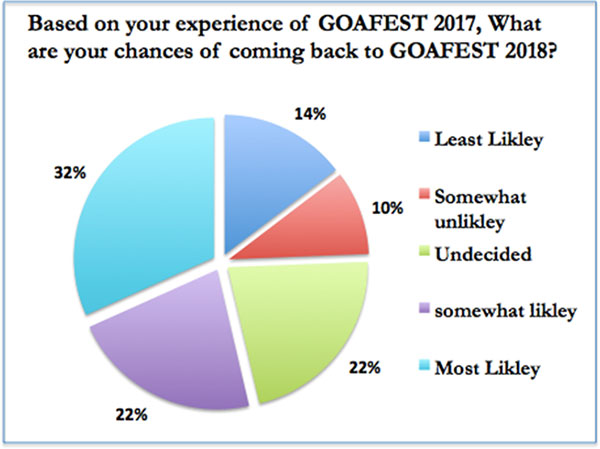
    It’s amply reflected in the answer to their probability of coming back the next year. Now, quite a few end the festival with ‘This is my last Goafest’. Come April, they change our mind. However, it is relevant to see that in the survey, around 54% of delegates are likely to come back, and some 22% are undecided.


    One thing I must state. Media representatives are all praise for the Viacom18 team handling media delegates. Sonia, Pradeep, Deepti, Ritam and the others did a wonderful job. In the knowledge seminar hall, how about a narrow table for media representatives to use… it will facilitate their taking notes on whatever device they use.

    The delegates wholeheartedly applauded the concept of the Marquees Awards. It’s different that they are unsure if it is part of Goafest or an independent award from The Ad Club, like Effies and Emvies.

    PS. The the stage set-up was perfect and far improved, we do not seem to have mastered this small detail.  The stage craft and presentation styles can also be used to demonstrate the new technology. I don’t think, I have even seen any presenter or Goafest use a Live voting.

    SUGGESTION- 13,  Live speaker voting post the session and live on screen voting of the best question. And you know, how easy it is to do.

    The team from AAAI and ADCLUB has yet again given a fantastic improved event. And perfection is after all work in progress.


    Sanjeev Kotnala is a senior industryperson, strategy consultant and trainer. As Contributing Editor, MxMIndia, he writes a weekly column that appears every Wednesday. The views expressed here are his own


  • Jaisurya Das: Tabloidisation of News: Bitching their way into oblivion

    By Jaisurya Das


    The past few months have seen tabloids and extensions sensationalise their news component that are pushed down your throat through vendors.

    There was a time when it was considered fashionable to ape international tabloids and rags that put out stories using paparazzi and their multi-faceted editors’ fertile imagination.

    Some perished as an outcome, and the others went on to become meek spectators of the media world. The readers moved on quite nonchalantly.

    The print media in India however, had a reasonable sense of maturity left in them and toed the safer, researched storyline. Never demean, rarely defame and certainly not sensationalise personal lives was the brief. Obviously this has changed for reasons best known to them!

    From names of rape victims to gory details and so-called scoops on income tax raids on prominent personalities find place every other day. It’s a different matter that a lot of this is based on editorial imagination and nothing may have come out of all this but that is ok. They know the media business best and never need to justify anything. Power of the pen, or so they imagine in this archaic world they see reason with…

    Pity isn’t it that their calendar hasn’t flipped pages in years?

    I asked a few of my friends in these papers to find out what this fresh whiff of scandals were about. Did they honestly believe their audience have an insatiable appetite for such journalism or was it part of a new corporate strategy to get the hormones racing? The latter of course makes more sense considering the graphic detail a lot these reports go into.

    I must confess at this juncture that I am not the universe, and certainly not the ideal sample of the readership these publications boast about. But, honestly, does all this get lapped up?

    Or is just their gut against audience intelligence? I have reason to believe this is the case today. A majority of the younger readers are not print-friendly and rarely glance at anything printed, leave alone a newspaper, so who is all this aimed at?

    At the risk of sounding like a soothsayer of doom, I have reason to believe that it won’t be long before such print brands cease to exist. After all clones of the digital world can never win over the original. I am reminded of Monica Lewinsky’s poignant talk at Ted when she talked about the power of the digital medium and how within hours her life was brought to a standstill.


    Yes, digital does this better. Why waste your time even trying.You have USPs and it may be prudent to stick to your knitting after all.

    Maybe it’s time these formidable print journalists realise that ‘Readers’ as we knew them, do not exist any longer. This is the generation of the ‘Consumer’; Informed, flirtatious and highly volatile.

    Understand them beyond what is apparent, befriend them and give them their piece of flesh! There is really no other option. Amen.


    Jaisurya Das is a senior industryperson and brand specialist based in Pune. Other than being Contributing Editor, MxMIndia, he runs consulting firm Xanadu and is co-founder of Pune365.com. The views expressed here are his own.


  • Ranjona Banerji: Fight of the Uber Patriots begins

    By Ranjona Banerji


    Watching local TV news in England in Easter weekend almost makes me take back all the ranting and raving I’ve done about Indian TV news. We learnt about one Nestle office in London allowing dogs into work, six schools somewhere in the North of England attaching cameras to sheep pens so that children could learn about sheep through “lamb cams”, the weather, an elephant hospital in Thailand, the weather, the death of a 117-year-old woman, the weather, Spanish bluebells overwhelming English bluebells in the woodlands, the weather..

    In between, there were two tiny segments on Donald Trump dropping the “mother of all bombs” on Afghanistan and Kim Jong-un of North Korea making war-like noises. However, not much time was wasted on this until we went back to the weather and lamb cams.

    There is a lot of talk, some of it scary, about news being tailored and customised according to one’s internet search patterns and social media accounts. We all live in our own “echo chambers” where we only hear what we want to hear, which is one thing. The other is that someone – a mathematical algorithm or some evil marketing control freak – decides what we need to hear depending on what we like the rest of the while.

    None of these nightmare internet scenarios has much to do with TV news or the choices a news editor or an executive producer (all right, all right, I watched most of The Newsroom) is free to make in a regular newsroom. These are “judgment calls” someone in editorial or more likely in marketing makes during, for instance, the Easter weekend. It is also second-guessing the viewer and second-rating his or her intelligence: Because it’s a holiday, people will not want to know about the president of America dropping a massive bomb. Instead, they will want to fret about bluebells and passing showers.

    News is always about choices. But sometimes, maybe a demonic algorithm may be more apt?


    **


    Meanwhile in wacko TV news land in India, a Fight of the Uber Patriots appears to be brewing. Apparently, either Times Now or India Today TV – according to various reports I have read – has sent a legal notice to ArnabGoswami threatening him not to use the phrase “The Nation wants to know” in his yet-to-be-launched channel, Republic TV.

    As any regular news watcher knows, Goswami as lead actor of Times Now was by far the most patriotic of all. But since he went off-air in November last year, there has been a massive rush for his former Uber Patriot Best Nationalist Title ever. The first two applicants and self-appointed title-holders have been Rahul Kanwal and Gaurav Sawant of India Today TV.  Rahul Shivshankar then of NewsX quit as quickly as he could and rushed to Times Now, thinking sitting in Goswami’s chair could win him the title.

    But before he could get there, Sawant stole a march on everyone. He followed UP chief minister Yogi Adityanath’s calves (as in baby cows not lower legs, though, well, who knows) as they frolicked about, he applauded the army tying a “stone pelter” to the front of an army jeep in Kashmir because in Uber Patriot land, neither the Yogi nor cows nor the army can do any wrong.

    And now, just when the award was within the grasp of so many “I love my bigoted idea of India more than you do” TV journalists, the original King Cobra has raised his hood and hissed with venom. He has dared the threatening rival channel, in a Youtube clip, to “do everything you can, spend all the money you have and arrest me… Viewers, the phrase “Nation wants to know” belongs to you, to me, and to all of us, every citizen of this country”.

    Cue in some patriotic music, either the National Anthem or the other song which bigots prefer or some AR Rahman song, pop the corn in the microwave and enjoy the rest of this show. Who will win the title? The nation, um, maybe wants to know?


  • Sanjeev Kotnala: Celebrity endorsement guidelines and why self-regulation is not ASCI’s job

    By Sanjeev Kotnala


    Self-regulation must begin with ‘I’ before it can migrate to ‘We’ and ‘US’. So, when Advertising Standards Council of India (ASCI) President Srinivasan K Swamy, suggests that ‘be it an advertiser briefing an agency or an agency briefing their team, it’s time we add the ASCI code signoff to every advertising brief’, for a moment it sounds so nice. If only such things could help. We all know what happens to such lovely things, they become a blind spot. Nothing can change, until each one of us ant to adapt it as our own motto and make it an involuntary reflex action. However, for the few that will read them, I will endorse adding it as a signoff.


    Adherence to ASCI code is is the responsibility of every true-blooded advertising, marketing or communication professional. If only each one of us could take the onus of no deviation on our beat, the situations would be far better. ASCI is all about advertising with a conscience; Honesty, Decency, Responsibility and Fairness. Trust, no-one has any argument against the thought. They don’t follow it, is a different case altogether.

    If we really want to see some tectonic change in the attitude, ASCI must get some teeth. We need some examples of real action of exemplary damage or penalties. In the absence of it, ASCI will remain a guideline that people will willingly and understandingly break with full knowledge. Let’s, for example, take the celebrity code of conduct.It is an issue that has kept raising its head at frequent intervals.

    The chase is partially over in the case of celebrity endorsement of misleading ads. Finally, new set of ASCI guidelines on celebrity endorsement are out. They ask celebrities to do the necessary due diligence of the claims made in the ads/ products they endorse. They have been created to help and encourage celebrities and advertisers to refrain from endorsing misleading advertisements.

    The guidelines have a very pious objective. They are meant to protect the interest of consumers. It is understood that celebrities have the power to sway consumer decision and choices, thus impacting usage and consumption with a large set of audience. It is the moral responsibility of celebrities, clients and agencies to ensure that this power is not misused. It is different than in the era of information parity and easy access, the credibility of celebrity endorsers is being questioned by liberated audiences.

    The guidelines asks agencies, advertisers and the celebrity to ensure the product/ brand they endorse to remain true to the claims being made. However, we are a bit too far from the orgasmic explosion of nirvana. There is no ‘MUST’ or a clear ‘THREAT’ of action. I am not sure, if the clients, agencies or the celebrities are really afraid of violating the ASCI code.

    “Celebrity should do due diligence to ensure that all descriptions, claims and comparisons made in the advertisements they appear in or endorse are capable of being objectively ascertained, are capable of substantiation and should not mislead or appear deceptive…. Testimonials, endorsements or representations of opinions or preference of celebrities must reflect the genuine, reasonably current opinion of the individual making such representations, and must be based upon adequate information about or experience with the product or service being advertised”

    I appreciate the effort and the process in creation of this guideline. I welcome the ASCI guideline asking celebrities not to endorse product requiring a health warning (as per law or are prohibited by various laws like the Drugs & Magic Remedies (Objectionable Advertisements) Act 1954 or The Drugs & Cosmetic Act 1940

    My fight is that it still remains at a milder really non-threatening ‘SHOULD NOT’. It only creates morally and ethically defendable escape routes for the stakeholders.

    I agree ASCI or anyone else can do nothing about it until the law bans these products, its advertising or the advertising with celebrity. Personally, I believe, no one should be stopped from advertising any product that is legally made, distributed and sold. If consumers are not stopped from consuming, why stop celebrities from endorsing. If they are really harmful, stop the sales of it.

    I am delighted for the guidelines to have further expanded the scope and definition of celebrity. In addition to people from the field of Entertainment and Sports expands to include well-known personalities like Doctors, Authors, Activists, Educationists, etc. who get compensated for appearing in advertising.

    This last phrase of ‘being compensated’ is another escape clause. It is irrelevant to the power of persuasion and or impact. It unnecessarily sparks the debate, if it is all right or is that not really endorsement if the person is not compensated. Hopefully, it will be taken care of in the next revision.

    The best part of the ASCI guidelines is in trying to fix the responsibilities. It says, “Celebrities are expected to have adequate knowledge of these codes, and it is the duty of the Advertiser and the Agency to make sure that the Celebrity they wish to engage with is made aware of them. Testimonials, endorsements or representations of opinions or preference of Celebrities must reflect a genuine, reasonably current opinion of the individual(s) making such representations, and must be based on adequate information about or experience with the product or service being advertised.’ Here the usages and expectations are squarely defined, and in a way one knows where the buck should stop. At least one little loophole of celebrity famed selective ignorance has been plugged.

    I like ASCI’s clarity on the actionable agenda. It sets up the process. According to the ASCI advice, the celebrity is absolved of his act or omission or commission if the Celebrity follows the recommended procedure and seeks Advertising Advice from ASCI on potential suitability of the advertisement, and it not breaching the ASCI code.

    And once it does so, it has to then absolve itself of the liability. So, ASCI’s Advertising Advice will not be construed as pre-clearance of the Advertisement.

    Now before we keep drilling holes and forget that perfection is always work-in-progress, we should be happy that ASCI is active and working on different fronts to create the right environment for truthful advertising. Everything needs time. ASCI is more nimble and agile now. We all can see the steps being taken, and we must first applaud it.

    ASCI as per agreement with AdEx India, a division of TAM, checks on a continuous basis all newly released TV and Newspaper print advertisement for violation of ASCI’s advertisement code related to unsubstantiated, misleading or false claim. Though we do not have an idea that since its start how many cases have been reported with its National Advertising Mionitoring Service ( NAMS)

    ASCI is ready to help educating clients and agencies on the ASCI codes and guidelines. It has an ASCI e-Learning Course  devoted to it. I bet most of my readers would never have clicked on the link and will not click even today. Should marketers and agencies not include ASCI code and e-course in their induction processes? I am sure it will help bridging an unstated gap.

    By the way, making a 60-second commercial encouraging practitioner like you to undergo ASCI e-learning to understand the ASCI code could make you win prizes. Last date April 30, 2017.

    Before I close, I must restate what I started with. We need citizen vigilance to control act of terrorism. And we need industry vigilance to stop misleading celebrity endorsements and ads. Misleading advertisement is a terrorism of a different style.

    I request each one of you to take the control of your beat. Your area of operation. Take the internal challenge and be the ASCI warrior in your organisation. Question every brief and the advertisement that you create or react to as a consumer. If it violates ASCI guidelines, don’t stop, go ahead and file the complaint here..

    Stop having a ‘Chalta Hai’ (It’s Ok, it happens, it’s normal) and ‘Dekh Lengey’ ( we will see later; we will manage) attitude. The moment you do, self-regulation will become truly powerful. We all are responsible to raise our collective voices on advertisements violating codes. It is the job of we all. It is not the job of ASCI alone.

    PS. Once in a while do visit the ASCI website. You will get updated information on many issues in this subject area. In my last visit, I ended up knowing a wee bit more about Comliance with the Emblems and Names ( prevention of improper use ) act 1950, MOU between ASCI and Ministry of AYUSH for monitoring of AYSUH advertisements, action on the advertisements violating the Indian Medicine regulation act as well as the University Grant Commission notice on Distance Education Programmes.

    Sanjeev Kotnala ( B.Tech, PGDBM- IIM Ahmedabad) with 29 years of corporate experience is the founder of Intradia World; a Brand, Marketing & Management Advisory. Additionally, he focusses on   Ideation, Innovation, design thinking and BRAND-I, be the brand. Email sanjeev@intradia.in tweet @s_kotnala web: www.intradia.inwww.sanjeevkotnala.com.


  • Ranjona Banerji: Compulsive, Obsessive… Repulsive!

    By Ranjona Banerji


    Bollywood singer Sonu Nigam puts out a tweet about getting disturbed by Azaan calls from a neighbourhood mosque and asks when enforced religion will stop.


    Let’s set aside the fact that noise pollution in India comes from a number of sources, not just mosques, and that Bollywood music for instance is one of the worst offenders. Let’s also set aside the fact that Nigam is entitled to have and share an opinion, no matter whether some people like it or not.


    Let’s instead make all the news only about Sonu Nigam and a narrow definition of secularism. Let’s concentrate only on what he said and on nothing else. Let’s go to his house and measure how far away every mosque is and check decibel levels. Let’s check how much one can hear with an air-conditioner on and with an air-conditioner off. Let’s follow responses on the internet and make stories out of those. Let’s listen for anyone else in his neighbourhood who makes too much noise.


    Then, wait for it. Inevitably, someone will issue a fatwa or put a bounty on Nigam’s head or literally in this case, on his hair. And someone will file a police complaint for offending “sentiments” which are most easily offended in India.


    The end result is that some hitherto unknown maulvi/mullah/priest becomes famous and Nigam gets loads of free publicity.


    The other result is that almost every bit of news of any significance gets drowned out.


    This obsessive follow-the-leader or follow-the-trend form of journalism is not just lazy, it is ridiculous. Yet it is obviously compulsive. One starts and like a flock of sheep every newsroom follows the leader. To what end is unclear but the effect is baa-ring. Sorry, sorry, I could not resist that cheap pun.


    Meanwhile, there is urban and rural distress in parts of India, thanks to climate changes and government policy, the economy is not showing any signs of picking up, the Babri Masjid demolition case has taken several turns which have political, legal and social implications… to list just a few issues facing journalists.


    Add to that list fights for privacy and the legality of the Unique Identity number or Aadhar, China walking in and renaming parts of Arunachal Pradesh, the condition of Jammu and Kashmir which has fast spiralled into disaster. Perhaps it is just easier for news editors to focus on Sonu Nigam and his dislike of Azaan calls, his voluntary shaving of his head to beat a mullah’s bounty on his hair and whatever else has happened in that little story.


    I even miss the days when cricket ruled every news cycle…


    **


    The journalistic game of trivial pursuits is evident everywhere though. Here in the United Kingdom where I am on holiday right now, prime minister Theresa May has announced mid-term general elections. The BBC spoke to one person who was horrified. Her trenchant and forthright criticism on elections again went viral. The BBC went back to her to show her that her comments had thrilled the internet. She said she had no idea about it …. Then we had to watch her drinking tea and watching television in her living room, standing in her kitchen and sitting with the reporter watching herself on the internet.


    Elsewhere in London, there was a fire on the railway tracks which shut Euston station down. The story however was not about what caused the fire or the cost or the commuter chaos so much as about the reporter standing outside the station telling us that there was commuter chaos. No commuter rage went viral on this story.


    #JustSaying


  • Republic TV: A One-Man Movement?


    By Shailesh Kapoor


    It’s a new English news channel. It has a strange name, and is in the middle of an active, and rather peculiar, launch campaign. The launch date is not out yet, but ArnabGoswami’sRepublic TV is coming soon.


    But the campaign would rather say #ArnabWithYouSoon. Each video, PR article or promotional tweet about the channel has an unmistakable ArnabGoswami element to it. In many cases, that’s the only element.


    Three years ago, making a face synonymous with an organisation worked wonders. The face was NarendraModi and the organisation the Bhartiya Janata Party. TV channels can be slightly different though. Much as one person can pull in the audiences initially, you need to offer a strong second line to keep the 24-hour ship running.


    It could be argued that Republic TV will have a strong second line, and the one-man approach is only for the launch campaign. Goswami’s well-cultivated and well-marketed disgust towards other senior members of his community is well-known. Hence, one expects to see only younger faces on the channel, and it may take a while for the channel to go beyond that one show which Goswami will helm.


    But Goswami has shown in the past that he can be like the fearlessheroes of those awfully titled South dubs on Hindi Movie Channels – One Man Army, Yodha: Man On A Mission et al.He may not need much support by the way of his second line, at least initially. He could be on-air for 4-5 hours a day, if that’s what makes his channel topple his ex-employer and now his targeted rival.


    Oddly though, the channel’s website says prominently: “Republic is your movement”.It’s this dichotomy – of a one-man channel at one end and a people’s movement on the other – that requires some demystification. What exactly, except Goswami firing questions, which ordinary Indians want to ask but cannot, at the rich and the famous, will constitute a people’s movement? If it’s only this one thing, it’s called Newshour and we have seen it before.


    Newshour had not lost its relevance when Goswami went off air. Far from it. It was his debate show, and when it’s back, with a new name on a new channel, it will find the Newshour audiences in good measure. Is that differentiated? Yes, but only because the leading man is differentiated. Everything else about the channel seems like scenery, waiting to be chewed up by him eventually, even if the marketing campaign makes a big deal of it using phrases like “independent” and “people’s movement”.


    The other potential concern with the campaign is an overkill before the actual launch. There was certain intrigue about waiting for Goswami to come back on-air. Over the last two weeks, with all the promos, the press statements and the public appearances, that intrigue has started to dilute. It will be a fine marketing balance to achieve, where one needs to build awareness and yet keep the intrigue factor going.


    The next few weeks will tell us how things unfold. Nothing but the most outstanding results would be expected from Republic TV, given the hype, a lot of which they have consciously created. If Republic TV is not the # 1 English News Channel about 2-3 months after its launch, the ArnabGoswami brand will come under the scanner. But if it knocks the competition out in the same period, you can be sure the man will let you know the minutest detail, down to the second decimal place.


    Let the fun begin!


  • Sexual Harassment – Raising the voice early is still the best solution


    By Sanjeev Kotnala


    In the recent times, there have been multiple high-profile cases of sexual harassment reported in the media. Some of the prominent ones are Arunabh Kumar, RK Pachauri, Tarun Tejpal, Ashok Kumar Ganguly, Mahesh Murthy and Sumant Bhattacharya.

    In September 2016, The Economic Times reported that there was a 26 per cent rise in cases of sexual harassment in NIFTY50 companies. Here, out of a total of 525 reported cases, Wipro (111), ICICI (87) and Infosys (62) make an unhealthy 50 per cent of the cases. ET in a mild tone hinted that this rise in reported cases may be a result of more robust processes and systems in the corporate world to handle the situation, increase in the number of women employees and lack of women in senior positions. In fact in case of IT companies a large chunk of cases are reported from abroad. Does it make any difference?

    In an article by Cassandra Jaramillo on August 18, 2016, Wall Street Journal noted that as per the new study by American Association of Advertising agencies, more than 50 per cent of the women in advertising have faced sexual harassment at least once in their career. It included cases of sexual discrimination and not being included into meetings and discussions. March 2016 saw male Chief executive of a large multi-national advertising company sued by a female subordinate for unending stream of racist and sexist comments.

    Every one of us has heard of rumours about sexual harassment in the advertising industry. Sometimes, we have also indulged in the washroom banter and laughed about things that did not concern us. However, we don’t have any data or report to refer. At least, I am not aware of any data available for companies operating in the Advertising, Media and Marketing sectors, which does have a large women employee population. Is it possible for voluntary disclosure by member of AAAI, IAA, Ad Club? It will be a welcome and relevant information that women may want to know while making their career decisions.

    It is not that men have suddenly turned predators, and hopefully the situation has not worsened. It’s most likely is the case of more women finding courage to raise their voice. In fact, one has seen that whenever there is a sexual case against any position of power, it opens floodgates of fresh allegations and reporting. They no longer accept it as a cost to career growth or as something that just happens.

    Thankfully, the times are changing. No longer, people accept its as ‘Chalta hai’ . The predator’s confidence is shaken if not broken. He no longer roams the power corridors and sits in his own small jungle waiting for the next prey. He is finally unsure of his ability to get away with it without risking injury to his pride, status or image.

    However, we are far from idealistic situation. A small step would be to plant shame where it belongs. Unfortunately, the injury and damages are still more on the woman, be it physically, mentally or emotionally.

    So, what are we talking about?

    Sexual harassment is every single incident of unwelcome sexual behaviour. Anything that can be expected to make the person feel offended, humiliated or intimidated is sexual harassment.

    It can be physical, verbal or written. It includes acts like indecent exposure, stalking, sexual assault, obscene or threatening communications, by phone, letter, emails, SMS, or posting irrelevant damaging material on social platforms.

    It includes sending suggestive letters, notes, or e-mails, displaying inappropriate sexual images or posters in the workplace, telling lewd jokes, or sharing sexual anecdotes, making inappropriate sexual gestures, staring in a sexually suggestive or offensive manner, or whistling, making sexual comments about appearance, clothing, or body part, inappropriate touching, including pinching, patting, rubbing, or purposefully brushing up against another person, asking sexual questions, such as questions about someone’s sexual history or their sexual orientation and making offensive comments about someone’s sexual orientation or gender identity. And this is not an exhaustive list.

    Mostly reported known cases centre around physical contact or advances, demand or request for sexual favours, making sexually coloured remarks, showing pornography, and other unwelcome physical, verbal or non-verbal conduct of sexual nature.

    Sexual harassment can be clubbed in two distinct categories.

    ‘Quid pro quo’, where a gain/ something is promised in return to willingly suffering and accepting sexual harassment or exploitation. There is a specific promise made that hints towards a particular path the career of the victim will take due to acceptance or rejection of the sexual act.

    The other is a hostile work environment created within the organisation. Unfortunately in this case, a single incidence cannot be construed as a hostile environment. Hence, it necessitates that the victim proves a series of incidents and situations to make her case. It makes it a lot more difficult to pursue or prove. The victim knows this and at times ends up compromising with the situation.

    Breaking some myth regarding sexual harassment.

    Sexual harassment at work is not confined to the work premises. Law sees a wider scope and agrees that it can take place at work, at work-related events, between people sharing the same workplace and even colleague outside the workspace. It further expands its scope to include contractors, agents, clients, vendors and any other stakeholder or business associate the women need to interact during her job.

    In 2014, in reply to a question, Menaka Gandhi in Parliament stated that said that only 8-10% of the sexual harassment cases reported to her ministry happened in what we loosely refer as work premises.

    Not objecting to an objectionable act / behavior at a point of time, does not mean acceptance or consent. ‘No is NO’ and a ‘no- yes’ is also a ‘NO’. Men unfortunately believe otherwise.

    The law clearly leaves it for the woman to decide that what makes her discomfort able and what she is comfortable with.

    I am not sure how many women are aware of their internal committees, guidelines and processes in their organisation dealing with sexual harassment. Click here for the Sexual Harassment handbook, everyone should read it.

    Any organisation with more than 10 employees is expected to implement the guidelines for complaints’ handling and must have an ‘Internal Complaints Committee’. Many don’t have it and the ones who have it have done nothing to educate and sensitize women and other employees. It is not mandatory that the sexual harassment incident must be reported to the boss. As many fear collusion and man bonding to prevent unbiased hearing. The internal guidelines must specify the process and usually have a differential route to report in case the instigator is the boss himself.

    No one speaks. Most take the easy way out.

    They change jobs, request internal transfer, stop working and in some cases compromise with the situation. Most victims fear pointing fingers at the instigator who is causing discomfort or creating a hostile environment. It is never easy. For many victims, it is a choice between having a job and being jobless. There usually is a power imbalance or a financial need.

    On one side, in the social matrix, the stigma is always attached to the women, and on the other side news of such incidents kills future job prospects. No one wants trouble makers!

    We as a society have rarely demonstrated the desired sensitivity to make the victim comfortable to report. There are many people and levers in the life of the victim, pushing her to sacrifice and suffer in isolation.

    One of the victim’s worry is the big question. What if the complaint is not taken seriously. The working situation in the organisation anyway becomes difficult for her. More challenging are the unsaid questions and rumours where many things are left for the recipient’s imagination to complete the loop.

    The fear that the investigation / case may drag and there are more chances of it remaining inconclusive is high. It is seen that in such cases, it benefits the accused and is not in favor of the victim.

    Nobody stops to read the hidden meaning of being inconclusive. It just means that there is not a sufficient reason to believe if the incidents happened or not. Not being able to prove an allegation does not mean that it is a false/malicious complaint. The case remains inconclusive because of lack of evidence. Hence, at least in the case of creation of hostile environment, it is advised that the victim keeps records of the incidences in writing. It allows for confrontation and confirmations, as the facts do not get fogged with time.

    At every stage, the woman is faced with a tough question. Is she willing to take the legal route?

    The internal committee though directed by the law has repeatedly failed to protect the identity of the woman. The penalty for this lapse is negligible. The judiciary has failed to raise the confidence that there will be a swift terminal conclusion to the case.

    In the new world, social and media justice favours the victim but it bars no one from taking pot shot at the accused. The reputation is at stake at both the ends, but it is the woman who has more to lose. Sorry, but that is the society we have created and live in.

    There is something erratically wrong within the system. It always needs a whistle blower to give courage to other victims to come out in open. And then, the society looks at them with suspicion and questions their motives for remaining silent for long. Media takes a unilateral decision and uses a biased brush to paint one of the sides as a possible victim, and that necessarily may not be the woman.

    Sexual harassment is normally a slow burner. The signals at the start are much softer and disguised. One is usually in a better position to take preventive steps at the initial stages than by waiting for a conclusive favourable twist to the case. It is better to report early and snip the behavior in the bud. The predator normally tests his victim’s reactions and capability to react and easily backs out if snubbed at the start.

    Mostly, it works, But in some case the accused may not stop / mend/ change the behavior. Then, it seems that it becomes the responsibility of the victim to generate proof. Not sure, if one should recommend investment in the new miniature-recording devices to collect the evidence. Nevertheless, it is always better to keep records of incidences, work progress and reviews. If they are with you at home, you will not be left stranded knowing that they are no longer accessible to you. Keep the message / call details if they are used to harass.

    Do note that delay in reporting, it tends to lesser the chances of favourable decision and closure?

    Unfortunately until women speak out, sexual harassment will go unnoticed. No one will comes to know about it and anyway no one else wants to speak and take action.

    Everyone acts like an ostrich. Nothing like it happens in their organization! And if it does, they don’t want such issues to come out in open. Their impact on brand value is seen as more damaging than the effect on the victim. HR and Management motivation is to sort it out. From the start, it smells of an un-natural bias to prove the complaint unfounded.

    It is still in everyone’s interest to prevent such behavior from a minority of employees. Every organization must find time to make an effort to create awareness, share their process and policies and across gender. It is time that individually we act.


    Sanjeev Kotnala, Contributing Editor, MxMIndia.com, is a senior industryperson, strategy consultant and trainer. The views expressed here are his own.

     

  • Ranjona Banerji: How many of the young will watch Arnab Goswami’s Republic TV?

    By Ranjona Banerji


    Based on the frank and delightful conversation between ArnabGoswami and PradyumanMaheshwarion mxmindia.comyesterday, I have now discovered that I am an “older generation person”. In case the nation wants to  know, I have reached this conclusion because I am older than the people whom Goswami has called “older generation persons”. Of course, I could be fooling myself and I am in fact an older than older generation person – in which case I expect the requisite respect.


    I am not however any of the other creatures whom Goswami has great disdain for – I am not a “Lutyens’ journalist”. Nor am I a “legacy journalist”. Nor am I any good at this sort of jargon. Even worse, I am not one category of journalist or an Indian whom ArnabGoswami finds abhorrent – I am not a great votary of nationalistic journalism, the sort of journalism which Goswami practices.


    I quote Rabindranath Tagore: “India has never had a real sense of nationalism. Even though from childhood I had been taught that the idolatry of Nation is almost better than reverence for God and humanity, I believe I have outgrown that teaching, and it is my conviction that my countrymen will gain truly their India by fighting against that education which teaches them that a country is greater than the ideals of humanity.”


    As if fake nationalism were not bad enough, there is an enormous arrogant conviction amongst TV journalists that they set the agenda. There is in Goswami’s interview great contempt for online news sites and other journalists. Luckily, he appears to have left print journalists alone – if you set aside the patent anger against his former employer The Times of India. But there are several problems with this. Already, for young people, TV is not the news media of choice. The online world is. There is no point talking about the digital presence that his Republic TV if he is going to have contempt for the medium as he has with thewire.in. From all accounts, his foray into reddit.com showed his unfamiliarity with the medium of our times. The median age of the global population is 29.7, says a new survey byworldometers.info. How many of those young people are glued to TV news do you think?


    With any luck though, the legacy of journalism will veer towards the print and web versions and not the TV version of journalism, which as the English news-watching part of the nation knows, is often not what the nation wants to know but more about the anchor telling us what he thinks we should know. Open debates and burning questions may have been off air since November 2016, but the yelling and screaming and hysterical nationalism of TV has been on in full force.


    And with or without Goswami’s Republic, the faux nationalism has been out in full force. And so has the bias – India has suffered terrorist attack upon terrorist attack since May 2014 but the government at the Centre has not been held to task by our Great Patriot News Anchors. The recent deaths of CRPF personnel in a vicious Naxal attack in Chhatisgarh was blamed on students, leftists, liberals, intellectuals and anyone but the Chhatisgarh government which has been in power in that state for three consecutive terms. You don’t need to be a Mensa member to know that both Central and state governments in this case are run by the BJP.


    Goswami says in his interview that he is proud that Rajeev Chandrashekhar is an investor in Republic TV. Chandrashekhar, who also owns Asianet, is also a strong BJP supporter. But he ducks Pradyuman’s question which asks about bias and about conflict of interest. This is disingenuous on Goswami’s part. Although to be fair to him, he does say that his idea of nationalism is close to that of the BJP. Although to be fair to everyone else, Goswami has been off air for only six months. There were plenty of opportunities when he was with Times Now to take on the government for attacks from Pakistan – Gurdaspur, Pathankot, Uri, to name just a few. But the focus was not on making the NarendraModi government quiver with fear at Goswami’s rage – and therefore, the questions.


    It will be interesting to see his reaction to the cow protection thugs who go around killing people when he is back on air. Perhaps those will be easy to blame on JNU students, liberals, other journalists and so on. As tweets from Republic TV did after the Sukma attack on the CRPF – which raises questions about lack of bias and a basic understanding that nationalism is not a form of journalism.


  • Bahubali 2: The Giant Arrives Today

    By Shailesh Kapoor


    Before the Hindi version of Bahubali: The Beginning released in 2015, not many Hindi film audiences knew about SS Rajamouli. Some may have seen Eega’s Hindi version (Makkhi) and enjoyed Hindi remakes of his Telugu films, Rowdy Rathore in particular being a big success. But the man behind these films was irrelevant.


    What Bahubali 1 achieved was rare and exceptional. To begin with, it broke a North-South divide that had existed in our cinema for eons. No South film had got theatrical traction among Hindi audiences. Robot managed some footfalls, but its lifetime Hindi collections were lower than recent films like Phillauri or Begum Jaan. To cross Robot’s 20 crore mark was easy for Bahubali 1. But the film went on to become the first dubbed film to cross the 100 crore mark, a five times improvement!


    Over these two years, Hindi film viewers have become familiar with Rajamouli and his work. His vision of Bahubali is something these newly-acquired fans have made their own. Of course, the first film left us with that one unanswered question, on ‘Why Katappa Killed Bahubali?’. But that’s just a catchphrase at best. Bahubali 2 is not about that answer alone. It’s a lot more than that.


    The film is set to open in the 35 crore range in the Hindi version alone today, which is seven times the opening of the first part. 200 crore is a foregone conclusion, and 300+ is entirely in the realm of possibility, especially given that there’s no major event film till Tubelight in June. (The first film had to face BajrangiBhaijaan within a week)


    That a dubbed film with no popular Hindi star can do this level of business puts our flawed star system in perspective. Escalating star prices make many film projects unviable at the onset, where a best-case scenario (great content and a open release window) would mean breakeven. Only a few stars today have the ability to open on their own strength, but since they cannot be doing all the films that are being made, the next lot benefits from their star power, creating economics which are fundamentally flawed and anti-growth.


    In the last three years, when footfalls have fallen and the business has stagnated, a common reason given for the industry’s stagnation is that the audiences are moving to digital. Bahubali 2 is set to prove how flawed that argument is. Of course, more audiences will embrace digital with time. But when there’s good content that deserves a visit to the big screen, they will opt for it wholeheartedly, even at escalated ticket prices.


    Bahubali 2 may not start a trend, because after all, there’s only SS Rajamouli, like there’s only one RajkumarHirani. But it definitely shows a mirror to Bollywood on how the power of original ideas can dwarf the power of stars and the packaging gloss. Bahubali 1 is already the highest grossing Indian film ever. After Bahubali 2, the Top 2 in the list will be both non-Hindi films.


    It’s a separate matter that Bahubali has been adopted by Bollywood as one of its own, and its Hindi version collections will be counted in Bollywood stats. And it is this difference of 200-300 crore that could ensure that the industry has a stronger 2017 than 2016. Now that’s an irony!


  • Ranjona Banerji: To report the truth, or not to…

    By Ranjona Banerji


    Sitting in another country, watching India on Twitter, life seems even more chaotic than it was two weeks ago when I was there. A minister in Madhya Pradesh gave bats to brides as presents so that they could hit their abusive alcoholic husbands. A Canadian academic asked me what I felt about news like this getting wide publicity, since it showed India in such an old-fashioned, regressive light.


    What is the answer to that question? Is the responsibility of a journalist to expose regressive behaviour and frankly harmful government decisions or must we whitewash and cover up the truth so that India is seen in a good light by others? Is the media going out of its way to present India in a bad light a sign of treason? Or, is it the job of the media to follow a story regardless of its PR consequences?


    Yes, yes, I know these are perennial questions that we grapple with everyday. But we all see them differently. So here’s another question: is a journalist a journalist who ignores such a story? Is a journalist a journalist who ignores this story because it shows the government, India and the party of his or her choice in a bad light?


    The thing is, if you have journalists who make a big deal about a chief minister feeding treats to his pet calves while ignoring “cow protection squads” who are running amuck murdering and beating people up, then what is wrong with a journalist who reports on a government minister who advocates violence? (It is another matter that not enough journalists report or comment on the appalling truth that so many politicians and public servants do not understand that they have sworn to uphold the rule of law.)


    **


    Brexit dominates conversations and the media here in Britain as do the upcoming general elections. There is conviction that the Conservatives will win again but there is also anger that there is no other party to put up a proper fight. This may sound familiar to many in India. However, there is no let up as far as coverage of any party is concerned. The larger focus is on Theresa May and the ruling Conservatives rather than the other parties who are not in power. This may not be so familiar to many in India.


    **


    Turkey’s terrible treatment of journalists has not got the attention it deserves – over 150 journalists jailed for criticised the RecepTayyib Erdogan government, for cartoons, for anything at all that the president and his team find offensive. Unfortunately, in spite of 120 plus journalists – while the government does not admit to more than 30 – being put in jail or just having vanished, the situation is not being taken seriously.


    The crackdown followed last year’s coup. Since then, media houses have also been shut down and many are being starved financially – over 2500 people have been laid off and 800 journalists have lost their press cards.


    Much of the brunt is also faced by Kurdish journalists who are serially harassed by the authorities if not put away in secret.

    There is a danger here for all journalists not least because Turkey purports to be a democracy. However we provide any support we can, surely we must?

    (Though perhaps not those of us who see ourselves as government or cow baby PR agents?)


  • So who will win the English News TV war?


    By Pradyuman Maheshwari

    As you read this, ArnabGoswami would be in his state-of-the-art news floor, putting finishing touches to his launch plans for Republic TV. The billboards are out, and the ‘coming soon’ has made way for the final pitch.

    But not far from the editorial headquarters of Republic is the Times Now newsroom. The brains trust there has been working overtime for a few months so that their former main man’s new venture doesn’t steal the thunder.

    In many ways, Goswami has already done that. And despite all the savvy mediaminds that it has in its fold, Times Now has actually contributed to the buzz around the Republic TV launch. The sending of legal notices may have been standard practice, but it gave enough ammunition to Goswami.

    Launching a channel is possibly the easiest of the tasks on hand. Ensuring that it thrives and hence survives are the tougher things to do. Goswami should know. Despite the moneypower of The Times of India group behind it, Times Now was floundering at launch in early 2006. It was almost like what NewsX is today.

    It took some effort and reorientation for the Times Now primetime to stand out and although the world says that its star was on the ascendant post November 26, 2008,  I thought Goswami was looking good from around a year earlier.

    In fact friends at CNN-IBN were mighty upset when I wrote that Arnab was better than RajdeepSardesaiat primetime. But he was… he asked the tough questions.

    Before one delves further on Republic and Times Now, let’s look at the rest.

    First WION, the newest English news channel. Zee Group chief Subhash Chandra’s intent of starting an international news channel with an Indian POV was great, but it sadly appears to be going nowhere. The only good contribution is that it’s creating some employment for newswallahs. WION made a disastrous start with Rohit Gandhi as editor. Now, with Sudhir Chaudhary at the helm, the man who anchors the most watched primetime show on Hindi News TV, it’s possibly trying to earn some stripes, but will it make a difference to the fortunes of Republic TV?Will it change the rankings of its tribe? No way.

    And what about NewsX? From what I understand, even though it’s not perceived to among an English news channel that matters, given that it’s got the India News backing and a media group that has fair muscle, it may not be entirely inconsequential. Also, it does have some good people working for it. But not again in the Top 3. Not even in the Top 5.

    So, who’s left now:

    NDTV 24×7, CNN-IBN, ah well, CNN-News18  and India Today.

    Hey, before that, one must not forget DD News, DD Lok Sabha and DD Rajya Sabha. All are doing their bit given the constraints of being government/Parliament-owned. The primetime DD News bulletin has an excellent round-up capsule at 9.45pm, but that’s only good for those who dislike the talking heads brand of television journalism, or are taking the Civil Services or entrances where GK is tested.

    Getting back to the threesome.

    NDTV 24×7: I was worried about how the channel would do minus BarkhaDutt, but I must say that she isn’t being missed much. Sreenivasan Jain is still no answer to Dutt, but I quite like the new primetime format that the channel has adopted. My worry is that it’s happened five years late. The final view: unless the others flounder, Dr Prannoy Roy will still be counted as the pioneer of the English News TV business, but his channel has lost out. And this time, his executives can’t even crib about the ratings.

    CNN-News18: The channel could’ve been in the dumps after RajdeepSardesai quit in 2014, but it’s commendable to see it make a comeback with a brand new leadership team and primetime faces. Zakka Jacob is excellent, and very confident of himself. Andif last night was any indication, he can shout at Pakistan defence analysts louder than Goswami and Navika Kumar put together. And he can rubbish them (the Pakistanis) to their face. I also found bossman Rahul Joshi excellent in his interviews with the Prime Minister, Amit Shah and a few others, but what CNN-News18 needs is a little something that it’s not taking it to the top slot. Loads more than just new shows clearly.

    India Today: Part of the India Today stable, it lost Karan Thapar recently who is by far one of the best interviewers on English News Television. But the rest of star cast exists – RajdeepSardesai, Rahul Kanwal and a recent addition being Anjana Om Kashyap, the leading AajTak anchor, who has just started her innings at 7pm. From what one learns, her show is supposed to match the noise factor of Republic, but if that was the yardstick, then perhaps having it closer to 9pm would’ve been better. While it was the Republic-Times Now war for viewership that was to be the focus of attention, it was interesting to see an India Today billboard right next to Republic’s. If nothing else, it helped create a buzz, though it won’t be right to compare the Kashyap show with Goswami’s primetime act.

    Times Now: It’s got itself to blame for the mess it finds itself in. Look at NDTV 24×7, CNN-News18 and India Today. None of them are dependant on just one face, and that’s the only reason why they’ve survived despite leading lights exiting the channel in recent years. But despite several CEOs and marketing heads helming the channel, they weren’t able to get a face who could match that ofGoswami’s. Or be a strong second-in-command. Sad. But now that what shouldn’t have happened has happened, Times Now is trying its best to counterArnabGoswami’s Republic. Can Navika Kumar’s Newshour kill Goswami’s primetime act? No way! Times Now ought to have reinvented itself like NDTV 24×7 has done rather than pursue the path of nationalistic belligerence where it clearly won’t be able to match Goswami. Times Now’s attempt to launch a flanking channel in the form of Mirror Now is a non-starter as of now, and I would’ve thought its editor and primetime face Faye D’Souza would’ve made for a good Newshour presenter.

    Republic TV:From the interview he gave me last week, it’s clear that Republic TV won’t be dramatically different from Times Now. It will of course sharpen the offering and with new shows and anchors. Goswami says he will have a clear second and third line, but there’s no denying that the present and future of the channel depends entirely on its founder and editor-in-chief. Does it have a future? Of course it does. But sadly content alone doesn’t make a channel successful. Distribution and other marketing dynamics are crucial, and that’s where it will need really big monies. Goswami is known to be a keen student of viewership analytics, he’ll surely be pouring over numbers to check what works and what doesn’t. What’s also interesting is that the orchestration with digital will be seamless (or so he promises), something that the others haven’t done well, even though the web entities of CNN-News18 and NDTV24x7 are very popular.

    So will Republic TV kill Times Now?Tough to do that in Week #1. And even if it does, it’s too early to predict how it will be six weeks later. However, if after all the excitement that has been built up over the last few months, it doesn’t get the right numbers, Goswami and Republic will need to re-examine their proposition. Ditto for Times Now which must relook at its offering any which way. And where does this leave India Today, CNN-News 18 and NDTV 24×7? As of now, I don’t see much of a change at NDTV. The other two will do their best to win a battle being fought essentially between Times Now and Republic. India Today says it’s got the most democratic newsroom, CNN-News18 has fashioned itself as non-aligned even though it’s owned by MukeshAmbani.

    The next few weeks/months are going to be exciting. And we’ll be watching and evaluating. Beyond just the numbers.

    PS: Interestingly, over the last few weeks, or months actually, the channel that’s knocking at the #1 slot is CNBC-TV18. But then that works well for only revenues. The war is still among the eight, or seven, or five, or four…