Category: COLUMNS

  • Ranjona Banerji: The sad, mad world of Twitter Bhakts, Turncoats and Trolls

    By Ranjona Banerji


    What a week we’ve had in journalism. The best of the rubbish was on display on social media, bringing our ignoble profession to new depths or heights depending on how you look at it.


    First well-known TV and print journalist Sagorika Ghose deciding to mock Congress vice-president Rahul Gandhi for going abroad to accompany his unwell mother back to India. She decided that he was taking a holiday although it had been announced that Sonia Gandhi was abroad for medical treatment. This insensitive comment brought the rightwing and middlewing and leftwing together on one page as Ghose was berated, chided and called out for her tweets. This coming together of all hues of the political spectrum does not happen often but it did this time.


    Many journalists also joined in as did I, because forsooth her tweet was unnecessary and too-clever-by-half, achieving nothing. Of course, I did not really see her tweet because I have been blocked by her as I discovered that day because I rarely follow TV journalists for various reasons including the use of the word journalist. Never mind. Anyway, many people put up screenshots of Ghose’s tweet, so all was clear to the world.


    There are several journalists who have decided to jump on to the winning bandwagon – in this case the BJP – after the UP election results. Needless to say, the results in Uttarakhand, Punjab, Manipur and Goa do not really interest most, should I really say this, “Delhi journalists”. They are places where other people live.


    The internet, that hotbed of speculation and innuendo, is certain that Ghose is one of those who have switched from centre or left of centre to right. It must be made clear that the internet – especially the rightwing internet – cannot clearly distinguish between the left and the centre of the political spectrum. Anything slightly to the left of them and they see red. Therefore anyone who does not adore the BJP is a Stalinist Nehruvian Congressi Commie or some such evolutionary aberration.


    But definitely many journalists have decided to vent all their ire on the Congress and Rahul Gandhi. There have been endless articles and Twitter discussions on what the Congress should do and where Rahul Gandhi should go. However in most journalistic worlds the focus is on government. Take a look at the USA or the UK for instance – journalists centre in on Donald Trump’s shenanigans as president of the United States and on Theresa May’s handling of Brexit as prime minister of the UK. The media is not lost in the condition of the Democratic Party or what Labour is up to. Yes, these are also examined but it is government which is the primary concern.


    Which brings us to the second point of fun on Twitter and India Today TV’s Rahul Kanwal telling the world that Yogi Adityanath should be “given a chance” as chief minister of UP before passing judgment on him. This attitude would be spot on perfect if Kanwal was a spokesperson of the BJP. He is not though. He is a prominent news anchor. It is his job to put ministers under scrutiny. If journalists bat for “giving chances” to politicians before they even start working then that is the end of journalism.


    And now we reach the saddest little to-do on Twitter. A couple of months ago, Opindia writer Rahul Raj was named as a troll by TMC MP Derek O’Brien in a brilliant speech in Parliament. Raj is a rightwing commentator with another day job and his main internet job appears to be to troll and abuse non-BJP people. Opindia itself is a giant whine against anyone in the media who does not like the BJP. Anyway, Raj’s Twitter handle was suspended for abuse and he was very unhappy. Many of his rightwing friends and editors of the rightwing Swarajya magazine which owns Opindia started an online petition to protect and stand up for Raj’s freedom of expression.


    Now Raj appears to have developed an opinion of his own where he disapproves of the BJP’s choice of Yogi Adityanath as chief minister of UP. The poor man has been excoriated and abused by the rightwing, including people demanding his Twitter account be cancelled. I searched for an online petition from Swarajya to protect Raj’s freedom of speech once again but sadly could not find anything.


    It’s a sad mad world on the internet.
     

  • Sanjeev Kotnala: Why single lane swimming is not good for your career?

    By Sanjeev Kotnala


    Organisations are complex entities. They thrive on templates and constrained experimentation. There is a discipline defined by department, position and work responsibilities. Each of them has their own agenda, objectives and SOPs. They are supposed to magically merge for the organisation to attain its goal.


    You are one of the units there. You have been given a lane to swim in. You keep focusing on it. And you are excellent in what you do. However, the results are not as per expectations. It takes time to realise that in this weird game, success is not defined solely by how fast you swim in your lane but a lot depend upon the other swimmers in their lanes to reach the end point in a synchronized beat. It is a different kind of synchronised swimming.


    Your lane is smooth for you. You know these waters. What you forget is the way it is interconnected with other lanes / departments. Each one of them, have their processes and policies. You are so much busy in your arena that you have no idea of what the life is in other lanes.


    The bigger the organisation, the higher is the number of lanes and their inter-connectivity, higher the chances of a swimmer completely unaware of what is happening in the next lane.


    Nevertheless, you were hired to swim in one lane. A solo race. You were told so, and you had no reason to doubt. Now, organisations are designed for a complex multi-lane race. You and your progress is dependent on many variables that you cannot control. You have to encourage other lane swimmers to keep pace with you.


    In spite of empowered horizontal flat structures, In most organisations, the vertical processes are largely interdependent. The topline and the bottomline move only when the middle line moves. For it, the participants must depend upon communication process and tools cutting through the hierarchical power structure. This leads to informal communication, which only ensure connection and is no guarantee of action.


    However, in the best intended and defined structure too, the inefficiencies creeps in and the cost of growth exponentially gets amplified. And we have not even discussed the turf war, that is ever simmering under the conference room carpet.


    If you’re happy swimming in your lane, you may find your efforts not generating the right results. I know you can point fingers to the pocket of resistance and inefficiencies. You know the lane and the swimmer dragging the organisation. The potential inefficiencies are quite evident to you.


    The only options are, to chill in your lane or wait for time to take its own course.

    Why should you react? You are not responsible for events outside your lane.

    This is precisely the defeatist attitude that creates the turf wars and insecurities.


    In today’s world, you need to work transparently with an attitude of co-creation. The organizations need each swimmer to align with the stated and unstated objective and culture. We all are aware of it.


    The organisation management hopes for every person to working towards the same objective. They bank too much on the systems and processes that were designed by consultants. They expect to work like a synchronised machine.


    Surprised, they don’t know that an idealistic situation like this does not exist. Swimmer in one lane helping the swimmer in other lanes. The one in front, productively using the resources and time to help others. A swimmer willingly without expectations reaching out and helping to solve problem, issues in the other lanes.


    I expect; you are much more than the narrowly defined expertise in your area of operation. At higher level in organisations, you need to have a diving board view and a willingness to change the style of swimming as per requirement.


    To succeed, forget the core area competencies. You should determine business areas beyond it and demonstrate some degree of expertise and involvement in it. Decide and chose between the strategic, functional or operational lane. A lane, where you will be able to visibly contribute.


    The best is to scan the lanes within the organisation and working with a swimmer not afraid of your intervention. One who does not see your attempt as undermining his or her clout. There is nothing official about swimming in more than one lane. And there is no penalty for helping others without neglecting your lane. You must be visibly noticed and appreciated for your presence and contribution in multiple lanes.


    Trust me, such swimmers don’t go un-noticed. They may get ignored once or twice. They may not get credit where it is due, but sooner or later, a point comes where they cannot but be acknowledged. They expand the scope of their Brand-i.


    There is a secret to all this. Do it because you want to and not because you want to be credited for it. Trust me, that acknowledgement and returns are bonuses; they will happen.


    Ok, to start, work with the swimmers in the lanes of maximum interdependence. Where even your performance gets enhanced, and a fair degree of mutual trust is needed. Where you and the other swimmer will together fail or succeed.


    Now, if someone else is helping you in your arena, don’t get protective about your turf. Be equally open to such inputs. And don’t forget to acknowledge their contribution. Remember, change starts at the basic unit, and that is you.


    If you do this, you will be contributing towards building a transparent, health, co-creation based work environment. Maybe at some stage, you will swim in a pool with no lanes.


  • Ranjona Banerji: Anything you can say i can repeat better?

    By Ranjona Banerji


    I know I am usually unkind and unsympathetic to Indian news channels. And that I am usually kinder to foreign news channels.

    So. Here’s a composite of BBC and CNN reports two days after the terrorist attack in London and after the police released the name of the attacker.

    Anchor in studio: 
    The attacker has been identified as Khalid Masood, 52 years old, British-born. He was known to the police for earlier convictions of GBH (grievous bodily harm to all of you unfamiliar with British police jargon) and being in possession of a knife. He was last picked up in 2003. Since then he has not been caught for any criminal activity. Masood was born in Kent but now lives in the West Midlands. Police have arrested several people in Birmingham who may have some connections to Masood but we do not know what those are. The prime minister said that MI5 investigated him for terrorist connections and found him to be peripheral to any terrorist-related activity. Now we go to our reporter outside Scotland Yard. Can you tell us anything about Khalid Masood?

    Reporter outside Scotland Yard:

    The attacker has been identified as Khalid Masood, 52 years old, British-born. He was known to the police for earlier convictions of GBH and being in possession of a knife. He was last picked up in 2003. Since then he has not been caught for any criminal activity. Masood was born in Kent but now lives in the West Midlands. Police have arrested several people in Birmingham who may have some connections to Masood but we do not know what those are. The prime minister said that MI5 investigated him for terrorist connections and found him to be peripheral to any terrorist-related activity. I have with me our Home Affairs correspondent. What can you tell us about the investigation?

    Home Affairs Correspondent:

    The attacker has been identified as Khalid Masood, 52 years old, British-born. He was known to the police for earlier convictions of GBH and being in possession of a knife. He was last picked up in 2003. Since then he has not been caught for any criminal activity. Masood was born in Kent but now lives in the West Midlands. Police have arrested several people in Birmingham who may have some connections to Masood but we do not know what those are. The prime minister said that MI5 investigated him for terrorist connections and found him to be peripheral to any terrorist-related activity. The police cannot be everywhere and check every petty criminal but now they will be talking to Masood’s family and friends. They will check his phones and other devices.

    Reporter outside Scotland Yard: Thank you.

    Anchor in studio: Thank you.

    **

    To be fair, I now go to Al Jazeera, which had a correspondent in Birmingham, where he had spoken to locals, spoken to those who knew the people who had been arrested and they told him that they had never heard of Masood. There was some more on-the-ground information here, although not very much more. At least you did not feel that you were part of the BBC’s superb spoof news programme, Broken News!


    **


    It was very sad to hear about the death of old friend and colleague Mani D’Mello, of kidney failure. Mani was only 54. We worked together for years and he was one of the old breed of hardcore crime reporters, with no illusions about the glamour of gangsters or any desire to become part of the romanticisation or exaggeration brigade. He moved on to other fields and larger organisation roles, as did we all, but he retained his internal cynical core, once integral to good journalism. A great loss.

    GovindTalwalker, 91, also passed away in America this week. Editor of the Maharashtra Times for 27 years, Talwalker was known for his strong liberal views and writing. He also wrote several books and remained a huge influence on all journalists.


  • Shailesh Kapoor: RIP, Dr Mashoor Gulati? We hope not!


    This is the 200thedition of ‘TV Trail’ by Shailesh Kapoor on MxMIndia.com. We are delighted with the insights the column offers and treasure our association with Shailesh and the column.– Ed


    By Shailesh Kapoor


    Shailesh Kapoor writes about how there’s a growing perception that Sunil Grover as Dr Mashoor Gulati, is more endearing than Kapil Sharma on the show.

    The Kapil Sharma Show (TKSS) has been a runaway success thus far. When Kapil Sharma moved channels, many were sceptical about his ability to recreate the magic of Comedy Nights With Kapil (CNWK) all over again. Fatigue had already set in with the original show, and ratings were not exactly at their peak when it ended.

    But the success of TKSS has been emphatic. The show has outperformed its precedent in several weeks. Buoyed by many repeat airings of the show, Sony has moved up to the #3 rank in the Hindi GEC category.

    But there’s always the lurking danger of having a high-maintenance celebrity at the helm of a media property. Anyone who has interacted with Sharma on TV, films or ad work in the last two years will tell you how you have to tread on thin ice.Hence, what happened on a flight about a week ago, by all accounts, is not surprising.

    There were similar but not-so-public tiffs during CNWK, when Sunil Grover had left the show. At that time, he was playing a character (Gutthi) which had screen space of 5-10 minutes in an episode, and had an appeal that was largely driven by a certain talking style. The novelty was bound to wear off at some stage. The Rinku Bhabhi avatar in TKSS is in a similar space.

    But Dr Mashoor Gulati is not. He’s one of the most exciting comic characters on Indian television in recent years. There are episodes when his screen time is as high as 40 minutes, and his spoken lines outnumber Sharma’s. There’s a growing perception that Grover, in this character, is more endearing than Sharma on the show. Over time, this has also translated into a growing perception than Grover is more talented, versatile and spontaneous than Sharma as a comedian.

    Grover’s popularity share in the non-fiction category on Ormax Characters India Loves has jumped from 7% in May 2016 to 21% in February 2017. In the same period, Sharma’s popularity share has been stagnant, hovering around the 40-50% mark. The show could lose its sheen overnight and simply disintegrate over time if Grover sticks to his very-public stand and doesn’t return to the show.

    My mind is conflicted about what I would want the outcome of this crisis situation to be, if I could control it. Watching Dr Mashoor Gulati on TV is an absolute delight. But I connected instinctively with Grover’s heartfelt Twitter post. It takes a lot to put your career on the line. And unlike some of Sharma’s, it didn’t seem like a drunk tweet. So, it will be weird if Grover took a U-turn after that post.

    Sony would do well to somehow come out of this crisis in a way that the show’s intact. If not, they must consider giving Dr Mashoor Gulati his own fiction comedy show. That can be one kickass funny ride.

    Where does Kapil Sharma go from here is an equally interesting question. About a year ago, I wrote a piece here titled ‘Kapil Sharma And The Loss Of Innocence’. A year has passed and things appear to have gotten only worse. If there’s no return of innocence, we can be sure it will be an early end to the career of an immensely-talented comic star, who simply lost his way.


  • Ranjona Banerji: Coverage that makes you laugh, and cry

    By Ranjona Banerji

    The coverage of BJP MP Yogi Adityanath as chief minister of Uttar Pradesh especially on television or by television journalists makes you want to laugh and cry. This is Gaurav Sawant of India Today TV on Twitter: “More than 350 cows at the Gorakhnath temple Gaushala. Several calves ran to Yogi Adityanath as he reached & gave them Gur & their feed”

    How sweet is that? Can you not see a Disney movie in the making: Yogi and the Moo-Moos?

    Meanwhile, in UP, butchers are closed and abattoirs being attacked and for sweeties like Sawant who missed this, the implication is clear: target Muslim livelihoods. There’s that old Hindutva saying: Pehle kasai, phir Isai. First the butchers, then the Christians. There is a cold calculating violence there which everyone will miss except evil liberals and commies.

    Also, the idiotically named “Romeo Squads” are running amuck pretending to save women from evil men but in fact targeting couples who do not follow the moral precepts of the Sangh Parivar. After all the pre-election screaming about law and order in UP, cops must be really happy to have this daft pointless job where they can harass people instead of doing any actual work.

    Most journalists can see the writing on the wall. In fact it was evident with the prime minister’s speeches in the election campaign and in the selection of the hardline Hindutva priest Adityanath as UP CM. “The move is a shocking rebuke to religious minorities,” says a New York Times editorial, “and a sign that cold calculations ahead of national elections in 2019 have led Mr Modi’s Bharatiya Janata Party to believe that nothing stands in the way of realising its long-held dream of transforming a secular republic into a Hindu state.”

    Bring on the singing cows led by Sawant, stage right.

    The BJP is not happy with NYT. Ho hum. The BJP is not happy with anyone who does not love it. But it has Sawant and a whole host of other journalists to push its agenda, to cover up what it does not want the world to see and to replace in-house cheerleaders when necessary. Speaking of which, veteran columnist Tavleen Singh, who has repeatedly told us that Mr Modi is the best thing ever since jalebis, if only he was not surrounded by bureaucrats, fringe elements, other people, also finds the choice of Adityanath questionable. No Padmas here?

    Pratap Bhanu Mehta, academic and columnist, who also spent much of 2013 and 2014 convincing us through his much-read columns in the Indian Express that Modi was indeed IT, has lately been disillusioned, far more than Singh. In the most recent of a string of critical columns, Mehta observed that “hubris” has set in for the BJP, “its politics shaped by resentment rather than hope”.

    Rakesh Sinha, RSS ideologue and a professor at Delhi University and also the RSS’s most visible face, wrote in a column the other day that Indians who believe the lie that the RSS did nothing during the Freedom Struggle must now free their minds. However, he provided no evidence of what the RSS did do during the Freedom Struggle. Interesting lesson there.

    Since many rightwing commentators and intellectuals are most upset about freedom of expression and its “misuse”, it was fascinating to read a rant against Tamil actor Kamal Haasan by Manika Gupta in the Financial Express. The writer objected to some comment made by the forthright superstar about Draupadi. A long diatribe followed telling Haasan he has no right to comment on Hinduism but should look to “his own religion” instead, which according to Gupta is Islam.

    This is the finest example of “my freedom of expression is more important than yours”. Haasan has no right to say what he wants but Gupta has the right to tell Haasan not to say what he wants. Besides, why should Haasan not comment on Hinduism? The writer, while denying him that right, makes a number of comments on Islam.

    And then there’s shoddy subbing and editing at Financial Express. Gupta may have jumped to some ignorant conclusions but anyone in India and journalism ought to know that Haasan is not a Muslim. The website has made the requisite changes after some social media mockery though one may argue that the damage has been done. And the vile, divisive pettiness exposed.

    These are just some examples of what we are in for as the pro-Hindutva media lobby gets into whine and defend mode. Fasten your seatbelts.


    Ranjona Banerji is a senior journalist and commentator, and Consulting Editor, MxMIndia. The views expressed here are her own.

  • Sanjeev Kotnala: Smiley Bricks, anyone?

    By Sanjeev Kotnala


    Symbols communicate concepts. They are a certifying proof. Implicit in them is an understanding and trust. The Green Dot says it is or vegetarian origin. The Red Cross with arms of equal size denotes protection and care. The sign says medical. Good Weave symbolises Child Labour-Free Weaving.


    What about the Smiley?

    We are all conversant with originally digital symbols. We use them with high frequency. Depending upon the smile or the frown, they communicate our emotions. These are SMILies, a creation attributed to Harvey Ross Ball, an American graphic artist. It is ‘a symbol that represents a smiling face, typically used to indicate the emotion’.


    So what is a smiley doing on a brick?
    It is smiling and telling a far bigger story. Engage with me for next few minutes to know all about it.

    Brick-making is a semi-regularised business. It mostly employs migrant labours at very low wages. A team of three working through the day make approximately 1,500 bricks and are paid at the rate of Rs 350 per 1000 bricks

    In Tamil Nadu, in the adjoining districts of Chennai, brick-making is big business. As you step out, you can brick kilns dotting the skyline. However, it is a seasonal business. Here job contractors sources migrant labour them villages and align them with specific brick kilns. The area that I visited near Chennai in Tamil Nadu had migrant labourers from Orissa.

    In this case, it is the complete family that migrates. Women and children are also productive working and earning unit. The brick-owner is not worried or concerned about it.

    The Aid-et-Action (AEA) project with migrant laborers in Brick Kiln chambers in Tamil Nadu is aimed at identifying all eligible children in the intervention zone and creates accessibility for education. To inculcate schoolgoing habit among children below five years, develops leadership qualities among children and encourages girl child education. Such projects educate and involve the community in the process of children’s education and ensure mainstreaming of eligible children in the formal education system once they return to their native places.

    Aid-et-Action with its motto of ‘Changing The World Through Education’ has been working with the brick owners and migrant labourers. There were multiple problems to be solved.

    • Orienting migrant parents and brick kiln owners on child labour and education.
    • Setting up seasonal education centres at the work site.
    • Ensuring that children were taught in their mother tongue. So in Tamil Nadu, the migrant children from Orissa are taught in Oriya.
    • Coordination with the adjoining states’ governments for continueance of child education. For example, in this case- Migrant laborer state of origin state; Orissa and work site state;Tamil Nadu. Ensuring, education is recorded and accredited, so that the child can continue their education on returning to the native village / state.

    AEA has been working with the brick owners and migrant labourers since many years. In 2016, it joined hands with S.V.R, V.B.C, R.V.K and S.E.B.I brick kiln chambers and introduced the SMILEY BRICK.

    This brick is a normal brick that in addition to the brick kiln, branding also carries a smiley. The smiley here represents the smiling face of the young migrants. It connotes caring and safe environment. More importantly symbolises a ‘FREE FROM CHILD LABOUR’ status for the brick.


    EVERY IDEA IS A SMALL BEGINNING. IT NEEDS TO BE NURTURED AND SUPPORTED AT MULTIPLE STAGE. IT NEEDS DEDICATION AND PASSION TO MAKE IT GROW. SMILEY BRICKS IS ONE SUCH IDEA.

    This is just a small beginning. AEA runs child education centres in about 12-15 brick kilns. As of now, only 5-7 chambers have adopted the SMILEY symbol. We want more and more owners to adapt the smiley brick concept. The concept has been introduced to Government officials.

    The real success will come when house builders and owners start insisting on SMILEY BRICKS. When the symbol use is completely regularised and enforced. When at least to start with the nearby government bodies insist on Smiley Brick for their work. And finally when Brick Kilns are completely child labour free.

    It is a beginning. And AEA depends upon contributions from like-minded people and organisations for their projects. Any and every help is appreciated.

    I am sure you appreciate the efforts of AEA. If you want to know about Aide-et-Action operations in India here. Through the projects, AEA seek to create a nurturing environment to ensure that these groups of children get access to schooling. You can directly donate for AEA projects and work in South Asia. There is please donate here.

    You can support it even by associating with it by providing Media coverage, Brick moulds, funding reading and play material for kids or just providing the much needed funds. Donations to Aide-et-Action (India) are eligible for 50% tax exemption under section 80G of Income Tax Act 1961. (Applicable in India only). A request: avoid contributing less than INR 150, as the associated processing cost makes it unviable for the organisation.


    MEANWHILE THINK WHERE IN YOUR LIFE YOU CAN ADD A SMILEY.


    Disclosure: Sanjeev Kotnala is associated with AIDE – ET-ACTION (AEA) as Director, India Board.


  • Ranjona Banerji: Where’s the coverage on the Finance Bill, Aadhaar and demonetisation figures? Lost in Moo-Moo Land?

    By Ranjona Banerji


    There has been a barrage of criticism that “the media” has not adequately covered the changes made to the finance bill, the peculiar relationship between the Aadhar scheme, the government and the judiciary and the exact numbers that have come out of demonetisation. The criticism is certainly true when it comes to television news because none of those three possible stories have much TV appeal.


    ABP News for instance outdid itself – and Gaurav Sawant of India Today TV special Moo-Moo Land coverage – by advertising a story where UP chief minister Yogi Adityanath’s barber “revealed” how the UP CM managed to stay bald all the time. It is a rule of journalism that any story from glamour to sports to politics to business is journalism if it follows basic rules. And yet, one longs to have been a fly in the newsroom as this story was discussed.


    How have newspapers fared with these three issues? The problem is obvious to anyone who has been involved in trying to bring out a paper. Serious as they are, they are not easy to explain or to analyse. Although all media outlets give massive coverage to the unveiling of the Union budget in Parliament, a lot of it is window dressing – massive graphics, pretty pictures and certain information boiled down to easily swallowed pabulum.


    The changes to the Finance Bill, passed by voice vote in the Lok Sabha and amendments forced on the government in the Rajya Sabha, are complicated and dry. They may have far-reaching consequences – possibly more than Adityanath’s barber’s secrets – but they have little sex appeal. Where then does the responsibility of a newspaper lie? Do people need to be told that they have been cheated or lied to, when it is hard to explain exactly how? Should one just take the easy way out and focus on how cricketer Virat Kohli has “unfriended” Australia instead?


    When it comes to Aadhar, the story is equally fraught with complications. The political angle – the BJP disliked it when in opposition, embraced it when in government – is covered. The judicial angle – the government keeps making Aadhar mandatory when the Supreme Court keeps saying it is voluntary – is covered, but less. Yet the most frightening aspect of Aadhar and the current government has got very little space. If the personal and biometric details of Indian citizens who have enrolled in the Unique Indentification Authority of India’s scheme are being sold to private companies or being used to spy on people, then surely those citizens have a right to know?


    If these concerns have any heft, then journalists have a duty to examine them. We are looking at state overreach, constitutional impropriety and a mockery of democracy. And yet, forget the cows that Adityanath feeds, any other story has got more traction than this. Even the fact that writer and entrepreneur Sameer Kochchar has an FIR against him for writing about Aadhar’s vulnerabilities has got more traction that the problems with Aadhar or how former cricketer MS Dhoni’s details were revealed and the resultant spat between his wife and a Union minister. But the actual nuts and bolts problems with privacy and Aadhar, are clearly not a “mainstream media” issue. The very fact of an FIR however is one more example of how there is something rotten in the State.


    And then we reach demonetisation. The government recently announced that it had no figures on how much black money there was in the economy before demonetisation and it has no figures now after demonetisation. This is a massive cheat on the people of India because we were told by no less than the prime minister that this move would end corruption and if not end, then severely damage the black money market. Some evidence would be nice and some journalists who look for evidence would be even better.


    Given the state of fear some in the media appear to live in now, perhaps sycophancy is less life-threatening? Therefore, more moo moo and snip snip and less actual work.


  • Shailesh Kapoor: IPL’s Tenth Edition: The Past, The Present, The Future

    By Shailesh Kapoor


    Come April 5, the tenth edition of the Indian Premiere League (IPL) starts. IPL has gone through its share of highs and low, both in equal measure, over the last nine years of its existence. The lows have been predominantly off-field, and in their own way, have contributed to building IPL’s imagery as a colorful, controversial and edgy brand.

    IPL’s history can be divided into three distinct phases. 2008-2010 was what one can call the ‘Novelty Phase’. This is when everyone involved was still figuring out the IPL. Its impact was grossly under-estimated when it first came in. When it became clear that IPL is a big-ticket entertainment property, with the ability to get 3+ rating on an average match and a sizeable crowd to the stadia, recalibration happened across the board.

    The ad rates were upped, the marketing push became more aggressive, the sponsor interest went up, TV channels started avoiding show launches in the IPL period, and Bollywood began to treat IPL as a graveyard period for big releases, despite May being a traditionally strong summer month.

    The 2011-15 period was the ‘Settling-In Phase’, when everyone began to come to terms with IPL’s existence, making peace with it, in a way. IPL became ‘business as usual’, as the novelty wore off yet the event value remained. This was also a period of controversies and of muck being thrown around. Ratings dropped a bit, with 2011 in particular being impacted by fatigue of the long Cricket World Cup that preceded the league.

    Last year, IPL had a fairly good season. Being the first season under the BARC India measurement system, comparing ratings would be a faulty thing to do. But the cricket was good and Kohli came into his own, boosting interest in the league. But if we go beyond specifics of what happened on the field in the individual games, IPL was slowly losing its ‘event value’ for the consumers since 2015. This phase is what one can call the ‘Stagnation Phase’.

    Stagnation does not mean loss of interest or viewership. It simply means there’s little evolution, and status quo prevails. Nine years is a long time, and once the novelty and then the event-value wore off, the league has entered in a phase when growth, or even maintaining the numbers, will be a challenge.

    In an ideal scenario, when IPL was in its Novelty Phase, the franchises should have focused a lot more on building a strong base of loyal fans, who would have ensured the event value never wears off even when the novelty does. Only two teams could do this to some extent, i.e., Chennai Super Kings and Kolkata Knight Riders. One of them is out of action for now.

    Two other teams were partially successful. Mumbai Indians relied on Sachin Tendulkar’s unparalleled equity in the early years, but in the long run, could not build a fan base that’s truly loyal. Royal Challengers Bangalore, on the other hand, had support for its star players than the idea of the team itself.

    Other teams struggled, most noticeable of them being the Delhi Daredevils. With no core fan base and a wide majority of viewers being casual and flirtatious, the league relied on its novel idea for a while. But long-term equity needs a deeper emotional connect with the viewers. In India cricket, it comes from a strong following of the national team, in what can be called ‘armchair patriotism’. IPL, however, is still driven by ‘entertainment’, which is highly ephemeral and extrinsic in the way it can create a viewer bond, if at all.

    IPL has done a lot for Indian cricket and cricket worldwide. But we live in an era where the concept of loyalty is dying in general. There are high chances that IPL’s future is that of an ‘Entertainer’, than that of a fan-driven, passion-fuelingsporting league.

    Yes, IPL is here to stay, probably for the next two decades, if not more. But can it do even more than just “stay”, is the real question.


  • Ranjona Banerji: Will media take views of women on prohibition and bans on alcohol? (+ Tennis blues continue)

    By Ranjona Banerji


    The Supreme Court ban on bars and liquor shops on highways in India is contentious and problematic. Almost all the media in India has jumped in saying just as much. Bans are problematic, contentious and highly indicative of a nanny state or a totalitarian state or a state that, as usual, refuses to treat you as an adult.


    However, apart from the various extremely legitimate problems of business losses, loss of livelihood, the ill-effects on tourism, liberty of the people, there seems to be a lack in the media on following this ban as well as giving us its genesis. The case has been in courts since 2004 is the best I could do from internet searches and listening to the petitioner’s lawyer on Karan Thapar’s show on Monday night. The date for shutting down these establishments – April 1, 2017 (not a joke) – was stated on December 16, 2016. And yet, it all sounds like a terrible surprise to everyone. I am not going to state the obvious but come on!


    What was not under discussion – and not much in the newspapers either – is where this order came from. The issues of road accidents caused by drinking and driving and the women who approve of bans like this and of prohibition, were evidently not seen as important.


    I would like the media to a full rundown on prohibition in states like Gujarat, discuss it with prominent Gujarat politicians, talk to some women and also underline the huge casualty list from road accidents.


    I would also be fascinated to see civil liberties being discussed and upheld with such fervour when it comes to rightwing goons attacking and murdering writers and thinkers, when film persons make bogus pleas for nationalism in order to get attention and presents from the government and when people are killed by the same rightwing establishment for eating something that goes against their grain.


    **


    Sting journalism and its fallout on the ethics, journalism and the pursuit of a good story comes to us again with the Quint and its “expose” of the sahayak or “buddy” system in the Army. The first big problem in this case is that the story led to a suicide. The other problem is that the journalist who did the secret filming has been arrested under the Official Secrets Act. The third problem is that the editors of Quint have been left untouched (try that in a newspaper).

    Veteran journalists Kalpana Sharma in scroll.in and GeetaSethu in The Hoot outline and examine various aspects of the issue.

    https://scroll.in/article/833386/sahayak-sting-the-army-has-a-few-questions-to-answer-as-does-the-media

    http://www.thehoot.org/free-speech/media-freedom/can-the-army-get-away-with-osa-against-journo-10015


    **


    I end this with my constant rant against our sports channels in India and their attitude to tennis. No matter what, they make it hard for me to love them. I was really happy when ESPN divorced Star and then came back with Sony. Aha, I said to myself, ESPN knows sport and Star must have been the problem with tennis coverage in India.


    More fool me. As ever, Sony ESPN showed tennis – in this case the Miami Open – but only on select days. So you start watching a tournament and then have to stop. It used to be that replays of the matches were shown the next day. No such luck. It used to be that the final was shown the next day, at least a couple of times. No such luck. It used to be that Ten showed WTA matches. No such luck.


    I think they want us to shift from television to the internet. Right?


  • The Sanjeev Kotnala Pre-Goafest Survey


    By Sanjeev Kotnala


    Tomorrow, the 12th annual Advertising Marketing Media and Technology Kumbh Mela of India —  Goafest, a joint initiative of the Adverstising Agencies Association of India (AAAI) and The Advertising Club starts at Grand Hyatt hotel in Goa.


    In the first year, delegates checking into their rooms found an emergency kit strategically placed next to the pillow. If I am right, it was a promotion by MTV. Inside it were three basic items of utmost importance. Aspirin to take care of headaches and mouth freshener to take care of smelsl after too much drinking and smoking. And a pack of condom, in case you needed it.


    Since then, Goafest has evolved to be a complex balance of knowledge, motivation, award, networking and drinks.


    A committee of dedicated professionals, selflessly working together creates this magic every year. In case you like the experience, please find one of them (Ashish Bhasin, Raj Nayak, Ramesh Narayan, Nakul Chopra, Sudesh Kapoor, Bipin Pandit) and congratulate them for their efforts, planning and execution.


    On the other side, if you do not like something or want to suggest something, you can also share it. Nevertheless, if you do not want to share it directly with them or you do not want to spoil the festival fever! Don’t worry, write in to me at netkot@yahoo.com or tweet at @s_ kotnala, and I will do the needful. Oh yes, it will be done post the festival.


    Industry members mostly nominated and sponsored by their companies collect at this mela. For few of them, it is almost an annual ritual. I have not missed a single year. I can vouch for the fact that GoaFest has been moving in the right direction.


    This year’s format is something I love. Thank you for a late morning start. We do have sessions that are longer than constraining 30-minute slots. Creative and media master classes. To top it up, there is intoxicating entertainment for the evening and a dose of spirituality for the balance.


    There are few things I am not sure of. Like, will the beer be available through the day or will they keep shutting and opening the bar. Can they put a board for bar working hours? Can I start dinner early if I am not attending awards? Will this clubbing of sessions allow or promote timely starts and ends?


    Here is the secret to get the max out of Goafest. Mix work with pleasure. Handpick the session to attend and then forget the rest. Define networking targets and keep the count. Find time to go through the exhibits, there is a wealth of information and ideas in them. If interested and winning some metals, you could attend the awards function or just get recharged at the after-award parties. And positively find sometime to get out to visit nearby attractions.


    This year, it is not easy to select the sessions to attend. Here is my list in order of priority and the strong likelihood of me attending them: Hemant Malik (ITC), Acharya Balkrishna ( Patanjali), Ishita Katyal (Youngest Ted speaker), Gaur Gopal Das (Spiritual Guru), Miss Malini Agarwal (The blogger), Geeta and Babita Pogat (Going to be crowd favourites), Eric Cruz (ECD AKQA), Claus Stangl (IG Creative Shop), Vivian Richards (Cricket), Juhi Kalia (Facebook), Laura Ries and Sanjay Dutt. How many I will end up attending is a matter of circumstances and impact of after-parties. Even so, the first six are almost certain. And then there are creative and media workshops which I have not considered in my list.


    Ok, now the last interesting part. This year, I floated a simple survey on the digital platform to get some clarity on what people think of Gafest. I had 55 people who have attended it in the past and 55 who have never attended a Goafest, replying to the survey. I think that is a decent size.


    Here are some highlights of what I picked up:

    Please promote the shortlisted entry display area with enough directional signage. Its importance has always been underplayed.

    On a scale of 5 stars, with 5 being the best, the people who have attended Goafest gave it a 3.45 rating and people who never attended gave it a 3-star rating. None of these are really encouraging.

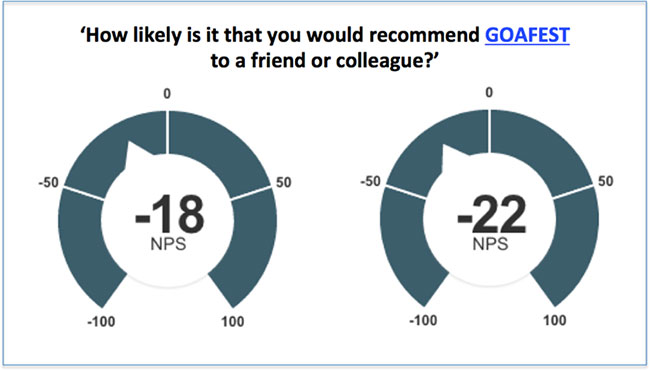
    This is reflected in the negative Net Promoter Score – 18 (Delegates) and -22 (Non-delegates) for Goafest. This is in response to the simple statement ‘How likely is it that you would recommend Goafest to a friend or colleague?’  with the standard 10-point scale. This is worrying, and I hope this year GoaFest will overall improve the score.


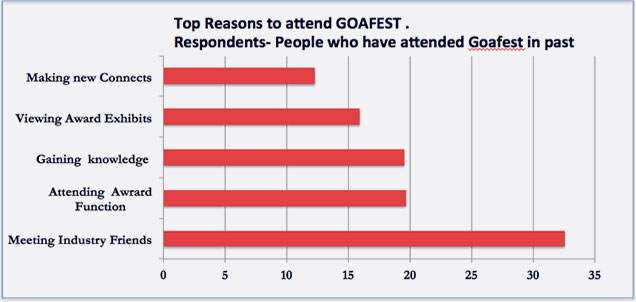
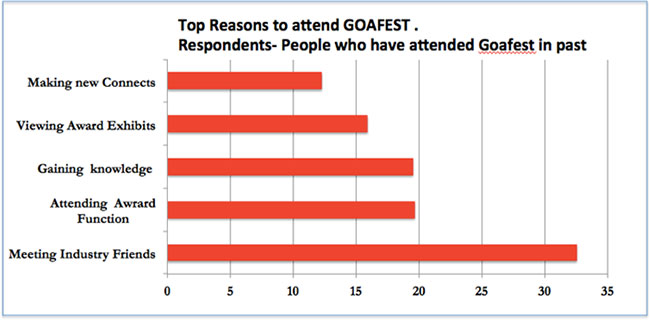
    Just concentration on delegates, the Top 5 motivations/ reason to attend Goafest seemed puzzling. Whereas non-delegates seem to be motivated on the thought of gaining knowledge! Making new business prospects and meeting industry friends among a host of other fragmented reasons.


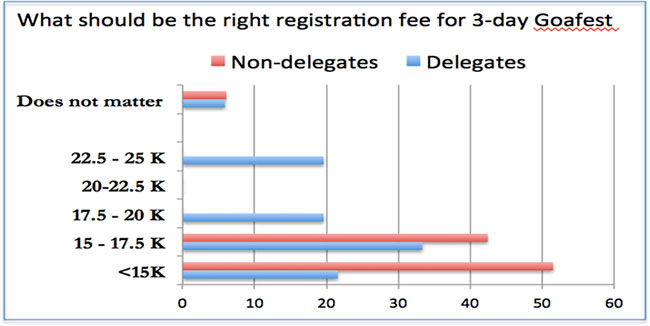
    Another interesting point to note is the spiraling cost of registration. Though it is much lower than the fee charged by international festivals, we cannot use that as a reference point. So, Rs 15,000 to Rs 17,500 seem to be a much-preferred band of the registration fee. Most do believe that the under-30 subsidised fee is un-necessarily inflating the fee they have to pay and the festival team should re-look at it.


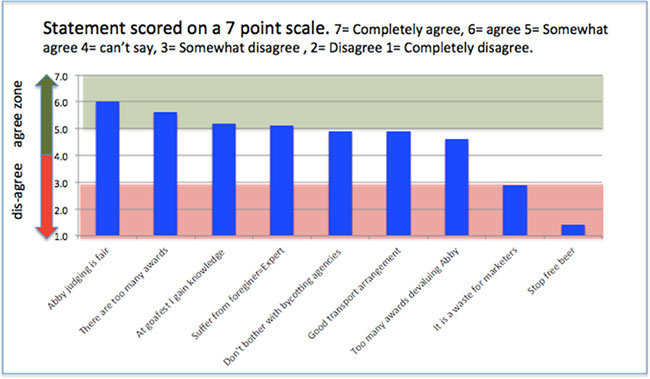
    Now, more importantly, the respondent believed that Abby judging is fair. However, they also say that there are too many awards, which devalue it.


    The delegates do gain knowledge at Goafest and they do believe that the festival suffers from ‘foreigner = expert’ complex. The data did capture a minority wanting to consider stopping free beer! Thankfully, they did not share their identity.


    Before I close, let me share that there is a strong demand for complete package that includes registration, stay, local transport, meals and travel. Before we deny it, we must realise that such packages are designed for events abroad. Maybe something like this will benefit a lot more individuals and small agencies. In my view, it is worth considering.


    So, here I close, wishing Goafest and the delegates all the best.


    PS: Before I say goodbye, let me plug something interesting. Last year, the last after-hours party was in full swing and by 2 am. I was a bit tipsy too. Right near outside the party area, I met a lady. What started with a cool borrowing of a smoke, extended long into highly engrossing conversation on nothing, in particular, here is the rider: I don’t know who she was, and it is equally likely that she may not remember me. I was the person who shared the last few cigarettes at a time when there was no place to get fresh stocks from. So, the young lady in question, if you are attending Goafest this year too, do connect with me. And yes, you can always find me around 1130, you know where!


  • Ranjona Banerji: Let’s examine the media’s role in the destruction of India

    By Ranjona Banerji


    “India’s Brave Men Rescue Kashmiris” is a running on-screen headline on CNN-News 18 on this Fridaymorning. Heavy rains in Kashmir as well as snowfall have led to the Jhelum breaking its banks and to avalanches. There is severe flooding. The Army is out on rescue missions.


    But please note the tone of that headline. Night after night, our nationalistic patriotic news channels rail and rant against Kashmiri separatists, yelling that Kashmir is part of India and anyone who does not agree is a traitor. The other night Rahul Shivshankar of Times Now screamed out a litany of complaints against Farooq Abdullah for his remarks on Kashmir and the separatist movement. You were left with the impression that Shivshankar knew more about Jammu and Kashmir than Abdullah, whatever Abdullah’s background and political experience. Maybe for all I know Shivshankar is a world-renowned expert on Kashmir. But he definitely is a fine proponent of television patriotism.


    I am not singling Shivshankar out. He is symptomatic of the general trend of television patriotism. Night after night they display their uni-dimensional ignorance and flaunt their “patriotic credentials”. No one who has a different point of view or even nuance is allowed to speak. Thanks to Arnab Goswami, “human rights” are bad words, uttered only by unconscionable liberal bleeding hearts who are in fact traitors at their core.


    And yet, we are now told that “India’s brave men” have been rescuing “Kashmiris”. If there were floods in Bengal, would the headline read, “India’s brave men rescue Bengalis”? Tamils? Gujaratis? Rajasthanis? How does India work for TV? Is Kashmir part of India or not? Or is it only about the subtext? Which as far as one can understand the petty mind of an Indian news anchor, might read like this: “Because there is a separatist movement in Kashmir, Kashmiris are inherently traitors to India. Kashmiris throw stones at the Indian Armed and Security Forces. Kashmiris can be Muslim. Kashmiris can be terrorists. Kashmiris can be pro-Pakistani. Therefore when the Indian Army conducts rescue operations in Kashmir, it is rescuing “Kashmiris” and not Indians and they do not deserve this help.”


    Forget all the historical ignorance and the logical inconsistencies in this line of thought. And consider the damage it does to India and to Kashmiris. As if the current atmosphere of criminals running around emboldened by the BJP win in UP and the actions of its chief minister Yogi Adityanath was not bad enough, we have the media consistently trying to create a divide in Kashmir.


    When a young Kashmiri IAS officer wrote about this dangerous media tactic of deliberately targeting Kashmiri youth as traitors last year, the intelligentsia commented and tried to understand but our Nationalistic news anchors went ballistic. The man was held up as one more example of a Kashmiri traitor who gets a salary from the government for daring to have an opinion counter to theirs. Senior cynics in the media tell me that this is just a dramatic technique by TV newsrooms or managements to pump up their viewership. I am truly tempted to replace “pump” with “pimp”.


    Even if it sounds dramatic, we seem to be at a breaking point in India. And some in the media are helping the process along. The “cow protection” squads, the moral police, the freedom to kill and attack in the name of nationalism and sentiment have dug up old fissures and are tearing us further apart. The justification of these actions by the ruling BJP is almost condoned by the media when they give them legitimacy. If all Kashmiri youths who throw stones are traitors, then why aren’t those who justify the killing of a man for transporting a cow, all murderers?


  • Shailesh Kapoor: VOD Services: Bollywood’s Latest Saviour

    By Shailesh Kapoor


    The VOD (Video On Demand) business has been at the forefront of media discussions in India for a while now. With the launch of Amazon Prime Video (APV) and Netflix in India, VOD has gone ‘mass’, being no longer limited to catch-up television and live sports services run by broadcasters. APV, in particular, has made a significant impact, with an aggressive marketing campaign and a price point that’s affordable enough to coerce a traditional, ‘non-paying’ market like India to consider SVOD (Subscription Video On Demand).


    While original series were the talking point in the VOD space till a year ago, led by some great work done by TVF, it’s the film content available on VOD platforms that’s an interesting point of study too.


    If we go back a decade or two, the film industry got a huge shot in its arm when it discovered a new source of revenue – Satellite Rights. Film channels were mushrooming all around, and library buying was an aggressive, cut-throat thing. Films were purchased at prices that were not recoverable over their run period (typically 5 to 11 years). But high demand in the market ensured that most movies, including the ones that failed to perform at the box office, found a buyer at these exorbitant prices.


    Many films released in the 2003-2013 period became viable, even profit-making, projects for their producers purely on the strength of their satellite rights sales. It was routine for a small film lacking a starcast to make more than 60-70% of its total earnings from satellite rights alone.


    Somewhere over the last five years, this model has run out of steam. Most new films released in the five-year period before that, including the ones purchased at a hefty premium, failed to deliver ratings. When dubbed South action (purchased at as low at Rs 50 lakh to Rs 2 crore for 7-11 years) can outperform Rs100 crore Bollywood hits (purchased at prices ranging from Rs15-40 crore) comfortably, telecast after telecast, the pricing levels were bound to break down.


    The cinema almost became more urban and niche, with only about half a dozen films in the mass comedy and action genres every year. What worked in the multiplexes did not work on the telly. Single screen oriented cinema was more aligned to the small screen, but with the proportion of single screens’ box office revenue dropping year-on-year, the intersection between theatrical and television audience of films kept reducing year-on-year.


    Many films released in 2014-16 have not been able to sell their satellite rights. In most of these cases, it’s not even a case of the price point. Channels are just not interested in picking up content that’s proven dud on the small screen. In some cases, the rights are transferred within the same group that houses both the studio and the broadcasting brand. But for this advantage, the situation could have been much worse for the studios.


    But with the launch of VOD services, especially APV and Netflix, the second shot in the arm has come. Digital rights of films are being sold at aggressive prices, including certain deals that reward box office performance. Compared to similarly-attempted satellite deals in the past, there is more logic here, because of the huge intersection between the VOD audiences and the theatre-going universe.


    Many films releasing in 2017 are going to be comfortably in the green even if they are average to dull at the box office, because the digital rights will recover large part of the investment, greatly reducing the box office burden.


    Much as the film industry is welcoming this as a strong business opportunity, they need to guard against short-term greed coming in the way for long-term growth. The Bollywood box office business has been stagnant for four years now. As per the latest edition of The Ormax Bollywood Audience Report, the Bollywood theatre-goers universe (defined as those who watched three or more Hindi films in a theatre in a year) shrunk by 11% within a year, from 3.66 crore individuals in 2015 to 3.27 crore in 2016.


    This is an alarming drop in what is already a low number. If movies are easily accessible at low cost on VOD platforms, this number could go down further. If the theatre-going habit breaks and the universe continues to shrink over the next two years, there is avery real long-term threat waiting. And competition from Hollywood is not too far away.


    VOD services have emerged as Bollywood’s short-term friend. Hope they don’t turn out to be its long-term enemy.