Category: COLUMNS

  • Sanjeev Kotnala: Can India’s 10 Most Dangerous Celeb list be surrogate for popularity?

    By Sanjeev Kotnala


    The seemingly hot looking women could lead to disastrous results. This learning was reinforced last week. I discovered ‘THE MOST DANGEROUS CELEBRITY’ list. Curious, I opened it to be better educated. It is interesting how things get interpreted. McAfee, yeah those computer safety guys officially release this list every year. These are the riskiest celebrity sportsmen, actors and politicians across the web.

    They get on to the list not by choice, but cyber criminals use them to get the unsuspecting gullible internet users to websites with malicious software. They are the bait and never the prize. The ranking reflects the % of malicious software leaden sites using the celebrity.

    I see it as an interesting surrogate reflecting success and fan following or even HOT QUOTIENT or desirability. Cyber criminals are smart they follow the latest fad. They leverage people’s fascination with the celebrities. They hook on to the desire of Internet user to be up close to the celebrity and have them as part of his or her virtual life.

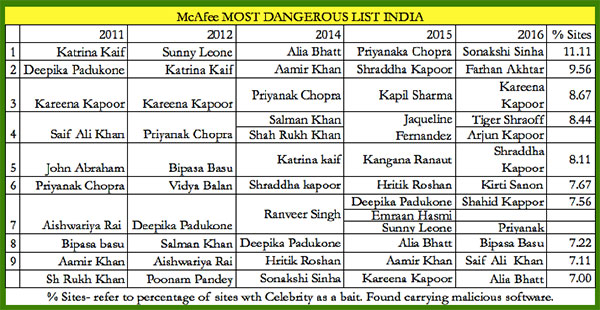
    The 2016 India list of MOST DANGEROUS CELEBRITIES is topped by Sonakshi Sinha replacing Priyanka Chopra, who topped the list in 2015


    These sites set up the bait. The malicious software gets ready to load as you type in the search window. The tags like the celebrity names with strings like ‘hot pictures, ‘sexy’, ‘Sex video’, ‘screen savers , ‘Nude Pictures’and ‘free downloads’ gives you a high probability of getting infected.

    McAfee is in business of cyber safety and protecting. Use f their product or services ensure you safely continue to do the dangerous searching and surfing with confidence. The MOST DANGEROUS CELEBRITY LIST, which is available on a Global and country basis. It is a great IP event, not yet fully exploited.


    Not much of a surprise that Sunny Leone, Katrina Kaif and Priyanka Chopra have topped this list at different times during their career. Once you place the annual list in an chronological order, the observations you can make are more than interesting.

    It is a good indicative list. It is based on Intel Security study using McAfee® WebAdvisor site ratings to determine the number of risky sites generated by searches, on Google*, Bing* and Yahoo!*, that included a celebrity name and commonly searched terms (noted below) likely to yield malware.

    The annual release keeps the hype and interest. Ten seem a good number as the list goes, and anyway they are not in a calendar business to take the list to 12. Temptation to do a monthly list would always be there.

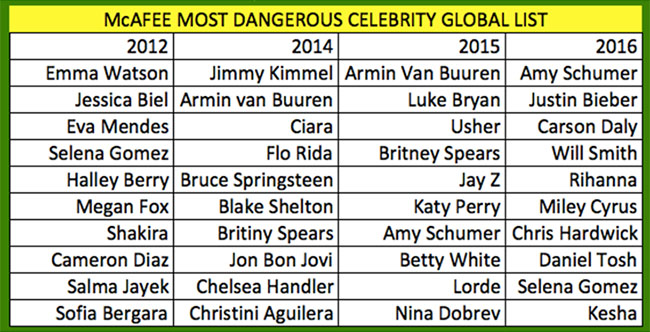
    The international list has more than the actors. It has been dominated by comedians like Amy Schumer, Chris Hardwick, Daniel Tosh, Nikki Glaser and Kevin Hart, Musicians like Justin Bieber, Rihanna, Miley Cyrus, Selena Gomez Kesha, Drake, Katy Perry, Jason Aldean, Justin Timberlake, Jennifer Lopez, Lady Gaga and Beyoncé.

    For this to happen in India, we will need more than solving the issue of data accessibility, affordability and availability. I can’t see Arijit, Abhijeet, Sonu Nigam or Lata and Asha in the list. I think that the list of 2017 will find Parineeti and Kangana Ranaut in the list.


    We also have one year where the list was dominated by men. That seems to be a exception. It is women who populate and dominate the list. And we know the reason, why.

    TWO OBSERVATIONS

    If you now go ahead and check for McAfee, Most Dangerous Celebrities India lists. It would seem that the list was only released in 2015 when Priyanka Chopra topped it. Was this a PR clouding of the search as the 2016 list (latest list) one has to drill down the pages to realise Sonakshi Sinha topped it!

    In the global list, there is one celebrity at every rank. In the Indian list, there are cases when two celebrities have been ranked the same and in 2015 Deepika, Emraan and Sunny all were ranked 7th. Is this a real result or again someone working behind the scenes to ensure to accommodate more than 10 on the list?

    …………………………………………………………………………………………………

    As a BONUS on this post, let me share some quick tips from McAfee to avoid catching the computer virus or malicious software loaded on your screens. * Think before you click! And get your content directly from the original source * Avoid searching for “torrent.”, it is the riskiest term on net. *  Keep your personal information personal. Just don’t share it * of course browse safely using protection like McAfee WebAdvisor software. *  Use cross-device protection. These are solutions that work across all your devices to deliver protection against threats, such as virus, malware, hacking and phishing attacks.


  • Ranjona Banerji: How Republic mimics real life in India…

    By Ranjona Banerji


    Unlike our Patriotic English News channels, who vowed not to discuss the progress or results of an early India-Pakistan match in the Champions Trophy (although they did discuss why they were not discussing it), I made no such promise not to watch Republic TV.

    In fact, for two nights, I blundered in just to see what actually goes on. Not that I am any the wiser but this is what I understand. The Mirwaiz, a religious head and political separatist leader in Kashmir, congratulated Pakistan for defeating England in a semi-final match. This caused incredible anger on television and immediately massive studio fight clubs were held where many people bashed each other verbally.

    Last night, India defeated Bangladesh in the other semi-final, which meant India would play Pakistan in the final. Times Now and Republic TV were still frothing at the mouth at the Mirwaiz’s tweet and now wanted to know how he would tweet if India beat Pakistan in the final. “Just shut up” shouted one man to another, the other man kept talking but no one could understand what he was saying, the anchor (okay, okay, ArnabGoswami) also kept talking but the context was difficult because he kept naming people who were supposed to speak but I have no idea if they were actually also speaking or not mainly because I recognised almost none of the 30-40 people on the panel.

    In a way I suppose Republic TV does mimic real life in India. For those who understand Mumbai, it was a bit like being stuck in a Virar local and trying to get off at Borivali and being unable to navigate your way through the angry screams of commuters. Luckily the TV remote allows a quick escape. So I went to Times Now. Here Navika Kumar was shouting at the Mirwaiz, who was not there in the line up of “guests”, about how he would tweet if India defeated Pakistan. Other people were also shouting but in all the resultant din, one could not tell if they were shouting in support of her, India, the Mirwaiz or the Wonder Woman movie.

    So I took in some peace and quiet at Wion. Here two people were discussing the India-Bangladesh cricket match. I assume since Wion is part of the Zee network and Zee has patriotically decided not to show India-Pakistan matches, that was the last discussion on cricket for Wion. Anyway, it was too quiet to really hear anything when you are used to cacophony.

    On CNN-News18, they had a proper cricket discussion going with experts like Kishore Bhimani, K Srikkanth and AyazMemon and three anchors. The experts all agreed that India was the superior team. The anchors sounded like little boys in India all of whom are cricket experts from the age of two.

    Republic TV incidentally, on the day before the England-Pakistan semi-final was furious with the UK for not sending tycoon Vijay Mallya back to India to face trial for some serious loan defaulting. In fact, Goswami wanted India to cut off ties with the UK to teach the UK a lesson. Surely a threat which is going to make England absolutely white with fright? I see immediate moves to send Mallya back, don’t you? I mean who would take on Goswami when in full patriotic flow?

    Therefore, if the Mirwaiz has supported England during the England-Pakistan semi-final, he would be equally guilty of treason.

    Meanwhile on Twitter, Rahul Kanwal of India Today TV was very clear that patriotic news channels like his could discuss results/get excited about an India-Pakistan cricket match because the rules of patriotism are very clear on cricket matches. If it is a bilateral tie between India and Pakistan, then you cannot have anything to do with that cricket match. But if other countries are also playing, then you can be part of Pakistan matches, because the tournament being ICC-mandated means Pakistan’s terrorist attacks on India can be ignored. The power of the International Cricket Council is therefore never to be doubted or questioned.


    **


    In some act of madness, I then shifted to CNN and BBC to see what was happening there. No one, just no one, was discussing cricket matches or patriotism. With disgust, I picked up the remote and watched WALL-E instead.


  • Ranjona Banerji​: Cricket back to centrestage… but for all the wrong reasons

    ​By ​​Ranjona Banerji


    India played a cricket match. India lost a cricket match. And in between, one would have thought that India fought a war, India got mauled by the enemy, that India lost all standing in the world, that India’s best cricketers were a bunch of useless traitors who did this purposely just to either: a) Upset television news channels or b) Give television news channels some work or c) both.

    I’ll grant you that this was not just any cricket match. It was an India-Pakistan final in the Champions Trophy where India went in as the sureshots and Pakistan as the underdogs. Also, that the match itself had been fraught with hysteria mainly caused and experienced by the news channels themselves. Some would not discuss the results out of patriotism, some as we discussed last time, found technical reasons why patriotism applies in some cases and not others and some decided that anything that can be used to whip up jingoism was fodder for their gigantic nationalist maws.

    I’ll also grant you that cricket has been dogged by allegations of match-fixing, spot-fixing and worse since that sad year of 2000. And that obviously any collapse like India’s on Sunday night has to be analysed, dissected and studied.

    But much as every Indian man imagines he is the world’s most talented cricketer in waiting, the post-mortem is perhaps best left to cricketers, cricket coaches, cricket analysts and so on. Not to the coroner, not to self-proclaimed RAW agents, not to politicians and not to the all-purpose news anchor. Flipping through channels, I heard on Times Now that the BCCI et cetera were to blame for this loss and one guest saying that cricketers should not be blamed and the anchor interrupting saying, “Don’t you think the cricketers…” Elsewhere, there were hashtags that ran “Pakistan Army mocks India…”

    In the background of the studios you could almost hear eager hungry angry peasants setting up the guillotine for the aristos to come home…

    On the internet, vicious, hateful and lying as ever, the discussion was about traitorous Indian Muslims supporting Pakistan, filled with fake pictures and videos.

    It was interesting in a way to have cricket back to centrestage but for all the wrong reasons of course.

    **

    It was not interesting to have no other news centrestage except the BJP’s candidate for the next President of India, the current governor of Bihar, Ramnath Kovind. It says nothing for all our political commentators, print, web and television, that they had no clue about what was going on in the minds of Amit Shah and Narendra Modi. (O dear, I should have switched the names around, no? Never mind).

    We all heard all sorts of names from LK Advani to Sushma Swaraj to Narayana Moorthy to Draupadi Murmu, currently governor of Jharkhand. Instead we have a quiet winner whom no one had heard of even though he is governor of Bihar and everyone is scrambling to learn about. Now we know that apart from being a governor, he is a lawyer and a Dalit. However he is also a proper Sangh Parivar person, who has not pushed for Dalit rights or for anything at all.

    It says very sad things about all our colleagues who work in politics that they could not pick up a single murmur about Kovind. The closest I heard was on Rajya Sabha TV over the weekend when some Delhi journalists suggested that the BJP would pick a BJP person. As indeed, they did.

    Before anyone said that however we had to go through endless talk about whether Modi would have a “Vajpayee moment” blah blah. Surely even to Delhi journalists it should be clear that Modi only has “Modi moments”.

    **

    As a result, who knows what’s been happening to farmers in India. Their boring problems of pricing and loans can hardly trump a defeat in cricket and an unknown man who is likely to become president of India.


  • Sanjeev Kotnala: What type of Whatsapp university student are you?

    By Sanjeev Kotnala


    There are many who hate ‘Whatsapp’ and many who swear by it. For few, it is a cause of anxiety and for some the way out of loneliness. Yes, there is a lot that happens on Whatsapp. And a great deal more can happen over Whatsapp. Every parent of 10th and 12th class students in India hates it and yet in many places it has been used as an education enhancement tool. Every couple complains about it and then bonds over it! It is a magic wand.

    Since WHATSAPP has come into life, it is an unexplained circus. In one moment, you are romantic and the next moment is a surge of patriotic emotions. Immediately after that comes Sunny Leone. You know what kind of mess you are in. Even before one could recover, someone pushes four lines from Swami Vivekananda. It is followed by some frustrated soul sharing jokes in an attempt to make you smile. The moment you find peace and stabilise, there is that threatening message of some god- or Saint, which you need to forward to 10 people in your network for instant good luck. Failure to do so will make unexplained unsaid things happen to your life. Meanwhile, someone has found a decently crooked quiz or puzzle to send you in a differential chase… this fast vignette of emotions and feelings can only be experienced for Whatsapp… whenever you open it… it seems like the mythical ocean of unfathomable knowledge… I bow my head in respect to all the knowledge sharers in the world of Whatsapp. I don’t know what I could have done without you. (This is a translation of a message received in my timeline)

    In fact. It reminds me of a saying in Hindi. It loosely translated would mean, ‘the knife – you could use it to cut vegetables or to harm someone. The choice is always yours.’ It is true for double edged swords like social platforms, including Whatsapp.

    Whatsapp is the new-generation information sharing tool. It is just one of the many channels to achieve faster uninterrupted real-time communication. It carries text, images, videos and audio with least distortion. It is free and unlimited. The 256 group member limitation is a boon too. It is accessible on WiFi network without a data plan, all of it and more on a simple device called mobile. It also has a smooth web avatar for PC and laptop screens. Which makes it a true anywhere anytime resource.

    Corporate teams leverage closed group interaction, that too with data encryption. Companies adapt Whatsapp for quicker knowledge transfer across the organisation. It is an apt tool for real-time status updates. In some places even educators have used it as a real-time link between learner, facilitator and information.

    It is hard to believe that the successful social media platform is just eight years young. It was in 2009 when Jan Koum and Brian Acton created it. In 2014, Facebook paid $19 billion for it. Today, it is the second largest social media platform with more than 1.2 billion monthly active users (MAU), seventy per cent of them using it daily. Across 180 countries, 50 million-plus messages fly over Whatsapp every day.

    Whatsapp is a necessity in life. This highly addictive platform has advantages like convenience, being cost-efficient and real-time messaging. However, it is known and blamed for negatively impacting the intensity and frequency of in-person interactions.

    There is so fluid exchange of authenticated knowledge in suspension of fake and unverified information. It is possible to be misled from multiple interpretations, point-of-views and stances scrolling on your screen. The radicals and lenient, the moulded and ready, the prolific commentator and the spectators; all find it easy to be heard on Whatsapp. A study of messages traded on Whatsapp can help us understand the attitude of the mobile owner. Here are some stark examples.

    THE PUSHER. He collates and shares content with every group and individual in his network. He is not bothered about the authenticity of content, need and interest of receiver and the possible impact.

    Some of them suffer from FFF (fastest finger first) challenge. They push content immediately on receipt. They are members of irrelevant groups only to keep the funnel of ‘content to push’ wide open. Just to ensure you do get the message, they will send content to you in the group and individual account too. They are unbiased in selection of the content to push. Their biggest fear is to someone else will share the content before them. FFF is a religion for them.

    In their college and friends’ network, they are responsible for enriching the collective intellect by providing interesting content.

    THE CURATOR. They are serious about Whatsapp. They are selective in sharing the content. They do not just cut-paste or push content. They always add or delete from the original content. When you get a video content from them, it comes with a clear descriptor and recommendation.

    CREATORS. A fast disappearing breed. With so much freely available, who wants to create something fresh. Few remaining creators are found in companies with interest in data and content sharing. They have business need to seed fresh content. Whatsapp survives on discovered, borrowed or re-circulated content.

    THE TAU. They are the advisors, only interested in answering queries and facilitating others’ existence in this planet earth. They are hugely passionate in their resolve to solving issues and problems. They selflessly work toward making other members feel better.

    THE BUDDHA. They believe sharing ‘Good Morning’ messages with a picture of rose, god or a smiling beautiful face is all it takes to have a good start to the day. They share pre-indexed, mostly borrowed and mutated motivating thoughts to bring a change in this world! They expect to be seen in a different light. Coaches, trainers and facilitators dominate this category. With nothing much to share, they share to remain in circulation.

    THE GURU. They have links and extracts for any question you may dream of. They are the one with fastest 4G network and an operating system that is cutting edge. They try impressing with a series of (some time even distilled ) information bullet’s firing faster than ‘James Green alias Sudden’. Guru of today’s generation, go find who ‘Sudden’ was.

    THE ADMINISTRATORS. These are people with polarised attitude. This is the only important role in their lives. Some lonely types live in the reflected glory of being an admin. This is nearest they come to managing life.

    The genuine administrators create groups and passionately work toward realizsing the objectives. A rare breed of administrators work towards a real benefit to the community. The IIM Alumni network, the EXPERT networks, The CSR and even HR group administrators fall in this subset.

    THE BROADCASTER. For them, it is god-sent business tool. They use it for frequent business opportunity realisation. They share less but at a pre-defined frequency. The content is overloaded with their views, blogs/website links, personal achievement and developments.

    This breed is dedicated and different than the pushers. They mostly share judiciously, and the content is most likely curated from other platforms. They are good storytellers and look forward to using Whatsapp as an image changer.

    THE SILENT MEDIATOR. They do exist. It needs and keen eye to observe them. They silently observe conversations in the group. At a relevant moment, they participate. The interaction happens in bursts. Once exhausted, they are like a dormant volcano.

    THE INSTIGATOR. They are bored with an excitement devoid life. For their daily dose of excitement, they selectively venture into group conversation on Whatsapp. They take polarised positions with radical statements, insensitive jokes, half-baked informations and then wait for others to clean the mess.

    Whatsapp is a complex behavorial matrix. People demonstrate a range of traits based on need of the situation and who they are interacting with. Nevertheless, a short observation of timeline is good enough to identify their major Whatsapp religion. So what is your type? If you have a different take or discover a new category, do write to me, and we will collectively expand the understanding.

    ………………………………………………

    BONUS. WHATSAPP is a time guzzler. It is addictive. Checking for non-existent updates with notification turned off is a fast-spreading epidemic. If you have more unfinished work than before, the answer most likely is in your social media and e-mail usage habits. Trust me, if there is really something important, people will reach out and call you. Phones were primarily meant for it.

    DEFINE YOUR SOCIAL MEDIA SLOTS. Switch on WiFi and data exchange only when you need them. Schedule your social media interaction slots. Indulge in it at these predefined slots and never go back more than two-screen length to check what you missed. You will find extra energy without the health supplements.

    Believe it or not, there are few lucky ‘Whatsapp negative’ people. They represent an endangered tribe of digital laggards without activated Whatsapp. They constantly fantasizse about Whatsapp. However, they are hesitant to make the first move.

    …………………………………………………

    Sanjeev Kotnala has over 30 years of corporate experience and is founder of Intradia World, a brand, marketing and management advisory. Additionally, he focusses on ideation, innovation, design thinking and BRAND-i (be the brand). Email sanjeev@intradia.in tweet @s_kotnala web: www.intradia.in www.sanjeevkotnala.com.
     

  • R​anjona Banerji​: The ethics (or lack of it) of sting operations​

    By R​anjona Banerji


    ​I have, as a journalist, been opposed to “sting” operations. Professional ethics entails declaring who we are to the people we question. We are not a branch of the government’s investigating agencies — and even they have rules about such operations. The most recent sting operation we discussed led to an army man committing suicide. What price “truth”?

    Now S P Udayakumar, a well-known anti-nuclear activist, has written a letter to the Press Council of India, complaining about a sting operation conducted on him by RepubicTV. Normally, in this column I defend journalists when they are picked upon, harassed, when people do not understand how the job works. But given the nature of sting operations, one has to look at Udayakumar’s complaint seriously.

    He has long been on the radar of the government – including the previous UPA – and of “nationalist” journalists who feel any criticism of government schemes is an act of high treason. Udayakumar and his group have spent years objecting to Koodankulam nuclear plant at Kumbakonam. This has led to several skirmishes with the pro-nuclear lobby, with the pro-nuclear energy lobby which is not the same as the pro-nuclear weapons lobby and other groups whether with vested interests or different ideologies.
    Judging from Udayakumar’s complaint, RepublicTV tried to lure him into accepting foreign aid which he is blocked from doing:
    “On April 9, 2017 she (Republic TV reporter Shweta Kothari, who represented herself as Shweta Sharma, a research scholar at Cardiff University who wanted help with her dissertation), requested me to stop by her hotel room as she had a few more questions. There she told me that “one of her British professors” was very keen on supporting our struggle against the Koodankulam nuclear power plant. I told her that we did not accept money from foreigners and our movement had no bank account also. She then asked me if there was any other way of donating money to us. I told her that my personal account was frozen and that even our party account could not receive foreign funds. So I said she could not donate money from abroad but her parents could do it here in India if she sent the money to them. I also mentioned clearly that I would give proper receipt and the money will be accounted for. I also informed her that we were not interested in getting foreign funds.”

    This is apparently what was shown on RepublicTV on June 20, including a panel discussion in which Udayakumar took part from Kumbakonam where he was part of a protest. So far, this is not completely objectionable although it is unethical. However while Udayakumar was in Kumbakonam, Udayakumar says that a Republic TV reporter called Sanjeev went to his house in Nagercoil and harassed his parents, aged 85 and 82. He stood outside his house from 2 to 11 pm, insisted that Udayakumar’s parents, wife and schoolgoing son respond to the sting operation. Apparently, this zealous reporter went back the next day, continued his harassment of the family and got into a fight with an 85

    ​-​yea​r-​old man. He then complained on TV that Udayakumar – who was not there apparently – had “scolded” him.
    Any sensible journalist knows that very little of this whole story constitutes meaningful journalism. The sting did not prove that Udayakumar took foreign funds which is he not permitted to do. It did not prove that Udayakymar’s stance on nuclear energy is unethical. It in fact constituted a clash of two points of view with one view using unscrupulous means to try and prove that it is right.

    One is sure that Republic TV has its own version of what happened. But anyone who has watched Republic TV for even five minutes knows that what it practices veers from being non-journalism to teetering on the very thin end of bad journalism.

    A sad, sad day for us all if this

    ​is ​indeed the number one English news channel in India as it claims to be.
    As for Udayakumar, no such complaint

    ​with the Press Council of India ever amounts to anything. He would be better off taking other recourse, starting with broadcasters’ associations to the courts for any semblance of justice.

  • A Derailed Media: The Wheels Have Come Off


    By Shailesh Kapoor


    If you have been a follower of news media in India over the years, there’s high chance that you would see the freedom of the pressas a fairly natural outcome of our democratic machinery. In a country where taking offense has turned into a national pastime, the media has still been an independent institution, except in extreme times like the Emergency.


    Sections of the media have been guilty of catering to political interests of certain parties or politicians. But the larger media landscape has been one of an independent, though often opinionated, press. There have been propaganda papers and party mouthpieces, but those have been exceptions in a largely flourishing media environment over the years. Till recently.


    Over the last month or so in particular, the derailment of the freedom of the press idea is stark and evident for us to see. The wheels are coming off. The issue has come into focus especially since the launch of Republic TV, even though many would argue at least two mainstream Hindi news channels have been BJP mouthpieces for almost three years now.


    But with Republic TV’s launch, all efforts on being ‘seen’ a neutral media, even while having a political agenda, has been discarded. The channel is so evidently pro-Establishment that even when it covers the odd anti-BJP story (only twice in two months so far), there’s a sense of apology in the way it’s covered.


    Pro- or anti-Establishment doesn’t bother me much. It’s an editorial prerogative to take a stand on political issues, and at times, ideologies could align themselves in a way that a certain vehicle may end up supporting or opposing the establishment in what may come across as a pattern.


    What bothers me immensely, however, is the distortion of the idea of “news” itself. If you see primetime coverage in the months of May and June, you will notice that there’s been endless discussions on several channels on two topics in particular: Kashmir and the Indian Army. There’s been a nationalistic fervor to call out those who are against the Indian Government and the Indian Army’s approach in Kashmir.


    In times when the GDP has declined, the GST is ready to roll in, farmer agitations over support prices are peaking, and the impact of demonetisationis still not fully understood, the economy would logically be the most topical theme to cover. But you will struggle to find coverage and analysis on these topics on TV in particular. Because apparently, it would need fact-checking, which is hard work, and may expose the establishment, which is not everyone’s idea of how they want to run their media house today.


    To further complicate matters, the NDTV raids came in the middle of this prevailing atmosphere of a polarized and divided media. The show of strength that followed at the Press Club indicated the growing dissatisfaction that parts of the mainline Indian media have with the current Government at the center.


    The silver lining, in such times, comes from the Internet, which has the structure and the ability to present the truth in a more layered and multi-faceted way than most channels and newspapers are willing to. Of course, you need to know which sites or handles to visit for that. But at least, you have some chance of getting an objective coverage of topics that concern us today.


    We are only two years away from 2019, and I dread to think if things will get worse. But is that even possible?


  • Ranjona Banerji: Times Now: Unprofessional or trying to spread communal disharmony?

    By Ranjona Banerji


    One of the most interesting and useful forms of media available on the internet today are a set of “fact-checkers”. (My apologies to all of you who thought that Opindia and MediaCrooks and so on were fact-checkers: they were in fact nothing but hate-spewing fact-inventors.) These look at claims made in the media and elsewhere on the Net and get down to the origins of “information” that spreads far and wide, via Whatsapp and other social media.

    Boom FactCheck @boomlive_in’s Twitter bio says “Fact-driven journalism” and works hard to counter all sorts of lies which float about the internet from rumours about film stars to claims about plastic rice to statements made by politicians. It is connected to the excellent IndiaSpend initiative founded by journalist (and disclaimer, former colleague, GovindrajEthiraj).

    IndiaSpend is data journalism, using available open data to check governance and policy claims. By relying on facts and not on sources or opinions, IndiaSpend aims to “foster better governance, transparency and accountability” in government. It is a site well worth visiting for every Indian journalist.

    Boom takes the mandate further, and focuses on the various bits of “news” of all sorts which float around on social media – entertainment, sport, bigotry, lies.

    SM Hoax Slayer, which causes great unhappiness to those who spread hatred on social media, says it was formed in 2015 with the express purpose of curing the disease of “common sense deficiency syndrome”. It works at unveiling the lies and “pranks” which float about the internet and which are often used as a way of fomenting trouble or hatred or hardening biases. And @SMHoaxSlayer has been highly effective so far, often used as a source for traditional media, when it wants to report on facts and not social media lies.

    The current bugbear of the rightwing is Alt News, run by the fearless Pratik Sinha, a social activist who comes from a family of well-known social activists, and his team. Alt News focuses solely on the propaganda and lies spread by the rightwing in India, from the current government to the various relatives of the BJP.

    More than @boomlive_in, both @SMHoaxSlayer and @altnews_in really roil rightwingers and “patriotic Hindus”, “True Indians” and the rest of the Hindutva brigade on social media. Given the small limited rightwing bandwidth, their first move is to spread the story that both these websites are run by Muslims and funded by various Middle Eastern states. In the Hindutva world view, both being Muslim and having Middle Eastern connections are about the worst transgressions of Indian nationalism ever. I have heard the same stories in the pre-internet era about former journalist and current social activist TeestaSetalvad for instance, even from once reputable journalists. Interestingly – as an aside – these nationalistic voices are silent when a BJP prime minister hugs several Saudi and Emirati princes for instances.

    The most damning story for the media, exposed by these fact-checkers is an “expose” done by Times Now. The TV channel – I balk at calling it a news channel any more – has been running a massive story over a conversion rate card for Hindu women used by ISIS in Kerala’s Kasaragad area, which is apparently the “Gaza of India” according to Times Now.

    (What this makes of Times Now’s idea of history, geography and politics I don’t know but it implies that the people who live in Kasaragod have calved out a small self-governing entity within India while fighting for their sovereign rights over another nation (us?) which occupied land that first belonged to those living in the Gaza strip, by Western powers post the Second World War.)

    Our intrepid fact-checkers have dug deep into this “rate card” to find that it first appeared seven years ago – no ISIS then by the way – on a blog titled “Sikh and Islam” in 2010. The image on the current rate card was then a Hezbollah flag. Times Now’s defence was shameful and disingenuous: “we made it clear we are still trying to contact the people mentioned on the rate card to determine its origins”.

    In the traditional form of journalism that essential check to determine the rate card’s origins would have been done before running the story. What does this say about Times Now’s understanding of the profession it claims to belong to? When researching back to the source of the rate card was not so difficult all? If you take the channel at face value, then it is inefficient and unprofessional. If you decide that Times Now ran the story wilfully without simple research then the channel is responsible for trying to spread communal disharmony.

    Sad times.


    Ranjona Banerji is a senior journalist and commentator and a former editor. She is also Consulting Editor, MxMIndia. The views expressed here are personal


  • Thank God, It is still about the Idea!


    By Sanjeev Kotnala


    Three decades back, I was a young postgraduate from the Indian Institute of Management Ahmedabad with stars in my eyes and passion for communication. I joined an Idea called Mudra. At this time, I have seen many changes. Agencies have recalibrated their specialisation. New media emerged in the world of rapidly changing technology. New theories were given fresh lease of life with redefined interpretations. Revenue models were challenged and redrafted. Business associates turned into vendors. The hotshops at creative boutique services opened direct channels with clients. Measurement currencies failed, and some were replaced. However, the industry kept its sanity and remained true to its core. The business of Idea remained the Business of Idea.

    The filters to evaluate the IDEA have morphed with changing needs. Newer matrices have crept in. Creative Awards became the wrong measurement of success and power. Effectiveness awards suffered believability threat and non-transparent data presentations. In this crossfire, Cannes stood up as an award where balance seems to reign.

    One may debate the number of lions uncaged every June. Nevertheless, Cannes has not failed in celebrating ideas. Here are some ideas that stood up in the reports I have access to. And my belief in the power of ideas and the untapped potential in every category got affirmed.

    UNUSUAL FOOTBALL FIELD.

    A deeper insight and what a simple idea can do. Do watch it. It’s a game should the shape of the field influence you?


    THE VAN GOUGH Airbnb

    The real VAN GOUGH ‘THE BEDROOM’ was on the way to North America, Chicago when Leo Burnett listed on Airbnb, a room that looked like the famous painting. It is reported to have created $2 mn additional revenue and incremental attendance of over 133K visitors for ‘The Art Institute of Chicago’. The Idea is creatively excellent and impacts brand audience and business.

    THE CHARM.

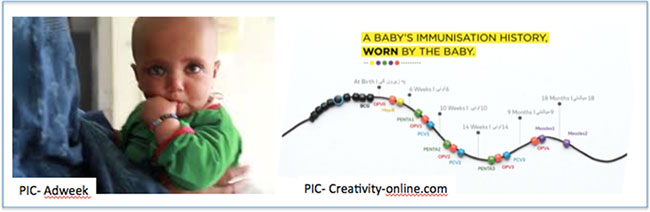
    Created by McCann Worldgroup’s for Ministry of Public Health, Afghanistan, the Immunity Charm takes in the local tradition of talismanic bracelets (meant to keep evil spirits away from children) and weave it in the vaccination story of the child. The colours and types of beads signified specific immunisation. It even allowed mothers to compare beads on the lucky charm their kids were wearing on their arm.


    COOK THIS PAGE

    Ever innovative brand Ikea presented a Kitchen poster series featuring food products you get get at Ikea. The poster allowed you to be creative with recipes and measure the ingredients by the sizes shown on poster. And then COOK THE PAGE


    THE ODD

    A special mention for a simple powerful Idea. Adidas launched a unique product- ODDS- a pair of shoes, where both were for the same feet. It symbolises courage and is dedicated to all the people who chose to run against odds. Creative was done by Taproot.


    Fearless Girl

    McCann’s Fearless Girl for State Street Global Advisers is an Idea seeking ‘more women in leadership position and draw attention to the organization ‘SHE’ fund, which invest in companies that they believe are doing a good job of putting women in top positions.

    When it was exposed to the world on March 7, 2017, I completely missed the point. Personally, I failed to appreciate its power and potential to represent Female Empowerment. This non-traditional outdoor earned media for the brand. It not only became the point of engagement in the city but also caught global attention.


    TWITTER #

    Twitter, the digital platform in-house campaign with just ‘#’, logo and visual from news and pop culture is a brilliant use of traditional billboard. It allowed the brand to present a vignette of situations. Twitter CMO Leslie Berland summarises the approach with a simple explanation, “Twitter is where you go to see what’s happening everywhere in the world right now.” It is so completely brand. I also appreciated ‘SHOT ON iPHONE’ campaign.


    MEET GRAHAM

    Transport Accident Commission ( TAC) presented an odd-looking representation of how the Human Body needs to be constructed to survive a car crash. The idea shows forces that act in an accident, and it forces the audience to realise the vulnerability of the human body in its current form. Hopefully, it will instigate few debates and discussions among the audience.

    This odd interactive sculpture immediately caught global attention. Using ‘Google Tango’ augmented reality technology, the visitors are able to look under the skin of Graham. With such an Idea, tsunami in social media and news media was easy part of the business. The site meetgraham.com.au recorded more than 10.4 MN hits in just a week.


    WORLD BIGGEST ASSHOLE

    The Martin Agency presents a case for ‘Donate Life’. The idea shows life of Coleman F. Sweeney the biggest asshole.. He is treated like one. However, he did one good thing in his life, donating organs. This makes him, the enormous asshole, a hero post death. Speaking to the millennial it uses their language and imagery. The idea also provides clues to how one life can impact as many as 50 lives by organ donation.


    Some other Ideas that caught attention for their simplicity and action based in-category envirounment and insight were ROADS THAT HONK, Burger King 15 sec ad that voice activated Google answer  and Jet.com Innovative saving Super Bowl commercial !

    ……………..

    BONUS : A perfect promotion activation ‘SLO-MO-MARTATHON’ for the movie BAYWATCH using its slow motion run to its advantage. Do not miss that this is the period when NIKE was trying the ‘Breaking2’ to run under 2 hour marathon.

    …………………………………

    IN THE PASSING. It is not the first time that Martin Sorrell questions the importance and time-effort-cost equation of the awards. He wants to move Cannes to New York. It’s an Idea that must be considered.

    Someone calculated that each Cannes Lion is worth around Rs10,00,000. You should participate and be part of Cannes if you can unlock equivalent business gain or PR. An Idea that will make people re-think.

    The Publicis CEO Arthur Sadoun announced at Cannes, that the agency would stay away from awards for 365 days and will invest the saving in their internal tool ‘Marcel’. This made it sound like a purely commercial decision. It started many debates and helped him corner global attention.

    However, many of us in India will not agree with his statement “I believe great work is work that arrives in Cannes being already famous. If you have to wait for Cannes to be famous, you have a problem.” We most likely will also not align with his polarised view “The number of work that arrives to the festival that is not known and needs the festival to be known, this I don’t like.”

    Come on we all know better than that.


  • Shailesh Kapoor: Panic Time For Hindi GECs?

    By Shailesh Kapoor


    Over the five years of existence of this column, one of the most-extensively covered topics here has been the status quo in the Hindi GEC category. Every few months, I have touched upon the concern that the category has got too inert for its own good, not recognizing the viewer dissatisfaction that’s been on a steady rise over these years.


    Over the last few weeks, the numbers are beginning to tell a story that’s harsher than ever before. In the equivalent eight-week period (May-June), 2017 saw a 11% drop in Hindi GEC ratings in Urban (HSM) India, compared to 2016. The drop is even higher at 16% at an Urban + Rural level. Since BARC’s last major market expansion in end 2015, the category has lost more than 20% viewership.


    Over-simplistically and erroneously, some may attribute this to the rise of the digital media. If that was the case, the drop would have been more significant in the Urban markets, and the Rural markets should have held steady. But that’s not the case. So, unless we attribute all of this to BARC panel settling down and the reporting getting more accurate with time, the problem is too stark to turn a blind eye to.


    There has been a 15-20% drop in weekly reach of the top channels, indicating lower sampling levels itself. Why are less people watching Hindi GECs over time? If there was an overall trend linked to panel correction, it should have reflected in similar de-growth in other genres. But that’s not happened. Kids and Hindi Movies are perhaps the two most mass genres to compare in context. Both have shown about 10% growth over the last year.


    Clearly, it’s a Hindi GEC specific problem. From an average number of actively-followed programmes of about 9-10 three years ago, an average core (heavy) Hindi GEC audience today actively follows only about 6-7 programmes. The interest to add new launches to this list continues to dwindle. Hence, with each established show going off-air or losing its sheen, the problem multiplies.


    We are in an era where digital content is grabbing the headlines. Much as its impact on television is miniscule, the GECs cannot possibly be caught napping in this period where digital is headlining content innovation. If not anything else, the advertiser can be swayed over time.


    From 300-GRP channels to 225 to now 150, the big guns in the Hindi GEC category are no longer the giants they used to be. The viewer has waited for a long while, patiently like she always does, to see a change that has not come by. There’s not been a truly blockbuster weekday show for almost four years now, since Yeh Hai Mohabbatein, which launched in December 2013.


    Innovation, when it has been attempted, has been at the cost of relevance. Genre lacunae like fiction comedy continue to remain. Serials becoming replicas of each other, both in terms of plot and treatment, is now a well-recognised consumer sentiment.


    There may not be any easy solutions around, but the “Innovation” button needs to be pressed, without losing sight of relevance. It may not be easy, but any category that has de-grown by double digits in one year needs to find hard measures to fix its issues. Another year of 10% de-growth, and GECs may not even be “mass” anymore!


  • Ranjona Banerji: How media covered #NotInMyName protests​

    ​By Ranjona Banerji​


    A good journalistic test for all media was how the #NotInMyName protests across 16 cities in India and four worldwide held on Wednesday were covered. The protests by citizens of India unaffiliated to political parties were against the recent spate of incidences of mob violence, usually against Muslims and Dalits and usually in the name of cow protection.

    NDTV carried news of the protests all Wednesday evening. After a while, so did CNN-News 18. India Today TV also touched upon it. Times Now decided finally that they too had to cover it but from a patriotic point of view of course, unlike all other anti-national media. Republic TV was on a rerun of a sweet little interview between a simpering Arnab Goswami and a smug Yogi Adityanath, chief minister of Uttar Pradesh where both participants were confident that a superb job was being done.

    Times Now’s pitch was genuinely unique. First they decided that only anti-nationals would carry such a protest in Karachi, proving that those against mob violence were traitors. Then they found that in the London protest at Tavistock Square, someone had placed a “Not in my name” placard on the statue of Mahatma Gandhi there. This according to Times Now was “desecration”. Presumably in their little ill-informed minds, a Gandhi statue is a religious idol and two, and this is significant, Gandhi would have been for mob violence in the name of the cow.

    By Thursday, Times Now had decided that this was a “JNU conspiracy” carried out in London to desecrate a Gandhi statue. I leave you to ponder on the absurdity of journalists who will not cover a protest in their own country but pick on some irrelevant angle in a foreign land. The only other prominent person who appeared to see a “foreign hand” ready to defame India in these protests was Professor Rakesh Sinha of the RSS and Delhi University and many TV channels, who generally blamed “the West”.

    As it happens, Prime Minister Narendra Modi apparently took the protests more seriously than them and spoke out against mob violence and murder in the name of the cow at the Sabarmati Ashram in Ahmedabad. This left some egg on some pro-BJP faces which had spent all of Wednesday on social media mocking the protests. Swapan Dasgputa, once a journalist, now a columnist and director of Larsen and Toubro, for instance, tweeted that this protest was “of the media, for the media and by the media” in spite of there being no evidence to prove this.

    Anand Ranganathan who writes for Newslaundry.c​om spent all week compiling statistics to prove that mob violence was nothing new and that Muslims and Dalits were not the only ones targeted. IndiaSpend countered this research with data-based facts but by then the damage was done and Ranganathan’s research was gospel for the agenda-driven, being quoted by the ABVP and by Vikram Sampath on NDTV.

    R Jagganathan of Swarajya questioned the protests on Wednesday and heavily praised the prime minister’s speech on Thursday.

    These are just some examples and of those who work in the larger media universe. Other BJP spokespersons on Twitter, self-appointed or otherwise, were a bit stumped by Modi until they were forced to erupt in praise.

    The rest of the media pointed out that hours after the prime minister’s remarks against such violence, a man – Usman – was beaten up by a mob in Jharkhand and his house set on fire over a dead cow. Perhaps they do not watch TV all day in Jharkhand.

    Newspapers, being anti-national, covered the protests.


  • Ranjona Banerji: Chaos UnLtd on GST

    By Ranjona Banerji


    The US media is fighting a bizarre battle with a bizarre president. Donald Trump recently released a GIF which showed him in a pro-wrestling arena fighting a person with the legend CNN as its head. Either one could treat this as a joke or as an extended threat by a head of state who sees every criticism as fake and fraudulent news. Perhaps Trump does have too much in common with Vladmir Putin and Russia after all?

    Meanwhile in India, we are fighting over whether it is correct to protest about mob violence when you did not protest against Babar’s invasion of India, whether more mob violence happened in the past or in the present, whether anyone has the right to disagree with mob violence in the name of the cow, whether liberals are the scourge of the earth and only the bigoted rightwing have the right to speak and act and so on.

    As a result, you even have newspaper editors quoting articles from websites run by pharma company employees pretending to be journalists to boost their idea – presumably – that because mob violence happened in the past you cannot protest about it now.

    However other websites run by journalists and using all available data have evidence to the contrary. It’s a rum world where the media is blamed for reporting on instances of mob violence, of murder and beatings and arson and vandalism. If the media did not report on them, would India be a better place? Ignorance is bliss or Knowledge is power?

    **

    The launch of the Goods and Services Tax with much midnight fanfare has confused the Indian media as much as it has the Indian market. While everyone is agreed that GST is a good thing, not everyone is convinced that the current form of GST is a good thing. Newspapers report chaos, TV shows us traders on strike, newspapers and TV have interviews with ministers and bureaucrats telling us that everything is going well and newspapers and TV have interviews with economists and former ministers pointing out what is wrong with this version of GST. Chaos is apparently a merry way of life in India.

    **

    Indian subeditors as we all know pick up on certain phrases and run with them. We have all made fun of “air-dashing”, “wee hours of the morning”, “donned their apparel” and other such horrendous nuggets of miserable, clichéd, thoughtless, unimaginative ways to shorten headlines and blurbs.

    I take great exception to the current term “rockstar” – which is apparently now one word – which is used for everyone and everything from a prime minister who meets NRIs to the Indian Space Research Organisation.

    I understand the need to find a metaphor to “sex up” headlines. But as a long time rock music fan, I would like to point out that rock singers become stars when they perm their hair, perform ridiculous antics on stage, have manic energy often from various psychotropic illegal substances, have a complete disregard for the law and the biggest stars of all become legends if they die young in some dramatic manner. I would certainly hope this is not the subeditor dream for India’s space programme?

    Unless subeditors are being incredibly subversive – which I doubt – when they call everything a “rock star”, I would humbly suggest that they find some other term.


  • Sanjeev Kotnala: Stop Blaming So-Real-Mar(ke)tin(g)

    By Sanjeev Kotnala


    June 27 1987 is the day advertising started its metamorphosis. Or so people would like you to believe. That day, Martin Sorrell with a confidence that only he understood made the successful hostile takeover of J Water Thompson (JWT). Most likely, he was unsure of the destination or the choices he will have to make on the way. He is equally an instigator and victim of the changes that shaped business in last 30 years.

    Today, with JWT, Ogilvy and Mather, GroupM, Grey, Young and Rubicam, Kantar and others, WPP is a $16.7 billion revenue group. So, go ahead and blame the leader. Truth is none of us had the same wisdom, insight or confidence. None of us were willing to be adventurous like him. We are moving with the crowd. I know the situation was not India-centric and there were many forces at work. However, I also know, there was never any resistance to the changes that defined business.

    It’s easy to blame others for your situation. It’s much more productive to search your own past and find what caused your fault. It is so true.

    We refer to advertising as an ‘industry’. It is our way to show respect to something that is nearly 50,000 core in size and employ many people unfit to do anything else. Anyone can get in this business.

    We keep pleading for adherence to rules and norms with hardly anyone listening. We are democratically inclined, data-driven and client-directed in our approach. Calling our work as science or art is an understatement of sarcasm.

    We are the perpetually in flux highly adaptive bunch of people. We have demonstrated it time and again from creative to media selection to activation and more.

    I presume idea is the core of our business. Belief that idea can come from anywhere and anyone, including the peon is highly appreciated. It shows humility and transparency. It was highly applauded. The client has no objection to such a self-defeatist thought. This was the birth of unsaid designations like ‘Marketing director and head creative communicator’.

    The insight mining agency immediately understood the shift in their audience number one. Taking the new lifeline it started appreciating the client’s creative interjections. The relationship was now dependent on their understanding the client in person and not necessarily the brand in the real world.

    The creative product suffered and yet in places of sinful deliberations, it even got awarded.

    The weapon of ideation was trashed and elevated at the same time. Creative hotshops, many of them strategically unstable flourished. The clients were reminded that strategy was anyway their baby, and now they could be creative too. No one in the business told the client that they knew more about the product and markets, and we never interfered in it. Similarly, if the client hired the agency and believed they are good, could they mind their own business when it came to developing an idea or a campaign. I know it doesn’t happen, but I know of instances when this did happen, and the client welcomed the thought.

    We did not cut cost until it was forced on us. We were going great with that 15% revenue model. People were passionate for higher media plans and exposures. Client servicing was still the king. And then fragmentation happened. Someone blinked for the first time and no one took notice. It was the innovative retainership approach a tool to hedge against media expenditure uncertainty and loaded to give stability to agency business. The story of Bhasmasura was repeated again though in a different context.

    Suddenly, the tap was drier than the need. Talent accustomed to be celebrated found that the business does not pay that well. Undoubtedly, mediocrity became the next benchmark.

    Like other respected professions, there was no barrier. Anybody could start a business or join the profession. The industry did not work with education institutes to get the right crop. Anyway, the premier schools of management and idea were getting beyond their reach. And none of us took notice of it.

    Everyone, other than few self-respecting mad men, was pitching. The size no longer mattered. The industry could not draw rules or norms. It remained busy in internal oneupmanship. The client became the god in the category. The industry bodies remained glued to their restricted constrained memorandum and no one bothered. And we are still playing catching up. There is no single source on all agencies, work and talent. There are no norms for calling for pitch. There are no templates that the bodies recommend. There are no penalties for misappropriation of the biggest treasure, idea hunting continues.

    Oh, the industry always chased the next wave and has hardly been riding the wave. This lag is evident across mediums and brands. Digital and outdoor possibility is a classic example of it.

    There is no fun in working within the agency. No, don’t think it has much to do with data-driven attitude. Primarily, the fun was in a lot more pressurised chasing of dreams and experiences. It was always about the environment and people. Technology has taken a lot of charm out of it, and we forgot to reinvent ourselves.

    The business is completely commodities. Cost/ price/ commission is the new grammar. Idea/ people/ talent and teams have taken a backseat. They are not partner, advisor, consultant but dignified vendors. It is procured and no longer appointed. The commission to retainership with no correlation to the size and shape of the business or the ideas and their results has hurt business more than anything else.

    Hypothetically, if there was an industry-defined norm for the cost of business flattening the price equation, it would have rejuvenated the debate on talent and people, what the business should have been about.

    The agencies are more of tailors, you tell them how you want your trousers. Unfortunately, they will never be like doctors who prescribe a solution and approach.

    It is likely that the industry will have to look up to wonderman Sorrell as the lighthouse in the rough weather. He has been right many times over. Hence has the right to be right.

    The future of advertising look’s dark and lacks respect. The data-driven deep insights best understood at AI level may become the starting point of campaigns or connectivity triggers between the brand and the consumer. If the industry believes in itself and ensures human-oriented insight-interpretation-creative leap will be the foundation of all the work, it may still have a window to crawl through. I hope it does.

    This article took birth while reading Anwar Alikhan’s ‘The day advertising industry changed’ published in Mint on June 27, 2017.