Category: COLUMNS

  • Special2MxM | Pooja Chaudhri: Monsoon Wedding & Mumbai Masala with the Tofflers

    By Pooja Chaudhri


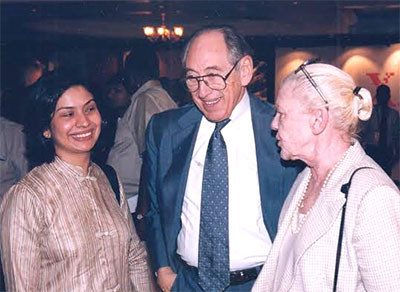
    When the ‘man who saw the future’ departed from the world he had predicted, I mourned with everyone else on the passing away of a beautiful mind, but it also brought back beautiful memories when the Tofflers decided to descend on Mumbai almost 15 years ago.


    It was January 2002 when as a young public relations professional I was assigned to work on this mega international event called Docuworld by Xerox Corp in Mumbai, with none other than Alvin Toffler as the keynote speaker. The world’s best futurologist was coming to town, and as a 20-something, I was going to interact with him one-on-one… I was the envy of my learned colleagues at work just for this opportunity alone.


    I quickly brushed up my knowledge on this illustrious man, the equally important Heidi Toffler, who was accompanying him, Toffler Associates, his management company, his global bestselling books – Future Shock, Powershift, The Third Wave… not once claiming to have read them, but, yes, enough to know about them.


    The morning of my introduction with them was a nervous one for me… I dreaded the moments that I would be alone with them… after all, what conversation could I possibly make with a couple that is so high on the global knowledge quotient and on topics that were clearly beyond my realm?! The time prior to the event went by quick, the event itself was a resounding success… the audience clearly in awe of seeing the man in flesh and blood right here in aamchi Mumbai. The rest of the day was a humdrum affair going about with my routine tasks at the event.


    During the course of the day, I had many opportunities to interact with them, and my nervousness soon disappeared. By lunch, the equations were set very clearly between us… I didn’t need to attempt any false gyaan and he was only too happy not having to share his! He treated me as an accomplished professional, and I treated him just the same. We were just normal people. He didn’t want to be fussed about… he had a childlike curiosity about things, was visibly enjoying Indian food. “Never mind the spice,” he said. For someone of his stature, he was just so normal, ensured my comfort above all… and immediately put me at ease.


    Mrs Toffler, on the other hand, was reserved, very stern, not as chatty as her husband… she would often interrupt him during media interactions to the point that they’d argue with one another right there in front of the journalists… she wanting to assert her point of view more than him! An accomplished author herself, she was always cognisant of the fact that HE was the keynote speaker at the event, and not her or them… and she felt it was only right to not have their combined brand power on display. She was the more argumentative of the two and not hesitant to show it. With me, she eventually softened up, and from there on, it was smooth sailing.


    The day of the event ended well… the Tofflers invited me over to their suite for dinner, much to the surprise of my client and my seniors (neither of whom got the invitation!). I politely accepted, not wanting to seem disrespectful. We ordered in room service… chatted about their travels, my work, home city, their family, Indian culture and food among other things. It was a quick dinner, and I left with a recapping the next day’s schedule. I was relieved that Day One had surpassed my expectations.


    I met the Tofflers the next morning after an early breakfast… we had a handful of media interactions lined up one after another. All went to plan, we wrapped up work at about noon… the client had done its customary sign-off and the Tofflers were scheduled to fly out later that night.


    Just as I said my goodbye, Mrs Toffler asked if I had any prior commitments for the rest of the day. Confused, I said, I was heading back to the office. Mr Toffler, the perfect gentlemen, requested if I could take the day off from work, and show them around Mumbai. I couldn’t believe what I was hearing… Mrs Toffler, her mother-like warmth at display, absolutely insisted that I accompany them for the day. Suddenly, I saw tourist-like exuberance in them. I agreed (who wouldn’t, right?!). Not wanting to waste any time, we quickly set off from Bandra straight to SoBo.


    It was a chirpy drive all through (no sealink those days, so, yes, took longer than it does now). We talked about many things, mostly them asking me questions and me filling in with answers… felt odd to be getting interviewed by THE Tofflers! They were fascinated with the drive, the driving styles on display, the crowds, the cops… clearly soaking in Mumbai’s sights and sounds like tourists normally do. We drove past all of SoBo’s iconic Victorian buildings, me the tourist guide with a running commentary as we drove along. We got off at the Gateway of India, they marvelled at the architecture.


    As we headed towards Churchgate, they said they’d like to watch a Hindi movie… and insisted that I take them for one even if it didn’t have English subtitles. It was just a little past 3pm… Monsoon Wedding was playing at Eros theatre. I quickly bought three tickets, and in minutes we were seated inside… me perched in between the two of them! Thankfully, the movie had a generous dose of English dialogues and subtitles too… I only had to fill in with the local cultural nuances, and of course, a quick overview on the changing face of modern Indian society.


    Having enjoyed the movie, popcorn et al, we set off back towards the hotel in the midst of peak rush-hour traffic. The drive back was quiet, the couple now anxious about reaching back in time and having enough time to pack, dinner, and head off to the airport. I was nervous, praying that we don’t get delayed along the way.


    As we reached the hotel, I said my final goodbye to them, wishing them safe travels… but they would have none of it. They insisted yet again that I join them in their suite for dinner and also drive them to the airport and that the car assigned to them would drop me home at night. I wasn’t given a choice actually and just had to do as told. I helped them pack, we ordered dinner in… after their last masala chai in Mumbai, we headed off to the airport.


    I had thoroughly enjoyed two full days with them in a way that no one could believe… it was one-on-one unadulterated time with one of the most renowned futurists the world had seen.


    As we parted ways at the airport for the last time, Mrs Toffler gave me a gift from her bag… we exchanged the warmest hugs, our eyes moist. There was something about how the two days had gone by… some wonderfully warm moments for me, both personally and professionally.


    Sadly, the Tofflers never came back to India after that, but I always looked them up and read about them as they continued to make an impact on the global stage.


    During our many conversations, the part I cherish most is when I asked them the secret to being happily married for more than five decades then… and pat came the reply in unison: “Our life has been one long argument, we both just never want to give up!”


    May your soul rest in peace, Sir.

    May God give you the strength to cope with the future, Mrs Toffler.

    And thank you immensely for giving me some of the best memories of my life.


    Pooja Chaudhri is Executive Director, Concept PR

     

  • By Invitation: N Chandramouli: The Trust Bond between a Brand and its Ambassador

    By N Chandramouli


    The relationship between a brand and its ambassador is highly interconnected, and that which will impact one will also invariably impact the other also very closely. The reaction of the consumers on the other hand is a case of the ‘congruence of values’ of the consumers with the brand. So when a brand or its ambassador consider its actions in the current day social era,  each must have a responsibility of building the trust of the other. Else, with its unfettered and unfiltered information exchange of the age, often even small things have a high potential of exploding out of proportion.


    After the recent Aamir Khan controversy, the brand he endorses, Snapdeal, came out with a statement distancing themselves from the ‘personal’ comments of Aamir. This was probably after a huge public resentment of the ambassador’s statement, demonstrated by one star ratings of its app by angry consumers, nearly 67,000 of them.  Similar incidents have happened in the past, but why do some actions get the response they do, while others simply slip by?


    The answer depends on how close a relationship the brand and its ambassador share. A similar reference that can be taken as an example that (luckily for the brand ambassador!) did not have the a different result – that of Shah Rukh Khan in his ‘intolerance’ quote to a TV channel a few weeks ago. However, that statement did not impact Bigbasket.com in the same manner as Aamir’s statement hit Snapdeal goes to show two things.  Firstly, it shows the success of the Snapdeal campaign in totality.


    If the first thing that comes to the public’s mind on saying Aamir Khan was Snapdeal, in no certain terms, the connection between the two was quite well-established. Secondly, it goes to show the relative importance of the brand to the consumer and its importance that the consumers place in its values. The consumers of Snapdeal relate to more than in the case Bigbasket, and this is evident in the sharp consumer action against Snapdeal. In all this mess, Snapdeal should rest happy in one deep insight, that whatever they were doing with Aamir Khan in their campaign was working well, and they should use this as an opportunity to knowing and understanding the trust of their consumers better.


    N Chandramouli is CEO, TRA Private Limited (publishers of ‘The Brand Trust Report’)


  • By Invitation/Spoof: Vivek Kaul: Tracking the Sensex Crash in a Biz Channel

    By Vivek Kaul


    What follows is a figment of the author’s imagination


    In the office of a leading business news channel:

    “Okay, we go in with the dark look today,” said the shift editor of the business news channel. The BSE Sensex had fallen by more than 1000 points.
    “Dark look?” asked the female anchor.
    “Are you carrying a change of clothes?” he asked her.
    “Yes, kind of,” she replied.
    “Your clothes are too bright for today’s show. Makes you look too happy. Wear black!”
    “Oh.”
    “The investor is unhappy today. You also need to look unhappy. Also, that lipstick is too bright.”
    “Eh? I just bought it yesterday.”
    “And hope you are carrying that kajal thingie. Make your eyes look dark.”
    “Dark?” the female anchor asked again.
    “Yes, I want that lack of sleep kind of look. You know slightly unkempt,” the editor said. “And why did you have to shampoo your hair today.”
    “Shampoo?” the female anchor asked, all confused.
    “Yes, messy hair goes very well with a falling stock market,” he explained.
    As soon as he had finished saying this, the male anchor walked in.
    “Hello, boss,” he said. “Aaj kya karne ka hai?” The male anchor was an old pro at these things.
    “Fold your shirt sleeves. And loosen the tie,” replied the editor.
    “Done.”
    “Ah, now you have that hard-working look,” said the editor. “Just right for the day.”
    “Yes, I know,” replied the male anchor. “Worked so well for us in 2008. The investors really bought into it. They really thought I was working so hard to save their money that I did not have time to wear my tie properly.”
    “And what angle should we take boss?” the female anchor butted in.
    “Kya yaar! This is the problem with these new girls,” said the male anchor. “Never seen a proper bear market.”
    “Sorry?” the female anchor turned around towards the male anchor and asked.
    “It’s simple,” said the editor.
    “What’s simple?” she asked again.
    “Every time the market falls, we sell it as a ‘good time to buy’ opportunity.”
    “Why?”
    “Why not?” the male anchor butted in.
    “That’s the business model yaar,” explained the editor, who was slightly irritated by then. “All our advertisers, from insurance companies to mutual funds to stock brokerages will only keep making money if the stock market keeps going up.”
    “Ah,” exclaimed the female anchor.
    “Tubelight jal gaya!” said the male anchor.
    “Yes. And they will keep advertising only if the keep making money,” continued the editor. “Okay, now let’s get onto the job.”


    In the studio, some 30 minutes later.

    “We have with us today, the technical analyst Mr Pehlaj Guglani. Sir, where do you think the market is headed?” asked the female anchor.
    “You know there is a resistance at 26,420 points. Or actually there is a support. And when the resistance meets the support, the stock market will start to rally again because the JET indicator is looking very robust. You know the whole country of the system is juxtapositioned by the haemoglobin in the atmosphere because you are a sophisticated rhetorician intoxicated by the exuberance of your own verbosity,” said the technical analyst.
    “Sorry Sir, but what does that mean?”
    “Talk less, invest more.”
    “Oh,” replied the female anchor.
    “We also have with us today Mr Tarun Sabharwal, who is a fund manager,” said the male anchor. “Where do you think the market is headed Sir?”
    “That is not important,” replied Sabharwal. “What goes up, comes down, only to go up again. The investors should realise there is a sale on at lower prices and they should buy. If they can buy things on Flipkart and Amazon sales, they should definitely be buying here as well.”
    “Sir where do you think the stock market is headed?” persisted the male anchor.
    “You see, Modi ji is doing a lot of good things for the country. And I can safely tell you that by next August the market will touch 35,000.”
    “How sir?” asked the female anchor.
    “Modi ji will ensure that,” said the fund manager, knowing fully well no one was going to remember what he said, even if the Sensex did not touch 35,000 points one year later.
    Meanwhile, the editor is getting bored with this conversation and tells the anchors over the teleprompter to get back to the technical analyst.
    “Mr Nehlani, what are your targets for this week?” asks the male anchor.
    “Oh, I think if the Sensex crosses 26,420 then it will touch 27,308. And if it does not cross 26,420, then it can fall to 25,768.”
    “What should an investor do then?”
    “If he believes in the first forecast, the investor should then buy stocks. If he believes in the second forecast, he should sell them.”
    Meanwhile, the editor is thoroughly bored with the responses. The female anchor has smudged her kajal and needs a touch up. An ad break is taken.


    The investor’s house:

    “Kya Ramnik bhai, aaj to stok market gir gaya,” Choksi bhai tells Raminik bhai.
    “Yes. Yes,” replies Ramnik bhai.
    “Oh, but why do you have the television on mute?”
    “Arre, bus bhav dekhne ka tha.”
    “Sun ne ka nahi?”
    “Sab upar se jaata hai re!”
    “To?”
    “Koi stok tip hai to bata na?”


    Vivek Kaul is a senior journalist and author of the Easy Money trilogy. He tweets at @kaul_vivek


  • Jaisurya Das: The Genericisation of Brands… Arnab & beyond

    By Jaisurya Das


    How often have you called  Acetylsalicylic acid’‘Aspirin’ or for that matter enjoyed the feeling of a warm ‘Jacuzzi’ jetting against your body? Or used a BandAid for that nick?

    How many of us actually know that Aspirin is actually a trademark owned by Bayer and Jacuzzi a brand name for hot tubs with swirling jets?

    Or for that matter Band Aid (from Johnson & Johnson ) is just one brand among many translucent, antiseptic, pressure adhesive plasters!

    This is precisely how much a brand can erode itself and become generic with the product category.

    It’s interesting how we have internalised these terms to the extent of believing that these are now products and services that go beyond brand names and symbols. Xerox or Fedex or for that matter Photoshop (Adobe) have today                                                                                                             become integral to these segments and sweet nothing will change this.

    The human brain internalises and transfers to the sub-conscious resulting in almost instant recall and brand linkage when demanded. Obvious links are identified and picked up by our neural network and returned to our conscious mind in milli-seconds. This by itself happens at a staggering speed that beats most human calculation.

    This is the science of brand recognition, linkage and ‘Genericisation’  that we have to deal with as marketers. Simple as it may seem, this can prove to be the toughest of all battles as we go along.

    If we were to study the TV news scenario in our country as it is today, it would be apparent that English news is much about one anchor and what a lot of noise he makes.

    Yet he’s in the news always be it his Newshour, or the news of his ostensible resignation that went viral. People chose to comment on him despite their seemingly indifferent attitude. The dichotomy of existence. We say we hate, we loathe and yet we wish to be associated with a newsmaker be it with hate, love or just camouflaged awe.

    And amidst all this din, one question remains unanswered: What will become of a channel that is known to have become so synonymous with Brand Arnab?

    I have friends in positions of pre-eminence in TTN who can’t be particularly relaxed having to deal with a high profile exit, or If I may so, the brand resonance exiting in itself.

    Was this brand marketed a bit too well for comfort? If you ask me, yes

    I seriously believe so.

    He sure has the intensity of a super investigative journalist coupled with amazing stage presence but does that translate to being the only face the channel should position?
    Stupas are good for the soul. One too little though.

    Maybe it’s time TTN takes stock and revisits the business of news and what really needs pride of place. Is it the anchor that makes the difference or do we  bring in enough meat to go beyond the individual ?

    And yes, if TV news is all about the anchor, then it’s time India creates a few

    good ones lest the same faces get bandied around from one channel to the other. This may just be the right time for TTN to get in a new face for Indian news who can also be moulded well into the corporate ideology framework

    among other things.

    I guess only time will tell. Till then Indian news channels can hope and pray that they have their act in place for this man is certainly capable of disruption with Fox News or otherwise!


    Jaisurya Das is a leading media professional and commentator based in Pune. He is also Contributing Editor,MxMIndia


  • Jaisurya Das: Careers at stake as startup financials fail

    By Jaisurya Das


    Yet another robust member of the famed startup ecosystem in this country just announced an 87 per cent cut in its workforce. Almost overnight the HR department handed out pink slips with 90 days’ severance pay.


    In 12 calendar months starting January 2016, over 11,000 employees of the startup ecosystem have been rendered jobless. Check the headlines: Snapdeal decides to get lean, Flipkart’s valuation takes yet another downsizing…


    Are we seeing yet another dotcom bubble on its way to extinction or is this much-touted ecosystem just losing focus?


    It’s interesting how a lot of young entrepreneur startups behave the moment they get their first round of funding. It’s almost magical, the old Accents are replaced with spanking Audis and Mercedez cars, cursory exploratory trips move from Indian cities to NYC and other exotic locations.


    No, I don’t envy them one bit despite their in-the-face display of opulence.My heart goes out to the investors and VCs who saw merit in a fancily packaged presentation and let their flood gates swing open.


    Great ideas and slick packaging isn’t a sign of maturity any longer. I wish a lot of these young companies had the ‘sphericals’ to weather the market. Unfortunately, they did not as a majority of them are built on the promise of community building beyond what is humanly possible.


    For long, valuation was the game and then came the dotcom crash and the ground realities brought people back to brick and mortar. And now, it’s come full circle again with exponential expansion and million in sales numbers bandied around as success.Enter the downsizing era now and every conceivable “successful startup” is busy crunching numbers to figure its relative staying power. What is the perfect business model then? And why do VCs believe in them? Maybe its time to examine the very fabric of business in today’s environment.


    As a keen marketwatcher, I can say with vehemence that a lot of the companies that are currently figuring the way ahead have majorly flawed business plans and projections. Unreasonable may be too kind a word for the sheer creativity used in their Excel-powered forecasts.


    All fine for the men at the helm for they have probably encased out but what happens to the thousands who are unleashed into the market in search of new employment? Is it time for regulation to avoid such bloodbaths? I seriously think a lot of this needs a closer look before a few more companies shut shop or downsize to dwarfed numbers.


    Several crores of rupees are borrowed and spent on higher education and all this seems comes crashing down when the fancy employment is pulled under their legs overnight.

    1. At the risk of sounding myopic, today I seek answers to these questions of every startup that’s touted “a success story’.
    2. How well do you know the audience of today? Do you know how irrationally their neural networks work?
    3. With such price-points, where do you ever see breakeven from a sustainable business point of view?
    4. You’re keeping the consumer happy, your brand is all over town but when will you deliver to your VC?
    5. How important is your personal gain in this enterprise? Shouldn’t this be linked only to profits and not revenue much like taxation ? Or are you a significant cost that the VCs need to fund despite horrid bottom lines?
    6. What is a successful business finally? Shareholder value? Consumer benefit? Employee Satisfaction? Or Principal Shareholder Wealth?


    To be honest, I haven’t got answers for these questions from all the discussions I have had with eminently successful startups that I have met.


    Yes, most are armed with fancy cars, internationally designed workspaces and an amazing work culture that comes pre-loaded with a generous wad of pink slips to meet that eventuality, but do they possess the craft and grit to sustain?


    Right at this moment while I write this, I hear of another telecom major Le-Eco firing 85% of its staff in India and two of its senior most resources have exited with immediate effect.


    Maybe it’s time they wake up and smell the coffee.


  • Ranjona Banerji: Is this the ‘Independence’ Republic looks to foster?

    By RanjonaBanerji


    This legend appears under the headline “Arnab’s Republic, Modi’s Ideology”, written by Sandeep Bhushan, posted on January 25, 2017, on the news website thewire.in.

    “This article, and comments on it left by readers, have been taken down in compliance with an ex-parte order of temporary injunction in respect of an interlocutory application filed by Rajeev Chandrasekhar before the Hon’ble City Civil Court at Bengaluru on March 2, 2017 restraining us from providing access to its contents.

    The injunction dated March 2, 2017, was received by us on March 6, 2017.

    The Foundation for Independent Journalism will be challenging the injunction.”

    The article is written by a former colleague of Goswami’s at NDTV. It discusses the possible rightwing slant of the channel given Goswami’s own predilections based on his Times Now shows and also the slant shown by Rajeev Chandrashekhar. The article also discusses how the chief operation officer of Jupiter, which handles Chandrashekar’s media interests like Asianet, put out a memo stating that only rightwing journalists should be hired. The memo was later retracted. What may have hurt is the reference to Chandrashekhar getting contracts in the aviation industry from this government. This issue was first raised by NewsLaundry, a prominent website which keeps track of the media.

    The need to file an ex-parte injunction is intriguing. It means that thewire.in’s views were not heard. If nothing else, this shows where the Republic may be headed as a channel and rest assured, if this is how it begins, its relationship with the use of the word “republic” in the Preamble to the Constitution of India, will be tenuous to say the least.

    After India’s most vociferous and nationalistic English news anchor quit Times Now, we were told that ArnabGoswami was going to return and sweep Indian journalism away with a fine example of how an “independent” media should conduct itself.

    Then we learnt that this “independent” media would be funded by Chandrashekhar, a businessmen with BJP leanings and TV Mohandas Pai, ex-Infosys and frequent TV studio guest with distinct pro-NarendraModi leanings. This “independent” media outlet was first hit when the BJP’s SubramaniamSwamy objected to the use of the word “Republic” by a commercial enterprise and threatened to move court if the name was not changed. Goswami’s channel will now be called “Republic TV”.

    We are yet to see the channel though, and the launch date of January 26 has come and gone, and now it appears that we cannot read some articles about it either. Or is it critical articles that will have injunctions filed against them, thus upholding various hitherto unknown principles of “independent” media? Independent of understanding of journalism itself, perhaps, given that Goswami’s last days at Times Now showed him treading a line which was far removed from how most journalists view their calling.

    Bhushan’s “contentious” article pointed out how a rightwing news outlet was not necessarily a bad thing. It has long been my case that it is time Indian media outlets declare their political leanings and affiliations as happens elsewhere in the world. Openness is definitely preferable to either furtive support or the bigger pretence that the media outlet has no viewpoint or is all things to all people. God knows in India at least intelligent rightwing or conservative comment is hard to find. Or even well-written for that matter – compare The Spectator to any rightwing writing in India and you will weep.

    It is another matter whether Republic TV will provide that sharp and intelligent rightwing commentary. It is clear that even before it has launched Republic TV and its owners do not like to be questioned. And that is going to be a long and bumpy ride, independent media or not.

    **

    An army jawan committed suicide after The Quint, a news website, put up a story about the Army’s “sahayak” or buddy system. The jawan was recorded criticising his superiors after being asked leading questions. His family says he was not aware that he was speaking to journalists or that he was being recorded.

    “Sting” journalism remains a murky and dodgy practice which needs to be both examined and excoriated further. If someone has to die so that you get a “good” story, surely that is murder and not journalism? I searched The Quint for an apology or an acknowledgement but could not find it. I would be grateful for a link.


  • Sanjeev Kotnala: Are you working enough to kill yourself?

    By Sanjeev Kotnala


    ‘If you don’t have hypertension, kidney problem, sleeping disorder or heart problem, even after working five years in advertising, you have not been working hard enough’.

    Don’t know who said it first, but have heard it repeated many times in the advertising and marketing. industry. Many of us laughed as we shared it with the new trainees. We never saw the irony in the statement. It is time you sincerely evaluate the lifestyle and think about the stress that is getting absorbed.

    Indian advertising and marketing firms seem immune to the work stress-related problems. It exists, but the excessive working is a tradition, a norm that remains unquestioned. No one is really bothered about the work stress. Moreover, it is not yet a legal issue in India.

    Everyone looks the other way. It is like ragging. The seniors must make the juniors go through it to earn their spurs.

    Employees themselves take pride and boast of the hours they put at work.

    We haven’t moved away from the old concept of face time and visible hard working. The art of smart working remains a subject of symposiums, conclaves and training hours.

    Medical research has proven, there exist a strong correlation between workplace stress and diseases like heart, hypertension, respiratory infections, ulcers, migraines, depression, and suicidal tendencies. Such continued stress can even lead to emotional distress and major psychological impact. Still, we don’t take the cause or the symptoms seriously.

    Unfortunately, unlike some of the countries, India is far from imposing compensation for injuries resulting from continued stress on the job.


    THE WORLD WE WORK IN.

    We work in a surreal hypersensitive challenging cut-throat work culture and expectation. It is the world of KRA, KPI and inflamed ambitions. Stress is considered a natural by-product. Employees are aware of it and willingly subject themselves to the torture.

    They suffer from the big Indian psychological disorder that makes them believe. They are immune to dangerous situation. A firm belief, it will not happen to them.

    The culture of adjusting and a case of helplessness with the ‘It’s like that only’ does not help. We defend the reality with a new set of question. Is the ideal stress-free workplace not just a thought?


    You are dealing with your life. The results will be for you to suffer. Even so, I don’t expect you to take the precautionary step and even check to realign your work style and hours.

    In May 2014, 24-year-old ad Li Yuan at Ogilvy & Mather Beijing, died of a sudden heart attack at the office. The organisation refutes that it was due to overwork. However, it is known that Li Yuvan worked overtime the whole month and was not leaving the office before 11p.m.

    Check and if you have any of the symptoms, please take immediate action. Like difficulty in concentrating, frequent tearfulness and mood swings, disorientation, difficulty in making simple decisions, sudden changes in behavior, drop in patience level and quickly getting irritated, avoiding work, not feeling like going to work, frequent temper flare-ups, feeling or decreased libido not related to aging. Even chronic back pain, neck pain, chest pain, rashes, breathing problems, constipation and diarrhea is classic symptoms of work-related stress.

    In 2014, Joey Tocnang, the hard stressed work schedule of the 27-year-old trainee at a casting company in central Japan died resulted in his heart failure at the firm’s dormitory.

    Stress leads to sleep deprivation. This prevents the body and mind to have the desired time for everyday recovery, resulting into further stress and the cycle continues. At some stage, it gets out of control. It’s important to get the right amount of sleep.

    Some time back, Matsuri Takahashi, a 24-year-old employee of the advertising giant Dentsu, was driven to commit suicide due to stress brought on by long working hours. She regularly worked more than 100 hours of overtime a month, including at weekends, in the firm’s Internet advertising division.


    HOW MANY HOURS ARE ENOUGH TO KILL?

    It is believed that in China, some 6,00,000 people die from causes linked to work-related stress. Japan believes 20% of the entire workforce is at risk of death from overwork. They even have a name for it ‘karoshi’. The figure for India is unknown, but the problem is very visible before the eyes.

    The people in advertising and marketing know the reality.

    Japan is worried that its 21.3% employees work 49 plus hours a week.

    It is believed that 80 hours of overtime a month is a real trap; it is like a suicide mission; it is walking towards serious stress related issues, problems and maybe death.


    Most in advertising and marketing in India would be happily punching above this level.

    Let me simplify the equation. Working 3 hours extra for 5 days during the week and putting another 7 working hours during the weekend is equivalent to 88-hour overtime. ! This is without buffering for the traffic led anxiety and additional stress that is affecting your life.


    YOU CAN ACT.

    Give yourself some time. Analyze your work pattern. Learn and implement time management. Check if you are biting more than you can chew. Address the causes and maybe speak with the HR and seniors at work. Invest into a hobby and even take some time out with friends and family that is not necessarily about partying and drinking.

    Realise that your work style is a lot dependent on computer and mobiles. You are almost married to these screens. You log on to Facebook, whatsapp or whatever is your solution, and you browse for long stretch. It can affect your mental and emotional health?

    I hope you do not suffer from the phobia of missing a message or notification.

    You do not suffer from anxiety attacks about not replying to another update.

    There is no fear of missing out, and you are yet not an emotional loner. All your life answers are not on the screen. You are not addicted to it. You do not hear unending silent notifications that never were.

    Truth is that these repeated innocent interruptions eat into the time available for other things. The result; enhanced time pressure.

    Stop constant staring at the screen. Stop keeping your phone and notification switched on, all the time. Maybe you could start with defining your own mobile-visiting hours. Do not keep the email open all the time. Yes, answer the call, if you have to. Or plan to answer them when you take a break from your work.


    ORGANISATIONS CAN ALSO ACT.

    Organisations that promote the culture of extra time in their attempt to increase productivity and efficiency are living a false dream. Excessive long hours do not increase productivity or efficiency. In fact, they cause more issues, problems, lead to more error, flared-up relationship, insubordination, lack of creativity and damage the organizational fabric.

    It is your role to check the processes and culture. What are you promoting? Are there sections and people who can be a potential victim of work stress? How can your policies, Manpower management, expectations, reviews and systems bring it under control?


    Remember It Is Your Life. Your Loved Ones Takes The Brunt Of Work-Related Stress. Organisation is immune to Such Issues. Think Again. What Are You Doing? Is The Cost Or The Outcome Justified?

    ………………………………………

    Sanjeev Kotnala with 28 years of corporate experience is the founder of Intradia World; a Brand, Marketing & Management Advisory. His focus area includes Ideation and Innovation; he also conducts specialized workshops like IDEAHarvest, Liberate and InNoWait. Email sanjeev@intradia.in tweet @s_kotnala web: www.intradia.in www.sanjeevkotnala.com.

    ……………………………………….

    REFERENCE: (1) Who is liable for stress on job : https://goo.gl/0AAKma (2) The alarming long term consequences of workplace stress : https://goo.gl/xmjBM3 (3) Seven ways stress harm your body: https://goo.gl/pJtPX7 (4) Can’t tear yourself away from the computer? Too much time online can lead to stress, sleeping disorders and depression: https://goo.gl/pU2V2 (5) Death from overwork Japan’s ‘karoshi’ culture blamed for young man’s heart failure: https://goo.gl/gDlPMx (6) Yet another reason to avoid stress- sudden death https://goo.gl/fH980x


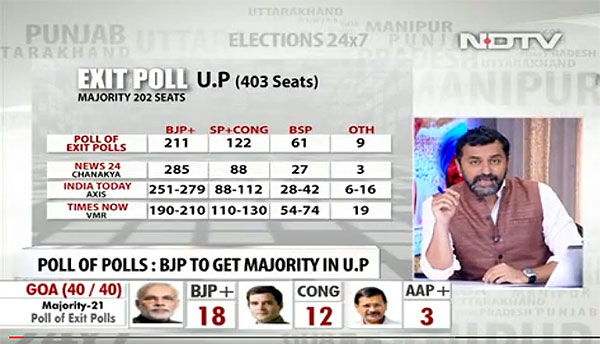
  • Shailesh Kapoor: Poll Of Polls: When Exit Polls become too many to handle

    By Shailesh Kapoor


    It’s the big election results day tomorrow (March 11), with counting and results in several states, including two that carry massive interest: UP and Punjab.


    Exit Poll predictions were released last evening across news channels. The last phase of UP elections ended on Wednesday, but since some bypolls were scheduled for Thursday, news channels had to wait that one extra day before releasing the Exit Poll findings.


    Exit Polls have become a bit of a mathematical maze in recent years. There are 8-10 different polls, co-branded with two entities – one a media house or a media brand, and second a research or psephology firm. The results can vary significantly at times, to the extent of comfortably changing the predicted winner. Some of these polls give a “range”, while others predict an exact number of seats (error margins may be documented, but no one cares about those details, as anyone in the forecasting business will tell you).


    The new entity in recent years that adds to the maze is one called the “Poll of Polls”. It’s a simple average of all available polls, taken to find a level that’s generally seen as acceptable, because it presumably reduces the overall error margin by leveling things up. That notion (that the error margin reduces via this method) may not exactly be true, but it’s a viewer-friendly thought nevertheless, riding on simplification a a central thought.


    About a decade ago, channels and newspapers fiercely protected their work, not wanting others to share their data, and not sharing theirs in return. But in recent times, this has changed, primarily because this multi-source approach hedges their bets. Some channels have had egg on their face in the past, because they stood by some numbers their Exit Poll predicted, only to be found way off the mark on the results day.


    So now, even if a channel has its own poll, they share that as one of the data sources. It may get considerable weightage and attention, because they will have better demographic cuts and detailing available inhouse. But the larger story is still projected based on the Poll of Polls. So, it’s routine to see names of competitive channels being spoken (and on the screen) on such days. Last evening, for example, ‘Times Now’ was very visible on NDTV 24X7.


    Some channels have stopped commissioning their own polls, well knowing that there will be enough and more available to bite into. In any case, the entire exercise, such as the one last evening, is laden with confusion. For example, while it is amply clear that BJP-SAD will struggle in Punjab, and may end up with single-digit seats, the polls just could not conclude who will win the state. And while most polls suggested BJP would be comfortably the single-largest party in UP, at least one gave a very different picture, putting SP in front.


    Politicians, of course, take a stance of acceptance or denial, depending on how the results suit them. Sometimes, they can take a stance of whole-hearted acceptance on one state and a stance of complete denial on another, within seconds of each other. Very few like Yogendra Yadav actually understand how it’s all done. “Expert” comments on Exit Polls are thus largely political rhetoric, devoid of any statistical or rational view on the data.


    Do we really need these polls with only a day-and-a-half for the results? Anything for a day’s viewership. And anything for some pre-election mood build-up.


    On a lighter note, I wonder what would happen if all channels decide to stop their own Exit Polls and rely on the Poll of Polls, which would then not exist to begin with?


  • Ranjona Banerji: Of what use are Exit Polls?

    By Ranjona Banerji


    Now it’s all about the fantastic universe of exit polls on TV. This is a great exercise in faith, belief, ritual and redemption which has nothing and everything to do with religion. It is likely that it has nothing to do with reality either. In any case, by tomorrow afternoon, that is March 11, we will know how the five states voted and the process of government formation will begin.


    This over-excitement about exit polls two days before results are announced is something of an exercise in futility. Much as it is true that today’s newspaper is tomorrow’s bhelpuri wrapping, it is also true that this morning’s TV noise is completely forgotten by the evening.


    The point of these exit polls, especially as they are now cabined, cribbed and confined by the Election Commission, is somewhat elusive. I understand they give employment to pollsters and I am all for employment. But for the media to get into such a tizzy over them, I am less understanding. It’s not just the varying success rate that raises questions but the need for them at all. A vote is a certain sort of a poll anyway so why a poll of a poll?


    **


    Meanwhile, I have a story idea for the media. I reckon that TV news will not be happy with this idea because it is not all rah-rah-government-gaga stuff but it does appear to represent the anger and frustration of some sections of the general public. The back story is that I put up a few tweets and some Facebook posts about the unfairness of the new cash withdrawal transaction fees imposed by private banks, the minimum balance penalty imposed by State Bank of India and the justification of this penalty because banks have been forced to open zero-balance Jan Dhan accounts. Above this, digital transactions will be taxed and mobile wallet company PayTM, endorsed and modelled for by the prime minister, has also announced additional charges.


    This means that since that disastrous demonetisation exercise, everything has become more expensive and troublesome for people who use the banking system. It’s not just me, several people have objected and there are a number of Whatsapp forwards doing the rounds too.


    I got a huge response to my tweets and posts, all of them angry, some funnily angry, some plain mad. My posts were shared by several people so I was forced to alter my privacy settings and make them public. Even those who normally register as “bhakts” were upset. The consensus is that the government cheated us and the banks are cashing in on it.


    Wouldn’t this make a fabulous TV debate?

    Sometimes I really make myself laugh. As if we’ll see our friends in TV reflecting the anger of the people. I can see all the anchors brushing up on new versions of “You have a point” and “Having said that” to justify the government’s position on its demonical schemes.


    **


    There is also a storm brewing over our Unique Identity scheme or Aadhaar. Much as the Supreme Court has insisted that the card is voluntary, the government is making it mandatory for more and more schemes. Including the absurd and heartless proposal – now halfway retracted – that children need an AadharCard if they want their mid-day meals from the government. And if one remembers correctly, the BJP declared that Aadhar was the worst invention since the nuclear bomb. O ya, we all love the nuclear bomb. Sorry.


    Any debates on this? Aren’t I funny this morning? There will always be something in Pakistan or a suspected terrorist killed to allow our TVwallahs to deflect and detract from the poor and other problems that plague the majority of India.


    **


    To get back to the beginning, I have kept track of all our various exit polls and their varying estimates and the long rope they have given themselves. I’m going to have fun on Tuesday, I can tell you that.


    Happy March 11 and Happy Holi!


  • Dealing with Death, the Life Insurance Way


    By Sanjeev Kotnala


    Death is the eternal truth. It is the only certainty in life. However, it is never a pleasant thought to engage in. No one really wants to discuss it. Insurance advertising has to balance the unpleasantness of this life event. In the process, insurance brands have used Saam (logic), Daam (price and not necessarily the cost of premium), Dand (penalty) and Bhed (Differentiation and doubt). They have used polarisation of Emotions and Expressions, Sad to not-so-sad (Happy), Fear to Hope, Guilt to Assurance, Love and Care, Unprepared to Certainties, Accidental to Pre-planned to varied level of Success.

    EMBED HDFC HIDE AND SEEK

    In the last few years, we have seen some remarkable positive shift in insurance brands connecting with the audience. Long-format storytelling in the digital world is the new flavour. Though keeping the audience with a lower attention span engaged is still a barrier that few have scaled successfully.

    Brands have tried moving away from the format of fear of unwarranted situation and tax savings to an emotional high of caring sensibilities. They have entered this area treading softly thus diluting the resistance of reference to death. However, the category cannot do away with the emotion of fear to jump-start the engines from time to time. A good example of it is the Max Life Insurance life ad (Sanju). My mom hated it and would change the channel because the protagonist shared my name.

    EMBED MAX LIFE INSURANCE AD SANJU.

    Rationality and logical sensibilities have been exploited to death. Brands know their limitation. They understand that consumer is not logical or rational but more of an emotional construct. Raising anxiety, dramatization of unpleasant scenario and Arousing tension before presenting the solution is no longer the code.

    There is another barrier. When it comes to the complex conditions and policy statement ( and unstated statements) few consumers can decipher the features and future on their own. Insurance agents are known to over sell features and non-relevant policies. Brands like Max Life Insurance (Aapke Sachche Advisor), SBI ( 10 questions) have tried addressing this issue.

    EMBED SBI 10 QUESTIONS

    To defuse the alienating effect of fear, it has been replaced with long-term benefits of insurance. It looked like someone watched the episode of ‘Mad Men’ in which Dan Draper outlines the appeal of fear as a tool for selling with chilling clarity. “Advertising is based on one thing: happiness,” he calmly tells his clients. “And do you know what happiness is? … It’s freedom from fear.” See the engaging SBI AD – Great Dad tackling this imagery.

    EMBED SBI LIFE

    I share with you the international ad by AVIVA. You see a family rushing for their vacation. You realise that the father is long dead, but all this is possible because of the insurance. The brand claims this helped encouraging families to think about taking out life insurance.

    EMBED AD PAUL WHITEHOUSE

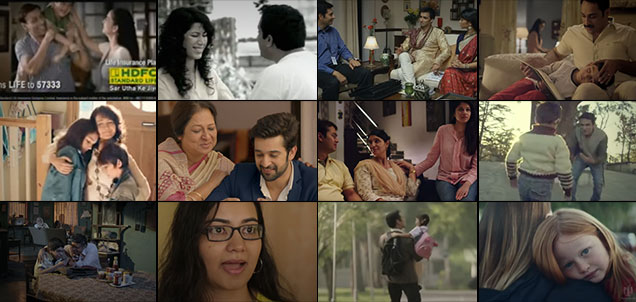
    Insurance brands have moved to the new level of understanding of their consumers. They have replaced the fear of ‘What If’ to a beautiful story of ‘That’s Why’, a far more positive statement connecting with the audience. One of the ads that did it well is the ‘Memories for life’ by HDFC.

    EMBED MEMORIES FOR LIFE

  • Time to show the door to Exit Polls?


    By Ranjona Banerji


    Uttar Pradesh

    Exit Polls

    Today’s Chanakya: BJP+ 285, SP Congress 88, BSP 27

    Times Now-VMR: BJP+ 190-210, SP-Congress 110-130, BSP 57-74

    India News-MRC: BJP+ 185, SP-Congress 120, BSP 90

    India Today-Axis: BJP+ 251-279, SP-Congress 88-112, BSP 28-42

    India TV-CVoter: BJP+ 155-167, SP-Congress 135-147, BSP 81-93

    ABP-Lokniti CSDS: BJP+ 164-176, SP-Congress 155-169, BSP 60-72

    Voters: BJP+ 325, SP-Congress 54, BSP 19


    Punjab

    Exit polls

    Today’s Chanakya: AAP 54, Congress 54, SAD-BJP 9

    India Today-Axis: AAP 42-51, Congress 62-71, SAD-BJP 4-7

    ABP-Lokniti CSDS: AAP 36-46, Congress 46-56, SAD-BJP 19-27

    India TV-CVoter: AAP 59-67, Congress 41-49, SAD-BJP 5-13

    Voters: AAP 22, Congress 77, SAD-BJP 18


    Uttarakhand

    Exit Polls

    Today’s Chanakya BJP 53, Congress 15

    India TV-CVoter BJP 29-35, Congress 29-35

    India Today-Axis BJP 46-53, Congress 12-21

    Voters: BJP 57, Congress 11


    Manipur

    Exit Polls

    India TV-CVoter: BJP 25-31, Congress 17-23

    NewsX-MRC: BJP 16-32, Congress 30-36

    Voters: BJP 21, Congress 28


    Goa

    Exit Polls

    India TV-CVoter: BJP 15-21, Congress 12-18, AAP 4

    NewsX-MRC BJP 15, Congress 10, AAP 7

    Voters: Congress 18, BJP 14, AAP 0


    Should one start by being kind? Scour through the exit polls to see who got it nearly right? Take UP. Everyone suggested that there was a surge for the BJP, especially from Phase 4 of voting onwards. In that sense, all the exit polls were correct. The BJP was the winner. But if one wanted a general idea of who was winning, why would you do an exit poll? The best that the exit polls gave the BJP in Uttar Pradesh was 285, from Today’s Chanakya. The Samajwadi Party and Congress alliance was not doing so badly according to the pollsters and apart from Today’s Chanakya, everyone else thought Mayawati and the BSP might come up with some decent numbers.


    The voters had other ideas altogether. In fact, the voters’ ideas were so different from the pollsters’ ideas that it is unfair to even say that Today’s Chanakya is the winner because it got it so wrong. Unless my arithmetic is very faulty, the BJP’s final tally beat Today’s Chanakya’s forecast by 40 seats. Mayawati and the BSP managed a pretty dismal tally of 19 seats and the Samajwadi Party and Congress could not do better than 54. That is, even Today’s Chanakya gave the BSP eight seats more than it would get and every exit poll gave the SP-Congress combine much more than the voters did. The lowest was Today’s Chanakya with 88 and minus 54 from that and you get it wrong by 34 seats.


    Don’t want to do it statewise because it’s so tedious? Take the AamAadmi Party’s seat-gathering ability then. According to our crystal ballgazers, Arvind Kejriwal’s push for a middle class, corruption-free India would win between 71 (CVoter, Punjab plus Goa) and 36 (ABP-Lokinit CSDS only Punjab) seats in two states. What did AAP win? A total of 22 seats in Punjab and zero in Goa.


    To say that there is a serious need for the media and for exit pollsters to relook at their methodology is a gross understatement. It may be better to admit that you have no idea what is going on that to get it so wrong. Many journalists one spoke to privately admitted just as much. In the end, even ground reports did not suggest the sort of victory that the BJP got in Uttar Pradesh and Uttarakhand. And while everyone was sure that the SAD-BJP alliance was going to lose Punjab, everyone also expected a bigger chunk of Punjab going to AAP.


    It is interesting, as an aside, to see how much our national media cares about India’s smaller states. Only two exit polls each were conducted for Manipur and Goa and it is as ever significant that both polls did not get it right.


    Today, after the results are out, hindsight has made us all wiser and some of us, illogically but egotistically, prescient. In fact, all that is rubbish. There is something going on in the Indian voters’ mind which is not being picked up by the media. You can choose between love for NarendraModi (UP and Uttarakhand but not Punjab, Goa and Manipur), joy over demonetisation, no joy over demonetisation, Hindu consolidation, the end of caste, the end of the Muslim vote, shoddy electronic voting machines and the arrival of new voters from Mars.


    Either editors in newsrooms do not listen to what their reporters tell them or reporters doctor their reports to fit in with newsroom ideas. Or, even worse and even more likely, few national newsrooms have enough people on the ground thanks to cost-cutting and the low value given to newsgathering by managements. That is why so many newsrooms houses rely so strongly on exit polls to do the work that they can no longer do. One cannot be certain that it is working. In fact, one can be perfectly sure that it is not.

    No?


  • Ranjona Banerji: Why no focus on BJP and government formation?

    By Ranjona Banerji


    The Indian media has shown an interesting turn after the election results of the five states were known. Just to recap, the Bharatiya Janata Party won emphatically in Uttar Pradesh and Uttarakhand. The Congress party won emphatically in Punjab. The Congress emerged as the single largest party in Manipur and Goa. The BJP and ShiromaniAkali Dal ran the Punjab government, so effectively, the BJP lost that state. The BJP was in power in Goa but could not win as many seats as the Congress.

    The Congress lost Uttarakhand in dramatic fashion – with the Chief Minister losing from two constituencies. The Congress was not in power in UP and has not been in power there for ages. The Congress was in power in Manipur.

    Now how does one interpret all this? If you are Indian television media and large swathes of Indian print media, your line of inquiry is clear. You immediately decide to work out whether the Congress party is dead or in need of life support and what Rahul Gandhi should do. It is as if, as a senior journalist pointed out to me, these people wanted the Congress to do better and are now looking for someone to blame because it didn’t!

    And yet, at all times, the focus of the media needs to be primarily on those who are in power. Therefore, the BJP in UP and Uttarakhand questions need to be asked on government formation. Therefore, the focus needs to be on the situations in Goa and Manipur where the BJP has quickly formed governments with rebels and other parties and without being the single largest party. The excuse trotted out by the BJP is that “the Congress did it first”. Is that a valid enough justification for the media?

    Take a look at the United States and Donald Trump. He is the president. He makes an accusation or a claim and the media take him up on it. The focus is not on Barack Obama and asking him whether he “wire-tapped” Trump or not. The implications are on Trump. Somehow, many of my colleagues are unable to understand the importance of examining government.

    To make it clear, I am not suggesting that opposition parties are not open to scrutiny. Of course they must be. But the larger focus of the media has to be on government. It has to be on the people in charge, at the Centre and in the states. And here the Indian media has been singularly amiss since 2014.

    Meanwhile, check for yourself how often we discuss Bastar and the Vyapam scam on national media. Compare that to how often we discuss Rahul Gandhi going abroad to bring his mother home from a health check-up.

    Just saying.


    **


    For one of the best and funniest media columns I have read for years, please read ShailajaBajpai’s take on the current election results, in the Indian Express. As she might put it, this is “yuuuuge”!:
    http://indianexpress.com/article/opinion/columns/telescope-dear-narendra-modi-from-donald-trump-tv-news-channel-india-shailaja-bajpai-column-4570684/


    **

    The Mumbai Press Club has extended the date of entries to the acclaimed RedInk Awards to March 31. Do go to www.mumbaipressclub.com for details and entry forms. And please send in your entries!