Category: COLUMNS

  • Jaideep Shergill: Diary of Odds and ends!

    By Jaideep Shergill


    I decided to have an occasional stab at compiling some oddities and such from the smorgasbord which is our world, the highlights and lowlifes of the world of media, marketing, PR and communication. So here goes:


    1. Fly in the ointment? Raghuram Rajan’s non-continuance, non-extension, exit or whatever else one would like to anoint this move as, has caused quite a storm especially since everyone in the media and some seem to know more about everything that happened (or didn’t) than even Mr Rajan himself. I loved what Rajan said to a leading newspaper recently- “I’m still here for two-and-half months in this job. After that I’m going to still be around somewhere in the world, probably a lot in India, so don’t write me off”


    2. Can Cannes?The winners’ list at the PR Lions has recently been announced at the ongoing Cannes Lions International Festival of Creativity. Indian agencies had pinned their hopes on this category on the back of the shortlist they had received, four in PR. Unfortunately, none of these shortlists converted to any metals. A total of 84 Lions were given away in PR.

    Serves the advertising firms right for masquerading under the PR category considering how little they respect and understand the PR business to start with.


    3. Storm in a tea cup: Nikesh Arora’s exit from SoftBank owing to the fact that Masayoshi Son choosing to hang around longer has caused a lot of stir in the business world and feeding frenzy has begun. A victim of retirement reversal, Nikesh is grabbing all the headlines this week. Once again everybody in the media always knows more than the people at the heart of the story. On a lighter note, Rahul Yadav (remember him, enfant terrible? aka The Housing.com boy) has been enjoying putting up fun posts about Nikesh Arora’s exit. Déjà vu?


    4. Feed Salman to Ramsay Bolton’s hounds: Salman Khan is still making news for all the wrong reasons and is also receiving lots of support for the shameful remarks he makes. We still have PR pros, celebrities and media moguls defending him. For god’s sake, can we get over with the celebrity hangover in our country? I loved what a friend posted on Facebook recently: At least we know its Salman tweeting since every tweet has at least one spelling mistake and another friend put this up: It’s reassuring to see every tweet in support of Salman Khan has at least one spelling error. Salman needs to be quickly fed to Ramsay Bolton’s hounds especially since their next meal isn’t so certain after the hounds just gobbled up Ramsay himself!


    5. “You’re in the great game now, and the great game is terrifying”- Continuing with the Game of Thrones narrative (minus Salman), what a great PR story this one has been and who would have thought so. Season after season, GOT continues to amaze and confound us with one of the greatest PR stories in recent history. Now, coming in at 69 minutes, the finale of the Game of Thrones’ sixth season will be the longest episode in series history, meaning there will be ample time for the show to both tie up loose ends and set the groundwork for next year’s premiere. Dubbed “The Winds of Winter,” Sunday’s installment will look to King’s Landing to see the outcome of both Cersei Lannister and Loras Tyrell’s trials — a storyline that many believe will come to a fiery conclusion.


    Jaideep Shergill, Co-Founder Pitchfork Partners Strategic Consulting LLP is a PR and communication veteran and has always been contrarian about most things, drawing extraordinary amounts of irk and ire from industry peers. He can be reached at jaideep.shergill@pitchforkpartners.com 


  • Jaideep Shergill: The Royal Scam

    By Jaideep Shergill


    I write this on the heels of an open letter which hit the internet about a leading ad firm scamming a metal at Cannes.


    The letter starts with these words: I’d like to start this post with a simple message. This is a personal one, not endorsed by anyone or organisation but me. That said, hear me and make no mistake: Grey Singapore and Grey Global – I will not entertain a pitch, submission or award from any one of you until you return that award that you falsely won for this travesty.


    Kudos to Alastair Bullock for calling out this scam. Grey did grudgingly return the Lion, calling it ‘unwarranted, unfair, unrelenting’ criticism.


    Scamming in the world of awards in our business isn’t new and has been long for as long as one can remember! Clearly there are more than enough firms and clients who partake in the cheap and gimmicky world of faking campaigns for the sake of metals. What really got to me though was the compunction with which these scams continue year after year with virtually no consequences for anybody. Shouldn’t there be rules around scam campaigns just like there are for everything else? Of course the fraternity was quick to jump to defend their fakeness. Many took to the internet to tell us all how only some rotten apples create scam campaigns while the rest are above board. Totally laughable actually!


    Another royal scam was pulled off by the PR Grand Prix winner, “The Organic Effect”a campaign for Co-op in Sweden, entered by Swedish ad agency Forsman & Bodenfors.


    The viral video campaign featured a Swedish family that switched to an organic, pesticide-free diet for two weeks, with urine samples taken before and after—showing a reduction of certain pesticide traces in their bodies. But the campaign which has been under a cloud of criticism for a while now because the company did not test for residues from the pesticides used in organic agriculture and just for those used in non-organic products.


    Kavin Senapathy, a writer for Forbes, has a great intro which starts with these words: I expose quackery and bust myths on health, food and science and Kavin had this to say in her piece:Most people don’t realize that organic agriculture uses pesticides too, albeit different ones. And the experiment didn’t test for pesticides used in organic agriculture.


    This is like assigning a group of people to drink screwdrivers (that’s OJ and vodka for our teetotalers), then having them swap the screwdrivers for rum and cola, and concluding that rum and cola drinks lead to zero vodka levels in the body.


    What’s also interesting is that this piece was run on Forbes before the Cannes winners were chosen. Clearly an oversight by the jury or is it just a case of turning a blind eye?


    We need many more Alastairs’ and Kavins’ if we need to call out these scams. God bless her and may their tribe increase!


    Of course these are only a couple of examples which caught my attention but we would fill volumes with scam campaigns across the world of marketing and communication if one really wanted to.


    In all of this, the vast majority of the fraternity enjoyed themselves at Cannes and will do so again next year. I can only tell you one thing, Kavin Senapathy, the folks at Cannes were certainly not on a diet of virgin screwdrivers or any other mock drinks. In fact, they were and will continue to be high and the scamming will live on. The mad rush to be a leader at any cost and live in a world of false glory in our industry only illustrates one thick skinned trait which is best described in the intellectually uncurious words of Alfred E. Neuman- What, me worry?!!


    Jaideep Shergill, Co-Founder, Pitchfork Partners Strategic Consulting LLP is a PR and communications veteran and has always been contrarian about most things, drawing extraordinary amounts of irk and ire from industry peers. He can be reached on jaideep.shergill@pitchforkpartners.com


  • Jaideep Shergill: What makes the journalist-PR professional relationship so nebulous

    By Jaideep Shergill


    One of the most baffling relationships I have encountered in my work life is clearly the one enjoyed by the “Fourth Estate” and members of the PR/ Communications fraternity. It has always been a nebulous relationship to say the least. One hears only “whispers “in corridors and it is one of those classically closeted relationships.


    Having said this, we also know there is a level of symbiosis and mutual gain in this relationship. While the relative number of trustworthy and reliable PR pros may have dwindled in recent years, I assure you that time- and information-strapped reporters still appreciate the value offered by responsive PR folks who “get it”.


    We’ve long since entered an age when every company and every individual can be a media outlet with the capacity to create and syndicate content. At the same time, nimble media upstarts have mastered the art of headline histrionics. In so doing, they have siphoned off a growing share of the public’s ever-divided attention spans from legacy media, which today are struggling to retain the influence they historically have enjoyed.


    There are a number of reasons fueling the growing acrimony between the two professions, or at least the short fuses journalists have for many PR consultants:

    1. The ratio of PR people to journalists is skewed heavily in favour of the former group, resulting in email inbox overload and phone calls, texts and WhatsApp messages.

    2. New data-driven service providers let PR pros automate the media relations process, producing greater volumes of misguided or inane story pitches.

    3. Journalists have many other sources for story ideas, including those they follow in real-time on the social media.

    4. Journalists are asked to produce more, often in different mediums. Hence, they’re under tremendous pressure and have less tolerance for story pitches.

    5. Media relations is pushed to junior staffers at many big agencies — and inhouse communications departments — with relatively little supervision or mentoring.


    Coming specifically to India, the “state of love and trust” between the two groups leave a lot be desired from both sides.


    Here is how it plays out every day…


    PR person to journalist:

    In spite of the overwhelming number of pitches landing in your inbox, please at least reply, especially if the story idea is editorially valid.  We just seek closure, good or bad.


    Journalist to PR person:

    Take the time to learn and understand what exactly you are pitching. Be able to answer basic questions about your client’s business.


    PR person to Journalist:

    If the pitch is not in your specific coverage area, but still viable, please consider forwarding to an appropriate colleague.


    Journalist to PR person:

    Think twice about sending the same story pitch to multiple reporters, and again, know what each and every person on the receiving end covers.


    PR person to Journalist:

    Just as you have a job to do, so do we.


    And so on and so forth. I am sure you get the drift by now!


    Isn’t it time we played well especially since we are in the same sandbox whether we like it or not?


    It does seem that we are doomed to have an endless debate about the relationship between journalists and PR professionals. The fact is that we have a mutually dependent relationship. The press cannot do its job without PR and PR needs the press.


    It is time that the representatives of both the press and the PR industry has a serious discussion about the rules of engagement. It is not good for society that the critical faculties of the press are being blunted. Neither is it good that the genuine contribution of PR to the public agenda goes unrecognised. There is a mutual responsibility for a respectful distance to be kept between both professions and an equal responsibility for both to act respectfully towards the other, and that means honesty and integrity must prevail if society is to be served.


    Jaideep Shergill, Co-Founder Pitchfork Partners Strategic Consulting LLP is a PR and communication veteran and has always been contrarian about most things, drawing extraordinary amounts of irk and ire from industry peers. He can be reached on jaideep.shergill@pitchforkpartners.com. The Devil’s Advocate appears every Monday.


  • Prema Sagar on Harold Burson@96: Harold has been and is our Idol

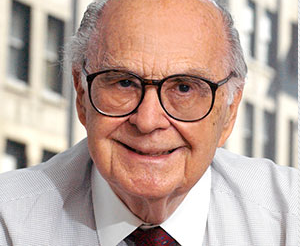
    Harold Burson. Picture courtesy www.burson-marsteller.com


    Special to MxMIndia: Prema Sagar, Founder of Genesis Burson-Marsteller and Vice Chair, Burson Marsteller Asia Pacific writes on Harold Burson, Founding Chairman of Burson-Marsteller, as he turns 96 today (Feb 16)


    By Prema Sagar

    People variously describe him as the godfather of public relations, the grandmaster of PR, “the century’s most influential PR figure”, “an industry icon”, and so on. He is all that, of course. But for me, even if you forget about all the professional achievements, Harold is an inspiring man with boundless energy—a personal idol. Every time I feel tired or overwhelmed by everything around me, I just have to remind myself that here is a 96-year-young man who goes to work every day. Clients still turn to Harold for counsel even in the age of dizzying changes in communication. Who is an active member of the community, chairing various social development bodies and initiatives? Who remembers every person he comes across and doesn’t hesitate to learn from anyone?

    I first met Harold way back in the first couple of years of the new millennium. He was already past the usual ‘retirement age’. We were in talks with Burson-Marsteller over an issue that a joint venture between an Indian and an American firm had. We were managing the Indian firm, while Burson-Marsteller was managing the American firm. As we worked together, we realised that nine of our clients were part of their Top 20 list of clients! I also realised that our way of working, and most importantly, our work ethos, were very similar.

    It all stemmed from Harold’s own work ethic. That’s when I knew that we wanted to partner with them for longer than just the immediate issue. I went to the US and met Harold for the first time. He just said one thing: “We need to do business together to be partners, not just have a partnership.” His clarity of thought, passion for what he does, and exuberant warmth had me in his thrall in no time. Bill Rylance, former CEO, Burson-Marsteller Asia Pacific charmed us in partnering with an exclusive affiliation and over time realised that the partnership was working well. And then we decided to go ahead with being part of Burson-Marsteller.

    Every year since then, I meet Harold as often as I can. I see the energy in him only increase further. I spent many hours with him recently in New York and I continue to feel blessed with his simple yet impactful thoughts.  His ability to cut through the clutter and arrive at the heart of the matter quickly—and politely—is something I admire a lot. And that sharpness has not dimmed a bit over the years.


    Prema Sagar


    One of the leading lights of the Indian public relations and communications industry, Prema Sagar is Vice Chair, Burson Marsteller Asia Pacific & Founder, Genesis Burson Marsteller


    Also watch: Prema Sagar on ‘When Genesis PR met Burson-Marsteller’


  • Is Hire & Fire the new normal in traditional news media?


    ‘Heartless and shameful’ 

    By Ranjona Banerji


    One thing that we do not talk enough about is the treatment of journalists and media employees by managements. It can be argued that the reason is obvious – people are scared for their own jobs. Certainly, that is a factor. But what does it make of us, who expose the wrongdoings of others and various injustices in the world, if we live by the Mafia’s omerta code when it comes to ourselves?

    It makes us hypocrites and cowards.

    A letter by Biswajit Roy, put up by the website PGurus.com, outlines in great detail the suffering inflicted on staff by the Ananda Bazaar Patrika Group – over 700 have been summararily dismissed as part of some downsizing programme. The act itself is one thing but the manner in which this was done was both heartless and shameful.

    Says Roy: “The ABP management did not allow me to write my resignation letter but got me signed on a one line format that had no mention of the company’s current culling of its workforce. Instead, it pretended that I left out of my free will. Neither had I received a written assurance on the details of the ‘special package’ and statutory dues when I had to sign another format about payments. One of editorial bosses countersigned the latter as I asked for a promissory note from the management. My HR handler told that the company would not commit formally to an individual (even if the job contract was between the company and me as individual) but no reason was offered. I had to insist for the photocopies of the two papers. The pressure on me to put in my resignation at the earliest was aimed at accomplishing the management’s mission by this month.

    Although I would be released on March 1, my access to the office computer system was deactivated even before I tendered my resignation. It was meant to make me feel completely unwanted.

    Also I was asked to surrender my entry swipe card. The arm-twisting tactics was evident as I was told that the processing of my dues would not begin unless I comply with. I became an outsider effectively on the very day. Now I would have to call or meet HR/accounts or editorial nodal men and meet them at the reception, if they want, to get my dues cleared. So I am at the mercy of the management to receive the fruits of its benevolence after serving the house for20 plus years.

    I am told to trust the company which did not think twice before humiliating and firing 700 odd men and women in the name of financial crisis but never bother to explain or discuss with the staffs on ways to overcome it. It did not bother to offer us an honorable exit or an amicable separation except a unilateral but informal assurance of a soothing package. Instead, a piece of paper handed over to the victims revealed the Orwellian absurdity of the world of ABP’s HR mandarins. It offered us help from career counselors, psychiatrists and tax consultants except an audience with the top guns or some exchange of parting messages, not even the corporate niceties like the exit interviews.”

    Some media commentators feel that four months’ severance pay is “generous”. This is being unnecessarily kind if nothing else. They believe the promise that the ABP offering to give senior staff who have been with the group for over 20 years their basic salary for life is sufficient. I feel it is fair to remain sceptical. All it takes is one swaggering new CEO to change that offer. Also, Roy’s letter belies that claim. The small print – something that journalists are no good at when it comes to employment contracts – needs to be read clearly. Further, no matter how media salaries have increased recently, print does not compare to television and journalists are still worse paid than managers. The humiliation heaped on long-time ABP staffers is clear in Roy’s letter.

    ~~

    The Times of India has expressed its own case in print – that demonetisation has hurt the industry badly. But it has held firm so far. The Hindustan Times however has been like the ABP Group – mass sackings, closing of bureaus and editions across India. However, in Mumbai at least, journalists’ unions have made their anger clear. Public protests have been held and a memorandum sent to ShobhnaBhartiya, owner of HT Media.

    Some sections read:

    1. It is clear that you have decided to close down these editions in other to avoid the implementation of the Supreme Court order and the Majithia Wage Board award.
    2. Your action led to untold misery and disrupted the lives of scores of employees, besides leading to the tragic and untimely death of a senior staffer of Hindustan Times — soon after his illegal termination by the company. Your callousness and cynical apathy only shows how much you are only concerned with the maximisation of profits.
    3. We do not accept your excuse that demonetisation has forced you to take this step because, although it is only a three month old process, you have evaded the process of implementation for more than three years.

    The JAC demanded the restoration of editions with reinstatement of all employees and implement the Majithia Wage Board Award in toto, thereby maintaining the spirit and letter of the Supreme Court verdict in this regard.”

    The crux of the matter remains the old, well-known media management ploy: cut down on journalists and try to run a newspaper with trainees and a few overpaid high-level toadies. We all know what rubbish will emerge out of that plan. Besides, when a trainee journalists earns Rs 15,000 a month and you think that’s a lot, remember the fat, bloated useless CEO who earns in crores and sits with accountants to cut costs. One newspaper I worked in had a man from the oil industry as CEO. What he understood about the media could be written on an old-style bus ticket.

    And then there’s demonetisation. We should think a bit before we toe the government’s bogus line on this one. Most of India and our fellow journalists and media staff are being burned by it. If we care, that is.


    Ranjona Banerji is a senior journalist and columnist, former editor and Consulting Editor with MxMIndia since 2011. The views here are her own


    ‘Time we smell the coffee’ 

    By Pradyuman Maheshwari


    Ask any one outside of the traditional news media in this country, and you’ll be told that the process of hire-and-fire is nothing unusual. Gone are the days of government organisations and large business groups offering you the luxury of planning your post-retirement holiday on the day of joining.

    There are cases of even a group like the Tatas showing the pink slip to people where and when it’s needed. I know of at least one newspaper CEO’s exit announcement dished out to him and the rest of the organisation on his birthday.

    For long, journalists have been subjected to a work environment that’s privileged. And as I am out of the system now,  I can say that the privilege wasn’t based on much logic.

    The only comfort that journalists had was – as it may still exist in some business empires, is that there is no way in which you could be sacked. But managements found ways to deal with the lot who were governed by the wage boards and didn’t want to switch to the contractual system. Their access to the paper – the very reason for working as journalists – was stopped and at least one large newspaper group ensured that they were near-shamed in full view of colleagues who accepted the management line.

    But are newspaper groups who believe in hire-and-fire regime cruel and indulging in unethical and illegal practices? On the legalities, one would think a lot would depend on what the contracts spell out for each employee, but otherwise one needs to accept this: that while the term of the contract is good to have on a piece of paper – stamped or otherwise, the maximum duration of any employment is effectively the notice period that exists from either side. So if my contract is for three years with a 30- or 90-day notice period, then the notice period is my minimum term of employment. And my services can be dispensed with just a 30- or 90-day notice and since I am a signatory to the contract – on stamped or unstamped paper, I can do sweet nothing if my employer terminates the contract. Hence one could well say that my employment is not of three years, but 30 or 90 days.

    The problem in the news media is a little different, especially in newspaper companies. Employee remuneration is pathetic in many publications but journalists are happy to take up employment despite the abysmally low salaries. Also, many newspaper companies are run more on emotions and intangibles than business arithmetic and scientific forecasting. For instance, if Reporter X gets Rs 30k in Mumbai, it’s possible that s/he will get just Rs 12k in a Tier 3 city. And lower in a Tier 4 city. Many newspapers continue to run editions in centres despite losses. I can understand that if the edition is of strategic importance, but more importantly these things work purely on the whim of a senior business or editorial executive or the owners.

    What’s more while progressive employers always think twice before processing the sack, many in the news media aren’t worried about their reputation. They know despite having a bad HR record, prospective employees will happily accept all the s**t they are subjected to.

    Unless we have a fair number of journalists who refuse employment in organisations which have treated their tribe unfairly, employers will do whatever they feel like.

    But newspaper employees – journalists especially – need to be ready for a hire-and-fire regime in their place of work.

    Demonetisation or the impact of it has hit all media as it has most business sectors, but that’s not enough reason for businesses to be shut or people to be sacked. Some rationalisation is fine, but the process is only to make these organisations leaner, with healthier financial books. And if any employer can’t take six months of financial stress, it mustn’t be in business.

    The wage board is something newspaper owners need to live with thanks to the excesses of some of their tribe in the past. If drivers are getting paid 60k when all that they deserve is 15, then it’s out of a logic that is rooted in the underpayment of employees by newspaper groups, especially outside of the metros.

    Clearly, if our news media wants the benefit of receiving the largesse from government in the form of DAVP advertising, then it will need to toe the government line to some extent… so the wage board recommendations can’t be wished away.

    All in all, the rules of business in newspapers has changed. It’s sad that someone from a progressive publishing group like ABP has reasons to feel aggrieved. But that’s the way modern business is run. Haven’t we haven’t heard of stories where financial institution employees were taken out by lunch by their bosses and on their return after the news was broken to them, the contents of their drawers and laptops were just handed out to them. The sack intimations handed out to dotcom employees in 2000-01 were similar. Did anyone shed a tear for them?

    Perhaps they did. But that’s sadly the way many businesses are. And journalists can no longer be insulated from this new normal.


    Pradyuman Maheshwari is a senior journalist and academic. Although he is Editor-in-Chief with MxMIndia, the views expressed here are his own and not necessarily that of the website.


  • What is the real size of Indian Ad Industry?


    By Indrani Sen

    Last week was exciting for the advertising and media industry as the two major reports on industry Adex were released on two consecutive days. GroupM released its ‘This Year Next Year’(TYNY) 2017 report on February 14 followed by the release of ‘Pitch Madison Advertising Report’(PMAR) 2017 by Madison on February 15. In the last few days, both the reports have been published and analysed in the business newspapers and websites, leaving hardly any scope for adding any comment on the same.

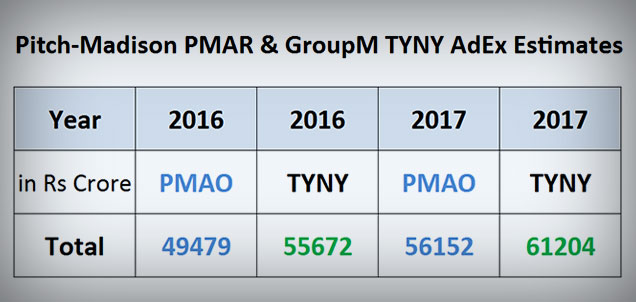
    As usual there is a difference between the two projections, this time it is of around Rs 5000 crore. The biannual report on advertising expenditure TYNY 2017 has forecast India’s advertising investment to reach an estimated Rs 61,204 crore in 2017 based on a growth rate of 10% over 2016. On the other hand, PMAR 2017 has projected a growth of 13.5% in 2017 over 2016 and has estimated the size of the industry to reach Rs 56,152 crore.

    According to Sam Balsara, AdEx dropped by Rs 1650 crore in the last two months of 2016 after demonetisation and as a result, the industry adspends narrowly missed the mark of crossing Rs 50,000 crore. On the other hand, the GroupM report, Indian advertising industry clocked Rs 49,758 crore in 2015 and crossed the Rs 50,000 crore mark comfortably in 2016 by scoring Rs 55,671 crores. Madison estimated Indian adspends as Rs 43,991 crores in 2015, Rs 49,480 in 2016 and has projected Rs 56,152 crore in 2017. The difference, between the two sets of estimates, has been hovering between Rs 5000 to Rs 6000 crore, which is not a small amount.

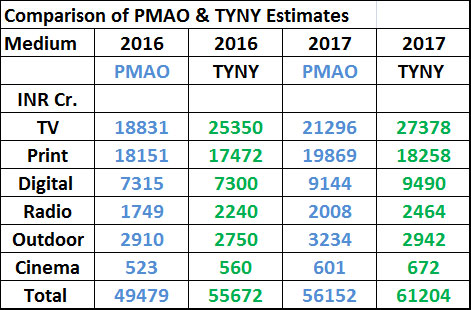
    If we compare the two sets of estimates by medium, we find that the major difference lies in the estimates of TV advertising expenditure, which is bit surprising as TV AdEx is very well-documented. Is there a difference in the way the two estimates are drawn up which leads to a gap of almost Rs 6000 crores between the estimated TV advertising expenditures?


    PMAR has shown more favourable estimates for Print and Outdoor than TYNY, while TYNY estimates for Radio and Cinema are higher than the estimates of PMAO. It is interesting to note that for Digital medium, the two estimates ran neck-and-neck for 2016 and are quite close for 2017.

    GroupM Report mentions that Media Adex reported do not include:

    • TV – special inventory like astons, L-bands, tickers, etc
    • Print – tender notices, appointments, classifieds/ matrimonial
    • Radio – activation spends
    • Digital – ad spends by SME segment
    • Outdoor – wall painting

    The above leads us to conclude that the numbers shown in the TYNY for the above five media would be actually higher than their estimations, particularly for Radio, where activation/ events tied up with digital has become a major source of earning for the FM radio stations.

    The Pitch Madison Advertising Report does not mention about the ad expenditures which are not covered in the report, but we can assume that Madison also has not covered the above expenditures which are not included in Media AdEx in their report.

    So, what is the real size of the Indian Ad Industry? Are we yet to cross the Rs 50,000 crore mark or did we cross it last year?


    Indrani Sen is a media services veteran, having worked with JWT, later Mindshare and then with Emami. In recent years, she is an independent consultant and academic. She is Adjunct Professor incharge of the Media Management programme at the Symbiosis Institute of Media & Communication, Pune. The views expressed here are her own.


  • Ranjona Banerji: Criticise and be damned!

    By Ranjona Banerji


    Carl Bernstein, one of the world’s most admired journalists, thinks that US President Donald Trump is dangerous to democracy and needs to be taken seriously. One cannot but help continue to compare most of the American media’s response to Trump’s lies, threats and controversial actions with the Indian media’s response to our own politicians. Again and again, the essence of our democracy lies exposed. Not in its functioning but in our understanding of it.


    Yes, there are toadies in the extended American media, which is not completely peopled by journalists, who feel that Trump should be respected by dint of being President but not by his words or actions. In India, that is the position of the mainstream media, especially television, when it comes to politicians in power. If you criticise a leader in India, it could be blasphemy, it could be lack of respect for the people’s wishes, it could be lack of respect for the chair or any other such absurd allegation.


    We are also, as Indian journalists, supposed to ignore comments made by politicians, who are elected and hold public office, during election campaigns. Apparently, anything you say during an election campaign is fine, regardless of whether it is outright lies, socially divisive, indecent or idiotic. When a Prime Minister becomes an election campaigner he is, by this twisted logic, no longer a Prime Minister.


    That some people in the media actually buy into this complete nonsense is even more shameful, especially in comparison with what is happening with the US media and Trump. Luckily in India, print and web journalists largely conform to the rules of journalism and do not consider these excuses valid. Unfortunately, comment pieces are the last read when it comes to any news outlet. And there is an additional divide in India – apart from the many we already have – between those who read “thought pieces” and those who believe the blabber they hear on television.


    And again, there is the desperate search by a pro-Modi media for equivalence, on the pretext of being “objective”. So UP chief minister Akhilesh Yadav’s comment to film star Amitabh Bachchan that he should not advertise for the “donkeys of Gujarat” is apparently the same as the Prime Minister of India stating that in UP, Muslims get more electricity for RamzanEid than Hindus get for Diwali.


    Yadav’s remark is a dig, no question about that. You can decide on whether it is funny or in bad taste. But Modi’s statement (which is uncorroborated) is a direct divisive attack — it is the Prime Minister of India using a sectarian argument to get votes. He has done it several times as Chief Minister of Gujarat and done well by it within his constituency.


    But the problem remains the attitude of the media. Bernstein’s observations on Trump could well hold true about Modi. We still have no clarity on the “benefits” of demonetisation and Modi’s rather incredible remarks that he needs “protection” from the people because of his glorious demonetisation efforts have gone largely unremarked in the media.


    It remains heartening of course that our most patriotic English news channels – namely Times Now, India Today and NewsX – continue to make their quick sidestep to Pakistan when they want to pretend that Modi is perfect. Right now, they are all defending Pakistani-Canadian commentator Tarek Fatah’s right to freedom of expression.


    Good on them, eh? I just wish they would display some larger understanding of their own right to freedom of expression.


    Last notes:

    The Hindu’s latest refurbishment looks impressive but needs further observation before comment. And with Sanjiv Goenka apparently buying the ABP Group, one hopes that its iconic publications will not lose their journalistic edge, even as they have discarded their staff.


  • 8 Filters to Evaluate Cause-Driven Brand Initiatives


    By Sanjeev Kotnala


    I woke up recently to a tweet that introduced me to the latest ad in the ‘Jaago Re’ series. I loved it. Here was a brand that has found relevant cause and could rejuvenate it frequently. On the same day, I read the probing blog by Lakshmipathy Bhat, ‘Cause – driven advertising: does it help in brand building?’ At the same time, there was another blog by Deepali Nair, with an alternate point of view at ‘Advertising that creates new paradigms’.

    However, let’s look at what is happening and why is suddenly a there a spurt of cause-related communication for brands.

    Advertising is a tool that the brands use to create a positive preference and alignment in the consumer mind. It is expected to reflect in sales impact and market shares.

    Earlier, a brand used gets into this track of thinking when it is forced to take the stance or wanted to influence certain powers to be or has already moved up the ladder of directly related logical/ regional/functional differentiation. Then it did not matter what was the format used how it was expressed.

    Today, a mega-trend has been identified. In the era of information parity and heightened social activism, brands have identified that the consumer still remains gullible to this weapon armed with long format digital amplification… the cause-based advertising.

    They strongly believe that the so-called over-researched, and the least understood millennial consumer is inclined towards brands that stand for the cause/ movement or activism.

    Hence when Bhat gets irritated with the Mirinda ‘release the pressure’ TVC, one understands. As a part of this article, you can view many such cause-driven communications of the brands like Miranda, CaratLane, P&G, Anouk , NIKE, Dainik Bhaskar, Times Of India, Tata Tea and Dove, and make your own reading of the subject.

    All such communications have a commercial role. They have above all a role for creating brand preference. Few of them have even moved beyond the simple task of brand salience and preference to becoming a real movement where the brands are just a support.

    In the process, the brands have overlooked and failed to take care of Eight filters. Scanning your brand proposition, cause or initiative through these can help you rightly leverage and create the brand impact you want.


    RELEVANCE. LINKAGE. UNIQUENESS. ASSOCIATION. TIME. REJUVENATION. BUDGET. And MANAGEMENT ALIGNMENT


    A case in point is Tata Tea – Alarm Bajne Se Pehle Jaago Re! You give it credit and listen in rapt attention.

    EMBED TATA TEA

    This communication by Tata Tea pass all the eight filters listed below.

    RELEVANCE. Is it relevant to the primary target audience and the wider segment? Is it something that bothers them? Do they think about it? Is that latent or it is subtle? Will a small push overtake the inertia holding it back?

    BRAND LINKAGE. What is the level of association that brand can have to create with the cause? How is the cause relevant to the brand functionality and emotional linkages with the audience it is trying to influence?

    UNIQUENESS. Is it something that is widely accepted as a category cause? Is t something that is obvious and anyway expected? Can the brand can take it up and own it?

    DEEP ASSOCIATION. Is it going to be just a lip-service? Are you getting deep and working across formats and across its tentacles? Have other media been integrated to amplify the proposition? Are you really willing to start a mission? Are you supporting it at the ground level?

    LONG TERM. Is this a cause that you have taken for this sales season? Will you come for the three to six months and then start to search for a cause that can give you the new high? Do you see this remaining relevant and strong pillar for the brand for years to come? How long does the brand plans to remain married and committed to the cause?

    REPEATED REJUVENATION. And here is why I believe that the Tata Tea thought of Jagatey Raho simply outscores all. Anouk does not commit to anything specific, and the audience knows about it. They are transparently willing to take up multiple causes and move on.

    BUDGET AVAILABILITY. Are there enough funds allotted to the programme to reach its ultimate goal?

    MANAGEMENT ALIGNMENT. Is the management completely in sync with the cause? Can it be a reflection of the philosophy rather than remaining at the level of brand initiative?

    Once again, while the cause-related advertising and communication seem tempting for a brand to take on, it will be critical to evaluate against RELEVANCE, LINKAGE, UNIQUENESS, ASSOCIATION, TIME, REJUVENATION, BUDGET And MANAGEMENT ALIGNMENT.

    …………………….


    The Mirinda ad lacks the synergy or association.

    MIRINDA


    CaratLane communication that walks the tight rope and talks of spreading love and care beyond romance at Valentine, one challenges the thought.

    CARATLANE


    Look at the P&G ad for its sanitary napkin brand that won the Cannes Glass Lion. It remained a communication that was appreciated but to general public, it never got amplified to a level of a real fight against the taboo. Though it may be doing a lot in the area and taking the thought forward, but when the audience which has been exposed to this insightful communication is not kept in the loop with the development, they are bound to see it as tactical.

    P&G


    Or Anouk which takes up various subjects for its communication. I am not sure, how the consumer sees it. And if it makes sense?

    AUNOK 1
    or


    ANOUK 2


    There is the powerful thought ZID KARO DUNIYA BADLO by Dainik Bhaskar that has seen different avatar at various points of time. It is something that fits the brand and the category, and the brand can maximise the leverage. Unfortunately, it is tactical and lacks consistency.

    ZKDB


    Sports brand Nike music video raised its voice and went silent. I am not sure, if it is a utilized or missed opportunity for the brand. The consumer does not appreciate opportunist leveraging of a cause.

    NIKE


    And on the other side, a powerful ‘Teach India’ ad is going from strength to strength. It is a movement in itself but somewhere the amplification within the readers is missing at present. Maybe it is a way in which the brand wants to operate in.

    TEACH INDIA


    The Dove campaigns for Real Beauty challenges the trend.

    DOVE

  • Ranjona Banerji: In Trumpland: Disagree and get banned!

    By Ranjona Banerji


    Fake news is the enemy of the people declares US president Donald Trump and promptly bars such well-known fake news outlets like the BBC, CNN, The Guardian, New York Times, Daily Mail from White House press briefings. However, the world’s most respected, fair, unbiased outlets like Breitbart News are of course top of the invitation list.

    This is not a joke. This is a bizarre scene being played out in the world’s most respected democracy. Trump does not like anyone who disagrees with him or indeed anyone who does not like him. Trump is not shy or wary of letting everyone know how he feels. Trump is, you may argue, without guile – he tells it like he sees it. Or, you may argue, he is like a spoilt child who is not used to be being denied what he wants or what he thinks he should get.

    America is fighting back. People, the media and the American system understand rights and responsibilities and what it means to lose them. Many are not afraid to make their voices heard. After the White House ban, many other news outlets simply boycotted the White House press briefing.

    Dean Baquet, executive editor of the New York Times said, “…nothing like this has ever happened at the White House in our long history of covering multiple administrations of different parties.”

    Lee Glendenning, editor of Guardian US, said, “This is a deeply troubling and divisive act. Holding power to account is an essential part of the democratic process, and that’s exactly what the Guardian will continue to do.”

    The White House Correspondents Association was “protesting strongly”, said its president Jeff Mason.

    Do you want to take a look at how we deal with this here in India? How easily we capitulate? How we justify giving in by saying there is no other way to get access? Although few administrations act like Trump’s – which seems to have based itself on Communist or Soviet models – it is open knowledge that the administration at the Centre in India, for instance, does not like to share information. And that is true of several states as well.

    Outlets which suck up get more access to those in power. And that is often all that matters to some journalists and their owners. The owners can have multiple business interests and that means that they need to keep on the sweet side of politicians in power. Nothing corrupts the smooth progress of journalism more than this. And the situation does not need to be made worse by careerists and opportunists who are willing to toe any management or government line just to get ahead.

    I repeat these points again and again because what we’re doing is killing journalism in India with this sort of attitude. If that sounds dramatic, I can amend it to suffocating journalism. Yes, there are news outlets which do not succumb, which continue to hold governments to account. Almost none of those news outlets, one might remind oneself, operate in the sphere of television.

    Yes, there are occasional news anchors and to be fair many more reporters in television, who stick to the accepted norms of journalism. But they are few and far between and usually get lost in the loud screaming melee of establishment stooges.


    **

    In some good news then, I am much enjoying Sarah Jacob’s version of the popular NDTV show, We the People. She is straightforward and refreshingly non-dramatic and does not appear to fall into the trap of false equivalences of allowing bigotry and prejudice to take advantage of freedom of speech.

    I now want to scream when I hear some TV anchor say “You have a point” when someone sets forth a polluted agenda, because the anchor is pretending to be “objective”.

    Get the point?


  • Sanjeev Kotnala: Is Scarecrow consciously trying to be different?

    By Sanjeev Kotnala


    I personally loved the new Rasna film Pyarelal Ka Bachpan Ka Pyar by Scarecrow. It was a bit of pleasant surprise. It is a classic case of the brand willing to refocus its lenses and to experiment. It is about a long journey and not necessarily just a drink that children love. Yes, there are people who raise their eyebrow and voice their dislike for the film.

    If you look through their portfolio of work, it does lead to an important question: Is Scarecrow trying too hard to redefine communication? Is it right for the brand and the audiences they want to engage? There are no straight answers.

    Rasna, is the world’s largest manufacturer of instant fruit based concentrate. It’s the leader within a very narrowly defined powdered drink segment with more than 85% share. It is still maintaining its costs per glass at just Rs 2 per glass!

    It is not only Rasna, where this young Scarecrow has been creating ripples with its approach. I don’t think their work ever goes unnoticed within the fraternity and the consumer.

    The Rasna new film was launched with a trailer in the digital world, and it raised curiosity.


    Manish Bhatt of Scarecrow defends his work stating: “Every Summer Season, Rasna does product attribute-led campaign. This year we have gone ahead with emotional over-arching campaign with the message ‘Spreading Love For Generations “. Like Coke occupies happiness, Honda occupies dreams and Volvo occupies safety, Rasna has always occupied the emotional space of spreading love in the consumers’ lives. With this year’s Campaign  ‘Pyarelal Ke Bachpan Ka Pyar’. We wish to summarise what Rasna stands for over the years.”

    RASNA TRAILER.


    They have won most of their metal in the Radio category. Manish Bhat empathises that it was a strategic call by the agency. They have been the radio kings. On the other side, they have been doing some fairly interesting work in the digital engagement and traditional media space. Viral experts, is the other tag that they have earned with their approach to digital exposure and engagement.

    It seems they hate being in the safe territory. It’s heartening to note that their clients share their conviction and show their confidence in them. I presume that their internal discussion starts with a simple question. So, what can we do differently?

    Fortunately, they have more hits than misses. It is worth complementing and appreciating this eagerness to do differentiating work.

    Rasna was a hyper-craze in late 1980s and early ’90s. The cute loved model Ankita Jhaveri ruled everyone’s heart. The category was booming. The tastes and formats have evolved. It made the task of engaging and remaining rejuvenated that more difficult. At this stage, this slow burner, lovely ‘Bachpan Ka Pyar’ tries to rekindle the charm and celebrate 120 billions of Rasna glasses consumed through the decades. Thanks, Rasna and Scarecrow, for not creating a chest-thumping 120 billion glasses numeric shouting irrelevant communication.

    Manish Bhatt further says: “Only 30% of Rasna demands comes from children. For the people who has been brought up consuming and loving this brand since childhood – it refreshes the memory, puts them into nostalgia, and gives them a reason to love the brand all over again. It is that ecstatic emotion of celebrating 40th wedding anniversary with the brand you always loved since childhood and married happily”.

    If that is the case, would you agree that the strategic direction seems right? I need not to add that Ram Seth ( Pyarelal) and Daisy Irani have not left any efforts to make the brand celebrate.

    RASNA FILM


    The new TVC is retro in its feel. However, it completes the loop with a quirky twist, it just about avoids becoming out-dated for the new generation. Rasna as a brand is planning a double-digit growth and further expansion of the product portfolio. For which, they will have to punch over their media weights.

    Now let me present some of the work, which demonstrates Scarecrow’s approach to work.

    No, I have not seen this one earlier. The TVC titled Mrs. Pinto for the Video Door Phone with Visitor recording by Panasonic. It does seem to be working over hard.

    PANASONIC ANCHOR FILM


    Public Service has been raised to new level of interest intrigue and communication with the famed work ‘11 Minutes’, an anti-smoking film with a twist.


    11 Minutes film

    But it is not just the public service. Watch the Wagh Bakri film: ‘Rishto Ki Garmahat.’


    WAGH BAKRI FILM


    Yes; they also end up doing over stretch of a thought and trying to wrap around a very forced emotional tag to it. View the Ksheer milk product’s film by Scarecrow.


    KSHEER FILM


    Then they build it up for the water pumps with an almost parallel cinema treatment of the concept.


    PUMP FILM


  • #TVRising: Reviewing the Big BARC Update

    By Shailesh Kapoor


    For several months now, BARC India have been using the hashtag #TVRising in its tweets and infographics. This hashtag replaced an earlier one that said #PastCantPredictFuture. The latter played to the gallery and suggested, not intentionally perhaps, that forecasting consumer trends is a futile exercise. For an advocate of forecast sciences like me, it was a hashtag waiting to be killed.

    #TVRising came across as a more interesting thought; one that focuses on category growth and positions the industry correctly. But the real impact of this thought came into effect only this year, when BARC India announced its universe expansion, based on the Broadcast India 2016 establishment survey conducted last year.

    The big highlight, pinned currently on BARC India’s Twitter feed, is the increase in TV homes from 154 million to 183 million. The original universe was based on data from 2011 Census and IRS 2013. At that point, especially given the industry pressure to launch, this would have seemed like a good option. Now that BARC India is settled and running, a homegrown establishment survey is a welcome fixture to have.

    The 19% universe size increase is a big headline, resulting in a similar increase in volume of viewership (Impressions) as well. For years, the currency debate on absolute vs. relative has gone on ad nauseam, but the collective will of all the stakeholders to move to an absolute measure has been missing. But even in such a scenario, it is difficult to ignore a jump as sizeable as this. Can it be monetized instantly? Perhaps not. But the story will find its way through the corridors of the media agencies and the spending brands. It cannot be side-stepped altogether.

    TV’s penetration going up from 54% to 64% is an equally powerful headline. “Media-dark” areas have been a challenge for several mass FMCG brands, and this 10-points jump addresses a part of that challenge, especially because this growth primarily comes from small towns and rural India.

    Change in reporting cuts in the BMW software seem to have been thought through well. Not reporting NCCS C and DE as stand-alone cuts is a smart, not-so-obvious move. If not anything, it will save the TV industry a few thousand hours of meaningless data ‘over-analysis’ over the next 12 months.

    Similarly, not reporting 10-75L and <10L market cuts separately for low-weighted states, as well as combining MP-Chhattisgarh and Bihar-Jharkhand, are excellent steps. MP-Chhattisgarh has gone up in its contribution to the universe too, and will rightly emerge as a stronger priority market for Hindi channels once again.

    Starting with 2+ instead of 4+ is a positive step too, though the sub-segmentation of kids being sacrificed in the interest of data robustness is a mixed story. Kids are growing up faster than ever, and the 2-8 and 9-14 yrs. cuts not being accessible anymore is a compromise, even if a valid one. As the panel size expands over this year, one could see this cut coming back.

    At an overall level, the most heartening feature of this update is that it shows a sense of pro-activeness on behalf of BARC India to question the status quo and bring in new ideas. The universe update was due, but the small little things done around it show that there’s some good thinking going on.

    There will always be detractors, as change is generally unsettling. But this is TV’s biggest opportunity in a while. Which category’s consumer base jumps “overnight” by 19%, after all?


  • Ranjona Banerji: Did HT play down story on RSS leader’s ‘fatwa’?

    By Ranjona Banerji


    An RSS officebearer in Madhya Pradesh puts a Rs one crore bounty on the Kerala chief minister’s head, while speaking at an event. He also mentions that in Gujarat, after Godhra, “we” put 2000 people into the ground.

    I have two physical newspapers in front of me, here in Gurugram, the capital of Haryana. The Indian Express carries the report under the fold: “RSS Ujjain leader announces Rs 1-cr bounty for Kerala CM, threatens mass killing as in Gujarat.”

    The Hindustan Times does not mention the story on the front page but for a small mention on the bolero jacket that HT has made part of its “design” and after you put on your magnifying glasses, you have to turn to Page 15 to read the rest.

    I fully accept, concede, reiterate and any other such word you might like to use that the design of the front page is the sole decision of the editorial team and often of the person in charge on the day. This is seen as a judgment call and different people can and do and must have different ideas on what the front page should represent to the reader on any given day.

    So is it fair to me to ask whether this particular decision of demoting this story to little more than a blurb on a “half jacket” that is an annoyance to many readers, represents intent, oversight or leaning?

    My answer is yes.

    The story had been on television all day and night, yesterday. It speaks to an ongoing bloody, murderous tussle for turf in Kerala. The RSS has been careful to call itself a “cultural” and “social “organisation, in public at least. It does not usually openly call for murder. Also, given that it is the 15th anniversary of the terrible riots in Gujarat, for an RSS leader to claim that “we” had killed 2000 people is intriguing to say nothing else. If he is right, where does that leave the Prime Minister of India and everyone else in the BJP?

    For these reasons alone, I would argue that this report needed more prominence. But that’s just me.


    **


    Meanwhile in TV land, the world spins on a different axis. The whole argument over Gurmehar Kaur and the harassment she faced for saying that war killed her father has shifted for our patriotic TV channels to their own definitions of patriotism which only revolves around the Armed Forces. It was quite a sight to watch Times Now’s Navika Kumar shout down retired chief of army staff General Shankar Roychowdhury about how soldiers must conduct themselves – clearly for one, she knows more about this than him. No matter that he headed the Indian Army or fought in a few wars. It was even more amusing to watch her quickly check his name. I am assuming, based on no evidence, that General Handlebar Bakshi was not available yesterday evening?


    **


    One must also greatly admire the BJP’s spokesperson GVL Narasimha Rao. He has been on every TV channel every night discussing everything, for a few days now. SambitPatra was also in evidence but the main burden appears to have fallen on Rao for now. A few more experts may help perhaps?!