Category: COLUMNS

  • Ranjona Banerji: Thankfully, the national media woke up to Chennai’s plight in December

    By Ranjona Banerji


    Tamil Nadu has been battered by rain for most of November. The city of Chennai has been particularly ravaged. Close to 150 people died from rain-related crises in November. But for the national media, especially television, all we saw was raging and fury over why Delhi chief minister Arvind Kerjiwal hugged former Bihar chief minister Lalu Yadav and how dare actor Aamir Khan’s wife express an opinion.


    It is unfair to claim this was just a north-south divide that we have seen in the media for decades. There was something more on display here. It was that sort of hysterical mindless race to find the subjects that could generate the most sound and fury that seems to have become the rule these days. It also demonstrated an obsession with politics and playing upon the political divide. When people’s lives and homes are being destroyed by unprecedented rain, you cannot really have a good noisy debate of Sambit Patra versus Sanjay Jha.


    One can grant them that many other things were happening. Paris suffered one more terrorist attack. The prime minister was travelling and meeting his overseas fan clubs. The climate was visiting the global stage once more. Election results had to be discussed threadbare. Artists and intellectuals continued to express distress. Rain, no matter how much damage it caused, was obviously not exciting enough.


    Thankfully, the terrible surge in rainfall in Tamil Nadu in December suddenly got the media’s attention. Newspapers had it on their front pages and news channels gave us 24 hour coverage. All of them were relatively sober in their coverage and until Thursday night had not descended into a political blame game. Massive efforts were made to coordinate with rescue services and to highlight the efforts being made by voluntary organisations and concerned citizens to help affected people in any way possible.


    Full marks must be given to all those reporters and camerapersons who braved rain and flood water to bring us their stories. It is they who are the backbone of this celebrity-driven TV media we are now surrounded by. TV has changed the dynamics of a newsroom to the extent that viewers cannot see beyond the anchors and young wannabe journalists only aim for that perceived fame and glory without realising background work that goes into making a story a success. Yeah, end of lecture and please watch Network (the film) if you haven’t already.


    But you have to feel for newsrooms here, even when it comes to getting politicians to comment on just about everything. We in India appear to have a shortage of experts who are well-known enough or articulate or can be easily located. It sounds odd to write this but it is something experienced firsthand when I was part of several edit page teams. We have partitioned our lives in such strange ways that academia is often aloof and also unwilling to communicate in a manner than non-experts will understand.


    Especially now when it comes to the environment and climate change and technology, we need public intellectuals to come forward and explain and share. If they don’t, we’re going to be stuck with Sambit Patra holding forth on everything…


    **


    December 1 was World Aids Day. There was cursory coverage in most newspapers and the horror story is that India, having done so well, is now back to the edge of disaster in controlling HIV/Aids, government funding having been cut and foreign funding having dried up. The best coverage of this impending horror came from the comedy group AIB, on their new very watchable show on Star World. Ya I know, but really. Go figure.


  • Two views on news on Chennai


    Shailesh Kapoor: For our Media, Chennai is no Mumbai or Delhi


    By Shailesh Kapoor


    Call it nature’s fury or a man-made calamity, or indeed a combination of the two, Chennai is reeling under one of the most severe crises a big city in India has seen in many years. And it doesn’t seem to be getting over in a hurry, despite great support from various constituencies, ranging from the Army to the social media.


    News of incessant rains in Chennai began to come in about two weeks ago itself. It was given the status of an also-ran headline, getting 30-second coverage in non-primetime, or a cursory mention in the inside pages of national newspapers.


    Earlier this week, when it became clear that the crisis is only deepening than solving itself out, media reluctantly began to cover Chennai. It was still outside the main hours and the front pages. Only about Wednesday (just two days ago) did Chennai become the main story in the Indian media. Ironically, the social media had taken up the subject at least two days before that.


    Chennai is no North-East. It’s not that obscure part of India that people have barely heard about, and have no social or commercial connect with. It’s a big city, traditionally classified as one of the four metros in India.


    But the media treatment of Chennai rains would make you believe something happened in Nagaland or Lakshadweep (not to say that these places do not deserve media coverage). It was news from the outside, through the lens of a media that operates out of Delhi and Mumbai, and looks at rest of India as if it’s only a matter of completion.


    Remember July 26, 2005? One day of rains and the resultant situation made the media follow the story full-throttle, for at least a week. Even this week, Delhi’s pollution story has competed with Chennai for coverage on most Hindi news channels.


    When it comes to showing and seeing Tamilian (or “Madrasi”) characters as caricatures in our entertainment content, most of us don’t bat an eyelid. But when it comes to covering a big story from Chennai, another section of the same media can develop cold feet. And “forced” to cover it, they carry headlines like “India stands united with Chennai”. What does that even mean? Chennai is a part of India. Why does India have to show its unity for one of its own?


    I call this the ‘Head Office (HO) Bias’. The editorial team tends to give naturally high weightage to stories from the city it is based in, or runs major operations from. There are two reasons for this. One, you see the story around you, e.g. if you are based out of Delhi, you can feel the pollution in the air. Two, you have some of your best journalists placed in these cities, especially the HO. So you are likely to get better stories and exclusives from there.


    Some would even give the ratings argument, such as Hindi news channels not being watched down South, and the story being of limited public interest in the rest of India. I would normally support that argument for a conventional political story, but when it comes to national crisis, a different lens can surely be applied. Or is that too much to ask for?


    Ranjona Banerji: Thankfully, the national media woke up to Chennai’s plight in December


    By Ranjona Banerji


    Tamil Nadu has been battered by rain for most of November. The city of Chennai has been particularly ravaged. Close to 150 people died from rain-related crises in November. But for the national media, especially television, all we saw was raging and fury over why Delhi chief minister Arvind Kerjiwal hugged former Bihar chief minister Lalu Yadav and how dare actor Aamir Khan’s wife express an opinion.


    It is unfair to claim this was just a north-south divide that we have seen in the media for decades. There was something more on display here. It was that sort of hysterical mindless race to find the subjects that could generate the most sound and fury that seems to have become the rule these days. It also demonstrated an obsession with politics and playing upon the political divide. When people’s lives and homes are being destroyed by unprecedented rain, you cannot really have a good noisy debate of Sambit Patra versus Sanjay Jha.


    One can grant them that many other things were happening. Paris suffered one more terrorist attack. The prime minister was travelling and meeting his overseas fan clubs. The climate was visiting the global stage once more. Election results had to be discussed threadbare. Artists and intellectuals continued to express distress. Rain, no matter how much damage it caused, was obviously not exciting enough.


    Thankfully, the terrible surge in rainfall in Tamil Nadu in December suddenly got the media’s attention. Newspapers had it on their front pages and news channels gave us 24 hour coverage. All of them were relatively sober in their coverage and until Thursday night had not descended into a political blame game. Massive efforts were made to coordinate with rescue services and to highlight the efforts being made by voluntary organisations and concerned citizens to help affected people in any way possible.


    Full marks must be given to all those reporters and camerapersons who braved rain and flood water to bring us their stories. It is they who are the backbone of this celebrity-driven TV media we are now surrounded by. TV has changed the dynamics of a newsroom to the extent that viewers cannot see beyond the anchors and young wannabe journalists only aim for that perceived fame and glory without realising background work that goes into making a story a success. Yeah, end of lecture and please watch Network (the film) if you haven’t already.


    But you have to feel for newsrooms here, even when it comes to getting politicians to comment on just about everything. We in India appear to have a shortage of experts who are well-known enough or articulate or can be easily located. It sounds odd to write this but it is something experienced firsthand when I was part of several edit page teams. We have partitioned our lives in such strange ways that academia is often aloof and also unwilling to communicate in a manner than non-experts will understand.


    Especially now when it comes to the environment and climate change and technology, we need public intellectuals to come forward and explain and share. If they don’t, we’re going to be stuck with Sambit Patra holding forth on everything…


    **


    December 1 was World Aids Day. There was cursory coverage in most newspapers and the horror story is that India, having done so well, is now back to the edge of disaster in controlling HIV/Aids, government funding having been cut and foreign funding having dried up. The best coverage of this impending horror came from the comedy group AIB, on their new very watchable show on Star World. Ya I know, but really. Go figure.


    Image courtesy: Press Information Bureau


  • Ranjona Banerji: How PIB made a fool of itself but also made the PM the butt of jokes on social media

    By Ranjona Banerji


    Why the Press Information Bureau did this boggles the imagination and contravenes every idea of good sense. PIB is the government’s official media wing; we understand and accept that. It is not the most exciting media organisation but it is vital as it chronicles government history and therefore in a sense, the history of contemporary India.


    But when the prime minister did an aerial survey of the Chennai floods, someone in PIB decided to be dramatic and creative on social media. As a result it made not just a fool of itself but also made the prime minister the butt of jokes on social media.


    For those who came in late, what happened is this: Narendra Modi went on an aerial survey of Chennai. PIB put out a picture of him on Twitter, on the plane, looking out of the window. As anyone would expect, the scene of the ground below, through the window, was hazy and blurry – rain, clouds, floods. A few hours later, the same picture was re-released on Twitter. This time, the view from Modi’s window was crisp and clear, there were no clouds and no blurring.


    Twitter was quick to realise that some computer wizardry had been used to manipulate the view from the window. And a whole series of memes crowded the internet.


    PIB put out an apology: “Out of the seven pictures released, one picture used the technique of merging of two pictures. This is being referred to as “Photoshopping” in sections of media. This happened due to error of judgment and the picture was subsequently deleted. PIB regrets the release of the above mentioned picture. The inconvenience is regretted.”


    The apology is as is obvious written in the worst sort of bureaucratese. The mention of reactions in “sections of media” (Twitter) and the sort of umbrage to the word “Photoshopping” only demonstrates that this apology was wrung out of PIB because of the ridicule it had to suffer, which clearly stung. The only inconvenience to be regretted is that caused to PIB itself because everyone else had a good laugh.


    Members and supporters of political parties and the general public are well-known for “using the technique of merging pictures” (since the term “photo-shopping” is seen as offensive!). Stations in China mysteriously show up in Gujarat, bullet trains from Japan arrive on Indian platforms and marooned United Airlines planes, complete with snow machines around them, materialise on the tarmac of Chennai airport.


    But the Press Information Bureau is not a nutcase on Twitter. Enough said. The inconvenience is regretted.


    This is from scroll.in:

    http://scroll.in/article/773697/government-apologises-for-altered-picture-of-modi-in-chennai-but-twitter-cant-stop-laughing

    **


    Talking of the technique of merging two pictures, here’s a report of how the Tej news channel merged picture of their reporter with rushing flood waters, to demonstrate the technique of sending a reporter to a site without moving out of the studio:

    Chennai floods and India media, why social media users are incensed!


    Now PIB can be “forgiven” for the “inconvenience” because it is part of the government. But media organisations which resort to such outright lies cannot make any excuses at all. This is not an error of judgment. This is a deliberate attempt to mislead.


    More shame on us.


  • Sanjeev Kotnala: Is your brand ready for business calamities like a cloudburst or an earthquake?

    By Sanjeev Kotnala

    Sajeev is one of our emergencies and disaster preparedness experts at Aide-et-Action. He learnt a lesson in the Chennai floods.  Being a disaster management expert, he is always ready with sufficient stocks of essential food items, milk powder, candles, torchlight, basic medicines, etc. However, after two days of power cut in the Chennai floods, when he wanted to fill petrol in his bike, he realised he is left with only Rs 200. The power cut meant that none of the ATMs were working.  We are over-dependent on Plastic Money and ATM. ATMs are clearly NOT  “any time money”.  So, Sajeev has added one more thing in his list of preparedness: sufficient cash. Your money is not your money in such situations.

    I remember a few months back after strong tremors were felt in Delhi, my sister-in-law called to share her fears.There had been too many earthquakes in recent past. She was worried. She stays in Patparganj, which is reclaimed marshland and is more at risk. The news media keeps reminding her that Delhi is on the earthquake fault line, the pressure in Himalayan belt has been building up for long and a big one is due.

    She is smart. Along with her friends she bought a light and small-but-sturdy trunk. The metallic one. Inside went important documents including land deeds. It is kept in an easy-to-access area. It is different that her new generation son has stored all scanned images on the cloud. But to her, the trunk is more dependable than something she does not understand, see or feel.

    In case of an earthquake striking Delhi, she believes she will have time to rush out with the trunk. I just hope that no earthquake of high magnitude hits and she ever needs to test the system.

    The year 2006 in Mumbai saw people buying small heavy hammers with pointed tips. A special variety in fact did brisk business. After the effect of 2005 Mumbai rains, even the Mumbai police asked people to carry it in their cars. The hammer is meant to break the windshield in case one gets locked inside their cars. In 2005, many were trapped when the sophisticated centre systems that controls all functions malfunctioned due to rising rainwater. Many could have survived only if they had something to break their strong laminated glass windows. The hammer is precautionary step. In the last 11 years, I have never heard of anyone using it. Slowly the hammer moved from the glove compartment to some obscure part of the car.  If today you were to ask these hammer owners, they are most likely not to know, where have they kept the hammer?

    We are human. We are trained to react. We adapt fast. We have selective memory. We relapse into safe feeling too fast. We take reactive measures. ‘We’ here include all brand owners, custodians and management teams.

    We may be better prepared for predicting rains and future impact, but we are not prepared for the rains. We are still trying to understand earthquakes. In the case of earthquake it may happen the next moment or may keep building the pressure for next decade.  We have two situations, predictable and unpredictable.

    The business environment is no different. The market you and your competitors currently operate in is no different. There are predictable actions (rains) that your current management is hopefully trained to handle. But, if a business is caught with an equivalent of Uttrakhand or Chennai situation, the best of the trained will find tough to cope. There is no template of response processes, accountability and responsibilities. You may have a hammer in place but it is useless.

    On the other side, there is that constant disruption and innovation (earthquake). A result of shift in current technology, consumer needs, product designs or services. The pressure in any stable category or service is always building up and the switchover is sudden. Look at the impact of WhatsApp on mobile voice. The impact of services like Uber and Meru. These are tectonic shifts.

    The business earthquakes have too many tectonic plates in friction. The pressure around product, service, process, technology is always building up. Even a simple consumer reorientation creates havoc. The only way to face it is to live in earthquake-proof buildings where the best you can do is minimise the impact and hope for the best.

    The creation of such an impact-bearing structure in business needs brands and organisations to be proactive. Maybe create planned obsolescence. Continue living on the edge and defining newer and better technology and service. It is better than a new trend-fad-disruption redefining your business. Be ahead of the consumer dreams curve. Do not only listen to consumers and keep track of technology development to catch the early tremors. Define the new business plates. Experiment with things that your consumer may not be able to tell you.

    But, maybe you already have a trunk for your brand. And that makes you happy. That makes you feel safe.

    When the earthquake hits, the trunk will be of no use. My sister-in-law knows her special trunk is at best a salvation device. It is not the solution. To be doubly sure, she plans to move to a better location, which is on firm land, and the building is constructed with earthquake-proof technology. I know unless there are more tremors in near future, she will take this action out of her priority list. ‘It will not happen to me’ is the easiest trap we fall into. So did Sony Walkman, Kodak Films, Pagers and many more categories.

    The firmness and longevity comes from constant evolution and proactive behaviour. It does not come from waiting for the next rain, earthquake or pollution reports.

    You will have to decide what you want to do. Yu want to be happy with the hammer and trunk for your brand or you want to create a brand protocol and system – an earthquake proof zone. If you tell me it is the latter, I know you are lying.

    May you never need your hammer and trunk.


    Sanjeev Kotnala with 28 years of corporate experience is the Founderof Intradia World. A Brand, Marketing & Management Advisor, hefocuseson IDEATION (Harvest and Liberate) and INNOVATION (InNoWait) process and workshops. He is devoted to enhancing human potential. He is also a certified Life & ‘Mid life transition’ coach.Email sanjeev@intradia.in tweet @s_kotnalaweb: www.intradia.in, www.sanjeevkotnala.com.

     

  • Ranjona Banerji: Peeves about Pronunciation

    By Ranjona Banerji


    In the Indian Express of December 10, Kabir Firaque wrote an article about how Assamese names are often mispronounced by Indian in general and especially Hindi-speakers. He was referring largely to the little political spat between current Assam chief minister Tarun Gogoi and the BJP in the state over this issue. However, the media were also mentioned.


    As anyone who is not from the Hindi heartland knows, there is every chance that your name and your language will be mangled beyond repair by journalists on television. Firaque explains how something as basic as murder victim Sheena Bora’s name is pronounced wrong almost every time it is used on TV, which is very often. The “Bo”, he says, is not the “Bo” of “Bose”; it is the “Bo” of “Bond”.


    How much effort does it take to get the pronunciation of a word correct, if you’re job is to speak in public? My teeth are on edge every time Kolkata is mispronounced (always). It is not “Kol” as in the “pol” of politics. It is “coal-kaata”, with a soft th. Might as well call it Calcutta as every Bengali has called it in English for years, just as every  Bengali calls the city Coal-kaatha” when speaking Bengali. Even the grating Hindi “Kul-kuthha” is better than the abomination of the Kol-pol.


    Okay, rant over.


    Of course, no one has more right to complain (sorry, Tarun Gogoi) than every state in South India. The North makes a merry mess of everything to the extent that even those of us who are not from the South know that something is amiss. It started with Doordarshan’s Hindi news bulletins years ago, which referred to the states of “Keral” and “Tamil Nad”. Since then, whatever the Hindi belt things is correct is what goes. The only thing in their defence is that no one from the rest of India can really make out why the “zh” stands for in so many names. The only possibly positive outcome for the media by the shocking revelations of the Niira Radia tapes is that more people now know how to pronounce Kanimozhi’s name correctly. Or somewhere close to correctly.


    On a personal note, and this has nothing to do with the media, my own name because of its peculiar spelling has been pronounced wrong my whole life. I now find it amusing, mainly because I’m not a politician trying to win an election on sectarian grounds. The best mispronunciation of my name was in Norway where the offensive “j” was replaced to give me an interesting “Ronya”. Maybe I should have changed it to that to start a whole new merry-go-round!


    **


    Is the following sentence incipient sexism or just someone trying to be too clever? The December 10 edition of the Dehradun edition of The Times of India carried a story its front-page News Digest and also on the inside pages headlined, “Girl turns back groom for flunking IQ test”.


    Let’s let the “girl” go though if you are old enough to be married legally, you are not a girl but a woman. The first line of the story reads, “God save men from brides like this.” The line is so offensive in so many ways that one can only hope that someone, either the writer or the sub-editor was trying to be funny. The story is about a woman (bride) who discovers that her groom who was supposed to be an engineer was quite clueless about most things and probably lied about his education.


    In fact, if I had edited or written this story my first line would have been, “God save women from lying men like this”.


    As is clear, I am not with the zeitgeist. Patriarchy rules.


  • Ranjona Banerji: How the media stopped being Modi-managed and was kicked into thinking for itself

    By Ranjona Banerji


    It’s that time of the year when the calendar takes over. And in the minds of us ever-chasing-the-obvious-cliche journalists, it’s countdown time! Why should I be any different? So how did we do this year, with sixteen calendar days left till we end with 2015 and start on 2016?


    Politics and the central government continued to dominate the media, with Prime Minister Narendra Modi taking centre stage. But unlike 2014 where traditional media was in full cheer-leading stage, taking several cue from the BJP’s and Modi’s own massive social media army, in 2015 some journalists and media houses discovered some other clichés of their own. That there are two sides to every coin, every story and such self-evident truths.


    By the first quarter of 2015, the honeymoon period for the Central government was over. The Delhi assembly results, where the Aam Aadmi Party won 67 seats, leaving just three for the BJP and allies and none for the Congress or anyone else, started the process. At the end of 2014, it had become clear that the promises of “good days” to come were a bit of an exaggeration.


    In February 2015, BJP president Amit Shah told the media that the promise of black money coming back to India within three months of the BJP’s victory and the Rs 15 lakh to be delivered to every bank account was just an election “jumla”. This was a remarkable event not just for introducing the word “jumla” (sentence, claim, meaningless?) to our everyday lexicon but also for the honesty of admitting that all election promises are not meant to be fulfilled.


    As public resentment against the Centre’s empty promises started rising slowly but surely – as is inevitable for any elected government – a series of events made even a benevolently disposed media sit up and take notice. There was the lacklustre budget, the constant foreign tours by the prime minister which seemed only to benefit Indians who chose not to live in India.


    The protests by retired armed forces personnel for a better pension system were a massive wake-up call, especially for a media which saw the happy armed forces as singularly pro-BJP. However the anger against the government for half-baked promises and solutions was palpable and could not be ignored. The embarrassing spectacle of veterans sitting in public protests, the horror of watching them being beaten up by the police was a public relations disaster that no country, no society and no government wants.


    The government was too slow to respond and the results were there for everyone to see. BJP spokespersons appeared on TV with the Manmohan Singh defence: the prime minister cannot comment on everything. But if that defence did not work for Singh, it could not be made to work for Modi either. The iron curtain of media love and protection was getting a tad rusty by now.


    The monsoon failed, which brought its own miseries and once again, the Central government moved like molasses.


    But it was the lynching of Mohammed Akhlaq in Dadri, a small town in Uttar Pradesh, on the rumour that he had eaten beef or had beef stored in his refrigerator that set off a course of unstoppable comments. Akhlak was Muslim, the mob was supposedly Hindu, several BJP politicians descended on Dadri to “protect” cows and Hindus, as many objectionable remarks on religious grounds that could be made were made.


    Media frenzy started building. And then writers and intellectuals began returning old awards and protesting against an atmosphere of “intolerance” caused by proponents of Hindutva. This caused a massive problem for the pro-BJP section of the media. It could not ignore the protests completely, although many journalists had no qualms in admitting that they had never heard of many of the writers – to no one’s surprise. But then the film world also got into the act and all hell broke loose.


    writers Or, perhaps I should not use my words so loosely. The Bihar state elections were pushed as a referendum for the Central government by the media and by some politicians. TV journalists gushed as they so often do every time the prime minister addressed a rally in Bihar. Other journalists concentrated on the divisive language used by the prime minister, the BJP president and other BJP politicians. But it was a five stage election and mid-way through, the air changed.


    Yet, on the day the results were announced, our news channels could not believe what was about to happen. They tried to set the agenda by declaring a win for the BJP. Within two hours, the truth that emerged was something else altogether.


    That loss for the BJP ended that honeymoon with the media effectively. You could see it in the coverage of Modi’s subsequent public interactions. Although people like actor Anupam Kher have tried very hard to blame the evil secular and liberal media for all kinds of crime, it is no longer possible for the media to pretend that cheer-leading for Modi is the only way to practise journalism.


  • Sanjeev Kotnala: Can You Blame Corporates To Equate Pregnancy With Unproductiveness?

    By Sanjeev Kotnala


    When the recent Myntra ad was commented upon in the positively-inclined diverse set of people in a Whatsapp group that primed itself for being open, transparent and seeking diversity in opinion, all hell broke loose.


    Now if you have missed the ad- you can see it here before you proceed further being an opinionated ‘Fly-on-the-wall’. Yeah, I forgot to share, you are free to have your own opinion and share them in the comments section. I personally do not promise to reply to some of the pregnant pauses I am sure to find there.


    I am only going to identify the gender of the speaker and not the speaker. I have added few pointers for you to make your assumptions. This may sound like a focus group discussion and that’s what it seemed.


    One way to do this is read the same speaker comments at one go. Trust me to be lazy in presenting as it happened. In the process I have been true to the art of being transparent and the science of tolerance.


    MARKETER FEMALE  – Oh, wait for my contradictory point of view in the newspaper next week. (Well she must not have time or the inclination to share the POV- or may be she was worried that the group may pick on and present it outside. The content protection buzzed in her head)


    GUITARIST MENTOR MALE – agreed to wait for it and suggested that Lipika Kumaran (identified as the planner who works with Santosh Desai) has just a discussion on the subject in some other space (he was going to participate in both of them- well maybe discussion points swap like Motorola Success transfer was going to be a reality) Lipika’s original post read. ‘Myntra’s ‘The Calling’  and is exactly the kind of bullshit that passes for “feminist thought” in advertising.


    GUITARIST MENTOR MALE – Don’t you think she’s going to be a little surprised by the profound experience of giving birth and then tending to a new-born human that clings to her for survival? It’s amazing that an ad that’s getting rave reviews for being some sort of feminist point of view on working mothers, completely denies the unreal physical, emotional and social experience that motherhood is.
    Please note that lesson 1 of feminism is to stop denying feminine experiences and choices.’ (Side comment that has nothing for the discussion said - ‘Denying feminine experiences reminded me of the person we met together in Mumbai, the one I expressed reservations about meeting’. It showed that GUITARIST MENTOR MALE had some solid strong POV when it came to feminism and corporates)


    MARKETER FEMALE  – The point is not about denying motherhood experience but about the much prevalent corporate abuse w.r.t pregnancy and motherhood related insensitivity


    GUITARIST MENTOR MALE – I agree there is corporate abuse on pregnancy.  We are very bad compared to the rest of the world. UK has 1-year maternity leave.  3 months full pay, 3 months half pay and so on. 4th quarter my daughter started working once a week to get back into it. And (holy shit!) she accumulated annual leave of 23 days during her maternity.


    A CHIRPY LOST IN THE WOOD FEMALE  – Hi, I have not seen the ad yet but will do shortly and post my views


    GUITARIST MENTOR MALE – yes CHIRPY LOST IN THE WOOD FEMALE  – wanted to know your views. Because I know you will have a point of view! (What’s wrong- every one will have) and can you do a post on it in the group we are part of. And remember the debate is not over on the Myntra ad! (Gets into success transfer mode) Arun Raman of Lowe expressed some very strong views on Lipika’s post.


    PSEUDO INTELLECTUAL MALE– Oh that advertisement on TV is nothing but a harsh reality. It is made stark by the woman Boss. I agree that there will always be a debate on how long should the maternity or paternity leave should be. At what stage should one be asked to come back and take full change?


    GUITARIST MENTOR MALE – Indian companies are harsh on leave. Surprisingly the Central Government is very fair with its employees. It is tough to imagine Central Government being better at anything than the private sector.


    PSEUDO INTELLECTUAL MALE – We appreciate motherhood and we know the amount of care that is needed. At the same time, we all would have experienced this at some stage of our lives.  Pregnant colleague ensures that you double up and take the extra load, even when you had nothing to do with the pregnancy. And it is true that organisations avoid women (more who are recently married) for the jobs that require full time concentration.


    At this time GUITARIST MENTOR MALE agree that he had also experienced thus phenomenon and it was unfair.


    PSEUDO INTELLECTUAL MALE – fair and unfair is contextual point of views. Just because some one gives longer leave or a shorter leave cannot be called unfair


    I MUST STIR THE POT MALE(walking in late to the discussion) I don’t get it. What’s the issue here? People make their choices. Choices aren’t forced on anyone. Both genders have their own moments of dilemma. Why do we make such a big deal about career?


    PSEUDO INTELLECTUAL MALE – side stepping someone for promotion is also an organisational call and is OK.


    I MUST STIR THE POT MALE - What unfair? Why do we act so helpless? It’s all finally us. We can choose one fulfilment over other or push ourselves and choose the ‘and’ option. Why do the women choose to be ‘man’? They do well being themselves. In fact they bring their own unique traits.


    FEMINIST AGGRESSIVE FEMALE –The thing is that role relaxation for men is neither expected nor desired by society at large. So when women enter men’s world of work they are expected to play by the rules set for a male world Motherhood then is forced into the reduces productivity and contribution box So women then face forced choice situations. Meanwhile to carry your point home- Central Government does not have ambitious market share gain and growth and profitability goals. So they also do not really have the hyper need to squeeze and extract productivity from employees they can be more humane


    MARKETER FEMALE – Maternity leave = period of zero producing = non-performance = demotion. This is a very prevalent mind-set


    I MUST STIR THE POT MALE -  If you have a problem. Make your choice. Don’t work in organisations that don’t deserve you. Choose ones that do. Work for your own self. Don’t work. Do as you please.


    PSEUDO INTELLECTUAL MALE -  (have been waiting to catch something that he could comment upon) do we say unfair. When it is the issue of late night working, it is always the male who has to take on the pressure, as if he does not have home and fatherhood should be undervalued.


    FEMINIST AGGRESSIVE FEMALE – I don’t think everything in life I about individual choice this is as false as a fatalistic attitude. We are members of a collective called a society that lies outside family extended family and clan That larger society needs to have enabling values laws and policies. That supports the enablement of all to reach their potential. We got more progressive values in our constitution because of what the progressive thinkers of that time thought our society to be. Else we could also be living in a country run by the mind-set of medieval clerics, which shoots and kills girls because they want to study


    I MUST STIR THE POT MALE– Let’s assume the current environment is suited more to men; men will do the easier thing, they will rush to become corporate slaves; by the time they realise they weren’t helpless it’ll be time to retire. Women have the opportunity not to choose corporate slavery.


    FEMINIST AGGRESSIVE FEMALE – So the argument you are making is that it is all down to individual choice and that reflects a position of great privilege. Sure say that to all the girls in Afghanistan or Bombay slums or tribal in Jharkhand.


    GUITARIST MENTOR MALE – The point really is that the current environment is discriminating. Women should have an equal right to corporate slavery if they choose so, as men


    FEMINIST AGGRESSIVE FEMALE – I think there is a role for individual response to circumstances and for collective action both are required for the fulfilment of the human potential not just a privileged few but the largest no


    I MUST STIR THE POT MALE – (not liking the slow simmering discussion throws some bait) do women have to be more ‘man’ then men to succeed?


    FEMINIST AGGRESSIVE FEMALE – (gets drawn to it) some women seem to think so I don’t agree. A woman trying to be more of a man than men is as foolish and mistaken a pursuit as a man trying to be more feminine than women. Each is different and both should be celebrated for their specific qualities


    GUITAR MENTOR MALE – (brings back the person I did not wanted to meet reference) I met a man-woman in Mumbai recently


    FEMINIST AGGRESSIVE FEMALE – (takes another bait) I have met some such women too in corporate life I feel sad for them because I see them as lost souls. (Suddenly realises she is in a group and must be a bot more polite) My view of course and others may totally disagree


    NEW VOICE MALE. – Corporate culture can be equally unkind to both genders. While for females the discrimination points become visible for men the discrimination issues can be more back stage. I quite agree with description of corporate slavery. But we make our own choices. There is a price people need to pay to sustain in a corporate environment. The price tag is the same for both sexes. The context of how that price gets paid or extracted could be different. The price is in the form of fulfilling expectations to deliver beyond the stated, almost all the time to remain relevant. Whether we like it or not either we are in the rat race or we are out. There is a price for both genders to remain in the race. Be it work life, family balance and so on.


    GET POSITIVE IN LIFE MALE  – Oh. Why I liked the ad is a bit…. errrr ummm… Primal?  Radhika Apte looks hot! . Did not notice the “bump” till Shernaz Patel brings it up. Even then I stayed glued to Miss Apte, till the Mercedes S350 showed up.  Is something wrong with me? But she totally does look hot. Perhaps a bit more than Miss Apte. Tough competition for me.


    WRITERS VOICE FEMALE – I remember a conversation (when I was newly married) early 20s, and meeting with an agency head after HR had done their screening etc.  This agency head asked me with no prelude – what my baby making plans were, I was aghast. Asked him what his plans on having the next affair with anyone were. Saw it as none of his business. Like it wasn’t mine to be asking about his liaisons. In hindsight could see his concern oh Woman, married, likely to become unproductive soon. But WTF


    GET POSITIVE IN LIFE MALE  – When I came back to India, I was indoctrinated with the US style of interviews where you could not even ask a question such as tell me about your family. What does your wife do? How many kids etc. etc. And the first interview I sat on, with my CHRO, who was a lady, she point blank asked the female candidate, how old are your kids, how do you manage, can you travel, will your family allow travel, recently married? When will you have kids? She outright rejected a candidate who was pregnant. I fell of my chair.


    WRITERS VOICE FEMALE – I know. I used to wonder if advertising gave people the license to be brash, out of line, with what was just not humanly acceptable


    GET POSITIVE IN LIFE MALE – (Now going back in life style of referencing) In another company that needed people for installation work at residential area, I broke norms. (Confession coming in) I went to a girl’s vocational course college and hired field staff from there. People told me, who would take responsibility, what if they get raped and molested by clients. These girls were being trained to be factory engineers. Guess what these six girls went on to become some of the best installers


    WRITERS VOICE FEMALE – But still, great u did that. Choices. They need to be available. My Brother has been a stay at home dad the last 2 years and the biggest hurdle is mom and his wife. The expectation of the male stereotype can be as daunting


    GUITARIST MENTOR MALEtries to complete the loop left somewhere in the discussion– Hey GET POSITIVE IN LIFE MALE, I know you find her hot. But her reputation on the Web is quite bad, and sleazy, hope you know. There are pictures and all kinds of things floating on her. So when she appears as a stereotypical pregnant mother it was a bit of a shock for me.


    PSEUDO INTELLECTUAL MALE – (thinks he must get back comment and then vanish again) Well. This is sure a big serotype.  Women with pic and a doubtful character cannot be stereotypical pregnant mother. Talk about self-made standards


    GET POSITIVE IN LIFE MALE – (comes back after scanning article) Just read the interview, fascinating trail on the Myntra ad and choices. To assume that everyone has equal choice or the awareness, let alone capability, to make considered, equal choices in consort with the unique signature an individual has or wishes to, is certainly not current reality. Actually far from it hence we need (to provide) facilitation at individual and or systemic levels.


    I MUST STIR THE POT MALE – People aren’t ‘equal’ but are equally free to make choices; if they stop feeling miserable about themselves and use their unique traits and privileges


    GET POSITIVE IN LIFE MALE  – The amount of latent and subtle abuse a woman faces, lets say for this discussion in the Indian business context is shocking. When I compare it to my years living overseas, where it is not perfect either and where the choice paradigm is more equal, by design. So much more need to be done in India both at an individual level and at the level of all systems
    But, did we expect an ad to answer/address all aspects of this diabolical (yes, strong word) mess we are in. I do not thin so. Does it raise some if not all issues, the answer is yes! Are they valid issues, yes?


    I MUST STIR THE POT MALE – Here’s a way to look at things: Those who have knowledge have the unique ability, as they know how to do things. Those who don’t often aren’t aware impossible is impossible and end up doing it in their ‘ignorance’. Now isn’t that a unique ‘ability’ if they care to use it?


    GET POSITIVE IN LIFE MALE  – But it is dynamic isn’t it. Those who are not aware become aware at some stage and perhaps at a stage where they cant turn the clock back. Don’t see it. A large number are in the grey zone. They want to change, exercise choice and don’t know how to. Hence strong need for facilitation.


    WRITERS VOICE FEMALE –  I agree with you. While there are choices most women, women’s family, corporates etc. they do not know that there are choices. And hence we need a movement to raise this awareness of choices.  To use an abused word, most people/corporates do not feel ’empowered’ to make these choices.


    CATCH THEM WITH SURPRISE MALE – How many of you have already seen Angry Indian Goddesses?   I have not seen Angry Indian Goddesses twice (not quite good enough for that) but now I’ve become adept at people watching while movie watching. The faces of the men squirmed more when the Suranjana character (played by Sandhya Mridul) was emasculating men in the boardroom, than when the Lakshmi character (played by Rajshree Deshpande) was grabbing eve teasers by the crotch.


    I MUST STIR THE POT MALE – Thank god some people aren’t wallowing in self-pity looking at what they don’t have and others do; the world would have been a miserable place with everyone feeling miserable about their lot.


    ………………………………

    The above is a set of people from industry discussing the ad. Meanwhile overheard two women discussing it.


    First woman: None of us ever get a chance to walk out and start on our own.

    Second woman: Even if we could, don’t think I will be able to do it

    Third woman: Eek Toh ( first of all )  , the family allowed her to work- and now she want to start a new business when she is pregnant.

    Fourth Woman: Kya Natak hai ( what Drama ), she had decided to leave the job much before this incident. Good maybe Boss did the best thing – loyalty zero.

    Third woman: To raise the kids with culture and family values is the biggest career and satisfaction. Yeh saab who upper wali society ( high society) ka chochale hai. ( life style )

    First Woman. Chaal bahut hua.( enough is enough) I have to go and cook. Today is paapu key papa ka  birthday  ( father of Paapu)

    Fourth Woman. Lagta hai yeh writer log kabhi pregnant nahi huey. ( looks like these writers never got pregnant) Otherwise who will ask such questions. Kaam na karogey toh promotion kyu denge. Baap ka maal hai kya. ( you get promoted when you work, it is not her dad’s office)


    ……………………………

    Meanwhile reality remains that pregnant woman lose some time off their career path- and that is a choice they and the organisation makes. People do not have choices like what is depicted in the ad- starting on their own. The laws will get a bit more relaxed and so would paternity leaves come in- maybe the 35 hour week will come in- MAYBE is the operative world- till that time- Pregnant woman is and will be seen as an issue by organisation- they may put up some mask of genuine care and support but inside they hate when women get pregnant


    Sanjeev Kotnala has 28 years of corporate experience and is Founder of  Intradia World. A Brand, Marketing & Management Advisor, he focuses on IDEATION (Harvest and Liberate) and INNOVATION (InNoWait) process and workshops. He is devoted to enhancing human potential. He is also a certified Life & ‘Mid life transition’ coach. Email sanjeev@intradia.in tweet @s_kotnala web:  www.intradia.in, www.sanjeevkotnala.com.


  • Ranjona Banerji: The incestuous world of politicians & political journalists

    By Ranjona Banerji


    A general consensus on social media at least is that Delhi-based journalists are going soft on Union finance minister Arun Jaitley, in the light of all the allegations against him made by fellow BJP member and former cricketer Kirti Azad. Jaitley is known as “Bureau Chief” in media and gossip circles because of his close proximity to journalists in the national capital. In fact, from the outside, the last politician I saw with such excellent media relations was the late Pramod Mahajan, who was friend and source and more for many.


    Perhaps this relationship is inevitable in the incestuous world of politicians and political journalists, as we heard in the Radia tapes or as anyone who has heard a political journalist showing off about how well they know whoever they consider important.


    But as a very senior journalist pointed out to be, as the years go by and TV journalists set the standards, some time-honoured standards (such as they ever were) appear to be slipping. It used to be a cardinal rule that you should never be really good friends with a journalist if you are a source. Because in a moment of conflict of interest, a good journalist would choose the profession over the friend. Which is, unfortunately, how it should be.


    The slight problem for political journalists though is that the allegations against Jaitley have to do with cricket, which remains India’s main religion in spite of all challenges. And almost every sports journalist you speak to has absolutely no doubt that the problems in cricket administration and that definitely includes the Delhi unit (cue Jaitley entry stage right) are far worse than have been revealed so far.


    Eventually one hopes that good sense will prevail and journalistic instinct will kick in. Some journalists may well remain loyal to their friend. Most will decide that eternal fame for a good story beats having a few friends here and there. Since I am in cold and raining England, it is hard to keep track of my colleagues on television but at least Twitter keeps one right in the thick of it!


    The background of the allegations against Jaitley is also intriguing since it started with a CBI raid on Delhi chief minister Arvind Kejriwal’s office. Then the Delhi CM alleged that he was being targeted by the Narendra Modi government, called the prime minister a few names and this whole intrigue developed. Attention has now been deflected away from the Kejriwal-Modi fight and has segued almost seamlessly into an assault on one of Modi’s most trusted men, the finance minister. And the attack comes from all sides. Former cricket great Bishen Singh Bedi – a man who has never held back – has said that not a leaf moves at Feroz Shah Kotla Stadium without Jaitley’s permission. The loyalty of Delhi’s media therefore is being severely tested here.


    Kejriwal of course knows firsthand how fickle media love can be. In 2011, he was a man who could do no wrong as far as TV journalists at least were concerned, as he led the India Against Corruption movement. Since then he has fallen considerably from the ladder of love.


    In fact the Kejriwal story is a lesson to all people who take the love of a journalist seriously. Here’s a tip: it rarely lasts forever.


    On that happy note, Happy Christmas and see you next week!


  • Sanjeev Kotnala: Not Just a Silly Envelope

    By Sanjeev Kotnala


    I have started liking Indigo as an airline. They have business like efficiency and humane behaviour. The planes are neat and clean. The stark blue spruced up seats welcome you. There is no garbage and the support craft always smiling. They keep you busy by sharing irrelevant information as what city the Pilot belongs to and what languages the hostess can speak. But some how you start liking them.


    The food service is nice. You can preselect your options before boarding or you can make your mind referring to the last section of the magazine that is always there in the seat pocket.  Everything seems nice. The brand blue with the 21 dotted plane, the trivia on the sandwich boxes and the reusable cookie boxes everything seems to be in sync. It would be good if they update the trivia on the boxes frequently and have some sandwich options without corn.
     

    But, I am not complaining, if there was a loyalty card in Indigo, I would have signed for the membership.


    This time, while flying Mumbai–Nagpur I decided to change the regular jungle sandwich I have been ordering as breakfast. Scanning the list in addition to veg biryani etc. what caught my attention was the Samosa.


    “It will be cabin temperature sir,” the smiling hostess informed me.


    “It’s Ok”. I could have eaten it frozen old for that smile.


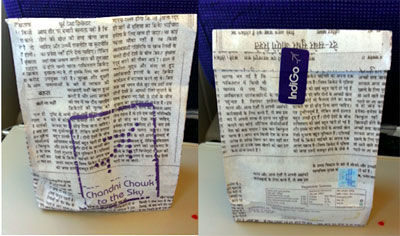
    I got my two pieces of samosa in a paper envelope. I liked it- sandwich in folded paper packs, cookies in reusable cylindrical boxes and samosa in paper bag. Someone was really particular about things. Close inspection showed that the bag was reprinted paper image and not the real newspaper for originality; I would have preferred the actual newspaper. The lead in the ink and mixing with food was not a problem as the packs were laminated form inside. But printing had the advantage, the additional information about content – cost and nutrient values were printed in the pack this avoiding need for additional sticker.


    I was enjoying the packaging and the detail the agency and client had looked at. It was all-good, till I started reading the news item on the pack. And then I realised in all its fineness and originality- in the marketing scheme of things- it was just a silly envelope for samosa. And surely after concept has been approved, no one had given thought to the final content that will feature in that reprinted newspaper packs that are stamped ‘ Chandani Chowk to the sky ‘.


    How tough was it to get it right. How could someone go wrong? Wrong or right is any way subjective. And that is for you to decide.


    The pack that I got- had an article titled ‘With time the relationship will improve’ – by an ex-test cricketer. Then just above where they mentioned MRP and nutritional values it read ‘ they use this for the terrorism acts in India and other countries- so does it men we…’ Somewhere else it said ‘The situations between the two countries is not conducive enough for cricket’. And right next to it ‘the common man in India believes that any money secured by any means that reaches Pakistan is used for terrorism in Indian and other countries. So, how will BCCI explain providing Pakistan such funds raised by cricketseries’? The side sleeve of the packet talks of ‘The fear of hell in heaven’.


    I am sure this is not a packet that Indigo really wants people to read while they are being served at 34000 feet. Any thing better feature-oriented that could bring smile would be better. Otherwise I have every reason to appeal that there is sheer discrimination. Rest all of the food items have their own colour packaging- it is only the Samosa served at cabin temperature that has to do with black & white envelope with a blue brand sticker closing the pack.


    Indigo can change the envelope and gets some good positive news or some humour feature instead of terrorism. Having my favourite Kangana Ranuat image may even help acceptance of cabin temperature samosas.


    It is consistency, innovation and service that make a brand. And Indigo is doing damn good work. So, this small lapse in judgement or oversight hurts. No element is small or big. Everything that the brand uses to interact with its customers is important- even this silly envelope.


    I wait for the day when some brand will use these paper envelopes for promotion and change the game.


    Sanjeev Kotnala with 28 years of corporate experience is the Founderof Intradia World. A Brand, Marketing & Management Advisor, hefocuseson IDEATION (Harvest and Liberate) and INNOVATION (InNoWait) process and workshops. He is devoted to enhancing human potential. He is also a certified Life & ‘Mid life transition’ coach.Emailsanjeev@intradia.in tweet @s_kotnalaweb: www.intradia.in,www.sanjeevkotnala.com.


  • Top 5 “Gamechangers” on Hindi GECs in 2015


    2015 has been an odd year for Hindi GECs. While long-running hits like Yeh Hai Mohabbatein, Saath Nibhana Saathiya, Kumkum Bhagya, Diya Aur Baati Hum and Sasural Simar Ka continued to dominate, most new launches failed to get going, many of them wrapping up even before the year ends.


    While the list of Top 5 gamechanger shows of the year for 2013 had a lot more variety, the 2014 list was a bit of a stretch, in the absence of any real impact properties besides Yeh Hai Mohabbatein. The 2015 list below has a peculiar problem of its own – It relies heavily on one genre (mytho-historical) which in not exactly on the ascendancy. The 2015 list lacks conventional daily soaps, where long-running shows have towered over new launches in a hopelessly one-sided battle that the former have been winning for over three years now.


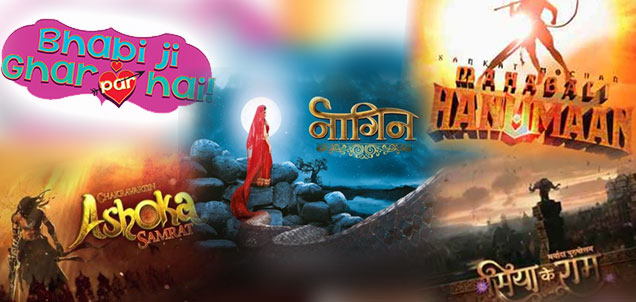
    5. Siya Ke Ram: Star Plus’ Siya Ke Ram makes it to this list largely for being a well-managed launch that ensured that the show opened very well. The interpretation of Ramayan is interesting, but the show lacks that operatic feel Mahabharat on the same channel had. Perhaps we would see more of it as the story progresses. Much else Star Plus launched this year did not work, but Siya Ke Ram has the ability to reverse that as it enters its third month soon.


    4.Sankatmochan Mahabali Hanuman: It’s perhaps the least-talked-about GEC success story of the year. On a platform where a regular fiction show struggles to cross 0.3 TVR, Hanuman has been clocking 1.5+ TVR consistently, with time-spent numbers at par with category leaders like Diya Aur Baati Hum and Kumkum Bhagya. The success of Hanuman, albeit limited by its platform’s current potential, proves yet again that viewers will discover engaging content, however cluttered the environment is.


    3. Chakravartin Ashok Samrat: The Colors show completes the hat-trick of mytho-historical shows on this list. The show has been on-air for about a year and perhaps past its peak too. But Ashoka has been the pillar (no pun intended) around which Colors built its strong challenger position to Star Plus during this year, overtaking it with great regularity in recent weeks. It also clearly separated Colors as being a variety-centric family platform, in contrast with Star Plus’ female-targeted fiction positioning.


    2. Bhabhiji Ghar Par Hain: &TV may have taken its time to find its feet, but its driver show, the modestly-mounted but sharply-written comedy Bhabhiji Ghar Par Hain, has managed to find an audience on its own. Fiction comedy is perhaps the most difficult genre to create formulaic hits in, given that a lot depends on performances and consistency of writing, episode after episode. This somewhat-saucy comedy has ensured &TV enters 2016 with at least one winner on hand.


    1. Naagin: There’s one thing common to this list in 2013-15: The winner stood head and shoulders above the rest. It was Comedy Nights With Kapil in 2013 and Yeh Hai Mohabbatein in 2014. This year, the extent of Naagin’s success has taken everyone by surprise.


    While those two list-toppers grew from modest beginnings to positions of strength, Naagin was a runaway hit, opening at levels most hit shows aspire to peak at, and growing further from there.


    Naagin deserves credit for infusing zest in an oft-told story, and upping the level of visual treatment and histrionics. But it’s also further proof of the Indian obsession with all things supernatural. And how that Naagin has hit the mark, watch out for more supernatural and creature stuff in 2016. You have been warned.


  • 15 must-reads for the High EQ Brand Manager


    By Sanjeev Kotnala


    This year been a mixed bag in terms of books that I have read or plan to read. I stayed focussed on business, marketing, advertising and media books, keeping my distance from anything political or fiction. But here are 15 books I believe one absolutely must read (if you haven’t already!) though not all of them were published in 2015. I tend to categorise my books into sections like ‘interesting, but not yet there’ and ‘selected for rejection’. But this list, I would say, is ‘highly recommended’.


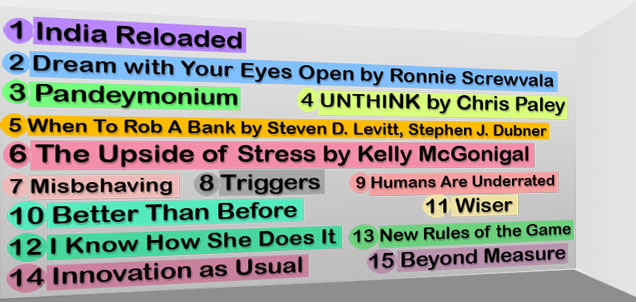
    1. India Reloaded: Inside India’s Resurgent Consumer Market by Dheeraj Sinha

    This is an attempt to demystify the complex Indian market from an insider’s perspective. It draws upon a wealth of data, from consumer research, market data, macroeconomic research, popular culture and case studies, to provide a thorough and compelling insight into what makes for success in the complex Indian market. You may disagree with some of the arguments, but you will end up appreciating the approach. Read it to sharpen your presentations –and also perhaps for a confident discussion with a confused MNC client.


    2. Dream with Your Eyes Open by Ronnie Screwvala
    A book for every entrepreneur-in-the-making. Just go ahead and dive into the learnings that will tell you how to manage failure, inspire success, raise the bar of ambitions and help you think big. Ronnie makes one thing simple: It’s all possible. Just dream your own dream. And when you do, dream with your eyes open.


    3. Pandeymonium: Piyush Pandey On Advertising by Piyush Pandey 

    You just can’t miss this transparent, one-to-one session with Piyush Pandey and how he has observed things that have become the foundation of realistic and memorable communication. Read at leisure and you will see that no observation or experience is ever wasted.


    4. UNTHINK by Chris Paley

    This is a book which is tough to like, as it really asks you to invest time and follow the proposed thinking. But yes, there is a bit of quirkiness about the whole concept and that is interesting. Read to start mining more things from your unconscious mind.


    5. When To Rob A Bank by Steven D. Levitt, Stephen J. Dubner 

    If you loved Freakonomics and Think like a Freak, here are 131 cherry-picked blogs from the authors. Like what people lie about, and why; the best way to cut gun deaths; why it might be time for a sex tax; and, yes, when to rob a bank. Read on to realign yourself to start asking  questions.


    6. The Upside of Stress by Kelly McGonigal

    With a promise of sharing directions on ‘Why Stress Is Good for You’ and ‘How to Get Good at It’ this is a tempting book to pick up. Whether or not it will help you, is something you have to decide. Recommended by ‘The Positive Company’. If you believe that even stress can have positive impact, go for this one.


    7. Misbehaving: The Making of Behavioural Economics by Richard H. Thaler

    We do not follow the standards of rationality while making our decisions. Want to know how to stop misbehaving in a rational, economist way and make smarter decisions? Read on. The book states that “when economics meets psychology, the implications for individuals, managers and policy makers are both profound and entertaining”. Not much of a choice there.


    8. Triggers: Creating Behaviour That Lasts, Becoming the Person You Want to Be by Marshall Goldsmith 

    A book by one of the world’s foremost executive coaches on how to break that cycle of pre-set reactions and bring in meaningful, sustained changes in life. What and how you can be benefited by taking responsibility for actions and failure to act. Discover a new you with this one.


    9. Humans Are Underrated: Proving Your Value in the Age of Brilliant Technology by Geoff Colvin

    Read it before expiry era. It banks on the belief that essential human skills like empathy, social sensitivity, storytelling and creativity can never be replaced by technology. The way we are advancing I have my doubts about that.


    10. Better Than Before: Mastering the Habits of Our Everyday Lives by Gretchen Rubin
    To build happier, stronger and more productive lives, we continuously try evolving by creating new habits. Hence it is an important need to know how to change our habits. It helps to know why some habits are tough to create, more so if that is what you love or want to do. Read if you want to change within or change something within.


    11. Wiser: Getting Beyond Groupthink to Make Groups Smarter by Hastie 

    Group decisions are necessary. But they are hard to arrive at and can sometimes go wrong. If you want to avoid the pitfalls of group decision like cascade effect, polarisation and over-empathising, to reach better outcomes by using some suggested technique including ‘silencing the leader’, grab copy of this one.


    12. I Know How She Does It: How Successful Women Make the Most of Their Time by Laura Vanderkam  

    This one uses a hard, data-based approach to unearth the surprising patterns of working by women who are consistently able to strike a balance between work and family. And also being able to make time for what gave them pleasure and meaning. A must for working women like yourself


    13. New Rules of the Game: 10 Strategies for Women in the Workplace by Susan Packard  

    Where would your career be if you could understand how your colleagues –especially men–succeed and win at work? And if, in understanding and applying the rules, you could win, too? Get nearer to the gamesmanship that fosters creativity, focus, optimism, teamwork, and competitiveness. Read to start effectively using these 10 rules for workplace success.


    14. Innovation as Usual: How to Help Your People Bring Great Ideas to Life by Paddy Miller and Thomas Wedell-Wedellsborg  

    Forget brainstorming, idea jams or offsites. Create the ‘innovation architects ecosystem of 5+1 keystone behaviour’ where engaging in key innovation behaviours is part of daily work. So that innovation can happen in a way that’s both systemic and sustainable.


    15. Beyond Measure: The Big Impact of Small Changes by Margaret Heffernan 

    Sweeping changes have repeatedly failed to do better, to earn more, and create happier employees.  Maybe the route to build ideal workplace cultures and create seismic shifts by making deceptively small changes, can help engage and enhance productivity. Start the journey of small shifts with this book and enjoy some real-life examples underscoring the motto.


    Sanjeev Kotnala is a senior brand and marketing and management consultant. He is Founder of Intradia World. This article first appeared in dna of brands dated December 28, 2015.


  • Sanjeev Kotnala: Digital needs new storytellers

    By Sanjeev Kotnala


    More and more campaigns in coming times are expected to break in the digital media. The relationship between digital and TV may never reach the TV–print equation. We know how TVCs are used as the starting point to create a print ad. I am not sure if the brand and agencies are taking concrete steps to prevent the situation.


    If I am to believe what I see and hear, in case of the brands using both digital and TV media, script is dominated from TV (the costlier media) point of view. This is a silly situation to be in.


    It is like commissioning a short story writer to write a longer story if not the complete novel. Now, the only art known to him is to be very precise and hold attention in short spurts.  Unfortunately this at times ensures that long digital ads are not a seamless story. They are a relay of situations repeatedly exposed to make the same point. They fail to build on to the tempo and push the viewer’s anticipation.


    We know that longer films are watched lesser number of times. Hence it has to deliver in fewer exposures. Importantly, in digital it needs to hold the audience in its first exposure.


    The Nescafe cartoonist is an exception. The film holds your attention as the story moves through paces and he thoughts are real. (link https://www.youtube.com/watch?v=GP_zdW6sl-k)


    The brand and agencies have been unprepared to create digital acts and ads that really exploit the media. Couple it with ad avoidance, ads playing in the background browser windows and ad-skipping digital media is known for. Not surprising that many digital film intervention fails to deliver the desired results.


    To break this barrier some of the brands like to get the brand association and presence in the very first part of the film.  There is nothing wrong in it, if you could keep the audience engaged for the rest of the film. Audience is not waiting to get engaged with the communication.


    Additionally every client wants a digital communication that can get viral. We know it will not happen- unless we have been able to trigger the behaviour of the audience.  Myantra with Whisper, Visit and Pregnancy has demonstrated it.  Again here is a story building up those fires emotions one can easily associate and expect.

    (link: https://www.youtube.com/watch?v=d7Bfi6d5mQk,  wait https://www.youtube.com/watch?v=aG9_2_3RYxw  Visit https://www.youtube.com/watch?v=Ef27m5ocK6Q  and Pregnancy https://www.youtube.com/watch?v=4l_-M93beYk )


    On the other side you have that the combinations of the situations are stitched together to make TV edits. In some case original 30 second edits stitched together make a digital ad.


    Remember the forgotten movie ads, every 30 second of it was a pearl, beautifully crafted directed and delivered, yes some 240 odd pearls could not hold the necklace together.  CInthol – alive is offline is one such ad (link https://www.youtube.com/watch?v=npVbzq4gxag)  It overplays the situation and treats audience as dumb. A classic case of creating for the lowest denominator. Two, the situation is not so common in India.  Lone rangers are still a new breed.


    The industry faces another problem. A short film of three to five minutes requires a different mind frame. The creative challenges are different and maybe industry is unprepared for it. Though the argument of basic remaining the same holds true, the end product still need to deliver to a new audience with a different pattern of media consumption.


    Before totally blaming agencies we must hold clients too responsible for the situation. They have been majorly exposed to AV and TVC. When they got this license to slow down and consume more time to tell the story, they went wild. The temptation to add and play scriptwriter-director got.


    Somewhere clients also need to be trained for the digital short films to flourish. The clients need to be  willing to experiment and take risk. Clients who are willing to cut-the-crap to cut-the-clutter and open to explore the options digital media presents.


    I am almost sure that the Kitkat 5-minute blank X’mas ad is not something we may get clients to approve. (https://www.youtube.com/watch?v=bHR-i2jbcIc  )  I am using this as an example of only experimentation and do not think it was a great ad


    ………………………

    Sanjeev Kotnala with 28 years of corporate experience is the Founder of Intradia World. A Brand, Marketing & Management Advisor, he focuses on IDEATION (Harvest and Liberate) and INNOVATION (InNoWait) process and workshops. He is also a certified Life & ‘Mid life transition’ coach.Email sanjeev@intradia.in tweet @s_kotnala web: www.intradia.in  www.sanjeevkotnala.com.