Category: COLUMNS

  • Sanjeev Kotnala: Don’t see peace coming down with Kabootar

    By Sanjeev Kotnala


    Mumbai is a city battling with the nuisance of many problems and one of them is really the over population of kabootar (dove).  There are kabootar khanas (where dove can be fed) and people eager to feed.  Everyone is aware of the diseases and allergies caused by kabootars and their droppings, yet the universal symbol of peace lives unchallenged, promoting peace. So, it is not surprising that a Peace Anthem using this symbol of peace – KABOOTAR originates in the city. Trying to thread together a social change, through ‘WINGS OF FREEDOM- Kabootar’ in an era of growing intolerance. This time the dove is not in a politically rally but among the common man. (Link https://goo.gl/iJI14C 6.46 Minutes)


    An initiative of Colors and Equal Rights Music Project, , the peace anthem was released on the Republic Day – January 26, 2016. Behind it is a well-known creative mind, Manish Bhatt, Founder Director, Scarecrow Communications and Eddie T Avil who has composed it.


    The song is sung well and it does get on your mind. Unfortunately, the message ‘When Will Peace Finally Grace the World/ Kab utrega dharti par, ein kabootar’ is a bit too subtle. Some may say it’s the way it should be. The audience completes it in their minds with many things unanswered. Unfortunately, like always we end up layering it with religious hues in the name of diversity. Once again religion is the backdrop to erratic peace. May be we cannot or should not see reality in any other way.


    We may have lost connect with peace. May be hatred and distrust are the overpowering emotion. Yet, I am not surprised when people see ‘Peace Anthem’ as just a ‘feel-good’ factor and nothing more. Expecting it to unite the nation and accelerate initiatives towards peace is asking too much.  And we definitely don’t need any more sensitisation to the subject.

    It will be interesting to know the expectations of people behind it. Are they convinced on the potential? Or they are satisfied with creative orgasm?

    Manish Bhatt says: ‘‘Peace is a subject which needs to be reinforced into the world constantly and consistently…  Poetry and music is ancient arts and often used in conveying public messages. At a broad level, it should remind that peace is inevitable for our planet. Anthem is a Public expression of music. It always works, if they are done with right spirit.”

    I review the execution. Am I the only person who sees the message too layered and subtle for the audience all around?

    Manish differs: ‘We often underestimate of intelligence and intellectuality of mass Indians and so this experiment should also revive the consumption of poetry and meaningful music by masses’.

    He sights two other anthems as an example (both on his show reel), which worked! ‘Respect The National Anthem’ (Link https://goo.gl/Sr46LS 2.06 minutes) and  ‘Jityu Hamesha Gujarat’ an anthem for Gujarat sung by 25 Gujarati celebrities (link https://goo.gl/HXWMI6 4.18 minutes) and I will let you decide.

    The reach for the peace anthem is banking on 13 million followers and digital subscribers of Colors  and social media getting the first exposure and doing some magic.

    I agree that ‘Not only Pathankot or Paris, and that the entire world needs peace’.  But the launch of the peace anthem as the first output of ‘Equal Rights Music Project’ (pioneered by Manish Bhatt and Eddie T Avil) on Republic Day, to me sounds more of an event opportunity than peace initiative.

    As the name suggests, Equal Rights Music Project is a music platform where professionals from across the music industry can come together to create original work. All rights of the produced piece are equally distributed amongst all key contributors. Not just the composer, lyricist or singer but also to Sound Engineer or Instrument player.

    As per the team, no better subject than peace to align the first song with the spirit of the platform. I know, if nothing else at least such a concept will promote PEACE among contributing musicians.

     

  • Ranjona Banerji: Bad journalism to flog fake letter? Or judgment call?

    By Ranjona Banerji


    There are many embarrassments in the life of a journalist. Let’s face it, the job by nature aligns itself to errors. Some are genuine and some are what we like to term “judgment calls”: a rose by any name you may well argue. For those who thrive on sensationalism, the “mistakes” are deliberate: to slightly twist facts, to mislead with a headline, to focus on one aspect while ignoring the context. To a certain kind of editor, this is what sells and this is what needs to be presented to the “gullible” reader. Because after all, if there are people who genuinely believe in the headline, “Woman gives birth to two-headed goat”, then who is the humble press to disillusion them. Yes, “tabloid” or “yellow” journalism has its place: Usually entertaining, often nasty and sometimes punishable by law.


    However, what about errors that spring from a complete absence of established journalistic controls and checks and balances? What happens when editors themselves decide to put information into the public domain without checking authenticity but having no qualms about maligning people? I do not hold with the theory that all television journalism is bad although I have excoriated it enough in these columns.


    But, the curious case of the letter about Netaji Subhas Chandra Bose deserves time and attention. Twitter and social media were abuzz this week over a letter written by Jawaharlal Nehru to British prime minister Clement Attlee in 1945 which apparently emerged from the files relating to the freedom fighter, declassified by the government on Bose’s birthday, January 23. Bose’s disappearance, as is well-known in India, has long been a source of controversy and conspiracy theories. The fact that successive governments have refused to release any information has only added to the myth and the dissatisfaction.


    It is therefore hardly surprising that a fake letter that has been doing the rounds for six months before declassification should excite people who are waiting for information that would put the Congress Party and India’s first prime minister under murky light.


    But is that reason enough for a seasoned television journalist like Rahul Kanwal, joined by Aditya Raj Kaul, to start pushing this fake letter as real on Twitter and Facebook and demanding an explanation from the Congress Party? The letter had many giveaways. For one, Clement Attlee’s name was spelt wrong and so was Nehru’s. What are the odds that Nehru did not know how to spell both his own name and that of the British prime minister? Further, Nehru was not prime minister of India in 1945 and Attlee was not prime minister of “England”. The letter is unsigned. The grammar is appalling. I can understand that people schooled in the RSS version of Indian history, filled with Vedic spacecraft and advanced infertility treatment, know nothing about Nehru but any regular school-going child knows that Nehru studied in the British public school Harrow and at Cambridge University. He also wrote several books. However much you hate him, his English was close to impeccable.


    There is more than ideological underpinning that is the problem here, though. It is the rush to get a story out without checking the facts. All Kanwal and Raj Kaul needed to do was sit down and think for 10 minutes. That is, I assume they did not do so. If they did, the situation is truly dire.


    As I have understood from social media, Kanwal deleted his Facebook post which had put forward reasons on why the letter was real and Raj Kaul apologised. This was only after historians and the general public explained how the letter was fake, which should in fact have been obvious. Here are details on the website scroll.in:

    http://scroll.in/article/802403/twitter-starts-to-mock-fake-nehru-letter-with-fake-nehru-whatsapp-messages


    As for the promotion of the fake letter: that was just bad journalism. There can be no “judgment call” excuse here.


  • Shailesh Kapoor: T20 Cricket: India’s ‘Second Sport’?


    By Shailesh Kapoor


    This Republic Day, India beat Australia in the first T20 International of the ongoing series. Earlier the same day, the Indian women beat the Aussies too, in a record run chase. Thus started a long season of T20 cricket for the Indian viewers; a season that will go all the way till May end, when the IPL concludes.
     

    India finishes three T20s in Australia, then plays another three with Sri Lanka, followed by the T20 World Cup in India in March, and the IPL in April-May immediately after. More than 80 T20 matches will be aired this period, not counting the women’s T20 World Cup, which is also scheduled for March.


    For those whose initiation into the sport of cricket was through Tests and ODIs, this may come across as a crazy cricket schedule, almost an off-putting one. But for a wide section of sub-25 audience, this is the cricket they enjoy seeing the most – the three-hour entertainment show, over the eight-hour or five-day drag.


    I may have made this point in this column a couple of years ago, but it’s worth saying again that the sport a person (and by extension, a country) grows up to love is the sport he (or she) grows up to watch (and possibly play) when he’s a teenager. Typically, 12-17 years is the age band when the mind is most impressionable regarding the sporting taste of a typical urban Indian.


    Times are changing, though. For many in the 12-17 age group, the “entertainment” that sports provided has been replaced by social options, loosely grouped under the generic category of activities (including the virtual ones) called “hanging out”. Hence, the challenge to engage them will continue to get tougher by the year.


    In the pursuit to find the ‘second sport’ in India after cricket, broadcasters and sports marketers have launched every possible sporting league. Some of these leagues have done genuinely well, while others are merely projected media successes, despite low viewership and financial losses to most stakeholders. A dozen leagues later, India has not got any closer to finding that second sport.


    But even as that effort continues, the sport of cricket is virtually getting split into two. Cricket 1 is the old cricket – Tests & ODIs – attracting a small section of 25+ male audience (40+ for Tests) and increasingly becoming a niche proposition, unless there’s a big event like the World Cup once in four years.


    Cricket 2 is T20, be it nation vs. nation or leagues (IPL primarily, for now, for the Indian audiences). Cricket 2 is entertainment first and sports later. It’s more gender-inclusive for that reason. It targets 15-30 as its core constituency, though the national team playing T20 would tend to get Cricket 1 audiences into it too.


    Year-on-year, the proportion of Cricket 2 audiences will grow, as the 15-30 year olds get older. A decade from now, Cricket 2 will address a much wider 15-40 audience, and be perhaps the only cricket that gets ratings.


    To that extent, India seems to have found its second sport (or the new first sport, more appropriately). Call it Cricket 2, Call it T20, it’s a new sport alright. And its strength will be on display, all the way till end May this year.


  • Ranjona Banerji​: How News TV rules with ​social issues

    ​By Ranjona Banerji​


    Just as television news was my target last week for its various sins, I have to applaud it for taking some issues head on. Gender equality, whether the rights of women to be allowed into temples and mosques or the discrimination inherent in menstruation taboos, the needless criminalisation of homosexuality in Indian law and police brutality against students were some of the subjects which were debated on most English news channels.


    In all cases, the TV anchors and reporters on the scene stood against the entrenched views of patriarchy and discrimination. As is as their wont, they gave more than ample space to the various regressive elements in our society in an attempt to appear “fair” – why is this gentleman Rahul Eshwar everywhere? But ​​they also brought to public attention a wide variety of new voices to speak about women’s rights and the sexual rights of Indians.


    Perhaps I am being unfair to our TV debate shows. Perhaps allowing these regressive voices to share their views only reiterates the irrationality and hatred in their positions. It is also very amusing to watch them squirming – the ubiquitous Eshwar for instance – when menstruation, bleeding and sanitary pads are mentioned. It is even funnier to watch them running for justification when asked to explain why religion discriminates against women.
    Unfortunately there are deeper points in all these subjects which TV debates, discussions and screaming matches cannot cover. This is where print comes in and print seems more focused on the various political shenanigans going on, which have their own need for ample space! Websites luckily will give you a bit of both.


    So should TV news debates have focused on the Supreme Court asking the Gujarat government if it was planning to secede from the Indian Union? Or on The Case of President’s Rule in Arunachal Pradesh, which is getting curiouser and curiouser?
    All things considered, social issues are well-suited to TV. As we saw with the khap panchayats or when the 2012 gang-rape case shocked the nation, TV worked extremely hard and effectively to expose and rigorously question the worst ideas and elements that thrive in society. The nuance of politics unfortunately gets lost in TV debates which as we all know and have mentioned often enough, become nothing more than slanging matches.


    **


    Since Delhi is the centre of the universe for Indian news television (barring Times Now), the thrashing of students protesting the treatment of Dalits after Rohith Vemula’s suicide by the Delhi police, got national coverage. The Delhi police is run by the Union Home Ministry which of course means the BJP-led government at the Centre. Thus even pro-government journalists were full of outrage – a staple of a media-driven world.


    Meanwhile, in Mumbai, the same problem prevailed of political sympathy versus public need. The killer smog that has engulfed the city over the past few days and the fact that some members of the municipal corporation were on a junket to the Andamans which Mumbai spluttered took up much TV time. Both the state government and the municipal corporation are controlled by the BJP and Shiv Sena, in various combinations of power.


    It is too early to come to any conclusions but seemingly, lathis and smog in big cities may sometimes outweigh political loyalties?


  • Sanjeev Kotnala: Do Publishers really value the Abby?

    By Sanjeev Kotnala


    I hope the answer is a resounding ‘Yes’.  But hope means nothing. It is the result which counts. The experience of the first two years points in another direction.


    In 2014, Goafest added ‘Publisher and Broadcaster Abby’.  I was one of the many winners in 2014 and part of the jury in 2015. Hence, this stupid-sounding question.


    The numbers of entries went up in the two years. I sincerely believe it is not even a token reflection of the quantum and quality of good work done by media (Publishers) brands. Last year, I was surprised that many of the good works were not even entered. More so, sitting in Mumbai, I am privy to just the tip of the iceberg. There is huge amount of good work by regional media brands in their territories and with the target audience that makes them.


    It is difficult to fathom the reason that kept brands like Malayala Manorama, Eenadu, Hindu, Sakal, Punjab Kesari, ABP and even Rajasthan Patrika away from Abby?


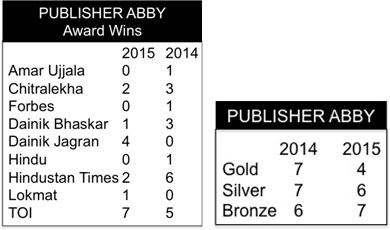
    Suddenly for no reason, Abby  seemed skewed in favour of TOI (Include Gujarati Samay, Mumbai Mirror), Dainik Bhaskar  (Include Divya Marathi and Divya Bhaskar), Dainik Jagran, HT (Include Hindustan) and Chitralekha, the brands that repeatedly walked to collect their trophies.


    If you take my word, there is a need for participation in Publisher Abby to hit new heights. The winning list shows a complete absence of magazines other than Chitralekha and Forbes.


    You will agree that there is award-worthy work happening in print – both newspaper and magazine in offline and online space. You will also agree that the entry fee cannot be a deterrent. Then what can explain the low turnout?


    Were the brand custodians and the marketing departments unaware of the new categories and entry deadlines? Tough to believe. Media houses have a huge delegate presence in Goafest and for that matter any industry event in or out of country. Media houses are also sponsors of industry events. Goafest makes enough noise in agencies and media about process and deadlines.


    May be by the time they realised the entry date was over. So, why wait this year. Why wait for call for entries. Publishers would do themselves good by evaluating their work and shortlisting what they will like t enter. Take the time to get the details like strategy, objective, results and supporting documents in place. Get internal in-principle approvals.  Ask your creative agencies to help prepare the entries. Then just wait for the announcement at www.goafest.com.


    May be they do not lack work and effort but the art and skill of sending entries. Possible. Very much possible. In that case, visit the Goafest site. The instructions are clear.  Ask your creative agency to help. Additionally if any media brands need help and guidance, I am more than willing to help.


    The print pressure on revenue and the shift in the media weights have impacted the internal thought process. The awards are something that are not considered worth – till they are for circulation and or editorial. Maybe the publications should think again. Goafest provides an additional window to showcase the brand- its work- and attitude. ‘Best front cover’, ‘Best front page’, ‘Use of activation’, ‘Use of digital and mobile’, ‘Best brand innovation’, ‘Newspaper marketing. and ‘Cause ( CSR) related initiatives’ have been some of the categories where media houses won awards. Maybe there is a need to add Abby for  ‘Best circulation drive’, ‘Best photography’ &  ‘Best use of typography – illustration and infographics’. (sorry, I  missed suggesting these in my earlier notings)


    Deciding the right categories to enter is one of the most important decisions. Good work will find itself eligible for more than one category. Enter it in all relevant categories. Make that extra effort to ensure right filing of form and providing quality supporting.


    ‘Only Big Brands Win’ syndrome. They suspect a cartel, where none exist. They are not wrong to be influenced and think so. The industry has always been full of such rumours. I suggest: kill the naysayers. I can vouch with my experience of the publisher Jury, judging is absolutely impartial. Each entry is judged on its merit.


    The award categories are not relevant. Nothing can be further from the truth. But what is possible is that the editorial- marketing- circulation volatile triangle in publications does not work in sync. The internal fights and claim for credit unnecessarily affect this process of award entries. This leads to non-ownership is really missing.


    One would want to see a multiple rise in number of entries at Publisher Abby and many more awards won. But remember even god cannot help you win a lottery (which Abby is not) if you do not buy the ticket.


    Three cheers to Goafest 2016 and the Publisher Abby.


  • Shailesh Kapoor: Kapil Sharma And The Loss Of Innocence

    By Shailesh Kapoor


    Till about two-and-a-half years ago, not many knew his name. Kapil Sharma had been on TV since 2007, when he featured on the third season of The Great Indian Laughter Challenge. But his real brush with fame and success came when he got a show with his name in it: Comedy Nights With Kapil (CNWK).


    Face recognition to name recognition is a critical leap every actor in showbiz aspires for. It’s a good barometer of “having arrived”. Lot of TV stars, and even film stars, don’t have name recognition after years of being around. TV stars are generally known by the name of the most famous character they played in their career. Till today, many know Boman Irani as “Maamu”. And we routinely meet consumers who refer to Dalip Tahil as Madan Chopra as a matter of fact.


    I had been following Sharma’s work on Comedy Circus for a couple of years before CNWK happened. He was the stand-out comedian on that show, head and shoulders above the rest, in his spontaneity as well as a unique touch of innocence he brought to his performances. His freshness stood out. There was an unmistakable sense of “common man” to him.


    When Colors gave him a show with his name in it, and even got him to produce it, they were placing their bets on a man who had the ability to deliver the goods. And he delivered them indeed. Enough has been written about the phenomenal success story of CNWK, including on this column. It seemed like a match made in heaven. A top channel and a top talent, with a show in his name. What could go wrong?


    But things indeed went wrong. Today, Sharma is off-air, putting together a show that is rumoured to be going on-air on Sony in the near future. CNWK itself didn’t have the best year in 2015, as ratings flattened out. Colors has a replacement show on-air, but without a titular hero this time.


    A small-town struggling actor-comedian comes to Mumbai, achieves success, has a huge tryst with fame, builds a fan base most top Bollywood stars will be enviable of, and then begins to lose his bearings. That’s a classic story, right? Wait, we have even seen the female version of that. The movie was called Fashion.


    Talent management is a tricky business, and all channels and production houses encounter celebrities who can give them a pain in their backsides at some point or the other. Petty squabbles over vanity vans, flight tickets for hair and make-up crew, hotel room class, costume selection, etc. are commonplace.


    But illusions stardom brings with it can go beyond such squabbles. By all accounts, official and off-the-record (I have never met Sharma), it’s apparent that Sharma had a tough time managing success, and didn’t have the best people around him to advise him either. Over time, that innocence of Comedy Circus, and the first two years of CNWK, was giving way to a certain swagger of success. He even started building his stardom it into his lines (a terrible thing to do), almost sub-consciously perhaps.


    But the camera can expose you. The weakening of innocence reflected on screen. May be he was not working on the show as hard as before, maybe he didn’t want success as badly as before, having achieved it already. Whatever the reason, the Kapil Sharma of 2015 was a less endearing version of the Kapil Sharma till 2014. Bollywood aspirations also took their toll (they often do for big TV stars) in the same period.


    The channel which airs his show has its task cut out. Sharma is a comedian of immense talent, the best mainstream Indian media has seen ever. But it’s not his talent they have to harness. They have to make the man find himself again. If they manage to do that, it would be like the last act of Madhur Bhandarkar’s Fashion. When one rediscovers innocence and the hunger to excel. All over again.


  • Ranjona Banerji: What the edit pages wrote on Rohith Vemula

    By Ranjona Banerji


    Reading opinion pages in newspapers about events in the nation can sometimes be very different from what you see and hear on television news. The reactions by columnists and commentators to the suicide of Rohith Vemula and caste discrimination in institutes of higher education has been more or less the same: dismay, distress and non-delusional about the continuing domination of the upper castes.


    The exceptions therefore stand out. Bestselling author Amish wrote a convoluted piece in The Times of India with some half-baked idea of history and Hindu texts and tried if not to justify caste discrimination then to at least put out the message that caste was not always a bad thing. Of course, it is vital that any edit page put out a variety of contradictory opinions for readers to sample. But sometimes – having worked on edit pages – you have to be able to assess whether your contributor is making sense or not before you carry him or her. Amish, sadly, was not making a lot of sense even if he showed slightly more academic ability than Chetan Bhagat, India’s other best-selling writer and also a columnist on the Times of India’s edit pages.


    The Indian Express carries the most intriguing edit pages however. The opinions of their columnists are often at total loggerheads with their edits which makes for intriguing reading. While it is very entertaining to read Tavleen Singh every Sunday, looking for a new person to blame for Prime Minister Modi’s shortcomings, some variety would not be amiss here.


    The Hindu remains one of the best when it comes to edit pages, though, with its writers showing depth, insight and scholarship. And the Readers’ Editor S Panneerselvan is always readable as he assesses how The Hindu covered the news and deals with complaints. The Hindu’s commitment to an ombudsman (person?) is exemplary however sadly no other journal in India seems to have followed suit.


    **


    The changes to firstpost.com after its change of management and newsroom are immediately evident. The most striking is that opinion, which was at the forefront of firstpost’s initial success, appears to have taken a backseat. Instead the website concentrates on news and is often on the ball with that. However, opinion is a vital part of the internet’s inherent character and firtspost would be wise to reincorporate it. All the best to the new team. How many of you miss those “Five things Modi should do Yesterday” columns by the way?


    **


    One of every editor’s biggest fears is the reporter who lies. Or should be anyway. Sadly, this is more common than anyone thinks or knows. There are some cases which are well known and others which are hidden from the newsroom and the public. Indian newsrooms as a rule do not acknowledge such mistakes and do not share them with the reader. Apologies therefore are almost never made.


    Yet, we have all worked with people who walked on that thin line between fact and fiction and we all know those who went over to the dark side. One gentleman I knew – senior to me – wrote his articles first and then went out and got the quotes and the facts to fit his writing. Another, much later, was known to go to Google and plagiarise material and yet he was supported by several colleagues and editors.


    Therefore it takes great courage to do what this editor did: apologise to readers for the actions of a reporter who had been manufacturing quotes.

    https://theintercept.com/2016/02/02/a-note-to-readers/.


  • Sanjeev Kotnala: I will always remain an AGKite

    By Sanjeev Kotnala


    A G Krishnamurthy ( 28th April 1942- 5th February 2016) will be remembered for different reasons. The industry may just note him as the founder chairman of Mudra Communication, taking it to newer heights earlier only associated with MNC and network agencies. Or as a person who has the vision to start MICA. Or even an author of books like ‘If you can dream’, ‘Ten Much’, ‘Desi dream merchants’, ‘Learnings of an advertising professional’ and many more.


    To me he will always be AGK and I will be another of the many AGKites.


    He always remained a person ingrained with middle class values and openness to ideas. One who could be called a homegrown ad man with a street-smart style and a belief of ‘success being a process not an end’.


    I remember the poster in his office at Mudra. Early days, when Mudra operated out of Manikyam apartments in Ahmedabad. It had a rooster running after a hen, while another in a corner was busy hatching an egg. It read ‘Yes, we run after new business- but we keep out existing clients satisfied’. This is a philosophy that he lived by.


    AGK was Mudra and in many ways Mudra was AGK. Mudra was started with a mandate for excellence and that remained the driving force behind its success. A lot of its growth was organic. So when AGK said ‘Truly and honestly the age of the fittest surviving has dawned on us. The only way we (can prosper is by raising our bar of efficiency… There isn’t any alternative’. You knew he meant it.


    He was also one of the toughest bosses I had. He never accepted mediocrity. I remember one incident where the legs turned lead- while we seven were paraded and blasted by him in Ahmedabad. (Full incident http://sanjeevkotnala.com/sardar-khush-hoga/). He was a great teacher of human relationships. One of the best bosses (not a direct boss) I ever had. Few people from whom I learnt the art of managing and motivating teams.


    My career in advertising could have been short-lived if he was not there to make sense of my brashness and actions. I did mistakes and he allowed them as a learning ground. This openness is something that I carry with me.


    He kept you on a leash. The leash of freedom of doing things you felt right and had conviction in. Yet he could be break your heart with one of the most brutal honest observation or a remark. Reward and reprimands ran parallel in his office. Biases were few and rare.


    We all Mudraities who have worked under him or interacted know how motivating were the simple Ganeshas and those silver or golden pens could be. They were medals that many of us hold dearer than the awards won at later stage of life. Many a time, it was even the hard-boiled sweets that could come your way as an appreciation.


    I will always remember him as AGK. That’s what he will remain for me.


    I know he never forgot a Mudraite who has worked with him. In my advertising career, he twice asked me to come back. For some reasons I had to decline. But I started my advertising career at Mudra (1987-90) and I ended with Mudra (2001-2004) with my second stint.


    AGK commanded respect that did not come entirely from the position he had but because he was through professional. I remember asking him for his observation as an ITC-Sheraton resident at Banaglore while I wasworking with HTA. And was not too surprised when I did get a handwritten note after two days. (http://sanjeevkotnala.com/upgrade/)


    I read the news of his demise in the Whatsapp group of old and current Mudraites actively praying for his recovery. It drained me as memories flashed by me. The only way to charge myself was to hold the four Golden Ganeshas and a silver pen that he gave me during my 1987-1990 stint with Mudra Ahmedabad. And to relive few incidents and episodic interactions. They will always hold a special place for me and they always will.


    Trust me SIR, whenever you look down from your heavenly abode, you will never find any moment of disappointment from Mudratites. Or better, AGKites


  • Ranjona Banerji: The attack on Scroll.in journalist Malini Subramaniam needs all journalists to stand up in her support

    By Ranjona Banerji


    This Sunday, the Jagdalpur home of Malini Subramaniam, a contributor to the news website Scroll.in, was attacked by a mob. Her car was damaged. And she was accused of being a “Maoist” sympathiser and of “tarnishing the image of the police”.


    Jagdalpur is in the state of Chhatisgarh and Subramaniam had been reporting on police atrocities in the Bastar region.


    Chattisgarh has a long history of imprisoning anyone who does not toe the government line when it comes to Maoists. Dr Binayak Sen was once the government’s most well-known target. The government also reacted with full state rage when its “Salwa Judum” or civil militia plan (ostensibly to target Maoist violence) was criticised.


    Subramaniam’s reporting therefore was exceptionally brave, given the circumstances. And the bias of the authorities is clear since Scroll.in now reports that she was not allowed to file a First Information Report about the attack on her house as the police came up with bogus excuses to stop her.


    In October, Subramaniam had also written about the alleged torture of two journalists, Somaru Nag and Santosh Yadav, by the police. This story was later picked up by newspapers.


    As is amply becoming clear, we as journalists need to move beyond our city-centric concerns about the practise of our profession. There are real and imminent dangers to journalists within our borders which need drastic attention. Most international agencies and watchdogs will list the difficulties faced by journalists in known war zones across the world. But there can be no doubt that we need more attention on problems faced in India.


    Various media organisations have spoken out about the attacks on Subramaniam. Newsminute has written this: http://www.thenewsminute.com/article/shame-shameless-attacking-journalists-their-line-duty-38725


    Scroll has reported on the problems faced by Subramaniam:

    http://scroll.in/article/803203/attack-on-scroll-in-contributor-chhattisgarh-police-refuse-to-file-fir-journalists-rally-in-support


    And the Network for Women in Media, India (NWMI) has issued this statement, which in fact covers the issue comprehensively:

    “NWMI condemns the attack on Malini Subramaniam


    We, members of the Network of Women in Media, India, strongly condemn the shocking attack on the residence of Malini Subramaniam, a journalist based in Jagdalpur, Chhattisgarh and correspondent for the news site Scroll.In, and the continuous attempts to intimidate and threaten her into silence.


    According to reports in the news site, Scroll.In, a group of around 20 persons had come to her residence at about 6p.m. on February 7, and shouted slogans attacking her, including ‘Naxali Samarthak Bastar Chodo. Malini Subramaniam Mordabad’ (Naxal supporter, leave Bastar. Death to Malini Subramaniam). The mob apparently tried to instigate neighbours to attack her and said that she was a Naxal supporter. Early on February 8, morning, at around 2.30am, a motorcycle slowed down her home and threw stones at her residence.


    Ms Subramaniam has identified two of the men in the mob — Manish Parakh and Sampat Jha. Both had visited her residence on January 10 last month and were members to the Samajik Ekta Manch, a Jagdalpur based forum formed to counter Naxalism in Bastar and support the work of the police in the area. Parakh is the secretary of the Bharatiya Janata Party’s Yuva Morcha and that Sampat Jha is a member of the Congress in Jagdalpur.


    The online news site, Scroll, has documented the level of intimidation faced by Ms Subramaniam and has pointed out that, over the last year, she has been writing consistently on issues of adivasis and of displacement, mass sexual violence as well as other human rights violations. It is these reports that the Manch appears to have targeted as being ‘pro-naxal’ and anti-police. Subsequent to the Jan 10 ‘visit’ by members of this Manch, Ms Subramaniam also received late night enquiries from the local police and had to face a number of questions and submit documents giving proof of her identity. The news-site had tried to take up the instances of intimidation with Chhattisgarh Chief Minister Raman Singh but received no response.


    It is clear that the local police, which is tasked with protecting its citizens, has chosen to look the other way while the mob demonstrated outside her residence. It has made no attempt to register an FIR or investigate the incident, much less ensure the safety and protection of Ms Subramaniam and her daughter.


    Already, journalists across the country have lodged strong protests over the arrest and continued incarceration of two journalists from Chhattisgarh, Santosh Yadav and Somaru Nag. Now, in this incident, the indifference of the police and the state administration as well as the Chief Minister is a dangerous portent for freedom of expression and for the safety and security of media persons.


    We demand that Chhattisgarh Chief Minister Raman Singh immediately announce a full and thorough investigation into the incident and take steps to ensure the safety of Ms Subramaniam. His failure to do so can only be taken as an indication of his tacit support for such heinous and coercive tactics.”


    **


    It can only be hoped that Subramaniam’s case will get ample publicity, not just for her but for all journalists who work in spite of threats, intimidation and worse.


    As journalists, surely we must now stand together and not give in to divisive political manipulation. Unfortunately, as we all know far too well, often journalists aligned with the government in power will use their influence and resources to back some particular party’s ideology and action.


    One can only hope that this is not one of those times.


    Subramaniam needs our full support and courage for her safety and future but also for all of ours.


  • Sanjeev Kotnala: The Ides of March: Are you ready for your next innings?

    By Sanjeev Kotnala


    So, you are happy with your current job. You are doing so well. Everyone praises you. Is that making you complacent? Have you stopped looking at the future?Are you too secure in your current profile? The answers are best known to you.


    The answers will tell you where you are headed. May be the ‘T-junction’ in your career is right ahead. May be you see a vision you don’t want to be part of.


    So, my humble request to you is to take a deep breath, find a nice place and time and evaluate your contribution in your current job.


    This is the key to know how far you will go.


    The current job is a responsibility entrusted on you. It says (may be) your contribution justifies the position. You must contribute more than the organisation’s investment in you. The investment is more than just your salary but also the cost of amenities and training.


    Simple, if you are earning Rs 66,000 per month and have a 22 working day month, in an organisation making 30% PPBIT. Your NETT contribution has to be INR 9,000 per day. ( (66,000/22)*2* (1+.3+.2)) or simple terms 1,96,000 per month.  This is bare minimum to justify your hanging in there. I believe that is not what you want. So read on.


    You are responsible for contributing to company’s growth- definitely much in excess of the apparent and hidden cost.


    Remember, you are as good as your last assignment. You are secure only if the organisation sees you punching above your weight now and in future.


    Thinking of the future, the year-end is near and people are eyeing the slots in the more flattening organisational pyramid. Oh boy, how is life changing..


    And  you want to be part of the growth. You want to earn much more. It’s simple, you need to demonstrate the capability to contribute more. Much more. That is the only way to increase your value.


    It is true even if you are looking for a job enhancement, new assignment or a change. All the places the organisations are really evaluating your capacity to contribute.


    It is something only you can do. Only you can change the equation. Only you can continuously redefine your utility to the organisation. Only you can continuously work toward enhancing your apparent value and your contribution to the system.


    Remember, like anywhere else ‘Perception is truer than the reality’


    So, go ahead and invest in yourself. In today’s world you need to be constantly educated. You need to keep your self-relevant and future proof.  You need to be thinking about yourself as a business and a brand.


    Look around you, Are you in a category or market that is shrinking? Are you in a place where a job is there in the future? Or have you invested your future in a job that is disintegrating with time?


    These are tough questions that only you can ask and only you can have the answers you will believe in.


    It is never too late. There is no better time than now. Go ahead revalidate and expand your capacities. It will help in creating capabilities to contribute in the business.


    While selecting the new capabilities evaluate how relevant they are. They should be useable to you in your current or future assignments.


    You owe it to yourself, not to be complacent. Not to be too comfortable with the current status and not to be worried of the changes.


    You should be preparing for the next assignment that you so badly want. You should be demonstrating capabilities in the identified desired in-demand field. You should be creating the examples that you can enumerate in few days time.


    It is your life and you can only Fire – your – ambitions.


  • Ranjona Banerji: No one does it better than Arnab Goswami on championing women’s rights

    By Ranjona Banerji


    After a long gap, I decided to watch Arnab Goswami, the voice of the nation on Times Now, India’s most loved and hated news anchor. And I was in luck. Because Thursday night was the night that he decided to champion women’s rights; and you have to concede that love him or hate him, when it comes to women’s rights, nobody one does it better. I am being extremely serious here. For all the problems I have had with Goswami’s style of journalism, when it comes to women’s rights, he is tops!


    The subject was the sexual harassment allegations against Dr RK Pachauri, scientist and part of a Nobel Prize winning team for work on climate change. Sexual harassment cases in India have always been treacherous territory and even more so when the accused are rich, famous, influential and so on. Given the details of the accusations, Dr Pachauri was suspended from TERI (The Energy and Resources Institute). But now he’s back and in a higher position than he was before in what seems to be a clever sleight of hand by his friends at TERI since he was the boss anyway.

    Hence, the outrage.


    The subject therefore was gripping enough. A very senior doctor, who works with women’s issues and empowerment, pointed out to me recently Goswami takes on such issues more often than anyone else. But the problem seems to be that guests on such shows have also twigged on how to manipulate the inevitable screaming match (“open debate”) to their benefit. “Let me speak let me speak let me speak” they go on, while saying nothing. Goswami interrupts them when he disagrees and this leads to higher decibel levels.


    Other guests know how to stay on the star anchor’s good side so they agree with him, adding their expertise when necessary. This means that they will be invited again and again. Pachauri’s lawyer however took the “let me speak” route which meant that he not only annoyed the anchor but everyone else. It did not help that he was trying to defend the accused. Nor did it help that he decided the best way to do so was to personally attack Goswami and the media.


    Pachauri’s lawyer also put up a sheet of paper claiming his mike had been switched off which further aggravated the host. He said that Goswami was not a judge and that he should have his own show where only he speaks. It is hard to understand whether the lawyer was being ironic or insulting or just thick since his own show is precisely what Goswami does have and he has established his authority over his show very emphatically over the years. It is Goswami who makes the show and everyone knows that. An easy tip for guests who want to remain in the public eye – do not upset the anchor!


    If Pachauri’s lawyer decided that he was the entertainment for the evening, we have a few problems here. The first is that the subject at hand was vitally important. The allegations against Pachauri are very serious and have not been made by just one woman. Students at TERI University of which Pachauri is the head have said they refuse to receive their degrees from him. The people on the TERI governing council are also big names. Although Friday’s papers report that the council will re-look at Pachauri’s role at TERI, it cannot be ruled out that the attention on this case prompted a re-think. For this, Goswami and others who highlighted sexual harassment cases including this one, please take a bow.


    However, through his show Goswami discussed media houses which are supporting Pachauri and are part of his large circle of influence. There was an old Tamil film song which asked “Who is the black sheep? Who? Who? Who?”. I repeat the question here! Who?


  • Ranjona Banerji: Arnab Goswami’s Newshour – Jingoism not Journalism!

    By Ranjona Banerji


    It had to happen. Just when I praised Arnab Goswami and Times Now for taking on Dr RK Pachauri and TERI in their unacceptable behaviour in the sexual harassment case against Pachauri, Goswami gets his channel into full jingoism mode deciding to bypass journalism for grandstanding.


    Let’s get back to the beginning. On February 9, some students at the Jawaharlal Nehru University organised an event in support of Afzal Guru, the terrorist who had been hanged for his role in the 2001 attack on Parliament. Guru’s involvement had been a matter of controversy then as it seems to have become again.


    But what’s happening now is something else. Like the last government, this one seems trigger-happy on the “sedition” angle to suppress all criticism. And as journalists, our primary role has to be to watch and report, not jump in and take sides. There was, as people have pointed out, something immensely cynical in the way Times Now decided that it had to play the “patriotic” card at all costs. This is one of those double-edged cards. Is it patriotic or anti-national to mention for instance that many Indians do not have access to adequate healthcare or toilets or education? You could well argue that it presents India in a bad light internationally to keep harping on our shortcomings. But if you never mention it, are you ignoring the reality for most Indians and failing as a journalist?


    So when journalists, students and teachers are attacked by lawyers at the Patiala House Court on February 15, as they waited for JNU students’ Union leader Kanhaiya Kumar’s sedition case to come up, how is a newsroom to respond? The usual procedure is for journalists to stick together and such violence to be condemned. The police stood by and did nothing. This normally makes Times Now furious. However, this time it broke the code and decided to concentrate on the families of those police and security personnel killed in the 2001 attack on Parliament to demonstrate the channel’s high regard for patriotism and sidestep the travesty of rule of law and the frightening excesses of mob violence on display at Patiala House Court.


    This is Alok Singh of the Indian Express on what happened to him on February 15:

    “You will not shoot videos,” he said. I told him I wasn’t recording and was only making a phone call. A third man, also in black robes, rushed over and slapped me. “Desh ke gaddar (anti-national),” the group shouted. Within seconds, I was surrounded by at least 10 men in lawyers’ coats. They started slapping and punching me, targeting my face and head. I remember screaming at them, “I am a journalist..I am a journalist.” But nobody seemed to care. After a few more seconds, they stopped but then another man dressed like a lawyer walked up and slapped me again. They kept shouting at me, “He recorded a video…get out of here…get out.” Finally, a lawyer from the court came to my rescue. He stopped the assault, and told me to quietly leave the premises. I asked for my phone, which was handed over to me. The screen was cracked. – See more at: http://indianexpress.com/article/india/india-news-india/jnu-patiala-house-court-attack-indian-express-journalists-recount-the-assault/#sthash.YP4MWRDV.dpuf.


    In case Indian Express is not credible enough for Times Now’s idea of journalism, here’s Sana Shakil, a journalist from The Times of India, its sister concern (or big brother, to be technically correct):

    “The agitators’ attention then turned to us. We thought our press ID cards would guarantee us safety, but of course that wasn’t to be. A journalist who sported a beard was called a traitor and his ID dismissed as fake by the assailants; I was told that I looked like a JNU student and was abused harshly for looking at my attackers in the eye.


    The frenzied lawyers threatened to teach us, “deshdrohi (traitorous) journalists”, a lesson. “Bone bhi todenge aur phone bhi todenge, (We will break your phones as well as your bones,” rasped an angry advocate. From my five-year experience of legal reporting, I thought things would be fine once the judge emerged from his chamber. But even as the pro-BJP/anti-JNU slogans got more raucous, the judge did not make an appearance. Instead, corralled by them, we continued to be tortured physically and mentally.”

    http://timesofindia.indiatimes.com/city/delhi/One-of-them-said-bone-bhi-todenge-phone-bhi-todenge/articleshow/51001849.cms


    Through the day on television, most news channels focussed on this behaviour. So did most primetime shows. However, Times Now could not be bothered, as it continued with its “patriotic” line. Whatever was happening on Arnab Goswami’s show was not journalism. It was not amusing. And it represented precisely why Goswami’s show is popular and why sensible people cannot watch it. I must in this congratulate Zakka Jacob of CNN-IBN as he stuck to his guns no matter how absurd Sudhanshu Trivedi of the BJP behaved on the evening debate.


    Meanwhile, the dangers of journalists and media houses aligning too closely with political establishments remain. The fact is that the people who beat up journalists, students and teachers outside the Delhi court were aligned to the BJP. The fact that you as a newsroom or a media house cannot shift away from that alliance to stand with your fellow journalists when they are under attack, demonstrates your understanding of what being a journalist means. Or not… most likely, not.