Category: COLUMNS

  • Shailesh Kapoor: Prime Time News Is Facing Spokesperson Crisis

    By Shailesh Kapoor


    If you are a regular primetime news viewer, you will be familiar with the various “official spokespersons” that represent their political parties on these shows. The debate format, which will be associated with Arnab Goswami for years to come, is now a standard format across most channels, Hindi and English.


    Being an official spokesperson is not an easy job by any stretch of imagination. You have to be on upto four shows on the same day, for an average duration of 30-45 minutes each. So that’s potentially three hours of on-air time. Add the preparation time during the day and it’s a full-time job. It’s also a job of superhero proportions. Sometimes, you are “live” on two channels at the same time, saying different things!


    It would still be a rewarding job, but for the obvious problem. Spokespersons speak for less than 30% of the time that they are on-air. And of the time they speak, not more than 30-40% is actually audible in the perpetual din.


    To improve their player stats, they exercise their need to speak more, interrupting others and talking over them. It seems like a party boss is watching and evaluating their performance in real-time (very likely too) and there’s the pressure to perform.


    What it has resulted in is a perpetual degeneration of the quality of spokespersons. No self-respecting and intelligent man or woman would want to subject oneself to this futility night after night. What we get, hence, is second-rung talent.


    However, it’s not just the lack of quality that worries me. There’s a lot of arrogance at display every night. Spokespersons, taking a cue from each other and sometimes from the anchors (who are under their own pressures to be Arnabs), often talk in offensive tone and body language, sometimes talking down to unsuspecting non-politicians and even citizens invited on the show.


    If this style of talking is a party brief, then it reflects very poorly on our political class. Though I suspect political parties have left their spokesperson free to figure out their life on-air. In which case, the arrogance of behaviour displayed on TV reflects their character. In either case, it makes the citizen viewer feel more disillusioned about the political class.


    Not very long ago, the likes of Ravi Shankar Prasad, Manish Tewari and Jayanti Natarajan used to be party spokespersons. While they too had their bouts of impudence, there was certain stature and grace that came with their personas. At least one heard them seriously, even if the content was not credible on many occasions.


    Why are parties not sending better talking heads on TV, or at least training those being sent to project a dignified image of the party on-air? Is dignity not in vogue, or are news channels too irrelevant in our politics for parties to worry about? I suspect it’s the former.


    Many of us comment on social media that we are losing interest in news television because of journalism in general, and the quality of anchoring in particular. What about the quality of political representation? For me, that’s the problem with more social gravity attached to it.


  • Ranjona Banerji: The reaction from the BJP to writers returning their awards has been weak and petulant

    By Ranjona Banerji


    The week on TV news in India has been nothing if not breathless and exciting. Okay. I concede. That sounds like any week on TV news in India. There is no TV news person in this wonderful nation who cannot make a simple nail found on the road into an international incident. Forget Shakespeare and Richard Whatever’s kingdom for a horse. We did it here first and we do it better.


    But this week, I am unfair. Barely had we recovered from the Shiv Sena defending our western border with Pakistan by assaulting Sudheendra Kulkarni’s face with black paint, than we jumped into the next attack of excitement. We had the prime minister express some little bits of sadness (dukkhojonok in Bengali sounds so terribly ponderous, as translated by Indian Express from an interview Narendra Modi gave to the Bengali newspaper Ananda Bazaar Patrika) about incidents like the Dadri murder and the cancellation of the Ghulam Ali concert, thanks again to the Shiv Sena’s Border Defence Force.


    These writers seem relentless in their movement against the shrinking space for dissent and keep giving away their awards. This has deeply upset the government so much that the Union Finance Minister Arun Jaitley took to Facebook to tell us that this was a dukkhojonok occurrence. However, he expressed more dukkho (sadness) for his own party and government than for what the writers are trying to convey. It is interesting that Facebook posts are now an established form of public expression, on the same level as an interview, an opinion piece or a blog. Some of us use Facebook to share cat videos with our friends and maybe “friends of friends”; others think of it as a public platform.


    On India Today TV, Karan Thapar held a compelling discussion on Jaitley’s comments on awards being returned, between writers Shashi Deshpande and Mridula Garg, actress and playwright Maya Krishna Rao, journalist Siddharth Vardarajan and journalist and BJP sympathiser Swapan Dasgupta. Deshpande and Garg have not returned their awards but are distressed by the assaults on writers and feel that dissent is being killed or squashed. Rao has returned her Sahitya Natak Award and made some powerful arguments debunking the accusation that she was politically motivated by pointing out that all art makes political statements.


    Vardarajan took issue with Dasgupta who defended the government and launched a side attack on everyone who is not in favour of the BJP’s way of majoritarian thinking. It is not a shrinking of space for dissent said Dasgupta but a truncating of an intellectual position. A fine piece of sophistry if there ever was one. Dasgupta even tried to separate writers like Nayantara Sahgal and Ashok Vajpayi from the other writers, implying that they were politically motivated and the others were just protesting. Deshpande put him right on that.


    Dasgupta then selectively quoted Deshpande’s letter of protest to the Sahitya Akademi, twisting her meaning, while she was sitting there. The purpose served by this deliberate attempt to lie which could so easily be debunked was not clear. It looked either like an attempt to demonstrate that you have reading skills or actually just like desperation.


    But it was Garg’s statement that she was disappointed in Jaitley who she had always considered one of the few intellects in the current dispensation that really upset Dasgupta. He took off on a diatribe on a class war being fought in the country and that ended the discussion. Perhaps Dasgupta was insulted that because he felt he was one of the main intellects in the BJP but apart from big words and coherent English, not much of intellect was on display. Quite tragic in fact.


    The BJP perhaps needs to find better spokespersons on TV who can put forward their position on such tricky issues. It was unfortunate that Thapar ended the show with Dasgupta.


    **


    Comic relief came from Times Now where Anand Narasimhan and guests ganged up on politicians who were defending the closing of dance bars in Mumbai. For a change, politicians were bleating weakly and everyone else was laughing or shouting at them.


  • Ranjona Banerji: Is every journalist asking probing questions anti-national?

    By Ranjona Banerji


    Ravish Kumar of NDTV, certainly one of India’s most brave and forthright television journalists, has given a visceral and honest interview to the website scroll.in on the state of the nation. He has discussed the Bihar elections, the rivers of hate running through India, the violence and the laziness of the Indian liberal. The liberal, all too often, he contends is comfortable in its fortress away from the hoi polloi, sometimes abroad, commentating from afar. Too many he feel even cosy up to the environment. Not enough speak out to stop the hatred and viciousness.


    But for this column and to my mind, it was Ravish Kumar’s comments on the media which are the most pertinent.


    This is what he says about the atmosphere today:

    “For decades, journalists have asked uncomfortable questions. They have either been answered with a smile or not at all. But it’s only recently that every journalist asking a probing question has been labelled as presstitute or anti-national. So let’s make a rule then, let journalists ask only good questions and print only nice answers – because it seems that is what the government wants.


    Many journalists who have slogged all their lives with a pittance as salary are being branded as traitors and dalals. While those who really have done such stuff are walking with their heads high. Why?”


    I would have liked to hear more of his views on the journalists who “are walking with their heads high”, as he puts it. Because these are the journalists who are giving a bad name to the rest. They are bigger opportunists than the “liberals” that he attacks, because journalists have signed a special covenant. To want to cosy up to the establishment is the death of journalism, no matter who the establishment is. This includes every award, every flat by special quota, every special invitation, every phone call that does not amount to a story. As journalists, our personal lives are precarious and everything can be fodder to the greater cause.


    It is those journalists who do not support the Hindutva cause who get the most public flak for being anti-national, “presstitutes”, “newstraders” and so on, all names used by the rightwing and sometimes important members of the Bharatiya Janata Party. Ravish Kumar reminds us that it is journalists who reported on all the scams of the UPA government, the same journalists who get called these names.


    But the problem runs deeper than that. Any media watcher (I do not mean rightwing websites like mediacrooks and so on which are clearly sponsored by an agenda) can see a disturbing shift in senior journalists, where criticism of the current dispensation is taken personally. This is not about journalists who are by inclination rightwing themselves. This is about those journalists who want to be part of the establishment to stoke their own sense of importance. The damage that they do to the media’s primary responsibility is incalculable.


    Veteran journalists who have become commentators and TV Talking Heads have limited leverage – even when (or especially when) they join a party like MJ Akbar or Minhaz Merchant. But there are many editors of publications, who are not TV regulars or columnists and therefore beyond public knowledge who wield huge powers and use them increasingly without responsibility. They also seem to carry an incredible pettiness within which reflects in their public comments.


    The situation is dire and even worse than Ravish Kumar’s interview points out. In 30 years, I have not seen journalists crawling like this when they have not even been asked to bend, to paraphrase LK Advani’s classic comment on the media during the Emergency. And I include the media division between the Rightwing and the Rest that happened during the Ramjanmabhoomi Movement in the late 1980s and early 1990s culminating in the demolition of the Babri Masjid.


    We live in bad times as far as the media in India is concerned.


    Ravish Kumar’s interview:

    http://scroll.in/article/762857/the-ravish-kumar-interview-our-lazy-liberal-class-was-always-opportunistic


    **


    Having said that, some better news. For over a year now I have criticised The Week That Wasn’t, the news satire show on CNN-IBN for going easy on the BJP and Narendra Modi. This was particularly evident in the run-up to the general elections and just after the government was sworn in.


    However, I now revise my view. The last episode of TWTW, where Kunal Vijaykar did a masterful impersonation of Modi giving an election speech in Bihar was once of the funniest I have ever seen!


    I salute you guys, too good!


    **


    And then another thought occurs to one: have the new owners of Network 18 changed their policy re: this government? Hmmm.


  • Sanjeev Kotnala: Is the Consumer developing an Immunity to your Brand Messages

    By Sanjeev Kotnala


    I hate it, when I am suffering from fever and my doctor refuses to prescribe painkillers or antibiotics. But his logic is simple. My body may develop immunity against prescribed chemicals and then I will need a higher dose. One day even the higher doses will stop working. A new prescription will be needed to treat the same problem. So an overdose and repeated prescription of same medicines is a sure trap. I will land  in a cycle for search of the next potent solution.


    You also must have heard this story before. The story of a shepherd who would playfully shout ‘Sher Aya, Sher Aya’ (the tiger has come). Villagers would rush to help him, but find no tiger. Then one day finally the dreaded tiger came. The shepherd shouted. But the villagers did not come to his rescue. They were sure it was another false alarm. The villagers were immune to his cries.


    The consumer is no different. S/he readily develops immunity to your repeated high dose of communication. Many times the brand remains blissfully unaware of it. It raises the dose and waits for it to be disappointed. All it needed was a new chemical to interface with the consumer. Find new messages, treatment or media to get him/ her to react.


    Unfortunately, the number of truly caring brands is low. And the consumers have seen through the screen of brand’s disguise while eyeing their wallets.


    It is a happy disruption when the brand custodians find a new trigger and insights. Soon the lazy category adapts the new mantra. It becomes the industry norm. As the consumer category DNA mutates, the new medicine impacts hurriedly moves on the curve of diminishing returns. None of the stakeholders is a winner in this case.


    The immunity developed is always potent.  It affects not just the default category but cuts across other similar categories. The brand custodians find another chemical and happily provide symbolic relief. They forget to focus on the root cause. They treat the same problem forgetting to read the consumer’s real evolved need.


    Immunity is the consumer’s AHA moment. It is when s/he says, I understand, I will no longer be affected by brands false pretentions. The earlier experiences are memories and I treasure them. You were useful to me in earlier life and avatar but I am a fast learner. Unfortunately you don’t think so. S/he no longer believes in the brand attitude. Nothing seems to move him/her. In this era of plenty consumers are not even looking at the brand for solutions.


    The brand custodians do what they are taught to do. Fire another research. They collectively fail using the same old techniques. They tend to use the same methods to reach them. They fail faster when the consumer stops trusting the messenger.


    For consumers, no news is good news. Even when their hearts are telling him to believe, their minds telling them to check for the catch. The believability and credibility is under scrutiny.  This is a polite way to say that there is a loss of Credibility.


    Let us take the case of multiple education awards and rankings. Each more unscientific in its approach and objective. Students don’t trust them anymore. They have their own sources. They tap into social media and connect with alumni. They connect with the current students to decide. The awards and rankings are more useless than ever before. I am willing to bet that the award organiser do not refer to their own results while deciding the institute for their child’s education. It does not mean that there is no scope for a really honest all encompassing ranking.


    This is festive time and talk of discount and sales is in the air. The consumer is no longer happy with the 15-20% sale. ‘Buy 1 get 1 free’ is dead. In some categories ‘Buy 1, Get 7’ is not exciting enough. The consumer has been over exposed to the pornographic sales tactics. Earlier it was a way to liquidate stocks. Now it is a way of life. Consumers have their own MVP (Maximum Value Price). They think the brand has been cheating them for long. The perceived relative price of every item is dropping faster than irrelevant value adds being provided by the brands. Premium brands in the race have lost their license to charge premium. There is a new defined immunity against MRP. Consumer treats the discounted price as the MRP and equates it against MVP. He is no longer easily seduced.


    The IVR system with ‘you are important’ was a breather. Now in its mutant version of ‘You are important to us, please wait’, it is helping accelerate immunity against the promise of service. The brands may find it better to deploy the ‘call back’ systems.


    Bulk e-mail marketing even if personalised is losing its impact. There is too much of it. The consumer is tired of deleting and unsubscribing. The brands, which take blanket permission under the comfort of long-winded acceptance and then flood the inbox, will lose out. The consumer does not only mark their mail as spam but subconsciously would be making the brands as irrelevant.


    The whitening and wrinkle-remedy creams are magical remedies that don’t work.  The consumer distrust is high. Consumer is more confident of their dreams and comfortable with their identities. Here it is no longer a case of over or under delivery. The promise though based on a relevant insight is over exaggerated.


    On the other hand, the deodorants ride a truly laughable execution underlining their highly improbable promise. Deodorants are fine. The consumer treats the category like AIB. Infact they are waiting for the new play that the category must soon discover.


    Whereas, ‘under-promise over-delivery’ (the biblical truth) in product experience or service helps developing POSITIVE IMMUNITY. It is like getting vaccinated. ‘Fevicol’ is a great example of it. The consumer is positively immunized. S/he blocks the possible impact of any message by any other brand in the category. In his/her mind, no brand can bind as powerful as Fevicol. Fevicol in a consumer’s mind is an expert. An expert who understands his/her world. Pathar Ki Lakir.  Written on rock.


    Positive immunity helps brands in case of crisis and reputation management. Nestle is a recent case. The amount of smiles and messages that greet the news of its revival is not funny. It has potential to brand December 15 (or the day of re-launch) as a date of Product Purity or brand resurgence.


    Positively immunised consumer looks the other way and pardons your minor mistakes. In best-case scenario, they are willing to stand up for you and defend the brand.


    Check if your Brand has Positive Immunity.

    May be it is time you included this in your agenda. In addition to repeated consumer insight study, also study consumer immunity. Check the things the consumer is immune to as a brand and the category. Evaluate how far your messages are overloaded and over exposed.


    Keep checking to time the introduction of the next chemical is needed. Do not think that every season or a pre-defined quarter is the time to introduce the new chemical in your interface with the consumer.


    Devote your energies to think ways in which you can make your brand gain positive immunity.


    Sanjeev Kotnala is Founder at Intradia World. A Brand, Marketing &  Management UnConsult Advisor. He conducts specialised workshops in the area of IDEATION (Harvest and Liberate) and INNOVATION (InNoWait). He focuses energy in enhancing client’s team’s potential and capabilities and decreasing their dependence  on external resources. Email sanjeev@intradia.in  or tweet at s_kotnala visit www.intradia.in  www.sanjeevkotnala.com.

     

  • Ranjona Banerji: Did the North Indian media underplay a Hindutva activist’s death in Karnataka? (+ Winds of change @ CNN-IBN)

    By Ranjona Banerji


    There is some anguish going around in rightwing circles and among members of the media who see themselves as “true” liberals, that the murder of Bajrang Dal activist Prashant Poojary is being ignored in the mainstream media. Poojary was a flower-seller in Karnataka and an active anti-cow slaughter campaigner and activist. He was attacked, allegedly by six (or four?) men on motorcycles, as he and his uncle were setting up their flower shop on the morning of October 9. Some men have been arrested in connection with Poojary’s murder, all Muslims and action has been demanded by Hindutva rightwing organisations against an outfit called the PFI or Popular Front of India.


    I write all this but with almost no conviction of whether my facts are correct because the rightwing is, well, right: news on this murder has been thin on the ground in newspapers and television, especially papers which come out of North India. I have scraped through the internet and till last week, most references to the Poojary murder came from The Hindu and from assorted non-media websites.


    The “facts” are therefore all over the place. Was it four men or six? Have the police claimed the death was a suicide? Was the victim shot or beaten up? I was even more confused by one website which datelined the accident to one year ago: October 2014.


    Karnataka has clearly become a breeding ground for incidents of religion-based hatred of all kinds. Perhaps that in itself requires extra media scrutiny. But, apart from the media’s late arrival to this gruesome crime there is one more intriguing factor: The number of journalists who work in large mainstream organisations who took to social media to complain that the media was not covering this death and concentrating only on Mohammed Ikhlaq. The accusation, by these journalists, was that other journalists were not true liberals like them and only covered the death of Muslims but not Hindus. I repeat: these accusations were made not by members of Hindutva organisations who are legion on social media but by journalists, mainly from the print media, who hold important and responsible positions.


    There is a terrible irony at work here: most of the stories on Poojary’s death did not appear in the newspapers these journalists work for. If they felt so strongly about this murder, as they should have, what stopped them from carrying them in their own newspapers and journals? It is impossible for commentators like me, for instance, who do not work in newsrooms any more, to outrage about matters that are not given press coverage.


    Any Google search done up to a week ago showed the most consistent coverage in The Hindu. Yesterday’s print edition had a follow-up as well, even in the early edition which comes to Dehradun. But I spent some time in Gurgaon last week and saw nothing in the North Indian print editions of some major Indian newspapers.


    I would request these true liberal journalists to please provide their readers with a wider coverage of India before making accusations which only expose their own incompetence as media people.


    **


    Former chief of army staff and current Union minister of state for external affairs VK Singh once more demonstrated his remarkable knack for insensitive and insulting statements by comparing the burning of a Dalit family in his Lok Sabha constituency to persons throwing stones at dogs.


    His remark was rightly the subject of much discussion on television on Thursday night. However on many panels, several non-BJP invitees felt that the BJP spokesperson was being given more time than them. At first glance, this accusation appeared to be true. However, on closer analysis it just appeared as if the anchors were unable to control their guests.


    Of course, this is not new on Indian TV but surely even a public weaned on sensationalism is tired of trying to decipher what various screaming people are saying? I am now genuinely surprised that people with something to say actually agree to appear on these channels.


    **


    I end again with CNN-IBN where Zakka Jacob was an exception to the rule: he was tougher than most and did not allow the BJP spokesperson to run his show. There is a slight perceptible change in the way CNN-IBN presents news. Is it the elevation of Bhupendra Chaubey to executive editor or some other winds of change flowing from the new inductees to top editorial and management positions at Network 18.


  • Shailesh Kapoor: With Rural Ratings, India is Split Wide Open


    By Shailesh Kapoor


    BARC India released the first rural ratings data Friday morning. There have been some delays in the rural rollout, and they have been understandably under some pressure here. But now, that’s all a thing of the past. We are in the rural data regime. October 23, 2015 could go down in our television history as the before-after date. Congratulations to those who made it happen.


    The data itself has enough meat to keep conversations going. That FTA (free-to-air) channels will benefit from rural data was evident, but the extremity of this “benefit” was perhaps underestimated by everyone. Sample this:

    1. In Rural HSM, four private FTA channels (Zee Anmol, Star Utsav, Rishtey and Sony Pal) have more combined viewership than the seven Hindi GECs that run original content.


    2. These FTA channels get 71% of their viewership from rural India, while the “mainline” Hindi GECs get only 37% of their viewership from rural India.


    3. As a result of this turnaround, Sun TV (despite just 1 GRP in HSM) is the No 1 channel at an All India level, and by a clear margin too.


    5. Zee Anmol, the No. 38 channel in the big metros, is the No. 1 channel in rural HSM.


    The dichotomy is apparent. India has been split wide open, into rural and urban India. This will change many things in and around the television business. For starters, it will change the idea of how data is viewed and analysed. Each genre has an operating TG in which the leading players measure their performance. It’s been CS 4+ HSM (Hindi-speaking markets) for Hindi GECs and Hindi Movie Channels for ages, and CS 4+ state equivalent for mass regional channels (e.g. CS 4+ TN for Tamil channels).


    HSM is no longer HSM, though. It is a combination of HSM Urban and HSM Rural. Many advertisers are understandably not interested in the rural ratings, addressing a target audience that’s still predominantly urban. E-commerce is one such category. However, categories like FMCG and telecom would be interested in rural India too. But even for them, the messaging in rural India and urban India (especially the bigger towns) would tend to differ significantly. Imagine Vodafone running the same commercial to entice a Mumbai customer and a rural customer in UP.


    Hence, a logical outcome could be that GECs would get naturally classified as Urban GECs and Rural GECs. The Rural GECs will attract brands targeting rural India, and will be measured in their “category”, while the Urban GECs will continue to operate much like they used to, in the pre-rural era.


    One could argue that rural penetration of pay channels will increase with time, and the gap between the two types of GECs may look much smaller a year from now. But an Urban GEC playing in the Urban+Rural space would bring its own share of confusion, like that commercial that would target a Mumbai customer or a UP rural customer, but play out to both. Having said that, technology solutions to localized ad targeting are available and likely to become a lot more relevant now than ever before.


    The dust will settle down over the next few weeks and a broad consensus on working definitions of categories and their target audiences is likely to emerge with time. For once, niche channels (not targeting rural India) would have more clarity on how to use the ratings data than their mass counterparts.


  • Sanjeev Kotnala: Developing Positive Immunity

    By Sanjeev Kotnala


    Last week, I proposed that brands must check the level of immunity its consumers have developed towards its message. And the brand should aim at developing positive immunity. A stage where consumers become impervious to messages from competing brands. Remaining unmoved by substitute category pokes. Examples: Fevicol, Maggi, Tata …


    How does a brand develop such strong immunity? May be the book of ‘Best Practices’ will have the answers.


    Be warned, the processes and practices that uniquely work for a brand with a set of target consumers in one category may not work for you. Brand custodians have to do the dirty work to help define the world the brand and consumers operates in.


    There are no shortcuts but there are some guiding rules.


    The first rule is simple. The brand must deliver the promise it makes. It should be able to surprise the consumer with a bit more than promised. No doubt, none of the telecom service provider have ever developed positive immunity.


    Rule Two:  Know your consumer and the brand. Understand brands physical and functional space. Understand both the covert and overt needs, wants and desires the brand fulfils. Understand and evaluate emerging trends and brand’s preparedness to handle it.


    Rule Three: Do not let over-the-top analytics and big-data to slowlyskewconsumer understanding towards just right sounding numeric parameters. This overindulgence may break the last and the strongest bridge the brand, marketers and consumers have. The bridge of emotional empathy.


    Rule Four: Know precisely where the brand is hitting and resonating with the consumer. It is to know the sweet spot in the unseen perceptual map consumer’s carry in their mind. An emotional understanding of consumer is the basic principle of all advertising. It comes from deeper understanding. It is not a race for the next insight. It is a synopsis of experience, observation and interactions at the point of purchase and consumption. The pre-purchase and post usage anxiety and confidence. It isabout understanding the pain points.


    Oncethese are clear and you have been able to productively crystallise it, all you need is to be consistent in message and tonality. It must rejuvenate by at least tweaking or twisting the treatment while keeping the messageconsistent.


    Fevicol has always been about the ‘Incomparable strong bond’. For Fevicol, the communication life revolved around this message. Everything else was secondary. In the Fevicol world, a bit of understated surprise and humour worked. No one raised silly questions like  Does Fevicol really work underwater? Can I really catch fish with it? They know, they can’t. No one was surprised when an egg becomes superstrong or when riders were glued during the jerky bus ride. Every one laughed but got the message right while the heroine is still hanging in one TV set and has slipped in the other one. That is the consistent edge and surprise the brand has been delivering, consistently. And when you do this you do not treat consumer as a moron.


    Will it work in your brand’s world? You will know.

    Maggi 2-Minute Noodles had its own history of resistance before family adapted it. Then it became a regular feature and strongly entrenched in the life of a mother and kid. The mother who was hesitantchanged to one who was proud to serve it to kid’s friends. 2-minute was just a reference to the speed and ease of preparation. The brand rode on the wave of positive immunity. It remained young and relevant with product enhancements, variations, promotions and contemporising its communication. But the centre of kids liking the taste, motherapproving of it and the ease remained centre to the messaging. The playfulness remained. And that is why consumers are eagerly waiting its comeback.


    Will it work in your brand’s world? Youshould have the answer.

    Ambuja Cement has always been about strength. So have been many othercement brands. The presentation of the message remains ominously similar and consistent it’s a trade trick for the category. From the Boman Irani funny brothers, Muskaan Anathashram, jailbreak and now Khali, the tonality is perfectly in sync with the brand.  Meanwhile, Sehwag and others clutter consumer’s mind by delivering similar messages. That diffuses positive immunity created by  Ambujacement.


    Will it work in your brand’s world? You will have to find out.

    There are no magical remedies. There are only some directional cues. You have to find which one will help create positive immunity for your brand.


    When the product delivers consistently. When the brand is available in all desired SKU’s and distribution points. When it understands the consumer. When it is part of the consumer’s world and speaks his language. When it sees the world from consumer’s point of view. When it remain true to the consumers and consistent to sub-cultures it addresses; the brand take a leap toward creating positive immunity for itself.


    Will it work in your brand’s world?  You will have to find out.

    But, for your brand’s survival and/ or growth, the brand interaction must vaccinate the consumer’s mindspace and help the brand develop positive immunity.


    Sanjeev Kotnala is Founder at Intradia World. A Brand, Marketing & Management UnConsult Advisor. He conducts specialised workshops in the area of IDEATION (Harvest and Liberate) and INNOVATION (InNoWait). He focuses energy in enhancing client’s team’s potential and capabilities and decreasing their dependence  on external resources. Email sanjeev@intradia.in  or tweet at s_kotnala visit www.intradia.in andwww.sanjeevkotnala.com.


  • Ranjona Banerji: Whiners gonna whine, but why the daft arguments?

    By Ranjona Banerji


    Most of my life in the media I have heard how opinion pieces are meaningless, no one reads edit pages, they are a waste of space which could be used to make money from advertising and so on. Marketing people plus journalists and editors with borderline writing skills would regularly produce data which showed that an edit page is read by two per cent of the newspaper readership. Some editors even got rid of the edit page when they were in charge of a newspaper.

    Now we have the piquant situation where the same editors and journalists have been putting their opinions out in the public domain and apparently, they love it. So the narrative changes when it suits their political perspective. Opinions, which no one reads, are now world- and life-changers and certainly influential when it comes to the Prime Minister of India, Narendra Modi.

    Apparently, Modi has not just walked into a trap set for him by evil, liberal English language journalists, all of whom live in the part of Delhi built by the British architect Edwin Lutyen, but his life is being affected by this trap. Actually I do not know if this is one trap or many or whether there is one EVIL LIBERAL ENGLISH LANGUAGE JOURNALIST IN LUTYENS DELHI who is manipulating Modi’s fortunes like Gogia Pasha did with the waters of India or whether there are many.

    Oddly though there are a large number of journalists and commentators who have been supporting Modi since he became the BJP’s prime ministerial candidate before the 2014 general elections. These worthies also write in English and many live in Delhi though I am not familiar enough with the national capital to know the architects who built their particular houses.

    Should we name some of them? Let’s see. Swapan Dasgupta and Chandan Mitra, also editor-owner of the Pioneer, have long been BJP faithfuls and are regulars on TV channels and in newspapers. They are the genuine old guard. Then there are those who jumped on to the bandwagon or joined the party later like Minhaz Merchant and MJ Akbar, both very well-respected names in Indian journalism. Veteran journalist Tavleen Singh, academic and author Meghnad Desai and economist Surjit Bhalla delight us with their ideas on who exactly is ruining Modi’s party every week in the Indian Express. Author and India’s most influential opinion-maker amongst the young, Chetan Bhagat, regularly offers advice to Modi, the BJP, women, Muslims, people in general. R Jagannathan, till recently editor of the influential English news and opinion website firstpost.com has been regularly telling Modi the five things he should do today and the ten things he must do tomorrow.

    These are just some of the brightest and biggest names in the Indian media and Indian public space who are avid supporters of Narendra Modi and/or also the BJP.

    This is from Jagannathan’s recent article in firstpost on Modi’s media strategy and the evil English media. (Disclaimer: I have worked with Jagannathan when he was editor of the business section of DNA and later when he was editor of DNA. The Daily News and Analysis was first a joint venture between Dainik Bhaskar and Zee and was later bought out by Zee.)

    “Modi’s communication strategy is simply not working. Making a rousing election speech is Bihar and speaking from the heart at a Mann ki Baat session are, of course, important, but they can achieve little when your rivals have a better strategy and, moreover, control the mainstream English media, with allies in the powerful international media, the Indian and international Left, and the Christian Right in the US.

    Let’s look at some media houses, whose flagship journals and channels are in English. Firstpost is owned by Mukesh Ambani’s Reliance and before that by Raghav Bahl’s Network 18. Dainik Bhaskar is owned by the Agarwal family of Bhopal. Zee is owned by Subhash Chandra. The Hindu is owned by the Kasturi family. Deccan Chronicle and Asian Age are owned by Ram Reddy. The Telegraph is owned by the Sarkars. The Hindustan Times is owned by the Birlas. The Times of India, by far India’s most powerful media group, is owned by the Jains.

    Which of these, I wonder, is allied with or controlled by the Kremlin, Karl Marx’s ghost and the Vatican or the Mormons.

    I have not mentioned the language media which is larger and more influential than any the entire English media regardless of whether language journalists live in homes designed by Lutyens or not. There is a fallacy that the language media is wholly in favour of the current prime minister and the BJP. Or that all journalists who write in languages other than English are cheerleaders for this dispensation. The argument of classism made by Swapan Dasgupta for instance is patronising in the extreme, implying that people who do not write in English cannot think for themselves or hold different and diverse viewpoints.

    Sadly, although I do not believe that no one reads edit pages or cares about opinions, I also do not believe that the media in India is strong or powerful enough to oust anyone from power. The people of India will decide and the people of India are intelligent enough to see through you, me and everyone. For all that Modi supporters in the media whine endlessly about how others in the media hate him and only support the Congress, remember that the Congress won only 44 seats in the 2014 general elections. The might of the Vatican and the US Bible belt and whoever else controls the Indian media was not enough.

    That might lead some of these worthies to realise how daft their arguments are but I doubt it. Like Taylor Swift could have sung, “Whiners gonna whine”.


  • Ranjona Banerji: Sad to see national biggies kill local dailies in Doon

    By Ranjona Banerji


    When my parents moved to Dehradun about 16 years ago, you got the “dak” or “first city” editions of whichever English newspapers bothered to even come here. All news therefore was about two days late and there was almost no local news to speak of. Dehradun was then still part of Uttar Pradesh, a small town below a famous hill station, filled with schools and retired people.


    There were a couple of local English newspapers. The oldest, The Himachal Times (no explanation why it has that name except according to members of the Pandhi family who own it, some family member liked the name), was in broadsheet format and barely written in English. Local news was as fascinating as “Car locked for three hours on Rajpur Road frightens residents”.


    People recommended Garhwal Post, a tabloid and certainly it had more local news, better English, opinion pieces, gardening advice, plenty of nostalgia and fascinating beauty and household tips. It also had the other thing which a newspaper needs to survive: local and retail advertising.


    Then the Times of India arrived with a local edition last year. It took time to build itself up, which surprised me as I have some small experience with increasing local coverage in more than one journal and also in a Times of India edition. The resident editor was a non-resident editor then but over time, coverage has drastically improved.


    The Tribune of Chandigarh also has an excellent Uttarakhand bureau which rarely misses a beat. The state of Uttarakhand is divided between the Garhwal and Kumaon regions and sometimes we are in a “never the twain shall meet” situation, given bad connectivity. But both TOI and Tribune cross that gap easily.

    However there is a tragic side to this. As these larger newspapers have grown and overtaken the local space, the area for local newspapers to thrive has shrunk drastically. The Garhwal Post has almost no local news now except updates of school events. It also has practically no advertising.

    There is a piquant situation here. The reader gets more news from the big papers but to have an established paper which served you over the years die as a result is sad. A bit like the corner shop versus the gigantic mall problem but in the current economy in India, the small shop is still surviving and even thriving. The small newspaper however may find it more difficult without money.

    Having said this, there are still some shortcomings in local coverage. The Times of India especially, which prides itself on its glamour quotient, has not yet got the knack of tapping into local “high society” for its Doon Times edition. And, not enough retail ads either.

    **

    As the political atmosphere heats up in the country, as it is doing, TV debates have become more hysterical. BJP spokespersons have become more strident which makes everyone else around them even louder and soon you will be able to hear them even when the TV is on mute. Still, you have to admire the talent of a political spokesperson (of any party) to keep talking very loudly while saying absolutely nothing. Do they practise?

    Having said that, TV anchors who can control their panellists reminds a fond and distant dream. On Thursday night, the anchor (not Nidhi Razdan who is sharp and firm) on Left, Right and Centre on NDTV did not even challenge a spokesperson for calling every writer, artist, filmmaker and scientist in India “juvenile”, nor did she allow anyone to defend themselves against this appalling name-calling.

  • Ranjona Banerji: Arun Shourie criticises the government on Karan Thapar’s show and the channel’s editors play it down on Twitter?

    By Ranjona Banerji


    So Arun Shourie, former editor, former minister in the AB Vajpayee government and now author and commentator, goes on Karan Thapar’s show on India Today TV again to discuss the Narendra Modi government. Shourie repeats what he said at a book launch last week and adds some extra garam masala to his criticism. The prime minister should stop acting like a section officer in the department of homeopathy and needs to be the moral leader of the country, he says. He also mentions that senior BJP leaders and ministers are frightened of writers and thinkers because they haven’t read a book in 20 years. He talks about how Nayantara Sahgal was an integral part of the movement which demanded action against those who participated in the anti-Sikh riots but her attackers have forgotten that.


    Indeed, Shourie, a former BJP member himself, criticised the government more effectively than any other commentator so far.
    http://indiatoday.intoday.in/video/pm-modi-has-failed-to-fulfill-his-moral-responsibility-arun-shourie/1/514331.html


    India Today TV has in it two of India’s most patriotic journalists. The senior one, Rahul Kanwal, is always on the lookout for evil liberal journalists who criticise the government and are not patriotic enough. On his very popular Twitter account he often puts out pithy bits of news, with no links and no evidence that his own channel or media group has covered the same news, and asks why there is no outrage about it.


    Most often, these bits of news are to do with attacks, physical, mental or emotional, on Hindus usually by Muslims or Christians or non BJP-governments.


    This is what Kanwal had to say on Twitter (at the time I wrote this at 10 am on the morning of November 3) about the Shourie interview carried on his own channel, in which he holds some important position:
    “Arun Shourie launches another attack on @PMOIndia Wonder what his responses to these questions would’ve been if he had been made a minister.”


    Perhaps Kanwal should have better briefed Thapar on the sort of interview to conduct. In fact, Thapar, a very thorough journalist and one of India’s best TV interviewers, did ask Shourie a similar question which Shourie dismissed very effectively.


    For some bizarre reason, I would have expected prominent members of the India Today TV team to have given this interview more publicity on social media, considering the channel itself was flogging it all day before the broadcast.


    India Today TV however walks the cleverest line of balance between being pro-government and critical of government of all the channels. Karan Thapar and the absolutely brilliant cartoon series So Sorry do the job of bringing down egos in government and opposition, daytime anchors like Shiv Aroor are balanced and Kanwal and Sawant operate in Uber Patriot Off With Your Head If You Criticise The Central Government mode. Rajdeep Sardesai these days dances on both side of the Line of Political Control.


    Of course, this is how a media house must be. It has to represent all points of view, even those that may make it unpopular with the ruling party rather than sucking up all the time. Perhaps some senior staff in the India Today TV newsroom need to look at journalism with a little more perspective.


    **


    Gangster Chhota Rajan, just arrested in Indonesia, was once part of Bombay’s famed Underworld. He was an important cog in Dawood Ibrahim’s gang but apparently quit after Ibrahim and Tiger Memon orchestrated the 1993 bomb blasts. However, he has been on the run from the authorities, once even jumping out of a hospital window to escape arrest.


    Sadly, today’s journalists who have no memory of the time when the underworld ran Bombay, have fallen hook line and sinker for the romanticism game played by Bollywood. Which itself sang, danced for the Underworld in real life and also acted in gangster-funded films.


    So Chhota Rajan is being treated like he is some sort of a film star by the media. Some even call him the “patriotic don” (Hindu) as if that gives him some claim on clemency.


    Distateful and frankly disgusting.


  • Sanjeev Kotnala: Simple ways to find out if a brand is developing Positive Immunity

    By Sanjeev Kotnala


    In the last two articles ‘Are consumers developing Immunity to your messages’ and ‘How to develop Positive Immunity’ we have discussed the concept of PBI (Positive Brand Immunity). For the brand custodian, it is important to know the impact of their messages.


    There are three possible outcomes to such efforts. The consumer can develop Brand Message Immunity (BMI).  The efforts are wasted with no impact; the consumer is neutral to them. Or result in brand developing PBI.


    The aim is to use uncomplicated methods to determine the outcome.


    The simplest of all methods is to ask consumers, their net take-out of the message. We look for the residual impression or perception in their mind. This helps in doing a simple directional Brand Character and strength analysis. It is like asking ‘Does Fevicol has the best bond?’.


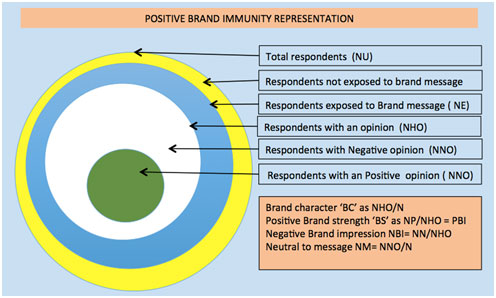
    If‘NU’ is the total number of respondents we connect with and ‘NE’ is the respondents exposed to the brand message. They will have an opinion or will have no opinion on the parameter.


    ‘NHO’is the number having an opinion on a set parameter on the brand. And ‘NNO’ (NE- NHO) is the set having no opinion.


    The second level is to find what is that impression. It is positive or negative.

    ‘NP’= the number of respondents who are positively inclined on the brand and ‘NN’ have a negative opinion. NHO= NP + NN

    In such a situation, we define Brand character ‘BC’ as NHO/N then
    Positive Brand strength ‘BS’ as NP/NHO = PBI
    Negative Brand impression NBI= NN/NHO
    Neutral to message NM= NNO/N


    The above example is a simplified version, where we have considered that only audience who have been exposed to message have an opinion on the brand parameter. In real life, people who have not been exposed will also have perceptions. And the diagram and values can be suitably be modified

    Tracking these comparable numeric values across competition will help us in fine-tuning our efforts. If one can isolate these figures for media exposed or lead media, it may help us determine media effectiveness.


    The brands aim should be to consciously focus on increasing the value of ‘NHO’ and ‘NP’. The high value of NNO is indicating creative inefficiencies.


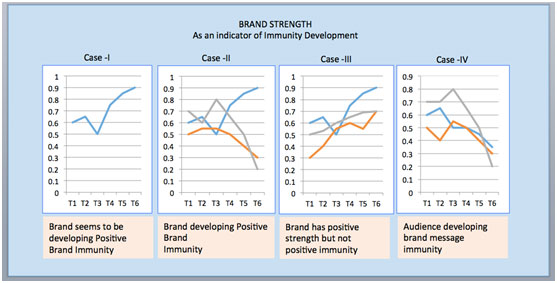
    If the trending line BS (numeric value) on a set message parameter is moving upwards (Case-I), the brand is developing Positive Immunity. It is a strong case when the BS for the competitive brandsisdecreasing (Case-II).


    If the BS value is climbing or high for all the brands (Case – III) then the consumer is developing immunity for the messages on that parameter, which is currently of  high importance.


    If the BS value for the all brands is all moving downwards (Case-IV) and is in low figure then the consumers has developing BRAND MESSAGE APATHY (BMA). It is the initial stage before immunity is developed.


    Another simple way is to use the Net-Brand-score result on ‘always- never’ scale. How likely they are to recommend the brand to their family and friends?  Use of ‘family and friends’ instead of ‘others’ is a stronger parameter. The respondents are forced to make a hard choice. They are clearly more accountable to friends and family than others in their circle.


    Priya Lobo of Ormax suggests use of perceptual scale than discreet values. The respondent places their brands visualising their level of confidence. It accommodates fractional differences andis a better measure of skew and inclination.


    But if there is no research planned, listening to chatter on social media can give directional inputs. Avoid using likes, shares and re-tweets as matrices for Positive Immunity. Positive Brand Immunity is a level before brand fanatics. Listen to find out if brand has succeeded in creating Brand influencers, ambassador and defenders?Use the tools to determine the size of Brand Bashers, which is reflection of Brand Immunity.


    These are some of simple ways to get directional recommendations.It is worth the brands time, efforts and money to get a research agency to probe the brands immunity levels. Hopefully that will help you enhance the effectiveness of your communication.


    Sanjeev Kotnala is Founder at Intradia World. A Brand, Marketing & Management UnConsult Advisor. He conducts specialised workshops in the area of IDEATION (Harvest and Liberate) and INNOVATION (InNoWait). He focuses energy in enhancing client’s team’s potential and capabilities and decreasing their dependence  on external resources. Email sanjeev@intradia.in  or tweet at s_kotnala visit www.intradia.inwww.sanjeevkotnala.com.


  • Fasten your Seatbelts for The Big Bihar Sunday


    By Shailesh Kapoor


    An election results day is here again. And this time, it’s a Sunday too. Bihar elections have been a long-drawn process, with an extended campaign period and five phases of polling. It will all come to an end on November 8, when the counting begins. And it promises to be a cliffhanger.


    Election results coverage is perhaps the only form of structured programming of any significance that news channels still have, besides the ‘talking heads locked in a debate’ format. It all gets over in a hurry, but it’s great fun while it lasts, especially if you can identify the best 2-3 news channels on the day and watch within that set, than surfing across more than a dozen of them.


    Most exit polls show a close finish for these elections, though Today’s Chanakya, best known for their 300+ forecast for NDA in the 2014 General Elections, is predicting a clear majority for NDA in Bihar. Sunday will be a crucial day for Chanakya too, not just for the two sides locked in a prestigious political battle.


    When we shifted from ballot paper to EVMs, the nature of election results programming changed overnight. Till then, anchors had all the time to engage in deep analysis. Psephologists, political experts and politicians themselves with spend considerable time in news studios. No one would be in a hurry. It would all roll out at a leisurely pace, with banter thrown in for good measure. Dr Prannoy Roy shone through those days. This format really suited his personality.


    When the EVMs arrived, we witnessed a time collapse. The real action, from the first leads coming in to a clear picture emerging, would take anything from half-hour to maximum two hours, depending on how one-sided or close the battle is.


    Most news channels are still experimenting with an ideal programming format that delivers to this T20-type brief. The viewer is bound to focus primarily on the leads window, much like business news channels are watched in market hours. So should one create a show that presents the leads information to viewers in a direct, almost idiot-proof, manner? Or should one create engaging programming for the high-engagement viewers who are deep into politics, and let everyone else focus on the window on the side or the bottom of the screen


    This is where anchor personalities can play a significant role. Choices like above are not easy to make. But viewers eventually tend to watch election results programming because they trust certain anchors for their experience and knowledge of the topic. Every anchor has his (rarely ‘her’ in this case) style that he needs to bring to the coverage. Technology and talking-heads are only aids.


    Yet, after Dr Roy, we haven’t had a standout election results anchor. Most top news anchors (across languages) do a serviceable job of the day, but there’s no one who will be remembered for his election results coverage before anything else. Perhaps an outcome of the EVMs coming in.