Category: COLUMNS

  • Ranjona Banerji: Damn the government, and get damned to death

    By Ranjona Banerji


    Jagendra Singh used his Facebook account to post his articles: he was a “social media” journalist based in Shahjahanpur. Apparently several “mainstream” reporters in UP checked with his page regularly for updates. Singh had put out several stories about allegations of the gangrape of an Anganwadi worker against Samajwadi Party member and minister for dairy development Ram Murti Verma. He also posted stories about land grabbing and illegal mining by the minister, a Kurmi strongman for whom the SP is his sixth party. Incidentally, the gangrape story has also been covered in the mainstream media.


    Singh was hounded and harassed by Verma and his men until on June 1 he was doused with kerosene and set alight, apparently by five policemen and Verma’s supporters. Singh remained alive long enough to record a dying declaration, accusing the minister and the police for his death and asking why indeed he was burnt when he could have been beaten up.


    Singh’s son Rahul says that people from the party have since offered him money and a government job to hush up the case.


    On one side, this incident represents total contempt for the law by the police and the political class. On the other, it shows the great difficulty of confronting those in power. Both sides tell a terrifying story. And yet one that is hardly new or unknown.


    In any other world, the minister would be made to resign pending an enquiry. Here, it took a week of public outrage after Jagendra Singh’s death for the five policemen involved to be suspended. The minister remains not just on the run but in power and it seems will continue to have support from above.


    To make matters worse, another journalist in Pilibhit, Haider Khan, was thrashed and then tied to a motorcycle and dragged along the road for 100 metres on Sunday. His “crime”? Stories on dubious land deals. He is in hospital in a critical condition and the police have started “an investigation against four people”.


    This is when you realise the importance of a forum for and of journalists. We do not need special laws. But we do need someone who can take up the fight for the Jagendras and Haiders of the world. Because even if you assume that Jagendra was wrong in his allegations, his punishment cannot be being burnt to death by policemen loyal to a politician. We know what can be expected from the UP government when the state’s horticulture minister ParasnathYadav refers to Jagendra Singh’s death by saying, “There are some incidents that happen in the course of nature and destiny.”


    I was going to write that we also need a society where accountability is taken seriously but it sounded like a clichéd joke when faced with such a legal and political system. The only hope is to keep covering such stories relentlessly.


    **


    A number of Twitter handles covering media gossip and news popped up last year using the word “Lutyens” to signify that they were focused in and Delhi politics. We all followed them and after titillating and entertaining their followers, most have petered out. @LutyensInsider remained strong however with its 40000+ followers.


    However, when @LutyensInsider started attacking journalist Swati Chaturvedi with malicious, pernicious and slanderous tweets, you knew both gossip and anonymity had gone too far. Chaturvedi, rather than laugh it off or ignore the abuse as so many of us do, decided to do take the anonymous handle on. She filed an FIR against the handle, complained to Twitter India and did whatever was necessary. The brave anonymous handle deleted all tweets and closed the account, shifted to another and then closed that as well. All power to Chaturvedi and every support for her case which she assured her followers she will pursue to the end.


    Does the employer of @LutyensInsider have any role to play here? He or she was presumably using information picked up in his or her line of work to share on Twitter. Was the anonymity of the handle licence enough for no one to be responsible?


    There is caveat here for all of us who use Twitter for salacious gossip. Twitter is an open forum and this is where its benefit lies. Trolling is one of the disadvantages but there is a difference between a sad lonely person trying to annoy people and working journalists using anonymity to settle scores.


    We also have the piquant situation where Chaturvedi is also accused of calling people names on Twitter. However, this “defence” of LutyensInsider has been put together by another anonymous Twitter handle which runs a website that attempts to critique the media. It is obviously not run by a journalist and it is nothing but a series of rambling rants on journalists the blogger does not like. It appears to be run by one of India’s millions of rightwing social media defenders of the current Central government. Irony? What’s that?


    Expression is free and good luck to such websites. My beef here however is with journalists who pretend that such websites are credible and post links with self-righteous zeal as if blogs about your personal likes and dislikes are equal to proof. No one can be that innocent, surely? Or, er, foolish?
     

  • Sanjeev Kotnala: Maggi and its many Lovers

    By Sanjeev Kotnala


    ‘Yeah, yeah, Uncle I know all this high decibel noise being created about Maggi and its illegal hidden affair with MSG. But, I don’t believe. I want as a protest. I want to start an ‘I Love Maggi Day’ or better ‘Get My Maggi Back Day’. All Maggi lovers will have at least one flavour of Maggi that day. If everybody who ever had Maggi was doing that, it will finish all the stock the government wants withdrawn. Definitely more environmentally friendly way to take care of it?’ This was Shweta, younger daughter of my friend said while really feeling the pinch of being denied her favourite Maggi.


    She asked if June 21 June would be a good day for the protest. I told here that there was a small problem: where will she find Maggi. She stopped for a moment and then said ‘yeah man you are right, so kids who cannot have Maggi will do a symbolic Maggi breakfast fast. In the evening, she visualises kids in Maggi brand colours with empty plates and fork walking in protest. All they will be carrying are two placards. ‘I LOVE MY MAGGI’ and ‘DECIDE FAST’.


    All she wishes is to get her Maggi back. It is on the brand to ensure an early return to shelves before kids like her find new love.


    To me this is  a demonstration of brand loyalty and power. It was like a mother who believes her son can do no wrong. Who believes that all the neighbours are unnecessarily complaining.


    The brand Maggi is not dead. It is not even in ICU. It cannot be allowed to die. It will make a come back. Sequels better than Hera {heri or Golmaal.


    I have been having Maggi since I was at IIM Ahmedabad, when it was the only thing you could surely find in all hostel pantries for late night snacks, much after even Soma Bhai tea stall at the gate was closed. Nothing happened. Another pack would do us no harm. With that thought, the Kotnala family for its love for Maggi, had a Maggi breakfast Sunday. It sounds so odd. When I asked for Maggi, the shopkeepers raised their eyebrows and gave me a knowing smile. I was not the only customer asking for Maggi. I could read his mind, given time; he could sell his stock at premium. And Shweta’s words started making sense.


    The marketer and the writer in me went hunting. The large subset waiting to give the brand a second chance was too bold to be ignored. It was their first and true love, with McDonald’s, KFC, Subway, all they have is a side affair.


    The Indifferent Dad. They ask their wives to take care of the issue.  They anyway were not the one pushing Maggi. If kids cannot have Maggi, then the mother must find an alternative to pacify them. That’s their way of resolving the issue. The day Maggi finds a solution, they will be Ok with it.


    I Told You So Dad. These are the super-literate highly logical people. They believe and take statements made in media at its face value. They philosophically add ‘ Brand you trust are the brand that break your trust’. They will willingly re-align to new-improved-equalised MSG MAGGI as and when it comes back. But till then Maggi is a no-no.


    It Is A Conspiracy Dad. They are the other extreme of rational thinking. They have many unanswered questions and their own theories. Why tests at some of the states are negative? Why all states are not withdrawing it? How come Singapore approved it? Is Maggi is so bad? Why not ban cigarettes and drinks too? Is the street food safe, why not check that? Why is the US suddenly finding fault with Haldiram? To them this is a larger conspiracy with some political vendetta. Most of them do not find Maggi at fault.


    The Hurt Mom. They are feeling let down. It took them time to adapt to Maggi. See the goodness in it. They welcomed it; they could add vegetables for the kids to have. The ease of making was something they always liked. They believe Maggi is not bad if not being good. But their motherly instinct hold them back from serving it now when its quality is a suspect. They are waiting for their own 2-minute kids pacifying fame to get back.


    The Anti-Maggi Mom. In the kitty party, while subtly showing off well-manicured nails, she speaks in a condaescending tone ‘We never give Maggi… It is not good, I knew it. How come something packed and fast to cook could be good.”  Their friends ignore her comment and side-step the discussion.


    When Will Maggi Be Back Kids. How has life changed? In Indore, they are back to Poha Jalebi. In Mumbai, to Goli Vada Pav. The Delhi gang is being fed Chjole Kulche or Aloo Parantha and so on. But they are missing their Maggi. They are waiting. This is the biggest subset. I believe if Shweta was to go ahead, a lot of them will join her.


    THE OLD ROMANTICS. The 40-plus age group. Gender-neutral. They grew up with Maggi. They are witness to the brand progress, from early rejection to a glorified adaptation and then becoming part of family, a staple diet. They have stories of Maggi dependency in college. For them a lot has happened over a pate of Maggi-Andaa before CCD came into picture. They are Romantics and the love for their old flame is alive. They surely rubbish the claims. They are like Salman fans, Maggi can not do wrong and they trust Nestle.


    I am of the firm opinion that the subset that believes in MAGGI is huge. They argue that MSG level should be checked at cooked level and not in masala sachet level. A point of view shared and popularised by Nestle.  They understand that ‘No Added MSG’ is wrong but willing to accept it.


    All they want is a fast resolution, so that they can get back to having Maggi.


    Hopefully, Nestle does not get over-confident and arrogant on this surge of love for the brand. They need to find the way to innovate and give the same taste in formats that are prescribed and acceptable to the controlling body. Getting into a long-term legal tussle is definitely not in favour of the brand. Nestle. It needs to get back much before the kids and their fans find a new better more contemporary exciting replacement in their life.


    Sanjeev Kotnala is Founder and Head Catalyst at Intradia. A Brand, Marketing and ManagementAdvisor. He conducts specialised workshops in the area of IDEATION (Harvest and Liberate) and Innovation (InNoWait). His focus energy in enhancing client’s internal team’s potential and capabilities. In processdecreasing their dependence  on external resources. To contact email sanjeev@intradia.in  or tweet at s_kotnala visit www.intradia.inwww.sanjeevkotnala.com.


  • Shailesh Kapoor: Lalit Modi: A Scam-Starved Media’s Saviour

    By Shailesh Kapoor


    The first 11 months of the Modi government at the Centre haven’t been the most eventful ones for the news media. In UPA-2, the media had the problem of plenty. One after the other, new scams would emerge, competing with each other for attention and news space. But that dried up May last year, after Narendra Modi came to power.


    The Delhi elections and the exciting, sometimes dubious, brand of politics by the Aam Aadmi Party ensured that there was some fodder for news channels to provide their viewers with their daily dose of political voyeurism. The occasional foot-in-the-mouth statements from the fringes in the ruling party also helped. But overall, it has been a lean, scam-free year.


    Till last week only, though. Starved for scams, the news media took to the Lalit Modi story like fish to water. It was like a homecoming after being away for an extended period of time. Five days down, the relentless coverage continues across channels and newspapers. And we know we haven’t seen the end of this ‘scam’ yet.


    Compare this controversy to 2G, Coalgate, CWG and other such big stories from UPA-2 and you would agree that this one is much weaker in content. There’s no real sense of loot after all. And lobbying and politician-corporate nexus have existed from times even before any of us were born. But, as they say, never let facts come in the way of a good story. Or in this case, never let facts decide how big a story it can be.


    There are many elements that make the Lalit Modi-Sushma Swaraj-Vasundhra Raje revelations newsworthy and highly entertaining too. First, the protagonist itself. Lalit is a media character in his own right. He’s not exactly the most pleasurable listening experience, but his unapologetic display of defiance makes it tough to ignore him. He gets journalists to fly to far-off Montenegro to interview him, and while a couple of them are in-flight, tweets that he will have to cancel the interviews because his ‘UK Lawyers’ advised him so.


    In many ways, Lalit is the face of crony capitalism that the Prime Minister has been accused of encouraging. It’s difficult for the Congress to launch a full-blown attack given the Robert Vadra precedent, but the controversy offers a delicious opportunity to the opposition nonetheless. I’m surprised no one has connected the common surname of the two Modis yet and tried to create a story out of it. Or may be I missed it.


    That the other two protagonists are women who have risen to powerful positions gives the story even more teeth in a country where politics is still a male bastion. This is a heady cocktail of powerplay, IPL, family ties, women empowerment, lifestyle of the rich and the famous, and even cancer. Our media would have to be too naïve to not lap it up.


    How this story has developed is also a good commentary of the state of our news media today, where the focus has shifted progressively over the last two decades from reporting the news to owning the news. There is bound to be impact and a head or two may roll in this case. And since the next scam may not be in sight, this story will be dragged for as long as it can sustain.


    So you know which industry you want to join if you want free trips to Montenegro and the likes.


  • Ranjona Banerji: Sycophantic media confused on govt reaction to Lalit Modi imbroglio

    By Ranjona Banerji


    For the past two weeks we have been consumed with the doings and sayings of Lalit Modi, ex- IPL commissioner, now on the run from the Enforcement Directorate for alleged financial improprieties during IPL season 2. Well, “on the run” is a slightly erroneous way of putting it since Modi has been safely ensconced in the UK since 2010 and travels all over Europe, thanks to his friends in high places.


    His “friends in high places” range from British politician Keith Vaz to a few British royals, India’s external affairs minister Sushma Swaraj, Rajasthan chief minister Vasundhara Raje and many others.


    The media has been all over the story and tales of impropriety which started with the UK’s Sunday Times have now taken over our TV channels and newspapers. However what, if anything, the Lalit Modi saga proves is the limited and largely delusionary “power” of the media. In spite of all the hysterics on our news channels and suitably outraged editorials, the Central government has not budged from its support of Swaraj and Raje and the prime minister has not said a word in public. Instead, he has been doing the relaxing makarasana on Rajpath.


    Those inside the media insisted that the revelations against Swaraj came from within the BJP – the ruling faction— which wanted to embarrass her. But Lalit Modi being the loose cannon he is, Raje was dragged in as were others. That was not apparently the intended result. Then rumours surfaced that Raje would be sacrificed and Swaraj saved. Be that as it may, the picture emerging now is a government refusing to relent in the face of something as wishy-washy as “propriety” and a sycophantic media a bit confused as to which direction to take.


    The neat segue to International Yoga Day and almost two days on non-stop coverage of people and politicians doing yoga underlines that confusion. The Modi (Lalit) imbroglio was almost forgotten as several contortions were made to prove anyone not doing yoga on Sunday June 21 was anti-India, anti-national and so on. Vice-President Hamid Ansari was also at the receiving end from the RSS’s Ram Madhav who then had to furiously backpedal to further incohesiveness.


    On Monday, we were back to Lalit Modi. Interestingly, what was called “Modigate” (because of the Indian media’s obsession with Watergate although most would be hard-pressed to remember what Richard Nixon looked like) is now being called “Lalitgate”. The reasons are obvious: Lalit Modi and Narendra Modi. Enough said.


    This story cannot go on forever and is already losing traction. There is additional confusion over whether to treat this as a cricket story or a political story. It is possible that to save our politicians and government, the focus will shift entirely to “cleaning up cricket” while everyone pretends that our politicians are squeaky-clean idols.


    **


    Soon after journalists in UP were killed and attacked, we have one more gruesome case from Madhya Pradesh. Sandeep Kothari, a journalist who worked in the Japalpur area and wrote for several local newspapers, was allegedly burnt to death for his series of stories on the sand mafia. Local journalists never get either the recognition or the rewards that mainstream and English language journalists do. Many are vilified as being fixers and operators. But it is also true that many do the groundwork that the media rests on. From all accounts, Kothari was relentless in his pursuit of the sand mafia in Jabalpur and paid the price in the worst possible way. Those of us who do not work against such odds must acknowledge, at least, how lucky we are if not the contribution made by the Kotharis, Singhs and Haiders of this cruel world.


  • Sanjeev Kotnala: 11 Reasons why your Training Programmes fail

    It’s the time of the year when most organisations tend to re-evaluate their training programmes and the progress they have made. Senior management sees it as not delivering the right ROI. Employees feel that right training is not being imparted. And the poor trainer suddenly has no idea why after a highly engaging interactive objectively driven session, the company has stopped calling him.


    The three major components to training management are Management, Participants and Trainers.


    The moot question is: does the training fails because of management attitude, participant apathy or trainer incompetence or a mix of all these?  Or it is the need gap analysis, timeline, frequency, content/ topic/ subject and the interest and view of the participants is where the organisation makes the mistake. 

    Surprisingly training session and or industry interaction and events get polarised reactions. From useless, waste of time to eye-opener and very relevant. Time one questioned  such unwarranted diversity.


    So we must check out where we are tripping in the process.

    1. TRAINING NEED GAP: Instead of trying to find excuses, the organisation will do itself good in analysing the way they determine training need gap identification. If it is end of the year review input, you are bound to get it wrong. Instead, if it asks the team leaders and team a simple input on what training is needed to ensure delivery on agreed objectives. Chances are you will get a far better result… you are bound to get a better result.


    2. QUALITY COMPROMISE: Next level of error is the cost-fee trap. The fixed/ ceiling on trainer fee per day create inefficiencies in your programme. You take out huge number of man-hours out of your system for training and yet willingly end up compromising on the venue, process and the trainer quality. Don’t we all know how badly it will impact the end-result?


    3. TREATING INDUSTRY EVENTS AS TRAINING: Replacing training with industry seminar/ conclave is the next culprit. On top of that, organisations tend to use non-strategic filters in nominating people for such events. They serve totally different functions. One must stop confusing between them and re-evaluate your reasons for participation ad process of nomination. Though not writing it off, being stringent on this count will ensure more funds for right training.


    4. SHORT NOTICE SHORT CHANGING TRAINING: Even if we do all things right, we still end up giving short notice to participants. This ensures failure. Allow delegates to create that work cushion providing them protection from irritant calls and mails during training. May be penalise who does not follow the rule… better penalise their team leader if such an environment is not created. It also allows your trainer to perfectly plan their schedule and enhance effectiveness.


    5. DIFFERENTIATE TRAINING AND PARTICIPANTS: Ensure that you are providing right training to right candidates and clearly differentiate into. (1) BASIC HYGIENE- EFFICIENCY ENHANCERS – that helps in doing the ritualistic topical day-to-day function. Every one must complete (2) HIGHER LEVEL- QUALITY ENHANCERS- still within the job requirement but somewhat strategic skill oriented. Employee must complete these to lead in that level  (3) GETTING READY FOR THE NEXT LEVEL- this is selective to the identified stars to get them ready for the future role. If this is followed then in long run the need for basic hygiene training will get limited to new recruits. (4) CROSS-FUNCTIONAL TRAINING- these are your real stars who must get trained in multiple function and verticals to create the internal mass you need for your future management.


    Do allow an employee a decent amount of liberty to opt out of only (1) and (2) types of trainings basis some internal skill evaluation


    6. WAITING FOR PERFECT FIT: The biggest challenge is to find that trainer, time, cost and delegates match and you keep waiting. Take a start, stop procrastination. May be even ask seniors within the organisation to warm up with few sessions.


    7. RESCHEDULE TRAP: The training programmes are recreated and drafted and rescheduled umpteen times. Don’t schedule any training on either side of the peak season. Don’t expect employees to completely take time out of weekends or holidays to participate in training. Have a one-day training on a weekday and for more day schedule do not depend on employees off time for more than 40% of the training time.


    8. REAL MONITORING: Do get feedback from participants immediately after training and once again after a reasonable time gap when you expect the delegates to have utilised some of the inputs. This will really answer if your programme is effective.


    9. MAKE TRAINING NOT A TASK BUT AN ADVENTURE. Not every training need to be experiential but the whole experience must be packaged in such a way that it is adventure. It must create that pull for attending and learning. Maybe it subject, content, venue, process or faculty. Do not overload and stretch your programmes into long hours unless it was an endurance-building workshop. Start on time-space training with decent breaks and finish n time.


    10. A TRAINING FOCUSSED AGENDA: Get committed and let everyone know how serious organisation is about it. Make it the seniors’ KRA to ensure that the designated delegate is relieved for training. Ensuring policies that strictly penalise employees missing a training session and awards consistency in training   is bound to help the organisation.


    11. CREATING TRAINING AMBASSADOR: Let positivity flow. If the above 10 were taken care of mostly you would have created training ambassador who will have good things to speak about the programme. Nothing works better than them. Ensuring that team leaders also share their training inputs with the team is another elementary move that gives positive results.


    Each one of us needs a recheck in the processes and the purpose of training. It is something that can really work wonders if executed well.


    Sanjeev Kotnala is Founder and Head Catalyst at Intradia. A Brand, Marketing and Management Advisor. He conducts specialised workshops in the area of IDEATION (Harvest and Liberate) and Innovation (InNoWait). His focus energy in enhancing client’s internal team’s potential and capabilities. In process decreasing their dependence  on external resources. To contact email sanjeev@intradia.in  or tweet at s_kotnala visit www.intradia.in  www.sanjeevkotnala.com.

  • Ranjona Banerji: Do we fight or do we bend and crawl to ensure our salary cheque every month?

    By Ranjona Banerji


    Forty years ago, the nation of India faced its toughest test. Its young democracy was attacked from powers within. The declaration of a national emergency by the then prime minister Indira Gandhi was a shocker and the beginning of some of India’s darkest days. Society however struggled to respond. It is hard for people today to imagine how different India was then. We had no 24 hour media. Most of us did not even have television. Newspapers were staid and conservative. Radio news broadcasts were still important. And Indira Gandhi was a towering figure, striding over the subcontinent, controlling us all.


    Or so we thought. In some ways, we did not even understand the importance of our fundamental rights and the freedom of the press until they were taken away. Although the JP movement calling for internal revolution against Gandhi and her policies excited students across India, we were still a conservative, status-quo society. Many people in fact welcome the Emergency because of the “discipline” it imposed on what was perceived as a lazy, good-for-nothing people. It was only later when the excesses of government policies, notably enforced sterilisation and slum clearance, became common knowledge that public anger started growing. The slogan “Nasbandi ke teen dalal: Indira, Sanjay, Bansilal” used to greet sterilisation trucks (Sterilisation has three brokers: Indira, Sanjay and Bansilal). And when everything is forbidden, as always happens, we were full of jokes and back humour about what was going on.


    But this is about the media. And what happened there was largely more shameful than the way Congress politicians acquiesced to the murder of democracy to save their careers. Most large newspaper groups felt it easier to give in than to fight. Interestingly, it is not far different from the way corporate and managers hold sway over newsrooms today. Or am I jumping the gun?


    Celebrated lawyer Soli Sorabjee wrote this about the Emergency in the book India 50: The Making of a Nation, co-edited and authored by senior journalist Ayaz Memon and myself: “The role of the national press in this was disgraceful. In the memorable words of LK Advani, when the press was asked to bend it chose to crawl. Leading newspapers and their editors fully realised both the absurdity and the illegality of the Censor’s action but were unwilling to challenge it in a court of law…”


    The Times of India, the Hindustan Times and the Hindu abandoned the most principles to play it safe. The Indian Express and The Statesman were far braver and therefore shone. Most memorable were the smaller, independent journals like Minoo Masani’s Freedom First, Rajmohan Gandhi’s Himmat and Astad Gorwala’s Opinion, who stood up to both Indira Gandhi and the Censor. Several language newspapers also held on to their rights.


    Sorabjee in the same article, quotes from the Bombay High Court’s judgment of February 1976, in the case of Binod Rau versus Minoo Masani: “It is not the function of the Censor acting under the Censorship Order to make all newspapers and periodicals trim their sails to one wind or to tow along in a single file or to speak in chorus in one voice. It is not for him to exercise his statutory powers to force public opinion into a single mould or to turn the press into an instrument for brainwashing the public… Merely because dissent, disapproval or criticism is expressed in strong language is no ground for banning its publication.”


    The Gujarat High Court called the censorship directives “a mask of suffocation and strangulation”.


    Indira Gandhi got her comeuppance in the elections of 1977.


    But what lessons has the media learnt from the Emergency? Do we still bend when we are asked to crawl? Have we fought enough for our rights – which amounts to the rights of the people to know – or have we decided it is easier to take a salary cheque than to fight for freedom of expression? Do we oppose transgressions on the rights of others or we calibrate our responses to suit our corporate masters and managers?


    Over the years, we have seen business and glamour journalism falling to market forces and done nothing. We now see political journalism being coloured totally by personal beliefs. The onus remains on individual journalists to stand up to newsroom pressures. Is that enough?


    I met Binod Rau, the Censor during the Emergency, in the 1990s. He was a broken man then, both apologetic and defensive about what he had been asked to do and what he did. An abject lesson in the dangers of giving in when you should stand firm no matter what you have to give up.


  • Ranjona Banerji: Fair, upright, always objective, never biased columnists to the PM’s rescue

    By Ranjona Banerji


    The recent attacks on journalists in Uttar Pradesh and Madhya Pradesh and the deaths of two, Jagendra Singh and Sandeep Kothari, have shocked many and started a small conversation between journalists. But the fact remains that the conversation is small. There is an undoubted divide between English language and regional journalists and the clout is largely concentrated in the hands of the English media.


    The divide is understood and accepted but it is not breached. On the whole, English language journalists are better paid and are seen as more professional. Language newspapers are often owner and agenda driven and journalists are used to do far more than report, sub and bring out a journal or produce news bulletins. Sadly, instead of the “professionalism” moving to local and regional journalists, English journalists are more and more opting to act as brokers for their owners and managers.


    We all know all this but are unable to give ourselves a voice and think and act as one. The outrage lasts for a while, dies and out and we are back to where we started. Thanks to cross-ownership patterns and television, some regional and local journalists are paid decent wages but not all and not enough. The wage board concept seems archaic and anachronistic but for many journalists it is the only safeguard to give them some wage at all.


    The plight of the local journalist is best explained in this op-ed piece by Omar Rashid in The Hindu:

    http://www.thehindu.com/opinion/op-ed/for-regional-journalists-its-a-fight-for-survival/article7364281.ece


    **


    There has been a lot of muttering on social media that “the media” has not been doing enough on the “Vyapam” scam in Madhya Pradesh. The allegation is the admission and selection processes to government jobs and colleges were rigged by the Madhya Pradesh Professional Examination Board. The numbers run into 1000s. The problem appears to go back to 2008. Investigations began in 2013. Over 1800 people were arrested. Oddly, somewhere between 25 and 40 witnesses and suspects have died since 2013. The state government insists that these are “natural” deaths but logic belies that argument.


    Stories, reports and opinions about this scam and the spate of deaths have all appeared regularly in local and national newspapers. The perceived problem in today’s India is that no issue is an issue unless it appears on television debates with plenty finger-pointing and defensive yelling. As we have seen in the Lalit Modi case.


    Unfortunately for the dead suspects and witnesses, prime time debates have not seen fit to take on the government in this particular instance. The Lalit Modi saga continues to excite although it may well die out soon.


    **


    One of the funniest aspects of the Lalit Modi case is the number of “expert”commentators coming out in support of the former IPL commissioner Lalit Modi, now in self-imposed exile in Mayfair, Montenegro, Portugal, Venice and such like tough places to live and party. Many of these belong to the category which tends to moan and bemoan the tremendous damage done to cricket by the short format game and the high glitz of the Indian Premier League. From Indian Express to New Indian Express to firstpost.com to The Times of India and more, they tell us how Lalit Modi is misunderstood and misjudged. He was wickedly hounded by the former UPA government and the BCCI for nothing.


    It does not take much to see that these fair, upright, always objective, never biased columnists, known for their slight tilt towards the BJP (unlike ghastly paid media unspeakably evil anti-Hindu anti-India secular dynasty hacks), are in fact trying to protect prime minister Narendra Modi from any and all possible muck from this case which has embroiled his external affairs minister and the chief minister of a BJP-ruled state.


    Looking forward to more efforts to sanctify Lalit Modi on the road to saving Narendra Modi…


    **


    The Press Institute of India and the International Committee of the Red Cross announce their annual competition for the three best articles and three best photographs on a humanitarian subject. This year’s theme is “Reporting on the fate of victims of natural/manmade disasters”. The awards carry cash prizes of Rs 50,000, Rs 30,000 and Rs 20,000.


    Reports and photographs need to have been published between April 2014 and March 2015 in any language or English journal.


    Please visit www.pressinstitute.in for further details.


  • Who’s Afraid of ASCI?


    By Sanjeev Kotnala


    Normally communication is not given high enough an importance and it’s common to point out that it is just a small part of the whole system. Right. But when it comes to brand image and perception, suddenly all fingers starts pointing at it. In case of an erroneous advertisement called to attention by the media or a consumer, communication and the stakeholders in the process become direct scapegoats. It is a situation that could be avoided with proper planning and sensitising people involved in the process.  Unfortunately, we have a whipping boy ASCI; the designate self-regulatory body – the Advertising Standards Council of India, which keeps low, and no one is afraid of.


    There are many things that go against ASCI, including their own processes and lack of willingness to be in focus other than infrequent press reporting in some remote page position. It fails to have an effective impact in brand and consumer life.


    The Time Trap or Time Warp. ASCI suffers because of its dependence on processes that were designed for a non-digital, non-instant and highly non-intrusive era. These processes designed to create fairness in hearing of a complaint and the gap between council meetings creates buffer that are more than sufficient for the brand-at-fault to take advantage of.


    Though ASCI has been at it and has done wonderful work in streamlining the processes, I submit they have been inadequate. Even an ‘express’ system is not fast enough for current times.


    There is a need to have council members who are passionate about ASCI’s role. Have rules that allow council members to consider, remarks and vote from a remote location. Maybe create a larger bank of council members so that not much pressure is exerted on their time and always there are available a set of members that will complete the quorum.  How nice it would be to get a direction and a verdict within 48 hours of complaint submission!


    If the brand has willingly strategies to create the ad, that has been produced, the background support should be available at the flick of a button or a click of the pad. Time we did away with that long time given for brands to reply.


    The Soft Velvet Touch treatment. No smart Brand manager is afraid of ASCI. When the max penalty for releasing a misguiding advertisement is just withdrawal, it makes life so simple. It’s easy to take advantage of this window between complain and resolution. In fact some brands can even plan the release to increase the window of opportunity.


    What needed is to give ASCI the power it deserves. At least the penalties awarded must be complied with before re-evaluation in legal system is entertained.  And during this readdressing of verdict, the default communication must remain caged.


    The wish to have ASCI as nodal autonomous body with final verdict may be far-fetched and full of legal loopholes. In current digital era when so much rides on communication, it should not be left to chance.


    May be it’s time we went a bit rough on defaulting brands. On first default, the brand should be asked to withdraw the communication. This is also the current practice. For a second default by Brand (even if a different communication), it must be forced to run a corrigendum in same size, duration in three main media. Vehicle used for the misguiding communication. For the third such act, the brand should run a corrigendum and be debarred form advertising in the media where the misguiding communication had appeared.


    Meanwhile like DND phone numbers, ASCI should create an easy to access archive of defaulting communication and brands. It must get its member media access and power to deny releasing a defaulting brand communication. May be in addition to the RO, brands must also provide a statement of ownership and confirm that the claims are not objected by ASCI or there exist sufficient data or reports to support the claim.


    Media B2B Communication: Something that is very near to the ASCI governing members. And maybe for media B2B communication a directional advice can be given to the brands through remote voting without waiting for defending the brand’s answer.


    I would want to see a situation where a brand is prevented from lodging any fresh complaints for a pre-decided time period if the last two complaints by it have not been upheld. Also, a brand against which complaint has been upheld should not be allowed to advertise for some period. I know this will never happen.


    Creative Agencies Becoming Mini-Regulators: There is a definite need to sensitise creative and media agencies. They must willingly and as ask their client clarification or detail in case the claims and supports do not match.


    There is even a pre-release checking facility at ASCI, where the brands can get an initial non-negative check done wrt the claims and representation. I am not sure how many are aware of and how many have availaed fo the service.


    Trust me, the era of taking things for granted is over. The offended brands are not going to remain silent. The common man – the ultimate consumer – now knows his/her rights and is willing to challenge brands on their promises. Social media is acting as a sword with twin edges.  Time to cultivate habit of self-regulation at every possible checkpoint. Time to have sub-regulatory teams in client office, in agencies and in media. Time to be far more transparent and vocal against the offending brands and to give ASCI decisions and progress a wider reach.  Or let us be ready for the alternate, which is a terrifying thought.  A new nodal agency thrust upon this industry. Then we know nothing will remain impossible.


    Sanjeev Kotnala is Founder and Head Catalyst at Intradia. A Brand, Marketing and Management Advisor. He conducts specialised workshops in the area of IDEATION (Harvest and Liberate) and Innovation (InNoWait). His focus energy in enhancing client’s internal team’s potential and capabilities. In process decreasing their dependence  on external resources. To contact email sanjeev@intradia.in  or tweet at s_kotnala visit www.intradia.in  www.sanjeevkotnala.com.


  • Ranjona Banerji: Does anyone remember what the Lalit Modi escapades are about any more?

    By Ranjona Banerji


    For what seems like years but could just be under a month, TV news has been going hammer and tongs at the NDA government at the Centre over the Lalit Modi escapades. Every night hapless BJP spokespersons, once masters and mistresses of The Smirk and then emperors and empresses of Arrogance in Victory, are pulverized, pummelled and made to look pitiful by TV anchors in their element.


    The facts of the case – whatever they were – have long been lost. We jump from new allegation, revelation and expose night after night and have possibly gone so far from where we started that there seems to be no way back. Is the issue Lalit Modi, former darling of the IPL, and money-laundering and other cases against him? Is the issue lack of propriety and probity by Sushma Swaraj and Vasundhare Raje? Is the issue the silence of the prime minister who excoriated his predecessor for his silence when the going got tough for UPA II?


    By now, I can bet the reader has forgotten what everyone is fighting about. If our news channels would like to continue with this until they get what they want, they need to run little refresher courses about what has happened so far. From what one has seen so far, the Centre would like to brazen this out or take its chances once the monsoon session begins. If TV thinks the story is still worthwhile, then some hard investigation may serve it better than nightly high-decibel hysterics. O lord, do I even know what I’m saying?


    **


    Is international news television more adult than India’s or just more boring? The last week has been Greece Greece Greece IS IS IS. Oddly, though, if you go to the home nations where these channels broadcast from then the main stories there are as local and often as piffly as ours. Which suggests that international viewing audiences are extremely aware, intelligent and interested in important world events. Or, they like to snooze with the TV on…


    **


    The Times of India, god bless its soul, seems to have lost its bearings a little. I must put in a disclaimer here: I worked for TOI for almost four years and had hardly any bad moments there. But lately, the paper has lost focus and sharpness. Its editorial page is one of the worst in the country and its choice of news and presentation is more questionable than it has been in a long while.


    The Mumbai edition, which had improved so much to make the citadel impregnable some 10 years ago, now resorts to some very sensationalist and cheap tricks. Take this front page headline from this week: “5 women held in 3 weeks for driving drunk.” The peg (!) of course is the Jahnvi Gadkar case, where a lawyer with Reliance had an accident which killed two people. However, the headline about the drunk women links to a story on an inside page where says that 824 people were booked for driving drunk in Mumbai in three weeks. For those with weak arithmetic like me, that’s 819 men to five women. So is driving drunk a gender issue? A gender problem? Are women behind the wheel (five to 819) a more significant statistic? Do the numbers correspond with the ratio of male to female drivers? Or is this pure sexist sensationalism?
    I wonder.


    **


    Last week saw the death of one of India’s most erudite, prolific and respected journalists, Praful Bidwai. He was only 66 and died of a heart attack in Amsterdam. His politics was emphatically left but his cogent and incisive analytical style and his scholarship made him and should make him an icon for all journalists. An irreparable loss.


  • Shailesh Kapoor: Are Reality Show Judges too Eager to Please?


    By Shailesh Kapoor


    The season of reality shows has well and truly taken off. It’s a typical phenomenon every year after the IPL concludes, but there seems that much extra on-air this year. Star Plus has Nach Baliye, and there will soon be Dance+. Colors had India’s Got Talent and there will soon be Jhalak Reloaded. One variant of DID on Zee has given way to a new season of the main DID show. Indian Idol Junior on Sony and The Voice on &TV complete the GEC reality list. So, if you have been tracking the category, eight reality shows have been in the mix, either on-air or in promotional stages. Not to talk about half a dozen others on youth channels.


    All the eight mentioned above have a format that needs a jury. So, we are talking of more than 20 different judges across these shows. Now, that’s an industry in itself. Choreographers, film directors and actors typically dominate the list.


    Watching a typical episode of one of these reality shows will make you feel there’s immense pressure on this lot of 20 to ‘perform’. It’s like a mini-competition on the sidelines of the larger channel battles. Everyone is out there to make an impact, without an understanding of the respect and awe that should accompany a jury chair.


    It’s cue-a-gimmick judging, where interspersed between performances (all eight are talent shows, though two of them are about celebrity contestants), a judge would take off on a journey that’s ridiculously disconnected with the show. Reading shaayri is the latest favorite. What Anu Malik and Navjot Sidhu started has now become everyone’s domain.


    Then there’s this sudden urge to hug contestants on stage that about a dozen judges should be medically treated for. It takes about 30 seconds of footage and barring rare exceptions, you don’t feel a speck of emotion watching it.


    The new favorite that’s emerging can be called ‘Let’s pull each other’s leg’. Admittedly, it’s a lot more entertaining than the shaayri and the hugs. But when it happens every seven minutes, you begin to wonder whether you should call it a talent show.


    Reality shows have been a core area of our work over the last seven years. There are three essential ingredients of what a good jury member should have, irrespective of the format of the talent show.

    1. Should be an expert in the field.
    2. Should encourage and motivate participants.
    3. Should come across as humble and rooted.


    The first one may seem obvious on the face of it, but go through the list of 20 and you would know there are at least five crosses on it. But it’s the second and the third where the real gap would lie. Fans of MasterChef Australia would know what these three points mean. The jury of that show embodies them. And yet, there is no trace of gimmick and showmanship on the screen. It’s a natural, free-flowing format that delivers emotions and entertainment within itself. Nothing needs to be ‘cued’.


    The original Dance India Dance jury (Geet Kapur, Terence Lewis & Remo D’Souza) met this brief very well. They had no star value at that time, and yet, would count in my book as the most successful jury combination in the two-decade history of reality television in India.


    The India’s Got Talent jury for the last two seasons (Kirron Kher, Karan Johar & Malaika Arora Khan) top the current set of juries. There was a lot of free flow in the judging process, especially aided by Kher’s disarming persona, and the gimmicks, while they were present, rarely interfered with the format.


    But at a larger category level, it’s time for producers and channels to question their penchant of ‘over-writing’ reality shows. Let the ‘reality’ prevail, and we may have better content!


    And a note to the hosts: When you ask for state capitals to test a contestant’s knowledge, it is not called an IQ Test.


  • Ranjona Banerji: Media finally wakes up to ‘Vyapam’ scam

    By Ranjona Banerji


    The poor media. Damned if it does and damned if it doesn’t. For the past two weeks, the media – particularly television – has been slammed on social media for ignoring the deaths of witnesses and accused in an examination and recruitment case in Madhya Pradesh. The implication was clear – because Madhya Pradesh was a BJP-ruled state with the much-respected Shivraj Chouhan as chief minister, some sections of the media were handling the story with those clichéd kid gloves.


    However, the death of Aaj Tak reporter Akshay Singh has galvanised the entire media into action. Most of English TV’s bigwigs landed in Bhopal to cover the story and “grill” the government on the deaths of more than 40 people connected to the “Vyapam” scam. There are two aspects to the story and the cynical might be reminded that while the scam itself is under investigation, the fact that so many people around it and involved in it have died is intriguing, if not a cause for concern.


    I have no doubt that very soon the defence of the BJP will begin within the media especially from neutral columnists who are emphatically pro-BJP. They will see a giant conspiracy to defame the ruling party and the prime minister Narendra Modi. Others will speculate on how all the scams and wrongdoings seem to emanate from people within the BJP who are direct competition to Modi. Others will of course see the immense power of the Congress and Sonia Gandhi – with only 44 seats in the Lok Sabha and failing influence everywhere else – which controls the media when it has almost nothing to offer it in return.


    This last thought process is already evident amongst respected columnists and prime idiots amongst our fraternity who feel that the Lalit Modi story was nudged off the air because the former IPL chief mentioned the names of the Gandhis of the Congress. The current weakness of the Congress Party seems to have passed these people by. Also, a basic journalistic sense would have told them that the story was bound to die out if the government did nothing. In fact, the government played the waiting game and for all that experts and journalists talked about probity and propriety, no action was taken against either external affairs minister Sushma Swaraj or Rajasthan chief minister Vasundhara Raje. The media is unlikely to carry on with a story for weeks when nothing happens. That is common sense and a little experience and a lot of common sense would have told these worthies that.


    The other sad fact of life is that when you are in power, you face the most flak. It seems absurd that I even have to write this. The focus of the media has to be on the government and the party in power. In the light of this, endless stories about Rahul Gandhi skipping around daisy fields are unlikely. (On second thoughts…!) Nor are stories about why Rahul Gandhi is silent and why Rahul Gandhi is out of the country going to be more exciting than why is Narendra Modi silent and why is Narendra Modi out of the country – although what is true for one is true for the other.


    **


    My very sad moral of the story to all my fellow journalists who are in love with Narendra Modi is this: it’s only going to get worse. And calling me or any journalist who focuses on the government in power a “presstitute” might make you feel better but it is not going to change reality. My condolences.


  • Sanjeev Kotnala: Media needs a makeover in the visual digial world

    By Sanjeev Kotnala


    One of my friends not from advertising and media world was working on a presentation for his Senior Vice President. A part in it dealt with the current status and future trend in the media and entertainment scene in India.  Somewhere, he decided to bring it alive pictorially in the digitally visual driven world.


    Once you have the presentation format and slide layout, life become easy. Now he was concentrating on visual aiding the same. He did what any other self-respecting-professional in his place would have done. He Googled and set out in his search for the best representation in sync with the presentation thought.  What Google played back was just amazing.


    If he was an outsider and was neither Indian nor PIO, I would understand his dilemma.  He  was completely dependent on the digital visual signatures and traces for his impression and perception about India. Truly the images that were staring back would represent this country but in early 1990’s.


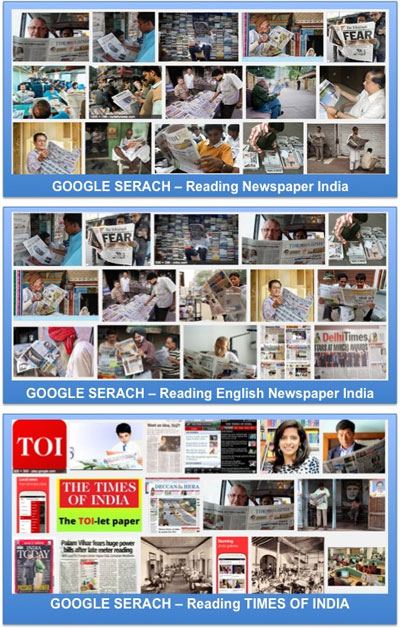
    It was nothing complicated and this is not something exaggerated. He Googled for few simple terms like ‘Reading Newspaper India’, ‘Watching television India’, ‘Media watching Cinema India’ and ‘listening radio India’ etc. The selection of pictures that he found himself staring on his screen projected an image that we all would vouch to be misguiding. But then he had used a completely trusted reliable global resource and an effective reference source even for advertising and communication.


    This too in an era where the government is shouting the gigital mantra few times every week.


    Surprisingly, the problem progressively decreases as we move from newspaper- Category to English News paper – Sub Category to TOI- a Brand.


    Again if you search for  ‘Reading Dainik Bhaskar’, the image that you get are much nearer to what the brand team may associate and want to see in an ‘egosurf’ results.


    Now, this is not an isolated case. The problem remains when you search for other medium be it TV, Radio or outdoor.The search keeps throwing up throwing up images like sea throws garbage on marine drive after high tide. The digital visual imagery does no justice to the status.


    So I am not sure, whose job it is to intervene and ensure that the first page of media image search, reflects the true picture. Is it the duty of the brands? It is definitely whenever it’s the brand in question. And they are doing a decent enough job. Maybe they need to just tweak their digital feed.  The beautiful pictures both category, brand and their audience which is much part of the B2B or B2C communication be properly tagged in this unforgiving highly dynamic digital world. Maybe it is a role of the industry associations that represent these media. Otherwise in a longer term we will find no change but people blaming  ‘Made in India’, ‘Swatch Bharat’, ‘Incredible India’ and maybe even a foreign hand for the same.


    Let me be honest, I am not sure if the search originated at LA or London, would the Google algorithm would have served the same images.  But, that is neither important nor the point being made.


    I did ‘egosurf’ myself to check if I am digitally alive, relevant and updated. At least, I could see the areas I should be working on.


    Maybe it is time that we do an ‘egosurf’ for the category, brand and associated consumers imagery and take some steps to correct as much as possible. It will not only work for the media but also the country.