Category: COLUMNS

  • Sanjeev Kotnala: Cross Media Matrix – Time for Indian Publications to take the leap

    By Sanjeev Kotnala


    Why should anyone be interested the latest report of EMMA, the Enhanced Media Matrix Australia? The answer could be a wishful thinking and the necessity of future. We are probably at the right point to leap forward. Today, in complexly fragmented multi-title and multi-screen media engagement, a study like EMMA, the cross-platform audience insight survey makes ample sense. There is chaos and as truly Indians we have adapted to the situation of mistrust of data. A rival rebel league is definitely into making as a section cries for relevant data. In TV mapping, BARC is already talking of multi-screen measurement. It is absolutely the right time for a disruptive jump.


    For the uninitiated, EMMA surveys “54,000 people in a year, seven days a week using sophisticated techniques”. For the survey part it uses a mix of 90% Computer Aided Phone Interview (CATI), 10% Computer Aided Personal Interviews (CAPI) and supplements with 8% door-to-door.


    EMMA measures readership across print, website, mobile and tablet. It covers AIR, Average Day of week readership, Reach and frequency data, cross platform audience for major newspaper and magazines and Newspaper inserted magazines. Additionally and interestingly it captures branded sectional data within the newspaper and provides contemporary segmentation and insights into 40 product categories down to brand level. Taking it a step further it covers Media Engagement data (Media Consumption and media most useful), Print engagement (Source, Loyalty, Motivation connection and action) and Demographics including Geo-demographics Segmentation.


    It covers 600 newspapers and magazines including 250 regional titles. The media fraternity in Australia sees it as an enabler for the advertisers and the media agencies to project a more realistic current size and profile of readers. It provides a Monthly report and uses a quarterly databases to project.


    The game of such readership or cross media matrixes is all about transparency and independence, rigour of methodology, collaborative efforts, dedicated unbiased body, better & deeper insights, industry acceptance, keeping pace with the change in media matrixes, support of Industry bodies and confirmed delivery on committed frequency. Seems like too many variables but who said it will be easy. These are essential for any new report sustainability.


    To battle the disputes and allow publications selective inclusion in the report, EMMA entertains new request for title inclusion in a quarterly cycle. Interestingly, the way out to publication is also open and transparent. A running title can request being dropped from EMMA coverage by providing a six-month notice along with an explanation, but EMMA can elect to continue measuring a title despite having received a publisher request to withdraw from the measurement. I personally like this simple framework.


    Independent Research Company ‘Ipsos MediaCT’ (IPSOS) developed the EMMA report in Australia. They have experience of conducting surveys in 40 other countries. This EMMA report is not too old or a very recent development.  Work on it started with the contract awarded by The Readership Works (TRW) in 2010. The first report was out in 2013 and the current report reflects a continuum of 18 months data with trends and comparative data.


    It is interesting to note that the first report of EMMA in 2013 showed huge surge in newspaper readership compared to the earlier ‘Roy Morgan’ reports. It resulted in news captions like ‘Time to fix buyer’s distorted views of newspaper’ and  ‘Publication giants swoon over EMMA data’. But it had strong support of publishers who believed in the process and that the data was just few reports away from stabilising. Somehow we find this kind of trust missing in our part of the world.


    TRW and Ipsos created EMMA with the sole aim to help advertisers make fast decisions with greater accuracy. It in process consulted with leading industry bodies like Media federation of Australia (MFA), Magazine Publishers of Australia (MPA), Australian Association of National Advertisers (AANA) and leading researcher & experts. Wish for an Indian game unveiled in some time cannot be just a dream.


    EMMA is delivered on a pre-defined release timetable. The dates for reports delivered over a Desktop software and cloud till Oct 2015 ares already announced. This predictability has been missing in Indian readership reports.


    For the cross media matrix to become a reality, we need someone with initiative and passion and belief. A wishful thinking. We are united in our division.


    But, if it was to somehow happen, the industry will benefit. It will be a leap forward. It would allow media agencies & planners to provide highly effective and efficient media investment plans for their clients. And efficient planning always favours the industry by enhancing belief and an urge to increase investment. Something the print industry needs at this stage


    ……………………………………………………………………….

    Sanjeev Kotnala is Founder and Head Catalyst at Intradia. A Brand, Marketing and Management Advisor. He conducts specialised workshops in the area of IDEATION (Harvest and Liberate) and Innovation (InNoWait). His focus energy in enhancing client’s internal team’s potential and capabilities. In process decreasing their dependence  on external resources. To contact email sanjeev@intradia.in  or tweet at s_kotnala visit www.intradia.in  www.sanjeevkotnala.com.


  • Shailesh Kapoor: 2015: IPL’s Watershed Edition?

    By Shailesh Kapoor


    Since its start in 2008, the Indian Premier League (IPL) has managed to grab advertiser and media attention like no other property ever did, before or after IPL launched. Today, it may not seem to be such a big deal, but the success of IPL was never a given. But on the opening night in 2008, when Brendon McCullum got the league zooming at top speed, no one has doubted whether IPL would work. It’s always been a question of how big a success it would be.


    2008-10 were strong, settling-in years for IPL. Audiences lapped up the entertainment, and viewership saw steady consolidation. However, it was clear by the end of 2010 that creating franchises with solid fan base will be no child’s play. Only Chennai, Mumbai and Kolkata managed to create a strong base for themselves, while others like Delhi, Punjab, Rajasthan and even Bangalore struggled to build brands.


    As a result of this fragile franchise loyalty, IPL became an “entertainment dose” for most viewers, than an emotional rollercoaster. This, in turn, led to low involvement viewership. When the 2011 season started, at the back of a long and highly satisfying World Cup for India, the cracks showed. Viewership dropped, because the need for the entertainment dose was not felt after the World Cup win, and the emotional benefits were missing anyway.


    2012-14 were difficult years as well. Viewership was stagnant to declining, depending on whether you consider the newly-introduced LC1 markets in the mix or not. Spot fixing controversies plagued the league’s credibility in the media in particular, and the cricket itself was, at best, semi-competitive.


    When the 2015 season started, again at the back of a long World Cup, there were question marks on how well the IPL will perform. But what we have seen this season may well be the turnaround story in IPL’s short history.


    To begin with, viewership has increased by a significant notch. Even as the industry gets used to a new currency, there are enough data points, including some run by us, that suggest this has been the best season since 2010 in terms of viewership and engagement levels.


    A series of close games have contributed to this success in no small measure. But that’s the cricket part that, unlike what some may like us to believe, is beyond the stakeholders’ control. The part that has been controlled well is the stability of team compositions, which has been a major concern in the past. Key players have now built strong associations with their franchises, and viewers know what to expect from each game, as a result. Mumbai, Chennai and Kolkata still remain big draws, but with enough star-power packed in, Bangalore has managed to pull in a sizeable viewer base too.


    Equally importantly, this has been a clean season, with no controversies on or off the field. The focus has been more on the cricket and cricketing entertainment, than on the frills that tend to spice up IPL on the face of it, but have damaged its core from within in the past.


    You may not be a big fan of the IPL. But you cannot deny the success story that it has proven to be, and the way it has impacted two ends of its stakeholders – the cricket community (players and boards), in whose life IPL is a very significant factor, and television viewers, who continue to be entertained year after year, even as mainstream television entertainment continues to test their patience.


    So, more power to IPL. May the two remaining games, tonight and this Sunday, cap off its best season so far.


  • Ranjona Banerji: Media unfair on Kejriwal (& why tennis lovers must now fight for their own TVviewing rights)

    By Ranjona Banerji


    It is hard for anyone to deny that the Aam Aadmi Party and its earlier avatar, the India Against Corruption movement, got unprecedented support from the media, especially television. At the end of the day, the AAP is a party which has not managed to make much headway electorally at least, beyond Delhi. It has got far more national media space than any other state government in India, most of which are full-fledged state governments.


    However, Delhi chief minister Arvind Kejriwal’s various tantrums and threats to the media notwithstanding, it now appears that the coverage of the AAP and its government has become vicious and even unfair. Undue and gleeful attention is now paid to every possible transgression by the party. Some TV channels seem to find it hard to accept that there are lawyers and constitutional experts who actually agree with AAP in the current imbroglio with between the state government and the lieutenant-governor over bureaucratic appointments.


    There is a need here for the media to step back a bit and consider its obsession –whether for or against – with AAP which is now bordering on the absurd.


    **


    It is commendable when the media and especially TV take on the important and self-important on behalf of the ordinary person. However, as we saw when it came to the brick-throwing story, a little more diligence would have been better journalism. Equally, when it came to the very courageous young woman in Agra, who objected to a security guard winking at her, some considered focus would have made for a more accurate story. For those who came in late, a gun-toting policeman accompanying some political type winked at a woman on a two-wheeler. She objected and tried to take a picture of the man. He picked up her phone and smashed it. She jumped on top of the car he was in, sat on the bonnet and attacked the windshield with the party flag on the car.


    She became an immediate heroine and with good reason. Women who have had enough street harassment empathised and people who are sick of political posturing wanted more. Evening discussions on TV however targeted the political party and the man in the car. As a rule, we in India feel that politicians are by nature venal and deserve to be dragged over the coals at every opportunity (except for those we admire or worship of course). The media also finds politicians the easiest target.


    But however idiotic the Samajwadi Party member was in this instance and how dare he ride around in a Mercedes and why does his sister speak for him, surely the first port of questioning should have been the head of whichever force the winker belonged to? The transgression that started the fight was his after all…


    **


    The French Open, one of the four Grand Slams of tennis, begins this weekend. And for reasons we should be familiar with now, all tennis and sports lovers will not be able to watch it. All those who subscribe to Tata Sky that is. Because the French Open rights belong to Neo Sports.


    My advice: start fighting for your viewing rights now.


  • Ranjona Banerji: Indian journalism exposed by ‘one year’ coverage


    By Ranjona Banerji


    The great gaps in Indian journalism have been exposed by the coverage of one year of the Narendra Modi government at the Centre. And also, the great divide within.


    The media, print, television and digital (if only we could add radio to this list), have embarked on a first anniversary analysis of the government’s performance. This includes report cards, which former prime minister Manmohan Singh used to do with his Cabinet.


    However, who do you find to both praise and critique the government’s performance and appear to be objective? Commentators and analysts have been very sharply divided between pro-Modi and anti-Modi since the nation kicked into election mode in 2014. The supporters are usually either BJP members or open admirers. The anti-brigade are the usual suspects and somewhat larger in number because they include academics and activists.


    The only recourse therefore to “balanced” coverage is to ask members of the BJP itself and BJP-appointed members of organisations or pro-BJP corporate to assess the government’s performance. Obviously there is no balance there at all but perhaps there is no option.


    So that’s as far as columnists and analysts go. What about bog-standard newspaper coverage? Here we see, more or less, straight outright hero worship. The Times of India’s Mumbai edition gives the Modi government over 77 per cent on May 26, the anniversary of the swearing-in or anointment as TV anchors preferred to gush. Oddly a survey for May 16, the first anniversary of the election results, in the same newspaper, showed many Indians, especially those living in Mumbai, not quite so happy with the government’s performance. Perhaps something dramatic happened in the last 10 days that the rest of us are unaware of?


    The Economic Times outdid its sibling paper with its 20 or more days of coverage and analysis of the first year. The paper on May 26 led with the headline “Lage Raho Narendrabhai”, a salute to the successful Lage Raho Munnabhai movies about the life and times of a lovable petty gangster. Not sure if the editors saw the irony there or had not seen the movies… Judging by the gush and mush, I would reckon they thought they were just being super-clever.


    The Hindustan Times, Hindu, Telegraph, Indian Express and so on follow the model but with comparatively less hero worship… but am not sure that that’s saying a lot… TV is so idiotically breathlessly ra-ra that analysis is sometimes not possible. The websites have managed to be better sources of opinion than newspapers but is that because they depend not as much on advertising revenue?


    **


    Rather than speaking to so many “experts”, how would it have worked if newspaper reporters or maybe editors themselves, actually ventured out to the streets to speak to the general public. After all, they are the ones who vote and who wanted “achche din” after four years of stagnation. Had these people understood that the promises made were dismissed as “jumla” or that the promised good days were not supposed to arrive for the next 60 years?


    It might have been interesting to know how editors would spin the word on the street. Surveys are so much easier and so what if they’re not always right? You can always increase the margin of error to plus-minus 15 per cent, no?


    The foreign media, perhaps most interested in India because of Modi, has been more balanced in their assessment. This is actually a scathing indictment of the Indian media as a whole because it means that too many managements and editors put business interests ahead of truth… Hmm, what’s new, eh?


    **


    Meanwhile, some Hindi newspapers reported that chairs were broken by crowds angry with Modi’s one-year celebration speech in Mathura on Sunday. Did any English newspaper or TV channel report this?


    Ranjona Banerji is a senior journalist and commentator. She is also Consulting Editor, MxMIndia. The views expressed here are her own. She can be reached via Twitter at @ranjona


  • Sanjeev Kotnala: Comparing apples with oranges. Why you must compare Goafest & Kyoorius

    By Sanjeev Kotnala


    It is bound to happen. And my telling otherwise is not going to help. Comparisons are inevitable. The industry remains divided between the two. No one has taken sides. They are waiting and watching further development.  Will they become two iconic award properties? Will Kyoorius replace Goafest? Will delegates attend both or will they sacrifice one of them? If yes, then who will lose.  Their being less than seven weeks apart adds to the conflict.


    Goafest, the event supported by the industry bodies like AAAI, Ad Club, ISA and IAA is 10 years’ old. It is held in Goa, the fun capital in the peak of the summer, something not everyone is comfortable with. But it helps to keep costs under control and attract more delegates. It may be credited to have brought the industry together on many subjects, yet it is the cause of divided too. On an average, on twin-sharing basis a delegate spends Rs 36,000.


    Kyoorius is two-year-old industry function in the advertising arena, run by an independent organisation. It extended itself to include partner events this year. It is held in Mumbai, the advertising capital of the country, which gives it advantage of reach. To attend the awards and ZeeMelt15 you spent on an average of 5,500 inclusive of travel to and fro from home.


    Here is disclaimer. I attended all editions of Goafest, first edition of Kyoorius Awards and missed this year’s edition + ZeeMelt15. The comments here are based on conversation with statistically significant number of delegates. As the rule goes ‘Perception is bigger than reality’, I did not contact any official, promoter or sponsor at the two shows.


    Kyoorius may have failed to generate the desired heat with so many seminars, workshops and talks but its contet been appreciated. Yet, an overall feeling remains that it lacked the buzz, the fun and the glamour associated with the industry. This was the real first year: give it time. Goafest wins hands down in area of buzz, excitement but definitely need to reinvent itself on content. Unfortunately, no one really knows what the fault with Goafest content is. Seems media verdict and conversation over tea and smoke shape perceptions.  Maybe it refers to parallel tracks, India-relevant talks and workshops. My belief: all it needs is to get the non-participating agencies back into game.


    This is where Kyoorius won. It had the agencies missing in Goafest participating. With its stated objective of awarding the work, jury gallery, transparency and the dazzle of the award function, it looked more popular, serious and inviting.


    Kyoorius defined its intent. It created space for  some relevant practical sessions with partner brands. Goafest seemed doing more of a lip-service to its ever-changing themes. If one believes  all the talk then it seems the partner brands with their relevant category / brand-centric events  are getting more buck for theuir money in Kyoorius than the sponsors in Goafest. Something that need serious rethink.


    Goafest seems more like what advertising events are. Fun-and-work together. Away from work. Immersion into complete festivity. The true Goa feel you can only get in Goa.  This was missing in Kyoorius. The delegate from Mumbai always had work in their backyard and many attended it for only one-half. The number of registered delegates can not be debated but there is doubt on how many really turned up at Kyoorius. Anyway it was far short of the target.


    Both awards have the capability of becoming Asia-Pacific events. One of them seems to be in a hurry and  has a headstart. It is speaking with the other regional awards for partnership. Goafest currently does not have much to show much other than few entries and delegates from neighbouring countries.


    Oh, on the party, Goafest outscores Kyoorius many times over. Though the party in Goa are really one banqet hall affair and very cramped for space. The party at Kyoorius was termed serious and no fun.


    Net net, even though we may say more the merrier and that space exists for more than three or four such events spaced out thrugh the year, the truth remain that finally there maybe  space for just two national level awards, but only one regional award festival. So, with time, one award function will have to supersede the other. Merger is out of question. Kyoorius has cleary stated its intent to be THE SHOW in India’s advertising calendar. There is nothing wrong with it but for the small hitch that is Goafest’s ambitions are the same. Having left few flanks open and allowed this to happen Goafest has its work cut out for the 2016 edition.


    Sanjeev Kotnala is Founder and Head Catalyst at Intradia. A Brand, Marketing and Management Advisor. He conducts specialised workshops in the area of IDEATION (Harvest and Liberate) and Innovation (InNoWait). His focus energy in enhancing client’s internal team’s potential and capabilities. In process decreasing their dependence  on external resources. To contact email sanjeev@intradia.in  or tweet at s_kotnala visit www.intradia.in  www.sanjeevkotnala.com.


  • Ranjona Banerji: Not enough on heat wave

    By Ranjona Banerji


    The latest count is over 2000 deaths in India because of the heat. Most are in Andhra Pradesh-Telangana but there are casualties across the nation. However, if you only relied on the Indian media to give you this information, you would have to concentrate on local media or mainstream South-based media. For the national media, 2000 deaths is a side story to all the usual political hoopla that we are obsessed with.


    So the main headlines in print and on TV have been one year of Narendra Modi, one year of Narendra Modi, one year of Narendra Modi, Kejriwal v Jung, school board results, the President of India and Bofors, TRAI allegations against Manmohan Singh, Manmohan Singh meets Modi, Rahul Gandhi eats fish in Kerala and more along those lines.


    Before all you defensive journalists get your knickers in a twist and mutter over stories that were carried on the heat wave please compare them to all the other headline news and you might get a chance to understand my point.


    My case is simple: whatever you did was not enough. There has to be more to newsgathering than politics and minutiae reporting about our (I mean “your”) political heroes. And this north-south divide has surely run its course. We cannot possibly boast of how we have entered the 21st century as a nation and still determine that 1400 people dead in South India is of little concern to people living north of the Vindhyas.


    The editors of the Dehradun edition of the Times of India for instance have decided that we who live here are not interested in these deaths at all. However, the local Garhwal Post is interested. So is the dak edition of the Hindu from Delhi, the Indian Express and of course the most news on the deaths comes from Asian Age because of its Deccan Chronicle connection. I have not noticed too many commentators and experts wasting their time on these deaths either. I may be wrong but the general feeling seems to be: if it’s hot, the poor will die and please crank up the air-conditioning. And yet, there are issues about global warming, environmental damage, increasing deforestation and development and water shortages which lead to these deaths. Are these not important?


    Am I being unfair? In 2013, I was in England in the summer. It was blisteringly hot. Two people died from heat reactions, including one young soldier. The coverage was constant and comprehensive. I am being unfair here and making a comparison. Things have reached such a pass that you can get better news of the heat wave in India from foreign websites, news channels and newspapers.


    **


    In all the massive sycophancy shown to politicians of this hue or that by journalists, you have to commend India’s cartoonists who have become our most objective commentators on life and politics. A big thank you to Keshav, Ajit Ninan, Manjul, Satish Acharya, Hemant Morparia and anyone else I have left out. I salute you!


    **


    What was the Mumbai Mirror thinking? Its film reviewer gave the film Tanu Weds Manu Returns two-and-a-half stars. This is why you hire reviewers: so that they share their opinions, favourable or critical, with your readers. However, after seeing a kinder public reaction (or reading other critics?), the newspaper put out a notice saying that since people liked the film, they were increasing the number of stars to three-and-a-half! Okay, you and I can read between the lines. It had nothing to do with readers or critics. Long live marketing!

    PS:  Just heard: the Mumbai Mirror reviewer Rahul Desai has quit on this issue.


  • Ranjona Banerji: Is there enough scandal in sports journalism?

    By Ranjona Banerji


    The way sports journalists look at scams, scandals and problems within the sport they cover is very intriguing. Many, and this is hardly surprising, choose sports because they have a passion or a fan interest. This makes them some of the best writers in the entire gamut of journalism. But does it make them good journalists? No one covers a civic beat for instance because they have had a childhood passion for municipal politics. But it can and is a treasure chest of great stories and an opportunity for excellent journalism.


    So the “Sepp Blatter and FIFA versus the rest of the goodie-goodie world” story was impossible to decode for the casual observer. And everyone agreed that it would make no difference to football fans across the world. The western media, sports and otherwise, often looks at such scams in terms of how the third/non-white world operates. So the main objection to Qatar being awarded a football World Cup was the human issue labourers dying while making stadia. However. it could be postulated that workers might also die building other structures in Qatar. It seems a logical impossibility that they only die when connected to football.


    If there is no outrage for those deaths then it would imply there is a bigger picture or the anti-Qatar feeling is tinged with racism and hypocrisy in the world of football. You see this very often with some parts of the British media and cricket where everything immoral about betting and match-fixing is sub-continental – the former Empire acting up and proving why the Brits shouldn’t have left. The “white” cricketers involved (and there are many) is because they were naive, innocent, trapped, really thought they were discussing the weather and so on.


    Even when former South African cricket captain Hansie Cronje was caught by the Delhi police with incontrovertible evidence of involvement in match-fixing in 2000, several sympathetic articles appeared in the western press on how a believing Christian could never be involved in such stuff. Cue in evil Indian police authorities for daring to point fingers at a white man!


    This is not meant to be a diatribe against racism in cricket journalism. It is just an example of how sports and general journalists cannot sometimes see the woods for the trees. They get caught up in other issues (why is the BCCI so powerful) or get affected by their fandom (how can someone who bats so well be a crook). I worked for a short while with a cricket magazine in 2000 when the match-fixing scam broke. Many of the sports journalists around me were genuinely shocked that such a thing had happened even though rumours had been swirling around for years and Tehelka had done a sting operation on dodgy dealings in cricket some years earlier.


    While cricket fans were to some extent appalled as events unfolded in 2000, we have clearly been told that no football fan is bothered by what FIFA is accused of. Like the intrigues of the BCCI, many international sports associations are dominated by one man, full of money, politics, lifestyles and fun and games of various sorts. Blatter’s surviving skills outdo most reviled BCCI members so what does that tell us about sport and fairplay?


    In tennis, which I watch very closely, I have noticed that issues of drug abuse and betting are barely reported before they are swept under the courts. French sports magazine L’Equipe went hammer and tongs at Lance Armstrong for drug abuse as he won Tour de France after Tour de France until they were proved right. But French tennis player Richard Gasquet gets a small ban and a tiny rap on the knuckles for kissing a girl at a party and getting cocaine all over his lips. Really. Marin Cilic comes back from a drug-related ban and wins the US Open. Hmm. Even if they are both innocent, and they may well be, where are the stories?


    It is, intriguingly, the players who talk the most about drugs and betting but cursory attention is paid to what they say. A scandal of sorts has emerged in the ongoing French Open about defending men’s champion Rafael Nadal asking the Association of Tennis Players to remove a chair umpire from his matches, a request apparently not made to the French Open but still followed. Senior and well-respected umpire, Carlos Bernardes’s apparent crime was to enforce the ATP’s own rules against Nadal. In other words, he was doing his job. There has been some minor reporting on this and other top players have objected to the favour done to Nadal, but that is about it. Has anyone seen much on this in the Indian media, although the French Open is covered by all newspapers?


  • Sanjeev Kotnala: The Sponsor’s Gita in Sports Mahabharata

    By Sanjeev Kotnala


    Mahabharata, the epic war between two polarised views happens in every yug. Kalyug is a bit different. Here it happens every year, maybe a new Mahabharata every moment, many of them at the global level.  The Kauravas and Pandavas are decided not on ethics and attitude but who wins. Pandavas always win and hence winners are Pandavas, it is that simple in Kalyug.


    FIFA maybe the (n+1)th Mahabharata. Where titans clashed for position. Where it is still tough to say who are the Kauravas.  Time and again, naive media (Sanjay) has been trying to report unbiased. Unfortunately, it takes its job far more seriously than needed. The audience (Blind Dhristrashtrya) is just a silent witness. There is no real option for them. They are addicted and misguided.   They think that the game is played for them. How interesting a thought that is!  They keep themselves busy with stars and  teams who parasitically feed on the psychological frenzy created.


    Unknown to them there are puppeteers that hold the strings. They are ‘the-know-all’ consultants, the Titans or the new Muraris of the game. In Kalyug, there is not one, but many Muraris. They fight their own battle and have their own self-defined dharma.


    Then there are the five pillars. They think they are the Pandavas and we wish they were.


    Yudhister, the top administrative body knows dharma and its role. In Kalyug, the definition of Dharma is more like drama. They are busy collecting Punya (good deeds) of hard currency. They see no wrong and lives by that order.


    Bhīma, the player, is there for his performance. Many Bhīmas in this yug have unsuccessfully tried creating newer versions and challenge the craft and Yudhister. But they have failed miserably


    Arjuna, the sponsor, is detail-oriented and very focussed. He is the saka (friend) of Murari. He has time and again tried to stand in his own. But he is powerful. Every time there is a new plan of Khandavprastha the doubt of house of wax creeps in his mind


    Nakul, the regional sports body, just follows and does what Yudhister tells them to do. Sahadev, the team and franchise-owner, is happy till the time they remain protected of their interest. They never have dreams so large that they would upset the cart.


    These Pandavas remain united for the world. But in Kalyug, there is no sharing of Draupadi, the lusty exciting life that is full of Maya and corruption.  And this fight remains between the top three Pandavas. Favours are traded, and every time the new Bhisma, the instigator and the whistle blower are silenced.


    Every time a new Mahabharata starts, the war to corruption takes centrestage. Arjuna, the sponsor, feels tremors and trembles with fear.  How will he make a difference? Then the Kalyug Murari consultant show him the complete mega-swaroop (physical representation) and gives him the Kalyug Gyan (Knowledge).


    ‘Who are you. You are transitory to the game. You did not create the game.  You do not own it. You do not live it. You are just one of the many visitors in this journey of growth which will some day end. Every product and a game have a life cycle, Acharya Procter said so but you are the immortal. You will leave this game and find another. Will that be better or bad is a fear that holds you. If you think you brought anything to this franchise. You are a fool. What you will take from here. Nothing. Because you came with nothing and once this link is broken Parth (friend), sponsor you will go with nothing. Every thing is transitory. Will your fighting make any difference? Not. Will your not fighting make any difference? No. See me, I bring them along. All of you are part o me. When I am there, you fear nothing.


    Sponsor Kiye ja. Corruption Ki chinta na kar. Tu nahi karega. Toh koi aur karega. Game eek maya hai. Nirantar anandikal say chalti aa rahi hai. Tere jaisey kahi sponsor aaye aur chalegaye. Ek din tu be jayega. Yeh satya hai. Par jab tak tu ish mahayudhya mai hai. Karm kiye za. Tu sponsor varna ka hai. Tera dharma hai brand association and audience linkages. Corruption sey tere kya lena dena.


    Keep sponsoring. Do not fear corruption. Do not think about it. If you will not sponsor, someone else will do. But game will get sponsored. That is also a truth. Games are just an illusion. It has been happening from centuries. Like you, many sponsors came and went. One day you will also leave. This is the truth. But till the time you are in this battle and this game, keep doing what you do the best.  You belong to the caste of sponsors. Your accountability and responsibility is brand association and audience linkages. You got nothing to do with the corruption.


    Now it is up to you. If you wish to strip off the mega-marketing arsenal of sponsorship and leave this ground open for your competition to own. It is your wish. Relationships are transitory, sponsorships and ownership of associations permanent.


    Arjuna the sponsor acknowledges the truth and he bows his head to the knowledge he has just gained. He has made his customary sound of disturbance. He has showed his willingness and desire to play the game as defined in his dharma.  Now he is free form his obligations. What he sees is stadium filled blind Dhrstrashtras. There are many more in their house waiting for Sanjay to start his coverage.


    And then there are few sponsors like Karna, coming from the same mother marketing (Kunti), but they are the losers.


    The Games are played at many level and few of them are on the pitches. Life continues and so does the games and successful Murari opens his bed in the first class cabin of the new flight. There are many fires that he must douse.


  • Shailesh Kapoor: Celebrity Endorsement Pangs and the Kangana Solution

    By Shailesh Kapoor


    It’s been the week of the Maggi fiasco, the discussions around which have been laced with more humour than anger or fear. While the real issue, of whether Maggi noodles are safe to consume or not, is still being investigated, someone’s fertile imagination propped up an entirely fringe element in this controversy – that of celebrity endorsers being held liable if the brand they endorse breaches standards of safety or ethics.


    The topic is of immense interest to me, given that a part of our work involves understanding popularity and imagery of celebrities, and its impact on the brands they endorse. If I had to summarise five years of collective learning on the topic: The top 15-20 celebrities in the country bring genuine value to brands they endorse (subject to threshold creative executions), and a long-tail of dozens of other celebrities get endorsements, because these brands cannot afford the Top 20, but add no real value to their brands at all.


    On an average, a topline celebrity endorses about 4-5 brands at any point of time. That would mean that about 100 topline endorsements are being advertised at any time. Add to that co-branded associations with film, in-film placements, IPL and other sporting leagues-led endorsements, fringe celebrities, etc. and the count would cross 300.


    Much as I have tried to objectively understand how celebrities could be held accountable for the conduct of brands they endorse, I have made little headway. If Madhuri Dixit signs a contract with Nestle to endorse Maggi on defined commercial terms, and the contract explicitly states that the brand will be responsible if Maggi is found to be lying to its consumers (or some such articulation), it should be Madhuri Dixit who should be contemplating a lawsuit against Nestle for tarnishing her image.


    What did we expect her to do? Take Maggi noodle packets to Government labs herself and get them tested? If a product is on the shelf, it is deemed to have passed all the statutory tests of safety. And if it is indeed found to be unsafe later, the testing authorities (Food Safety &Standards Authority of India in this case) and the brand itself must be accountable in an investigation that may reveal huge lacuna in some of the testing processes, not to speak of the potential corruption that could exist.


    Celebrities have been soft targets for years now. While we should be critical of celebrities making insensitive comments in their attempts to show solidarity towards co-celebrities who were found to be on the wrong side of the law, we should be equally critical of (mostly) fringe groups that exploit celebrities as soft targets, sometimes for fame, sometimes out of jealousy, sometimes out of plain stupidity.


    The celebrity endorsement market has its own set of challenges. Things are far from perfect there. For me, the big story from this market over the last month was when Kangana Ranaut revealed that she has refused fairness cream endorsements and went on to explain her stand: “People tell me that I don’t know English but they should know what is acceptable and what is not. You are pale, you are dark, you are brown or you are black; there is nothing called fair. So stop using this humiliating word.”


    Much of the media industry advocates self-censorship, and celebrities too should be applying the same to their choice of brands, than going about signing up endorsements recklessly in what tends to become a rat race between them. We need many others like Ranaut to portray a more responsible and wholesome image of the celebrity fraternity. Much as that expectation is a “fair” one, lynching celebrities for just going about their work in a professional way is not cool either.


  • Ranjona Banerji: Should the media highlight or ignore the PM’s comments in Bangladesh?

    By Ranjona Banerji


    Alan Rusbridger, editor of The Guardian for 20 years, stepped down at the end of May. In that time, newspaper – in keeping with its formidable reputation – has held politicians and governments to public scrutiny. In recent times, The Guardian has exposed the nexus between the media and politicians in the phone-hacking scandal and also carried Edward Snowden’s revelations about government snooping. Rusbridger considers The Guardian’s powerful presence in the digital space one of his triumphs. He steps down as editor but continues to stand up as an influential voice and an inspiration to all journalists. An evening spent listening to him at the Mumbai Press Club a couple of years ago was revelatory and educative as he shared his insights and the lessons he had learned in a charming and self-deprecatory manner.


    The Guardian now has Katherine Viner as editor and Rusbridger heads the Scott Trust which runs the Guardian.


    This is his farewell piece to readers:

    http://www.theguardian.com/media/2015/may/29/farewell-readers-alan-rusbridger-on-leaving-the-guardian


    **


    The prime minister’s visit to Bangladesh was a success with the signing of some very important agreements between the two nations. Yes, it is true that much of the groundwork had been done by the previous government but it is also true that government is a continuous process.


    So has the media failed in its duty by its coverage of the PM’s trip next door? First, there was blanket broadcasting by all news channels and constant bombarding on Twitter about every single prime ministerial activity down to the vegetarian meal he was served. The inner details of the agreement were left to newspaper columnists and to channels like Lok Sabha and Rajya Sabha TV to discuss.


    Our private TV channels got caught up in Narendra Modi’s needless remark about Sheikh Hasina, the Bangladesh PM, having zero tolerance for terrorism, “despite being a woman”. Or Modi’s observation that he or India and Bangladesh deserved a Nobel prize for the land border agreement.


    Here’s the conundrum: If you ignore such comments, are you then airbrushing over the prime minister’s errors? Do these comments not deserve to be highlighted? But if you do discuss them, are you ignoring the larger picture and indulging in nit-picking?


    The correct answer would be one supposes to focus on both but when it comes to today’s Bollywoodised lowest-common-denominator thinking, drama has to win over content. We go back to all the research that tells us that no one reads edit pages anyway.


    **


    Rahul Desai, the film reviewer who quit Mumbai Mirror after the newspaper changed his rating for a film based on popular demand or some such excuse, has written this excellent piece on the plight of the film reviewer in these market-driven times. It is a sad commentary on how hard it is to remain fair or free when everything around you has succumbed to PR and market pressure. It also shows the scant respect that many newsrooms or managements have for individual points of view.

    http://scroll.in/article/732431/what-the-mumbai-mirror-critic-who-quit-over-altered-movie-ratings-has-to-say-about-reviewing


    **


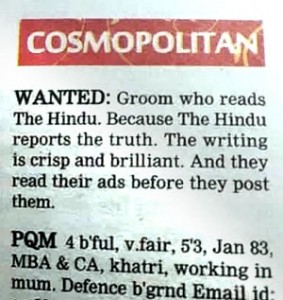
    And while on Mumbai Mirror, The Hindu pulled a fast one on the paper by putting a little ad promoting itself into the Mirror’s classified sections. It’s not often that Indian media makes jokes like this…

  • Sanjeev Kotnala: Appreciating contribution in creating highly untrained leadership in advertising

    By Sanjeev Kotnala


    The classic quote “Our assets go down in the elevator every night” still reflects advertising and communication organisations and highly people-centric professions. Yet, the practice defies logic. Surprisingly, beyond learning on the run, they do nothing in terms of organised training. Throwing in the deep end seems to be the only formula the top management and poor HR believe in.


    No surprise that employees lack loyalty and find it necessary to look at outside opportunities to expand their scope and relevance in ever competitive environment.


    Continued training, learning and development process can provide leverage in talent acquisition and retention in addition to enhance human capital and efficiencies at work.  Motivate employees infusing them with the skills and knowledge sets that make them future proof and more attractive to hire. Expect no change till the top management continues to see HR as a recruitment cell and an expense.


    The management is happy doing lip-service with yearly annual conclaves punctuated with few nominations to industry forums and seminars. That is neither training nor coaching. The knowledge pedalled in such sessions is easily available to the proactive smart employees without organisations intervention.  No one is voicing their concern, raising the voice or ask for it. HR is busy filling the gaps created by loss of employees failing to realise that lack of training could be one of the cause for the situation.


    There is a shocking lack of investment in identifying training needs. There exists no set process for evaluation of the content, process and partners that can help train. Training, if any, never ventures outside the tactical job requirement restricting its scope and impact. Unfortunately, the new generation looking for wider exposure is not satisfied with on-the-job training. They are looking for complete cross-functional area training, involvement in their employees’ development and discussion, policies that provide support for sabbaticals, support on going education.


    “A average Starbuck Barista employee gets more training than the average communication employee,”  commented Arnold Bennett on a 4As worldwide survey.  Truth may not be different. Organisations are not realising that this apathy is creating a future untrained management and talent pool. Yet, we are surprised when clients go hunting with consultants, niche agencies and freelancers who as a practice invest a lot more in their training, knowledge acquisition and keeping pace with new business realities.


    If you agree that employees are your best assets and bet, if you agree that the ratio of new employees to old will always be miniscule and if you agree that the existing employees have a stronger understanding and are in sync with the process and culture, then it makes absolutely no sense in creating a future management team of highly untrained leaders.  May be you need to rethink your training and L&D policies and plans.


    Sanjeev Kotnala is Founder and Head Catalyst at Intradia. A Brand, Marketing and Management Advisor. He conducts specialised workshops in the area of IDEATION (Harvest and Liberate) and Innovation (InNoWait). His focus energy in enhancing client’s internal team’s potential and capabilities. In process decreasing their dependence  on external resources. To contact email sanjeev@intradia.in  or tweet at s_kotnala visit www.intradia.in  www.sanjeevkotnala.com.


  • Shailesh Kapoor: Getting Used to BARC

    By Shailesh Kapoor


    The new (BARC) ratings are settling in and individual-level data is now available as well. As the market adapts to a new measurement system, there is a hint of confusion in the air. And there’s one dominant reason for it – the constant comparison between the old (TAM) and the new measurement systems.


    No two designs of a large sample study give similar results, especially when there are several conceptual changes in their design, like that of the NCCS being adopted instead of the SEC system. At best, one can compare ranks. For example, it is reasonable to expect that the No 1 channel in a category would not be different in the two systems, especially if there was a wide gap between the Top 2 in the old system.


    BARC has been built on the premise that it is more robust, secure and future-ready compared to the old system. It was created because there were widespread concerns about the old system. A comparison exercise, then, becomes a contradiction in itself. Hopefully, the dust will settle soon, and the focus will shift on the new data than its comparisons with the old. And there will be enough and more to unravel.


    The Hindi GEC programme ratings of the latest week (as well as recent weeks) tell their own story. The Top 5 programmes last week were Saathiya, Ashoka, Sasural Simar Ka, Balika Vadhu and Yeh Rishta Kya Kehlata Hai. Except Ashoka, which launched earlier this year, the other four are old horses, with an average lifespan of five-and-a-half years!


    There’s a clear consumer statement in this rather simple, back-of-the-envelope data point. More than 150 new fiction shows have launched over the last five years. Yet, the audiences have stayed with their staple primetime diet over half a decade! That’s less a comment on the high quality of the staple and more a comment on how the new attempts have not managed to take the offering to the proverbial next level.


    Even Diya Aur Baati Hum, which would have made it to the list in another week, is a 2011 show. What exactly happened to Hindi GEC fiction content in 2012-14? Equally importantly, because large proportion of viewership of the top shows isdriven by habit and nostalgia, wouldn’t there be viewership attrition (if and) when these shows are off-air? We would need many more Ashokas to keep the fiction flag flying high.


    Meanwhile, even as new fiction struggles, non-fiction continues to make some impact. It may not feature in the Top 5 this week, but the latest season of India’s Got Talent is by far its best. There’s little to fault in this reality show that combines outstanding talent with great production, and a jury that should get full marks for their chemistry alone.


    I was also impressed by the first two episodes of The Voice India. The format is strikingly different from other singing shows, and the casting of the four coaches makes it a near-coup. I’m curious to see how the show shapes up, especially once the team selection process, the current differentiator, is over.


    Yes, there’s enough to talk about on the content front, once we shift focus from TAM vs. BARC.