Category: BLOGS

  • One Big Idea by Tuhina Anand: Find and nurture the right talent

    By Tuhina Anand


    The media and advertising sector needs a major shake-up to bring back their shine. This can only happen if the industry is able to attract the right kind of talent and most importantly is able to nurture its existing talent. The industry is made by its people and if you have best of talent it will reflect on the work that the industry will produce. Most importantly it’s not just enough to attract that talent but also being able to retain and nurture the talent so that there is constant motivation and encouragement to continue doing the good work.


    The industry needs to look beyond the predictable places from where they usually get talent. There is a need to come out of the boxes they have created for themselves within which they try to fit in a person’s skill and qualifications and if that doesn’t happen it doesn’t work. But that should not be the case. Instead, scout for talent at the most unlikely places and then nurture them to become the future leaders. The idea being that the industry needs to give up their biases when zeroing in on a talent and they will be amazed with the quality of people that might emerge from their unconventional approach.


  • One Big Idea by Shruti Pushkarna: Video needs a perception change

    By Shruti Pushkarna


    When I was asked to write this piece, I was totally blank. We keep complaining about the industry and how things are but when confronted with the question, “What’s my one big idea for the media sector?” I couldn’t put my finger on any one thing in specific.


    I have been part of this industry for around seven years now and much has changed over the years, technology for one has changed the way we function at various levels. While there is hue and cry over how Internet is the next big thing or not even next, ‘Internet’ is the big thing, the reality is still very different in some aspects.


    Talking from my personal experience, whenever I have approached industry people for video interviews, (and I have shot quite a few for MxMIndia in the past one year), their first response is of excitement, excitement from being featured on camera, but the minute you tell them it’s for the Web, the excitement levels go down a bit because the web is not ‘television’.


    Somehow television still remains the bigger medium (while that is true in terms of visibility) but for change to come, there needs to be a change in perception, of course apart from infrastructural development for other mediums to thrive and become as popular. The Media needs to be more neutral in approach I think, the content should matter more than the medium. If people in the trade will differentiate between formats (web vs. TV vs. print), then how do we expect to reach a level of convergence for the mass consumers?


  • One Big Idea by Johnson Napier: Have an idea, seal it!

    By Johnson Napier


    An idea, it is said, has the innate ability to strike when one least expects it. If we were to go back in time over the past few years and look up ideas that were discovered by its inventors, most could be attributed as being born at the spur of the moment. But while the basic premise for an idea is for it to be converted into an actionable force, not many go on to achieve that milestone. If we consider the realm of media and ponder over ideas that have managed to bring about a change in the recent past, the list would be an endless one. But ask anybody who comes from a media background in India about ideas by individuals/organisation that have changed the business environment and one name that would find a quick mention is Zee Group. Not that the others have not done enough but we don’t need to be told what the Subhash Chandra-led Zee Group managed to do when it bought in digitisation in the early 90s thereby pioneering the Indian cable and satellite television industry or the changes that it bought about in the woefully cluttered broadcast environment by flagging off its direct-to-home initiative.


    Like Zee, there are several examples that one can boast of to drive home the point that our industry indeed has what it takes to get us going. But then the thing about ideas is that they need to keep evolving constantly and cannot be stopped even momentarily. After all, the industry has leapfrogged many a milestone to reach where it is today and to be ready to embrace the future it has to stay prepared today. And, as we’d all like to believe, it is only by the power of one big idea can we rise above the horizon and be an example worthy of emulation.


  • Ranjona Banerji: Time to junk ‘exclusive’ tag

    By Ranjona Banerji


    When television bigwigs grace us with their onscreen presence in the daytime, you know that the Supreme Vampire Council has decided that sunshine is no longer anathema to night crawlers. Okay, okay, I’m kidding. It means that this story is a biggie and the bigwigs want to be part of it.


    So how would this work in newspaper terms? Do all the senior editors run out of their cubby holes, cubicles and cabins and decide that instead of all the reporters well-versed in this biggie story, they are now going cover it? Or do they brush aside all the copy editors and take on the task of collating, investigating, interviewing, reporting and presenting the story themselves? Or do they do the job they are supposed to – plan, direct, add on, prompt, encourage, roar, explode and whip a story into shape?


    It is a measure of how TV runs that the limelight seems like the deciding factor. Senior print editors can take on some of the roles of their colleagues but they would be foolish to try and replace them – not that there are no fools in newspaper newsrooms; no dearth at some times, it seems. But this is where these two branches of journalism run on fast separating tracks. No editor-in-chief of a newspaper worth his salt would jump into a story just to get a front page byline – unless he or she (on the off chance) had played a major role in breaking the story or has some impeccable sources. They might analyse it, they may do an interview here and there and provide perspective. There is a great satisfaction in being the behind-the-scenes master of ceremonies or puppeteer or even manipulator in a newspaper.


    Anyway, back to the point. The chit fund scam broke in West Bengal and on the day that the owner of the Saradha group Sudipta Sen was arrested, all the TV bigwigs announced their presence on daytime television.


    Sen had written a letter before he ran away claiming that he was being harassed and used and was contemplating suicide. I myself first read about this letter in The Indian Express. But Times Now and Headlines Today simultaneously claimed to have exclusive rights to the letter and later the rest of TV had it as well. The next day The Times of India said it had revealed the letter first.


    Perhaps it is about time that this whole “exclusive” angle of a story is junked unless there is incontrovertible proof that it is so. Like “breaking news” which no one believes any more this “exclusive” claim has lost all its lustre.


    In the aftermath of the Boston Marathon bombings and arrest of the two brothers, the American media has done a fair bit of public hand-wringing and analyses of the way the story was covered. One conclusion that was reached is self-evident in a way – a reporter cannot be an effective news gatherer if he has to appear on TV every five minutes with an update for live television, especially when the story is still unfolding. Add the imminent threat to life and the drama and the task becomes impossible.


    Social media played its own role in the proceedings and here is some food for thought: http://socialmediatoday.com/node/1401431 which is pro Twitter and the inimitable Maureen Dowd from The New York Times: http://www.nytimes.com/2013/04/24/opinion/dowd-lost-in-space.html?smid=fb-share&_r=0


    **


    A couple of years ago, the news was owned by Anna Hazare, Arvind Kejriwal and India Against Corruption. Hazare was deemed India’s most powerful man by India Today. This year, Hazare does not even make it to the list. Veteran journalist Harish Khare analyses the phenomenon in The Hindu. The headline says “Be wary of false prophets” and that is a fair warning for the reader and viewer. But there is another message here for those who get taken in by concentrated media coverage, as Hazare and his friends were. Media attention blows hot, cold, indifferent and you believe it at your own peril.

    http://www.thehindu.com/opinion/lead/be-wary-of-false-prophets/article4647786.ece


    Ranjona Banerji is a senior journalist and commentator. She is also Contributing Editor, MxMIndia. The views here are her own. You can reach her via Twitter at @ranjona


  • Anil Thakraney: Kya Super Cool Jury hain hum!

    By Anil Thakraney


    Hahaha. If I was Ms Shobha De, I would scream ‘I told you so!!!’. But unfortunately because I am not, I shall try to keep the gloating level down. Yes, I have to say it was always pretty obvious that the so-called ‘Super Jury’ members would never declare themselves guilty as charged, even if the crime committed is a daylight robbery, witnessed by thousands. Simply because people charged with misdeeds can’t be appointed as policemen, that’s nothing short of a joke. Here’s the link to my last week’s post, in case you missed it.


    http://www.mxmindia.com/2013/04/anil-thakraney-superjury-keep-the-cds-out/

    What I find appalling is that the Super Jury dudes have used a technicality to escape the plagiarism mess. Nope, they aren’t saying there was no chori involved with the ads whose awards were taken away, they are using timelines as the explanation for retaining the trophies. According to a report, this is the ‘ final verdict’: ‘During the meeting, the Super Jury believed that sufficient time was given during short listing of entries and the final judging for complaints and objections, and all of them were accepted and followed up prior to the announcement of the final awards list. It was also felt that the awards’ sanctity had to be maintained and deadlines strictly adhered to. Therefore any speculation after the Goafest/Abby Awards cannot be entertained. In light of the above decision by the Super Jury, it has hence been decided that all awards given will stand. In addition, awards that had been rescinded due to similar complaints for DHL (agency BBDO Proximity) and Electrolux (agency DDB Mudra Group) will be reinstated’.


    Well, darlings, the robbery usually gets noticed once the entry is in the limelight. How could many of us be in the loop on every single entry being sent by every single agency for awards? And so what if the theft is discovered after the so-called ‘deadline’? That doesn’t make the cheating any lesser. Notice the stunning parallel, this is exactly what politicians would say: You should have discovered that the winning candidate is a rapist BEFORE the elections; you had ample time do so. Now that you’ve elected him, we shall take no action, go to hell.


    The bigger message, of course, is this: Keep the photocopy machine buzzing.


    ***


    PS: Who says advertising for soaps has to be boring, straightforward and led by a thakela movie star? Dove shows the way to doing excellent work in this category. Using a combination of realism and powerful lateral thinking, they have created a heart-warming ad. An ad that would make every woman feel happy. And beautiful. Respect. That’s the only word I have for people who create such wonderful communications.

  • Reviewing the Reviews: Aashiqui 2

    Aashiqui 2

    Key Cast: Aditya Roy Kapoor, Shraddha Kapoor

    Directed By: Mohit Suri

    Written By: Shagufta Rafiqui

    Produced By: Bhushan Kumar, Mukesh Bhatt, Krishan Kumar


    Mahesh Bhatt’s 1990 film Aashiqui was a hit mainly because of its music. But when Aashiqui 2 comes out 23 years later, there is a feeling of nostalgia among so many critics. And the sense that the new film does not measure up to the original. Even if it did, it would still be loud, melodramatic and outdated.


    Most reviewers settled for 2.5 stars, except for a bunch of RJs who, for some reason, have raved about it.


    Surprisingly, so many named Abhimaan and Rockstar as ‘inspirations’ but hardly anyone picked the real one, A Star is Born!


    Shubhra Gupta of Indian Express wrote, “Aashiqui number 2 has similarities with the first: the Bhatts are co-producers along with Bhushan Kumar (son of the slain T series magnate Gulshan, who was responsible for the phenomenal success of the original’s music, still bouncing about in playlists). Music leads from the front again. But this time around, it is not as distinctive, and that’s because the Bhatts may have become victims of their own created template of sufi-soft-pop-cum-rock. No single song of the new Aashiqui leaps out at you. And this, along with a story that starts with some lift and then dips makes the new film a messy meander.”


    Karan Anshuman of Mumbai Mirror found some merit in it, but commented, “It’s a pity that a few weak moments of stupidity preempt in sacrifice for quality drama. That and the fact that they seem to be living on separate continents while the makers pass it off as one city. Pepper the scenes with some poor dialogue and what should’ve be a satisfying, sentimental date film turns out less than what you’d have hoped for.”


    Anupama Chopra of the Hindustan Times was disappointed too. “The film, however, never becomes more than the sum of its parts. Aashiqui 2 falls into that lukewarm category of ‘I didn’t mind it,’ which is not the same as ‘I liked it.’ It could have been so much more.”


    Sanjukta Sharma of The Mint was scathing. “Shagufta Rafique’s script and dialogues are dead from the word go. Some of the most insufferable moments are about how heinous alcohol is – the writer even suggests hitting the gym and ‘following a diet’ are the best panacea for alcoholism. Odd platitudes like that fill the script.”


    The Times of India’s Madhureeta Mukherjee gave it 3.5 stars, but didn’t sound too enthused. “Suri’s musical love story doesn’t bear much semblance to the original Aashiqui; instead it finds its own rhythm. He pitches the story with old-world romance, high-drama and well-crafted heart-breaking moments. Aarohi’s character is endearing and Rahul stays ‘bottled’ (like ‘Devdas’ with a cause), with sudden outbursts. The story slows down in parts and the climax might seem unreal to many, but maybe a ‘fix’ for die-hard aashiqs.”


    Upperstall’s Mr Care nailed it: “Besides being one of the most slipshod, inarticulate, and senseless films in recent memory,Aashiqui 2 is also nothing like the film of which it is touted as a sequel to. A mashup of Rockstar and Abhimaan, it tries embarrassingly to achieve the intensity of the former and the tenderness of the latter. It fails on both counts and more, and begs the question of what was the point of the whole film.”

     

  • Anil Thakraney: Opportunity for Jet to raise the bar

    By Anil Thakraney


    If you are a shareholder with Jet Airways, you just made a neat profit. The airline’s share price has shot up by over 20 percent, following the equity participation with Etihad Airways. But this post isn’t about stock prices (which I don’t understand at all), it’s about domestic air travel, and that concerns every single one of us.


    Am sure Naresh Goyal has exciting international expansion plans in mind with the huge sums he’s pocketed  following the tieup (a jaw-dropping 2000 crore rupees). All that’s very fine. But Jet must use a part of the huge funding to make domestic air travel a better experience for Indian flyers (at a reasonable fare), and thereby dominate the one segment that’s been stagnating in recent times: Full service flights.


    With the demise of Kingfisher, low-cost carriers have been ruling the Indian skies. Even Jet, which was at one point a full service carrier, had to cut down on frills and promote JetLite and JetKonnect, both low cost options from the group. If you visit their portal and key in any flight schedule, you’ll notice that most options thrown up would be Jet’s budget flights. In short, majority of the market is now dominated by cheap flights, flights where you are forced to pay for a cold, yucky sandwich. And that welcoming cold towel is now a thing of the past.


    Jet must regain the full service segment, invest in food and service, and with no competition on the horizon, they will own it for a long time to come. They can once again bring back the fun into flying (rather than the ordeal it’s now become), and pamper their guests with some cool frills. This will generate tremendous brand loyalty in the business travelling segment. They must also examine the possibility of providing additional leg room in the ‘cattle class’, that will be a huge draw for cramped flyers. Even Mr Shashi Tharoor would be delighted.


    In short, here’s hoping that in his quest to make Jet more global, Naresh Goyal doesn’t overlook the opportunity that’s staring at him back home. He’s finally got the moolah to make things happen.


    ***


    PS: Yet another insensitive ad, this time Hyundai and its German ad agency are the culprits. The ad wants to communicate that the car doesn’t produce carbon monoxide fumes, it only jets out water emissions. And to demonstrate that, they have shown a man trying to commit suicide. Following outrage, the ad has been withdrawn and disowned by Hyundai. The only people who should kill themselves are creators of such utterly irresponsible trash.


  • One Big Idea by Rafiq Barak: Good to see design drive content

    By Rafiq Barak


    As someone who is into design, for me the way things look is very, very important. Thankfully, in the last two decades or so, Indian media companies have started concentrating on the look-and-feel of their properties. Remember Doordarshan… it appears now that no one was really bothered. The news background, the ‘Rukawat ke liye khed hai’ announcements were all-so-pedestrian.


    Most newspapers too didn’t care too much design, and it was left to the magazines to offer jobs to art directors. Things changed dramatically from the early 1990s, as competition grew stiffer.


    And it’s interesting to see design virtually driving content, along with advertisers who have grabbed the opportunity to play around in the hitherto-sacrosanct editorial space.


    At MxMIndia, I am happy to see a fair amount of importance given to design. Our homepage is clutter-free, with very easy navigation. Although it’s an internet news portal, the approach is magazine-ish. Every morning, or the evening before, we work on the Big Story image. Often there is no clear visual possible. It’s tough, it’s fun. Like the life and times we live in.


  • One Big Idea by Kishor Kate: It’s okay to do away with gifts

    By Kishor Kate


    My job requires me to be a Jack of all trades. So even though I don’t actually write stories or go on sales calls, everytime I answer a phone call and take the message, I have to digest the information that is being handed down. By now, I know what the message really means when I hand it over to the team. When I visit other offices for submission of invoices or collection of cheques, I notice the congenial atmosphere that exists in most media companies. At first I used to think it’s because of the relations of the respective bosses, but I know find it a common trait of media companies. This is not necessarily the case elsewhere where everything is a lot more formal. It is always good for people to enjoy their work and have fun at their workplace without sacrificing on discipline.


    What I find noteworthy in my job and it’s perhaps my ‘One Big Idea’ for the industry is our clear policy about gifts. As per the Code of Ethics, we don’t accept most festive giftables. You are most often greeted with a grunt, but recently when a courier company representative praised us for our policy, I felt good about it. It’s the right thing to do. I hope all media companies adopt this as their ‘Big Idea’.


  • One Big Idea by Ananya Saha: The Right Mentors

    By Ananya Saha


    How many of us have mentors in the industry? By a mentor, I do not imply a person corrects, as grammar and the like can now be corrected by MS Word (only if one is open to competition from a comp), but someone who can lead them ethically. A lot of us entered the field wanting to be P Sainath or Prannoy Roy. Are we not disillusioned when we work in this industry for paycheques rather than creative satisfaction or ethical reporting?


    From Copy Writing to Reporting to Editing to PR to what not (change it in whatever order you prefer) to finally quitting the industry altogether: is the story that is generally becoming the norm. Is there anyone who can stop and ask us: ‘what are you exactly looking for?’ Or tell us if we are not cut for it? Or guide us and take us to the next level from ‘stuck in the rut’ to a ‘passionate vocation’? I am sure that media is not losing talent for it will attract many more as semester ends. But media is losing the faith. Who is responsible?


  • Ranjona Banerji: When journalists get taken for a ride

    By Ranjona Banerji


    The collapse of the Saradha Group in West Bengal has dominated TV time and newspaper headlines. A chit fund empire with a real estate front and close connections to the ruling Trinamool Congress in the state is certainly excellent news fodder. But there is another angle to this story which directly affects the media fraternity. The Saradha Group also owned a number of newspapers and TV channels. Most of those were abruptly shut down and scores of journalists and other employees left in the lurch with no salaries and no prospects. Through their work days, journalists probe and poke into other people’s businesses, looking for transgressions. But as a fraternity, we have been unable to protect ourselves from the shenanigans of our employers.


    The Indian Post shut down suddenly and journalists fought against the management for years, to little avail. The newspaper was owned by Vijaypat Singhania – not a fly-by-night operator like Sudipta Sen of Saradha appears to be. The Ambanis bought the Sunday Observer and started the Business and Political Observer with great fanfare but as time passed realised that running a newspaper as a PR newsletter is counter-productive and shut them both down.


    Conversely, a businessman – Rajen Raheja – has apparently been almost a model owner as far as the newsmagazine Outlook is concerned, which carved out a distinctive style for itself under the editorship of Vinod Mehta.


    How is a journalist to know whether an employer is trustworthy or not? When the Bengal Post was started by the Saradha Group, I spoke to the editor about his owner. The editor assured me that the owner seemed like a straight guy – with this massive real estate business – and a leaning towards Mamata Banerjee and the Trinamool. However the newspaper was going to be allowed to carve out its own editorial line. On speaking to other journalists at Bengal Post, it soon became clear that they had no clue about who their owner was. That is, hundreds of sceptical journalists – who have gossip about everyone else at their fingertips – signed up for jobs without basic background checks, forget due diligence.


    This carelessness has cost us, not just our pockets but also our credibility. And in the old days, when we were paid a pittance, eking out a life with a Rs 75 annual increment under some government-controlled salary scheme to ensure that our employers didn’t diddle us, the shock was manageable. In most cases, we had very little to lose. The whole job was a weird adventure anyway and people picked themselves up and carried on.


    The stakes changed in the 1990s with the contract system and the advent of television pushing salaries up. Now there is a lot more to lose. Journalists are no longer “jholawallahs”, hanging about with the dregs of society. There are EMIs, expectations for children and better lifestyles. Perhaps the fraternity cannot afford to be so callous about who starts newspapers and television channels and increasingly, websites. Just about everyone who holds out the promise of a “New York Times” style paper need not be trustworthy.


    Curiously, the plight of the journalist is not much of a concern for other journalists. I don’t what that says about us really.


    But as a matter of interest, here’s Indian Express editor Shekhar Gupta on owners of media houses. For what it’s worth, I found the argument confusing and convoluted. http://www.indianexpress.com/news/national-interest-mere-paas-media-hai/1108319/0


    And here’s former colleague Seema Guha, who worked for Bengal Post on the mysterious Sudipta Sen: http://thehoot.org/web/home/story.php?storyid=6736


    **


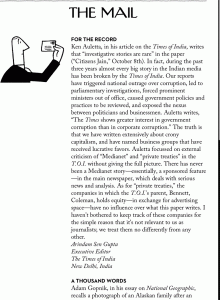
    Click to enlarge

    Ken Auletta of the New Yorker did a massive article on The Times of India and the Jains who own it. Here’s a response from the Times of India’s executive editor. Make of it what you will.


  • One Big Idea by KV (Pops) Sridhar: Smartphones herald the new technological world order

    By KV (Pops) Sridhar, Chief Creative Officer, Indian sub-continent, Leo Burnett


    The last few decades of India have witnessed a plethora of changes, myriad remarkable ideas and lots of inspirational work leading to the progress of mankind at a staggering rate. Some ideas out of these have transformed the way we think, act and live today. We as a country have been riding on the shoulders of such giants to storm the gates of progress. However, if I have to put my finger on the single biggest game-changing idea that has influenced our present and future, it has to be the advent of technology which has transcended the boundaries of just connecting people to giving immense power in their hands.


    It took us nearly 50 years to cross the 10 million landlines mark post-Independence, but less than 15 years to cross the 900 million mark in mobile connections as of now. Technology has a way of bringing about change faster than one can anticipate. The arrival of smartphones plus 4G combined with entertainment has turned out to be revolutionary. Imagine the sheer power of the combination of smartphones and 4G if they are available at cheaper prices. The most powerful tool in the hands of man has been technology, which has redefined the rules of the game. Today, a smartphone empowers us in a way that was hard to imagine a few years ago, allowing people to interact even without the knowledge of language by a slight touch of a tiny icon. 4G enables you to have entertainment at a pace that leaves us gasping for more.


    How smartphones have been embraced by our country itself is amazing. We essentially are a ‘voice country’ where we call more rather than send SMSes or voice messaging. We like to talk to a person directly. With smartphones, without even typing a single word one can get to know the weather report, or by a single touch speak to anyone. The array of apps that comes with it takes us into a world that we never even dared to dream of earlier. So much empowerment and knowledge in our hands at all times seems at times too good to be true.


    With 4G the smartphone user base in the country is certain to shoot up from the current numbers of 27 million. Suddenly it will change the way people live in the country, making it one of the biggest game-changers of the future. Smartphones powered by 4G and packed with entertainment at a cost less than a tankful of petrol ( for cars) will alter the way we live our lives and embark on our progress.


    We are talking about a storm that is rising. People are hearing and watching everything through this device. People today are living their lives through this device. Thanks to smartphones, the position of mobile phones has shifted from beside the ear to in front of the eyes. This is going to have a tremendous impact and bring a change to people’s lives taking it ahead of its times. Imagine an Indian version of Siri in 3000 dialects of Indian languages. This is where the power of technology and future lies.