Category: BLOGS

  • Anil Thakraney: Remembering Devyani Chaubal

    By Anil Thakraney


    I was much too young when the kickass film journalist, Ms Devyani Chaubal, was in her prime. So I have no personal opinions to offer on her. The name cropped up in the wake of Rajesh Khanna’s death, not just because she was very close to the star, some even credit her for playing a part in his meteoric rise.


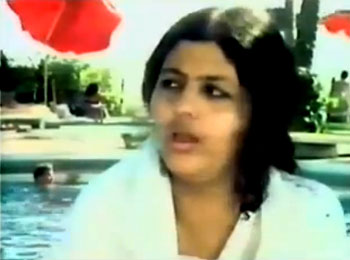
    An ancient BBC documentary on Rajesh Khanna has surfaced on the internet, and it’s a must-watch. Devi (as Devyani was called) has been interviewed in the film, and it’s easy to see she was one hell of a feisty lady. No wonder the Hindi film world of the sixties and the seventies loathed and respected her at the same time.


    Devyani Chaubal in the BBC Documentary posted on YouTube. Source: Pavitra66

    This got me interested in Devi, and I spoke to a couple of people who knew her, and also read up on her modus operandi. And I must say I am left very impressed. For those who may not know, Devi was a hot film gossip-writer employed with the magazine, Star & Style. Her fortnightly column called ‘Frankly Speaking’ was immensely popular and it was quite acerbic. Because of her superb connections in the movie biz, and her close proximity to stars, their secretaries and their chamchas, Devi would fish out red hot goss and then lace it with her own acidic views. More often than not she used to be accurate with her stuff, and this is why movie stars used to dread her columns. She could make or break both, careers and relationships. In fact, her juicy notes on Hema Malini and Dharmendra’s torrid affair didn’t leave the latter very amused. The ‘He-Man’, after downing some Patiala pegs, went after Devi and rained a few punches.


    So what emboldened Devi? I suppose there must have been many reasons. One, her own fiery temperament and the devil-may-care attitude. Secondly, the full backing from her publishers and her editor. Also, Devi came from a wealthy family and the fear of losing her job may not have played on her mind at all. As a bonus, her dad was a well-known barrister, therefore legal notices from movie stars (and there were plenty) would have had no effect on her.


    Devi passed away in 1995 and I must say there hasn’t been a filmi journalist like her since. What you get these days is convenient ‘leaks’ doled out by the stars’ agents and sometimes the stars themselves. Film reporters have become sub-servient, and not wanting to rub stars the wrong way seems to have become the credo. Part of the problem is the media boom. With so many media options now available, the film industry can block out an ‘inconvenient’ journalist without batting an eyelid, and the show goes on.


    This means we’ll never get to see someone like Devi again. This is great news for the movie stars, but it’s a loss for the desi media.


    P S: Here’s some dope on Khanna which no one’s spoken about. It tells you the man had a sense of humour too. On the eve of the release of Bachchan’s huge film called Shakti (1982), Rajesh Khanna was overheard making a snide remark. He said: “Wow, such a long queue outside movie halls for the man! Didn’t know Dilipsaab is such a crowd puller even at this age.” Haha. Rest in peace.


  • Ranjona Banerji: How TV and print covered Rajesh Khanna

    By Ranjona Banerji


    The death of superstar actor Rajesh Khanna was felt very deeply by the Indian media. Although Khanna had been largely forgotten in the PR driven-celebrity obsessed circus that we now live in – except for his foray into an ad which many found offensive – his death brought out a tidal wave of nostalgia. Everyone tried to look back on their Rajesh Khanna moments and several actually found them.


    On Wednesday, TV followed its normal procedures, which in the current climate is outrage at various discriminatory procedures heaped on hapless citizens by ourselves or others. But once news of Khanna’s death came in, everything else came to a standstill.


    Is there scope for criticism here? There can be no doubt that Khanna was an enormous star and in his heyday, he was so high as to be untouchable. He was also a bit unfathomable, which made him all the more appealing. Many TV anchors – notably Nidhi Razdan of NDTV and Rajdeep Sardesai of CNN-IBN – found it hard to believe that Khanna did not “reinvent” himself in his later years. Their bewilderment is understandable. In a world where everyone endlessly (apparently) craves for fame, this man retreated once the world moved on. Of course, in Rajesh Khanna’s case this is not really true. He did try a few times to come back but it just didn’t work. Then, he retreated. But facts are often difficult to muster when you don’t have personal knowledge and everyone around you is 11 years old.


    Arnab Goswami jumped into the Times Now studio much before the appointed time but he was clearly clueless about Rajesh Khanna’s days in the sun. Most news channels therefore pulled out the guests they could – Shobhaa De, since the rise of Stardust coincided with the rise of Khanna, Shabana Azmi who acted with him later, Mahesh Bhatt who made his name a little later and Javed Akhtar, who wrote some of his films with Salim Khan (who is almost never acknowledged by the media although he is very much around). Sharmila Tagore was interviewed – she was the star with whom he had his biggest hit Aradhana.


    The biggest confusion was between Khanna the actor and the songs in his films. Few TV journalists seemed familiar with playback singing and the fact that Khanna did not sing anything and the songs in the movies had nothing to do with him. Endearing journalistic naivete or the need for a few more celebrity news anchors from Mumbai?


    However, at the end of Wednesday, one might conjecture that there was no need for TV panel discussions on why Rajesh Khanna was so popular. It’s not the sort of subject that needs to be debated the day a man dies. It’s not even a subject for debate really.


    **


    The newspapers the next day obviously did a more comprehensive job, especially the Times of India since it has better archival resources and institutional memory. It is at times like this that the youth tilt in the media at the moment becomes a liability. Wikipedia cannot give you everything you need to know. Also lack of journalistic imagination is a hindrance – although it seems to be very common – and this was evident in both Hindustan Times and DNA.


    Mumbai Mirror carried an informed and incisive piece by De, best qualified to do so. Mid-Day’s front page headline told us that Jatin Khanna is dead while Rajesh Khanna lives on, a play on the transience of life but the permanence of memory. Indian Express treated it like one more news story.


    **


    Since Khanna’s funeral procession saw unexpected crowds, his death practically overshadowed Rahul Gandhi’s ascension to who-knows-what in the Congress party on Friday morning.


    **


    Outlook’s latest cover is on Barack Obama, headlined “The Underachiever”, mimicking the recent Time magazine cover on Manmohan Singh. It may seem funny at first glance – I thought it was a joke, actually – but it is surely a tad childish. Why should an Indian newsmagazine take up cudgels for the prime minister? Time has a right to its opinion and is not Obama’s mouthpiece. Why should Outlook want to look like the PM’s mouthpiece?


  • Anil Thakraney: Cap on TV ads harsh. but necessary

    By Anil Thakraney


    TRAI’s proposal to control television advertising does sound anti-free market at first glance. They have proposed 12-minutes per hour cap on ads. And also a ban on drop-downs and half-screen ads. Surely this is unacceptable. In an open market economy, marketers must be allowed to run their own commercial agendas, as long as no law is being broken. Just as all other media formats and most other businesses are allowed to. And I do see matters reaching the boiling point as the D-Day gets closer. Fair enough.


    Having said that, there is no doubt that TRAI’s new guidelines will vastly enrich the TV viewing experience. There are often too many ad breaks, and the Hindi news channels are particularly guilty of this. Many of us get scared of watching these channels more because of the breaks rather than the bhoot prets they regularly feature.


    And on some entertainment channels, the ad breaks are so long, leave alone No 1, you can actually manage No 2 inside one break! I know this example is crass, but you have to admit it’s quite relevant in this context. 🙂


    And of course, some of the sports channels have made a mockery of the TV screen. The way they splash live action with ads and commercial graphics, it’s like a naughty child has been let loose on canvas with a bucketful of paint. Half the fun of watching live action cricket has gone because of these sad gimmicks.


    TRAI’s proposal attempts to correct these things, and that’s a good thing. Also, because the ad rates will zoom up in the new regime, advertisers will be pickier about the programmes they choose, and will make sure they are focused. This will provide them with better return on investment. Today, on a very serious programme like Satyamev Jayate, one is bombarded with rubbish chaddi/baniyan ads. This makes no sense, neither as a marketer nor as a viewer.


    In addition, advertisers and their ad agencies will be compelled to get innovative on television. People will have to think beyond the classic 30 seconder, and as a creative person, I find that idea pretty challenging.


    Bottom-line: Yup, TRAI’s proposal is autocratic and draconian. They have no right to decide how private operators choose to make their money. I accept that point. But if their new guideline does get implemented, the television medium will regain some of its lost sheen. That, too, is a fact.


    * * *


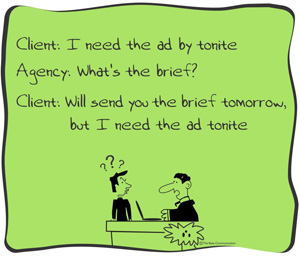
    PS: Ah! Just another fun filled day in the ad world. It was like this a hundred years ago, and it’s still the same. And outsiders wonder why ad guys are often found inside watering holes. This is the key reason!


  • Ranjona Banerji: NCP ties itself for Whiner of the Week award

    By Ranjona Banerji


    The winner of the presidential election maybe Pranab Mukherjee but the award for Noosemaker/Whiner/Tantrum Thrower of the week is divided between PA Sangma and Sharad Pawar. One is former NCP, the other current NCP and both founders of the NCP.


    Pawar suddenly decided that he was very upset with the sort of musical chairs being played at Cabinet meetings. I quite sympathise because I never liked musical chairs as a kid at birthday parties. Today’s children will not understand, but in the olden days birthday parties were an elaborate form of torture for children, who were forced to compete with each other and make fools of themselves in order to get a slice of cake and a few chips. Sounds a bit like today’s political parties actually.


    Anyway, Pawar felt that every time the music stopped, he was forced to sit in another chair. Sometimes it was the second chair (first being the prime minister) and sometimes it was chair 3 or 4. This was clearly insulting. He might have only nine MPs but why should that other chap from a much smaller state holding a job that Pawar once did get the second chair?


    Later we were told he was not so petty to be worried about chairs. All he wanted was a coordination committee. Whatever.


    PA Sangma, former Lok Sabha speaker and the country’s best known Tribal and Christian – according to him – wanted to become President of India. This is a legitimate goal, but Sangma, one might say, went about it the wrong way. He approached, of all people, Naveen Patnaik and J Jayalalitha for help. However powerful they may be in their own states, they did not have the numbers to make Sangma President.


    Since Sangma was part of the UPA, he could have at least spoken to someone within the coalition. Instead he chose to go out of it. After much reluctance, the BJP decided to support him. The UPA and two NDA allies supported Pranab Mukherjee. Everyone except Sangma saw Mukherjee’s victory as a foregone conclusion. Not because Mukherjee is much loved or the greatest person ever but because the UPA had the numbers. Then Sangma and the BJP said he wanted to be the loser with the highest number of votes (this is a strange award category known only to Indian politicians).


    Then Sangma said that he had to win for India’s Tribals and Christians. Most Tribals and Christians were silent. (As it turned out, not all of their representatives voted for Sangma.) Then Sangma said that Mukherjee had used a comma where it was not needed in his nomination form and had not used the right kind of nib in his pen. Also, he did not stand on the right side of the table when submitting the form (unlike Sangma who seems to be heading quite firmly to the right). Since Sangma was by now advised by the world’s biggest litigator Subramaniam Swamy, the plan was to go straight to the Supreme Court with 1,000 public interest litigations. The Election Commission blocked that route.


    So now that Sangma has not become president, he is nibbling away at sour grapes. He should not, because he is now eligible for the Best Sore Loser and Most Ungracious Defeat speech awards, with a good chance of winning both. The Congress used bribery, extortion and threats to get Mukherjee to win and the North East states (which elected Mukherjee by the biggest margins) betrayed him.


    Boo hoo hoo.


  • The Anchor: 5 reasons when you know you can become an entrepreneur

    By Kavita Jain


    When you are driven by passion:

    If you are driven by your passion, entrepreneurship is the way to go because there are slim chances you would enjoy working with someone else coz people are not likely to share same vision/passion and it’s the best learning opportunity you can create for yourself.


    When you have the courage to take risks:

    “The word ‘entrepreneur’ actually is actually scary for many because it takes guts, self-belief (and a little bit of stupidity) to go out there on your own… If you want the freedom to do things your way and not having to listen to dictates of others entrepreneurship is the thing for you. Being happy in life is most important. So what if you can’t earn much money as an entrepreneur. As long as you’re happy doing it, I think that’s the best goddamn reason you can ever think of.


    When circumstances lead you:

    Sometimes you don’t really have a choice but a do or die situation, and in most cases answer is “do” and do it really well.  Sometime your situations lead you towards entrepreneurship, for e.g. economy down turn. Some friends lost their well paying jobs couple of years back thanks to down fall of economy and the situation forced them to be on their own and they are doing very well today and are happy to be an entrepreneur.


    When you are ready to work round the clock:

    ‘Flexibility of time and ability to do more in little time and a time of your choice as you are not bound to a 9 to 5 routine.


    When you are ready to take challenges head on:

    As an entrepreneur, you are in control of your life (being at two places at the same time.  You enjoy working with and learning from the best people you decide to work with. Being an entrepreneur is a tough and a challenging task, sometimes scary too, especially when you are trying to balance it with your personal life but at the end of it if you play it right and manage to balance it right it gives you a high like nothing else could do.


    Kavita Jain is Founder, Schwelle Media


  • The Anchor: Ajay Chandwani on 5 reasons why youngsters/MBAs should join advertising

    By Ajay Chandwani


    1. Brand Management

    For those who have studied MBA, marketing management is just one part of the spectrum, but one should realize that in advertising you also get to do brand management. This is a dynamic field to be a part with immense opportunity.


    2. Variety

    In advertising, you are not restricted to one industry, but you get to work on various categories. So if one time it is about selling a washing powder, next time it could be about selling biscuits and then about selling cars. One has to think different thus not getting stuck in stereotypes.


    3. You do it for a living

    Advertising promotes lateral thinking. It’s not that you can’t do out-of-box thinking in marketing, but in advertising that’s how you are making a living. You get to interact with creative minds and you need to be an ideas person to survive and succeed.


    4. Never a predictable moment

    You could get to work on a new product, marketing plans keep changing, new brands gets launched, so in short, there is no boredom. There is so much going around in advertising business that it promises to be one roller-coaster ride.


    5. Today advertising is at the helm of a marketing function

    The former has taken a 360 degree avatar which included advertising, PR, digital, BTL and the works. There is a desirable exposure to brands. Hence it provides a wider canvas to work on and promises to be an integral part of marketing.


    Ajay Chandwani is Director at Percept Ltd


  • Debrief: HCL: Fresh and entertaining

    By Anil Thakraney


    HCL is back with its Mr HCL and Mr Banker campaign. The positioning is the same as before: ‘Technology that touches lives’. But innovation is at the heart of the new commercial.


    This time the two dudes are marooned on a remote island. The banker plays the bumbling idiot, and Mr HCL is, of course, the smart one. The latter uses the banker’s dead cell phone to light a fire on the beach. The smoke is detected by a rescue helicopter, and the two are saved. But not before the banker has made a fool of himself for some quick laughs.


    This commercial works for me. Mainly because Mr HCL isn’t shown using technology to provide a solution, he uses ingenuity. Imagine if he had used techno magic to perform the rescue act, the TVC would have become literal and therefore boring. At the same time, this approach projects HCL as an innovative company that’s ready to think out of the box. Ergo, message delivered.


    [youtube width=”400″ height=”225″]http://www.youtube.com/watch?v=1gAASVe09VM[/youtube]

    I didn’t much care for the ‘ass on fire’ slapstick stuff, it is much too forced, but our cold techie friends will find this funny, so that’s fine. But why make fun of investment bankers? Are they such morons? This is the only part I don’t quite get.


    All in all, an entertaining ad that delivers the message. Also, the Discovery Channel type of a setting, of being rescued from wilderness, adds to the freshness of the communication.


    Rating: (On a scale of 1 to 5): 3. Focused message. Cool delivery.


  • Ranjona Banerji: TV news viewing can be injurious to the lower jaw

    By Ranjona Banerji


    Since president-elect Pranab Mukherjee spoke to almost everyone on Tuesday, it was hard to see why news channels rushed to qualify their interviews as “first” or “better” or whatever. Exclusive, in TV parlance, is apparently when you do the same thing as everyone else, except five minutes before.


    Anyway, Mukherjee did not say very much about anything he was going to do as President although he talked about his childhood and his early political career. The silliest question I reckon came from Sagorika Ghose of CNN-IBN who asked whether Mukherjee’s ascension to Rashtrapati Bhavan was a “return of Bengal to the mainstream”. At this point my jaw dropped so low that it fell off and I was so busy retrieving it that I couldn’t pay attention to the rest of the interview.


    The best I could get from Arnab Goswami’s interview with Mukherjee on Times Now was that first Mukherjee walked round his garden 40 times, then 33 times and now 30 times and he did not know how many times he was going to walk around the Mughal Gardens. He said he heard the gardens were very large. Anyway, as President he will have ample time to work out stuff like that. Or if he asks someone they might tell him how big the Mughal Gardens are.


    * * *


    Sunday was all about the presidential election as well as everyone gave us live coverage. Of course, after some time they ran out of things to say because there was very little to say about a presidential election in India, at least not enough that can last a whole day even given TV’s marvellous propensity for waffling on about nothing. The highlight of the day was losing candidate PA Sangma’s losing speech. He started by congratulating Mukherjee and then went into a whine about how the Congress had used bribery, extortion and threats to ensure Mukherjee’s victory and how the North East and betrayed not just him but all tribals and themselves as well. (They didn’t vote for him.) Sangma’s entire campaign was based on pettiness, so nothing surprising here. What was surprising was Navika Kumar of Times Now stating emphatically that this was the best, most gracious and most sportsmanlike speech she has ever heard from a loser. Her guests Krishna Prasad of Outlook and commentator NN Satchidanand tried to point out otherwise, but she would have none of it. Jaw-retrieval is a common affliction for those who watch too much TV news, as I should know by now.


    * * *


    Rupert Murdoch has stepped down from several boards which control News Corp’s titles in the US, UK and India. The pressure to do so apparently came from investors, after the phone-hacking scandal led to the closing of The News of the World and all the arrests of News Corp staff, current and former. Murdoch’s rise saw a lot of bile but in his fall are some abject lessons for media bosses and for those journalists who decide that principles are nothing when faced with corporate pressure to perform in a particular manner or to do anything to get results. The Nuremberg trials ought to be required reading for young aspiring journalists: the fact that you got an order is not defence enough.


    * * *


    I was appalled yesterday and continue to be appalled today about Monday’s front page anchor in The Times of India about a group of Indian athletes that went to the 1936 Berlin Games under a saffron flag singing Vande Mataram and impressed Adolf Hitler enough to give the group a medal. The story behaved as if getting a medal from the 20th century’s most frightening dictator was a great honour. There was not a squeak in the story about Nazism and what the organiser of the group thought of that. The glorification of Nazism in India is restricted to those influenced by the religious nationalism that comes of out of Nagpur. The story, therefore, should have mentioned or questioned the RSS connections of the group. Saffron flags and Vande Mataram were clear giveaways but why not come out openly and say so? And for a journalist – and a newspaper – to ignore the Nazi angle to such a story is criminal.


    * * *


    Vikram Doctor’s article in The Economic Times on food and the Olympics was extremely readable and well-researched. Try it: http://blogs.economictimes.indiatimes.com/onmyplate/entry/thanks-to-french-humour-here-s-best-of-british-food


  • Anil Thakraney: Murder in the factory

    By Anil Thakraney


    What happened at Maruti’s Manesar plant is extremely sad. You don’t go to work and expect to get burnt alive by your own colleagues. And this is no longer a business story, it has moved to Page 1 as a sensational crime story.


    Naturally, we now have to wait for the police investigation to get done, so that we know exactly what transpired that fateful day. Apart from nabbing the criminal workers (which isn’t going to be easy given the political pressure), another truth needs to be uncovered: There are rumours that the slain HR manager provoked a group of workers by hurling casteist or communal abuse. This doesn’t lessen the crime, but it still needs to be investigated.


    As of now, I know just one thing: HR managers who deal with factory workers need high level of skill and training. It is a very difficult job because there is always a huge degree of mistrust between white and blue collar workers. Everything is vastly different: Sensibilities, motivations, attitudes, culture, language, you name it. I sometimes wonder if CEOs put in special efforts to appoint the correct HR personnel for their factories. And ensure they are heavy trained for the job. It’s just not the same as air-conditioned corporate offices, where even if the HR staffers did nothing (and many do precious little!), life simply goes on.


    How do I know all this, since I have never worked in HR? It’s simple. My dad, before he retired, was the chief of personnel and human resources at Shaw Wallace. And the factory HR was his key result area. I am aware of the high level of tact and diplomacy he used to need at his disposal to keep the workers and the management at peace. It was a very stressful job, and despite his best efforts, he would, at times, receive violent threats from a section of workers.


    I got a chance to watch him in action when he took me for a factory visit to the company’s Uran (Maharashtra) brewery. This was when I was in school, and the visit introduced me to beer very early in life, but that’s another story. 😉


    * * *


    [youtube width=”400″ height=”225″]http://www.youtube.com/watch?v=pTjHCCU2E4c[/youtube]

    PS: ‘The web is what you make of it’. Google Chrome has been doing some nice adverts in this campaign. This particular one, where a man is trying to woo his lost love back, is quite charming. The strength of this work lies in what is known in advertising parlance as ‘vivid demonstration of the product’. Whereby you experience exactly how the product works. But they do it in a very entertaining way, which is why the ads shine. Something to learn here for all those guys who make those ultra boring mechanical car commercials.


  • The Anchor: 6 ways to create pathbreaking & sustainable communication for a brand

    By N Chandramouli


    Everyone loves to win, though only a few have what it takes to prepare for the win. Sustainable Communication is that organizational winning strategy.


    1. Future relevant communication

    In my several thousand interactions with CEOs and top management, one significant conclusion with regard to communication has dawned – successful organizations always have top-driven communication.


    Though everyone understands the importance of communication, most top management are unwilling to get involved enough to deep-impact it. Most only want to see results without wanting to participate in its creation.


    Communication is treated as an essential, but ‘extraneous’ service to the organization. Therefore, while the result is important, how it is achieved, is not. The communication function most often reports into marketing, and due to this, the entire organization’s communication remains partial to marketing communication.


    Sustainable Communication is that which impacts the future of the organization, and without the direct involvement and guidance of the top management, the organization’s future cannot be impacted. Organizations where the top management does not give communication the maximum attention remain myopic without much control over their own destiny. It also silently encourages the ‘dynamite fishermen’ to play havoc, severely damaging the communication environment of the organization.


    For an organization that wants to remain relevant in the future, the person piloting it has to be fully committed to Sustainable Communication giving it requisite time, energy and direction.


    2. Communication Philosophy

    All systems run on some principle and only when articulated explicitly do they become ‘believable’- a prerequisite for adherence. Its expression is the first step for Sustainable Communication to take root, and this creates adherence at the deepest level in the organization.


    The Communication Philosophy of an organization is an analysis of the organization’s reason for existence, its values, nature and its reality. It asks three fundamental questions, the answers to which define a Brand’s topography for Sustainable Communication.


    Q. Why do we communicate?

    Neophytes usually get drawn to answering this in terms of the business goals of the company, but this question must not be taken too literally. It is necessary for the answers to be unshackled from the business goals, and therein lies its difficulty. The Communication Philosophy seeks out the intrinsic nature of the organization’s communication, and this answer helps understand the organization’s true objectives in relation to its ecosystem.

    Q. How will we communicate?

    The answer to this question gives guidelines for communication to the organization. It also elaborates the tone and tenor of communication, and most importantly, the Brand’s not-to-do list.  This usually sets the foundation for all to adhere to.

    Q. What do we want to communicate about us?

    The answer to this reveals the ideally desired perception. Since the seed of communication lies in its action, it is necessary that this ideal seeps into every action the organization takes. While articulating its response, one must consider the different states of the entity; current, future and the approach to overcome this aspirational gap. The danger with ideal perceptions is that they tend to fly, and therefore, its articulation should be grounded in reality.


    3. Discovering Communication pathways

    Every organization has natural communication trails within them. They use these pathways predisposed to communication because of interdependencies within the sub-group. Use of these interdependencies provides natural energies for supporting the Sustainable Communication structure. Often hidden beneath the surface, unexposed to the organization, these trails need to be discovered with focus. Once found and worked on (no different from real pathways), these pathways will automatically draw more communication traffic through them.


    To discover these trails, a deeper understanding of each sub-group’s aspirations, interests, preferences and culture is necessary. These communication trails are also useful in two-way communication and have the scope to become robust feedback systems.


    4. Integrated approach

    An integrated approach looks at the organization’s communication philosophy from various dimensions. Some are listed below, but this is a dynamic list and must be added to by the communicator – the more that get included in this list, the more sustainable an organization’s communication will be. The communication should be integrated from the dimensions of:


    1. Culture – The organization’s communication must be integrated with the culture of its people and of the society that it exists in.

    2. Vision – All communication of the organization must emanate from a common, expressed vision.

    3. Time – The organization’s communication must be relevant to the past and the future of the entity while remaining aligned to its present.

    4. Environment – The communication must be in harmony with the environment the brand engages with, eliminating any damage to it.

    5. Audiences – It must be integrated with the needs of all the primary audiences of the organization; clients, employees, shareholders among others.

    6. Audience Degrees – It must be integrated with the primary, secondary and tertiary audiences and must be relevant to all three.

    7. Knowledge – Sustainable Communication must have an integrated approach to creation, storing and dissemination of knowledge.

    8. Lifecycle – It must have a regenerative approach such that the birth to demise message lifecycle is considered.

    9. Function Collective – Each function of a business must reinforce the collective, and the collective must reinforce each function’s communication.


    5. Multi-polarity

    Multi-polarity tends to maximize communication efficiencies and as it looks at several polarities achieved through each message. For an organization to have Sustainable Communication, while the main focus could be one or a few, the multi-polarity maximizes value by deriving more from the same message. The more polarities that get included in the message, the more sustainable it is. These polarities are:

    1. Multi objective – Each communication must impact multiple objectives in positive ways.

    2. Multi sensory – Such that it integrates experiences of as many senses as possible – cognitive, tactile, auditory, visual.

    3. Multi-audience - The same communication should reach several audiences.

    4. Multi noded – There must be several crossover nodes of several communication pathways to facilitate interaction at the nodes.

    5. Multi functional – It should take into consideration the needs of all the functions (like finance, human resources, marketing and others) around the communication.

    6. Issue Chain

    An Issue Chain is the identification of the natural issues of any system that gives it the propensity to communicate. These depend on its contributors – sector, audiences, technology and others that are issues that drive communication energy. To better this Sustainable Communication method, it is necessary to identify the various issues in the sub-systems and then build communications around these. Such communication sustains itself through the energy that others put into it as it is of their interest.


    N Chandramouliis Author of upcoming book Decoding Communication and CEO Comniscient Group

     

  • Debrief: Raymond’s boring celebration

    By Anil Thakraney


    The Raymond shop wants the suits to celebrate everyday. Even if they are stuck on potholes or the share prices have crashed or the babus are sitting on their business proposals or their wives have walked out on them. (Okay, all that is my nasty two-bits!). Nothing wrong with the concept per se, so then it’s all left to the execution.


    The TVC lives the life of a suit through the week, from Monday to Sunday. It shows how, by wearing the Raymond suit on different occasions, the man makes his life rock. Whether it’s work, partying, chicks… and of course, spending time with parents. The Raymond man is a complete man, you see, and until he obediently touches the feet of the elderly, his week is incomplete.


    [youtube width=”400″ height=”225″]http://www.youtube.com/watch?v=Jf5R_fIyZb0[/youtube]

    Completely stupid work this is. While I appreciate Raymond’s attempt to expand their market share by positioning the brand for all occasions, the ad is totally dull and trite. Same old suits, same old corporate meetings, same old moving and shaking… this looks like a commercial from the sixties. And the thakela jingle only manages to pull things down even further.


    A complete wash-out in my books. However, I shall add a rider: I am not a suit, so perhaps I don’t understand these pin-stripes. It’s quite possible they like such floozy stuff. In any case, with the general dumbing down that’s happening with Young India, perhaps such work is the order of the day. And I feel very saddened to state this.


    Rating: (On a scale of 1 to 5): 1. Tired and jaded.


  • Anil Thakraney: Page 3 versus Oprah

    By Anil Thakraney


    Oprah Winfrey is a super talk show host. That is well known. We now also know that apna Aamirbhai is a huge fan of the lady, after he formatted his maiden TV show based on her work. All very fine and dandy. But we’ve just discovered another thing about Oprah that some hoity toity Indians are finding very hard to digest: Apparently, she thinks poorly of us Indians because we ‘still’ eat food with our hands. And the TV queen has made a video of her shock over our crazy dietary habits for the consumption of her local audiences inAmerica. And it’s mainly targeted at the Texan rangers, who must obviously be having a good gaff at our expense.


    I searched for the offending video on Youtube, and not surprisingly, they have been blocked for viewing in India. And that’s stupid, really. You can find the link through other websites. Oprah made this sensational comment when she sat down for a desi thali meal with a conservative Somani family from Mumbai. One can see in the video that the family is going out of its way to please the honourable guest.


    The result: All those Page 3 types who were falling over each other to get close to Oprah when she visited India in January this year, are busy spewing venom against her on TV talk shows. These are the same people who were excitedly tweeting their smiling thopdas in the company of the exalted lady. I have only two things to say to these angry beauties.


    One, Ms Winfrey is a television presenter and she will use footage that can get her American audiences transfixed. That’s her profession, that’s her job. Western audiences don’t want to see the high rises of Nariman Point, nor are they interested in videos of Parmeshwar Godrej’s glitzy party in Oprah’s honour. They want to see the poverty and squalor they usually associate withIndia, stuff they find quaint. The huge success of Slumdog Millionaire proves that. So don’t hold this video against the lady, she’s got TRPs to worry about.


    This incident should also remind you guys and gals to quit the gora (which ironically, Oprah is not even) fixation and get over the colonial hangover, it’s been over sixty years since we ousted them. Treat them like any other guest when they arrive, so that when they return to their own nations and report unflattering things, we simply ignore it and move on.


    Let’s be a little more confident about ourselves for god’s sake.


    * * *


    [youtube width=”400″ height=”225″]http://www.youtube.com/watch?v=x3jTSB2ez-g[/youtube]

    PS: Do watch this video on the art of designing a logo. It talks about the evolution of the logo over the centuries and its huge relevance to marketing. And there are some super examples too.