Category: BLOGS

  • Debrief: Maruti: ‘Kitna deti hai?’ continues to rock

    By Anil Thakraney


    I have always been a fan of Maruti’s ‘Kitna deti hai?’ campaign. Okay, the phrase has an erotic ring to it (admittedly that’s my dirty mind at work), but its single-mindedness of purpose is admirable. And also the fact that it’s totally relevant; Indians tend to be obsessed with mileage. There’s one more reason for my liking this campaign: The commercials are always entertaining.


    Well, Maruti is back with yet another ‘Kitna deti hai?’ ad. And the timing could not have been more appropriate. With petrol prices going through the roof, this is the one question on top of every middle class car buyer’s mind. The new TVC re-creates the thirties. A firang lady called Amelia Johnson is the first woman to fly solo from England to Australia. She’s arrived for a ‘stop-over’ in Mumbai, and crowds have gathered to meet her. Amelia excitedly boasts about the various technical features of her aircraft when a desi jumps her with that most important question: Kitna deti hai?


    [youtube width=”400″ height=”225″]http://www.youtube.com/watch?v=1AyynrjP3EM[/youtube]

    Super stuff. Love this ad. The humour is solid and the treatment outstanding. (Not easy to re-create that era in an ad… ads usually have limited budgets.) And most importantly, I simply adore Amelia’s expression when that deadly question is fired at her. It’s a cross between amusement and astonishment. And it’s not an easy expression to deliver. A huge pat on the back to the film’s director just for this.


    Rating: (On a scale of 1 to 5): 4. Wonderful idea. Lovely execution.


  • Ranjona Banerji: Kudos to TV news

    Ranjona Banerji

    By Ranjona Banerji


    Wonders of wonders, I find myself forced to praise media efforts in a few rather reprehensible cases. The first is the curious story of former athlete Pinki Pramanik. This Asian Games medal winner was accused of rape by her long-time partner. As Pramanik is female, this raised all kinds of questions and plenty of salacious interest. It is just the kind of case that the media could have gone overboard with. But instead, it has concentrated on the human rights abuses which Pramanik has been subjected to. Not only has she been put through several gender determination tests, a video clip of those tests was made public with some extraordinary scenes apparently of policemen groping her breasts. She has also been placed in a male prison, pending the rape investigation. Thanks to media scrutiny we now know that West Bengal, where Pramanik lives does not have adequate gender determination facilities. Yet she was humiliated over and over again.


    This media attention will hopefully focus on the group of people who could be called “inter-sex” with indeterminate physical sexual characteristics. They may see themselves as male or female and society has to find a way to integrate them without stripping them of their dignity. Since there are situations where we see things only in the male-female perspective (like sports for instance), some greater awareness and sensitivity is needed in dealing with this issue.


    The media is often accused of being prurient and insensitive. However, in the Pramanik case the current “permanent outrage” mood has come to its assistance. Both TV and print media have taken up this story from the human rights angle.


    **


    The second case is that of Suja Jones Mazurier, a mother of three who has accused her husband, French consular officer Pascal Mazurier of sexually abusing their four-year-old daughter. The Bangalore police have apparently treated her as an accused rather than a mother trying to protect her child. This is extraordinary behaviour by the police who usually decide that all accused are guilty – as in the Pramanik case – without the benefit of investigation and trial.


    The media has informed us that the police not only delayed filing an FIR, they also delayed taking the accused into custody, well after it was made clear that he did not have diplomatic immunity. They also asked Suja Jones the most incredible questions as well as conducted tests on the child in the most appalling conditions.


    **


    The third case is that of the 10-year-old girl being forced to drink her own urine by a hostel warden at the prestigious Patha Bhavan school in Santiniketan. This is a case with very few grey areas and the media has gone hammer and tongs at the Vishwa Bharati university authorities for trying to protect the warden at first and slapping “trespassing” charges against the girl’s parents when they tried to rescue her as well as at the police for delaying taking action.


    **


    All these cases involve human rights abuses, exposing which has usually been the domain of NGOs. But the media now appears to have stepped in as well and upped the ante. This challenges old media notions of what is a “big” story or not and shifts the focus from politics. It might be too early to herald this as a shift towards a more mature society but it does appear to be a step in that direction.


    **


    All kudos to TV news however for having the courage and naivete to challenge old journalistic traditions, as they insist on answers for what India wants to know.


  • Anil Thakraney: Oye, ‘Time’ mein job milega?

    By Anil Thakraney


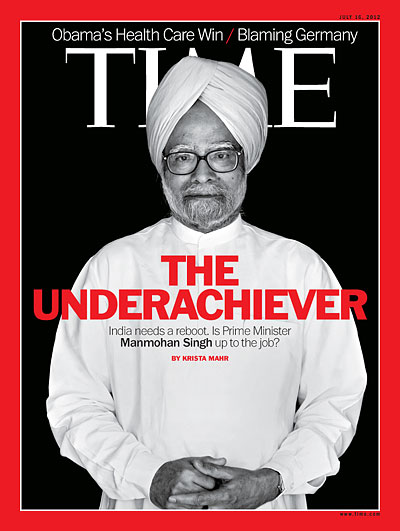
    TIME mag has termed our Prime Minister an ‘Underachiever’. I completely disagree with this description, it is much too kind. The truth is, and every sane Indian would agree, MMS has been a total flop show since he became PM once again in 2009. His government failed the country on every single parameter, and in particular, his team has damaged India’s growth story. Anyway, enough has been said on Manmohan Singh’s stellar performance, so I won’t delve on that.


    What got me interested is the impact of TIME’s cover story in India. Both, the politicians and the media got their knickers in a twist discussing this article threadbare. Almost as if the final report card had arrived from the Big Boss. As if what the goras, located thousands of miles away from the action, think of our PM is the gospel truth.


    All sorts of insinuations are being flung around. Some people suggest it’s a marketing gimmick from TIME mag to boost its circulation in India. One Left leader claimed it’s a conspiracy hatched by America to put MMS under pressure so that they can launch new businesses in India! And of course, the netas are busy hurling dirt at each other. As the BJP leaders gloat over the article, the Congresswallahs are firing back with: ‘Hello, but they were harsher on Atal Bihari Vajpayee!’

     

    However, what hurt me the most in this tamasha is that various Indian columnists and speakers have been dissing Manmohan Singh’s policies for a long time, but no one takes them seriously. It’s as if what India thinks about India does not matter. Quite obviously, after over six decades of independence, our colonial hangover hasn’t gone. No wonder then that some top industrialists from India happily meet the foreign press, while desi journos don’t even get a response to interview requests.


    My conclusion: To be taken seriously in India, I need to work for a foreign publication. That’s the irony of our existence. Therefore I am busy preparing my CV afresh, and will soon be knocking on the doors of gora editors. Jai Hind!


    * * *


    [youtube width=”400″ height=”225″]http://www.youtube.com/watch?v=aMfSGt6rHos[/youtube]

    PS: Glad this utterly charming ad from Chipotle won the Grand Prix at Cannes. My most favourite commercial of last year. Superb idea backed by terrific animation. It’s all soul, and it makes you think where we are headed. The film is particularly relevant in India, where we have lost our way in the mad ambition to be an industrialized nation. And yes, Coldplay’s haunting track, ‘The Scientist’, works wonderfully out here.


  • Ranjona Banerji: Don’t bother, Indian analysts… let Time do it

    By Ranjona Banerji


    The Indian media has taken a round beating here. Day after day, print and TV criticise the government and politicians. Columns, analysis, debates and discussions focus on the weakness, incompetence, “policy paralysis” of the current government. Does anyone care or pay attention? Of course not – unless the criticism comes in cartoon form about a person or issue long dead.


    But an article in the Asia edition of an American newsmagazine criticises the prime minister and the whole political community goes into a frenzy? Let us not be unfair to Time magazine, but the fact is that no one considers it to be a respected analyst of Indian politics. Nor indeed is the magazine the powerhouse it once was. Now if the Economist were to get so seriously critical, since it is known for its carefully considered views, then you might want to sit up and take notice.


    Time’s “crime” is to call Manmohan Singh an “underachiever” and ask whether it is time for him to move over and let someone else become prime minister. This made the Congress jump to his rescue and the BJP to behave as if they’d won Uttar Pradesh.


    The Congress then looked back at an old Time article which had said Atal Behari Vajpayee was “asleep at the wheel” as prime minister. This was supposed to shut up the BJP as the same newsmagazine had also criticised them. Sigh.


    The BJP however could point out that Time’s tally is still higher since last year the magazine appeared to favour Gujarat chief minister Narendra Modi. Then the Congress can point out that Modi did not make it to Time’s poll of the greatest people in the world or whatever because of negative voting.


    And so we can go on and on about the various articles and activities of a barely read newsmagazine and the political classes can carry on doing even less than they do normally.


    As for all you analysts in the Indian media, why do you bother? Clearly, no one pays attention to all your criticisms and opinions. Congratulations are due to Time for having successfully upstaged the entire Indian media. Henry Booth Luce would be happy.


  • The Anchor: Veetika Deoras on 5 highs of being a marketer

    By Veetika Deoras


    1. It’s a ‘soul-to-soul’ job

    To build deeper and richer connections with customers, brands must arise above the rational benefits and build emotional bridges. Taking your brand to the emotional level involves cutting through the clutter to link the ‘soul’ of your brand with the ‘soul’ of the people. This necessitates reaching out to your right brain, as much, if not more, than the left brain. And more often than not, this ends up being a very fulfilling and heartwarming experience.


    2. Thinking out-of-the-box

    Overload of communication, multiple media vehicles and an ever-evolving customer, necessitate out-of-the-box thinking and innovation, in both the planning and execution of marketing campaigns. This makes a marketer’s job challenging and ensures that there’s never a dull moment.


    3. Proximity to customers

    With customers, brands and the environment changing constantly, there is a critical need for marketers to be in constant touch with their customers. To reach out to customers, and observe and understand their behaviour, with a view to garner deep insights is a highly fruitful and enjoyable experience.


    4. The debates

    In some interesting way, marketers have always had the dual challenge of selling their ideas, first to internal stakeholders and then to external stakeholders. The debates make the job most invigorating, the output superior and the victories, sweet.


    5. Satisfaction of creating an ‘intangible’, which yields results better than most tangibles.

    How often does one get the chance to say – I have created a ‘perception’, a ‘bond’, a ‘genuine promise’ and this perceptual bond, based on a genuine promise is worth a billion bucks! This probably is the biggest high for me as a marketer.


    Veetika Deoras is Head – Brand Marketing & Corporate Communication, Tata Capital Limited


  • Debrief: BombayTimes = Lokhandwala Times?

    By Anil Thakraney


    I like the Bombay Times commercial. Mainly because it’s entertaining and the musical score is nicely languid and quite catchy. The ad also has an idea: People in Bombay like to dress well and like to get noticed for their glam quotient. The TVC features aam aadmis and aurats wearing bling and lagaoing style: a government daftar babu, a fisherwoman, a rick driver, etc. So unlike the colourful supplement, the ad isn’t air-headed and that’s great.


    However, there are a couple of problems I have with this treatment. The ad doesn’t really gel with the product. The commercial features people who would NEVER be seen in the pages of Bombay Times. And this creates dissonance in the head. Because every morning, all I spot in the supplement are pics of the hundred usual suspects. And I must add here that I would actually like to see pics of the shining aam junta in Bombay Times. Would make it a little interesting.


    [youtube width=”400″ height=”225″]http://www.youtube.com/watch?v=tUjhPjGw8DI[/youtube]

    Secondly, I am not sure all Bombayites like to glam up on the streets. Most are forever stuck in the worst sort of traffic jams, or packed inside the ultra-crowded public transport. And surviving the city is all that goes on in the mind. Therefore, it doesn’t really capture the ethos of Bombay. This ad would have worked wonderfully for Andheri’s Lokhandwala Complex, the one street that’s swarming with glam wannabes.


    Still, the TVC does deserve good marks. Because it doesn’t bore you even on repeat exposures. And because it’s (thankfully) not even trying to project BombayTimes as an intelligent read.


    Rating: (On a scale of 1 to 5): 3.5. Strategically off the mark but very entertaining.


  • Ranjona Banerji: I also hate the chip chip!

    By Ranjona Banerji


    I’m taking off from next week and staying with the advertising industry since it is also “news” as some Indian media organisations have told us for years. Also, you cannot escape advertising if you watch the news or read newspapers and magazine. After careful consideration and consultation with others, it is clear that Priyanka Chopra’s “chip chip” ad for Garnier remains the most annoying on television. It comes on so often and with such clever cross-channel planning that you are forced to watch it unless you jump up and run every five minutes. By this time, the sun, the dog, the grass have all started looking extremely embarrassed at being made party to the ill-matched song and dance routine.


    But close to this one are those with annoying children like the rude boy in the McCain’s ad. I don’t see why he deserves to be treated with various kinds of fried potatoes. He should stay in his room downloading food while his family has fun without him. Next is the little girl in the Cadbury’s ad who is smiled on indulgently/ protected for not wanting to share her chocolate. (I am far more generous. If anyone gives me a chocolate product made by Cadbury’s I promptly give it away.)


    Today’s newspapers say that table manners are becoming a thing of the past. The advertising industry has long known this which is why it is particularly fond of promoting messy eating. People who eat Cadbury chocolates not only give each other long and profound looks while discussing vegetables they don’t want to eat, they also manage to get half the bar of the chocolate they’re eating all over their faces. This is an Indian rule I think and also applies to eating ice-cream. To save money, these ads should be joint ventures with washing machine/washing powder companies and maybe even whatever Garnier is selling in that “chip chip” ad.


    Then there are irritating mothers – based on the general feeling that the advertising industry specialises in mothers you want to murder. The Kellogg’s mother, who does something as amazingly innovative (sarcasm emoticon please) as putting almonds on top of a bowl of cornflakes, wins the current round of MYWM. If Kellogg’s only sold their variety of cornflakes with almonds in it in India, she wouldn’t have to be quite so smugly clever.


    An award has to be given to both Rahul Bose and Mahesh Bhupathi for agreeing to tell us that their mouths are full of germs. This is courage extraordinary. Also, for the ungrammatical manner in which they both say: “and much less germs”. Since both speak very good English the rest of the time, one assumes (or hopes) that Colgate paid them a lot of money.


    Vodafone’s attempt to make old men cuddly and lovable after Tata Docomo’s portrayal of them as curmudgeonly and crotchety should win an anti-ageism award at one of the next 1,000 award ceremonies the advertising industry seems to organise. At which, the best actress award has to go to Anushka Sharma for not only being convincing in selling cameras, internet services, scooters and so on but also for beating Amitabh Bachchan, Katrina Kaif, Priyanka Chopra and all the rest of the stalwarts for successful grabbing of TV time.


    Currently, there are several ads for a film called Cocktail starring, I think, Saif Ali Khan and Deepika Padukone. I saw a film called Cocktail once. It had Tom Cruise in it. Any relation?


  • The Anchor: Faisal Farooqui on 5 changes he would like to see in digital media

    By Faisal Farooqui


    1. Government adopting Digital:

    There is a lot that the government can do by adopting the digital media. We look forward to significant changes in the government where the entire delivery of the government public interface services should be digital. I would like the government to understand that digital media is not just about having a website but it is really about reaching out to your citizens on a larger scale.


    2. More schools adopting Digital:

    All schools inIndiastarting with government schools must adopt digital as part of their curriculum and treat it as a separate medium. All the schools in this country should realize that digital is not a separate medium, but a medium which can be integrated with their teaching and curriculum, and they should make this change.


    3. Cutting down on the middle men:

    I would like advertisers and publishers to reach out directly to each other. There are a lot of middle men involved in the whole process of buying and selling of ads in the digital space. If the digital industry, both on the advertiser and publisher front, has to make progress then we need a lot of direct interaction between buyer and sellers. This will help ad buyers reach out to inventory sellers directly. Therefore, we need to cut down on some of the layers in between.


    4. Cell phone operators adopting digital:

    Cell phone operators inIndiahave not adopted digital completely. They have to realize that digital doesn’t just mean subscribing to SMS jokes. Most of their websites are not optimized. Hence, a great push can be given if the mobile operators can go digital. Cell phone companies must therefore make a lot of their services digital. So if they can change their digital strategies and adopt digital in a bigger way, I think that will be a big boost.


    5. Digital industry must think beyond the websites:

    Digital industry has to think that digital is beyond the website. You have to build social integration and a lot of these digital companies inIndiahave not embraced social media. Hence digital I believe has to become social.


    Faisal Farooqui is the Founder – CEO, Mouthshut.com


  • Ranjona Banerji: TV debates are sound, fury with nothing significant

    By Ranjona Banerji


    TV debates, it should now be universally acknowledged, have become a bore. This is not the fault of the news channels but of their guests. Though I suppose one could blame them for not getting better guests the way you might disagree with the way a newspaper chooses its columnists or edit page writers. I digress. Since my cablewallah condescended to give me CNN-IBN again, I decided to try and watch it. Karan Thapar on The Last Word tried to work out what he called the “natak in Karnatak”. A needless pun perhaps, based on two different language families being expressed in a third language, but never mind. Nirmala Seetharaman of the BJP was probably tired of being politely defensive so barely let anyone speak. Earlier in the week on Times Now, Smriti Irani as part of a discussion on P Chidambaram’s comment about the middle class being happy to spend money on ice-cream and bottled water but not petrol, shouted so much that she drowned everyone else out. She also moved the subject around so much that the rest of the guests were left quite bemused.


    Even more puzzled was Nidhi Razdan of NDTV on Thursday night when a discussion on Sharad Yadav’s comment that temple funds need some sort of regulation was turned into some long defence of Hindus being targeted by Tarun Vijay of the BJP. The other guests were equally amazed since no one had said anything derogatory about Hindus. Most in fact felt the government had a bad track record in managing temple funds and that was not the solution. In the second discussion on Razdan’s show about PA Sangma’s presidential campaign, Vijay accused senior journalist Kumar Ketkar of being prejudiced against people from the North-east even though Ketkar had not said a word about the North-east at all.


    Does this sound like I’m targeting spokespersons for the BJP? It is however surprising that for a party which is so media savvy normally, it has to depend on people who are so incapable of carrying on a discussion in a civilised manner. They just make the other parties look better, even if they are hardly deserving of that.


    I could not watch CNN-IBN any further because it went back to the fight in the civil aviation apparatus over Kingfisher Airlines which Arnab Goswami also took on later. By this time I was bored and the faces all looked the same. Headlines Today had no sound so I could not indulge myself in the battles of the two Rahuls.


    The fight against “apathy” and “indifference” on Times Now remains interesting however. The squirming by doctors as they tried to somehow explain why ward boys and cleaners were standing in for them in UP hospitals was amusing, especially when they were attacked by members of the public. The strike by UP doctors also attacked by callers, to which there was really no answer.


    But at the end of all this, these debates are just sound and fury signifying nothing. It is not the media’s job to find solutions but there is not even any food for thought to be found in these discussions. People invited to TV studios need to work a little harder on how they sound when they lose control of their thought processes and their behaviour. They’re becoming like MLAs in our legislative assembles. News channels must invest in silencer buttons for unruly panellists. Or come down to the lowest common denominator and become like the Jerry Springer show with physical combat as part of the entertainment.


  • The Anchor: Ritu Kapur on 5 ways factual entertainment channels can score over GECs

    By Ritu Kapur


    In a cluttered TV environment with increasing content sameness and fatigue, factual entertainment channels are a refreshing “window to the world”, with unpredictable, spectacular, high end productions.  But with the number of infotainment channels on the rise, it’s important, we feel, to re-look at factual entertainment as an alternative experience to general entertainment.


    Production Style

    Factual channels need to change the production style to make the content more entertaining, interactive and accessible. History TV 18 has broken the documentary “all-knowing voice of God” format with shows like Pawn Stars, Ice Road Truckers and a competition show like Top Shot. Where the content is not shying away from information, but presenting it in viewer friendly, character-driven reality format.


    Characters

    Television across the world is driven by iconic characters. For the longest time animals took centre-stage. There is already a move towards characters becoming the defining face of channels like Bear Grylls on Discovery. But it’s important for these characters to evolve further and break away from repetitive formats.


    Unlike other channels, factual channels need to create identifiable characters out of everyday people, doing extraordinary things.  And it’s not enough to just build these characters but to use them creatively to convey information to the viewers.


    Drama

    Why should drama only be the forte of a GEC? Factual entertainment channels should take the lead in creating high quality drama that is not there just for drama sake but to bring alive themes from history, science and survival. History TV18 is taking its first step towards that with an Emmy award winning drama series called The Kennedys. The series is very well-researched, hasHollywoodgreats like Katie Holmes and is a big budget production.


    A 360 degree view of India

    High end productions onIndiahave always had the western perspective. It’s important now for Indian channels to assert and present the realIndia, breaking all clichés. These should be done with global syndication in mind so that this perspective is accessible internationally.


    Making International Content Accessible

    Dubbing in regional languages has been the primary means of reaching out to larger viewership inIndia. It’s important now to review the kind of experience this dubbing provides for its viewers. Languaging that creates a context for the aspirational regional Indian viewer is important. It is also important to go beyond dubbing to also use short formats, promo styling and other creative TV devices to make international content relevant and “belong” to the Indian viewer.


    Ritu Kapur is the Programming head at A+E Network, TV18


  • Anil Thakraney: Satyamev Jayate: Handkerchief entertainment

    By Anil Thakraney


    Okay, the nation’s most expensive and the most-hyped TV show is drawing to a close. In a few weeks from now Satyamev Jayate will be history (there may or may not be a sequel). In fact, host Aamir Khan’s already moved on to what he does and what he knows best: Making movies. The hero’s strutting around in his ‘Dhoom 3’ look these days. It’s a good time to do an appraisal, and I have three large points to make.


    The ratings of SJ have been disappointing. It reported an okayish 4 when the show began, but in recent times the TVR points have dipped to about 3. And that is sad. This means India isn’t really euphoric over a TV show that discusses serious public issues. Dance reality shows enjoy better ratings. We can’t blame this on the channel or the producer. And this is also the reason I doubt they’ll put out another season.


    I also doubt if the show has made any impact on the nation. And I had expressed this concern when I first wrote about SJ. Because every Sunday, a new issue is being raked up, the one discussed a few weeks ago gets erased from the memory. In that sense, SJ has ended up becoming what I call ‘handkerchief entertainment’. Weep a bit and then discuss where to step out for lunch. This also tells me entertainment channels cannot change this nation. News channels can, but they have other problems which we’ll discuss another day.


    The onus then falls on the star host to keep the pressure going on the various issues he’s brought up. The only reason SJ even scores a TVR of 4 is Aamir Khan. Take him out of the equation and it will earn less than 0.5 points. It’s his charisma that drives the show. Which is why if Aamir doesn’t keep the fires burning, no one else will. But obviously the actor won’t and can’t do this. He has many other fishes to fry, and in any case his involvement in public causes in the past has been at a superficial level. So there’s no reason to believe it will be any different this time.


    Net net: An average performer. A nice Sunday tear jerker. Even voyeuristic to some extent. But all those of us who believed SJ will change India got a might egg on the face. Just as Aamir hummed ‘Meri jaan meri jaan Sunday ke ande’ in the show’s promos.


    * * *


    PS: Here’s a respected TV producer saying that advertising is killing the television medium. Of course he makes valid points. However it’s tough to visualize a situation where TV is freed of these irritating ads. Unless subscribers are ready to pay a lot of money to broadcast stations. That’s never gonna happen. Also, if there were no ad breaks, what happens to the loo breaks? 🙂


    Link: http://news.bbc.co.uk/2/hi/uk_news/scotland/8227864.stm


  • Ranjona Banerji: Media was hero & villain of Guwahati horror

    By Ranjona Banerji


    The media turned out to be the villain and the hero last week. The case was the same – the shameful and horrific molestation of a young girl on a busy street in Guwahati last Monday night. The girl was apparently coming out of a bar where she had gone to celebrate a birthday party. She was then attacked by a mob which beat her and stripped her for about half an hour till the police arrived. The reason for the attack seems unclear as yet but it is enough to say that no reason is justification enough. What increases the shame is that there were several bystanders – it was about 9 in the evening and the area was crowded – who did nothing but watch.


    A local TV channel, Newslive caught the incident on camera. One version is that a passing reporter from the channel alerted his office. Another is that the channel “got to hear” and came rushing out. Editors of the channel claim that its employees called the police. The DGP says the call came from a neighbouring hotel. The editors of the channel also claimed that they debated for a whole day about whether to show the footage or not and decided that it was in best journalistic interests to show it, if only to help catch the perpetrators. The incident was televised on Tuesday. By Thursday it was picked up by the national media and went viral on the internet as well.


    By Friday, it was the news of the day everywhere. Most news channels showed it, blurring the victim’s face. She appeared to be a young girl being brutalised by this mob of men. The men’s faces were seen clearly. Most channels also interacted with viewers who were obviously outraged.


    In the early evening on Friday, Times Now put its own spin on the story and decided that it was not going to show the footage because it would only lead to the victim being further traumatised. The channel said it would only show the faces of the attackers. It then asked its viewers to call in and discuss whether the channel was right or not.
    The media itself was now an integral part of the story. The first question is one that journalists regularly face when covering such events – should they do their job and observe, collect information or should they have a human reaction and help. It is a difficult problem and probably has to be answered on a case by case basis by the individuals involved. But it is fair to ask whether the journalists on this case needed to watch for half an hour without stepping in. This was not a war, this was a street fight. One journalist appeared on TV saying he was too frightened by the mob. Headlines Today interviewed the girl, face blurred, who said she was begging for help which did not come.


    Rajdeep Sardesai, editor-in-chief of CNN-IBN, tried to grill Assam DGP Jayanta Narayan Chaudhury on why so few arrests had been made and why the police took half an hour to arrive but only got anodyne answers.


    Then there is the issue of whether showing the footage served any purpose. The sad fact is that had Newslive not shown the story, no one would have known about it nor seen, in all its horror, what such an attack looks like. The anger which was felt across the country was precisely because people saw what happened. Just reading or hearing about it is not quite so moving. The helplessness of the girl, the glee on the men’s faces – the brutish nature of the human condition was laid bare for all to see. Was Times Now therefore being too squeamish or even self-righteous?


    Also, by showing the incident, the faces of the men were clearly seen and some were even identified. (It is another matter that the main culprit, Amar Jyoti Kalita, also identified by his Facebook page, is still absconding.) Many viewers pointed this out to Times Now.


    However, the involvement of the media has now become murkier. An India Against Corruption activist from Assam, Akhil Gogoi, has handed over footage to the police which shows Gaurav Jyoti Neog, a journalist with Newslive, inciting the mob to molest the girl. Gogoi showed the footage at the Guwahati Press Club. Neog has resigned his job and said he is “cooperating” with the investigation.


    If indeed Gogoi’s allegations are correct, then the shame on the media is incalculable. Sadly this is not the first time that TV journalists have been accused of inciting people to horrific acts just to get a story. But some attempts need to be made to ensure that this is the last. The Indian media has enough problems without walking down the News of the World road to get a scoop.