Category: BLOGS

  • The Anchor: Zubin Driver on 5 things to keep in mind while launching a creative co

    By Zubin Driver


    Choose the right people!

    It is very important that every team member is hand-picked, because he or she should have exceptional qualities that compliment other team members. A strong team with diversified skills is of utmost important in a creative agency.


    Have a clear vision…

    It is essential to have a clear vision and make sure you live up to it every day in word and deed. Make sure your visions are clear, concise and specific. Your vision needs to be a clear message which has the ability of keeping you and your team inspired along with keeping you focused when you face obstacles and come across challenges.


    Practical and Reasonable Goals

    Make sure your business goals are practical and achievable. It’s better to be prudent and grow steadily than over promise and crash out of the game. Also keep in mind that your goals should be high enough to inspire you to push yourself even more but at the same time it should be grounded too.


    Value your people

    In a start up or in any creative agency, people are your biggest asset. The work force of a start up is its best resource. You have to keep them charged up and motivated to get the best out of them which in turn helps them grow as well.


    Think big, spend small and invest in the future

    One should keep an eye on the bottom line and the horizon line. An ideal balance between expenditure and investing on the future of your company is vital and rests on your vision. A profitable present will carry you into a fantastic future.


    Zubin Driver is the Founder & CEO of Pundalik


  • Anil Thakraney: To Archies. With love

    By Anil Thakraney


    Makers of Archies greeting cards have made a sensational announcement: They have a brand new logo! Wow! Can’t wait to hit their store! Am sure there’s a stampede out there!!


    Just kidding, of course. If there’s one product category that continues to disappoint me, it’s these festive cards, a category in which Archies is the market leader. These cards have got stuck in time, the design is the same old boring eighties stuff, and the messages seem to be written by juvenile delinquents and/or a group of really bored housewives. Each time I’ve dropped by at the Archies outlet, I have struggled very, very hard to find one single witty and sparkling card. It’s always the same rubbish: ‘Dear Husband, you mean the world to me, I will love you for the rest of my life.’ ‘Dear Mother, you are the best mom in the world, you make me happy.’ And this nonsense relentlessly goes on.


    Isn’t it amazing that people continue to buy this cheesy trash? Especially in these days of e-cards and social media? Why does it happen? The answer is quite simple, and it’s this human quirk that has helped Archies thrive despite years of staggering mediocrity. People, especially women, like the personal touch of a hard copy card, they don’t much care for the e-card. They appreciate the fact that someone they love made the effort and spent the time to buy them a special card. So what if the card itself sucks, that’s not really important. The gesture is.


    And it is this human quirk which has helped the card maker amass a lot of money without ever ploughing some back into improving the product. Thing is, I wonder how long this affection for a hard copy card last. As the generation changes, many Indians would smoothly switch to the internet for greeting each other, and be quite happy using that medium. And that would mean a quiet death for Archies cards.


    Dear Archies, there are enough very talented designers and writers in this nation. Please loosen your purse strings and spend some money on content and design. That alone will assure a future for you. A cosmetic logo change certainly won’t.


    * * *


    PS: Don’t we often land up on a page that does not exist? When that damned ‘404 ERROR’ warning springs up? Well, some designers have decided to sex up that dull and un-inviting page. And the results are great fun. So much better to spend energies on this than indulge in fake ads to win awards.

    Link: http://www.topdesignmag.com/30-awesome-404-error-page-designs/


  • Debrief: Honda: No need for desi flavour

    By Anil Thakraney


    On Tuesday we examined what Hero is up to. Today let’s see what’s happening with their estranged partner, Honda Motorcycles and Scooters India (HMSI). I suppose the key task Honda set for itself is to establish a bond with the desi youth, now that the ‘Hero’ moniker is gone. And they have rushed to macho hero Akshay Kumar for help.


    The idea in the TVC is that every Indian is in a great hurry to make his/her dream come true. And that the Honda bike imparts acceleration to those dreams. The voice-over is provided by macho ‘dood’ Akshay Kumar (decked up in a horrendous hood), who claims to know all about chasing dreams because he’s been there, done that. Or some such words. And the ad is peppered with Indian symbols and attitude to further embellish the local flavour.


    An entirely boring commercial. It features nothing that we haven’t seen before. In fact, the ad re-hashes all the usual Indian advertising cliches. Worse, Akshayji’s non-stop drone gets on the nerves, and what saves your life is the biggest tech boon known to humanity: the blessed remote control.


    [youtube width=”400″ height=”225″]http://www.youtube.com/watch?v=Rz6Zxh7rbH4[/youtube]

    Apart from the TVC being a complete flop show, here’s a thought for Honda: Now that you are on your own, and now that your only USP is the Jap connection (and it IS a positive connection), why do you want to desperately bring out the Indian touch? Wouldn’t it be better to go full-on on your Japanese lineage and expertise? As a bike purchaser, I would actually find that a lot more appealing.


    Bring out the kimono, guys. And chuck the dreadful hood.


    Rating: (On a scale of 1 to 5): 1. Boring and misdirected.


  • Oh God! Why Higgs-boson and not Bose-Higgson?

    Ranjona Banerji

    By Ranjona Banerji


    The main question in the discovery of a Higgs-boson particle at the CERN in Geneva is simple: How many Indians were involved? This is the conundrum that has enthralled and mystified many as the search began for this sub-atomic particle that explains how matter got mass.


    It has been well known for years that no discovery by the human race is of any significance unless Indians are somehow involved. In the case of Higgs-boson, this Indian connection is even more significant: it is also called “the god particle” and the world knows that India has first dibs on anything connected with god. Or even better, gods.


    The Higgs-boson god we will soon be told is described in detail in the ancient Indian scriptures. But there are other Indians involved too. Some worked at CERN or were seconded there. Then there’s that “boson” part of the Higgs name. That’s Satyendra Bose who worked with Albert Einstein and postulated the existence of sub-atomic particles in the 1920s.


    An international inquiry will now be held to find out why the particle is not called “Deva” particle and equally important, why it is not called Bose-higgson. Peter Higgs after all wrote his academic paper in 1964. I don’t know much mathematics but even I can guess that the 1920s is many years before 1964.


    The Indian media must now investigate this international conspiracy to demean India: this is almost as important as why McDonalds used beef fat to fry its French fries, even if the fast-food chain started in a country where cows are not holy and often used as food. Indians make up one-sixth of the world’s population most of which are Hindus and that has to count for something (80 per cent of 1.2 billion).


    Some in the media last night were very worried that the world famous scientific research institute which has been at the forefront of global work in quantum physics, the Indian Institute of Technology, was not involved in the Light Hadron Collider at CERN, Geneva, Switzerland. Subramaniam Swamy can file a PIL on this and at the same time, find out how much money from Swiss banks was used in this experiment.


    I might venture to point out to the media that there is a significant difference between science and technology, but I fear for my life. It explains why Steve Jobs was credited with inventing the computer after he died and Alan Turing’s birth anniversary only noticed by Google.


    Of course, few really understand this sub-atomic mass matter stuff, so we need to find a suitable person sorry I mean Indian to explain it all. How about Raj Koothrapalli from the Big Bang Theory? He’s the only famous Indian astrophysicist I can think of.


    Incidentally, in one of the early runs of the Light Hadron Collider, the experiment failed because of some faulty wiring. Anyone think an Indian was involved?


  • The Anchor: Asif Syed on 5 Things that are getting hotter in New Delhi

    By Asif Syed


    1. Manmohan Singh – Will the sardar become asardar?

    For a while now, many observers of the Delhi durbar have felt that the real Prime Minister wasn’t Manmohan Singh, (no, not Sonia Gandhi, she’s the super PM) but Pranab Mukherjee. Whether it was with government work, party work, troubleshooting for the UPA sarkar or heading 13 Groups of Ministers that deliberate on government policy, Pranab was the man. The joke is that the PM (Manmohan) spoke so little is because the real PM (Pranab) didn’t let him.


    Now with Pranab on his way to becoming President of our republic, many ministers in the Union Cabinet have found some additional breathing space, but none so much as Manmohan Singh. So much so that the very day he took over the Finance Ministry, the sardar ordered the government to go looking its lost “animal spirits!”


    So will the sardar become asardar or will the real number 2 – P Chidambaram, who was second only to Pranab in the GoM count with 12 in his kitty – muscle in and fill in the vacuum.


    2. The Summer of 2012

    The venerable Times of India has reported that Delhi has had the hottest summer in the past 33 years with the average temperature frizzing the mercury to an average of 41.25 degrees. Interestingly, and what is probably a sign of the times, the data for this investigative story was sourced not from the Metrological Department of India but from the website of the National Climatic Data Centre (NCDC) in the United States.


    Unlike Bombay and (ahem) some other parts of the developed world that have uninterrupted power supply, Delhi seems to have introduced the new concept of uninterrupted power cuts. Add to this the severe water shortage – basically no water at all from the MCD – and one gets situation where residents who are out on the streets to protest the lack of bijli get into a scuffle with each other over tankers delivering water.


    Of course, Lutyens Delhi, home to national level politicians, bureaucrats and businessmen has no bijli or paani problems. The air conditioners in the MPs homes are humming and sprinklers keep their lawns achingly green.


    There is fervent hope that the monsoon rains will bring some respite but they too seem to be avoiding Delhi and are stalled somewhere over central India. Maybe the ToI can talk to the NCDC about what to do…


    3. The most modern thing in Delhi

    Not all is bad in Delhi and the Delhi Metro Rail Corporation is the best thing going on the ground, below the ground and above the ground. It has changed the face of Delhi for the better like nothing else and with every phase of expansion it is bringing the spread out city of Delhi and the other parts of the National Capital Region closer to each other. It is the one thing that works in the city of a thousand hindrances and works very well.


    With two phases completed and almost 200 km of track laid and services running, the DMRC has commenced Phase III which it aims to complete by 2015 and Phase IV by 2021. By then the Metro will have more than 400 km of track and will reach every corner of the megapolis. It is already one of the most advanced metros in the world and soon will also be one of the largest. (check out this map – http://en.wikipedia.org/wiki/File:Masterplan_of_Delhi_Metro.png)


    Like Vicky the eponymous sperm philanthropist of the move Vicky Donor says to his nani, “Dill mein sirf do cheezein modern hain, ek hai metro aur ek tu.” I can’t vouch for the old lady, but he is bang on with the metro.


    4. News Capital

    For a city where the large majority of the people have at best only a passing acquaintance with the English language (or as they say in Delhi – bus sirf hi/hello hai), it is home to more English language newspapers, magazines and television news channels than any city in India.


    At last count there are more than 15 mainstream general and business daily newspapers being published from the city in English. The Millennium Post was the latest of the blocks and a couple more are reportedly in the pipeline. At this rate we run the risk of soon having more English newspapers than readers who read English.


    Throw in Hindi and other language publications and Delhi is probably host to the largest print news industry, with more print journalists than any city in the world. And in no other city can one find such a large number of journalists that speak, report and write in such a range of Indian languages.


    Sucking in all the content produced everyday and spitting it out in a physical form is a robust contract printing industry that is centred largely in neighbouring Noida. The printing industry there probably has the distinction of having not just the largest number of printing presses of all shapes and sizes of any city but of also printing newspapers not just in English in Hindi but also a number of other languages. For example, Vibha Printers (in NOIDA obviously) print newspapers in six languages.


    Never mind the lack of revenue, let alone profits, the news business inIndiais growing faster than ever before.


    5. Rahul Gandhi – naram but still garam

    As ever, Rahul Gandhi remains the hottest politician in India and with talks of an impending Cabinet reshuffle he is hotter property than ever.


    There is now talk about him finally finding a seat in the Cabinet as the Deputy Prime Minister, no less. The logic goes that this will be a suitable post for him to make his entry into the government as it won’t be decried as nepotism at its most obvious and it will still be a prominent enough to position him as the next leader of the party and the government. Party pundits feel the results of the next general election in 2014 will be determined by the ‘Youth Vote’ and who is better to capitalise on this demographic dividend than the youthful Rahul Gandhi.


    His middle-of-the-road pragmatism and firm resolve to stay away from the politics of caste and religion give him a universal appeal. And that, the thinking goes, will lead to a windfall of young urban and rural votes for the Congress and its allies.


    Though it would be wise to recall the ‘Rahul Effect’ in recent elections. Beginning with Bihar and followed by Pondicherry and most recently Uttar Pradesh, the last three assembly elections where he has played a significant role, it has become clear that Rahul’s presence alone does not bring in electoral results for the Congress party.


    However, the party, and specially dye-in-the-wool Congressmen, can’t stop gushing about him like schoolgirls with a crush on Ranbir Kapoor.


    Asif Syed is Editor and Publisher of Current and www.CurrentNews.in. He toggles between New Delhi, Mumbai and Buenos Aires

     

  • Ranjona Banerji: Times Now = Alternative government on Pakistan?

    Ranjona Banerji

    By Ranjona Banerji


    There is a need perhaps for news channels to rethink their positions as far as prime time studio discussions are concerned. One might be so bold as to suggest that they are running out of steam. Sadly, not everyday brings up a topic so incendiary that the nation’s hackles rise one way or another and as has happened over the past few weeks. If panel discussions (debates, fights, yelling matches, whatever you want to call them) are about subjects like India’s team selection for the World T20 Championships (NDTV) or one more interminable inquiry into Air India (Times Now), then who’s really watching?


    Times Now however seems to be setting itself up as an alternative government when it comes to Pakistan. Night after night it badgers various Pakistanis (not members of the government) and tries to get them to confess that Pakistan is sponsoring terrorism in India. There appears to be some sort of strange naivete at play here. No one in India doubts Pakistan’s involvement. But it is hard to imagine that this kind of TV assault is going to make the situation any better.


    * * *


    Are newspapers alive or dead? Two takes on the debate are in the links pasted below. Well, the first is certain that death is imminent. The second is one of those “India rah rah” stories which foreign news agencies alternate with ‘India boo hoo” stories. Sadly, the reasons given in these links on why newspapers are dying are as pedestrians as the reasons why newspapers in India are booming.


    I have another take: news is not dying. Conventional methods of dispersal are. Any other ideas?


    http://listverse.com/2011/07/03/top-10-reasons-the-newspaper-is-dying/


    http://www.bbc.co.uk/news/business-14362723


    * * *


    Senior journalist Sevanti Ninan of The Hoot writes a scathing piece in Mint on the collapse of newsgathering in newsrooms and the replacement of reporting with hectoring on TV channels. She also lifts the lid of newsroom practices and the ruthless retrenchment policies followed by newspaper managements.


    http://www.livemint.com/2012/07/04211735/The-changing-newsroom.html


    * * *


    Meanwhile excerpts from veteran journalist Kuldip Nayyar’s autobiography show the former editor to be in vicious form as he eviscerates former colleagues young and old. There is lesson here: refuse a former editor a column or suddenly cancel the column and you will pay the price later by being exposed in print.


    The link is from the blog sans serif: http://wearethebest.wordpress.com/2012/07/05/kuldip-nayar-on-shekhar-gupta-n-ram-co/


    Read and enjoy. And may there be a lesson for all those who have refused to give this writer columns…


  • The Anchor: BG Mahesh on 5 reasons why the future is regional language internet

    By BG Mahesh


    Diversity of India is the main factor:

    Official data related to literacy is 74.04 per cent. Now internet is used only by the upper middle class, slowly penetrating to the huge middle class sector, which is the largest in India. The upper strata of this middle class is moving to the upper middle class category and their aspirations are high.


    The Economy Factor:

    Indian internet penetration will double in coming years. Upper strata of the internet users may not understand Indian language but others, which is the majority, is going to outnumber this upper strata. If the economy grows, middle class internet usage will increase, which will lead to consumption of Indian language content.


    The changing in media consumption:

    One can see the phenomenal growth of Hindi language newspapers circulation during last five years, soon news papers will see stagnation in circulation and readership – users will be depending other media channels like Internet and Television.


    The increasing demand for mobile internet access:

    There are 898 million mobile subscribers in India, 292 million of these living in rural areas. The same data showed that 346 million Indian mobile users had subscribed to data packages. Telecom operators are already activating GPRS by default as they realize their users want mobile internet access. We need to recognize the fact that mobile internet (and possibly desktop internet) is not a luxury anymore but a necessity.


    Regional language internet involves masses:

    Unless there are content and services out there in a language the masses can understand why will they use the internet? Regional languages will bridge this gap. Advertisers are not for or against any language. Once they see there is a huge user base of regional language users, they will jump onto the advertisers’ bandwagon on the language sites.


    BG Mahesh is the Founder & MD of Oneindia.in


  • Anil Thakraney: Hysterical news channels

    By Anil Thakraney


    On Wednesday noon I got a serious jolt. Was in the middle of some work, and during the quick lunch break I switched on the TV to check if there was any khabar on the heavy downpour in Mumbai. What I saw instead made the food plate drop out of my hands. All the news channels were going ballistic over the discovery of a ‘suspicious looking’ object inside a Lokhandwala Complex (Mumbai) mall. Even as the police was busy sussing that mysterious object, it was being freely referred to as a ‘suspected bomb threat’. In fact, close-up shots of the damn thing were being flashed.


    Totally panicked, I frantically got onto the phone to alert family members who live in the vicinity (and am sure many people did ditto), and then rushed back to the television set. Suddenly, instead of the bomb threat, all the news channels were hectically ‘breaking news’ on the Indian cricket team’s selection for the up-coming Sri Lanka ODI series! And I was like: Arre, bomb ka kya hua, behenji?


    I had to strain my eyes to read the fast moving ticker. Which, very quietly, indicated that it was only a false alarm. Meanwhile, of course, many weak hearted sods (like me) had to endure a great deal of stress. Now this is worrying. It’s clear that not many lessons have been learnt from the past, and that the news channels are busy making the same goof ups. It’s back to alarm-raising and hysteria. (Also, I later discovered this led to intense rumour mongering all over the city.)


    Guys and gals, it’s simple, really. No ‘God Particle’ science, see? Maybe we should hold the news till some sort of an official statement is made by the cops? Maybe the media needs to let the investigators do the initial work in peace, that of determining what the ‘suspicious looking’ object is? So that people don’t needlessly panic. And most importantly, the same old disturbing question: What public service is being served by such ultra hurried, speculative reporting? Correct, the answer is none.


    Frankly, I really don’t know if and when we’ll get our act together on terror coverage. I guess our news channels simply cannot resist going live at the very first hint of terror. In which case, there’s no hope at all. Keep your pace maker on stand-by.


    * * *


    PS: Hahaha. Really enjoyed this series of comic strips on the advertising life. Hit this link only if you belong to the crazy world of advertising, because only then you’ll be able connect with these situations. Yep, we ad buggers have lived each one of these moments! Awesome stuff.


    Link: http://theawesomeworld.tumblr.com/archive


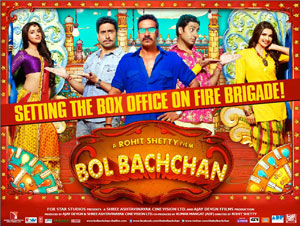
  • Critics don’t get generous with Bol Bachchan

    Bol Bachchan

    Directed by Rohit Shetty

    Produced by Ajay Devgn, Dhillin Mehta

    Screenplay by-Yunus Sajawal

    Starring-Ajay Devgn, Abhishek Bachchan, Asin Thottumkal, Prachi Desai, Krushna Abhishek


    Nobody in their right mind, except, of course those involved in the making and trade media could have anything good to say about Bol Bachchan.  It is loud, crude, garish and braindead. Rohit Shetty obviously wants box-office success, which such films seem to achieve, even if a majority of the audiences don’t actually like them, but with source material as rich as Hrishikesh Mukherjee’s Golmaal, there is no excuse for a film like Bol Bachchan. Except for The Times of India’s standard 3.5 stars, no critic could go over 2.5 stars, if they were feeling generous.


    It actually got 0.25 stars from Yahoo’s acerbic Kunal Guha. “Just after a cameo jig in the title song, Big B offers a disclaimer: he isn’t a part of this film, even though his name is. And that is hint enough for the wise. But for those who don’t know, Bol Bachchan (BB) jams chopsticks up the nose of Hrishikesh Mukherjee’s comic classic Golmaal and digs itself six feet under with it. While the story is same in theory, being a Rohit Shetty film only adds some cars nailing somersaults, trucks attempting a ballet, baddies playing mid-air Garba after being biffed and Ajay Devgn drawing his eyebrows close enough to show that he means business.”


    Sudhish Kamath of The Hindu savaged it too. “Sitting through Bol Bachchan is like sitting through multiple car wrecks. No, seriously. There is enough car-on-car action all through this unwarranted Rohit Shetty remake of Golmaal.   Well, it’s made by stuntmen, you see. Something they don’t want you to miss….There’s enough bad English in this film under the pretext of humour to make even Rowdy Rathore go: Don’t angry me. If you liked Hrishikesh Mukherjee’s Golmaal, which you sure did, you would want to protest this assault on one of the effortlessly funny films of all time.”


    Anupama Chopra of Hindustan Times gave it two stars and wrote, “Bol Bachchan, like most of Shetty’s earlier films, including the Golmaal series and All the Best: Fun Begins, isn’t so much a film as a series of gags strung together with songs and the requisite car-bashing action. There is no attempt at plotting, storytelling, delineating a character, building coherence or following logic. Shetty’s only agenda is to give you a good time.”


    Rajeev Masand of IBN went with 2 stars as well and commented, “‘Bol Bachchan directed by Rohit Shetty, revels gleefully in its silliness. This is a film whose pedestrian humor requires neither taste nor common sense to appreciate, and anyone seeking wit, a clever screenplay, or inspired performances might want to revisit Hrishikesh Mukherjee’s Golmaal, which Shetty plunders in the name of inspiration for this lazy film.”


    Karan Anshuman of Mumbai Mirror also gave it 2 stars and wrote, “The main problem with Bol Bachchan is that it unfolds like a play. There are literally a couple of sets where an overwhelming part of the action (and songs and dialogue exchanges) takes place. If you’ve experienced mainstream Hindi or Gujarati comedy theater (loud and forced comic situations devoid of experiment) you know precisely what to expect in BB. Even the genuinely funny bits are lost in a deluge of recycled jokes, preposterous situations, over the top ‘drama’ (you only know it’s drama because the background score suddenly spikes up to deafening levels), and – of course, how could a have a comic hit film without – offensive gay jokes.”


    Sukanya Varma of rediff.com raised it to 2.5 and ranted, “Shetty picks up all the major plot points of the original only to alter it with his boisterous, cheesy, slapstick and visually flashy sensibilities, known to work hugely in his favour given the success of the propitiously titled Golmaal franchise. Unlike the Utpal Dutt-Amol Palekar starrer, however, Bol Bachchan isn’t an out-and-out comedy throwing in large-scale action and irksome melodrama.”


    Shubhra Gupta of The Indian Express must have been in a good mood since she gives it 2.5 stars too and writes, “This is a Rohit Shetty film. Which means it is full of primary colours. I counted a red-blue-green-yellow palette more than a couple of times, all in the same frame. It is full of cars and jeeps hurtling down roads and crashing and smashing. It is full of Ajay Devgn, which is a given because Shetty and Devgn are long-time collaborators; plus, the star is the producer of the film. But this time around, there’s a slight difference. It’s also got Abhishek Bachchan, and that makes ‘Bol Bachchan’ not as much a Rohit Shetty film as his previous ones, which is not such a bad thing : I laughed more in this one than I have in his previous loud comedies.”


    Which brings one to Times of India’s Srijana Mitra Das of the 3.5 stars. “BB’s a dialogue-lover’s delight – lines like ‘fish and chips without water’, Devgn conveying the situation of a ‘jal bin machli’ – sparkle across the plot and you can feel the love as the actors reprise bits and bobs of vintage Bollywood. On the downside, it exceeds by about 30 minutes and has that odd, uneven heart-chart quality accompanying the film. But that aside, BB showcases Shetty as the maharaja of madness, Devgn clearly his crown prince. And Abhishek? His judwa bhai, of course. Tip-Off: Don’t strain your brain applying reason to this laugh-riot – but do buy more popcorn for that extra half-hour.”


  • Anil Thakraney: BBH must remain the black sheep

    By Anil Thakraney


    So, Sir John Hegarty has sold out his cult hot shop to the Publicis Group. The latter already owned a substantial stake in BBH, but now it’s a complete buy-out. How this acquisition will impact the future of BBH, only time will tell. It will all depend on how the new parent handles the adopted baby.


    BBH definitely gains from the acquisition in terms of financial muscle power. The ’boutique’ agency will now have a lot more moolah in its kitty to play around with. So that’s the good news. The bad news however is the agency has lost its independence. How much ever Publicis claims they will leave BBH alone to carve its own future, the ground reality is that as people change, as leadership changes, and as egos clash, this reassurance can change too. When push comes to shove, the ultimate power lies with the man who signs the pay cheque. That’s the new reality BBH now wakes up to.


    There’s another, larger issue to worry about: Sir John Hegarty and his partners will have run into serious personal money with this acquisition. Good for them, and they do deserve every penny of it. But it’s also a fact that Hegarty isn’t getting any younger, and BBH could come under a cloud when he retires to his farmhouse. Which is likely to happen pretty soon, within the next two years to be precise. As long as the Big Man is around, the Publicis suits will resist the temptation to interfere. Once he’s gone, it’s anybody’s guess how things will pan out. Suffice to say this: BBH, in its new avatar, won’t find it as easy to attract hot creative talent as it did till yesterday. It’s a pucca family member now.


    [youtube width=”400″ height=”225″]http://www.youtube.com/watch?v=MZtDqpdvy7s[/youtube]

    Publicis’s best bet is to allow BBH to maintain Hegarty’s famed ideology, even after Hegarty walks into the sunset: ‘When the world zigs, zag.’ They poke their neck into this and try to tweak it; BBH will immediately lose its magic and turn into just another ad agency. And that would be a pity.


    * * *


    PS: Heineken’s new ad. It’s a simple idea: ‘The perfect beer calls for the perfect bar.’ But the magic has been created by the art director and the production designer. A good example of how superb art direction can really lift a film. I feel like a Heineken already!


  • The Anchor: Naved Akhtar on 5 things that have changed in advertising

    By Naved Akhtar


    1. Advertising has become a business:

    The pressure to perform is so high that many times creativity is given a miss. There is a role reversal – earlier the creative people were held in high esteem, now the client has become the one leading the show. Advertising has become a business with roles being changed.


    2. Work for awards v/s real work

    There are two different kinds of work that has emerged. The work that is done to purely win awards and then there is real work that is done to drive the product in the market. Twenty years ago one would see the same ads that were have worked for a business also winning awards but now there is just no connect. I think that now the award winning works are more like fine arts and done for self-exultation.


    3. The aura gone from advertising

    In the earlier days, the creative fraternity had an aura around themselves; and were respected for their creative genius. Now advertising is seen as just any other business and the appeal that people emanated who were a part of the business has gone.


    4. TV has become important

    Today television has become ‘the’ medium for advertising unlike earlier where press was given more due.


    5. Fun is low

    I think the fun has gone out of advertising because of pressure of work, win new businesses and remain ahead of competition. There was a time when people were into advertising for love of advertising now this is purely business and means of earning bread and butter.


    Naved Akhtar is the Founder at Shop Design and Advertising


  • The Anchor: 4 steps to stay away from misleading advertising

    By Alan Colaco


    1. Backed by a scientific study

    Ads should be truthful and honest. Before making any claim in an ad, there should be a scientific study in support of the claim. This scientific study should be preferably done by an independent government-approved laboratory.


    2. Support by consumer media research company

    If in an advertisement, one is relying at consumer data for an opinion, then the same claim should be supported by a related consumer media research company.


    3. Use clinical research

    When in an ad, one is resorting to technical claim, it should be backed by a clinical research study, and not consumer studies. Suppose a toothpaste brand is claiming that it cleans 99 per cent germs then don’t ask 100-200 consumers their opinion on the claim, but use a clinical research to support the claim.


    4. Disclaimer should be legible

    If there is a disclaimer that has to go along with the ad, then it should be legible and on television it should appear for at least 4 seconds. The disclaimer should also be on a clear background.


    Alan Colaco is the Secretary General of ASCI