Category: BLOGS

  • Troll travails thanks to Twitter

    Ranjona Banerji

    By Ranjona Banerji


    Warren Buffett’s research has shown that while people may no longer read mainline newspapers, they are still loyal to their local community papers. Or at least that’s why Hathaway has invested in any number of community papers in the US but will not put money into the mainstream media. The same research also shows that people who do not buy mainline papers will read them online but not if they have to pay.


    This is a lesson about the internet that the traditional media in the west especially has yet to understand. In India, newspapers are free online but even they have irksome proceedings – like having to register to read the e-paper format like The Hindu. Others like Mail Today only have an e-paper format and no website which is also annoying.


    The freedom of the internet is what makes it appealing – even if no more than 200 people gathered to protest internet curbs – and this includes freedom from opening the wallet.


    The Huffington Post and Daily Beast both every effectively use social media like twitter and Facebook to push their stories – the Indian media is not quite so effective. Although Firstpost (web) and Mid-Day (paper) are not too bad and Firstpost also has the advantage of a fan base which retweets.


    The Times, London is a downer because it requires a one pound payment to open any story and the question is not of the amount so much as the procedure. This also stops The Times from reaching a wider audience as its stories cannot get picked up websites which collate news of a certain kind or allow readers to pass interesting articles along.


    * * *


    Until someone invents something better, Twitter remains the best disseminator of news as it happens. There are disadvantages, as passionately delineated by Namita Bhandare in the Hindustan Times (http://www.hindustantimes.com/technology/SocialMedia-Updates/Running-away-from-the-trolls/SP-Article1-868619.aspx). Bhandare’s problem is mainly to do with the viciousness of internet trolls and she has clearly suffered. But of course it could be argued that the only reason that these “trolls” are so annoying/frightening is because of the enormous access that the internet provides. These “trolls” exist in real life also but we may not meet them that often. The internet cannot invent new ways of human behaviour.


    This response to Bhandare’s article by someone who calls himself a “troll” (aah, irony thou are not dead in India yet) is also illuminating  http://chamchaa.wordpress.com/2012/06/10/an-open-letter-to-namita-bhandare/.


    * * *


    From my personal experience as a columnist for many years I can safely say that people will insult you if they want via any medium of communication open to them. Twitter is just one more. I for one have got death threats, legal notices envelopes filled with talcum powder pretending to be anthrax and plenty of questions raised about the sexual habits of my ancestors and in the old days, all these came via the post office. So what, say I?


    Years of reading letters to the editor (in practically every publication I have been part of) has at least made me realise that people are dying to be heard and deeply resentful when their voices are blocked – or when they perceive it as such. Twitter gives them such a wonderful platform to vent and get rid off their frustrations. Worse than any “troll” remains the famous Mumbai postcard writer with the initials ‘MSK’ whose imagination and capacity for personal insults was prodigious. I believe he is no more and his loss is deeply felt. These are the people who make becoming a journalist worthwhile.


    Yes, there are offensive people on Twitter but one can either not encourage them or just shut them off!


     

  • The Anchor: Indranil Das Blah on 5 essentials in talent mgmt

    Indranil Das Blah

    By Indranil Das Blah


    Create a Brand

    It’s crucial to create and maintain distinguishing individual brand images while managing talent. On that basis, we plan and execute a plan that will help project that brand and communicate a certain persona/image. There may be times when certain attributes maybe similar but the job of an effective brand custodian is to find that one USP that helps create that distinction and makes the individual stand tall in a crowd.


    Identify the Appeal

    Appeal is another very important factor to be kept in mind while managing talent. The idea is to find out not just what TG he or she appeals to but also to find out what makes them so appealing. You can work to create brand that works on the marketable appeal.


    Word of mouth

    Even if a talent is considered to be a good brand and has a desirable appeal, the word of mouth around him/her is what makes or breaks a talent. It’s important to protect the talent’s image from negative perception – be it via the media or via industry whispers. And as a brand custodian, our role also includes an advisory aspect where we share our inputs with our talent to ensure that they help us protect them from the negative backlash and make them a formidable entity in the business.


    Image building road map

    To gain the maximum out of the aforementioned pointers, a proper road map needs to be charted out that will help build the talent’s brand persona. The core thought needs to filter down through various audience touch points – be it endorsements, public appearances, media interactions, films and so on to create the desired consumer and audience mindset and thereby attain the goals you set out to achieve with your talent.


    Visibility

    Visibility is a very key aspect of managing talent and building their brand. We need to ensure that we expose talent to the various touch points and create a strong, positive buzz around them. More the visibility, better the quality, more is top of mind recall. Recall is what changes the game for talent as it helps them consistently build and enhance their positioning in a competitive environment.


    Indranil Das Blah is the COO at KWAN Entertainment and Marketing Solutions


  • Ranjona Banerji: Media double faults in Paes-Bhupathi match

    Ranjona Banerji

    By Ranjona Banerji


    After years of working with city reporters, I accepted the fact that many grappled to understand the concept of “presumption of innocence”: If the police made an accusation against someone, why then it had to be true. But, of course, every accused has the right to defence. And while reporting a story, journalists are supposed to be objective. If they cannot provide both sides of a dispute, they must explain to the reader why they have failed.


    But in the initial rounds of this rather unfortunate fight in Indian tennis, where Mahesh Bhupathi and Rohan Bopanna have refused to partner India’s top tennis player Leander Paes in the 2012 London Olympics, the media started out batting for Bhupathi alone. In what appears to be a well-thought-out campaign, the doubles pair of Bhupathi and Bopanna sent out a series of letters and emails signalling their refusal to play with Paes even before the All Indian Tennis Association decided on the Olympic team. Several newspapers and news channels did not even make a willy-nilly attempt to contact Paes.


    The exceptions are possibly DNA and Headlines Today, who got in touch with Paes’s father. But for the most part, it was about the terrible wrong that was about to be done to Bhupathi and Bopanna – being forced to play with Paes for the Olympics. Mail Today and The Times of India seemed like they had stakes in Bhupathi’s career.


    These pressure tactics appeared to have failed and the AITA decided to pair Bhupathi with Paes. This is where objectivity completely failed India’s sports journalists. Bhupathi came on air and was quoted in print making all kinds of allegations against Paes. The Times of India at last informed us that they could not contact Paes. Therefore, the story remained one-sided.


    Bhupathi and Bopanna meanwhile, perhaps emboldened by this out-and-out media support stated firmly that if either had to partner Paes, they were willing to forgo the Olympics. Despite the media’s usual pattern of extreme jingoism, even this display of lack of country love, did not deter the pro-Bhupathi-Bopanna journalists. One cannot state that sports journalists are less jingoistic than the rest – we see what they do to cricketers regularly. In fact I can guarantee that any top cricketer who refused to play for India because he did not like his team members would be hung, drawn and quartered by the media. By the way, cricket is not even an Olympic sport and technically, when Indian cricketers play, they represent the board. Not so for tennis, where professional players put aside career considerations to play Davis Cup and the Olympics.


    However, as the week of allegations by Bhupathi and Bopanna came to a close, the media slowly started to turn. Paes may have contributed to that by issuing a statement that he was willing to go by the AITA’s decision. The Indian Express and Mid-Day started to look at being fair to all concerned. The Hindustan Times later also presented a larger picture. The Times of India came to the party last – but more on its edit pages than its sports pages.


    Where a reader should have been given perspective on this battle and information to negotiate through this unseemly fight, he or she got a minefield of accusations from only one side. Now the villain of the piece is apparently the AITA as Bhupathi has approached the sports ministry to step in. Bhupathi has accused the selection committee of being a bunch of bureaucrats who know nothing about tennis. To me they appear to be former players – perhaps not of the stature of Bhupathi but tennis players nonetheless, a fact which needs to be pointed out in the media.


    Monday night saw Times Now’s Arnab Goswami ask Mahesh Bhupathi some tough questions – some of which he struggled to answer. This is the first time that Bhupathi’s accusations were questioned. Later, the fathers of Paes and Bhupathi were on Times Now, where Paes Senior pointed out that Bhupathi was not blameless in this battle, while Bhupathi Senior tried to shrug that off and say the Olympic riddle had to be solved not the mistakes made by the boys.


    Appalling as this ego battle between India’s top tennis players may be, the media’s partisan stand has been as appalling.


  • Anil Thakraney: The ten commandments of social behaviour

    By Anil Thakraney


    Tweeters and Facebookers often get into strife, and find themselves with their feet stuck firmly in their mouths. Some have paid a huge price for being Twitter-happy. Relationships have broken down. Posts have been used as evidence in courts. People have lost their jobs. A few like Lalit Modi have turned into fugitives.


    Here are my commandments for social media usage. Strictly obey them so that you can have fun, make new pals and remain trouble free.

    1. Thou shall think before posting. The problem with social media is that there’s no editor whetting your content, you are on your own. Instant accessibility and the urge to be the ‘first out there’ is too strong to curb. And this can lead to trouble. I suggest you delay your post/tweet by at least 10 minutes. That will give you a little margin of safety. Mama said ‘look before you leap’. In today’s context that reads ‘look before you tweet’.


    2. Thou shall try to familiarize yourself with the basic laws of the land. Social media is a public platform, it’s not your private spittoon. No defaming people, no communal slurs, no porn stuff and definitely no negative comments on Mamata Didi.


    3. Thou shall NOT post pictures of you partying wildly with buddies from the opposite sex (or the same sex if you are gay). This can and will be used against you at an appropriate time.


    4. Thou shall not befriend colleagues from your organization on Facebook. Some of them will use your posts at the opportune time to stab you in the back.


    5. Thou shall not post boring tweets. If you aren’t born witty, steal someone else’s updates. Or quote Abraham Lincoln or Mahatma Gandhi or Mother Teresa or Mohammed Ali Jinnah. Always works.


    6. Thou shall not beg movie stars to retweet your garbage. That’s like admitting to lakhs of people what a dull and desperate moron you are.


    7. Thou shall not post cho-chweet utterances and playful deeds of your little kids. Remember, just as in real life, only you find your bachchas cute. Deal with it.


    8. Thou shall promote your work. But only once a month. If you do it every hour, you will find yourself sad and lonely in the virtual world. Unless you look like George Clooney or Angelina Jolie.


    9. Thou shall not post holiday albums. No one wants to spend time watching 1000 pictures of you and your family posing near a little waterfall at Khandala. Unless you are wearing really skimpy clothes, of course.


    10. Thou shall not troll anyone on Twitter. It’s the most offensive form of social behavior. (PS: An exception can be made for Mr Chetan Bhagat. Go after him!)


  • The Anchor: 7 reasons why Cannes Lions is a must-attend!

    By A N Chorrea


    Okay so you haven’t made it to Cannes, but perhaps you ought to have. My suggestion, just as you have those SIPs from the various financial institutions, starting a recurring deposit account to fund your trip to Cannes 2013. If your agency/company/funds do not allow you to get there, take a weeks’ break, and head there. Don’t see enough reason still? Read this:


    1. Yes, it’s expensive getting there. From India, a minimum of Rs 2 lakh if you don’t want to stay in a five star and carry food from back home for the week. So theplas or those packs of ready-to-eat food? Or you buy a loaf of bread every other day , some butter and assorted meats/wafers to keep you through. However, it’s worth every rupee spent.

    2. The sessions thus far have been exhilarating. R Balki and Shekhar Kapur were super ambassadors for the country with their plainspeak. Soon, China and India will sweep Cannes Lions!

    3. We haven’t done too well in the awards tally, but there has been a gold, and a couple of silvers and bronzes. And some of the big ‘uns are still too be announced.

    4. Digital is the way of life at Cannes Lions. Streaming sessions if you don’t want to be watching it live, Tweets. Though not as many of YouTube videos and no live webcast, but it’s clear that Digital is the way to go. Those who want to be on top of technology and how it’s going to be used in marketing and advertising, ought to have been at the Lions.

    5. Europe is going through a mess, but there seems to be no sign of that although there were planeloads of people from the Americas and Asia.

    6. Cannes is the perfect place for a week-long event. And some of the people are there for nearly a fortnight. Locals may crib about the weather, but those from smouldering Delhi and sweltering (and now wet) Mumbai can enjoy.

    7. Most of the big boys are at Cannes. Note: most, not all. Purrfect networking ground. That’s good reason why one must be there.


    A N Chorrea is a seasoned media industrypeson who writes under a pseudonym


  • Debrief: Cadbury Gems: Not really a gem

    By Anil Thakraney


    After ‘upgrading’ their chocolate brands to adults, Cadbury is trying out the same trick with the totally kiddie Cadbury Gems. And I must say this is a very brave move. While one can understand and accept the fact that adults do indulge in chocolates, uncles and aunties gorging on Gems is pushing things a bit.


    The strategy is that Cadbury Gems brings out the inner bachcha in you. And that the brand makes you behave in a childish manner in adult situations. ‘Raho Umarless’ is the creative interpretation. I watched two commercials. In one, an oldish aunty sitting on a park bench notices a Cadbury Gem. She can’t resist it and sets off a volcanic eruption of candies. In another ad, a man spots an artifact inside a museum. It’s created out of Cadbury Gems. He plucks one candy out, and this action dislodges the entire structure and the creation is destroyed.


    There’s a basic problem with this creative treatment: It’s kiddish. Cadbury has failed to replicate the magic they create with their chocolates. For the latter, one is shown adult situations in which adults behave like adults. This creates empathy, and the brand wins. In the case of Cadbury Gems, adults behaving like silly kids will draw zero empathy from adults, there is no emotional connect. At best, the kids, who are the core consumers of Cadbury Gems, will love these commercials, and laugh their little heads off watching adults make fools of themselves.


    In other words, all that Cadbury has done is to reach out to the bachchas once again, this time showing adults in slapstick situations. And because of this, despite the ads being entertaining, they will score no points with the adult market. In any case, I think it’s a bad idea trying to promote a hardcore kiddie candy to adults. It’s not going to work.


    [youtube width=”325″ height=”225″]http://www.youtube.com/watch?v=Ink9lAkrcxY[/youtube] [youtube width=”325″ height=”225″]http://www.youtube.com/watch?v=jjV91ZRqu-o[/youtube]


    Rating: (On a scale of 1 to 5): 2. Dicey strategy. Flawed creative.


  • Ranjona Banerji: What the Whacky-dooky?!

    Ranjona Banerji

    By Ranjona Banerji


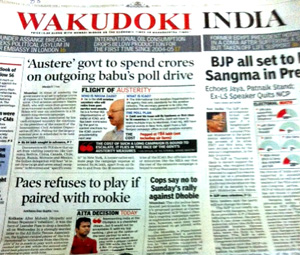
    I understand that advertising is vital to the well-being of a newspaper but just who invented these idiotic “half-jackets” which either split the front page of a newspaper or cover it with some meaningful and wholesome message about a bank or a soft drink?


    What I mean is, does one blame an advertising agency or the ad sales department of a newspaper?


    My problem however is not to do with the advertising message itself – although I was hard-pressed to understand today’s Wakudoki message on The Times of India masthead. Why this car company had to say Wakudoki to us, I don’t know. What Wakudoki is I don’t know. In some places Wakudoki was one word and in other places Wako-doki was hyphenated. Actually this made me happy in a schadenfruede kind of way – copy checkers in ad agencies are of the same calibre as sub-editors in newspapers.


    My primary objection is that they don’t allow you to fold the newspaper properly. This is particularly annoying as you reach the last pages of the paper as the half-jacket page with not enough hold flies off or falls off or slips out. This makes me want to shout something far more robust and potent that “Wakudoki” or even “Waku-doki”. Hyphen or not, the words I’m thinking of do not start with a ‘w’.

     

    Halfway through reading about Leander Paes’s current tantrum to compete with Mahesh Bhupathi’s original tantrum, I suddenly find the names have changed to Drogba and Rooney. These names are as mysterious to me as “Wakudoki” (and “Waku-doki”) and as I wonder if my coffee has some magic mushrooms in it, I realise that the last page of the newspaper has slipped off.


    I realise that The Times of India is not the only guilty newspaper here. Everyone does it. It’s just that I was whacked in the face today by this vastly annoying invention. It even beats the detergent bubbles and spouting soft drinks I had to deal with as a young sub-editor.


    In my view, I would rather the newspaper just sold its front page, self-respect and identity in one go rather than in half-measures. That way you can just turn the page, know that it will fold obediently and carry on with the latest Purno, Pranab, Nitish, Narendra fight.


    Instead of wanting to start the day by whacking whoever comes close because the newspaper begins with some cheapie corporate who only wants to pay for half a sheet of paper.


  • Debrief: Hyundai i10: Same old, same old

    By Anil Thakraney


    In my books, the worst celebrity choice in Indian advertising has to be Shah Rukh Khan endorsing the poor man’s Santro. It’s a cruel joke, really. The multi-billionaire hero would want to be caught dead inside such a ‘down-market’ vehicle.


    Well, Hyundai has cast him again, this time for their i10 car, which is one level above Santro. But is still an aam aadmi ki gaadi. I often wonder what SRK does with such a car, assuming one ‘sample’ is sent to him gratis. I suppose he gifts it off to one of his security guards. Anyway, let’s get to the task at hand: The commercial has a strange idea – something called ‘the helping hand’. And this mystery hand blesses the i10 owner with good things in life. Like a hot babe, great weather, etc. But frankly, all I recall is shots of SRK primping and preening throughout the ad. The same old Bollywood expressions of his that the junta is tiring of.


    Nope, this isn’t working at all. Not only is SRK over-used and over-abused in media and advertising, by no stretch of imagination can I visualize a brand match out here. Therefore, he neither brings in freshness nor salience. The i10, if they must used celebs, would be far better served with fresh new faces from the showbiz. In addition, there’s no story, no narrative in the TVC. Same old boring lifestyle shots that most car ads use.


    [youtube width=”400″ height=”225″]http://www.youtube.com/watch?v=J9q_6214N_8[/youtube]

    It’s a flop show. The people who need a helping hand out here are the brand manager and his/her ad agency.


    Rating: (On a scale of 1 to 5): 1. Poor casting. Weak creative.


  • The Anchor: Jwalant Swaroop on 7 reasons why IRS is a valuable tool for measuring readership

    By Jwalant Swaroop


    Whether we like it or not, we cannot help but accept IRS as the currency for readership measurement. I do not think that we have an option.  In fact, I find IRS most valuable tool for its robustness and brilliant consistency. Over a period of time IRS as a product has evolved and is must for the media planning.


    1. IRS is the industry’s most acceptable currency. For the benefit of the professionals joining the industry now, let me share that there were times when we had NRS and IRS the two conflicting readership surveys. Now that the merger of both is official, IRS has emerged as the most acceptable currency.


    2. IRS is a technically sound product which encapsulates expectations of all the stake holders.


    3. Given the sample size IRS captures the readership trends having geographical and demographic details with precision.


    4. Despite the fact that it is largely industry funded, IRS has a neutral stance delivering value to clients and agencies equally.


    5. The product linkage data in IRS is significant for understanding the market size and set directions to brand and media owners.


    6. IRS can also be leveraged for setting directions for the content team to develop content for building attractiveness in the target readership which the media owners desires to build.


    7. Since the IRS results are out every quarter, it builds the excitement.


    Jwalant Swaroop is COO-Publishing, Lokmat Media Pvt Ltd


  • Mediaah! Why Ambika Soni is to blame for the delay in digitization

    By Pradyuman Maheshwari


    I have been a huge fan of the current information and broadcasting minister Ambika Soni. After the likes of Priyaranjan Dasmunshi and Anand Sharma, Madame Soni’s tenure came as a breath of fresh air. And a much-needed one, because she didn’t make life miserable for the broadcasters like her predecessors did (and I am told wanted her to).


    The I&B minister’s job is a thankless one. Several hundred Parliamentarians and politicians, consumer groups, corporates, lobbies and alert citizens writing to her with comments and requests, and most of which cannot be ignored.  If Colors didn’t face any problems with Balika Vadhu or Star Plus didn’t have to pull out Sach Ka Saamna, it’s thanks to the minister warding off various pressures.


    I think just keeping all these complainants at bay and letting the various players do their job is an achievement. She has also gently ensured that news and non-news broadcasters adopt a stringent (and effective) self-regulatory mechanism.


    So what’s the problem? Well, part of it is thanks to successive I&B secretaries having short tenures. Uday Kumar Varma, the incumbent, also has a two-year stint prior to retirement or an extension. Mr Varma has the advantage of having worked with MIB in the past at senior positions so he didn’t spend a few months understanding the nuances of the job as a few of his predecessors may have had to.


    Over the last few months, several industry captains and observers have told me that the ministry is inefficient which I have vociferously countered by saying Ms Soni’s achievements need to be counted by her proactive opposition to regressive forces. At least one CEO even told that me that I was too pro-MIB. Perhaps, but that’s because she’s not regressive.


    However, the fact is that the ministry lacks the initiative to deliver on bold measures. Nothing happened with Doordarshan even as much was promised when it celebrated its golden jubilee in 2009. The radio sector is still floundering: there is still no news on radio even as television stations even in the most sensitive of zones in the country are allowed to air news. The minister wasn’t able to stand up to her colleague in the food and consumer affairs department on ad regulation and more recently it’s made a mess of the entire digitization process.


    The Minister and her secretariat were aware of the requirements of the process, so even before accepting the TRAI regulations, they ought to have looked at whether the Sunset Date of June 30 was achievable. It wasn’t as most stakeholders told us.


    Even now, as a few of the people familiar with the situation on the ground have told me that October 31 is going to be a tough ask.


    It’s critical that the government monitors the execution carefully and ensures that there is no room for any further delays. Care must also be taken to ensure that the respective state governments and municipal corporations are taken into confidence… especially in Chennai and Kolkata.


    As to those who raise the bogey that digitization puts television out of the reach of the lowest common denominator, the answer is that they can always access terrestrial transmission. Quality software must be paid for.


    Meanwhile, all is not lost for the Honourable Minister. She must get aggressive on digitization and various other pending issues in her ministry. Or let history remember her as one more ineffective I&B ministers that India has had.


    Buzz me if you have a story to tell. Confidentiality assured. There are various ways you can reach me:

    pradyumanm[at]mxmindia.com, Gtalk pradyumanm@gmail.com, Twitter @pmahesh and of course the mobile: 98338 76278.  The views expressed here are my own.


  • Ranjona Banerji: TV lacks training to cover live events

    Ranjona Banerji

    By Ranjona Banerji


    The fire which engulfed and destroyed large portions of Maharashtra’s most important government building on Thursday afternoon dominated news broadcasts and the newspapers on Friday – hardly surprisingly. TV channels switched from whatever they were covering – mainly the unseemly drama over India’s tennis stars and the Olympics to concentrate on the fire in Mumbai.


    It’s self-evident that TV is the best medium to cover live events. However, this is where lack of training – both anchors and reporters – gets exposed. Having shown viewers the fire over and over again – which really points to the camerapersons being able to locate the targets – TV reporters then appear to be at a loss. Instead of hundred several of them “standing by” at various locations around an incident, news channels might be better served if they trained some reporters to collect information while others dealt with on-camera duties. This way, viewers would get some news instead of having to hear: “The fire is still raging and as you can see people are waiting anxiously and if my cameraperson could show you…” over and over again.


    This is an aside: Instead of concentrating on emulating some fancy foreign accent, reporters who appear on English channels might spend more time on their grammar. A young girl on Times Now kept talking about the “backside of the building.” Backside however refers to the derriere, posterior, bottom, buttocks, bum – that is, the rear end of humans. She could have just said “back of the building”. This would not have been so jarring – or amusing – if she had not acquired an ambivalent pseudo-foreign accent.


    * * *


    Incidentally, local channels usually win at times like this and Times Now, being the only major English news channel located in Mumbai had the clear upper hand.


    * * *


    And the same can be said of The Times of India. For the past four years now, Mumbai’s largest English newspaper has been flexing its muscle when it comes to local coverage. With the Mantralaya fire, they covered just about every angle. Since they have employed a large proportion of the city’s reporters, they also benefited from the expertise their staff has picked up in other papers!


    In order, Mid-Day comes next and the tabloid newspaper has done a comprehensive and detailed job, then the Indian Express and finally, Hindustan Times. It is at moments like this that Hindustan Times seems to pay the price for concentrating more on packaging than substance. The Times of India has dispensed with packaging to provide material and this seems to be a winning strategy. Undoubtedly, a commendable achievement for a “product” from a group which is also responsible for some of the worst practices in the media today?


    “Sabotage” asked the Economic Times in a boxed item on their front page, thus emphasising the suspicions that almost everyone has about this fire.


    * * *


    Eminent heart specialist Ramakant Panda’s defence of the medical fraternity (obviously still feeling hurt by Aamir Khan’s Satyamev Jayate) on Times of India’s edit page was not just weak, it was quite funny. Imagine using the incredible service provided by Prakash and Mandakini Amte to the tribals as an example of how great doctors are. If other doctors bothered to even do half of what the Amtes have managed for years, our healthcare to the poor would not be so despicable. Most doctors in Maharashtra however refuse to do their rural stint since it severely cuts into the ka-ching of big city cash registers. Please.


    * * *


    This is just a personal note. My rage against biased coverage of the tennis fiasco led one young (am assuming young from the way it was written and the handle Poopsonurface) person to call me a “Calcutta partisan presswalla”. Amused as I am, I must humbly declare that I have never worked in Calcutta or Kolkata in my career which spans almost 30 years. Other than Mumbai, the only other place I have worked in is Ahmedabad. As to his or her’s other suggestion that I “get a life”, I have taken that under advisement!


  • Anil Thakraney: Freelance writers need to be paid more

    By Anil Thakraney


    Although I haven’t suffered the same fate (so far at least!), freelance journalists/columnists I know still crib about very poor payments. They have been cribbing about this for many years, and it hasn’t changed. Despite the so-called economic boom, the media explosion and the killing inflation. Even those publications that are doing pretty well for themselves, and don’t think twice before splurging on photography, travel, technology, and so on, get suddenly hit by poverty pangs when it’s time to negotiate with freelance writers. It’s still that pre-historic, measly ‘per word’ figure.


    And this amazes me, really. One would have thought with the increased competition across various media forms, quality of content would be given maximum priority. Which means ensuring that the best writers and reporters are assigned to do stories or write columns. And these people are paid handsomely to keep them engaged and fired up. But that’s not how it seems to have panned out. From what I hear, freelance contributors continue to get step-motherly treatment.


    This then results in quality writers who are unable to survive on freelance assignments being compelled to seek other options. Some get married to loaded partners, some turn into full time authors, some migrate to the corporate world and others simply fade away. And who loses in the process? The media, of course. No wonder the quality of writing is so low in many publications and web portals. Because the editors/content heads offer peanuts, they end up with monkeys, as the proverb goes.


    So then why is this ancient mind-set not changing? Why are freelancers still being put at the bottom of the food chain? I think it has got to do with the mind block most editors suffer from, it’s a legacy they have carried over from the past. This must change very quickly. Media brands that continue to dish out sub-standard content will find the going tough. Because quality contributors will move away to greener pastures.


    I must also add here that this mind-set has changed in the Indian film industry. In the past, story and screenplay writers were paid shabbily and this resulted in so many pathetic flicks being churned out. In recent times however, writers have come to the party and they command good remuneration. The overall quality of our cinema has also improved. If it can happen there, there’s no reason why the media must remain frozen in the ice age.


    * * *


    [youtube width=”400″ height=”225″]http://www.youtube.com/watch?v=oGgByLLQwSw[/youtube]

    PS: This commercial is never going to score atCannes. Simply because it’s a very provocative way to promote cancer awareness. And theCannesjury shan’t be amused. But that doesn’t change the fact that it has worked big-time, lakhs of men have already viewed this link. But do NOT even think of emulating this inIndia. Unless you have been granted permanent asylum in a first world country.