Category: BLOGS

  • Ranjona Banerji: Getting a bum deal from Yahoo India

    Ranjona Banerji

    By Ranjona Banerji


    Last month, I dumped my Reliance internet connection (dip in connectivity and more importantly, rude service) and opted for Tata Photon. But my grouse is not with either of them. It is with Yahoo India. The Tata Photon opens with a Yahoo India page (I can’t shut it down too quickly because then Mozilla Firefox won’t reload and I can’t go back to Google Chrome because it slows down my machine and particularly did not like this website… so who said the internet was all plain sailing!).


    The page is dominated by Bollywood nonsense (celebrities who married young, star break ups that hurt us more than it hurt them) and then a sprinkling of political news in the next segment and only cricket news in the next.


    I am now inured to the stranglehold which Bollywood has on our lives. But I still question a news source which can look no further than the lowest common denominator. I also don’t quite know if the average internet user in India wants only Bollywood and cricket and nothing else. Has Tata Photon done any such research about its average user?


    Out of curiosity and since the damn page was open, on Tuesday evening I ventured further into the Yahoo India page and decided to see how it treated other news. In the sports category, there were only cricket, tennis and football, in that order. I went to tennis since that’s my area of interest. There was a story about Maria Sharapova, nothing at all about Rafael Nadal and Novak Djokovic’s French Open battle and Nadal’s historic seventh French Open title.


    Instead I see a story about how reality TV star, Kim Kardashian, “flashed her bums” during some family tennis match. I went no further into the story, credited to ANI, but it is wrong on so many levels. For one, the English. It is not “flashed her bums”. Bums when it applies to the buttocks is a singular entity, like bottom. Unless Kardashian has cultivated a collection of homeless drunks which she brought along to a family tennis match.


    But more than the grammar, it is the intent which is offensive. I understand that sex is a human impulse which beats all others (well…). But why should this daft little story find itself in a sports section of a well-known website? Is there any connection with tennis at all? If I wanted to fulfil my baser instincts on the internet there are enough explicit sites for my guilty pleasures. Yahoo India is not the preferred choice for anyone, unless that it is intention? The Yahoo.com website has an excellent, up to the minute and comprehensive sports section. Is Yahoo India so far away from there?


  • Anil Thakraney: Film critics cannot be trusted

    By Anil Thakraney


    I was once having a conversation with Mrs Jaya Bachchan on film criticism. And she made a valid point, and this is also the reason I have steered clear of taking up film review assignments: It is important for columnists who review cinema to take part in a film appreciation course. So that even if they aren’t completely familiar with the job of making movies, at least their basics on script writing, editing, background score, art direction, production, etc, are in place. And they are able to dole out insightful observations to their readers. Very true. And since I haven’t done such a course, I am reluctant to review cinema. Don’t think I am qualified enough.


    And that new flick called ‘Shanghai’ is the last time I shall go by the critics’ verdict. Although wary of these guys, I did get carried away into believing this must be outstanding cinema. After all, almost every single desi reviewer was wildly gushing over it. Frankly, I couldn’t sit through the film. It was boring, wannabe, pretentious and very laboured. And even the story offered nothing new; every kid knows this nation is very corrupted. Self indulgent cinema at its worse, where the director gets carried away with his/her own sensibility, and forgets that movies are meant to engage and entertain the junta above all else. And no, in case you are wondering, I am not a fan of ‘Rowdy Rathore’ or ‘Dabanng’ sort of trashy cinema. In fact, I avoid Salman Khan and Akshay Kumar films like the swine flu. So this isn’t about my lack of ability to enjoy ‘refined’ cinema. I may not be an expert but I can tell fraudish work quite easily.


    So then what’s going on? What’s gone wrong with the critics? There have always been hushed allegations of sycophancy and corruption in this trade, but I will choose to discount that. Instead, I would urge editors and programming heads to do what Mrs Bachchan suggests. Enroll your film reviewers for a good, reputed film appreciation course. You will see the results immediately. And pretentious films like ‘Shanghai’ will end up with a completely different review.


    * * *


    PS: My time is now. Another wonderful ad from Nike. This one is set inside a barber shop, and it’s interactive too. What I like most about Nike’s advertising is the jehadi zeal with which they stick to the established brand personality. The Nike attitude is always a constant.


  • The Anchor: Anil Garg on 10 reasons why specialty channels are the need of the hour

    By Anil Garg


    The television landscape in India has seen a paradigm shift in the last few years.  From a plethora of channels offering General Entertainment, News including Business & Market News, Music, Movies, Kids, Sports and so on, one is seeing the emergence of newer specialized genres such as Infotainment, Food, “Classroom” Education, Science and Technology, Specialty Sports (e.g. Golf), Home Shopping and Travel.  There are dozens of reasons for this (be it advances in technologies, affordability, availability, changing lifestyles and such) here are TEN reasons why specialty content will not only survive but thrive in the coming years:


    1. Consumer Awareness and Demand

    India, like most other countries, is fast realising that audiences are increasingly discerning especially with multiple TV households in Tier I, II and even III cities across all SEC groups.  Look at how Discovery has diversified from a single channel to Discovery Science and Discovery Turbo; or for that matter NatGeo. Infotainment content is entertaining and educative. Today people increasingly want to learn and know more about the world they live in. For instance, one would never stop a child watching a clip on the “Blue pottery of Jaipur” as opposed to watching cartoons on a kid’s channel.


    2. The Nature of Specialized Content

    Specialised content such as a cookery show or a travel show does not need to be in a 30 minute format, so typical of traditional television. Specialised content can be “snacky”; a five minute show on the “Fishing Nets of Kerala” or “48 hours in Cairo” can ignite the angst and aspiration in the mind of viewers who have or would love to experience this. Such content can be informative, educative and yet entertaining. Also such content appeals across all age groups four-adult. Plus, it is non-controversial as in there is no rape or murder or such.


    3. Passion

    People who want specialized content are passionate about it. So are the viewers! Take for instance Food or Travel. Specialised content has to be produced by people serious about the domain. As more and more people choose to work in their field of interest, so will they choose to talk about it in more and more creative ways. Likewise, an ever increasing consumer base aware about the affordable availability of such content will tune into what they are passionate about.


    4. Forever Content

    Most specialized content is forever in that it does not age. A show on the Taj Mahal or the Pushkar Mela is timeless. Unlike most soaps, reality shows or sporting events, most infotainment content is ageless and can be watched again and again for generations. We still love to watch a clip on what Mumbai looked like in the 50’s even though it is black and white; this will be the case even fifty years hence!


    5. Technology including New Media

    Affordable technology makes it possible to offer thousands of channels to viewers.  Technology trends, be it the downward cost of increasingly powerful Cameras, inexpensive video editing Software, dramatically reducing Storage cost, affordable and increased Bandwidth, ever increasing Connectivity, Interactive and Mobile devices and increasing use of innovative Applications – all this makes it possible for a specialized channels to stream to their audiences, anytime, everywhere. As rich content moves from Beta tapes to digital video formats, from huge physical libraries to compact server scale storage in a box, growing a business around this new realisation that the concept of space has changed will help new age entrepreneurs build organisations and brand architectures with specialized content.


    6. Portable Content

    The very nature of specialised content is interesting. There is a growing need and demand for on the move infotainment and on demand infotainment (e.g. what to see and do inSingapore), as opposed to a two-three hour movie. As consumer attention spans get shorter, information they seek has to be at their finger tips “here and now”.  Thanks to technology, this is made possible. Specialised content is easy to port for on-demand viewing.


    7. Going Digital – Growth of Television and the Net

    As India moves to digitization with the possibility of a 500-1000 channels though fibre and cable to the home, multiple TV households, increased Internet bandwidth and technologies such as 3 and 4G for the masses, affordable yet powerful handheld devices, access to specialized content will be easier and affordable for consumers.  Also for aggregators and distributors of such content, it will be imperative to reach out to every single viewer with a rich and varied offering.


    8. Education

    As the Indian population comes to grips with evolving technologies, the nature of content, applications and their usage will explode. From ten years ago when not many people used an ATM machine or a cell phone, the scenario is changing rapidly and dramatically. As people learn how to use a phone for purposes other than talking, to using the net for purposes other than checking emails or making a railway booking, we will see people searching for informative content and entertainment.


    9. Targeted appeal

    For advertisers, sponsors and the like, specialized channels offer a focused, targeted audience. Also, technology is fast reducing the costs for reaching out to the customer and getting a better handle of behavioural and psychometric testing – e.g. social media and viral.


    10. Business Sense

    Businesses understand the reasons above.  Channels like a GEC, Movies, or Sports are very expensive to setup and operate; in India we have seen many such channels go down.  For the cost of a single show on a channel in these traditional genres, it is possible to setup and operate a specialized channel and also to make it profitable. Ten years ago not many people thought that a channel like Discovery made any business sense! Also, specialized infotainment channels have multiple revenue streams; the touch-points for consumers sourcing information of interest are multiple.  The same content can be sampled on TV, researched in print and enabled/fulfilled via the web as an example – all thanks to technology.


    In a nutshell, emerging technologies are playing a big role in bringing about this shift from traditional TV (latent viewing) to active TV (active viewing).  For instance in a specialized genre such as Travel, television can provide excellent programming backed up by a supporting interactive mechanism either through a website or an interactive mobile gadget which can create lead generation for travel booking, with applications that can provide ‘here and now’ information while at home or office or on the go. This increases the opportunity base and revenue potential for all possible trade partners – traditional travel operators, tourism boards, hotels and airlines, fleet operators and more – with the help of emerging new media technologies which help link up all possible interactions.


    As all trends point to specialized content, such content will become the trend!


    Anil Garg is Chairman & Managing Director, Explore Travel Channel

     

  • The Anchor: Mahrukh Inayet on 5 reasons why anchoring is more about substance than style

    By Mahrukh Inayet


    1. News always comes first

    Viewers want the news first. Rest, very little matters. Your style has little bearing on the viewer nor does it alter the impact of news on the viewer. Facts are sacrosanct. Information rules. It needs no garnishing.


    2. The new age viewer

    Today’s viewer is a global citizen. Aware, informed, educated and opinionated. More importantly, s/he is consistently running against time. They get their news and boom – they are out. Your personality might make them stop, but it is the news that will make them stay.


    3. Credibility

    News anchoring is all about credibility. The more you establish your substance, the more the viewer will notice your style. But remember, substance comes first. Think about it – most well known TV faces have been around for years. In theUS, the average age for prime time anchors is 60. Larry King, Peter Jennings, Dan Rather – the list is endless.


    4. Journalism v/s Style

    News does not come in fancy packages. It’s hard hitting and raw. Floods, drought, bomb blasts, terror strike, petrol prices – can you even imagine viewers bothering with anything but the information.


    5. News, not the newsreader

    In broadcast journalism school you are taught to conduct yourself in a manner that takes attention away from you and highlights what you are presenting. News anchors only disseminate the news – they are the medium, not the message


    Mahrukh Inayet is Former Senior Editor, Times Now


  • Debrief: Airtel Digital TV: Big promise, poor delivery

    By Anil Thakraney


    Airtel has launched a new TV campaign to promote their digital TV service. The idea is: ‘Sirf cable nahin, life badlo’. The core thought is that in today’s world, the idiot box not only entertains, it changes your life. A bit far fetched? It is. I think the only way TV has changed some people’s lives is by turning them into lazy couch potatoes.


    Anyway, now that they have chosen to travel this exaggerated path, the commercials have to be truly sensational for the idea to get wings. But sadly, the one ad I watched left me flattened. There’s this always chilled out bloke who never gets angry at anything in life. Not even when his pal smashes his car. But he goes ballistic and mad with rage when the TV set conks out and the local cable supplier won’t take his calls. So this couch potato switches to Airtel digital TV, and he’s back to being his chilled out self.


    Another maha boring before/after ad. The creative lacks spark, the script is contrived and the youngsters featured in the ad are very irritating. Here’s a suggestion for Airtel and all other advertisers: When you have to show slothful people, it’s critical that they look a bit cute and charismatic. Else, the combo of laziness and ugliness repels the viewer. And you’ve lost the battle even before it has begun.


    Rating: (On a scale of 1 to 5): 1. Weak and uninteresting creative


  • Ranjona Banerji: Is the media fickle, or just having fun

    Ranjona Banerji

    By Ranjona Banerji


    Television is, of course, very worried about the next President of India, but newspapers have given it the treatment it deserved – reporting on the news rather than trying to create it.


    Which means that Friday morning saw the straining of the ties between the UPA and Trinamool Congress get full play in the papers, although Mamata Banerjee’s mocking of the prime minister seems to have got a muted response.


    There has been a distinct movement to belittle Manmohan Singh and the media now appears to have been taken along for the ride. It seems a bit odd that rather take a non-partisan stand, the media has been party to this campaign. Or maybe it is not odd and I am not surprised.


    The downside for Team Anna is that Mamata Banerjee has stolen their limelight. Of particular interest is her declaration in today’s Times of India that she is a “simple man”. Indeed.


    * * *


    Mumbai’s newspapers have focused this week on the extraordinary behaviour of the Mumbai police, with its raids on bars and restaurants and treatment of customers. On Thursday, The Times of India, Mid-Day and Hindustan Times dedicated pages to the police’s highhanded methods and its reliance on archaic laws to harass people. Vasant Dhoble, the assistant commissioner of police who conducted most of the raids, was also targeted. Pritish Nandy has written an impassioned article on the destruction of civil liberties in Mumbai over the years in TOI.


    Some of this concerted media focus has prodded the minister of state for home to ask the police to exercise some restraint. There has also been some discussion to re-look at all these old and pointless laws.


    Friday’s Mid-Day has a story on how the protests against Dhoble and the police which started on cyber space are now entering real life as well. And, according to the paper the city’s “young leaders” like Milind Deora and Poonam Mahajan have also asked the police not to harass the innocent.


    * * *


    The unfortunate ego battle between Indian tennis stars Leander Paes and Mahesh Bhupathi has now got full media attention, especially as it affects India’s Olympic media chances. Here too, the media is divided between the two and as Bhupathi is better at building media relations, his case is being viewed with more sympathy. This is, in spite, of the fact that Bhupathi is the one putting up terms and conditions and refusing to play with Paes and also that Paes has bigger dibs on the Indian Olympic team because of his higher ranking.


    * * *


    The News Corp noose around British prime minister David Cameron gets closer and closer. Testifying in front of the Brian Leveson Inquiry into media ethics, Cameron tried to stand his ground that he had done no wrong but was hard-pressed to explain a text message from former News Corp CEP Rebekkah Brooks which said “we’re definitely in this together” just before the general election which the Conservative Party and Cameron won.


    The nexus between Britain’s political classes and the Murdoch organisation is no secret but its tentacles appear to have poisoned British polity, the establishment and the media itself.


    * * *


    Interesting to see after all the hoopla over former army chief VK Singh and all that bombastic media support, suddenly the media focus seems to have shifted to his detractors!


    Fickle or just having fun?


  • Anil Thakraney: Need more Amul girls

    By Anil Thakraney


    The Amul baby has turned 50. And what a super brand representative she’s been for so many years. The babe’s lost none of her spark, wit and zip. And unlike heavily paid celebrities, she can live on forever. And guess what… she doesn’t charge a penny! I must tell you, I have been strictly advised against butter consumption due to my high BP. But once in a while, unable to resist the charms of the little girl, I do smuggle out a pack from the department store. Such is the pull of a human brand mnemonic.


    This makes me wonder. Why don’t we see many more such powerful human brand symbols in Indian advertising? One would have thought Amul’s example would inspire many brand managers. Yes, it’s costly to build a brand mnemonic, you have to invest in it, and it takes many years to make it a powerful brand associator. But the long term benefits justify all that expense. Surely, movie stars and cricketers cost a lot more and they can never be exclusive to a brand. And long term association is out of the question. Even Taj Mahal tea had to eventually drop Zakir Hussein saab after using him for many years.


    Incidentally, the Amul girl’s story reminds me of two other memorable desi brand figures. Both, unfortunately, died along the way. One is the Air India Maharaja. He was much adored for many decades, and His Royal Highness actually did not deserve to be killed. Brand Air India has deteriorated badly in recent times, and perhaps the guardians realized the Maharaja doesn’t fit in any more, that they don’t deserve him.


    The other one is Asian Paints’ Gattu, the cute little painter boy. Although I once handled that account, I am not entirely sure why they wrote his obituary. I suspect it happened when Asian Paints launched their luxury emulsion, and found Gattu to be too ‘down-market’ for premium imagery. I personally think it was a mistake, a knee jerk reaction. Gattu could have lived on for many more years and served the paint company well.


    Anyways, here’s hoping to see at least a few brand managers take a cue from the Amul girl in the near future.


    * * *


    PS: I am aware a number of media, advertising and marketing professionals read my blog posts. But now I have discovered that politicians like Mamata didi and Mulayam bhaiyya are also my fans! As early as last month I had written a post suggesting that Dr Manmohan Singh be made Prez. Well, the two seem to agree with me! 🙂


    Here’s the link.

    Link: http://www.mxmindia.com/2012/05/anil-thakraney-mms-for-prez-puhleez/


  • The Anchor: Sneha Iype Varma on 5 things to do when at Cannes


    By Sneha Iype Varma


    1. Soak it in

    This year Cannes is promising to be full of very exciting talks. Some very prominent names include Ridley Scott (Film Director) , Zaha Hadid ( renowned architect), Bill Clinton and Dan Weiden. Some interesting sessions such as The Bill and Melinda Gates Foundation – can your idea change the world , Global India – Talk by Shekhar Kapur and Balki/Jeff Goodby Saatchi new directors showcase/John Hegarty and Dan Weiden… among the several other very interesting sessions by Google, P&G and the rest. Soak it in and come back feeling rejuvenated!


    2. Party party party!

    Attend all the happening parties and connect with the world. Shots beach party, Cannesutra India party – all the award functions followed by each party. Meet associates from across the world and exchange ideas and, of course, just hang loose and have fun. Go to the Gutter bar everyday and tank up till the wee hours!


    3. The grand Prix and some art anyone?

    Go toMonaco. Monacois very close to Nice and Cannes. It’s a must since you are travelling all the way there. Especially if you are a car enthusiast. It’s a very small town and densely populated. It hosts the Monaco Grand prix and is an extremely popular place for the rich and famous. Of course, all of the French Riviera is and that’s where you will be, so may as well soak it in a bit. If you aren’t inclined and are the more arty sort – please go to Eze. It’s a small quaint artists’ village and you can spend hours just window shopping or shopping all the way up to a stunning view from atop the hill. Truly worth it. If you have an international driving license, it might even be worth it to drive yourself and some friends around.


    4. Food! Glorious Food!

    By the third day most of us Indians crave spicy food and some hot (as in garam) food. The bland fish and the hard baguettes become a bit boring! So go looking for a good Indian/ Pakistani / Chinese or Thai joint and load the chilli sauce on anything half edible. If you find a half decent place, recommend it to fellow Indian delegates and you will soon be worshipped and become a hero of sorts. Keep looking or better still think up ideas to open shop there sometime!


    5. Why are you here?

    Watch all the shortlists. That’s what you’re in Cannes for, remember! That’s also why the jury toils endlessly, so please go get a good glimpse of work that scores. The shortlists play across categories and you must catch all the film categories to understand where we stand in the global mix. That’s when the final award night makes more sense. Cheer loud and clear for your country. Make lots of noise and have lots of fun. You are in the Mecca of advertising and this is your time! Have a great trip and bon voyage!


    Sneha Iype Varma is the Executive Producer/ Partner at Nirvana Films. She is also on the jury of the Film Craft category at Cannes 2012.


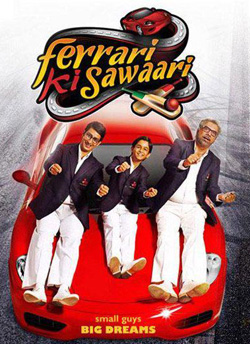
  • Reviewing the Reviews: Ferrari Ki Sawaari

    Ferrari Ki Sawaari

     

    Directed by-Rajesh Mapuskar


    Produced by-Vidhu Vinod Chopra


    Written by-Rajesh Mapuskar, Vidhu Vinod Chopra, Neeraj Vora


    Starring-Sharman Joshi, Boman Irani, Ritvik Sahore


    Sometimes ‘well-meaning’ is not a compliment. When applied to a film that has a lot of good elements, but doesn’t quite make the grade, it sounds like a lot of critics struggling for compliments.


    Newbie Rajesh Mapuskar’s Ferrari Ki Sawaari, settled into the 2.5 to 3 groove, with only the usual suspects, Times of India and bollywoodhungama.com, going higher.


    It’s the kind of film that might get awards for wholesomeness, but doesn’t come anywhere close to the Hrishikesh Mukherjee kind of cinema it aspires to. (And just by the way, how does a middle-class, scooter-riding Parsi and a tapori manage to drive a Ferrari?)


    Rajeev Masand of IBN gives it 2.5 and writes: “Starting off nicely as a portrait of a middle-class Parsi home, Ferrari Ki Sawaari coasts along comfortably, delivering clean laughs punctuated by occasional moist-eye moments. But from the moment Rusy makes off with the master blaster’s hot-wheels, the film seems to abandon all sense of logic, and subsequently sinks into a sludge of melodrama.”


    Shubhra Gupta if the Indian Express is usually fair and not swayed by Bollywood hype. She gives it 2.5 too. “The title says it all. This is a film about a Ferrari and a boy who takes a very special ‘sawaari’ in it. The boy is cricket-mad. The super-fast, super-luxe car belongs to the one and only Sachin. Can a film which has these ingredients – cricket, cars, and how-dreams-can-turn-into-reality – turn out less than a cracker? ‘Ferrari Ki Sawaari’ is well intentioned, well produced and well acted, but doesn’t really vroom off the screen.”


    Preeti Arora of rediff.com, 2.5 again: “So much love flows around but nothing is really happening on screen. Sit back and admire the father-son duo, the narrative will move ahead at its own pace. It’s the predictability which pulls the story down. Like one knows even as Kayo’s father searches desperately for a new bat, he will reach the cricket field in time to hand it over to his son. Or when we see him enviously eyeing a new pair of shoes, Kayo’s shoes will come undone on the field, causing him to stumble mid-run. Ho-hum.”


    Saibal Chatterjee of NDTV, 2.5 too: “This competently crafted and well-intentioned cricket-themed film steers clear of many of commercial Hindi cinema’s narrative conventions – it sure gets full marks on that count – but succumbs to some of its most retreaded clichés. You might root for the young underdog and his honest-to-a-fault family as they chase an impossible goal, but Ferrari Ki Sawaari isn’t another Iqbal. It won’t have you springing off your seat. The protagonist’s battle against the odds lacks the dramatic horse power that could have sent the film zipping down the fast lane. The characters are lovable enough, but their little joys and setbacks, and the emotional ebbs and tides, dangle somewhere between reality and make-believe. Ferrari Ki Sawaari is a bit like a warm bear hug that eventually leaves you cold.”


    Now come the 3s.  Vinayak Chakravorty of India Today comments: “We have here a Rajkumar Hirani film that the director didn’t make. Every twist about Ferrari Ki Sawaari bears the Hirani trademark and logically so. The filmmaker co-wrote this script and also penned its dialogues that bring back the good-natured humour of the two Munnabhai flicks and 3 Idiots. Ferrari Ki Sawaari takes us back to Planet Hirani, where even evil is basically nice. It’s a world where the hero doggedly defines innocence and does a wrong turn only by chance. The baddies can’t quite mess with goodness no matter what they do, and a tearduct-friendly finale will see a large group of people coming together to root for the hero (recall the college Q&A session in Munnabhai MBBS or the FM radio/shaadi climax of Lage Raho Munnabhai). Debutant director Rajesh Mapuskar doesn’t break the formula. Being Hirani’s associate director on 3 Idiots and Lage Raho… obviously rubbed off on his cinematic sense.”


    Karan Anshuman of Mumbai Mirror gives it a generous 3 stars and writes: “In the end, Ferrari ki Sawaari tries too hard. With its manipulative music, serendipity-dependent writing, over the top characters and its length, it does get a little tedious. I love cricket, the underdog story, and well, who can resist a head turn at a Ferrari? It still didn’t work for me. But that’s not to say it may not for you.”


    Aniruddha Guha of DNA, 3 stars, comments: “Where the film flounders is the hyperbole. Time and again, we’ve compared Hirani’s films to Hrishikesh Mukherjee’s, and while the legendary filmmaker’s characters were as good-natured and lovable as Hirani’s, they were also very real. Hirani, and now Mapuskar, tend to show their characters to be a lot more extreme – either too good, or too honest, or too naive – and the situations they are put under are sometimes so unreal, you start feeling disconnected.”


    The gush and 3.5 stars come from Taran Adarsh: “On the whole, Ferrari ki Sawaari is a noble film, a film that has its heart in the right place. It’s well-intended and sincere and it goes about its business with incredible earnestness. Of course, the film has its share of hiccups, but then all films do, right? But keeping the fault-finding apart, Ferrari ki Sawaari is an accomplished effort. It’s that exceptional film that communicates a point and tells a sensitive story in those 2.10 hours. This heartwarming, tender and sprightly film should not be missed!


    And the crowning 4 from TOI’s Madhureeta Mukherjee: “Sometimes, it doesn’t take 11 players to make a dream team. Debutant director, Rajesh Mapuskar has a winning team with just three, plus a red hottie (Ferrari of course, we’re not talking about boombaat Balan). And guess what…we don’t miss the presence of a pretty ‘maiden’ here too. The spirit of the film is in the effusive chemistry between Rusy and his son, which is entertaining and utterly moving. The writing (Mapuskar and Vidhu Vinod Chopra) is refreshing, Raju Hirani gives the dialogues his trademark spin, and the film unfolds with sheer subtlety and simplicity. Except that, the ride could’ve been shorter (jumping a few red signals would’ve helped), and a few speed bumps saved (a song with a flying red car). The climax goes on an emotional overdrive, and at times, with extra spoonfuls of sugar the film is too-good-to-be-true. But that’s feel good cinema for you!”


  • Ranjona Banerji: Will Pranab Mukherjee be our next President?

    Ranjona Banerji

    By Ranjona Banerji


    Do we have a President of India at last in Pranab Mukherjee? The Union finance minister, perhaps inspired by incumbent Pratibha Patil’s wonderful lifestyle, wanted a similar retirement plan for himself. Lovely house and gardens, lots of fuss and protocol and nothing to do – perfect!


    This is hardly surprising since Mukherjee is the most hard-working man in the Universe. Not only is he the finance minister, a bad enough job, he is also the go-to man for both the government and the party. If the prime minister’s not there, Mukherjee’s in charge. If some ally is misbehaving, off goes Mukherjee to sort it out. If anything in the government is going wrong, Mukherjee to the rescue. If Parliament needs to be taught a lesson, up pops Mukherjee. Since he is 900 years old and has been part of every Parliament as long as anyone can remember, no one can contradict him. Earlier, in the 1970s, no one could contradict him because he always had a pipe in his mouth, so no one could understand him. Now he has got rid off the pipe but comprehension is still a prerequisite to contradiction. He also has a look in Parliament and if he gives you one, you quail and sit down quietly. This puts an end to the Opposition usually.


    In addition to this, he is head of some 8,000 Groups of Ministers and another 8,000 Empowered Groups of Ministers. (I really don’t know what these are but they sound important.) Effectively, this means the government will come to a standstill once Mukherjee moves to Rashtrapati Bhavan. Since we in a form of paralysis anyway, the government is hoping no one will notice.


    The main thorn in Mukherjee side is his “sister” Mamata Banerjee, also known as “I am a simple man”. The “simple man” does not want Mukherjee in the top chair. Bengali parochialism has still not recovered. This is akin to Bengalis supporting Kolkata Knight Riders instead of Pune Warriors. Oh, right, they’ve done that anyway. The TV channels are wondering how the man who everyone (except them) knew would get the job, eventually got it in spite of all their best efforts. India demands an answer here.


    The two comedy acts running on the sideline are PA Sangma and Arvind Kejriwal. The BJP is wondering whether or not to join this laughter challenge.


    The only person laughing all the way to the Mughal Gardens is Pranab Mukherjee!


  • Anil Thakraney: Wake up, Dilliwallahs!

    By Anil Thakraney


    Ever wondered why TV studios identify their location as ‘News Centre’ (or similar words) instead of the city of broadcast? Well, they don’t want to declare ‘Delhi’, which is where most of the news TV headquarters are located. Because, I suppose, they desire to project themselves as being pan-India. And yet, they often find their Dilli bias hard to dilute, and it shows up again and again.


    That’s exactly what happened with the breathless, 24X7, carpet coverage of the ‘Kaun Banega President?’ reality TV show. Ball by ball account, blow by blow detail was being dished out on the presidential race. Anchors and reporters just couldn’t conceal their excitement. It gets worse: Most of the coverage consisted of wild speculation and unconfirmed reports. This was like a gang of retail shop owners in Lajpat Nagar hectically discussing politics over aloo chaat and sweet lassi.


    Now, when you live in Delhi, politics becomes a part of your DNA. That’s well known and it’s fine too. But that is certainly not the case with the rest of India. If a new government was being formed at the Centre, some of us non-Dilliwallahs would take part in at least some of the discussions. But so much gas over the selection of the President? An ornamental post that, at best, is a dummy designation, and at worst a parasitic ‘job’ for which we tax payers pay through our noses. Just for the record, in case it hasn’t occurred to my friends in the capital: Finance Minister to Rashtrapati is a demotion, a VRS scheme, actually.


    I know that a whole lot of people in Mumbai disconnected from the news channels all of last week, as we were left with a feeling of alienation.

    And I am sure this was the case in the rest of the nation too. Because we had more important things to worry about. (Like Mr Dhoble’s sensational antics in Mumbai.)


    Dear Dilli news channelwallahs, please get this: You are not running a local city station. You are supposed to be running an Indian news channel. And you are meant to take into account the sensibilities of a billion desis. I know it’s tough, but a sense of balance and proportion is critical in this business.


    * * *


    PS: Poor poor Rajat Gupta. He’s been convicted by a US court on charges of insider trading, and now faces many years in jail. The gentleman must be sorely regretting not having done his number in India. Here, he would be out on bail in a few months, and then would chill at home for 30 years. And if he was still alive when the conviction happened, he would file a clemency petition on account of old age.


  • The Anchor: 5 ways to keep audiences coming back to your channel

    By Amogh Dusad


    Extensive variety in offerings

    India remains largely a single TV market. Therefore, a channel should offer an array of genres and appeal to all members of the family. Variety also ensures that viewers find the channel fresh and vibrant.


    Extending beyond the TV screen

    Gone are the days when television channels just aired promos and expected to keep viewers glued. The need of the hour is to create brand extension programs. It is also important to be a part of local festivals and important historic days which make the viewers feel closer to the channel – for example Christmas or Independence Day


    Exclusive content – premieres

    In the age of hyper-competition, it is important to be the first and the only one to offer great content /movies. Television premieres make the viewers look forward to channel announcements and promotions along with making the channel an exciting destination.


    Enjoyable viewing experience

    Watching a channel must be enjoyable for it viewers, otherwise they will simply move onto another channel. Therefore, it is essential that the content is showcased in a viewer friendly style to enhance viewing experience.


    Engaging the viewer – starting conversations

    A channel has to interact with its viewers to keep them glued to the channel. A consumer today is constantly bombarded with one-way conversations through print, outdoor, radio, and television but how much of it really resonates in their mind! One must engage with the viewers and remain in constant dialogue with them. Digital is great medium to create conversations.


    Amogh Dusad is Programming Head, PIX