Category: BLOGS

  • Ranjona Banerji: Switching subjects when the Budget is a bore

    By RanjonaBanerji


    What do you do if you are a super-nationalistic journalist and the annual Budget presented by your favourite government in the whole universe turns out to be a lacklustre bore, full of half-truths, post-truths and dissembling?

    Why, you switch subjects of course.


    First option: Pakistan. Pakistan is the go-to place (no, no, we are not discussing where liberals and intellectuals belong for now) for TV journalists in search of a proper patriotic subject. The formula is simple: invite a few Indian handlebars, a few Pakistani handlebars, at least one fake R&AW agent and give the star anchor a whip. All the circus animals respond appropriately. They bluster and yell and take home fat attendance cheques at the end of it. The viewers also know what to expect, chief amongst which is to understand nothing but feel full of country-love zeal and fervour.

    Mission accomplished.


    Second option: Focus on “very important” issues like upcoming state elections. Conduct and/or get paid to telecast exit polls. Showcase these exit polls by much running around all over the studio brimming with excitement at your audacity at presenting something that may well be proved wrong but anyway the stupid viewer will never remember. Try as hard as you can to ensure that your favourite ruling party in the universe currently in power at the Centre is going to win “yuuuuge” like The Donald did.

    If by any chance the exit poll suggests otherwise, use your star anchor status to obfuscate the exit poll results and produce various options on how and why your favourite may well win because there are so many other factors that rule the world other than your exit polls. Do not actually ever say this but drop some hints.


    Third option: Discuss Donald Trump. There is enough fodder here for fun. But remember to give ample space to bigoted NRI organisations in the US to spread their prejudices. This is called being “objective” in TV-speak. Be careful not to mention Trump’s battle with the media. That is verboten territory for patriotic Indian TV journalists. After all, Trump called Prime Minister NarendraModi third or fourth or within the Top Ten of world leaders after becoming US President. Yaaay! We are so great!


    Fourth option: Try and discuss the Budget but freely use the standard star anchor trick – do not allow anyone who has a contrary opinion to be heard. If the irksome guest does not listen to you, call in the ruling party cavalry or at the very least, shout, plead, implore, beg him or her to try and at least see things from the finance minister’s point of view.


    Fifth option: Do not under any circumstances discuss demonetisation. It was not mentioned in the Budget, it was not mentioned by the chief economic adviser as a great achievement of the government and it has no bearing on life at all in India. Everyone is incredibly happy, even (or especially) the dead people and all is well. The prime minister said so, remember?


    Additional Tips: Forget about the Jallikattu protests and other stuff which you concentrated on for days. The Supreme Court has said something? What is the Supreme Court?


    Final Idea: When all else fails, try fancy dress. So Dr Prannoy Roy of NDTV runs around Amritsar in a red pagdi. Why? I mean, why?

     

  • Ranjona Banerji: Those shameless American journalists doubting Trump’s credentials…

    By Ranjona Banerji


    The response of the international and American media to the new US President Donald Trump remains in stark contrast to a bulk of the Indian media’s response to the BJP-led government at the Centre and to Prime Minister NarendraModi. The German magazine Die Spiegel had a cover illustration where Trump was shown beheading the Statue of Liberty. Yes, there have been cries of outrage from Trump supporters and from Rightwing Coalition of the Permanently Outraged but that does not seem to have stopped the media.


    The president himself has continued with his Twitter war with the American media because apparently that is how you run the free world when you are its leader. And shockingly, there are no telecasts of prominent news anchors calling Trump a rock star or a tsunami wave or the greatest invention since tanning lotion.


    Where are the photographs of American journalists falling over themselves to take selfies with Trump? Where are the breathlessly excited journalists retweeting every Trump tweet, joyous that no president has ever tweeted before? Where are the senior journalists writing long columns headlined, “20 things Trump will do to make America great again”? Where are the faithful experienced well-known journalists retweeting for us, “Trump woke up today”, because, wow you shameless anti-Trump journalist, you always doubted that Trump did not sleep at night?


    Sounds familiar, my dear shameless faithful journalists?

    I would have expected by now some very angry tweets and columns from Indian journalists about how terrible the American media has behaved with Trump. And at least a series of tweets on how anti-national the American media is and Breitbart is the only appropriate news medium for Indian journalists to emulate.


    I am secretly hoping that they have at least sent loads of agarbatti and aartithalis to the Republican Hindu Coalition, so that they can add their blessings to the Trump presidency. In fact, I would have never heard of the Republican Hindu Coalition if it wasn’t for the Indian media and I am unsure that my life has improved from knowing them. Apart from the humour they provide of course. Though I wonder if that was the reason for highlighting them…


    In case you think I am an evil exaggerator, here is the Indian Express reporting on the earthquake in Uttarakhand on Monday night:

    “Soon after the quake, which took place at 10.33 pm, Prime Minister NarendraModi said in multiple tweets, “Spoke to officials & took stock of the situation in the wake of the earthquake felt in various parts of North India. PMO is in touch with officials in Uttarakhand, which is the epicentre of the quake. I pray for everyone’s safety & wellbeing.” ”http://indianexpress.com/article/india/5-8-on-richter-quake-rocks-uttarakhand-delhi-4511344/


    As any media person in India knows, when the Prime Minister tweets, the world gets validated.


    **


    Meanwhile, watching TV news after the earthquake – which was pretty scary for those of us who experienced it – was most amusing. There are several websites where you can get immediate information about earthquakes. The US Geological Survey website is one of the best. The ESMC website is very quick, especially with its tweets. So anyone with access to the internet was able to find out in a short time what had happened and where. The epicentre was near Rudraprayag and Joshimath, some 112 km east of Dehradun. Could our intrepid TVwallahs figure this out? Should I laugh or cry? Some told us about the tremors in Delhi where most of them are based. Wind chimes and light fittings shook in the National Capital Region. Some spoke to people in Pithoragarh. Some told us the epicentre was Pithoragarh. I had a lovely sense of déjà vu. Last year during the forest fires in Uttarakhand, people asked me if I could see fires in Nainital from Dehradun. Ah, well.


    I’m not going to insult your intelligence by telling you that Pithoragarh is not 112 km east of Dehradun. Perhaps you could just find a Prime Minister to retweet?


  • Ranjona Banerji: Our Media, Their Media

    By Ranjona Banerji


    Am I putting too fine a point on it? Is the American media really thatsuperior to the Indian media? Am I being unfair in my comparisonsbetween the two? Am I giving American democracy too much credit while denigrating the Indian version?

    But even as I ask these questions, I remain horrified by a portion ofthe Indian media and impressed by the relentless assertion of rightsby a large proportion of the American media. The Prime Minister ofIndia, NarendraModi made an unsavoury reference to a former PrimeMinister in Parliament. It was gratuitous and beyond the normal realmof polite conversation – even keeping Parliamentary norms, rules anddecorum aside for now. Certainly, Modi had every right to criticiseManmohan Singh – as has anyone else in India. Certainly, he can pointout, question, attack Singh’s flaws, mistakes and misdemeanours.

    But it is easily argued that Modi crossed the line when he used themetaphor of Singh bathing in the bathroom with a raincoat on. This wasstreet language, maybe even election rally language but it isquestionable whether it is language befitting of an Indian PrimeMinister speaking in the Houses of Parliament.

    Naturally, as it has done with everything Modi has said and done, somesections of the media ignored Modi’s comments and others presented itwithout comment. Individual journalists took to social media to defendModi and blame the Congress for Modi’s remarks. I am not countingsenior journalists like SwapanDasgupta who are now part of theestablishment and are clear about their loyalties. They are not hiding
    behind a false mask of being neutral. But there were enough others tomake one cringe.

    Contrast this with US President Donald Trump and the American media.The fact that Trump tweeted in favour of his daughter and against adepartment store was discussed threadbare, with all the problems of
    protocol and conflict and interest the tweet implied. His adviserKellyanne Conway’s justification of Trump on this issue was dissected.

    The invented terrorist attack in Atlanta by White House presssecretary Sean Spicer was torn apart by most of the media and all itsversions. Even rightwing media has called Trump out when he has neededto be. There are several ongoing battles on Twitter between Americanjournalists and the Trump administration.

    As for comics and those shows which track the news, Trump has beenexcoriated. The fact that Trump blusters and bullies his way throughlife has not stopped these shows from attacking him or making fun of
    him.
    Now try another contrast. Look at the way the Indian media – in amajor part – has reacted to Modi’s defence of demonetisation and hislies about how his plan worked very well. How many have taken up theselies and countered them with facts? Instead, anodyne headlines andbland reporting has been our way.

    Of course, the dramatic and fast-moving events in Tamil Nadu havegiven our media some respite. And certainly every bit of this fightbetween two chief ministerial aspirants from the same party and onegovernor caught between the two, his duty and a Supreme Court judgmentnot to mention political wrangling, interference and popular anger hasbeen covered extensively by our English news channels.It is not often that South India gets so much attention from ourNorthward-looking channels so it is heartening when it happens. Thismay show up the general biases in Delhi-based newsrooms but it is goodto know that they make the effort sometimes. Am I damning them withfaint praise? Well, immediately evident was the lack of good Tamiltranslators available to the English channels. CNN-News18 had an
    in-house advantage with their top anchor Zakka Jacob but the otherswere shown up when OP Panneerselvam emerged from his dramaticmeditation at the late J Jayalalithaa’s memorial and started his
    revolt. Viewers who did not understand Tamil got no help at all fromthe anchors at the time. A sort of joint struggle to understand whatwas going on if you like!


  • Ranjona Banerji: TV’s protectionism of the BJP and is the Nine O’Clock News back in fashion?

    By Ranjona Banerji


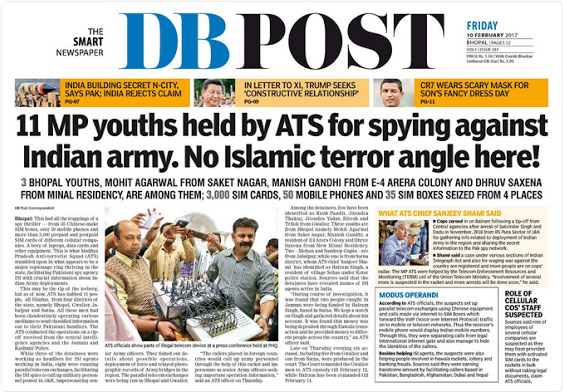
    February 10 had a story about 11 people arrested in Madhya Pradesh with suspected links to Pakistan’s dreaded Inter-Services Intelligence. One of those 11 arrested by the Anti-Terrorist Squad apparently has links to a BJP politician in MP. Another is supposed to have been part of the BJP’s IT cell in Madhya Pradesh


    So, here’s my question to you: How many TV debates have you seen on this subject on our English news channels? And, how many stories, editorials or columns have you read about this in our newspapers and magazines? Is this not a wee bit strange? After all, a political party is accused of having links to Indians who are spies for Pakistan. And not just any political party but the ruling party in both Madhya Pradesh and the Centre, as it happens; a ruling party which has been harping on sending anyone who disagrees with it, to “Pakistan”.


    But umm, a deafening silence falls around us. The DB Post headlined the article and India Today and Indiatimes have covered this on their websites. And yet, the group’s news channel which has the most patriotic news anchors ever, has not gone ballistic over it. Is it because the men arrested are Hindus? One has to ask this unsavoury question if only because of the BJP’s inherent hatred of religious minorities, particularly Muslims and Christians?


    Our news channels will hold a debate over any trivial subject that occurs to them at breakfast. And yet, members of the BJP being accused of having links to Pakistan’s spy agency? Never to be discussed apparently.


    Here’s a link to prove I haven’t made this up:
    http://indiatoday.intoday.in/story/isi-agents-arrested-in-madhya-pradesh-linked-to-bjp-party-leaders-privately-express-anguish-over-possible-infiltration/1/880043.html


    **


    Drastic job cuts have been seen in the media, especially in the Hindustan Times and the ABP group. Demonetisation has a clear role to play here with many newspaper managements warning that their businesses cannot handle both demonetisation and the requirements of the wage board. As ever, doings within the media are largely ignored, brushed aside or given scant attention.


    **


    The departure of NDTV’s star anchor Barkha Dutt has led to some interesting changes in the news channel’s evening line-up. And both are welcome. For one, Nidhi Razdan’s Left Right and Centre has moved back to its 8 pm slot. And more significantly, NDTV is now experimenting with a traditional 9 pm news broadcast. This is a rarity for Indian new channels at prime time. But what a relief! No yelling guests, no hysterical anchors, no absurd subjects – just the news of the day like a proper news channel. Am not holding my breath about how long this will last though…


    **


    Meanwhile, we wandered into Times Now by mistake on Sunday night. Someone from the DMK was asking why the BJP was not being questioned about the governor’s role in the ongoing political confusion in Tamil Nadu. It was very funny to see the anchor quickly stop this man from speaking and from questioning the BJP (blasphemy!). As the gentleman from DMK carried on, she tried to switch responsibility to the Congress and then moved superfast to another guest. I wonder what happens to these anchors when they watch Jon Oliver and Trevor Noah or Melissa McCarthy doing Sean Spicer on Saturday Night Live. Do they laugh or do they stop watching in disgust?


  • Is Hire & Fire the new normal in traditional news media?


    ‘Heartless and shameful’ 

    By Ranjona Banerji


    One thing that we do not talk enough about is the treatment of journalists and media employees by managements. It can be argued that the reason is obvious – people are scared for their own jobs. Certainly, that is a factor. But what does it make of us, who expose the wrongdoings of others and various injustices in the world, if we live by the Mafia’s omerta code when it comes to ourselves?

    It makes us hypocrites and cowards.

    A letter by Biswajit Roy, put up by the website PGurus.com, outlines in great detail the suffering inflicted on staff by the Ananda Bazaar Patrika Group – over 700 have been summararily dismissed as part of some downsizing programme. The act itself is one thing but the manner in which this was done was both heartless and shameful.

    Says Roy: “The ABP management did not allow me to write my resignation letter but got me signed on a one line format that had no mention of the company’s current culling of its workforce. Instead, it pretended that I left out of my free will. Neither had I received a written assurance on the details of the ‘special package’ and statutory dues when I had to sign another format about payments. One of editorial bosses countersigned the latter as I asked for a promissory note from the management. My HR handler told that the company would not commit formally to an individual (even if the job contract was between the company and me as individual) but no reason was offered. I had to insist for the photocopies of the two papers. The pressure on me to put in my resignation at the earliest was aimed at accomplishing the management’s mission by this month.

    Although I would be released on March 1, my access to the office computer system was deactivated even before I tendered my resignation. It was meant to make me feel completely unwanted.

    Also I was asked to surrender my entry swipe card. The arm-twisting tactics was evident as I was told that the processing of my dues would not begin unless I comply with. I became an outsider effectively on the very day. Now I would have to call or meet HR/accounts or editorial nodal men and meet them at the reception, if they want, to get my dues cleared. So I am at the mercy of the management to receive the fruits of its benevolence after serving the house for20 plus years.

    I am told to trust the company which did not think twice before humiliating and firing 700 odd men and women in the name of financial crisis but never bother to explain or discuss with the staffs on ways to overcome it. It did not bother to offer us an honorable exit or an amicable separation except a unilateral but informal assurance of a soothing package. Instead, a piece of paper handed over to the victims revealed the Orwellian absurdity of the world of ABP’s HR mandarins. It offered us help from career counselors, psychiatrists and tax consultants except an audience with the top guns or some exchange of parting messages, not even the corporate niceties like the exit interviews.”

    Some media commentators feel that four months’ severance pay is “generous”. This is being unnecessarily kind if nothing else. They believe the promise that the ABP offering to give senior staff who have been with the group for over 20 years their basic salary for life is sufficient. I feel it is fair to remain sceptical. All it takes is one swaggering new CEO to change that offer. Also, Roy’s letter belies that claim. The small print – something that journalists are no good at when it comes to employment contracts – needs to be read clearly. Further, no matter how media salaries have increased recently, print does not compare to television and journalists are still worse paid than managers. The humiliation heaped on long-time ABP staffers is clear in Roy’s letter.

    ~~

    The Times of India has expressed its own case in print – that demonetisation has hurt the industry badly. But it has held firm so far. The Hindustan Times however has been like the ABP Group – mass sackings, closing of bureaus and editions across India. However, in Mumbai at least, journalists’ unions have made their anger clear. Public protests have been held and a memorandum sent to ShobhnaBhartiya, owner of HT Media.

    Some sections read:

    1. It is clear that you have decided to close down these editions in other to avoid the implementation of the Supreme Court order and the Majithia Wage Board award.
    2. Your action led to untold misery and disrupted the lives of scores of employees, besides leading to the tragic and untimely death of a senior staffer of Hindustan Times — soon after his illegal termination by the company. Your callousness and cynical apathy only shows how much you are only concerned with the maximisation of profits.
    3. We do not accept your excuse that demonetisation has forced you to take this step because, although it is only a three month old process, you have evaded the process of implementation for more than three years.

    The JAC demanded the restoration of editions with reinstatement of all employees and implement the Majithia Wage Board Award in toto, thereby maintaining the spirit and letter of the Supreme Court verdict in this regard.”

    The crux of the matter remains the old, well-known media management ploy: cut down on journalists and try to run a newspaper with trainees and a few overpaid high-level toadies. We all know what rubbish will emerge out of that plan. Besides, when a trainee journalists earns Rs 15,000 a month and you think that’s a lot, remember the fat, bloated useless CEO who earns in crores and sits with accountants to cut costs. One newspaper I worked in had a man from the oil industry as CEO. What he understood about the media could be written on an old-style bus ticket.

    And then there’s demonetisation. We should think a bit before we toe the government’s bogus line on this one. Most of India and our fellow journalists and media staff are being burned by it. If we care, that is.


    Ranjona Banerji is a senior journalist and columnist, former editor and Consulting Editor with MxMIndia since 2011. The views here are her own


    ‘Time we smell the coffee’ 

    By Pradyuman Maheshwari


    Ask any one outside of the traditional news media in this country, and you’ll be told that the process of hire-and-fire is nothing unusual. Gone are the days of government organisations and large business groups offering you the luxury of planning your post-retirement holiday on the day of joining.

    There are cases of even a group like the Tatas showing the pink slip to people where and when it’s needed. I know of at least one newspaper CEO’s exit announcement dished out to him and the rest of the organisation on his birthday.

    For long, journalists have been subjected to a work environment that’s privileged. And as I am out of the system now,  I can say that the privilege wasn’t based on much logic.

    The only comfort that journalists had was – as it may still exist in some business empires, is that there is no way in which you could be sacked. But managements found ways to deal with the lot who were governed by the wage boards and didn’t want to switch to the contractual system. Their access to the paper – the very reason for working as journalists – was stopped and at least one large newspaper group ensured that they were near-shamed in full view of colleagues who accepted the management line.

    But are newspaper groups who believe in hire-and-fire regime cruel and indulging in unethical and illegal practices? On the legalities, one would think a lot would depend on what the contracts spell out for each employee, but otherwise one needs to accept this: that while the term of the contract is good to have on a piece of paper – stamped or otherwise, the maximum duration of any employment is effectively the notice period that exists from either side. So if my contract is for three years with a 30- or 90-day notice period, then the notice period is my minimum term of employment. And my services can be dispensed with just a 30- or 90-day notice and since I am a signatory to the contract – on stamped or unstamped paper, I can do sweet nothing if my employer terminates the contract. Hence one could well say that my employment is not of three years, but 30 or 90 days.

    The problem in the news media is a little different, especially in newspaper companies. Employee remuneration is pathetic in many publications but journalists are happy to take up employment despite the abysmally low salaries. Also, many newspaper companies are run more on emotions and intangibles than business arithmetic and scientific forecasting. For instance, if Reporter X gets Rs 30k in Mumbai, it’s possible that s/he will get just Rs 12k in a Tier 3 city. And lower in a Tier 4 city. Many newspapers continue to run editions in centres despite losses. I can understand that if the edition is of strategic importance, but more importantly these things work purely on the whim of a senior business or editorial executive or the owners.

    What’s more while progressive employers always think twice before processing the sack, many in the news media aren’t worried about their reputation. They know despite having a bad HR record, prospective employees will happily accept all the s**t they are subjected to.

    Unless we have a fair number of journalists who refuse employment in organisations which have treated their tribe unfairly, employers will do whatever they feel like.

    But newspaper employees – journalists especially – need to be ready for a hire-and-fire regime in their place of work.

    Demonetisation or the impact of it has hit all media as it has most business sectors, but that’s not enough reason for businesses to be shut or people to be sacked. Some rationalisation is fine, but the process is only to make these organisations leaner, with healthier financial books. And if any employer can’t take six months of financial stress, it mustn’t be in business.

    The wage board is something newspaper owners need to live with thanks to the excesses of some of their tribe in the past. If drivers are getting paid 60k when all that they deserve is 15, then it’s out of a logic that is rooted in the underpayment of employees by newspaper groups, especially outside of the metros.

    Clearly, if our news media wants the benefit of receiving the largesse from government in the form of DAVP advertising, then it will need to toe the government line to some extent… so the wage board recommendations can’t be wished away.

    All in all, the rules of business in newspapers has changed. It’s sad that someone from a progressive publishing group like ABP has reasons to feel aggrieved. But that’s the way modern business is run. Haven’t we haven’t heard of stories where financial institution employees were taken out by lunch by their bosses and on their return after the news was broken to them, the contents of their drawers and laptops were just handed out to them. The sack intimations handed out to dotcom employees in 2000-01 were similar. Did anyone shed a tear for them?

    Perhaps they did. But that’s sadly the way many businesses are. And journalists can no longer be insulated from this new normal.


    Pradyuman Maheshwari is a senior journalist and academic. Although he is Editor-in-Chief with MxMIndia, the views expressed here are his own and not necessarily that of the website.


  • Ranjona Banerji: In Trumpland: Disagree and get banned!

    By Ranjona Banerji


    Fake news is the enemy of the people declares US president Donald Trump and promptly bars such well-known fake news outlets like the BBC, CNN, The Guardian, New York Times, Daily Mail from White House press briefings. However, the world’s most respected, fair, unbiased outlets like Breitbart News are of course top of the invitation list.

    This is not a joke. This is a bizarre scene being played out in the world’s most respected democracy. Trump does not like anyone who disagrees with him or indeed anyone who does not like him. Trump is not shy or wary of letting everyone know how he feels. Trump is, you may argue, without guile – he tells it like he sees it. Or, you may argue, he is like a spoilt child who is not used to be being denied what he wants or what he thinks he should get.

    America is fighting back. People, the media and the American system understand rights and responsibilities and what it means to lose them. Many are not afraid to make their voices heard. After the White House ban, many other news outlets simply boycotted the White House press briefing.

    Dean Baquet, executive editor of the New York Times said, “…nothing like this has ever happened at the White House in our long history of covering multiple administrations of different parties.”

    Lee Glendenning, editor of Guardian US, said, “This is a deeply troubling and divisive act. Holding power to account is an essential part of the democratic process, and that’s exactly what the Guardian will continue to do.”

    The White House Correspondents Association was “protesting strongly”, said its president Jeff Mason.

    Do you want to take a look at how we deal with this here in India? How easily we capitulate? How we justify giving in by saying there is no other way to get access? Although few administrations act like Trump’s – which seems to have based itself on Communist or Soviet models – it is open knowledge that the administration at the Centre in India, for instance, does not like to share information. And that is true of several states as well.

    Outlets which suck up get more access to those in power. And that is often all that matters to some journalists and their owners. The owners can have multiple business interests and that means that they need to keep on the sweet side of politicians in power. Nothing corrupts the smooth progress of journalism more than this. And the situation does not need to be made worse by careerists and opportunists who are willing to toe any management or government line just to get ahead.

    I repeat these points again and again because what we’re doing is killing journalism in India with this sort of attitude. If that sounds dramatic, I can amend it to suffocating journalism. Yes, there are news outlets which do not succumb, which continue to hold governments to account. Almost none of those news outlets, one might remind oneself, operate in the sphere of television.

    Yes, there are occasional news anchors and to be fair many more reporters in television, who stick to the accepted norms of journalism. But they are few and far between and usually get lost in the loud screaming melee of establishment stooges.


    **

    In some good news then, I am much enjoying Sarah Jacob’s version of the popular NDTV show, We the People. She is straightforward and refreshingly non-dramatic and does not appear to fall into the trap of false equivalences of allowing bigotry and prejudice to take advantage of freedom of speech.

    I now want to scream when I hear some TV anchor say “You have a point” when someone sets forth a polluted agenda, because the anchor is pretending to be “objective”.

    Get the point?


  • Ranjona Banerji: When TV journalists lose all semblance of being observers, reporters & editors

    By Ranjona Banerji

    Coming back to India this week after a month away in the UK, I see that I have Republic TV’s commitment to nationalism to look forward to. Or, in another way of putting it, more of the same but this time, with a great leap backwards to Arnab Goswami.

    Advertising appears to suggest that Goswami and his news channel will be “Pakistan’s migraine” and that the mantle of nationalism that has been lying forgotten will now be won with pride. That India’s borders will defended to the last shout in Indian TV studios. Where else, you may ask, should India’s borders be defended?

    However, given the make-up of Republic TV and much of Indian news television, almost no one is likely to question how and why India’s borders have been breached quite so often in recent times or how terrorists from Pakistan have walked into armed areas with so much apparent ease. Perhaps it is unfair of me to suggest that no one has been questioned. Over and again, India’s first Prime Minister, Jawaharlal Nehru, who died in 1964 has been questioned. His great grandson Rahul Gandhi, who has not held any constitutional administrative post has also been questioned. No one currently in power has been found responsible in any way.

    My fellow columnist Jaisurya Das was asked recently if “decorum was dead in the news media”, after a news anchor told a studio guest from Pakistan to “shut up”. Jaisurya commented: “This is typical of the immature arrogance of anchors who often forget where to draw the line in their effort to build TRPs. Little do they realise that such language and demeanour only turns people off and they stand to lose more in the bargain.”

    That people are writing in to complain about such behaviour is small comfort when you know the immense reach and influence that TV has on the public. Adulation, stardom, hatred, familiarity all allow TV journalists to become bigger than they are. The result is that they lose all semblance of being journalists, of being observers, reporters and editors. Sadly, TV has brought out the worst in us.

    Goswami in his interview to Pradyuman Maheshwari before the launch of Republic TV declared that he was proud of his nationalism and that he held no truck with “Aman ki Asha”, an initiative towards dialogue with Pakistan started by his former employer, the Times of India.

    This makes for an intriguing position – would any attempt at peace with Pakistan be stopped by Goswami? If the current Indian government tried it, would he fight them? Is diplomacy to him a lost cause already? Because Goswami operates only within the confines of one news show, it is hard to grasp his intellectual position on such matters. Is humankind doomed to never make peace in his mind?

    Interestingly and perhaps expectedly, Republic TV’s big “scoop” on launch day was some expose on former Bihar chief minister Lalu Yadav. As anyone with any smattering of political knowledge is aware, Yadav is already debarred from standing for elections because of corruption cases. The target for Goswami and his backers is never likely to be the BJP government or the Prime Minister or indeed any minister in the BJP.

    Once you know that, it makes life and choices much easier. As Maheshwari pointed out in a column here last week, “Or is it that a country which is not too fussed on ethics and corruption, passage of time ensures things are forgotten and condoned. We all know of some entities indulging in unethical practices, but do we really shun them? On the contrary, we embrace them. We allow them to flourish. We read or watch them, we attend or speak at their events, we accept their awards.

    Perhaps we deserve such a media.”

    Do wee?


    Ranjona Banerji is a senior journalist and commentator and Consulting Editor, MxMIndia. The views expressed here are personal

  • Mediaah!: Is BCCL right in registering a copyright infringement complaint against Arnab Goswami?

    By Pradyuman Maheshwari


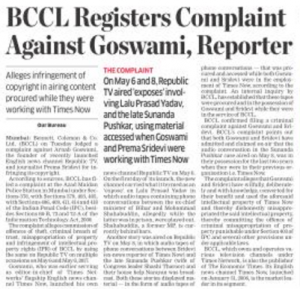
    Is Bennett, Coleman & Company Limited (BCCL) right in registering a copyright infringement complaint against Arnab Goswami? Yes, it is. I am not sure how legally tenable the complaint is, but in my limited view, it was unethical. When the story was first aired on Republic TV on May 8, one couldn’t help sitting up and take notice. But then along with the various questions that Goswami raised in his ‘super exclusive’, there were some questions that I had.


    The Economic Times report (Page 3, May 17, Mumbai edition)

    See report in Economic Times on the complaint: link

    In fact, I tweeted about it (see link).

    The fact that it was only retweeted twice indicates that copyright and editorial ethics aren’t considered very critical and holy to many (or most?) in India. Copyright, it’s often joked, is the right to copy!

    But this isn’t about copyright. That’s something for Times Network owners to take up with the Courts.

    It’s an issue of ethics.

    The recordings of the conversation between Prema Sridevi, the reporter and Shashi Tharoor or Sunanda Pushkar’s Man Friday was done when the reporter reportedly worked with Times Now. Unless her terms expressly stated it, or she was just a freelancer with the channel, the recordings belong to work done when the reporter was an employee.I am not sure what is the legal view on it, but it’s not ethical.

    I am not even raising issues of why Goswami and Sridevi, now Editor-News at Repulic,  didn’t air the recording when they were in Times Now, but that’s not really my concern though it’s a question that must be answered.

    The Nation wants to know…


    **


    All eyes are now on the BARC India numbers that will be out tomorrow (Thursday, May 18). Given all the promotions and distribution via multiple frequencies, it’s quite likely that Republic will be #1, but the question is that it’s not a play over one week. Republic can’t be spending so much monies on distribution as it’s today, so the real story will emerge after a few weeks when it opts of taking multiple frequencies.

    To Goswami’s credit, his equity with viewers is huger than all the other anchors. The MxMIndia-MRSSINDIA poll earlier this week indicated that Rajdeep Sardesai is a close second and not a distant one in the trust factor, but it’s for India Today to use this to their advantage. Possibly promote Sardesai a little more.

    We’re going to see some interesting times over the next few weeks or months. And we aren’t complaining


    Pradyuman Maheshwari is Editor-in-Chief and founder, MxMIndia. The views expressed here are his own.


  • Hang your heads in shame, NBA Board!


    By Pradyuman Maheshwari

    The News Broadcasters Association has some really big industry folk on its managing committee… the Board of Directors as they call it.

    At a personal level, they are all achievers, and I respect them. Click here for the list. Now, let me first say very unequivocally: I hold no brief for Republic TV. I must confess I am not really a huge admirer of the Arnab Goswami school of journalism. MxMIndia – with our Consulting Editor Ranjona Banerji chiefly and myself – has damned his shows enough when he was on Times Now.

    But that’s my – or our – personal view. We believe it’s a free world, and if he does transgress – as in, cross the line, there are enough forces – political, business and legal to correct him. For the now, the masses are lapping him up. He’s the voice of the new Indian.

    The fact of the matter is that the Arnab Goswami brand of news television has worked wonders. And this not just in terms of viewership or ratings, but also with those with the monies. Republic TV’s list of benefactors tells the story.

    So when he decided to start his own channel, there were worrylines all over. Here was a man who could rewrite the rules of the business if he has enough staying power – moneywise.

    Remember just having a credible, independent voice is not enough. If that was the case, MxMIndia would’ve been super-super-successful revenue-wise. But that’s not the case, we don’t aggressively solicity advertising. We just nudge. Those who believe in us, back us.

    But this is not our story. This is the story of an industry association leadership that must indeed hang its heads in shame.

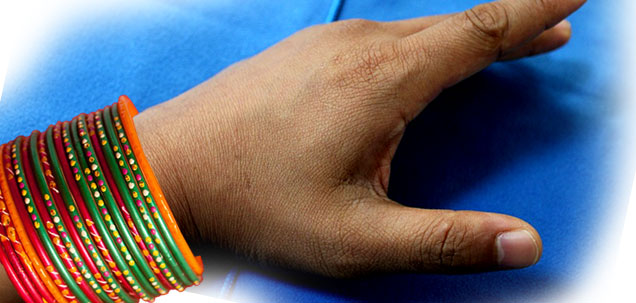
    Or perhaps wear bangles, like this:


    Gosh, have we gone too far… bahut ho gaya?

    Nahin. Nooooo. Do you recall the disrobing of Draupadi in the Mahabharata? What happened on Thursday evening is something as bad as that.

    Or let’s look at another example. We all know that the examination-oriented system of education has major problems. We also know that papers leak. We also know that kids cheat. But do we just exit the system screaming “Screw it!”. Will a school or a parents’ association advise students not to take their exams because the Class 10 or 12 exams are a sham?

    Well, we can exit the education system. It’s possible to flourish without the degree or certificate. But you’ll need to figure how the world will assess you.

    I am not convinced that the News Broadcasters Association – which is headed by some very discerning names – could be buckling under pressure from some members who perceive Republic TV as competition.

    If it genuinely felt aggrieved, there were other things that NBA could do. Like when it realised that BARC was going to go ahead with the release of ratings, if it felt it had a genuine case, it could’ve approached an appropriate Court of law (and not the Courts set up by some of our anchors across various channels) and urged for a stay!

    Why didn’t it do that?

    Why doesn’t the NBA issue a diktat to all its members asking them to not go in for any ratings-boosting activity like dual LCNs, landing pages/slotsetc?

    As I write this, I am aware that some advertisers are reconsidering their advertising on the English news channels. They may threaten a pull-out very soon. And much as I would like every media entity to flourish, the English news channels who have pulled out of BARC ratings need to see reason. Or be shown the stick.


    Here’s what needs to be done:

    1. The NBA must reverse the advisory to its English news channels to pull out of BARC

    2. The English news channels must get the watermarking back

    3. The NBA, ISA and AAAI must convene a special meeting – which may be convened by the CEO of a network/channel who has no skin in the game – like NP Singh of Sony Pictures or any other respected industryperson like, say, Sameer Nair (now CEO of Balaji). Note I have not mentioned the names of Star India Uday Shankar because he is a former news television CEO. Also the Zee and Viacom18 heads have sibling channels in the news business.

    4. All broadcasters must take a joint decision on the issue of dual LCNs, landing slots

    5. The AAAI must be urged to only deal with channels/entities that are affiliated to the IBF or NBA, so that it will ensure that all channels toe the IBF/NBA line

    6. All advertisers on television channels (Patanjali included) should be convinced to become ISA members to ensure that the rules are followed. Similarly, broadcasters should only deal with AAAI-membered agencies.

    7. IBF and NBA must admit members provisionally without any delay, on clearance of cheque/RTGS/NEFT etc

    8. Since NBA has limited number of members, and there can always be charges that all the channels can gang up against a new entity, there should be a recourse available to an aggrieved member to go to a joint committee of the IBF, NBA, AAAI and ISA which may be set up

    9. Meanwhile, BARC must set up a clear deterrent as a rule that if any channel decides to opt out of its ratings, it will not be allowed to return for a period of one year or payment of Rs10-25 crore or some such

    10. IBF and NBA must ensure that the BARC advisory/guideline on channels advertising is followed strictly. Those who are repeated defaulters should be penalised in the form of a lower payout of advertising monies on the channel. And eventual debarring of payment.


    All of the above needs to be actioned before the Week 20 BARC numbers are released.


    Pradyuman Maheshwari is Editor-in-Chief, MxMIndia. The views expressed here are his own


  • Ranjona Banerji: Pakistan! Pakistan! Pakistan! Jharkhand? Where’s that?

    By Ranjona Banerji


    The lynching of seven men accused of being kidnappers by an angry mob in Jharkhand has sent waves of shock and horror through India. Did I just say that? What a lie. Since the horrific story and the heart-rending images of a man’s blood-soaked hands begging for mercy went viral (they killed him anyway), what have our intrepid brave patriotic English news channels concentrated on?


    What a question. Obviously, cricketer Mohammed Kaif’s Twitter take down of a Pakistani after India won first round at the International Court of Justice over the death sentence of Kulbhushan Jadhav. Duh.


    Or perhaps, it was Pakistan in general or more particularly, get a whole lot of former generals and wannabe generals together and encourage them to carry out a proxy screaming match on television.


    But the Jharkhand lynching? Tut tut. How anti-national to expect news channels to show India in a bad light, when they put up those where’s-the-war-with-Pakistan dramas, night after night.


    Newspapers have carried the story, social media has made the photographs go viral but news channels have remained completely patriotic.


    Luckily Nidhi Razdan picked up the subject on mob violence getting out of hand in India on NDTV’s Left, Right and Centre on Monday night. She held her own against the RSS’s Dr Rakesh Sinha and Syed Jaffar Islam of the BJP, who either tried to blame the media for naming communities or going back to some incident in 1968 or, as usual, making sure that the prime minister must not be tainted by anything that happens in BJP-ruled states. The old Sangh Parivar chestnut of “India’s federal structure” was trotted out. Of course, this argument at its logical end, leads one to assume that a national spokesperson for the BJP has no control over the BJP in the states. Jai ho!


    Razdan did not buckle down to the two government spokespersons on her panel and to some extent the others – sociologist Shiv Vishwanathan, Congress member Sachin Pilot and columnist Sadanand Dhume (who has lately taken to criticising the BJP a bit, unlike his earlier stand) were allowed to speak.


    This show will undoubtedly bolster the impression of all Modi Bhakts that NDTV is anti-BJP. However, there was always Vikram Chandra on The Big Fight the other night who told us that the economy is doing wonderfully well under Modi ji and agreed with BJP spokesperson Nalin Kohli’s somewhat fantastical numbers. Jai ho! All kudos to Mohan Guruswamy who asked Modi Toady Sunil Alagh if they were both talking about the same country when Alagh toed the Kohli line.


    But forget NDTV. Let’s look instead at the glorious and brave Bhupendra Chaubey on CNN-News18. Actor Paresh Rawal, now a BJP MP, demonstrated both his serious brain power and great sense of humour when he tweeted that instead of tying a stone pelter to a jeep, the army should have tied writer Arundhati Roy instead. Roy has long been a BJP critic, a government critic and stood up for the rights of anyone affected by state oppression. Obviously she is unpopular amongst nationalists especially nationalists who co-relate the nation with whoever is in power at the time.


    On Monday, Chaubey tweeted the question around which his show would be based, with this soon-to-be a classic for TV brainiacs: “Is Paresh Rawal right in asking for author Arundhati Roy to be tied as a human shield?”


    In a deeply philosophical sense, every question needs to be asked. Why not also ask, “Was the Jharkhand mob right in lynching people it suspected of a crime without any proof?” However, there is philosophy and there is stupidity and I leave you to figure out the difference. It is not that difficult.


  • Criticise & Get Damned?


    By Ranjona Banerji


    Context and timing: That’s what makes the CBI raids on the properties of NDTV’s main promoters so suspicious.

    I fully understand that supporters of the Narendra Modi government will find the criticism of the CBI’s actions hard to swallow. But this column is not directed at them. It is about the media and attempts to silence the media – by anyone.

    Before the bellowing begins, yes, the Emergency imposed by Indira Gandhi in 1975 was the worst instance in the history of Independent India on authoritarian curtailment of fundamental rights. But what lessons have we learnt since then?

    Sadly, the lesson is stark and dangerous: that every political party – no matter whether it fought against Mrs Gandhi during the Emergency – tries to influence and /or gag the media when in power.

    During the Congress-led UPA’s last stint in power, we saw cases of sedition against cartoonists who criticised the way Parliament functions. In Maharashtra, sedition was applied liberally based on mischievous police complaints, including on two teenage girls for “liking” a Facebook post criticising the late Bal Thackeray of the Shiv Sena.

    Were those actions criticised by the media? Yes, emphatically. Were Barkha Dutt, then with NDTV, and Vir Sanghvi, then with the Hindustan Times criticised for their connections to the Niira Radia tapes? Yes, roundly, strongly and emphatically. Sanghvi paid a heavy price and took a while to recover, in spite of his apologies. Dutt was examined critically and stringently on NDTV itself, by a panel of independent senior journalists.

    I put this all out here because of the natural “whataboutery” that will emerge whenever anyone criticises the Narendra Modi government, the BJP and other elements of the Sangh Parivar. As a matter of interest, the owners of the newspaper I worked for in Ahmedabad, were under tremendous pressure from the Government of India (BJP-led NDA) to tone down its coverage of the 2002 riots in Gujarat. So let us not pretend that the BJP comes out all covered in flowers and glory when it comes to upholding the freedom of the press.

    I would also like to make clear that the current outrage against the CBI raids on NDTV’s promoters is based on the now and on recent events. It has nothing to do with Alexander’s attempt to conquer India.

    Nothing that happened before justifies what is happening now. Of all the news channels in India, NDTV, both in Hindi and English, have been more critical of the Modi-led BJP government. It should be remembered that NDTV’s Hindi channel was almost forced to stop broadcasting for one day last year on the pretext of “national security”. Ravish Kumar of NDTV India has been scathing in his attacks on the government and its policies, far more than his colleagues who broadcast in English. Some newspapers and some websites have been extremely critical and continue to be so. But NDTV stands out mainly because of the tremendous pro-government push by its competitors, disguised as “nationalism”.

    I cannot comment on the power or influence of BJP spokesperson Sambit Patra within his party. But it is telling indeed that days after he accuses NDTV of having an “agenda” which he is going to “expose”, the CBI raids NDTV’s promoters. The message is clear: criticism leads to harassment.

    If indeed NDTV’s official statement is correct and the loan to ICICI Bank has been paid and the complaint to the CBI has not been filed by the private bank, then the timing of these raids is even more questionable.

    NDTV has taken a strong stand that it will not be intimidated. The Editors’ Guild has expressed its concern. At the time of writing this, broadcasters’ associations have not responded.

    But for the media in general, there is a serious message here which will affect us all if we do not take it seriously. And it is made all the more frightening by the number of media houses which are succumbing to the pressures of pleasing a government in power.

    Resist or perish. Whether you like it or not.


    Ranjona Banerji is a senior journalist, commentator and columnist. She is also Consulting Editor, MxMIndia. Her views here are personal


  • Indrani Sen: Reinventing the wheel: Mobile Theatre Vans

    By Indrani Sen


    On last Saturday, June 10, 2017, Brand Equity carried a report on the Digiplex mobile theatre vans introduced recently by Picture Times for promoting high quality movie viewing experience on large screen in a near multiplex ambience for rural audience. According to the report, the venture is attracting advertising and merchandising support from private as well as public sectors (http://brandequity.economictimes.indiatimes.com/news/media/rural-india-gets-its-dose-of-entertainment-with-mobile-theatre-vans/59079746).


    I found the headline of the above article “Rural Media gets its dose of entertainment with mobile theatre vans” quite intriguing. Mobile vans, also known as Video on Wheels, have been an integral part of rural media and marketing operations based on staple diet of filmy entertainment for rural audiences over last five decades. Beginning its journey asa media innovation, VoW became a part and parcel of distribution and below the line promotion in rural India.  At present,video-van campaigns during the day includeproduct promotion with playing of popular film music, audio announcement and product jingles supported by interactive games. During the evenings, the same vans usually screen Hindi/ regional language films interspersed with product commercials.The vans are equipped either with a projector and a screen or with a flat screen large TV set for the evening entertainment. In more recent time, some of the mobile vans are equipped with dish antennas and have tie ups with TV channels for playing TV programmes and news to the rural audience. The mobile vans are used independently on a pre-determined route or are tied up with rural fairs and festivals.


    So, what is new about the Digiplex mobile theatre vans launched by Picture Times? It is their scale of operation based on today’s technology which make the medium unique. On reaching the target village, the van converts a large land of about one acre into a DigiPlex marketplace with 100-meter-wide intranet sites, equipped with facilities offered by urban multiplexes with e-commerce enabled stalls for public and private sector organisations.


    There is also the facility of Wi-Fi hotspot there and a Micro ATM enabling the villagers to link their Aadhar card numbers with their bank accounts. This new avatar of the village fair/ haat rolled into one has the potential of becoming a regular feature in large villages.


    The entertainment offered by Digiplex does not come free of cost to the rural audience. The DigiPlex pitches a collapsible all-weather canopy that can accommodate at least 120 viewers and charge them Rs.30 per show for high quality movie viewing experiences. This approach reminded me about the travelling theatres in South India who used to travel in semi-urban and rural areas with a collapsible tent and movie projector and screens till TV became popular in late 80s of the last century. The paid for entertainment offering current movies will have a huge attraction among the rural audience as the VoW normally relies on old movies for entertainment. This offering with the internet facility and the state of the art market place makes the Digiplex mobile theatre vans a unique outreach medium for rural India.


    Marketers must distinguish the Digiplex mobile vans from the current mobile vans operation in rural areas.  Most advertisers have been hiring mobile vans for rural advertising from a local service provider, who knows the territory and regional languages. There are a number of such local operators in each region. Very few marketers have their own vans due to the on ground operational hassles, Eveready being a notable exception as they own a large fleet of vans and use the vans effectively for distribution as well as promotion. Among the large media agencies, only Madison has an independent rural unit Anugrah Madison, though many others have experimented with the format.


    Marketers have a different opinion about the value for money offered by the medium. Some are of the opinion that the medium does not offer good ROI while others have complete faith on its effectiveness.  The efficacy of the Digiplex mobile theatre vans cum marketplace will have to be evaluated afresh by the advertisers and agencies looking for bridging the gap in media consumption in rural areas.According to a survey “Masters of Rural Markets: From Touchpoints to Trustpoints — Winning over India’s Aspiring Rural Consumers”conducted by Accenture in 2015, rural India holds a large and attractive investment opportunity for private companies. It will require many more private enterprises to adopt the model of Digiplex mobile theatre vans for creating a viable outreach medium for entire rural India consisting of about 650,000 villages,  850 million consumers making up for about 70 per cent of Indian population and contributing around half of the country’s Gross Domestic Product (GDP).


    Indrani Sen is a media services veteran, having worked with JWT, later Mindshare and then with Emami. She is a consultant and Adjunct Professor in charge of the Media Management programme at the Symbiosis Institute of Media & Communication, Pune. The views expressed here are her own.Â