The Advertising Agencies Association of India (AAAI) and Subhas Ghosal Foundation (SGF) has that announce the 2019 Subhas Ghosal Memorial Lecture will be delivered by Uday Shankar, President, The Walt Disney Company Asia Pacific and Chairman, Star and Disney India on Monday, November 11 in Mumbai. Shankar will speak on “Why have I been in media for 30 years” and take the audience through his journey in the media and entertainment industry over the past three decades.
Said Ashish Bhasin, President, AAAI: “We are very happy that Uday Shankar will be delivering the AAAI Subhas Ghosal Memorial Lecture 2019. As a captain of the industry, Uday perhaps has the best visibility to all the facets of the broadcast and OTT industry and we look forward to hearing his views. I must also compliment Sam Balsara on behalf of the AAAI for driving this initiative with great gusto”.
Added Balsara, on behalf of SGF: “In a rapidly changing advertising world, TV continues to dominate ADEX and grow at a double digit rate. It will be interesting to hear Uday Shankar’s views on how the TV Industry has carved out a dominant share for itself in the advertising market and plays a very major role in the lives of majority of Indians, through the absorbing stories, that it puts out every day, 24 X 7.”
Ogilvy Mumbai in association with Mission Green India attempted to create an awareness about pollution this Diwali.
Said Talha Bin Mohsin and Mahesh Parab, Group Creative Directors, Ogilvy Mumbai: “Mission Green India approached us with a challenge to help make Diwali greener. We came across this study comparing firecrackers and cigarettes, and the numbers in it really scared us. We knew it was something a lot of people don’t really know about, and they should. We realized the best way to achieve this is to have a warning on every pack. With the support of netizens everywhere, we can make mandatory warnings on firecracker packs a reality.”
Added Shubhajit Mukherjee from Mission Green India: “More than food, air is the primary need of citizens which needs to be treated with the utmost care and responsibility. Firec rackers are an international problem where standards are not followed which leads to poisoning of the air. I’m glad Ogilvy has come up with a unique way to inform people about this.”
The 16th edition of Goafest, the marquee eent of the Advertising Agencies Association of India (AAAI) and The Advertising Club will be held from April 2 to 4, 2020. The venue is the same as has been in the last few years – the Grand Hyatt hotel.
Nakul ChopraShashi Sinha
Veteran adperson Nakul Chopra has been appointed Chairman of the Goafest 2020 Organising Committee and Jaideep Gandhi will be Co-Chair. Shashi Sinha has been elected as Chairman of the Awards Governing Council for the ABBY Awards 2020.
Speaking about the 16th edition of Goafest, Ashish Bhasin, President of AAAI said: “Year-on-year, it is our endeavour to make Goafest the most sought after gathering of the Indian
Jaideep Gandhi
Advertising & Media industry both in terms of knowledge sharing and raising the bar for creativity. Goafest has been consistently putting India on the global map of a creative powerhouse and as we put together this edition as well, our endeavour is to bring the best of speakers, workshops and experiences to boost the next-gen of advertisers,” adding: “Nakul as an industry veteran has been adeptly handling Goafest and his vision for the industry is sure to translate into an engaging and inclusive festival experience for all.”
Speaking about the focus of the 2020 edition of Goafest, Partho Dasgupta, President, The Advertising Club, added: “The purpose of Goafest is to bringforth a platform that encourages India’s A&M industry to engage, innovate and share cohesively. The 3 days of Goafest sees the entire media and advertising fraternity breaking the barriers of organisation and come together to share common achievements, failures and learnings. ABBYs have always been recognised as the gold standard in creative awards and with Shashi at the helm, we are sure that the awards will continue to follow the highest standards of quality and due diligence.”
Said Chopra on being re-elected as Chairman for the festival: “Goafest is the only premier festival that is a holistic representation of the Indian advertising and media industry. Our focus continues to remain on driving up the ante of scale, inclusivity knowledge sharing. The 2020 edition of Goafest will also focus on creating an experience that is immersive, transformational and continues to contribute to the enrichment of the Advertising, Media and Entertainment industry.”
On being re-elected as the AGC chair, Sinha said: With the ABBY Awards, every year we try to widen the horizon and be more inclusive. Our belief has been to let works of excellence do the talking and this year too we will continue to look for campaigns that inspire change, make a difference and become an inspiration for the industry.”
The Awards Governing Committee for ABBY Awards includes:
Shashi Sinha (AGC Chairman), CEO – IPG Media Brands
Ashish Bhasin, CEO- APAC, Dentsu Aegis Network
Nakul Chopra, Chairman, Goafest and immediate past President AAAI
Jaideep Gandhi, Director, Jaya Advertising
Anupriya Acharya, CEO India, Publicis Media
Rana Barua, Group CEO, Havas Group India
Ajay Kakar, Chief Marketing Officer, Aditya Birla Capital
Partha Sinha, Vice Chairman and MD, McCann Worldgroup
Virat Tandon Group, CEO, MullenLowe Lintas Group
Ajay Chandwani, Director, Percept Limited
Raj Nayak, Media Veteran and Founder, House of Cheer
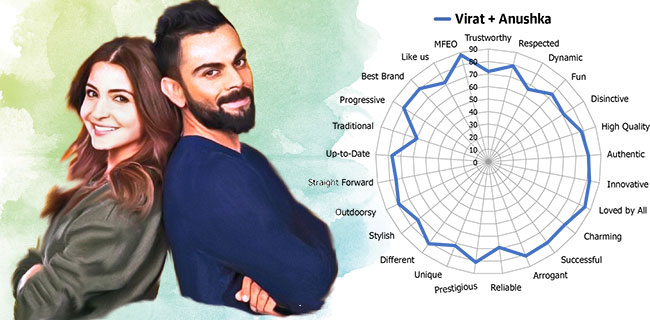
The Mumbai-based Indian Institute of Human Brands (IIHB) has unveiled its study on ‘Power Couples’ in India. Called the Sparklers Report, it features a study of the following duos: Virat-Anushka, Deepika-Ranveer, Ranbir-Alia, Akshay-Twinkle, Abhi-Ash and Saif-Kareena… what it bills as “the hottest, and commercially-most-in-demand couples in the country”.
Sandeep Goyal
Said Dr Sandeep Goyal, veteran adperson and Chief Mentor of IIHB: “Power Couples are the new phenomenon in the brand endorsement business with many brands trying to sell aspirational and experiential products to millennial couples who are starting families, using famous couples as the ones to emulate. But there is no empirical research so far on what these Power Couples actually represent or how they are seen by potential audiences. At IIHB we decided to track each one of these trail-blazing couples over a set of 24 important brand attributes,” adding: “There is also an interesting throw-back study on Romantic Couples of Bollywood since Partition, something never researched before”.
Here’s the report:
Who are Power Couples?
A Power Couple is a couple who is famous and accomplished; and together seen to be successful and influential in society. More importantly, each of them is individually successful and influential. Together they are the epitome of what anyone would desire or want in a relationship. Hence, admired and emulatable.
Where did the term Power Couples come from?
It was during the FIFA World Cup 2006 that David Beckham and Victoria Caroline Adams (also known as Posh Spice from her singing days as part of The Spice Girls band) were a toast of the celebrity circuit. With media coverage of the World Cup including the wives and girlfriends (WAGS, as they are called) of the stars, David and Victoria Beckham became the original power couple for Indian celebrities to take a cue from. Today, the term is on steroids in Indian media.
Why did it take so long for India to have its own Power Couples?
The Power Couples Report gives interesting perspectives on how Bollywood and cricket could’ve given us these aspirational sparkler couples much earlier but a long list of famous celebrity couples … Dilip-Saira, Sunil Dutt-Nargis, Rajesh Khanna-Dimple, Amitabh-Jaya, Nawab Pataudi-Sharmila, Dharmendra-Hema, Rishi-Neetu, Gavaskar-Marshneil, Dhoni-Sakshi, Sachin-Anjali, Azhar-Bijlani … somehow fell short of the ‘famous-together’ threshold despite being well-known.
The IIHB Report earlier this year researched current ‘Sparklers’ and the six listed above – Virat-Anushka, Deepika-Ranveer, Ranbir-Alia, Akshay-Twinkle, Abhi-Ash and Saif-Kareena – were shortlisted for a more detailed study. Kajol-Ajay Devgn, Shahrukh-Gauri, Madhuri-Dr. Nene and Priyanka-Nick were also researched but their score together remained below acceptable threshold.
What are the key attributes to Power Couples?
Trustworthy, Respected, Fun, Distinctive, Charming, Different, Stylish, Progressive, and MFEO (Made-For-Each-Other) are some of the key Image, Human and Personality brand attributes that add value to Sparklers. The IIHB study covers 24 such attributes.
Who are the winners?
On select attributes:
TRUSTWORTHY
Rank
Couple
Score
1
Virushka
72
2
DeepVeer
70
3
AksTwink
65
RESPECTED
Rank
Couple
Score
1
Virushka
79
2
DeepVeer
78
3
AksTwink
74
DISTINCTIVE
Rank
Couple
Score
1
AksTwink
74
2
DeepVeer
72
3
Virushka
71
DIFFERENT
Rank
Couple
Score
1
RanbirAlia
81
2
Virushka
81
3
AksTwink
80
TRADITIONAL
Rank
Couple
Score
1
DeepVeer
72
2
AbhiAsh
70
3
AksTwink
68
STYLISH
Rank
Couple
Score
1
RanbirAlia
76
2
Saifeena
75
3
AksTwink
74
Without a doubt, Virushka and DeepVeer top score across most attributes, with AksTwink a respectable third despite being much older. Ranbir-Alia despite not being married (the only unmarried couple in the Top 6) do well too, especially on being seen as ‘Different’. Saifeena are ‘Stylish’ (after all he is a Nawab and she is true-blue Bollywood royalty) but Abhi-Ash who trail on most attributes are seen to be ‘Traditional’.
Pointers from the study
:: All the couples are bunched together fairly close, yet have attributes that differentiate them, hence can be leveraged by brands.
:: Virushka and DeepVeer are very close in imagery … they top score across the attributes.
:: AksTwink are ‘Straight Forward’ and ‘Like Us’, hence most relatable. Brands need to leverage this in communication.
:: Saifeena are ‘Up To Date’ and ‘Stylish’ but ‘Arrogant’.
:: Abhi-Ash are the laggards of the survey. That may not be hard to explain … careers of both partners are largely in doldrums.
“So far very few Power Couple ads have been exceptional … the best, without doubt being the Maanyavar ad of Virushka. But most others including DeepVeer (Lloyd’s), RanbirAlia (Lay’s) and Saifeena (AirBnB) don’t really sparkle on creatives. Advertisers and their agencies need to carefully match brand attributes to those of the celebrity couple and maximize what the duo best stand for”, says Dr. Goyal.
The Romantic Couple survey in the later part of the Report shows various couple combos over the years with the honours going to:
1950s : Raj Kapoor and Nargis
1960s : Guru Dutt and Waheeda
1970s : Amitabh and Rekha
1980s : Amitabh and Parveen Babi
1990s : Shahrukh and Kajol
2010s : Ranbir and Deepika
Amitabh Bachchan is paired amongst the best in two decades with two different heroines. India’s most famous romantic hero Rajesh Khanna doesn’t make the grade despite famous pairings with Sharmila Tagore, Asha Parekh and Mumtaz.
m/SIX, a unit of GroupM, has bagged the AoR media mandate of key Emami Group businesses such as Emami Ltd, Emami Agrotech Ltd, and Emami Cement Ltd. The account will be handled by the agency’s Mumbai and Kolkata offices and the scope entails the television buying and implementation responsibilities.
Harsh Agarwal
Said Harsh Agarwal, Director – Emami Limited: “We are happy to have m/SIX on board and look forward to the value-add they promise to bring to servicing of the mandate. We are confident that with the very dynamic and fast changing media scenario, m/SIX with their global presence and wide experience and expertise will be able to develop a robust strategy for our media buying to add impetus to all our marketing initiatives.”
Prasanth Kumar
Added Prasanth Kumar, CEO GroupM South Asia: “It’s a great win for m/SIX and we are excited and delighted to partner with Emami. Emami Limited, Emami Agrotech and Emami Cement are great brands and these wins are the testament of great efforts and solutions that the team brings on to the table for our clients.” He added, “These wins motivate us and we will continue to work with our partners to deliver the best.”
Dentsu India has announced the launch of Dentsu India Slingshot. To be led by Kunal Dubey and Lucky Saini as country heads, the agency will provide specialised marketing and digital solutions in the areas of digital strategy, brand play book and media play book. It will also design and develop communications roadmap and advertising campaigns for clients across platforms.
Simi Sabahaney
Said Simi Sabahaney, CEO, Dentsu India: “Yes, it was apparent that we at Dentsu India needed to go beyond our current expertise. We needed to enhance our offering to our clients by providing them with solutions that were geared for new-age platforms. When I met Lucky and Kunal, I could sniff their ambition, hunger, passion, knowledge and above all the two different skill sets they could bring to the table. The duo was too potent to be ignored! And thus, began the journey of Dentsu India Slingshot.”
Columbia Pacific Communities has unveiled its first TV ad campaign at Ted Talks India Nayi Baat–II hosted by Shah Rukh Khan.
Highlighting the concept of the TVC, Piali Dasgupta, Vice President, Marketing, Columbia Pacific Communities, said: “Produced entirely in-house on a shoe string budget, the communication, with the help of captivating images, tells the story of a happier, brighter, healthier and blissful future for our seniors. It weaves in the brand purpose of positive ageing and clearly positions the offering as “serviced residences for seniors” differentiating it from old age homes. The creative challenge was to tell our story in 40 seconds in a way that it showcased our product and service offerings optimally. The communication needed to be engaging, appealing and leave the viewer with a sense of hope and optimism while delivering all of the above. The communication addresses the brand’s primary TG (55+ seniors), who have sought and not found this solution.”
Added Basav Mukherjee, Chief Revenue Officer, Columbia Pacific Communities: “We are proud to partner Ted Talks as we believe that change of any kind is triggered by conversations. At Columbia Pacific Communities, it is our constant endeavor to shift paradigms as far as senior citizens is concerned. And this will be possible only through conversations. Star World has been one of the most popular entertainment channels in India, reaching out to 1.3 million English speaking audience for over two decades in our country. It was our channel of choice given its deep resonance with our audience.”
Dentsu Impact has bagged the creative and social media mandate for Antara Senior Living. The brand and the agency had engaged in a partnership earlier to launch Antara Senior Living’s first community in Dehradun.
Amit Wadhwa
Speaking on the win, Amit Wadhwa, President, Dentsu Impact said: “This is our second innings with Antara and it’s a matter of extreme pride for us that they decided to partner with Dentsu Impact once again. With Antara Senior Living expanding into a larger audience space and moving into a new and exciting phase, coming back couldn’t have been sweeter. The interesting thing here is that we are looking at the brand holistically, which includes digital at the core of it.”
Renuka Dudeja
Commenting on the partnership, Renuka Dudeja, Head of Marketing and Communications, Antara Senior Living added: “We are very happy to re-engage with Dentsu Impact. The first time around was very different as we were just bringing in a whole new dimension to senior living. The category was very nascent, and we had a huge task at hand to launch Antara Dehradun. Now that we are a well-recognised brand within the category, the focus is to make Antara Way of Life more relatable to a much larger audience and touch many more lives. Team Dentsu Impact with their vast and varied experiences seemed just the right partners in this journey. We look forward to a great partnership.”
With the vision of offering the best and relevant insight-driven digital solutions in India, Hashtag Orange has announced the appointment of top executives to diversify its operations in India. The Gurugram based digital solutions agency has appointed Gaurang Menon as Creative Chief and Vineet Gambhir as Director – Client Servicing & Strategy. Both Gaurang and Vineet would be based out of Hashtag Orange’s head office in Gurugram.
Saurabh Kapoor
Speaking on the appointments, Saurabh Kapoor, CEO & co-founder of Hashtag Orange said: “As we continue to expand our business offerings and digital solutions portfolio for brands in India, our senior management team will provide the required thought leadership, domain expertise & strategy for our growth in the market. I am confident that together, we will write a new chapter in the digital solutions space in India and will keep ‘insights’ at the core of what we do.”
Divya Karani, CEO, Dentsu X India has been named the ‘Agency Leader of the Year’ at The Mumbrella Asia Awards 2019. The ceremony was held at Marina Bay Sands, Singapore on November 6.
Commenting on the win, Karani said: “I feel extremely honoured. To be recognized by the astute Mumbrella Asia Jury is absolutely gratifying. The accolade attests our differential design thinking that is rooted in understanding consumer motivations and in delivering experiences beyond exposures on our clients’ business.”
Bang in the Middle has been appointed by Colorbar Cosmetics as its creative agency. The agency has been tasked to create the upcoming consumer campaigns for the brand.
Speaking about the development, Prathap Suthan, Managing Partner, Bang in the Middle, said: “Colorbar is a beautiful brand and stands at the threshold of brilliant growth across India and other regions. In a market that’s more conscious about looks and empowerment, Colorbar is a brand that has pitched tent right in the centre of the action. It’s been awesome to be entrusted with their journey forward, and we hope to build even more love for the brand.”
Apple’s TV streaming service has launched and this week Disney will launch Disney+ in the US, Canada and The Netherlands. AT&T has also now announced details of its new HBO Max SVOD service. While expanding SVOD services will increase consumers’ choices, , the already negative trajectory of traditional television will not necessarily accelerate. In the short-term, the constraint is probably not consumers’ willingness to access these services. Subsidies such as Disney’s arrangement with Verizon give subscribers on its unlimited wireless plan access for free for the first year. Apple’s bundling of access for its hardware consumers will help ensure that subscriber numbers are high from the start. Instead, limitations of their impact on traditional TV will be a function of the pace at which SVOD services increase spending on programming.
Some of the new SVOD services are launched by traditional TV owners, so accelerating investment in SVOD content will partially depend on overcoming the friction tied to cannibalizing their existing revenue streams. These are hard decisions. Taking risks and making investments will help future-proof their businesses, but not every company will do all they need to in the short-term in order to ensure long-term health.
Within several years, SVOD owners could spend $30 billion on exclusive streaming content in the US alone – and multiples of this figure globally – if each one seeks parity with the current largest players in the space. Consider the following:
:: Domestically, Netflix is spending around $3.5 billion this year on an accrual basis, or probably closer to $5 billion in cash terms (assuming one third of the global $15 billion in expected spending this year is attributable to the US). This amounts to around 5% of the ~$75-80 billion spent by all MVPDs and streaming services in the US. This spending is arguably reasonable considering how much viewing Netflix generates. The company accounted for 37% of all streaming consumption on televisions in the US, and streaming accounts for around 14% of TV consumption, according to our analysis of Nielsen data. Their spending share is roughly in proportion to the share of consumer time their platform. Over the next several years, costs will undoubtedly rise as Netflix looks to maintain its audience share, and so it is not unreasonable to think in terms of $5 billion in spending on an accrual basis or more than $6 billion on a cash basis by 2024.
:: Disney expects to be spending $5 billion annually on content by 2024, with one third of subscribers inside of the US, and presumably a proportional amount of spending on content assigned to their US content expenses. Paired with spending on Hulu which last year amounted to around $2.5 billion and which will presumably rise. Even backing out costs associated with Hulu’s vMVPD service, we could expect a $4+ billion streaming content bill for Disney’s domestic operations in 2024.
:: Similarly, AT&T has indicated that by 2024 it will be spending an incremental $3 billion on domestic programming for its HBO Max service, above and beyond what it already spends on HBO today.
:: According to the Financial Times, Apple has committed $6 billion to spending on original shows and movies for its TV service, presumably globally, over an unclear time horizon.
:: Comcast’s spending plans for Peacock, set to launch around the same time as HBO Max, have not yet been disclosed.
Assuming each of these services aim for viewing parity, it is not hard to imagine each of the six services spending $4 billion per year, on average. Additional services will also undoubtedly be significant buyers of content, especially CBS and Viacom which will presumably invest more heavily in their initiatives after the two companies formally come together.
All of this new spending would be consistent with recent increases in industry-wide programming costs. If the non-streaming world were able to hold the line on their content spending at around $70 billion, the $30 billion referenced above would represent an incremental $20 billion on spending (as streaming services spend around $10 billion on content annually at the present time). This would equate to a roughly 5% increase in spending annually over the next five years on programming by the services consumers receive in the US, a lower figure than the +7% increase in spending on programming we saw from cable and satellite operators over the past five years, between 2013 and 2018.
However, the economics of streaming services are very different than the traditional MVPD business. They are less favorable on a stand-alone basis and usually need to be considered in context of other services with which they are bundled. Assuming that advertising attributable to streaming services will not be incremental (only a limited relationship between changes in supply or improvements in targeting and changes in total spending), direct revenues probably won’t fully offset costs by much, if at all. If consumers continue to increase their spending on all forms of video (services, cinema, and DVDs: $140 billion last year) through to 2024, there would only be an incremental $20 billion in consumer spending available for new services. This is roughly equal to the amount of new spending on content we estimate above. This suggests there is no positive financial contribution to the industry from new services, even if we only considered content costs. Favorably for Disney, Comcast, AT&T and Netflix, the money will mostly go to these companies as Amazon and Apple appear to primarily look at streaming services as a value-added product and are not likely to attempt to recoup all of their costs directly. The overall economics of these services can be viewed more favorably if we consider their contribution to other business, including reduced churn reduction or pricing premia for services they are bundled with.
Of course, content spending is only one cost item for SVOD services. Other costs can be substantial as well. For example, AT&T has indicated it will spend around $1 billion per year on what it is categorizing as customer acquisition. Netflix is currently spending around $1 billion annually on marketing expenses domestically (and more than double that figure internationally), which is likely the most similar comparable expense. Altogether, each SVOD service could very well spend incremental billions on advertising every year. Partnerships with hardware companies, call centers and subscriber management, streaming delivery and other costs will add billions more. And then there are the costs of cannibalization. New services may cause cord-cutting to accelerate or cause consumers to actually reduce what they are spending on video services. For example, greater numbers of consumers might decide that traditional free-to-air broadcast channels paired with a collection of SVOD services are a more than sufficient replacement for traditional cable, at a much lower cost. With all of these new costs, profit margins across the industry likely fall.
For the media industry, the question is what their tolerance for margin erosion will be? This will drive the pace of change in the years ahead. Some owners of streaming services will be more tolerant than others and position themselves more favorably for the future than others. But it’s also possible that every one of them agrees this kind of business reinvention ultimately leads to a better business in the long-run. For consumers this world arguably looks more favorable: more industry-wide spending on content and the opportunity to purchase content packages more granularly. For advertisers, some elements of television will worsen because ad inventory is likely scarcer and reach is likely harder to come by. On the other hand, where advertising does exist in this new world – and many streaming services will embrace it – it will likely reach more engaged consumers, in potentially more valuable environments than those which have come before.
Brian Wieser is Global President, Business Intelligence GroupM. This article was first published at https://www.groupm.com/news/svod-services-fifth-billion-hardest