Category: ADVERTISING

  • iProspect launches initiative to empower women

    By  A Correspondent


    iProspect India, which recently saw a senior employee shamed in a me-too expose, has announced an initiative for its women employees. A part of Women@DAN, the initiative, will focus on three essential parameters – safety, gender diversity and leadership. The initiative, a regular feature every quarter, will be led by iProspect India’s CEO Rubeena Singh.


    Talking about the initiative, Singh said: “iProspect has always believed in enriching and helping its employees grow. Through this initiative we want to empower diversity as well as help women reach senior roles with much more confidence. It is sad to see that while women form almost half of India’s population, their representation at workforce is very little and it further shrinks at senior levels. At iProspect, we want to change that.”


    The first session, held on December 10, saw ICICI Bank’s Deputy General Manager – Marketing and Communications, Azmat Habibulla, share her story. “It is a great initiative undertaken by iProspect and I believe we need such initiatives across boards to help women rise to become leaders of tomorrow. At ICICI too have various initiatives to help women employees overcome challenges that many of them face at certain life stages.”


  • November 26, Dus Saal Baad


    By A Correspondent


    For news journalism in India, the Mumbai terror siege was a gamechanger. News channels had gained ground from the mid- to late 1990s, they played a key role in covering various political and social events in the period, Kargil, the Gujarat riots, the no-condidence motion that Atal Behari Vajpayee lost, the various Budget presentations, the various cricketing specials… but the Mumbai terror siege starting November 26 saw news television play a dominating role in news breaks.


    MxMIndia pays tribute to the departed soul and salutes all those who fought the terrorists and helped in those trying circumstances.


    The Amul ad that you see above was released on the first anniversary of the terror siege.


    At MxMIndia, we’ve carried many articles on the media coverage of the terror strike. Here, we bring you some of the articles we published on November 25, 2013 to mark the fifth anniversary of the attack.


    What’s made Arnab the Face of News TV

    The events of November 26, 2008 and thereafter saw the rise and rise of Republic TV editor-in-chief and chief promoter Arnab Goswami. A freewheeling chat with Goswami when he was Editor-in-Chief of Times Now.

    http://www.mxmindia.com/2013/11/whats-made-arnab-the-face-of-news-tv/


    Sebastian ‘Saby’ D’Souza: I want to erase the event from my memory completely

    Other than images of the Taj Mahal hotel and scenes of frenzy around the spots where the terrorist had struck, the Mumbai Mirror picture Ajmal Kasab in the concourse of the Chhatrapati Shivaji Terminus (CST) got Saby much fame and accolades. But the ace photographer says he doesn’t like to about the event. “I want to erase the event from my memory completely. I wish it had never happened,” he told us.

    http://www.mxmindia.com/2013/11/sebastian-saby-dsouza-i-want-to-erase-2611-from-my-memory-alert-some-explicit-pictures/


    Ranjona Banerji: 26/11 – battleground news channels and newspapers

    If 26/11 was the making of Times Now, it was also a battleground for newspapers, writes Ranjona Banerji. For journalists, it was the story of the decade playing out in front of one’s eyes.

    http://www.mxmindia.com/2013/11/ranjona-banerji-2611-battleground-news-channels-and-newspapers/


    Sachin Kalbag: No time for water, no time to blink

    Hindustan Times Executive Editor Sachin Kalbag reported on the Mumbai terror siege for Delhi’s Mail Today, where he worked as Senior Editor from 2008 to 2011. Here, he recounts the hardships faced by journalists covering the Mumbai terror siege. This article was written when Kalbag was Execuitve Editor at MiD-Day

    http://www.mxmindia.com/2013/11/sachin-kalbag-no-time-for-water-no-time-to-blink/


    Page 1 of some Mumbai dailies – Nov 27-30, 2008

    The following are the front pages of some Mumbai dailies from November 27-30, 2008

    Page of some Mumbai dailies – Nov 27-30, 2008

    http://www.mxmindia.com/2013/11/front-pages-of-some-mumbai-dailies-november-27-30-2008/


    Amul ads on the terror attack & after

    The creatives we see on Amul Butter’s billboards are excellent indicators of popular mood and perception. Here we bring you some of these released after November 26, 2008 and until the Kasab hanging.

    http://www.mxmindia.com/2013/11/amul-ads-on-the-terror-attack-after/


    Ranjona Banerji is a senior journalist and commentator. She is also Consulting Editor, MxMIndia. The views here are personal


  • Singer India awards its digital duties to iCubesWire

    By A Correspondent


    iCubesWire has bagged the digital mandate of Singer India Limited. The agency will be responsible for handling 360-degree digital marketing for the brand which includes social media platforms, website maintenance, SEO and media buying. iCubesWire won the mandate post a multi-agency bid.


    Commenting on the association, Rajeev Bajaj, Managing Director, Singer India, said: “We chose iCubesWire as our digital partners as their strategies were distinct and focused on enhancing brand integration. We have a strong foothold in the sewing machines segment and aim to elaborate that to the home and kitchen appliances as well. To foster this thought, we plan to increase our market share in consumer durable segment with a CAGR of ~25%. With iCubesWire’s digital quotient, we anticipate efficacious results.”


    On acquiring the account, Sahil Chopra, Founder & CEO, iCubesWire, said: “We are excited to work with Singer India and our efforts will be towards creating long-term engagements for the brand through innovative campaigns. We aim to maximise growth for Singer India in terms of reach and consumer engagement. Singer India wants to carry forward their legacy to the digital platform, and we are proud to associate with them in fulfilling their objective.”


  • Newell Brands appoints WPP as global communications partner

    By A Correspondent


    Newell Brands has selected WPP as its communications partner for its portfolio of brands globally following a review of some of its agency relationships.


    In January, WPP will launch Team Newell to accelerate Newell Brands’ growth globally (https://www.newellbrands.com/our-brands), whilst also helping the client to leverage its scale and bring a new focus to developing integrated communications across a broad range of channels. Team Newell is an expansion of the relationship between the client and WPP that began in 2016 when J. Walter Thompson was hired as the client’s lead agency.


    Geometry, Mindshare and Eicoff will add their respective expertise in shopper marketing, media investment management and direct response television to Team Newell. Additionally, the former Wunderman (now Wunderman Thompson) has been engaged on the client’s digital marketing work, and VMLY&R on social media. Those agencies join existing Newell agencies, BCW, Superunion and Wunderman Thompson as Team Newell. The team, which will be based in New York, will continue to be led by Eva Ruzicka.


    Said Mark Read, WPP CEO: “We are delighted to have expanded our relationship with such a valued client, and to support Newell with our simple, integrated offer that harnesses the full power of WPP for clients.”


  • Big Ideas for 2019


    By Dipti Jain, Abhigyan Chand and Isabelle Roughol


    If 2018 left you breathless and exhausted, expect little break from action in 2019. That’s the one conclusion we could glean from the predictions of our soothsayers – corporate leaders, authors, journalists, and political commentators – for the next year. And change will cut both ways: while our work, life, and institutions will be impacted by new challenges, we’ll also find solutions to some pressing pain points. Here’s our annual look at the year ahead. We also want to hear from you: weigh in with #BigIdeas2019.

    1) AI will be in every industry and every job…

    We asked 200 LinkedIn Top Voices about their Big Idea for 2019; one in four mentioned some application of AI, from parsing evidence in medical research to helping surfers spot the best wave. Six of the 15 hot emerging jobs of the past year relate to AI, while AI skills are the fastest-growing on our platform, up 190% globally from 2015 to 2017. “While 2018 was the year of AI hype, it feels like we’re at an inflection point where these technologies are being incorporated into more of the tools we use every day,” says Sharon O’Dea, co-founder of communications consultancy Lithos Partners. “It’s when technology trends start to become invisible that they really make a major impact.”

    2) …but its indiscriminate use will result in a clampdown.

    Late last month, a Chinese scientist announced he had used CRISPR-Cas9 – an AI-powered gene-editing technology – to alter embryos. That would have been acceptable science, had he not implanted the genome-edited embryos in a mother’s womb. Kamesh Goyal, chairman of Digit Insurance, feels governments will be compelled to devise some kind of regulatory framework because life-altering AI is dangerous and unethical. “Next year, a huge debate may start where at least one country – and I hope it’s America because that’s where the technology is most advanced – starts seriously thinking about some checks and balances,” says Goyal

    3) Governments will seize the opportunity to tax and regulate Big Tech.

    India is in the throes of finalising its data policy framework. That would require companies in payments, e-commerce, and adtech to house data locally and compel them to start offices here, says Satyarth Priyedarshi, head of product marketing, JioChat. Other countries are also tightening norms. The UK plans to introduce a “digital tax” of 2% on tech companies’ British revenue, fighting back against US tech giants that evade taxes by domiciling their profits in Ireland or the Netherlands. European governments are also likely to turn to antitrust, predicts Emily Taylor, CEO of Oxford Information Labs. “We will rediscover competition law and regulation as a way of combating over-concentration of power and distortions in the market,” she says. Smarter companies will help shape regulation rather than obstinately oppose it, says Booking.com CEO Gillian Tans. “This collaboration will be the deciding factor of which sharing economy companies will see success in the future,” she says. “Regulation will be something to lean into – not fear.”

    4) Inclusive design will go mainstream.

    A growing awareness among professionals and advances in artificial intelligence is transforming inclusive design, says Satya Nadella, CEO of Microsoft (LinkedIn’s parent company). “We used to call it assistive technologies and it used to be a checklist of things you did after the product was built,” he says. Now it’s “about taking this way upstream into the design process. What if we said upfront we want a design for people of different abilities to fully participate?” He points to the new Xbox adaptive controller, where even the packaging was designed to be accessible, or new AI that helps people with dyslexia read and comprehend written text.

    5) Machines will take over your hiring and performance appraisal.

    The upside: Expect a fair and unprejudiced evaluation of your efforts and skills. “Sensors are capable of killing gender biases, interaction biases, frequency biases, et al. The resourcefulness of machines will be superior to the resourcefulness of human beings and the starting point will be in 2019,” says brand strategy specialist Harish Bijoor. The downside: Leaner HR teams, meaning job cuts.

    6) Automation will disproportionately impact women’s jobs.

    By Christine Lagarde, managing director of the International Monetary Fund

    “New technologies like artificial intelligence and machine learning are changing the way work gets done all over the world. The automation trend is especially challenging for women because they tend to be employed in more routine tasks than men across all sectors and occupations, making them more prone to automation. New IMF research estimates that 26 million women’s jobs in 30 countries are at high risk of being displaced by technology in the next 20 years. This means 180 million women’s jobs globally!

    We don’t have much time to act, so 2019 is the year to make important inroads in tackling this challenge. How? We must help women get the skills they need to succeed. Education and training will be key — including greater emphasis on lifelong learning and STEM. Think, in particular, of coding programs like Girls Who Code in the US or developing tax deductions for training as they do in the Netherlands. We also need to close gender gaps in leadership positions across all sectors, while doing more to help men and women combine work and family life. Finally, we need to do a better job at bridging the digital divide and ensure women have equal access to finance, bank accounts and connectivity. 2019 is the year we should take a leap forward in leveling the playing field between men and women.”

    7) The future of online is offline. And vice versa.

    The Amazon vs Flipkart rivalry could soon play out at a storefront near you. “Expect explosive growth in hyperlocal (commerce) with Amazon translating its stake in More (and the other retailers it aims to buy) to new products with additional cities or offline stores,” says Satyarth Priyedarshi, head of product marketing, JioChat. Flipkart hasn’t responded assertively in this segment and with a new management (read: Walmart), I wouldn’t be surprised if they take the M&A route with a player like BigBasket,” he adds. And that would compel more mom-and-pop stores to reinvent themselves with digital payments, e-billing and loyalty programmes.

    8) We are finally going to spend more time online than watching TV.

    Around the world, people will start spending more hours a day on the internet than on television. The glass-half-empty way to look at it is people are turning away from legacy media, says Viacom president and CEO Bob Bakish. The glass-half-full vision: “There is more content being consumed today than ever before in history,” he adds. Closer home, regional language content will find more takers as people turn to digital screens for news and entertainment. “Vernacular and Indian language-focused startups are booming, as domestic and international investors look for India’s very own social network,” says Pooja Sareen, editor-in-chief of Inc42.

    9) Content creation will move beyond studios.

    User-generated content has long been touted as the holy grail for businesses tapping into the power of content. Ankush Sachdeva, co-founder and CEO of Sharechat, feels there will likely be an explosion in the segment: “These would not be studios producing content. These would be common people, in towns and cities of your country, building content for the people around them.” Data and handsets have never been cheaper in India, so the stage is well and truly set. But what’s going to be fueling this revolution? Advanced camera technologies (doing duty in humble phones) and machine learning are at a scale where UGC won’t just compete but even surpass professionally generated content (PGC), Sachdeva adds.

    10) For respite, we will turn to inspirational commerce.

    In an anxious world, we’re going to need more than a juice cleanse to take care of our exhausted psyches, writes Gina Bianchini, CEO of Mighty Networks. Health and wellness influencers, exhausted themselves, are shifting their models to building supportive communities and connecting their fans to each other, rather than amassing a large number of one-way followers — communities they can monetise through memberships or events.Bianchini writes: “While the first generation of e-commerce was about selling physical products online, this coming wave of ‘inspirational commerce’ is about creating opportunities for people to buy experiences and connections to realise their full potential.”

    11) We will stop living an Insta life.

    The social media honeymoon is over. As people question their screen addiction, the impacts are felt in all walks of life, from dinners where guests demand the phones be put away to changing trends in the beauty industry. “In 2019, people are looking to scale back, simplify their routine and their look,” says Melissa Butler, founder and CEO of The Lip Bar, after years where trends were set by Instagram influencers and elaborate makeup tutorials on YouTube. “Social media has played such a big part in pressuring us to show up in a certain way. People are looking to reconnect with who they are, go back to the basics.”

    12) Move over, Millennials; it’s Gen Z’s time.

    In 2019, Generation Z will outnumber Millennials, that generation you’ve loved to hate for the past decade. “Generation Z is now heading into the workforce in meaningful numbers and for the first time in modern history five generations will be working side by side,” says Michael Dell, CEO and chairman of Dell Technologies. Gen Z — which Pew Research Center defines as those born from 1997 onward — will be about one-third of the global population and one-fifth of its workers. What is this new generation’s work ethic? “My experience is that they lean in and lean hard,” says best-selling author Brené Brown. About half of her staff is Gen Z. “They are all very different people, but as a group I experience them as curious, hopeful, always learning, painfully attuned to the suffering in the world, and anxious to do something about it.”

    13) A US-China cold war will first be fought on the technology front.

    Despite current tensions, the US and Chinese economy are too interlinked for a trade war to truly escalate in the short term, says Eurasia Group President Ian Bremmer. A cold war is more likely in five or 10 years, he adds, when an economic downturn and sustained animosity have undone those ties. But for 2019, the fight is on the technology front: “There you do have a cold war. There you have the Chinese with their AI model, the Americans with our AI model. The Chinese with their internet, the Americans with our internet,” he says. He echoes former Google CEO Eric Schmidt, who warned in September that our online world risked a “bifurcation” into Chinese-led and US-led internets. “They’re not playing nice at all,” Bremmer adds. “I do think that longer term we’re heading for big trouble between the Americans and the Chinese.”

    14) …and India will be a key battleground.

    Chinese and American companies are facing strong headwinds in each other’s markets and winning in a large country like India can be a gamechanger for both sides, “especially if you believe data is the new oil,” says Ravi Venkatesan, UNICEF’s Special Representative for Young People & Innovation. But the influx of foreign capital and companies could also stoke fears of digital colonisation. “The absence of strong Indian companies, barring Reliance Industries, in most sectors queers the pitch for Indian policy makers and regulators trying to decide what is good for India in the long term,” Venkatesan adds.

    15) But desi equity investors won’t complain: they could become richer.

    Expect the trade conflict to hamper the US’ economic growth and necessitate a second round of quantitative easing, says Vivek Kaul, economic commentator and author of the Easy Money trilogy. “All the easy money that drove up Indian stock markets between 2008 and 2015 might just come back. And the stock market might reach a newer high,” he said.

    16) India will (finally) get a national policy on employment generation.

    It will help the country move away from a growth-based approach to an employment-first slant, across government plans, says Amit Basole, associate professor, Azim Premji University. In fact, the National Employment Policy will demand that job creation becomes the primary goal of India’s fiscal and industrial measures. Eventually, we will also get the answer to a needling question: is there a job crisis in India?

    17) Coalition politics could make a comeback.

    2019 promises to be an election year with a difference. “The swing away from (power concentrated with) a single dominant party has begun and we will see more pluralistic kind of politics,” says economist and former Union minister Yoginder K Alagh. And that means governance will be more decentralised. Expect higher collaboration between the government and private organisations, including industry chambers such as the Confederation of Indian Industry, he adds.

    18) Brexit will continue to consume the European political scene.

    UK Prime Minister Theresa May is now touring European capitals to attempt to renegotiate her Brexit deal with the EU after she canceled a parliamentary vote. Brexit should have been the most predictable geopolitical event of 2019 – we’ve known for two years the clock runs out at the end of March. Instead, it continues to defy predictions. Negotiations will be uncertain to the very last minute, Ian Bremmer, president of Eurasia Group, warns. “May now needs to be thinking about plan B, since she’s lost so many [members of parliament],” he says. A revamped “Norway plus” deal is becoming the most likely outcome, but the tail risks of a no deal Brexit or a second referendum are also increasing, he adds. “It is really, really hard to come to terms to negotiate something this complicated with one of the most challenging supranational institutions in the world, the EU, and one of the most dysfunctional developed governments in the world today, the UK.” Writing any more about Brexit at this point would just be handing the stick you’ll beat me with in a day or two.

    19) A “me first” world will be harder to steer.

    Some of the institutions that since WWII have held the world together — the UN, NATO, G20 and more — are weakening, notes Stan McChrystal, CEO of the McChrystal Group and former commander of US forces in Afghanistan. What comes after is uncertain, he warns, because when you pull the key stone from the arch, things may fall apart that you did not expect. “Our challenge is we’re in a ‘me first’ world now, and I mean ‘me first’ by nations, but also ‘me first’ by leaders, ‘me first’ by companies,” he explains. Leaders need to make decisions from a broader perspective and consider interdependencies, McChrystal says. If you go into a negotiation expecting to win everything and leave the other side weakened, he warns, “in many cases, what’s happened is the very ecosystem we both depend upon is gone.”

    20) #MeToo will enter Phase Two…

    Less than a year after #MeToo exploded onto the public scene, the stream of executives undone by their own bad behaviour flows unabated. In India, the movement took down several powerful men from the journalism, media and entertainment industries in its wake. It will now spread to mid-level leaders and less visible industries, predicts Ross Martin, CEO of marketing firm Blackbird. “You won’t know all of their names, but you’ll certainly know the brands that they lead or work for,” Martin says.

    21) …but some disgraced executives will make a comeback.

    The spin doctors have learned to plan for it and manage what Martin calls “the sorry cycle.” “We’re compressing the time and space between success, failure and then redemption,” he explains. “Apology content has become a major component of any marketing strategy.” It’s OK to find that cynical; he does too.

    22) Workforce diversity will be a core priority for HR heads.

    While most big companies are already trying to move the needle on gender balance, the scope of inclusion will “expand to differently-abled professionals, and an out and proud LGBTQ community,” says Nathan SV, Chief Talent Officer at Deloitte India. The last couple of years have seen the emergence of a gig economy powered mainly by India’s millennials and the Gen Z. In 2019, Nathan expects the part-time work culture to cut across age and experience as retirees, early retirees, and young mothers look to restart their careers. Project-based hiring suits employers too since mid-to-senior-level employees drive up payroll costs. Net-net, organisations will be gauged on how well they manage the integration process, predicts the HR influencer.

    23) What will matter at work is your humanity.

    When robots take all our jobs, what do humans have left? Precisely that — our humanity. Creativity and so-called soft skills are becoming all the more important to your career because that’s what can’t be automated. In fact, LinkedIn data shows the fastest-growing skills gaps — the difference between what employers seek and what workers bring to the table — are related to soft skills: oral communication tops the list, followed by people management, time management or leadership. Employers who want to make the most of their human employees make sure to look after them as whole people, not just task performers, says Susan Cain, author of “Quiet” and CEO of Quiet Revolution. “I’m increasingly seeing employers having a goal of facilitating the entire life of an employee,” Cain says. “I don’t mean it in a Big Brother type of way, but being an aid in the entire life of an employee as opposed to just the part that shows up to make wages.”

    24) Conscientious objectors rise up in the workforce.

    In a tight labour market, professionals can afford to have principles. It’s starting with Google, always a bellwether of corporate culture, where in the past few months employees have spoken up against the company launching a censored service in China, forced it to back out of a contract with the Pentagon and staged a walkout to protest sexual harassment in the workplace. “Employees at these companies are no longer going to stand for leadership doing things they just don’t believe in,” Ross Martin, Blackbird CEO, says. This instinct is particularly potent among Millennial and Gen Z workers, Redfin CEO Glenn Kelman notes. “This idealism has opened a generational rift between managers and our younger protégés, who can sometimes be strident,” he says. “But their passion is one of the main reasons I’m excited about the future: The people just entering the workforce now will become the conscience of the corporation.”

    25) The combustion engine will get smarter before it goes away.

    Going green doesn’t have to be reserved for the wealthy who can afford to switch to an electric car, says Bertrand Piccard, chairman and pilot of Solar Impulse, who flew a solar plane around the planet. For middle class people struggling to fill up the tank — we were speaking at the start of the Yellow Vest protests in France — there are solutions. He points to an anti-smog device installed on the engine for a few hundred dollars that reduces fuel consumption by 20% and particles by 80%. Built-in AI in your car can help you drive greener and cut another 20% off the bill. “Today, half the energy we use is wasted because we have inefficient systems,” Piccard says. “There will be more carbon taxes because we can’t afford to keep wasting fossil fuels. But we can put systems in place to be less wasteful, to consume less, and in the end we’ll save money.”

    26) Don’t even try to guess the price of oil.

    By Bethany McLean, author of “Saudi America: The Truth about Fracking and How It’s Changing the World”

    “Here’s a prediction for 2019: Energy markets are going to remain wildly unpredictable. One realization I came to when I worked on my last book was that most everyone who makes predictions about the future of oil prices is alike in one remarkable respect: They are wrong.

    “Remember M King Hubbert’s famous prediction of peak oil back in the 1970s? He looked roughly right — until the shale revolution changed everything. Now, the shale revolution is supposed to ensure a mammoth and growing supply of U.S. oil for the foreseeable future. ‘Lower for longer,’ meaning oil prices in the $50 range, has become something of a mantra on Wall Street. But skeptics suspect there may be fewer wells that are profitable at $50 oil than executives would have you believe. If so, and if the dearth of long-term projects over the past decade results in less supply than expected, there may be price spikes in the future. Or not. I think this is the ultimate truth about the oil market: It defies people’s attempts at predicting it, much less controlling it.”

    27) Expect a multimodal transport platform to emerge.

    As the country’s public transport system improves, last-mile connectivity will become the battleground for mobility players. “What we are trying to do at Uber is build this platform that allows you to, say, take a bike to the bus station, take a bus to go to near your office and, from there, take an auto or another bus,” says Apurva Dalal, head of engineering at Uber India. The company placed its bets in the space with the $200-million acquisition of electric bicycle company Jump, and it is negotiating with scooter-sharing startup Bird for a potential “multibillion-dollar” acquisition. Closer home, Amazon led an $11 million round in bus-aggregator Shuttl, Hyundai pumped funds into car rental startup Revv, and Ola led a $5-7 million round in bike-sharing startup Vogo. Dalal does “see a company building that multimodal platform, furthering the cause of transportation to a whole new level.”

    28) We will reach peak outrage.

    In the last couple of years, public opinion has been driven by “polarised tribes,” says Willow Bay, dean of the USC Annenberg School of Communication and Journalism: “Outrage has been modified, optimised, personalised and, of course, monetised.” Outrage, like fear, is helpful in the short term but unsustainable in the long term, she says. “Many do not want to live in a state of semi-permanent outrage, they’re simply tired of it,” she adds. “And I believe increasingly, people are going to want to reclaim consensus, collaboration and shared values rather than polarizing ones.” While Bay is referring to the United States, any country where people discuss politics on social media will recognize a version of this. She points to a study by More In Common which showed that 67% of Americans did not conform to partisan ideology or had disengaged from politics. They’ve been dubbed the “exhausted majority.”

    29) We will ask ourselves hard questions about what free speech means.

    By Glenn Kelman, CEO of Redfin

    “This isn’t about the death of free speech on college campuses, which sometimes can’t find a hall to host a political provocateur on short notice. It’s about a deeper and more deeply fraught idea that has already been embraced by Twitter, YouTube and Facebook, that European-style censorship may be necessary. Maybe there are ideas so obnoxious, like the belief that the parents of students slain in a mass shooting are part of an anti-gun conspiracy, that we shouldn’t let them be amplified endlessly on the Internet. Or maybe we should be uncomfortable that these censorship decisions are being made by a few tech leaders, who historically have had little interest in either the journalistic principles that have guided other media magnates, or the costs of paying human beings to gather and weigh facts. It’s unclear to me how we quash or validate dangerous ideas except through vigorous, open debate, but even I have to admit that this hasn’t worked well recently. What we all know now is that the case for free speech is weaker now than it has been in 50 years.”

    30) The battle against extreme poverty will heat up.

    Over the last 25 years, more than a billion people have lifted themselves out of extreme poverty, and the global poverty rate is at its lowest level in recorded history. However, that trend may not continue into 2019 due to increasing poverty concentrations in areas like Sub-Saharan Africa, says Melinda Gates, co-chair of the Bill & Melinda Gates Foundation. “We can’t always change the circumstances a child is born into, but we can invest in that child’s potential to thrive in spite of them by investing in their health and education,” says Gates. “Economists call health and education ‘human capital,’ because they’re proven to be the twin engines of economic growth.” Especially important, she argues, is investing in the health and education of women and girls. “Healthy, economically-empowered women are some of development’s best allies,” says Gates. “If the number of people trapped in poverty continues to decline, these women will be a big reason why.”


    Republished with permission of LinkedIn. Original post at: https://www.linkedin.com/pulse/big-ideas-2019-what-india-can-expect-year-ahead-editors-india-/

  • Bizongo unveils new brand identity

    By A Correspondent


    Bizongo has announced the launch of its new identity. In addition to launching a new logo, the company has undergone a brand revamp for its solutions – Procure Live, Design Square and Partner Hub. The identity is in line with the company’s mission to become synonymous with its tagline ‘Everything Packaging’.


    On launching the new identity, Aniket Deb, CEO, Bizongo said: “Bizongo was founded on the firm belief that creativity and technology combined, have the potential to set into motion transformation across industries. Today, we have evolved to become a brand that has been responsible for bringing in experience, efficiency, and innovation to the packaging ecosystem. We have also advanced rapidly to become the go-to choice for India’s leading companies for all their packaging needs. The evolution into a single platform that caters to all needs of packaging required us to give this company an identity that resonated with the same idea. A massive growth rate called for a massively appreciated and understood identity.”


  • Havas appoints Manas Lahiri as GM for Gurugram office

    By A Correspondent


    Havas Group India has appointed Manas Lahiri as General Manager Havas Gurugram. Lahiri’s mandate includes bringing in new business and managing overall operations of the Delhi branch, leveraging Havas Group’s integrated capabilities.


    With over 16 years of experience in advertising, Lahiri has worked with agencies like Contract Advertising, McCann, Ogilvy & Mather and Creativeland Asia.


    Commenting on the appointment, Rana Barua, Group CEO, Havas Group India said: “For Havas India Advertising operations in North, we needed a driven and capable leader who is not only aligned with our vision of exponential growth in terms of winning new clients, attracting versatile talent, and demonstrating our integrated strength but is equally comfortable leading a strong Havas team and our partnership with Reckitt Benckiser. In Manas we have the perfect leader who will help me drive both mandates and make our operations stronger, more relevant both externally and internally”.


    Added Lahiri: “I am very excited to be part of the Havas India team. The concept of Better Together truly comes to life here with our various offerings from Havas and our partnering companies from Vivendi Group. We now need to strengthen our communication solutions to local and global clients.  My focus will be on driving on aggressive business growth, creating exciting work for our clients and building a team that lives up to Havas’s global standards of creativity.”


  • Need to be ready for digital abundance: Mukesh Ambani


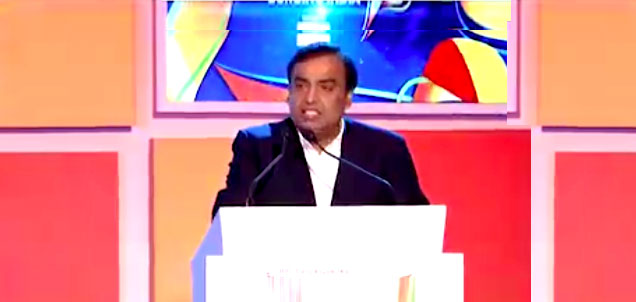
    Given the key influence Mukesh Ambani, Chairman and Managing Director, Reliance Industries has on the Indian media, we publish here his speech at the Republic TV Summit on Wednesday, October 19.


    Distinguished Guests, Ladies and Gentlemen, I am honoured and privileged to be addressing the First Republic Summit today.


    Arnab, your Republic TV is less than two years old. Yours must be one of the most successful media startups in the world. It’s not easy to be so successful so quickly in the media business. You have proved that Arnab Goswami, a professional entrepreneur, with purpose, passion, sincerity and commitment backed by a talented team, can be successful in this new India. You are an inspiration to every young entrepreneur. My warm congratulations to you, Arnab and your team. And wish you even more successes in the future.


    Dear Friends, The name ‘Republic’ has a profound meaning. It means that the Praja are the new Raja. Digital Technologies have empowered the Praja in ways that have no precedence in human history. Before the advent of Digital Technologies, the so-called mass media was essentially without the masses. The masses were passive consumers of media. Now the masses have become both producers and owners of media.


    Look at Social Media. Its very name connotes that it belongs to Society as a whole. I believe that Digital is the greatest friend of Democracy. Let me explain why. The old media model was ‘From Few to the Many’. The new media model is ‘From Many to Many’ and ‘From Anywhere to Everywhere’. In other words, media in the digital age is “OF THE PEOPLE, BY THE PEOPLE, AND FOR THE PEOPLE” in the true sense of the term. And this trend will continue and become more mature in the future. When Digital and Democracy work together, their combined power will produce a prosperous India – a Dhanwan Bharat.


    Friends, I congratulate the inaugural Republic Summit for choosing ‘Surging India’ as its theme. This theme is as timely as it is appropriate.


    Today’s India is surging ahead on the back of technology. I can say with confidence that if there is one place in the world where the transformative power of digitisation is breaking new ground every day, it is India. India’s digital transformation is unmatched and unprecedented. In less than 24 months, India has taken a leadership position from being 155th in the world in mobile data to number 1. And the impact of this unprecedented growth can be seen across all digital domains.


    Over the next two decades, I can confidently say – that India shall be leading the world and shall contribute the next wave of global economic growth. Friends, Let me tell you why I am so optimistic about India’s potential… Not just optimistic, I am actually convinced. Earlier, the world had witnessed three industrial revolutions. The first was powered by coal and steam. The second was fuelled by electricity and oil. And the third used electronics and information technology.


    During the first two revolutions, India languished on the fringes. It started playing catch-up in the computer-driven Third Industrial Revolution. The Fourth Industrial Revolution is now upon us. It is marked by a fusion of technologies straddling the physical, digital and biological worlds.


    Data is the foundation of this revolution. This revolution will be driven by data and will be defined by humanism. India is already generating significant quantum of data. I can say with confidence that India has a chance of not just participating in the Fourth Industrial Revolution, but also leading it.


    And I say this because of three main reasons: First, The India of today is remarkably different from the India of yesterday The India of today is a very young nation – 63% of our 1.3 billion population are aged below 35. India’s vast tech-savvy young population is its key strength.


    Just imagine the kind of connected intelligence India can create if the power of a billion-plus minds is combined! Our nation is more vibrant and ambitious than ever before on the back of its youthful energy and enterprise.


    Second, India is a democracy and is run on the model of equitable and inclusive growth with a society-wide culture of empathy. And India is openly embracing the digital technologies of tomorrow. With a world-class digital infrastructure in place, each one of the 1.3 billion people of India can now productively participate in the Fourth Industrial Revolution. We can solve the biggest unsolved problems facing humanity right here in India.


    Third, India is a rich and fertile ground for entrepreneurship. It has already succeeded in creating a healthy ecosystem to nurture entrepreneurs, especially young entrepreneurs. Most significantly, India has emerged as the fastest growing start-up base worldwide. Today, the nation is home to the third largest number of technology-driven start-ups in the world. Never before has India witnessed such an explosion of entrepreneurial spirit. Friends, How can India rise to its full potential, to its destined eminence?


    There are five major areas, which India needs to focus on and embrace: First, we need to prepare ourselves for a period of information and digital abundance. All Indians will have access to massive computing on the cloud, and access to all information on the planet. Jio is determined to connect everyone and everything, everywhere – always at the highest quality and the most affordable price. I am proud to say that, instead of a digital divide, India today is digitally united. All 1.3 billion connected minds are going to accelerate the future. Digital platforms make it possible for many consumers to be entrepreneurs at the same time. Imagine a force of 1.3 billion networked consumers and entrepreneurs having access to all knowledge and all computational power they want at an extremely affordable price. Every single aspect of our lives – the way we earn our living, we entertain or conduct our businesses – will undergo a massive transformation… not in 100 years…. not in 50 years… but within the next few decades. Early adopters will have the opportunity to leapfrog competition, and create unprecedented societal value.


    Second, we need to adapt ourselves to the scorching pace of innovation and learn to collaborate on scale. All the new technologies are accelerating in speed, rate and power. You could be an expert in any one, but it’s the convergence of two, three or four of these that’s transforming existing ways of working. Which means, collaborations will become both a necessity and a requirement for success. You may have a brilliant idea that has the potential to disrupt an industry.


    We need to quickly transform the idea into a breakthrough innovation. And in order to do that, you have to master the art of collaborating with your peers anywhere in the world. In the digital world, none of us is as smart as all of us put together. Third, we have to shift from a system of time-bound education to a mode of continuous learning.


    Now, it is both possible and necessary to reorient education for the new kinds of productive and creative opportunities. We have to groom our children to be digitally-savvy right from school. Schools should train students in ‘the four C-s’ – critical thinking, communication, collaboration and creativity. These are the skills required to build the foundation for a sustained leadership in the digital age for India. Within a single generation, we can empower and enrich our vast and young human resources to give India a competitive edge in the world.


    The Fourth major task is closely linked to the third. It is to ensure that new and disruptive technologies create more employment opportunities than they take away. I have no doubt that they will. However, there is a lot of apprehension on this score. And these very apprehensions could resist or delay digital transformation of our societies. That would be a mistake. Therefore, governments, businesses and civil society organisations should put together an ecosystem for massive upskilling of our workforce.


    Significantly, most of the upskilling can happen on digital platforms. And the fifth area of focus is in Data Ownership. . In this new world, data is the new oil. And data is the new wealth. India’s data must be controlled and owned by Indian people ─ and not by corporates, especially global corporations. The Supreme Court of India has mandated that data privacy is sacrosanct. Therefore, for India to succeed in this data-driven revolution, necessary steps will have to be taken to migrate the control and ownership of Indian data back to India ─ in other words, Indian wealth back to India. Data colonisation is as bad as the previous forms of colonisation. Similarly, data freedom is as precious as the freedom we won in 1947.


    Friends, today, we have the opportunity to digitally reinvent all sectors of our economy – be it financial services, commerce, manufacturing, agriculture, arts and crafts, education and healthcare.


    India can leapfrog competition and lead the world in each of these sectors. Let me focus on three important sectors ─ agriculture, education and healthcare. First, I have chosen agriculture because we cannot ignore the reality of underdevelopment in rural India.


    Over 60% of Indians still live in villages. And by 2050, there will be 300 million more Indians to feed. Today, our average farm yields are only about 20-30 % of the best global yields. We can substantially increase the income of the farmers by encouraging adoption of technologies for water conservation, soil management, precision farming and waste reduction. There is both a pressing need, and a golden opportunity, to create a digital green revolution – an evergreen revolution.


    I am sure that if we combine digital technology tools with the innate knowledge and wisdom of Indian farmers, we can usher in an evergreen revolution. The second big digital opportunity is in education. India’s youth is our biggest asset. But we need good quality education for all to make them a productive asset.


    We need digital tools and innovations to break geographical, social, language and economic barriers. 58,000 colleges, over 700 universities and 19 lakh schools in India will be digitally connected, with Jio playing a leadership role. Any student, even in a remote village, can have access to the best teachers and the latest knowledge in the world. AI-based smart assistants can bring personalised learning adapted to the needs of each student. And this can overcome the gaps and constraints of classroom education —– like any age, any time and any subject learning in any language.


    Thirdly, healthcare is a basic human right of every Indian. The purpose is to ensure affordable and quality healthcare to all, which is both a national necessity and a national responsibility. For the first time in history, this has become possible because of digital technologies – accessible even in remote locations.


    Today, constraints of budget, physical infrastructure and trained personnel make it difficult to deliver quality healthcare to India’s large and growing population. India can overcome these constraints by adopting digital tools and innovations.


    As in education, the best doctors and best diagnostic facilities can become accessible to all citizens anywhere in the country. India can design a path-breaking and affordable healthcare system that will be a model for the rest of the world. Similar disruptive and scale opportunities exist in India in virtually every domain.


    Friends, Let me quote our Prime Minister Shri Narendra Modi : “India’s contribution towards the Fourth Industrial Revolution would leave the world stunned.” These words will be prophetic. Across the world, the digital era is dispelling despair and bringing new hope. I can safely predict that, from now on, every new generation of Indians will live a better, longer and more-fulfilling life – than the previous generation. India must embrace this digital fourth industrial revolution with a new mind-set to create a bright and prosperous future for our nation.


    As a nation we must rise to this occasion. The climb is difficult. The challenges are many. And the goal cannot be achieved by any one person, one enterprise or by any single government. All of us – 1.3 billion Indians will have to work together with a single purpose to realise this. We must have a partnership among all sections of society to realize this potential in the shortest possible time. Collectively, let us commit ourselves today to work together to make Surging India a reality. And make it Irreversible. And make it Unstoppable. And may God bless us as we embark on this most exciting new era in India’s history. Thank you.


  • Rediffusion unveils new brand identity

    By A Correspondent


    Rediffusion has unveiled its new brand identity that is a play on bright yellow and purple and is new-age in its approach.


    Said Navonil Chatterjee, Joint President & Chief Strategy Officer, Rediffusion Brand Solutions: “Our belief is that Creativity needs to be amplified to the power of technology to arrive at break-through solutions for brands. And when Creativity meets Technology, the result is Connections, Conversations and Conversions. That’s the future of brand building and that’s what this new Rediffusion is poised to deliver on.”


    Added Rahul Jauhari, Jt.President & Chief Creative Officer, Rediffusion Brand Solutions: “The need to build powerful brands has never gone. What has changed is the toolset to do so and the environment in which we operate. Brand building is what we have done for decades now. It’s in our blood. In this world of data, analytics and never ending stream of possible specialist partners, the new Rediffusion aims to be that one partner who will hold our clients’ hand as they build their brand in this mad new world of marketing,”


  • Genesis Burson-Marsteller names Deepshikha Dharmaraj as MD

    By A Correspondent


    Genesis Burson-Marsteller (GBM) has named Deepshikha Dharmaraj as Managing Director. She will work closely with Chief Executive Officer and Founder Prema Sagar to oversee the organisation and implement its growth strategy for 2019. In January 2019, the firm will announce its new leadership structure to set the future growth path for its clients and people. Recently, longstanding senior executive Nikhil Dey quite the agency to join Weber Shandwick India as vice chair.


    Dharmaraj joined GBM 24 years ago and has held a number of different leadership roles during that time including Chief Talent Officer and most recently, Chief Business Growth Officer, where she oversaw the development of the agency’s client portfolio, talent and partnerships as well as innovation around new services to deliver on the firm’s promise of integrated communications for global and Indian brands.


    Said Sagar: “Deepshikha has been an integral part of our journey almost from the beginning. In all of her avatars, she has lived the Genesis ethos and it is her pursuit of excellence in making the firm a truly integrated communications business that has helped us grow stronger with each year. “That, in turn, has helped everyone at the firm push the boundaries of communications for our clients and enabled us do more for our people, industry and community. I wish her even more success in her new role.”


    Added Dharmaraj: “It has been a great privilege to be part of Genesis Burson-Marsteller’s eventful and illustrious journey so far. Our plans for growth in 2019 will take the firm to greater heights and I am looking forward to this next phase in my new role with much excitement.”


  • ASCI welcomes Consumer Protection Bill: D Shivakumar

    By A Correspondent


    On Thursday, the Lok Sabha passed the Consumer Protection Bill, 2018. The Bill will now go to the Rajya Sabha for consideration and action. If it is adopted, it will replace the Consumer Protection Act 1986.


    D Shivakumar

    Commenting on the development, D Shivakumar, Chairman, Advertising Standards Council of India (ASCI) said: “ASCI welcomes the new Consumer Protection Bill which replaces the old 1986 bill. ASCI has been actively involved in addressing consumer grievances on behalf of the Department of Consumer Affairs. With the new bill brand owners need to think sharper about claims they make and product quality as product liability will be an issue if not delivered on promise. celebrities will have to pick the right quality brands. ASCI will help in ensuring that consumers rights are protected”.


    The Bill provides for protecting consumer rights and setting up a redressal mechanism at the national, state and district levels. Consumer Affairs Minister Ram Vilas Paswani sought help of members to help with the passage of the Bill to protect the interest of consumers.


  • Mindshare announces senior appointments for APAC

    By A Correspondent


    Mindshare has announced two major leadership appointments to its leadership structure in Asia Pacific. The first is the elevation of Prashant Modi to become Asia Pacific Chief Operating Officer. Modi, who was previously Chief Commercial Officer for Mindshare in Asia Pacific, will take on the broader responsibility of managing the Singapore hub and working with Mindshare Asia Pacific CEO Amrita Randhawa on future-proofing the overall company structure and offering.


    Modi has been with the agency and GroupM for over 16 years working across both GroupM and Mindshare in its India and regional office in Singapore. Commenting on the appointment Randhawa said: “There are few people who care about our people and our company as much as Prashant. He is the beating heart of Mindshare and one of our absolutely finest minds. I am delighted that this role is going to give him the canvas he deserves to make an even bigger impact on our organization and on our people.”


    Prashant Modi

    Speaking on his elevation, Modi said: “16 years with Mindshare and it still is a dream place to work with great colleagues and clients. Mindshare has always provided a very open atmosphere to fuel personal growth and I am looking forward to continuing to contribute to our achievements and growing our business further”


    Rohan Lightfoot

    The second appointment is that of Rohan Lightfoot as Chief Growth Officer of Mindshare Asia Pacific. His role is focused on developing high growth opportunities for new and existing clients with an emphasis on new products, innovation and digitisation.


    Speaking on Lightfoot’s appointment, Randhawa said: “Rohan’s been on my must-hire list for years! He is uniquely placed having spent solid time in China, having a blend of creative, media and digital craft experience as well as working on some of the region’s biggest accounts. He understands the changes that the agency needs to deliver in order to continue to be a valued partner for our clients.”


    Added Lightfoot: “I am so excited to be taking on this new role. It’s a perfect fit for my experiences and passions in my career. The breadth and depth of capability at Mindshare is staggering. The challenge of keeping the world’s leading media agency always ahead was impossible to turn down. I’m already loving being part of the team that Amrita is building.”


    Both roles are based in the agency’s Regional Singapore Office and effective immediately.