Category: ADVERTISING

  • Future still fuzzy for Communication Agencies?


    By Prabhakar Mundkur

     

    2018 has been a bit of a watershed year for communication agencies.  The threat that has long been echoing in the corridors of the largest advertising agencies, “Is advertising dead?” finally seemed more real than ever before.


    In some ways, Martin Sorrell who was responsible in the late 80s and early 90s for taking over some of the world’s best advertising agencies and changing their structure from the all-encompassing full-service agency to little unrecognisable bits and pieces by separating media, and other services might have been in some way also responsible for another huge second wave of structural change in the communication agencies of today with his exit at WPP.  The communication agency as it stood in 2018 was a shadow of what it was in the 80s, fractionated and decimated into several pieces that no longer made any sense together.


    The surprise announcements by WPP in 2018 to merge VML and Y&R and Wunderman with JWT, I see as a brave and perhaps rash move, (of course time will tell) to kill some of the best-known communication brands in the world without adequate justification.


    To take you into a bit of history, in the 60s, two erudite gentlemen called Stephen King and Jeremy Bullmore threw two buckets of hot water on the communication theories of that time, which believed that the harder you hammer a message into consumers’ minds the better it will work to convince consumers to buy a product.  Nay, they said. If you want someone to believe you are funny you don’t just say “I am funny” as expect someone to believe it.  Instead you would tell him a joke which is a stimulus. Then the response would be “Oh yes, he is indeed very funny!”


    Is Data helping us design the Stimulus?


    In the loud din caused by words like ‘digital’ and ‘data’ and the current narrative of how it has overtaken the importance of advertising I only have one question.  Can someone please show us some case studies of how data helped you to design the stimulus?  Is designing the stimulus an act of creation or has it been relegated to the world of algorithms?  In which case we wouldn’t need creative people at all in the communication business.  Also, I am suspicious of the word ‘content’ because it autosuggests that it is not as stimulating as creative or persuasive enough?  But someone told me that that is the idea. You might think I am old-fashioned.  But are you saying American citizens voted for Trump without persuasion?  And content works in hidden ways that only content makers understand?  Or data scientists understand?


    The biggest hoo-ha about data stealing and how personal data was used to influence personal opinions at least for me was the Cambridge Analytica case.  But of course, after having read hundreds of reports on the subject, I still haven’t got a clue on what kind of stimulus did the Russians design on Facebook that made consumers in America vote for Trump.  If this would be revealed to the world at large, I am sure it would create another third wave in communications. A chance to duplicate another landmark just like Stimulus-Response did when King and Bullmore first spoke about it.   Is data only helping us understand consumers better?

    (It always did! Now that data is digital perhaps that’s all) Is it helping us design the stimulus or only measure the response?  There are many questions that need to be answered here, which when I read the average local or international advertising weekly hides behind large words like data and digital without any specifics on how it really works, as if it is still a mystery, that cannot yet be revealed.  Or are the people touting this great advancement in communications not competent enough as communicators?


    Whatever it is I don’t think all the questions have been answered. To me it sounds like a lot of gobbledegook.  I am reminded of Sir David Ogilvy’s famous words in “Confessions of an Advertising Man” when he said some individuals use statistics as a drunk man uses lamp posts – for support rather than illumination.  There is something in that.  After all I can’t forget that our own Piyush Pandey was recently elevated to the global creative head of Ogilvy but I can’t for the life of me remember who the head of Cambridge Analytica was! Oh, thank god you are around, Google.


    I think the future is still fuzzy for communication agencies.  Hopefully they don’t throw out the baby with the bathwater!



  • 1 Minute View: Future Shock for Ad Agencies?

    1 Minute ViewMxMIndia columnist and veteran adperson Prabhakar Mundkur has very effectively pictured the state of affairs as they exist in the advertising business. His article appears on MxM today at: http://www.mxmindia.com/2019/01/future-still-fuzzy-for-communication-agencies/
    The advertising business in India has had one of its worst years last year. We don’t know if the state of the economy is the cause (demonetisation, GST etc) or it’s a global phenomenon where digital and consulting firms are taking over the business, but the future, as Mundkur writes, is indeed fuzzy for creative agencies. The going is set to be tough for media agencies as their role gets diminished by the Accentures of the world as well as standalone and more agile digital shops.

    So is it a cul-de-sac for advertising? Perhaps, if one looks at things from the traditional prism. However, one must remember that people hire the services of advertising agencies for creativity. Creativity in creative work produced, creativity in the form of innovative ideas and creativity in the form of strategy and effectiveness.

    If creativity continues to be be the primary driver of an advertiser-agency relationship, the path ahead for creative agencies needn’t be fuzzy. In fact it could well be fun.

  • AdEx for Festive Advertising in 2018


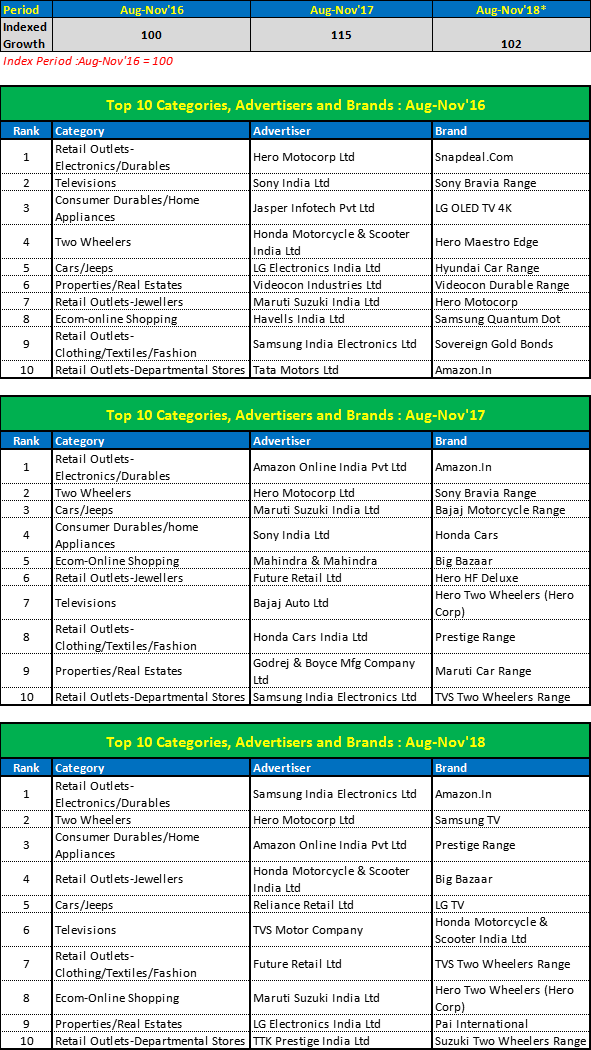
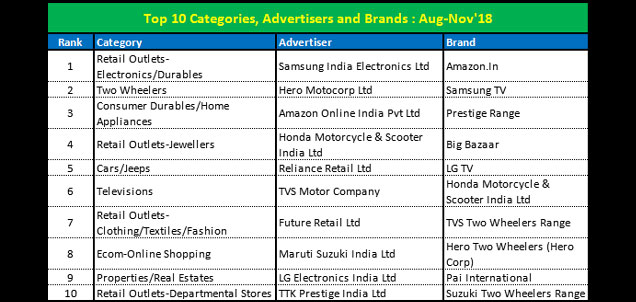
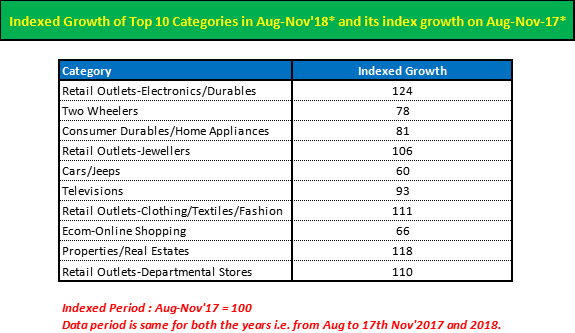
    TAM AdEx, a division of TAM Media Research, has shared with MxMIndia numbers for festive advertising for 2018. The data tells the story:


    This is a very important chart. Index grew to 115 in 2017 but only 102 in 2018. Below the first chart are the Top categories, advertisers and brands for 2016, 2017 and 2018 (also above as the main story image)


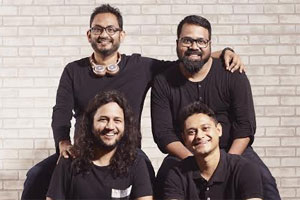
  • Leo Burnett elevates Prajato Guha Thakurta, Sachin Kamble and Vikram Pandey to NCDs

    By A Correspondent


    Top L-R – Rajdeepak Das, Sachin Kamble Bottom L-R – Spiky, Prajato Guha

    Leo Burnett India has announced the promotion of Prajato Guha Thakurta, Sachin Kamble and Vikram Pandey to National Creative Directors. They will report to Rajdeepak Das, Managing Director – India and Chief Creative Officer, South Asia, and Dheeraj Sinha, Managing Director – India and Chief Strategy Officer, South Asia. Prior to their promotions, the trio has been Executive Creative Directors in Leo Burnett’s Mumbai office.


    Speaking about the elevation, Rajdeepak Das said, “Sachin, Projo (Thakurta) and Spiky (Pandey) have been the engines driving the creative culture at Leo Burnett. They have been leading the Fight Club (the creative brain trust of the agency) to produce and incubate new-age work done for some of our biggest brands – ‘The Nation’s Bike’ and ‘Invincible Indians’ for Bajaj V, ‘Salaam Loans’ for Tata Capital – among so much more for Google, HDFC Life and others. They have been responsible for winning multiple Cannes Lions, One Show and D&AD awards for our clients. Most importantly, they have been the true flag-bearers of the Humankind philosophy and the open-collaboration culture of the agency. It is this spirit that has helped name Leo Burnett India as the Agency of the Year 2018 among our 86-office network.”


    Dheeraj Sinha

    Speaking about the promotions, Sinha said: “The greatest thing about Leo Burnett is the ‘boundarylessness’ of our talent. Our best talent is available for our clients irrespective of their geography. Projo, Sachin and Spiky have done a spectacular job of the creative product which has won accolades at Cannes Lions, Spikes Asia and consistently gotten a 7+ on the Leo Burnett GPC scale. They have contributed hugely to the new business wins of the agency and have added value to clients across offices. These promotions are a formalisation of the roles that they are already playing. These elevations are timely as we enter 2019 on the back of great momentum of 2018, both, in terms of business growth and global recognition.”


  • Will adland buy Shortlist?


    By A Correspondent


    It’s an initiative that will help agencies manage costs in the area of awards entries. Entries to awards – especially the international ones – cost loads of monies, and in times when agency budgets are shrinking and client fees are touching a new low, this could well be a, well, Whattan Idea Sirji development.

    So basically there will be a group of 27 judges – Indian and international – all of who have been on the juries of major awards – who will tell agencies in confidence if their entry has it to win a metal in the global or desi awards.

    There’s a small catch though: in order to save big monies, you need to pay small monies. So in order to get the expert view from The Shortlist’s jury, you need to pay Rs 4000 per entry. The decisions of the jury will be confidential and there will be no awards event, release of lists etc.

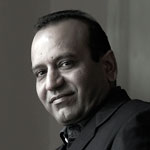
    Rajesh Kejriwal

    Rajesh Kejriwal, Co-founder and CEO, Kyoorius is ecstatic about the idea. “All the people in the agency business we spoke with – CCOs and even CFOs – love the idea. Awards are expensive investments – the reasons for entering an award show are many. As the economic climate in which agencies operate gets tougher, wiser decisions have to be made to ensure better ROI. The Shortlist provides valuable feedback and validates what eventually can or should be entered into awards shows.”

    The smart businessman that Kejriwal is has perhaps hit a winner idea. The communique that his office sent us was loaded with near-endorsements. Josy Paul, Amer Jaleel, Santosh Padhi, Bobby Pawar… all the gods of the business. And since it’s Kejriwal and Kyoorius, obviously the blessings of Ogilvy will also be there.

    The Shortlist has been set up in partnership with Zee Entertainment Enterprises Ltd, and with the support of The One Club For Creativity, organisers of the One Show and the ADC Awards. Kyoorius has now allied with The One Show to power its awards. It was earlier tied up with D&AD.

    Said Kevin Swanepoel, CEO, The One Club for Creativity: “The Shortlist is a highly useful new resource that will greatly assist creative directors as they determine their awards show entries. The decision to enter a piece of work to an award show must be well thought-through, and The One Club has worked closely with Kyoorius to develop this platform to help agencies make that determination. The Shortlist utilises a robust evaluation process, designed specifically to provide an actionable audit. At the end of the process, creative directors will have greater confidence in then submitting their ‘shortlisted’ work to The One Show global awards.”

    The question though we had is will agencies respect the decision of The Shortlist jury and not submit an entry that has not been found to be awards-worthy? We spoke to a few people who had heard of the initiative and while they are hoping that the idea works, they are unsure if they will actually accept the Shortlist jury decision if they reject a creative.

    Said one creative biggie requesting anonymity: “It’s great when they say ‘yes’ to a creative, but if they reject it, then there are larger issues at play. Keeping the client happy, taking care of the egos of the creative team, etc etc.” Added another: “It’s a CFO-friendly agency and most agencies – especially the networked ones – are managed by accountants. But we must remember that it’s finally a creative idea. I think Year 1 is going to be a wait-and-watch one. We will all see how it has worked.”

    Details on the call for entries, categories, submission guide and jury to be revealed soon at theshortlist.kyoorius.com. The evaluation of entries to The Shortlist will be announced in February 2019.

  • 1 Minute View: Nice, pre-audit idea. Hope it works

    1 Minute ViewIf it works, it will do the industry a world of good. Obviously, there’s some money to be made by the people who’ve created the concept and are executing it, but those are small monies considering the amount that can be saved.


    Rajesh Kejriwal’s Kyoorius has come with the idea of The Shortlist, an attempt to advise advertising agencies on whether the work they wish to enter in major international and national awards stand a chance. This will be a confidential report given to the agencies who send in the entries for an appraisal. No awards night. No metals awarded. Comprising the jury will be global and desi greats who’ve been part of the jury at some of the best awards in the business.


    While Kejriwal sent us a communique which had many biggies in the business endorsing the concept, one needs to figure how well it works. For, if an agency goes ahead and enters work that the Shortlist jury may not have found metal-worthy, it would defeat the exercise. But for that we need to give the concept a chance. Here’s to Kejriwal and Kyoorius for a winner idea.


  • Delna Sethna exits L&K Saatchi & Saatchi; Kartik Smetacek and Rohit Malkani elevated to Joint NCDs

    By  A Correspondent


    L&K Saatchi & Saatchi has announced that its Chief Creative Officer, Delna Setha will be moving on from the agency after a five-year stint in order to pursue other interests.


    The agency has also rolled out a new creative organisational structure which will be led by Kartik Smetacek and Rohit Malkani who have been elevated to Joint National Creative Directors, with immediate effect.


    Said Anil Nair, CEO, CEO & Managing Partner, L&K Saatchi & Saatchi: “It is always a sad moment to say goodbye to someone who has been an integral part of our growth story over the last five years. I’d like to thank her for being an exceptional leader and paving the way for path-breaking work along with her team. I wish Delna the very best for her future endeavor.”


    Said Sethna: “All through life I’ve only ever followed my heart, and I think I’m much too old now to mend my ways. I wish everyone at Saatchi much luck.”


    On the newly appointed roles Nair said: “Rohit and Kartik have played a critical role in shaping L&K S&S’s creative product. They have been an integral part of the Leadership team for many years now. It was quite natural to look within and choose them to take on this larger mandate. I am absolutely certain that both of them will surpass everyone’s expectations in raising the creative bar further.”


  • Pune Design Festival will take place on 11-12 January

    By A Correspondent


    It’s that time of the year when the design fraternity converges in Pune for the Pune Design Festival. The Association of Designers of India (ADI) – Pune chapter is organising 13th edition of the Pune Design Festival on January 11 and 12 at Hyatt Regency.


    As good design is inclusive and co-creative, notes a comunique, this year’s conference theme “Collab” will bring to life discussions around collaborations beyond design.


    With 22 talks, seven workshops, panel discussions, film screenings and award presentations, the conference will span across two extended days. The conference will open with music by Vasu Dixit.

  • Welspun hires Leo Burnett for flooring biz

    By A Correspondent


    Leo Burnett India has won the flooring vertical of Welspun Group. Leo Burnett India won the mandate after a multi-agency pitch, and its Mumbai office will look after the business.


    Speaking about appointing Leo Burnett India as its creative partner, Meraj Hasan, Chief Marketing Officer, Welspun Flooring said: “To use a clichéd phrase, the idea at Welspun Flooring is to catalyse a ‘paradigm shift’ when it comes to do or change your flooring. We are looking at a behavioural change from the Indian consumer. Flooring can be easy, exciting, colourful and modular. We called for the top agencies to present their ideas. The strategic, as well as the creative solutions that team Leo Burnett presented, are solid and holistically crafted to achieve category leadership in line with our product and service offering. They are based on the proven Humankind approach and are integrated in their essence. And here we are together in this partnership.”


    Added Dheeraj Sinha, MD – India & Chief Strategy Officer – South Asia, Leo Burnett: “We have a big opportunity here with the Welspun Group in building a power brand that delivers discontinuous business impact for the flooring solutions business. We are excited about the innovations that the group has across its offerings. We need to work on behaviour change and our Humankind philosophy is helping us navigate this. We are extremely excited about this relationship and we look forward to creating long-term business success for Welspun.”


  • Searching for Trust in Digiland


    By A Correspondent

    Dentsu Agency Network arm  iProspect has released its fourth annual whitepaper, 2019 Future Focus: Searching for Trust, built to help marketers navigate and master the notions of truth and authenticity in the hyper-sensitive global media landscape today. The report predicts that those businesses grounded in credibility, relevance and reliability across all their marketing channels will see trust at the very foundation for their success in the digital economy.

    Here’s the Executive Summary of the Report:

    The digital economy has brought new opportunity for development and innovation in every business sector. While the majority is “good innovation”, we continue to see a significant gap at a societal level, driven by a continued disparity in access to technology based on socio-economic factors. In today’s hyper-sensitive media landscape, how should brands and publishers navigate the notion of truth and authenticity? If we are to derive one truth from the digital economy it is this: trust is not an issue, it is the issue.

    The fourth annual edition of iProspect’s Future Focus explores how the consumer experience and the intricacies of personalisation influence the role of convenience in commerce. Brands that are built on credibility, relevance, and reliability will see trust as the very foundation for their success in the digital economy.

     Global Marketers move Trust to the Forefront in 2019.

    The 2018 iProspect Global Client Survey, comprised of interviews of more than 300 global marketers and brand leaders, including CMOs and marketers of FTSE 100 and Fortune 500 companies, found that 88% of marketers are responding to these polarised times, making trust in their brand a priority for 2019.

    • 76% say trust is important to keep consumers buying their brand
    • 47% define trust as brand loyalty and 47% define trust as consumers being ambassadors
    • 62% don’t have a proactive role in approaching online reviews, although they think reviews represent the greatest risk to consumer trust
    • 88% say trust is a priority in 2019
    • 62% say the quality of their purchase experience and after-sales service will be a priority for 2019
    • 69% think the rise of digital assistants represents an opportunity to become closer and develop stronger relationships with consumers
    • 83% don’t believe brands will dominate over convenient experiences in the future

    The report also includes exclusive interviews with global leaders from businesses such as The New York Times Company, IBM, Microsoft, Hilton, The Economist, Rachel Zoe, Inc., and AccorHotels.

    Feedback shows that trust is at the forefront globally with 88 per cent of marketers making trust in their brand a priority in 2019. Marketers see gaining consumer trust as vital to business growth with 76 per cent stating that trust is important to keep consumers buying their brand.  Digital will play a clear role in this with 34 per cent stating that Voice Search is their priority emerging marketing channel in 2019, and a further 60 per cent believing that the rise of AI will increase consumer trust as it allows for more relevant and personal experiences.

    Said Ruth Stubbs, Global President, iProspect: “As businesses continue to transform in the digital economy, successful brands will be differentiated through their ability to establish unique relationships with their most valuable customers, ensuring time is well spent and value is equitably exchanged. As technology further blurs the line between information and value exchange, consumer trust is paramount.”

    Added Rubeena Singh, CEO, iProspect India: “In our latest edition of iProspect’s Future Focus, we examine how commerce is influenced by consumer experience and the ramification of personalisation. In our view, brands that focus on credibility, relevance, and reliability will be successful in establishing trust with consumers. Trust, we believe, is the foundation for successful brands in the digital economy.”


  • SRK brand value erodes as Virat continues at #1


    By A Correspondent


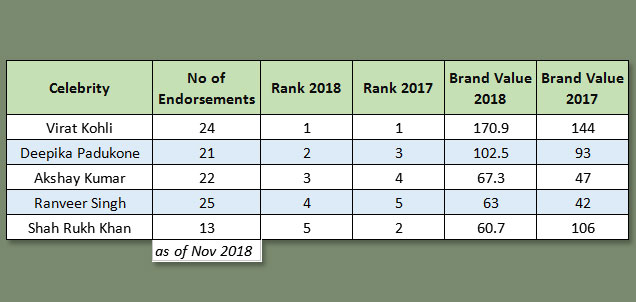
    Global advisory firm Duff & Phelps announced findings from the fourth edition of its Celebrity Brand Valuation Report 2018: ‘The Bold, the Beautiful and the Brilliant.’ The report, released on Thursday, provides a ranking of India’s most powerful celebrity brands based on brand values derived from their endorsement contracts.


    Key findings from the report include:

    :: Virat Kohli retains the top position for the second consecutive year. His brand value rose by 18% to US$170.9 million in 2018.

    :: Deepika Padukone rises to the second position, whereas Shah Rukh Khan falls to the fifth position.

    :: Total value of the top 20 celebrity brands stands at US$877 million, with the top 10 contributing more than 75% of the total value.


    Celebrity – Top 10

    2018

    2017

    Brand Rank Brand Value Brand Rank
    Virat Kohli 1 170.9 1
    Deepika Padukone

    2

    102.5

    3

    Akshay Kumar

    3

    67.3

    4

    Ranveer Singh

    4

    63.0

    5

    Shah Rukh Khan

    5

    60.7

    2

    Salman Khan

    6

    55.8

    6

    Amitabh Bachchan

    7

    41.2

    8

    Alia Bhatt

    8

    36.5

    9

    Varun Dhawan

    9

    31.6

    10

    Hrithik Roshan

    10

    31.0

    7


    Commenting on the rise of the endorsement market in India, Varun Gupta, Managing Director and Asia Pacific Leader for Valuation Services, Duff & Phelps said: “The celebrity endorsement market in India has matured from vanilla endorsement deals to full-fledged partnerships through innovative routes such as equity deals and strategic partnerships. On the other hand, rising internet penetration, varied formats of content consumption and a burgeoning middle class with increasing disposable incomes is boosting media spends for traditional and digital advertisements through celebrities. Millennial celebrities continue to be the first choice for brand endorsements as companies want to have a greater focus on the youth segment fuelled by demand in sectors such as e-commerce, retail, FMCG and smartphones, among others.”


    As per data from GroupM ESP Properties, over the past decade celebrity-led endorsements increased in number from 650 in 2007 to 1,660 in 2017, representing a steady CAGR of 10%. Further, TV ad spends with celebrity endorsers rose from INR15.5 billion in 2007 to INR66.6 billion in 2017 at a CAGR of 16.1%. TV ads with celebrity endorsers represented close to 24% of the total TV ad spends in 2017, which represents a 5% uptick from 2007.


    Added Aviral Jain, Managing Director, Duff & Phelps: “While Bollywood celebrities dominate the rankings of the top 20 celebrities, sportspersons provide tough competition. Virat Kohli, Sachin Tendulkar, M. S. Dhoni and P.V. Sindhu collectively contributed almost US$241 million, which is over 27% of the cumulative brand value of the top 20 celebrities pegged at US$877 million.”


    “Brands are also increasingly going regional in their endorsement strategy to cater to the heterogenous peculiarities of Indian states. They are leveraging the equity that local celebrities enjoy. Product brands are also looking for better returns on their investment through a step up on regional markets and have started coming up with region-specific commercials featuring regional celebrities like Mahesh Babu and Tamannaah,” Jain added.


    Further, the report focuses on the rising trend of power couples. By tapping into a power couple’s reach and impact, brands can target each partner’s unique following and voice. The coming together of a power couple creates a larger platform that brands want to leverage to target the youth. This year, power couple Virat Kohli and Anushka Sharma have endorsed around 40 brands together such as Head and Shoulders, Manyavar, Pepsi, Celkon, Boost, Audi, Fastrack, Goinee, Wrogn and Polaroid.


    Celebrities are also increasingly being leveraged to create social media buzz. A celebrity’s hold on social media is now a major determinant of the influence that he or she can have over a brand campaign. Duff & Phelps sourced data from Meltwater, the vertical leader in online media intelligence solutions, on the top celebrities and their social media presence, engagement and influence index.


    Commenting on the power of a celebrity’s social media influence, Christo van Wyk, Area Director – India and Middle East, Meltwater said: “ Like marketers, celebrities are continuously building their brand, and those that are aware of current trends and of the difficulties in breaking through the clutter, recognize that social media is a unique opportunity to stand out above the crowd. Celebrities with well-crafted social media strategies are able to maintain relevance, build more intimate relationships with fans and garner real-time feedback on their work. Much like a corporate brand’s, a thriving social media presence can serve as a reflection of a celebrity’s public desirability.”


  • Grey appoints Minakshi Menon to head Bengaluru

    By A Correspondent


    Grey Group India has appointed Minakshi Menon to lead the agency’s Bengaluru office. She joins Grey as Senior Vice President & Office Head. Menon will closely work with her reporting head -Yashaswini Samat, Chairman and Managing Director, GREY group India.


    On the appointment, Samat said: “We are delighted to have Minakshi join the team at Grey. In the current business environment, agencies are seeking the sweet spot where creativity and brand thinking converge with an understanding of the digital ecosystem. With her international experience in digital marketing, strategy, and advertising communication Minakshi is uniquely qualified to fit this need and create famously effective work.”