Category: ADVERTISING

  • Prashant Mehta joins Isobar as SVP, Global Head of Delivery

    By A Correspondent


    Prashant Mehta

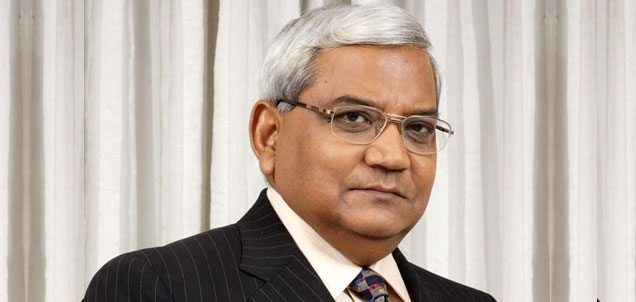
    Isobar has appointed Prashant Mehta as Senior Vice President, Global Head of Delivery, effective immediately. Mehta will be responsible for re-imagining the next generation of Global Delivery Models for the agency, and will leverage the power of Isobar’s global network to connect talent and drive complex and strategic business transformation projects for clients. Mehta will report to Mike Mulligan, Isobar Global Chief Operating Officer and will be based in Gurgaon, India.


    Jean Lin

    Said Jean Lin, Global CEO, Isobar: “We are delighted to welcome Prashant to the Global Isobar team to lead our Global delivery function. Agile and effective cross-border delivery and locally relevant customer experiences on global platforms, has become one of the biggest strategic challenges when businesses and brands embrace cross-border commerce. Prashant’s vast experience from consulting to delivery, and deep expertise of the most advanced worldwide technologies, will be critical in ensuring the success of our clients’ business transformation journeys.”


    Added Mehta: “In today’s age, when business are getting transformed and disrupted globally at the speed of light, Isobar has an industry leading proposition to deliver experience led business transformation for our clients in a truly agile way.  I am excited to join Isobar’s Global team to drive complex & strategic Digital transformation programs leveraging the intersection of Creative, Technology & Data / AI powered by Modern software engineering to ensure our clients thrive and commercially succeed in today’s experience economy.”


  • Remembering Nabankur ‘Nobby’ Gupta


    Not many in the current crop of marketing services and media professionals may know much about Nabunkur Gupta or Nobby, as he was popularly known. But ask the shining stars of the 1980s, 90s and the 2000s, and they’ll tell you without any hesitation that Nabunkar Gupta was indeed the Marketing Superstar, as AdAge, billed him in 1996.


    By Paulomi Dhawan

     

    A humble man, a gentle soul, a fabulous human being!

    I first met Nabankur Gupta when he was at Videocon and I was representing his advertising agency.  He guided Videocon through its fastest pace of growth. It was when there was a major battle among television brands with schemes developed and announced overnight, which is a norm today. He developed strategies for sub-branding and multibranding in the consumer durables business for the first time in India winning him international accolades. Advertising Age, New York recognised him for this successful initiative by awarding him with the title of ‘Marketing Superstar’ in 1996, one of the 20 recipients of this title globally.

    He thought of  the creative/ media agency format, the fee system in the late 90s. He was calmly involved on all aspects of the business including advertising and media details. In fact, he supported me on many an interesting new media concept. Television and sponsored programmes conceived with brand values were a novelty then. The popular show Videocon Flashback, innovations in print, outdoor were all cleared instantly and released. He was methodical, organised and disciplined. All plans and estimates needed him to sign off. There was a fixed time every morning… if you missed that slot, it would shift to the next day.

    Mr Gupta was a client first, then my boss and, above all, a mentor who I owe a lot to. He was always there to guide, support me. He initiated my move to Raymond.

    Mr Gupta joined the Raymond Group (from Videocon) as Group President and Board member in 2000. During his tenure, he acquired some highly synergistic companies (like Color Plus) to support Raymond’s strategic growth plans.

    Mr Gupta strongly enhanced the nuances of consumer marketing at Raymond especially with the introduction of aggressive branding, trade promotion activities which ensured enhancement of market shares. He played a lead role in expanding the Raymond retail network as well as conceptualising novel retail formats, much in advance of competition, like  Be: for affordable designer wear. Customer orientation, ROI focus and ability to remember details of marketing were some of his impeccable qualities.

    He relaunched the brands in the textile and apparel space and further reinforced Raymond’s leadership position. Brand-building was his forte. It was under his leadership we did the Raymond commercials – “Feels like heaven, Feels like Raymond” series. The ‘Baby’ commercial was launched among trade –over 1500 –with an applause and on the cricket platform ‘Champions Trophy’. He had an eye for guiding the work with a great sense of the brand core. He brought back the ‘Teacher’. He did the Father and Son, Man and Puppies and many more ads. “The Complete Man” was contemporised, made more sensitive, younger. The Style Guides set the brand apart. He indeed personified the Raymond credo: The Complete Man, The Complete Professional, The Complete Marketer

    Media consolidation at Raymond and introducing the Corporate Communication cell was his vision. We did some amazing work together – he was always supportive on any pathbreaking idea. Dressing TV anchors, owning news segments, print innovations, style guides, the much prized Haji Ali hoardings were in his time. It was 360-degree marketing solutions,  including the ET Awards for Corporate Excellence initiated by him to synergise with Raymond’s core values of Excellence, Leadership, Innovation.

    Mr Gupta interacted with media – both the editorial with interesting insights and their marketing teams, ever ready to hear a new idea at a cost-effective solution. As an advertising friend said: “The two of you were a formidable and good team.” Extremely soft-spoken and well-mannered in his handling of difficult situations and he was truly a marketing genius. He represented Raymond on many industry bodies like MRUC, ABC delivering wisdom and experience.

    He was truly an industry leader. He was a master in adding a high level of professionalism wherever he went. His leadership as Group President was eventful and noted for all this and more.

    At 70, he leaves behind his wife Nita, son Kaustabh and daughter Timira, and a very large family of indebted souls whose lives he touched. RIP. May God bless his soul for his onward journey.

    In 2005, he relinquished the post to start his own management consultancy “Nobby  Brand Architects & Strategic Marketing Consultants”. He was on the Board of many companies, including Raymond. Besides brand architecture, he was professionalising family businesses and mentoring their next gen.

    A warm, good human being with an infectious smile who was highly respected by all. A gentle leader, a man of principles, a guide and mentor to many. Humble, a great professional and a thorough gentleman. His warmth, his quiet demeanour was like none other.

    Thank you, Mr Gupta, for being there!


    Paulomi Dhawan is a senior marketer, and currently a Strategic Advisor – Media and Corporate Communications with Raymond. She also consults at Paulomi Dhawan Advisory. She was earlier Vice President Media and Corporate Communications at Raymond. When she met Nabankur Gupta, she was with iB&W Communications as VP – Media and President – Media Supermarket of the media agency.


    Now Strategic Advisor Media & Corp Comm Raymond.

    And Paulomi Dhawan Advisory



  • Indrani Sen: FICCI-KPMG Report 2017: Scripting the Digital Decade

    By Indrani Sen


    I must confess that I am disappointed with the title of the FICCI-KPMG 2017 Report on Media & Entertainment Industry – “Media for the masses: The promise unfolds”! Has not the media always been for the masses? What is this promise which will unfold particularly in 2017? After last three years’ reports with exciting titles which spoke volumes: 2014 “The-stage- is-set”, 2015 “#shootingforthestars” and 2016 “The Future: now streaming”; this year’s title sounds drab though it is politically correct.


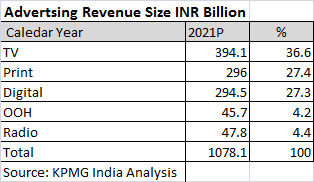
    After going through the report, I felt that “Scripting the Digital Decade” could have been an alternative title from Advertising Industry’s view point as the predicted growth in advertising revenue shows Digital ad revenue equaling Print ad revenue in 2021. The total advertising revenue will grow at 15.3% CAGR over 2017-21 with digital advertising revenue growing at double the rate of 30.8% CAGR over 2017-21.


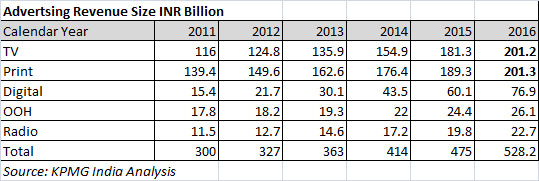
    Everyone is talking about the evolution of Free to Air TV channels post expansion of rural audience measurement by BARC and the impact of the 4G rollout as the highlights of 2016. It should be noted that as per KPMG India Analysis, TV advertising revenue for the first time touched the Print advertising revenue (201 INR Billion) in 2016 as shown in the table below.Further analysis shows that from 2011 to 2016, Print advertising revenue has increased by 61.9 INR Billion and a similar amount of 61.5 INR Billion has been added to Digital advertising revenue.  During the same period, TV advertising revenue has grown by 85.2 INR Billion to catch up with the Print advertising revenue.


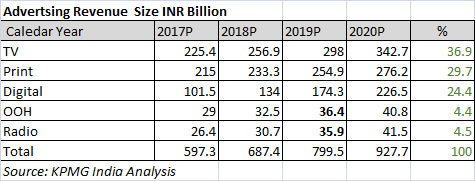
    An analysis of the future projections show that in 2019 advertising revenue of radio industry will catch up with advertising revenue of the OOH industry and will have similar share of the Indian advertising pie by 2020.


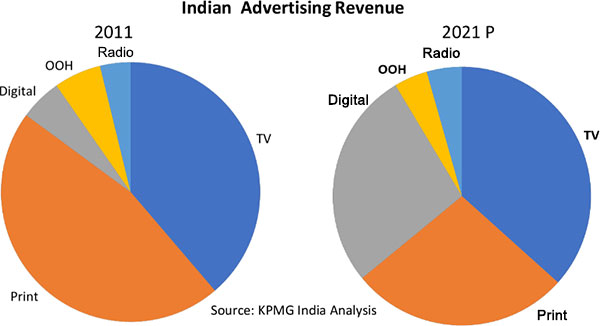
    As per the FICCI KPMG M&E Industry Report 2017, the shape of the Indian advertising revenue pie will change completely during this decade. The rate at which digital advertising revenue has been growing and the digital industry is predicted to grow during 2017-2021, it will not be surprising if we find that the size of digital advertising revenue equalises the print advertising revenue even before 2021.


  • Indrani Sen: E-commerce muddles advertising growth in 2016

    By Indrani Sen


    Last week, Pitch Madison released its mid-year advertising report for 2016 and revised the annual advertising growth forecast from 16.8% to 13.2%. It appears that our advertising growth rate will take a plunge in 2016 after achieving growth rates of 16.5% in 2014 and 17.6% in 2015. Madison no longer expects the total advertising in India to cross Rs 50,000 crore by end of 2016.

    A slowdown in TV advertising in the first half of the current year has compelled the agency to cut down on its original projection of TV advertising annual growth rate from 20% to 11%, the same as the growth rate achieved by the medium during the first half of 2016. The TV advertising expenditure has lagged below the estimated level for the first half of 2016 largely due to the lower contribution from the e-commerce sector. The shortfall in TV advertising has downgraded the overall advertising growth forecast by 3.5%.

    Shortly after the release of “Pitch Madison Advertising Report 2016” in February 2016, the Union Government gave a blow to the e-commerce industry by prohibiting them to offer direct discount to the consumers in March 2016. Financial Express warned in an article on March 29, 2016 about a slowdown of funding in e-commerce companies from last quarter of 2015 (http://www.financialexpress.com/industry/companies/flipkart-bigbasket-alibaba-flows-to-e-commerce-slow-down/230340/ ) backed by some hard data.

    In its issue dated April 24, 2016, Business Today carried a cover story “The Party is over” by Goutam Das (http://www.businesstoday.in/magazine/cover-story/realism-now-takes-root-among-indian-e-commerce-cos/story/230732.html) suggesting that “After two years of reckless funding and growth, realism takes root among Indian e-commerce companies.” The article showed that venture funding in e-commerce had slowed down since October 2015.

    However, around the same time Deloitte, supported by Mjunction and CloudBuy released the report “E commerce in India: A Game Changer for the Economy” commissioned by CII which (https://www2.deloitte.com/content/dam/Deloitte/in/Documents/technology-media-telecommunications/in-tmt-e-commerce-in-india-noexp.pdf) marginally raised the hopes of the advertising industry.

    The writing on the wall was all over the financial and trade media during the last two months (June and July 2016) with various articles appearing on the changes in India’s e-commerce industry.  It became quite clear that all is not well in the e-commerce sector even before Pitch Madison released its mid-year advertising report. The revision in the advertising growth rate of e-commerce sector raises a question if it is too conservative. The festive season advertising spends usually yields a higher growth rate in the second half of the year compared to the first half in most categories, but we find that the Madison has pegged the revised advertising annual growth rate for the e-commerce sector at the same level as the first half of the year.

    GroupM released its “This Year Next Year” report in January 2016, a few weeks before the Pitch Madison Advertising Report. In 2015, the adspending in India grew by 14.2% which was higher than their predicted growth rate of 12.4%. GroupM projected a growth rate of 15.5% in advertising spend in India in 2016 to Rs 57486 crore driven by Digital. TV remained as the dominant medium with a 47.1% share, up from 46.3% in 2015. It also predicted that consumer product, automobile and e-commerce companies would continue to drive the growth in advertising expenditure as they did in 2015. The e-commerce sector has been burning less money on the traditional media as well as digital media for advertising, which will also affect the GroupM projections.

    The government has recently set up a high-powered committee to review all issues including FDI of the e-commerce industry in India. The committee will submit its report within two months. The introduction of Goods & Services Tax (GST) is also supposed to give relief to the e-commerce companies. However, the effects of all these measures will not be felt in immediate future and media and advertising industry will have to wait and watch for the revival of e-commerce advertising spends.


    Indrani Sen is a veteran media agency and marketing services professional. She is currently an Independent Consultant and Adjunct Professor, Media Management at Symbiosis Institute of Media & Communication, Pune. The views expressed here are her own.


  • Sagar Mahabaleshwarkar joins Contract as CCO

    By  A Correspondent


    Contract Advertising has announced the appointment of Sagar Mahabaleshwarkar as Chief Creative Officer.


    Tarun Rai

    Said Tarun Rai, Chairman & Group CEO, J. Walter Thompson: “We have been in discussions with Sagar for the last few months. And I am very happy that we have him on board, finally. Sagar is an industry stalwart. He has built his reputation over the years across many agencies in India and abroad. He has worked with more traditional FMCG clients as well as some of the iconic technology companies. And he has excelled across media platforms – with the last decade, especially, building his reputation as a digital-first creative leader. Contract has some of the most exciting and high-profile brands. We have big ambitions for the agency. With Raji Ramaswamy as the CEO and Rohit Srivastava, one of the finest strategic minds in the country, what Contract needed was a CCO with the depth of experience and a solid reputation of creative excellence that Sagar brings to the agency. He is the ideal creative leader to take Contract to the next level and make it a creative powerhouse”.


    Raji Ramaswamy

    Added Raji Ramaswamy, CEO, Contract: “I am delighted to welcome Sagar Mahabaleshwarkar as the Chief Creative Officer responsible for guiding the creative output of Contract in the digital age. He is a seasoned new age creative leader who has the finest art and design sensibilities. He has worked on some of the biggest brands in the country across both traditional and new media platforms and excelled in every one of them. Contract manages some of the biggest brands and businesses in the country and we believe Sagar will be able to contribute and add value to each one of them.”


    Sagar Mahabaleshwarkar

    Commenting on his appointment, Mahabaleshwarkar said: “The vision of Contract and the direction that JWT group is taking globally, is to make brands agile and to make brands purposeful. That’s a dynamic shift which is challenging and forward looking. I am excited with Tarun’s strategy. Having worked on a winning note in a highly competitive, tech-first consumer business for the last three years, I am confident the shift is in the right direction.”


  • Text of Sudhanshu Vats speech at CII Big Picture 2018

    By A Correspondent


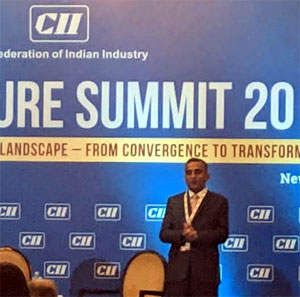
    Text of the speech by Sudhanshu Vats, Chairman – National Committee on Media & Entertainment and Group CEO & MD – Viacom18 on Changing M&E landscape – from convergence to transformation at the just-concluded CII Big Picture 2018.
     

    Namaskar ladies & gentlemen, many thanks for investing your valuable time with us at the CII Big Picture Summit. It is my privilege to host all of you, over today and tomorrow to discuss, debate and deliberate on the rapidly changing media and entertainment landscape in this country.


    The first CII Big Picture event I attended was in 2012, I believe it was also the first edition of the event. As a regular learner at these events, I can say with utmost certainty that a lot of the issues we discussed back then – ambitious revenue targets, radio auctions, TV measurement, digitization and so on – a large chunk of it – while still relevant – are in various stages of development today. And that’s only fair – such is the nature of the beast we ride. Also, this trend of convergence and consolidation – the 2 ‘Cs’ – is a universal one – taking place all over the world. That brings me to the theme of this edition of Big Picture – from convergence to transformation.


    This is an interesting thought, convergence is a reality – one that is here to stay. It’s being driven by consumer needs and industry’s response to those needs – meaning that it’ll be a long-lasting phenomenon. Transformation is a much bigger – and more daunting – phenomenon. That said, what do we mean by ‘transformation’? It’s a big word. I’m going to do what my professor at university used to do when we asked her the meaning of a ‘big word’ – throwback 2 bigger words – MORAL DILEMMAS.


    On a serious note, I want to take this precious opportunity to share a point of view that may not make headlines like aggressive industry targets do, but is, in my humble opinion, even more important.


    If you step back and introspect about all that is happening with our industry across the world, you will agree that we are battling several changes – and most of them are a result of moral dilemmas and our response to them. If we can tackle these dilemmas successfully (and defining success is the hardest part), we can believe that we have transformed.


    Interestingly, our rich cultural heritage is a treasure trove of insights when it comes to handling moral dilemmas. I recently had a young director from the South approach me with what he called was a ‘modern adaptation of the Mahabharata – told from the perspective of the Kauravas’. It was an interesting thought and we’re testing it – but that’s beside the point. We all know about Dharamraj Yudhishtira and his half-lie – when he told Drona  – on Krishna’s counsel – that Ashvathama is dead. Yudhishtira was referring to an elephant who had died in battle – knowing that Drona would mistake Ashvathama to be his son of the same name. On hearing that ‘Ashvatahama is dead’, Drona put down his arms and was killed by Dhrishtadyumna. Was Yudhishitra right in doing what he did? It’s a debate that divides many till date.


    I gave this example to showcase the greyness of moral dilemmas. Let’s look at our industry and the moral dilemmas we will have to face or are facing –


    :: How do we deal with the power we have? What do we do if we find out that our reach and credibility is being used to influence electoral processes across the world?

    :: How do we ensure fairness in theterms of availability of our content to our consumers and parity across distribution platforms? Especially in a foreseeable future when convergence is going to dial up vertical integration across value chains.

    :: As consumption moves online, our access to data will increase. In many ways, data will be a competitive advantage and drive advertising revenues and personalized user experiences – what processes do we put in place to ensure it is not misused – how and where do we draw the line differentiating personalization versus privacy?

    :: Human resources – our people- are our biggest asset – on screen and off it – how do we react when their individual, personal behaviour questions the fabric of the society we want to create? Think of this especially in light of the recent issues around diversity and inclusion that we’ve experienced. It’s important for everyone, but especially so for our industry.


    The list of moral dilemmas is endless. We need to be cognizant of these dilemmas – as organizations, industry bodies, policymakers and governments – as we look to scale up our businesses.


    I’ve always been an ardent supporter of data and its importance in driving decision making. In this address, I have not used a single data point – because I believe that the course we take over the next decade will be determined more by these fundamental issues of values and how we tackle moral dilemmas than just commercial considerations. Driving consensus will be difficult yet more important than ever before. This is even more so given that India is today amongst the world’s largest ‘open’ media markets and home to a multitude of players from all over and of all sizes.


    Yudhishtira had to spend a day in hell to make up for his half-lie. He was willing to spend a lifetime there to atone for his sins. I’m not sure that we are as brave as him. We must tread carefully, follow our dharma in the toughest of times and be patient. Only then will we have truly transformed.


    Thank you ladies and gentlemen, thank you.


  • BARC bags accolades at CII Awards 2018

    By A Correspondent


    BARC India bagged the ‘Most Innovative Company in Service – Medium Enterprise Category’ at the CII Industrial Innovations 2018 awards. In addition, BARC also been recognised as one of the ‘Top 25 Most Innovative Companies in India’. The announcement was made at the fifth CII Industrial Innovation Awards 2018 held in New Delhi on December 3..


    The Industrial Innovation Awards identify and celebrate innovative Indian enterprises across various sectors. The award has been instituted by the Confederation of Indian Industry (CII), and is one of the most coveted innovation awards in India.


    Said Shashi Sinha, BARC India Technical Committee Chairman and CEO, IPG Mediabrands:  “BARC India was set up with the aim to give the industry a measurement system that it deserved, and this could not have happened without having a strong technology backbone. The team at BARC India has been able to give the industry a technology marvel which is capable of providing the industry a representative data that helps them take better business decisions. The CII Industrial Innovation Award is proof of the great work done by the team.”


    Added BARC Chairman Nakul Chopra: “BARC India has been a key change agent in the viewership measurement space, and its initiatives have already started to redefine the industry. Since its inception, BARC India has tackled several challenges. But, considering we work in a dynamic industry, these challenges are never-ending. The key to success is to constantly keep innovating and be the change-maker. BARC India has been successful in doing so. We are now looking at implementing some key future projects such as Unified Video Measurement and Return Path Data, which will bring another paradigm shift in the industry.”


    Said Partho Dasgupta, CEO, BARC India: “In future, technology will disrupt every single business, be it Cement, Retail, Telecomm, E-Comm or Media. It is therefore important to keep pace with the changing technology. As is said, in tomorrow’s world, the big fish will not eat the small fish, but a fast fish will eat the slow one. We at BARC India firmly believe that innovation is imperative and not a choice. We also believe that it is important to be the fearless first to inspire change and not be a mere follower. I am delighted to see that our efforts have been recognized by CII. We shall continue to empower the industry with our robust measurement,”


  • DS Group takes humorous rote for Pass Pass Pulse

    By A Correspondent


    Pass Pass Pulse, the candy from DS Group, has rolled out a set of three ad films promoting the product. This takes forward the ‘Pran jaaye par Pulse na jaaye’ narrative that was introduced with the release of the first TVC.


    The TVCs have been conceptualised by J Walter Thompson Company and the three commercials being released are titled, Astronaut, the Swing and the Bedroom. Each commercial showcases how the protagonists upon seeing a Pulse Candy in their proximity reach out to grab it, even in unfavorable situations.


    Speaking on the brand, Shashank Surana, VP, New Product Development, DS Group, said: “The Pulse candy has retained number one position, second year in row due to its irresistible taste heightened by tangy twist. The communication of Pulse is hinged on the temptation to seize a Pulse candy, whatever the circumstances. This three film campaign also highlights the extend people go to get one in ‘Pran jaaye par Pulse na jaaye’, situations presented in comical and eccentric plots.’’


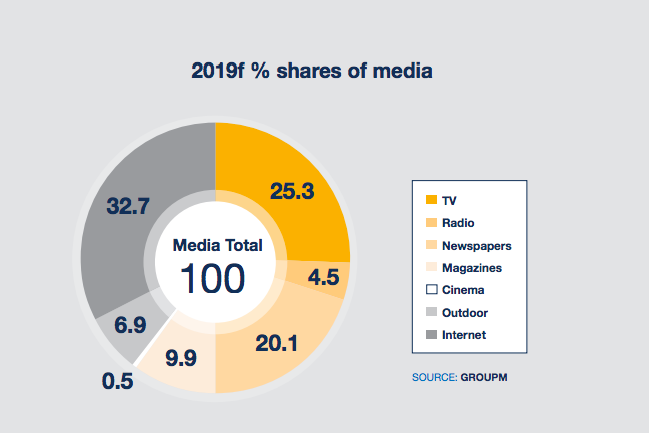
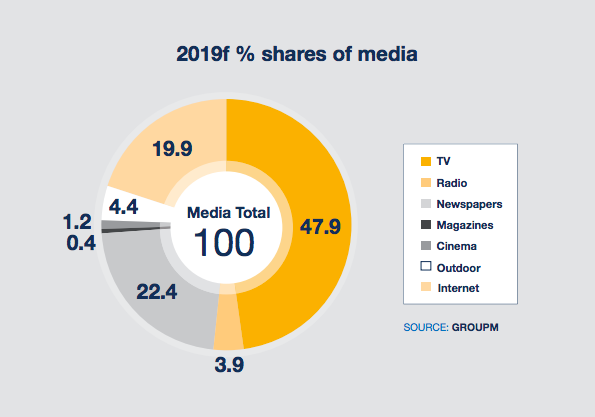
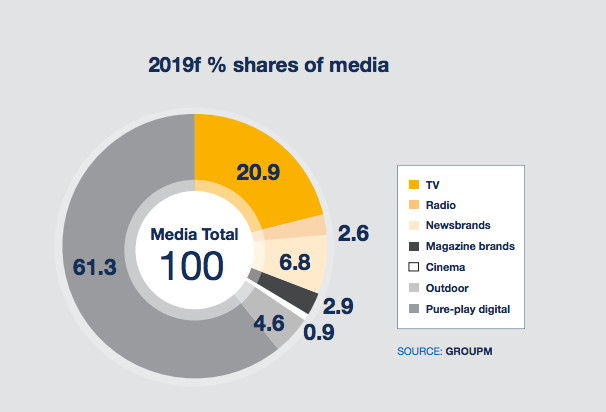
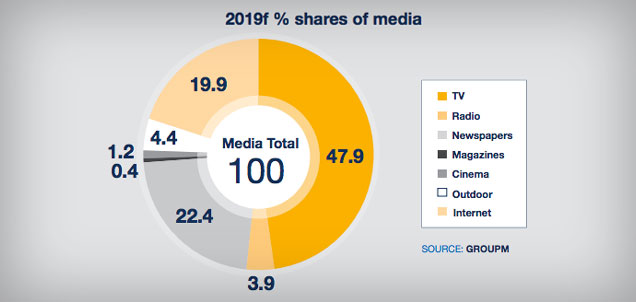
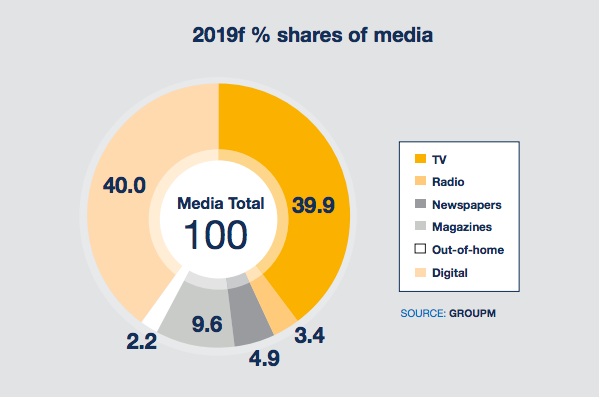
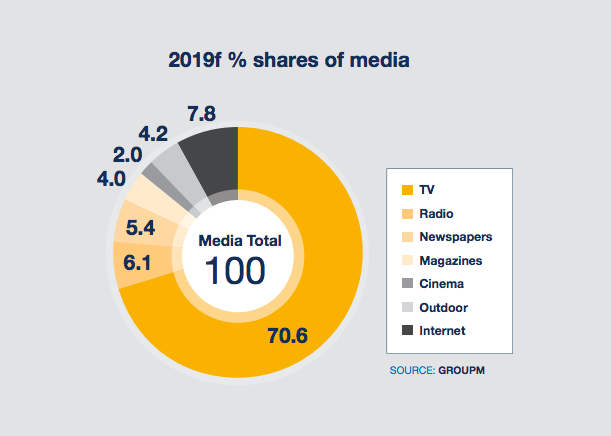
  • So where do adspends on print stand vis-à-vis TV & digital for 2019?


    By A Correspondent


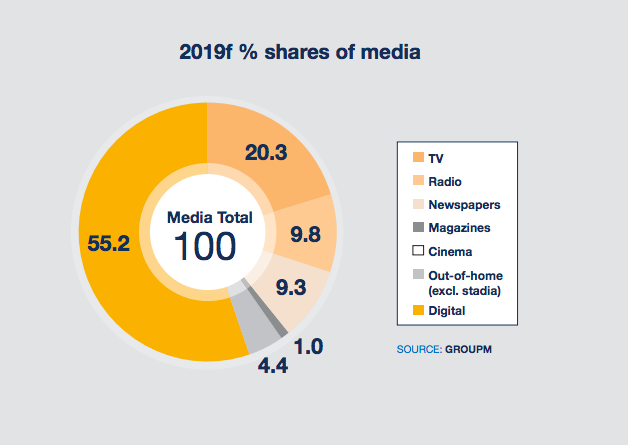
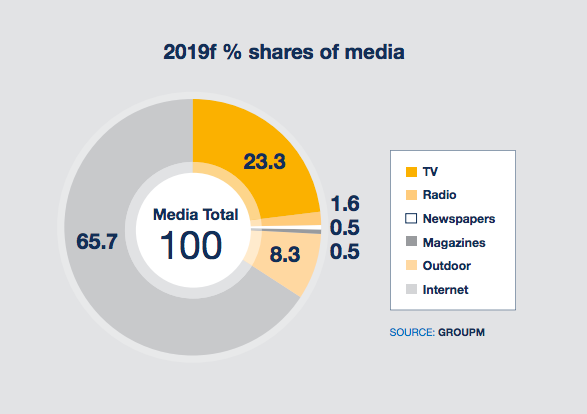
    So where do adspends on print stand vis-à-vis TV & digital for 2019? Earlier this month, GroupM’s TYNY (This Year Next Year) report threw up some interesting data forecasting adspends for 2019 and more.


    We have pulled these pie charts from the TYNY report released by GroupM. Read on… the charts tell the story.


    US


    Brazil


    Canada


    China


    Germany


    India


    UK
  • L&K Saatchi & Saatchi wins creative mandate of Jindal Stainless Group

    By A Correspondent


    Leading stainless steel conglomerate, Jindal Stainless Ltd, has announced the appointment of L&K Saatchi & Saatchi as its creative Agency on Record (AoR). The appointment follows a multi-agency pitch.


    The mandate will be managed out of the agency’s New Delhi office and would span the gamut of offline and online mediums including television, print, outdoor, radio and digital.


    Said Abhyuday Jindal, Managing Director, Jindal Stainless: “Our aim is to bring JSL close to the consumer’s heart, as a brand. We want the consumers to be aware of the versatility of the metal, the role it can play in their lives and that it is not just limited to industrial usage. This provides us with the task of reinventing the way we communicate about the brand and to do that, I whole-heartedly welcome Law & Kenneth Saatchi & Saatchi as our strategy and communication partner in creating this new approach.”


    Added Anil Nair, CEO and Managing Partner, L&K Saatchi & Saatchi: “The ambition of redefining a category is challenging and exciting. And we’re looking forward to doing the work that is going to do deliver that.”


  • Peps unveils new brand positioning

    By  A Correspondent


    Peps Industries has announced its new brand positioning – ‘DreamMakers’. Conceptualised by Phantom Ideas, which recently won the brand’s creative mandate, this is the first in a series of 10 to 30 second spots highlighting Peps’ proposition of a good night’s sleep as vital to chase dreams.


    Said K Madhavan, Managing Director, Peps Industries: “Peps has led by example with respect to disruptive innovation in the mattress category. With the new brand narrative, we seek to bring a fresh perspective in the spring mattress category via product innovations that will shift focus from great sleep to waking up refreshed with a purpose. Thereby, harnessing one’s ability to perform at their peak to chase and achieve their goals.”


    Added Robert Anthoney, Founder and Chief Creative Officer at Phantom Ideas: “To start with, it has introduced yet another fresh perspective through a compelling proposition that seeks to ‘give purpose to energy’. When PEPS got on board, the mandate was clear – Change the narrative. Take the brand to the next level. When we observed the consumer and category canvas, we realised there is a tremendous opportunity to add purpose to post-sleep energy by plugging into the dominant mood that was sweeping the country, especially with the age cohort that would dominate the emerging consumer demographics.”


  • JWT Amsterdam & India partner Jimmy Nelson to highlight diminishing cultures

    By  A Correspondent


    Photographer Jimmy Nelson has launched a bid to preserve cultural diversity by issuing the caution ‘Blink. And they’re gone’. A campaign has been conceptualized and created in a joint effort between the India and Amseterdam offices of J Walter Thompson.


    The campaign kicked off with a short film that is made using over 1500+ photographs taken by Nelson during his journeys across the world. The film was directed by JWT India’s Chief Creative Officer, Senthil Kumar, working closely with JWT’s Global Creative Lead, Bas Korsten, who is based in Amsterdam.


    Said Nelson: “If we let the cultural identity of the indigenous people disappear now, it will be lost forever. It’s literally a case of BLINK and they’re gone. And if this happens, we will lose one of the most valuable assets we have – our rich human cultural diversity and heritage. The depth and wealth of our humanity will shrink. This must not happen. Our collective cultural identity is too valuable to be destroyed by homogenization. We must unify and fight to support indigenous cultures and take personal pride in the myriad of their cultural traditions that are still to be found on the planet today.”


    Added Senthil Kumar, Director of the film & Chief Creative Officer, J Walter Thompson India: “It was a huge honour to collaborate with legendary photographer Jimmy Nelson and direct this all important film. It was life-changing to travel far and wide across the indigenous earth, through each one of Jimmy’s stunning photographs. The ambition is to share the cultural evolution of these remote and ancient indigenous cultures in a mind blowing form, which will move every viewer to share the experience with the world.”