Celebrating India’s greatest design thinkers, practitioners and educators from established businesses to emerging practices, the India Story Design Awards presented Elephant Design with an award in the Packaging Design category for its work on Paper Boat
Pune-based Elephant Design had helped shape the packaging design for the popular soft drinks brand – right from contributing to its name, story, packaging structure, brand and visual identity.
Amagi Media Labs has entered into a partnership with BARC India that will help advertisers monitor geo–targeted ad-campaigns of brands across TV channels.
With this partnership,TV networks offering geo-targeted split of its national channels, including their national and regional feeds will be monitored on a separate basis and will be listed across BARC India’s interfaces. This will help Amagi’s advertisers evaluate their national geo-targeted ad-campaigns on BARC India’s software and as a result will increase the credibility of the concept of geo-targeting advertising.
“Our partnership with the BARC India is a proof of the increasing ad spends of brands geo-targeting on TV. As competition becomes local, be it large brands or small regional brands all of them need to target specific region as their product has specific regional promotional needs.This will help marketers measure the ROI of their targeted TV campaigns and fine tune their media strategies. It will also be a great tool for our future customers to understand the large and varied audiences they can cater to using Amagi’s patented geo-targeting technologyâ€, said,Baskar Subramanian, Co-founder, Amagi Media Labs.
As the industry’s authoritative voice on TV viewership data, BARC India’s association with Amagi will provide transparent and quality data on geo-targeted advertising, thus enhancing its offering to its own clients, and providing unprecedented insights into the viewership patterns of the diverse and heterogeneous Indian market.
“BARC India has always endeavoured towards providing the media industry with cutting edge viewership and advertising data. Our tie up with Amagiin monitoring geo-targeted advertising is a big step in this direction.As more and more companiesopt for geo-targeted advertising, the importance of this data is only growing. This partnership is an essential tool in providing the industry with data that will help them plan their campaigns with deeper insights,†said Partho Dasgupta, Chief Executive Officer, BARC India.
Pinaki Bhattacharya has been appointed as the National Planning Director, J Walter Thompson India. Bhattacharya has been with JWT for over six years and in his last role as Senior Vice President and Executive Planning Director, he was the planning lead on many of the marquee brands in the Delhi office.
With over 20 years of experience, Bhattacharya has worked across diverse categories such as Food & Beverages, Nutrition, Confectioneries, Technology, Automobile and Durables.
In his role as NPD, Bhattacharya along with Mythili Chandrasekar (National Planning Director) will work closely with Bindu Sethi- Chief Strategy Officer to champion the just-launched, new J Walter Thompson way of working – ‘The Pioneering Process’.
Making the appointment, Tarun Rai, CEO, J Walter Thompson South Asia said; “The planning function has always been J Walter Thompson’s strong suit. After all, we invented the planning function in New York, way back in 1968. With so much disruption in just about every aspect of marketing and communication, Planning as a function assumes even greater importance today. The focus of JWT Planning is on solving our clients’ business problems and our new collaborative process – The Pioneering Process – seeks to do just that. It gives me great pleasure to announce Pinaki’s new role as a National Planning Director. Bindu Sethi, our Chief Strategy Officer, now has two senior colleagues in, Mythili and Pinaki to lead the largest team of planners in India.â€
“Pinaki is a real asset to the team. There are a few senior planners in India who are able to bring consumer insight into category and brand solution thinking. Mythili adds dimension to our trio by bringing a unique creative edge into the planning thinking process.â€Â says Sethi.
“It’s been six wonderful years of working on and learning from some of the most exciting brands and interesting categories. The new role gives me a wider canvas of brands and people that I hope to influence and help grow. Taking on new roles and challenges that are otherwise daunting seem easier when you are at JWT because of the wonderful and absolutely top class teams and leaders that one is surrounded by- both, within the agency and in our client organizations,†said Bhattacharya.
Outside of work, he tries to find time to interact with and share his experience with students of management across different Institutes. He also is a keen follower of political developments around the world and a cricket buff.
GroupM has unveiled ‘Brew’- its premier content upfront event, exclusively for clients. This day- long event brought together several leading partners from the content industry and over 150 brand managers and marketing heads, across categories. Industry stalwarts such as screen writer Juhi Chaturvedi and Sports journalist Harsha Bhogle were among those who took the stage.
The ‘Brew’ line up was a mix of formats that included TV, Radio, Digital video and also native content. Presenters included Digital content specialists YFilms, TVF, Arre, Qyuki, OML, Conde Nast, TV Channels MTV and the Star Network, radio channels Radio One and RED FM, and native platforms Firtpost, Mycity4kids, and DailyHunt. Over 20 presentations were made in the course of the day and clients had the option of going online and registering their bid for it immediately after a presentation. The collective worth of the properties presented at Brew 2016 exceeds INR 65 Cr (about $10 Million). Each of the properties have been bid for by multiple clients.
Branded content, especially on digital is at a tipping point in the Indian market and GroupM estimates this sector to grow manifold. Over the last many years, GroupM has invested in creating a specialist team that works closely with clients to deliver branded content that impacts business goals in a significant manner. “There is a dire need for brands to stay relevant beyond campaigns and we see branded content bridging that chasm,†says Tushar Vyas – Chief Strategy Officer, GroupM South Asia. “It is critical for brands to invest in content across the calendar, to keep the conversation goingâ€.
“While our endeavour is to strategise and manage the branded content calendar for our clients across the year, Brew is a critical property as it evangelizes an upfront culture in the country, which currently does not exist†says Karthik Nagarajan, who heads the content practice for GroupM India. “The 20 ideas that were presented on the day were shortlisted from over 300, so they could be most relevant for the brands in the room. Brew will be curated as the first stop for premium content in the market.â€
Vizeum, the full-service media agency from Dentsu Aegis Network, has launched a media consultancy service in India in an attempt to help mainstream media companies adapt and transform for the new-age digital ecosystem.
Named Binary, this latest service from the Vizeum stable, aims to bridge the gap and provide the right mix between the old world learnings and new-age solutions.
Binary will cover customizable and dynamic modules under two key areas – the Transition and the Transformation roadmap.
“In this age of media disruption, the mainstream media companies have no option but to transform. The new milieu is unlike what we have experienced in the past and needs a fresh perspective. The consumer-media interface is at a tipping point even as the youth of India continue to consume news and content through newer platforms. Clearly, the need to have and follow a transformation roadmap is but inevitable. And yet, few companies have one,†says Shripad Kulkarni, MD, Vizeum India.
“There is still time and opportunity for mainstream media to capitalize on their strengths. But it needs a ‘refresh’ strategy to be absolutely relevant to Young India and to the digital brands that target them. The transition must be consistent and lead them into a Transformation Vision Roadmap,†he added.
Binary Transition will cover the four modules – RevenueMax (New Age Pricing and Sales Strategies for revenue maximisation) True 3600 (Holistic, Marcom Strategy to be relevant in the new milieu), Trainware (Getting the team trained and ready for the New Age challenges) and Sales Assist (Technology based real time sales support).
Binary Transform covers the sequential modules – Digital Audit, Content Strategy, “The New Company†and Strategic Road Map for Digital Transformation.
Adomantra, the online video advertising solutions company, is planning expansion in well established markets like the UK and US and growing market like Middle East. The online video advertising industry has been growing enormously due to increasing number of people watching online videos. Hence, these markets are gateways for brands to gain foothold to a larger target audience.
With the expanded outreach, Adomantra will cater to its partner agencies and brands in a highly effective manner in the key markets. The company expects to generate revenue USD 1 million in this quarter, as the response in the first month is encouraging.
Vikas Katoch
Said Vikas Katoch, Founder and CEO, Adomantra:  “Online video has been growing exponentially across the UK and globally, as internet users experience higher bandwidth, more compelling content and multiplicity of network choices. The video consumer behaviour has helped in penetration of online video advertising along with high click through and ROI.â€
News media companies expect sharp growth in native advertising revenues over the next two years as cultural obstacles are overcome and best practices embraced, according to survey results released by the International News Media Association (INMA) and the Native Advertising Institute (NAI).
“Native Advertising Trends 2016: The News Media Industry†features a survey of 156 mostly newspaper media companies in 48 countries conducted in July to September 2016. Most respondents are members of INMA, representing the leading news media companies in the world.
“It’s the first-ever global study done on native advertising for newspaper media,†said Jesper Laursen, founder of NAI, and Earl J. Wilkinson, executive director and CEO of INMA, in a joint statement. “Our goal has been to shed light on one of the most important topics and fastest-growing streams of revenue in the industry today.â€
According to the INMA-NAI survey, 11% of overall advertising revenue from newspaper media was channeled to native advertising in 2015. That share is expected to grow to 25% by 2018.
While publishers will manage this shift over the next two years, the data and the case studies suggest a growing body today of actionable best practices.
As of late 2016, 48% of newspaper media are already doing some form of native advertising, and another 39% are likely to add it as an advertising option, according to the survey. Some 89% of respondents say native advertising is important to their companies – with a plurality rating it as the most important new advertising source above programmatic. More than three out of four publishing executives surveyed are bullish about native advertising.
Beyond the survey results, the report features five best-practice case studies on native advertising:
Other highlights of “Native Advertising Trends 2016: The News Media Industry†include:
The role of editorial: How native advertising gets executed is as hotly debated at media companies today as print advertorials were in years past. Yet the INMA-NAI survey sheds light on emerging trends:
42% use editorial teams for native advertising, 33% use their own native advertising studio, 28% use a separate native advertising team, and 26% use an external agency partner.
The fact that publishers already have general editorial expertise is considered by 66% to be the top strength for native advertising at their companies.
Yet 38% say the lack of separation of the editorial and commercial sides of the business is a threat to proper execution of native advertising.
Labeling: A clear consensus among media companies that participated in the survey emerged about how to label native advertising in publisher ecosystems. Some 60% say “sponsored content†is their label of choice, while 24% label native advertising as “advertisement†or “paid content.†Disturbingly, 7% of respondents don’t label native advertising, prompting a chastisement by the authors.
Native vs. traditional advertising: A slight majority of media companies surveyed (54%) sell native advertising in combination with traditional advertising, while others sell it as a separate product. Eight out of 10 respondents do not have a dedicated sales team for native advertising.
Charging more for native: While native advertising is more expensive and more time-consuming to create, it also is more lucrative. Some 65% of respondents charge more for native advertising. Laursen said that in the early days of native advertising publishers could generate up to six times the rate of traditional advertising, but a saturated market is mitigating those differences today.
Hurdles to overcome: There are hurdles to overcome with native advertising. According to the survey, explaining native advertising to marketers and convincing advertisers to tell real stories are the Top 2 challenges. Some 55% of survey participants said poor client understanding of native advertising is the biggest threat to success.
Written content top opportunity: Not surprising for a survey targeting a media segment built on the written word, the INMA-NAI survey respondents overwhelmingly said written content was the top opportunity for native advertising at their company. At 90%, written content was far ahead of the next biggest opportunity by 36 points.
Other report highlights include how publishers are measuring the effectiveness of native advertising and the most effective types of native advertising. The 51-page report is available for free to INMA members via INMA.org and to others via the Native Advertising Institute.
Tanishq has launched a high-decibel integrated campaign with emphasis on print and oututdoor. Apart from its push on television, Tanishq has tapped several cities to execute the activity across India.
Commenting on the initiative, Deepika Tewari, General Manager, Marketing, Tanishq said, “Tanishq always looks forward to Diwali because it’s the biggest time for our customers. Gold is an extremely integral part of Diwali and, with the Shubham collection, Tanishq aims at owning the Diwali space. The collection, inspired by some beautiful temples across India, has been especially crafted for those who love tradition and look for beautiful, contemporary designs. The new campaign by Lowe Lintas brings alive the traditions associated with the festival, as well as the inspiration; and we hope that everyone has a very ‘Tanishqwali Diwali’ this year.â€
Added Rajesh Ramaswamy, Executive Director, LoweLintas Bangalore, “We just wanted to bring out the essence of the jewellery and the idea of auspiciousness;â€
The outdoor and print leg of the campaigns comprises over 300 hoardings in 25 cities and over 500 insertions nationwide. Also, the video film which has also been conceptualised by Lowe Lintas Bangalore, is being aired on social channels and on television.
A new study from Hubert Gatignon, an Emeritus Professor of Marketing and the Claude Janssen Chaired Professor of Business Administration, Emeritus at INSEAD, the business school for the world, finds that the extent of a firm’s environmental management practices depends on how customer-oriented it is.
Following on from previous research in which he found customer-orientation to be a crucial element of firm innovation and product performance, the new paper titled ‘Customer orientation and organisational innovation: the case of environmental management practices’, published in the Journal of Business & Industrial Marketing, shows that customer-oriented firms gather more critical market information, recognise new customer opportunities and satisfy customers by delivering the demanded products or services.
Firms respond by demonstrating their environmental credentials or building them to meet the expectations of their customers. But how does this work in practice?
In a large-scale survey of 4,324 French companies with ten or more employees, Gatignon measured customer orientation by examining the companies’ commitment to quality standards, such as ISO9000, whether the firms had information-gathering systems in place to capture customer data and translate it into action and the firms’ commitment to after-sale service.
In his paper, Gatignon found that the higher the firms scored on these dimensions, the higher the likelihood that the firms adopted environmental management practices, such as procedures to identify and measure environmental impacts by preparing environmental audits, setting environmental performance goals and obtaining ISO14001 environmental certification.
However, under two conditions, there was no support for the hypothesis; periods of market growth and periods of market uncertainty, which did not add significant incentives for firms to try and win customers. “It’s clear from this research that customer satisfaction is an important driver of the implementation of environmental management practices. Firms need to integrate environmental issues into their strategic marketing and environmental management practices into their operations,†Gatignon said.
The study also found that whether the firms were responsive to customers or not did not have a significant impact on their environmental management practices, which Gatignon explains by the fact that a focus on only resolving current customer claims makes firms miss the needs of new customers, making them less innovative. The dimensions that mattered most were the firm’s values and its information-gathering capabilities.
The firms surveyed spanned several sectors, such as food, consumer goods, cars and equipment and transport. Construction and intermediate goods and energy were most sensitive to the adoption of environmental management practices.
“Customer-orientation not only contributes to the firm’s environmental performance but also contributes to the development of long-term relationships and a firm’s capacity to innovate,†Gatignon said.
BBDO India chairman and chief creative officer Josy Paul will head the outdoor advertising jury as Jury Foreman at the 2017 D&AD Professional Awards. This was unveiled along with names of other jury foremen and women and the announcement that the 55th annual D&AD Professional Awards are now open for entry.  Although there haven’t been any new category additions, there are some notable changes within sub-categories that will celebrate the latest innovations. For the first time D&AD will now award innovations and fresh new work that comes to the market in Beta or as prototypes. New websites, products and new iterations of existing platforms will get the chance to submit their work to be judged and win a Pencil. This work will be eligible for a Wood Pencil.
The Established Campaigns sub-category will recognise integrated campaigns that have lasted the test of time whilst entries into Collaborative (part of the Integrated & Collaborative Category) will be rewarded for the relationship between agency and client in producing great creative campaigns for three years and over.
Said D&AD CEO Tim Lindsay: “D&AD evolves and changes to reflect the landscape of commercial creativity, which is why every year you’ll find us listening to feedback and making changes to our categories. 2017 will be the year of awarding the established and the very new. Innovation is at the heart of every great creative idea, it is how we measure creative excellence every year. With this in mind, awarding work that has nailed that initial concept but hasn’t necessarily gone into full production was a natural next move for us. At the same time, it isn’t all about the new, there is much to be learned from rewarding successful creative relationships and ideas that have survived the test of time which is why we will be looking at both ends of the spectrum this year. As ever we wait with growing excitement to see what great creative work is entered in the next weeks and months.â€
With the launch of D&AD Impact earlier this year, the White Pencil is no longer part of the awards line up, however as one of the most popular categories, Creativity For Good continues to develop with the addition of Product and Service Design subcategories which reflect the growing trend for these as part of creatively worthy campaigns.
Also, the following categories have notable changes: Branded Film Content has been changed to Branded Content to reflect the changing media in this space and now live-streamed, audio or user generated content can be entered into this category as well as films. Branding has also had some re-organisation with Logos moving over from Graphic Design and the addition of Campaign Branding & Identity which will give design agencies the opportunity to enter specific branding and identities of campaign projects. Finally, D&AD has retired Mobile Marketing as a category as it plays a key role in most campaigns and is no longer briefed in isolation, moving instead as a sub-category to other design and marketing categories.
Meanwhile, D&AD has also announced a list of senior professionals as Jury Foremen and Women. This includes BBDO India chairman Josy Paul. Commented Awards Director, Donal Keenan: “At D&AD we strongly believe in championing equality in the creative industry and aim to lead by example. This year we are pleased to announce that our line-up of Jury Foremen and Women are equally split by gender for the first time, a trend that we will work to ensure continues into the future.â€
– Art Direction: Margaret Keene, Executive Creative Director, MullenLowe, USA
– Book Design: Coralie Bickford-Smith, Designer, Penguin Books, UK
– Product Design: Victoria Slaker, VP, Product Design, Ammunition , USA
– Radio & Audio: Jenny Glover, ECD, TBWA/Hunt/Lascaris, South Africa
– Spatial & Experiential Design: Douglas Broadley, Group CEO/Creative Director, Imagination, UK
– Writing for Advertising: Susan Treacy, EVP, Executive Creative Director, FCB Chicago, USA
– Writing for Design: Elise Valmorbida, Founder/Creative director, word-design, UK
Jury announcements will be made later in the year, full information on categories, pricing and dates can be found athttp://www.dandad.org/en/professional-awards/. The D&AD Festival will be held from April 25-27, 2017 in London. Work entered into the 2017 D&AD Awards must have been commercially released between January 1, 2016 and March 18, 2017.
Equitas Small Finance Bank, the first private sector bank from Tamil Nadu post-Independence, announced bowler Ravichandran Ashwin as its brand ambassador. Commenting on the association, MD & CEO P N Vasudevan said: “Equitas is a new age bank which seeks to provide high tech banking, where the customer enjoys the banking experience and Ashwin is a high performer who gives joy to spectators. We believe each complement the other and look forward to a long association.â€
The cricketer will endorse the bank’s products and services through advertising campaigns and other promotional programmes.
Commenting on the occasion Ravichandran Ashwin said: “It is indeed a proud moment for me to get associated with Equitas Small Finance Bank. I love their vision of empowering 5% of Indian households through financial inclusion in next 10 years and I look forward to doing my small bit in this great vision.â€
Dentsu India has appointed Indrajeet Mookerjee as Executive Vice President. Mookerjee has spent two decades in the communication business having worked with Lowe Lintas, Ogilvy, Leo Burnett, Rediffusion Young & Rubicam and TBWA in India and Indonesia. In his last role, he was the Managing Director of Soho Square, Indonesia.
Some of the marquee brands he has worked on are Unilever, Nestle, Mondelez, Heinz, Adani Wilmar, Arvind Brands, Cathay Pacific, Himalaya Herbal, Sab Miller, Suntory Garuda and L’Oreal.
Commenting on his appointment, Simi Sabhaney, CEO Dentsu India said, “Indrajeet brings with him a breadth of experience across various categories. His endeavour would be to add value to the businesses in his portfolio, to consolidate relationships and nurture talent.He is a great team player and a joy to work with.â€
On joining Dentsu India, Mookerjee said, “These are exciting times in the communication business in India with rules being re-written and Dentsu India has been in the forefront in leading this change. I am really excited in my new role and looking forward to doing some amazing work at Dentsu.â€
 Celebrating India’s greatest design thinkers, practitioners and educators from established businesses to emerging practices, the India Story Design Awards presented Elephant Design with an award in the Packaging Design category for its work on Paper Boat
 Pinaki Bhattacharya has been appointed as the National Planning Director, J Walter Thompson India. Bhattacharya has been with JWT for over six years and in his last role as Senior Vice President and Executive Planning Director, he was the planning lead on many of the marquee brands in the Delhi office.

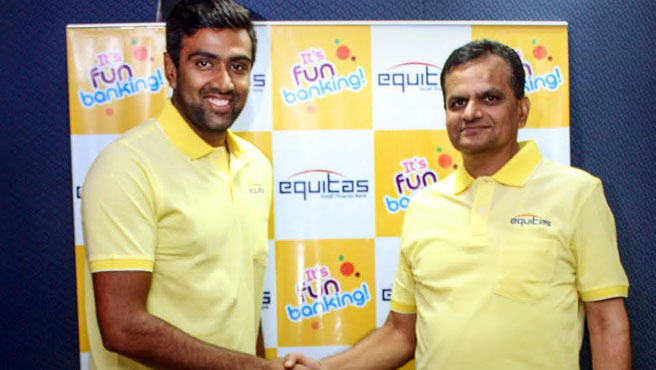 Equitas Small Finance Bank, the first private sector bank from Tamil Nadu post-Independence, announced bowler Ravichandran Ashwin as its brand ambassador. Commenting on the association, MD & CEO P N Vasudevan said: “Equitas is a new age bank which seeks to provide high tech banking, where the customer enjoys the banking experience and Ashwin is a high performer who gives joy to spectators. We believe each complement the other and look forward to a long association.â€