Category: ADVERTISING

  • UrbanClap partners Publicis to launch inaugural brand campaign

    By A Correspondent


    UrbanClap has partnered with Publicis to launch their first ever brand campaign on television this year. UrbanClap has previously run a variety of outdoor and social media campaigns while working in tandem with different agencies.


    Founded in October 2014 by Abhiraj Bhal, Varun Khaitan, and Raghav Chandra, UrbanClap is India’s leading services marketplace. Currently, UrbanClap has operations in 7 cities, with over 36,000 professionals on the platform, and receives over 5000 customer requests each day for services across 60+ categories.


    Abhiraj Bhal, co-founder at UrbanClap, said, “We are confident that Publicis, with their innovative approach and creative solutions will enable us to drive impactful media presence and assist us in building a strong consumer brand. We look forward to working with them.”


    Paritosh Srivastava (COO, Publicis Ambience) & Jigar Fernandes (Executive Creative Director, Publicis Ambience) said, “UrbanClap has very strong fundamentals. It is helping bridge a real need gap for an emerging world with first world aspirations. It has taken the tougher path to build the business in a segment that has remained unorganized till now, and our job is to let the world know honestly and interestingly about their approach. We’re confident that with the trust and collaboration from the entire team at UrbanClap, we will succeed in achieving this task.”


  • Publicis bags UrbanClap creative mandate

    By A Correspondent

    Publicis has bagged the creative mandate for UrbanClap. The account will be handled by the agency’s Mumbai office. Founded in October 2014 by Abhiraj Bhal, Varun Khaitan, and Raghav Chandra, UrbanClap is a services marketplace with operations in seven cities.

    Said Paritosh Srivastava, COO, Publicis Ambience and Jigar Fernandes (Executive Creative Director, Publicis Ambience) said, “UrbanClap has very strong fundamentals. It is helping bridge a real need gap for an emerging world with first world aspirations. We’re confident that with the trust and collaboration from the entire team at UrbanClap , we will succeed in achieving this task.”

    Abhiraj Bhal, co-founder at UrbanClap added: “We are confident that Publicis with their innovative approach and creative solutions will enable us to drive impactful media presence and assist us in building a strong consumer brand. We look forward to work with them.”

  • McCann elevates Jitender Dabas, others to key roles

    By A Correspondent


    McCann India has made few key announcements. Jitender Dabas who joined McCann Delhi in January 2011, has been elevated to Chief Strategy Officer – McCann Worldgroup India. Also, Suraja Kishore, who joined McCann Mumbai in Nov 2013 has been elevated to National Head Planning—Truth Central. Meanwhile, Punit Kapoor, who Joined MRM McCann in May 2006 and was heading its Delhi operations has been elevated as Vice President & General Manager for all India operations of MRM McCann.


    Prasoon Joshi

    Commenting on these promotions, Prasoon Joshi – Chairman McCann Asia Pacific & CEO McCann Worldgroup India said,“I am happy to announce these promotions. Over these years,Jitender brings forth an intricate understanding of brands coupled with Leadership in building a stellar strategic planning team. I am confident he will bring tremendous value to the organization at McCann Worldgroup level. Suraja who has been instrumental at great brand work will now also head the “Truth Central” which is McCann Worldgroup’s Global Thought leadership unit engagedin creating original research, unearthing unique truths to help shape and grow clients’ businesses. Punit, who has helped grow MRM’s Delhi business year on year beyond industry average is ready to take on the challenge for MRM at national level.”


  • The New Trust Imperative


    In Mumbai to conduct a session on the new realities of consumer insights, Terry Peigh, Senior VP and Managing Director, IPG made a presentation on the trust factor. In this report and presentation on which IPG and more specifically Cogito Consulting in India collaborated, Peigh writes about how consumers are changing in their consumption of information. Read on…


    By Terry Peigh
     

    For the past six years, we at IPG have fielded an important piece of global research that looks at the changing nature of consumer decision making. We call this New Realities, as clearly the emergence of many new media channels and new sources of product information have created a new reality in how today’s consumer goes about evaluating a product and making an eventual decision.


    Over this time, we’ve seen a dramatic shift in how consumers view the “consumption” of product information…and the channels they most value in making product decisions.  They’ve evidenced changes in their degree of comfort with new information; their desire for information as a way to gain “social value”; the joy they receive in learning about brands; how information has made them more confident in brand choices; and how they segment in terms of valuing product information.


    But underneath this dramatic growth in valuing product information has emerged a very powerful requirement for that information.  …the demand for total trust.  In this paper, we’ll review how today’s consumer is changing in their consumption of information and lay that up against their pressing need for information that is highly trusted. As part of that, we’ll review the research we’ve recently conducted that attempts to dissect what goes into a trust evaluation by a consumer—exactly what’s considered when a consumer goes about making a decision to trust or not trust.


    In total, we see this information as critically valuable in learning about the ever-changing habits and preferences of today’s consumer, and in designing marketing and marketing communications programs that respond to this new reality.


    The New Realities research.

    In 2009, IPG saw a need to help our clients get a better understanding of exactly how consumers around the world were dealing with the many new channels providing product information.  No longer was it a matter of a consumer learning about a product from just a print ad or a TV commercial.  In a very short period of time, she was also confronted with product information served to her via websites, blogs, numerous social sites, price comparison sites, product comparison sites, mobile platforms…and, oh yes, still (and increasingly!)from her friends down the street. We wanted to know, and to share with our clients, how she was coping with all this new information.  Was the additional product information frustrating? How did it affect her confidence in the product? Did she enjoy this learning? Was she inclined to share what she learned? To what extent did the consumers differ in how they “consumed” this information?


    With these questions in hand, we began the research that year in two countries—US and China.  Since then, we’ve expanded it to several other key countries: Brazil, India, Russia and England.  We now have multiple years of data from these countries and are able to make observations and comparisons among countries, and within a country over time.


    We conducted every wave of the study among 600 people per country, with an equal mix of Gen X, Gen Y and Baby Boomers, equally split men/women.  Working with our research partner, we sampled people from a geographic cross section of the country’s population. (The questionnaire was submitted online, so we need to appreciate that the results obviously reflect the attitudes of a computer-literate audience. But with this audience representing a prime target for many of our clients, we were comfortable with that screen.)


    Attitudes toward information.

    When we present these research results to clients and industry groups, we often begin by asking the audience to provide their opinion on what country ranks highest on a few different measures.  Let’s try it here.


    Among all the countries researched (US, China, Russia, India, Brazil and England), for each statement below which country do you think ranks highest in saying:

    • “information gives me control in my buying decisions”?
    • “I have personal pride in knowing a lot about certain brands”?
    • “I enjoy researching information for buying decisions”?
    • “Brand information and brand reputation matter more these days than ever before”?


    The answers might surprise you (as they often surprise our audience of brand marketers). If you got at least half correct, consider yourself one of the very few!


    It turns out that the Russians are most likely to say that information gives me control in my buying decisions.  The Chinese rank highest in saying they have personal pride from brand knowledge, and in saying brand information and reputation matter more these days.  And the Brazilians are most likely to agree that they enjoy researching information for buying decisions.


    The point being that it has become very difficult (and dangerous)  to use old standards of country groups and cultures when determining what a particular group of people does and does not want when it comes to consuming product information today.


    What we’ve learned.

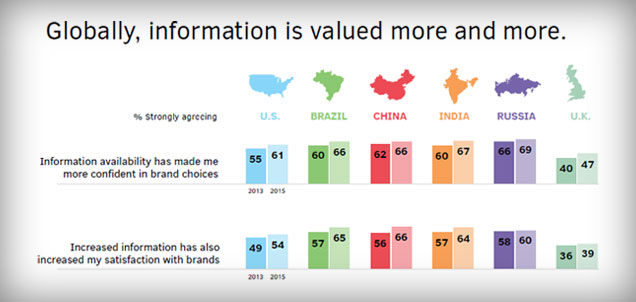
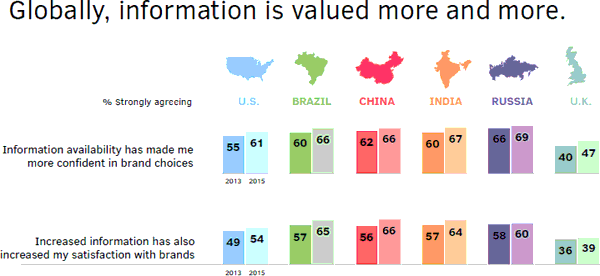
    Clearly, product information is valued more and more by consumers around the world.  As noted in Figure 1, in all countries surveyed their populations strongly agree that information availability has made them more confident in their brand choices, and has increased their satisfaction with brands. And we see all data points increasing over the last two waves of this research (2013 and 2015)


    Figure 1
     

    Importantly, this product learning is a real source of joy and fulfillment around the world. Please see Figure 2.  A very significant segment of the population finds the researching and learning about products to actually be fun, rewarding and enjoyable.  And was seen in Figure 1, this joy and fulfillment has increased in most countries over the last 2 years. (When we look at earlier waves of the research, there is clearly an even longer term increase in these measures).


    Figure 2
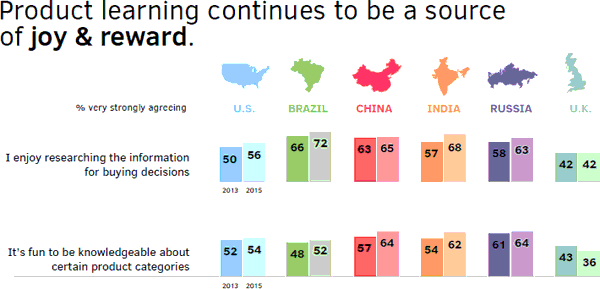
     

    We have found that much of this enjoyment and fulfillment from product learning is sourced in consumers’ finding social value from that information.  Their knowledge about a category or product gives them “social currency”—information to share with others when discussing various products. In so doing it enhances their sense of self, and self-esteem. Please see figure 3.  (A good example of the longer term growth in this attitude is China, where we’ve seen consumers’ strong agreement on the measure of “people admire me because of my expertise” increase from 25% in 2009, to 57% in 2015!!!)


    All of this data reinforces the need for marketers to aggressively supply consumers with this desired product information, and to do so in such a way as to make it easy for consumers to obtain it, internalize it, enjoy it, and pass it on.  Truly, consumers are one of the most important (and cost effective!!) channels of information a marketer could ever ask for.  They present their brand knowledge to friends and families with enthusiasm, and we know that their words—due to their trusted nature– are usually the most respected and valued by consumers vs. alternative “media” channels. The key question, addressed later in this paper, is how to instill trust in the information provided to the consumers, so she accepts it wholeheartedly, embraces it, and gladly passes it on.


    Figure 3
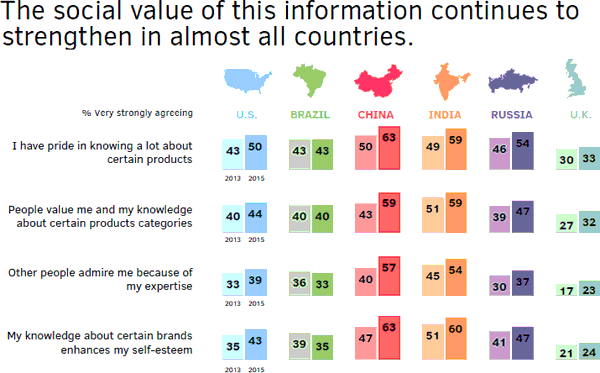
     

    Luckily for marketers, consumers today often manifest this desire for social currency by becoming active advocates for brands.  As noted in Figure 4, many of the respondents studied in our research have shown growth over the last two years in their desire to actively advocate for brands.  And in countries like China and India, the overall levels of advocacy interest are very high.


    Figure 4
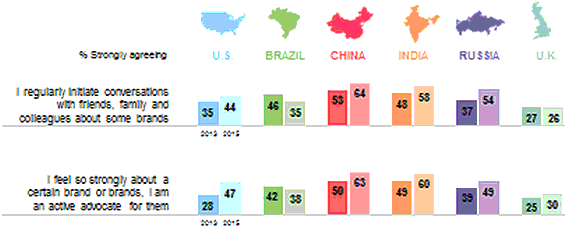
     

    So we’re seeing continued and dramatic growth in consumers wanting more and more information to help with their purchase decisions.  They’re finding the information to be a source of happiness and fulfillment.  For many, it actually provides them with a social currency that positively affects their sense of self and helps pave the way for interaction with friends.  And a great many are more than happy to take that new found brand understanding and actually go so far as to advocate for the brand—to , in essence, become new (inexpensive!!) media channels for the brand!


    But while all of this is pleasing for marketers to hear, today’s consumers worldwide are also putting up a hurdle that the brand information must meet in order for them to gladly accept and act on this product information.  And that hurdle is their growing demand for trust.


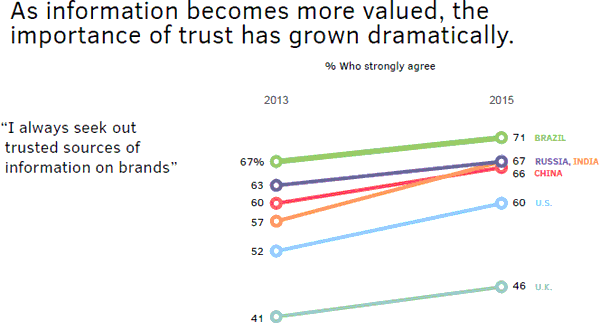
    One of the questions we asked consumers in our New Realities study is to what extent do they always seek out trusted sources of information on brands.  Not only are the absolute levels of “strongly agree” very high for the countries, but these levels have increased since the 2013 study. Figure 5. As noted below, in Brazil, China, India, and Russia, over two thirds of the respondents now strongly agreed that they always seek out trusted sources!


    Figure 5
     

    The New Demands for Trust

    A scan of news stories today across the world points to many many instances where people have lost trust.  We see them losing trust in government, religion, business, and in brands.  A few facts to underscore this development:

    • According to the Edelman Trust Barometer,when consumers around the world were asked about their level ofsatisfaction with the way their government is running their country, the highest scoring country reported only 31% satisfaction.
    • The same study from Edelman notes that two-thirds of the world’s countries have populations that fall into the “distruster” category…and that this level is rising every year.
    • A Cohn & Wolfe study in 2014 indicated that only 3% of Americans, British, Italians, Swedes, French and Spaniards say that “big businesses are very honest and transparent”.  And in Germany, the number is only 1%!!


    And the marketing world is not helping itself when it comes to engendering trust.


    • A MediaBrix/Forbes report indicates that 86% of US internet users feel they have been misled by videos that appeared to be content, but turned out to be sponsored ads
    • In the UK, only 20% of consumers report a high level of confidence in information on social media (Source: YouGov.UK; 2014)
    • And 57% of marketers say that bad behavior by brands on social media is eroding trust in their content (Source: KeepSocialHonest.com/YouGov Survey)


    Marketers have heard for years…and, of course, it’s really is common sense… that having product information trusted by consumers is very important.  We’ve all seen report after report showing the connection between trust and higher purchase intent,stronger repeat purchases, higher share of wallet, a willingness to pay a price premium,and even stronger growth in a brand’s stock price.


    But what we’re seeing now is a dramatic increase in size of the trust hurdle consumers are putting up. If there’s any doubt about the veracity of the information, today’s consumer will turn elsewhere.


    At a global level, Figure 6 shows consumers are becoming more discriminating, and “holding brands to higher standards than ever before.” With the exception of Russia, again we’ve seen solid year-over-year growth in this measure since 2013.


    Figure 6
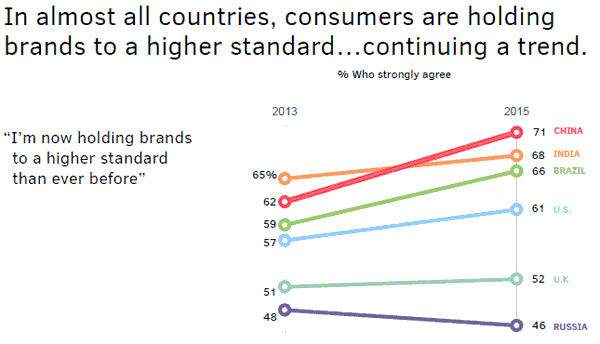
     

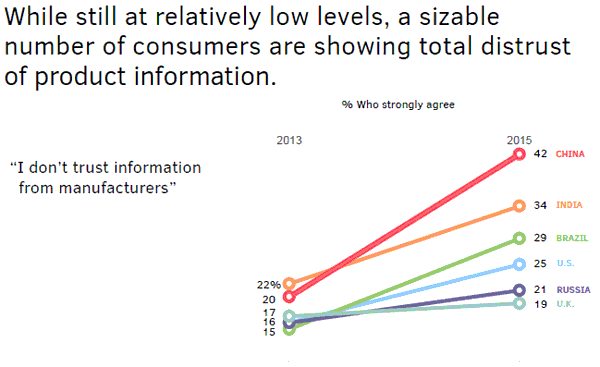
    Figure 7 demonstrates that the demand for a “higher standard” translates to a greater seeking of trusted information on brands.  And we’ve also seen an increase in consumers rejecting manufacturer-led information, with distrust being highest in China, figure 8.


    Figure 7
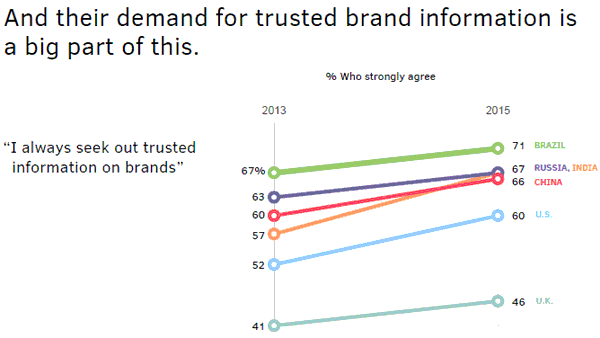
     

    Figure 8
     

    In order to obtain a deeper understanding of this dynamic, we set out to understand which attributes drive brand trust in the minds of today’s consumers. We factor analyzed 30 attributes (e.g. reliability, transparency, responsiveness, innovation, etc.) globally and identified 6 different factors that contribute to trust with varying levels of influence.


    The top two drivers of trust were most closely connected to a manufacturer’s products: product performance and claim truthfulness. Product performance was seen as a function of quality (I’m always confident in the quality of this brand), reliability (This brand always delivers what I expect) and the ability to meet expectations on a consistent basis (I’m never disappointed with this brand). Claim truthfulness was considered a function of a brand’s character (This brand has a character that I respect; can always believe) coupled with a history of producing reliable claims in the past (I can always count on this brand to tell the truth about itself).


    The second, but significantly lower,set of drivers were“innovation” and “customer-centricity”, where innovative is considered a function of product updates (This brand is always up-to-date) and the frequency by which a manufacturer brings such products to market (This brand is a leader/continually innovates). Customer-centricity, seen as slightly less important than innovation and significantly less important than the product-related drivers, stemmed from a brand being seen as putting their consumer’s needs front and center (This brand has great respect for customers/is always looking out for its customers). While seen as viable factors, surprisingly “support for social causes” and “transparency around criticisms” weren’t considered critical drivers of brand trust.


    A few things for brands to consider.

    Product efficacy rules the day. Building things that work (and that consumers have a need for) is a sure-fire way to gain their trust. These days, with the continued increases in available information, consumers are becoming increasingly skeptical. It’s essential to pair good products with claims that accurately represent their effects without setting unfair or unrealistic expectations. Overpromises might get you the first sale, but they’re awfully hard to sustain over the long-term.


    Social responsibility efforts are good (and in some categories and emerging markets, essential) but they can’t make up for product short-comings. Instead of funding expensive yet disconnected CSR efforts, brands might do better looking for ways to harness their product’s power in a participatory, socially responsible fashion. A recent example of this can be seen in Kimberly-Clark’s efforts to remove the cardboard center tubes of its Scott Naturals brand toilet paper, or Crayola launching its Meld N Mold kit allowing kids to recycle old crayons and transform them into new packs of custom-colored crayons.


    While innovation is on the tongues of every TED-talking CEO, consumers are quickly becoming trained to expect fast turnarounds of the latest products. Once seen as the provenance of the Silicon Valley few is now the headline of the many, and while essential to driving revenue, “innovation” seems to come up a little short when driving the trust scores of today’s consumer.


    Time will tell how consumers react to the ever-increasing wealth of information available to them at their fingertips. But one thing’s for certain. A brand will always want consumers to answer affirmatively to the all-important question, “can I trust you?”


    Terry Peigh is Senior Vice President and Managing Director, Interpublic Group

     

  • Mullen Lintas wins creative mandate for Bajaj Avenger

    By A Correspondent


    India’s leading two-wheeler brand Bajaj Auto has appointed Mullen Lintas as the creative agency for its popular Bajaj Avenger range of bikes. Mullen Lintas has been given the mandate for integrated campaigns for Bajaj Avenger and would collaborate with group company LinTeractive, to create a seamless brand experience across the entire eco system including television, print, OOH, web and mobile (including social media).


    Sharing his views on the appointment, Sumeet Narang, Head of Marketing, Bajaj Automobiles said, “We welcome Mullen Lintas as our brand partners for Bajaj Avenger. We were really impressed with their holistic thinking on Avenger that went beyond the conventional approach. We look forward to an infusion of their thinking for developing the next phase of brand Avenger and strengthening our position as the pioneers of the leisure biking category.”


    Sumeet Narang


    On being chosen to lead the creative duties for Avenger, Amer Jaleel, Chairman & CCO of Mullen Lintas, said, “It’s a lovely feeling for us to work with a great brand like Bajaj. Avenger is one bike that clearly stands apart in the sea of sameness. It is an important and premium brand for Bajaj and we are delighted to have been entrusted with the task of growing it to even higher levels. It’s a big high for us at Mullen Lintas.”


    Bajaj Auto recently launched its new Avenger range – The Avenger Cruise 220, Street 220 and Street 150. The new Avenger series redefines the cruiser bike segment to offer un

    Amer Jaleel

    matched international styling and cruising comfort. The Cruise 220 retains the classic cruiser comfort and looks while the all new Avenger Street range is designed for easy city riding and is based on the international Sportster format. Bajaj is fully focussed on continuously improving its core competencies in all functions and working together with its consumers to make the ride worthwhile.


    On the brief received from the client for Avenger, Virat Tandon, CEO – Mullen Lintas said, “Bajaj’s brief to us was to show them how we would relaunch the new Avenger bikes and grow the franchise significantly in numbers. We believe we’ve managed to display to the client how we will not just launch the new bikes, but also create a following for this new tribe of Avenger riders.”


    Virat Tandon


    In fact, Bajaj is already happy with the initial response that they have received around the newly-launched bikes. This is over and above the fact that several brands under the Bajaj Auto portfolio have been throwing up encouraging numbers too. Adding his views on this achievement, Narang said, “The genuine cruiser segment has steadily grown over the years with the Avenger as the torch bearer. With the addition of the all new Street 220 & 150, we have been able to significantly expand the cruiser segment in the country. With the new Avenger models joining the immensely successful Pulsar range, Bajaj Auto has strengthened its offerings to discerning customers in the Indian market, and reinforce Bajaj Auto’s leadership in the premium motorcycle segment.”


  • Vanakkam! Indian languages need to rule. Theek hai?


    By A Correspondent


    Advocating the need for more content in Indian languages to propel internet penetration, a report titled ‘Proliferation of Indian Languages on Internet’ finds that enabling local language content on the Internet will lead to a growth of 39 per cent in the current Internet user base. 75 per cent growth will be from the rural users while only 16 per cent growth will come from urban India.


    The report, published by the Internet and Mobile Association of India (IAMAI), finds that English language still accounts for 56 per cent of the content on the worldwide web, while Indian languages account for less than 0.1 per cent. However, while Internet in India is predominantly English, there is high potential for regional language content. According to the report, in the last year alone, Hindi content on the web has grown by about 94 per cent, whereas English content has grown only at 19 per cent.


    The report further asserts that there is significant scope for various stakeholders to benefit financially while addressing the needs of the local language content consumers. If the Indian language book publishing industry moves online, it can create a digital opportunity worth nearly US$ 7 billion for both the content providers and technology players.


    According to the report, accessing the internet in local language broadly has two challenges.

    1. The first challenge is to generate content in local languages and popularising such content for broader adoption2. The second challenge is on the technical front, pertaining to availability of Indian scripts for generating digital content


    Currently, local content availability is restricted largely to news agencies as other forms/sources of content generation are extremely limited. User generated local content is still very low, as adoption of local language usage in social media and other such fields are still restricted.


    The report cites some of the following initiatives that can help increase public awareness and engagement in local language content.


    1. Development of websites in local languages and providing a user-friendly interface for local language user can be an integral part of e-governance initiatives by the State Governments.

    2. Media companies should adopt digital media as a separate entity from print media and actively expand their e-presence. Currently, the former is seen as merely an extension of the latter.

    3. Increased spending on online advertisements in local languages would help the companies generate higher revenues through online content in local language.

    4. Digitalization and online release of the various local language archives and books in various libraries and universities across the country can be undertaken to increase local content availability

    5. Social media companies need to support local languages and promote their availability. The interface has to be user friendly to provide easy interaction for the users.


  • Marketing & advertising ecosystem Digi Osmosis launched

    By A Correspondent


    After a successful stint with Hungama and Red Chillies, marketing veteran Manish Kumar has launched Digi Osmosis, a marketing and advertising ecosystem that helps brands be future-ready in digital. Through digital innovations, content, engaging fans and followers and helping connect influencers via their preferred platform and technologies in the space of sports and entertainment, Digi Osmosis aims to provide a complete digital solutions package, not only driving content but become creators.


    Manish has over eight years of experience in being an instrumental front runner in driving innovations and creating never-before-seen business opportunities for the Indian entertainment and sports industry in the digital space.


    Digi Osmosis’ goal is to become the best digital consultants, providing high quality end-to-end solutions for the online ecosystem. Exuding knowledge in technology, marketing and digital industry and also acting as the nucleus connecting the arms of sports, entertainment and technology brands, the agency uses simple strategies and easy communication options to create digital assets for their clients through multiple ways. It integrates with systems and digital assets like media buying, viral marketing, social media marketing and using analytics efficiently to predict trends and create content in an organic manner.


    Digi Osmosis empowers influencers to become a direct source of media, connecting personalities to their followers through creativity, innovation and content. They enable strategy by leveraging existing properties like co-branded content, 4G, DTH, gaming, technology partnerships and many more. They believe the future is an integrated digital economy, one that is ever expanding and all-encompassing. The lines are increasingly becoming blurred and soon, there will be no difference between offline and online.


    Manish Kumar

    Talking about the development of Digi Osmosis, Founder, Manish Kumar, said, “It’s simple…we understand digital and technology. We are constantly exploring new ways to exploit the digital landscape and simplify it for both the clients and the consumers. Through this company, we aim to create content that engages the fans and appeals to them and marry innovation through technology by partnering with the best tech gurus in the business. We are young, passionate and think new! We don’t just dream, but we back it up with numbers. Our backbone is analytics, and we tailor solutions according to the figures. Digital is in our blood. And we bleed ones and zeroes.”


  • Cut The Crap unveils Design Sell

    By A Correspondent


    Cut The Crap, a Mumbai based full-service creative agency announced the launch of its design unit- Design Sell.Design Sell will work as a part of CTC; however will function independently with its own separate team. The new entity will focus on Brand Identity, Packaging, Digital and 3D Designs, BTL and more.


    Design Sell will be headed by Renuka Desilva, Creative Director (Art).


    Jagdish Acharya

    Commenting on the launch of Design Sell, Jagdish Acharya- Founder & Creative Head, Cut The Crap said, “I am excited to announce the launch of Design Sell! CTC has made its mark as a creative boutique for brand building. Design Sell derives its DNA from CTC. Design is never without a marketing purpose, the objective of Design in the world of brands is to sell and to therefore it is imperative that design be strategic and a part of the brand building ecosystem. Therefore the name Design Sell. The need was felt to launch the division on its own so it can be nurtured and grown to its true potential.”


    Renuka DeSilva

    Renuka DeSilva, Creative Director & Head, Design Sell says, “I am looking forward to building Design Sell on the terra firma of strategy and creative foundations of design. It is the understanding of brand and marketing needs that will differentiate us from other design houses. Our aim over the next 2-3 years will be to build a strong portfolio that showcases our point of difference. Business will only follow.”


    Renuka comes with over 15 years of experience. She has worked with agencies such as O&M, Interface, Mudra and Law & Kenneth.  Her last stint before joining CTC was with Lowe where she worked on J&J and Knorr. Other brands that Renuka has worked on include Kotex, Mattel, Huggies, Asian Paints, Fanta, Godrej and Skoda. For a brief while, she dabbled in Health & Lifestyle brands and her work won Rx Club and Global awards. Renuka has also won awards at The New York Festivals.


  • Fourth edition of the IAA Leadership Awards announced

    By A Correspondent


    After three successful editions, the International Advertising Association announced the 4th edition of the IAA Leadership Awards. The awards recognize individuals and teams across the fields of marketing, advertising and media and celebrate their achievements. The event will be held on Saturday, 12th March 2016 at Grand Hyatt, Mumbai.


    For the fourth year in a row, the IAA India chapter will recognize the achievements of diverse groups in the A&M community for their incredible performance as they raised the bar of innovation and creativity in delivering high impact marketing initiatives. 24 categories have been identified after deliberation over an extensive number of quantitative and qualitative parameters.


    This year, the performance of the shortlisted individuals will be scrutinized by a technically-sound jury comprising of industry leaders.


    Sam Balsara

    Speaking on the fourth edition of the IAA Leadership Awards, Sam Balsara, Chairman – IAA Leadership Awards Committee said, “2015, as a year, has seen some truly remarkable and noteworthy marketing initiatives that have furthered the brand value and propositions for many businesses. The IAA Leadership Awards honours these programs, designed by some of the best marketing minds in the industry, which have helped in furthering of the organization’s goals through a focused and targeted outreach. With competition on a rise across sectors, we are looking forward to celebrating the achievements of those talented individuals who have shined through.”


    Srinivasan K Swamy

    Srinivasan K Swamy, President of IAA India Chapter said, “Over the past three years, the IAA Leadership Awards have become a coveted one to win within the community, which makes us strive harder to ensure the winners are picked through a robust process. As we prepare for the fourth edition to take off, we are looking forward to celebrate the hard work of the marketers and professionals who have furthered the meaning of excellence within their respective industries / sectors.”


  • Adidas moves from one Omnicom agency to another

    By A Correspondent


    Sports and leisure wear brand Adidas has moved its creative mandate in India from TBWA\India to DDB Mudra. The account moved in December, but there is no official intimation from either DDB Mudra or Adidas India.


    According to sources, the account will be handled out of the agency’s Delhi office. It is learnt that DDB Mudra is expected to come up with a high profile multiple media campaign next month.


  • Nupur Mahajan takes charge as CEO, Percept One

    By A Correspondent


    Sanjay Shukla

    Sanjay Shukla, COO, Percept One has resigned from his post at the company. He will be stepping down with immediate effect. Sanjay Shukla joined the Percept Group as National Head, PDM in 2007, and was promoted to COO, Percept Activ in 2011. He was elevated to CEO, Percept Sport & Entertainment in 2014 to manage the vast portfolio encompassing Activations, Sport, Entertainment, Talent and Weddings.


    Meanwhile, Nupur Mahajan has taken charge as Chief Executive Officer (CEO), Percept One, and will be responsible for leading the Vision, Strategic direction, Business Development and Integration of all the Marcom Services at Percept One. She will be overseeing a team of over 500 people across 27 offices in 10 markets to ensure seamless collaboration of the Group to ensure stronger client relationships and offer customized creative solutions to clients. She joined Percept in December 2015 and has been working with the Management to draw out future plans for the Marcom business and is well inducted.


    Nupur Mahajan

    Nupur has handled varied challenging portfolios spanning Journalism, Business Development, Brand Solutions, Radio, Business Acquisition, and has worked closely across both national and international markets. Prior to joining Percept, Nupur was a consultant with some of the leading business houses in the country, viz. the Star Network, DB Realty and a columnist with the tabloid newspaper, Mid-day. She kick-started her career with the Times of India and rose to become the youngest Editor of the Times group at the age of 24. She moved to television to launch Star News. Later, on the behest of Anand Mahindra, she took on the mantle of Brand Development Director and devised the growth and strategy plan for the popular ‘Verve’ and ‘Man’s World’ magazines.


    Post that, advertising beckoned and she joined McCann New York (HQ), as Brand and Communications Head alongside Prasoon Joshi, where she was the custodian for brand MWG in India. Her last stint was at the Times Group where she was National Creative Director. Here she led the creative and strategic responsibilities of the Group with a specific focus on reenergising Times Group IPs together with creating new domain-defining IPs across Group companies.


    Ajay Upadhyay, Chief Operating Officer, Percept Limited said, “We strongly believe that Nupur will be able to provide the leadership that Percept One needs to become a strong unified Marcom service.  Her global leadership experience and brand experience across manifold portfolios will help us leverage the scale and achieve the growth targets we have set for ourselves. Collaboration and integration is the value we bring to the table and Nupur is the ideal person to lead us on that path.” He further added, “Sanjay has been an integral part of the successful growth story of Percept, and we wish him the very best as he steps into new frontiers.”


  • McCann looks to lead from the front at Goafest

    By A Correspondent


    McCann WorldGroup India has shared their plans for upcoming Goa Advertising festival.


    Confirming their presence at the Festival Prasoon Joshi Chairman Asia Pacific & CEO McCann India said, “We will send symbolic token entries to honor the festival in all the categories but our delegates will participate and attend the fest in large numbers.


    We believe that genuine efforts have been made by the organizers this year to overcome the shortcomings and we also want to partner them in this journey.  Positively in the future we will see the festival touching newer heights.”


    McCann has been No.1 most awarded agency in India for last three years (International Gunn report), McCann also garnered India its first D&AD Gold pencil this year. Another feather in McCann’ cap came when Happydent was declared as one of the Top 20 ads done in world in the last century (Gunn report).


    Prasoon further added, “We take immense pride in our creative product, decision of participation in award shows is collectively taken by our global/local creative councils. We wish GoaFest the very best.”​