Category: ADVERTISING

  • Dentsu Aegis Network launches DAN Women’s Council

    By A Correspondent


    In an attempt to encourage women to continue and reach top positions inside corporate India and also to create an environment where theycan grow and flourish, Dentsu Aegis Network (DAN)has established the DAN Women’s Council.


    Rajni Menon

    Chaired by Rajni Menon, Executive Vice President, Carat India, the advisory committee will have Nipun Kapur, COO, WATConsult, Divya Karani, CEO, Dentsu Media, Sunita Prakash,Senior Vice President, Dentsu Marcom, Neha Mayekar, Vice President, Finance, Dentsu Aegis Network, Dimple Maheshwari, Director – HR, Dentsu Media, Harsha Joshi, Executive Vice President – Group Trading, Dentsu Aegis Network, Komal Verma, Associate Vice President-Human Resources & Administration at Fountainhead-MKTG and Simi Sabhaney, CEO, Dentsu Communications as its key members.


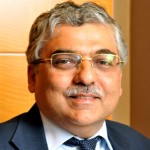
    Ashish Bhasin

    “Our women leaders and managers will continue to play a very crucial role in taking us forward as we move ahead to become the No. 2 marketing communications agency group in India by the end of 2017. Today, we are already the leading network when it comes to creating a balanced and uniform work-environment for our women workforce in India. Now, our ambition is to surpass global standards and makeDAN the gold standard for encouraging the women talent force. I believe our women managers are second to none,” said Ashish Bhasin, Chairman & CEO South Asia – Dentsu Aegis Network and Chairman Posterscope & MKTG – Asia Pacific.


    “Though at an overall level the DAN numbers are significantly healthier than the industry average, we felt it was time to take a proactive step as leaders of the marketing communications industry to ensure that in a growing network, the environment and policies are conducive to grow the women numbers at all levels,” Menon added.


    The DAN Women’s Council will primarily focus on helping women reach their highest potential based on merit, facilitate a path formore women occupying leadership positions in the organization, provide an avenue for a structured mentoring process and create an environment which is safe and equal.


  • Dentsu Webchutney wins digital mandate of Red Bull

    By A Correspondent


    DentsuWebchutney has been awarded the digital mandate for Red Bull. The agency’s Mumbai office will be leading the account services. The agency won the account following a multi-agency pitch.


    Sidharth Rao

    Commenting on the win, Sidharth Rao, Chief Executive Officer and Co-founder, DentsuWebchutney, says, “We are delighted to partner with Red Bull. The brand as well as the category are pretty dynamic – something that will certainly help us push the envelope and come up withsome refreshing work!”


    DentsuWebchutney is the digital agency from the Dentsu Aegis Network with offices in New Delhi, Mumbai and Bengaluru. Its clientele includes Flipkart, Airtel, Unilever, MasterCard, and Coca Cola.


  • Percept bags integrated campaign for Kalinga Lancers

    By A Correspondent


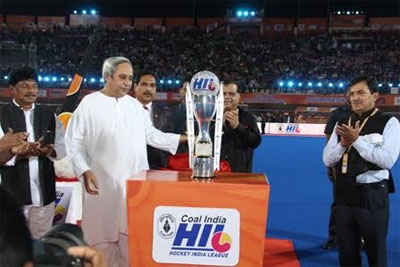
    Percept Sports and Entertainment has bagged the prestigious mandate of managing and executing the integrated marketing and promotion campaign for HIL’s Kalinga Lancers. Percept Sports & Entertainment is responsible for handling the 360-degree scope of work encompassing conceptualizing, planning and executing the entire campaign for Kalinga Lancers.


    To continue the momentum of last year’s popularity of Kalinga Lancers, and to make the event bigger and better in HIL 2016, PSE made the most of a diverse range of media platforms including electronic media, BTL, social media, out of home, and the overall branding of Kalinga Lancers.


    Kalinga Lancers is a field hockey team based in Bhubaneswar, Odisha. This is the 3rd season of Kalinga Lancers with Hockey India League. It is jointly owned by Odisha Industrial Infrastructure Development Corporation (IDCO) andMahanadi Coalfields Limited (MCL). Former Australian player Mark Hager is the head coach of the team while former Indian captain Dr. DilipTirkey is the chief mentor and advisor of the team.


    The assignment includes managing the games at Kalinga Stadium end to end inclusive of production, security, ticketing, team management, and accreditation, also promoting and marketing the matches across mediums spanning social media, print, TV, radio & OOH.


    Percept Sports & Entertainment presented a sporting radio jingle and TV Commercial for Kalinga Lancers along with a playing contest, sharing posts, and re-tweeting on Facebook and Twitter. It further executed the on-ground activation in malls by inviting team players to the mall. Players also attracted the throng in schools by having one-on-one interactions with the kids. To create awareness, PSE cantered hoardings, banners, poles and splashed bus branding around the city.


    The integrated marketing and promotion offered by PSE also comprised the service of welcoming players, player’s photo-shoot, conceptualizing and executing the newspaper ads, the launch ceremony of the jersey & mascot, ticket selling at box office and via book my show, promoting the brand via in-stadia branding and also executed the parking plan and security plan during home matches.


    Commenting on the success of the event, Jaydith Debta, Manager – Operations & Marketing, Kalinga Lancers said, “The HIL event in Bhubaneswar demanded meticulous planning and attention to detail. The entire team of Percept Sports and Entertainment has boundless energy and enthusiasm. I really appreciate all the hard work & turmoil that went in to this to pull off an event of such magnitude and stature. PSE’s unending capacity to manage crises has reassured us all and I would personally recommend the services of PSE for such events.”


    Commenting on the win, Jayaram Nair, National Business Head, Percept Sports and Entertainment reiterated Percept’s dedication and commitment to the sports domain and stressed on how this project added another feather to the long run and successful history of PSE executing some of the country’s most prestigious and large format sporting events.


    “It’s an immense opportunity to be associated and to manage the account of the prominent team Kalinga Lancers. The mandate was won after a multi agency pitch and was a result of Percept’s thorough understanding of the 360-degree scope of integrated marketing and promotions, understanding and execution detailing that went into the pitch.”


  • ICICI Pru pushes long-term investment gains in new MF ad

    By A Correspondent


    In order to help investors understand the benefits of remaining invested for longer periods, ICICI Prudential Asset Management Company Limited has launched its latest Investor Education campaign #StayInvested. The campaign takes a fresh look at long term investing by aptly bringing out the analogy of long term relationships.


    The campaign has been conceptualized by Lin Engage, the experiential marketing & activations division of the MullenLoweLintas Group. The campaign begins with a couple shown celebrating their tenth wedding anniversary. Upon being asked by his younger brother on how it feels to be together for ten years, the male protagonist replies by saying that ‘when everything is good it’s magic, when it’s not good then use logic.’ He further goes on to elaborate how one needs to be patient in a relationship and keep hanging on till one reaps the benefits of being together for a long time. That’s when his better half intercepts and asks him if he is talking about their marriage or about a mutual fund that they have invested in. He realises he’s been caught and sheepishly says: both! The VO further explains why staying invested for a long time is the right thing to do.


    Speaking on the launch of this initiative and the thought process behind it, Abhijit P Shah, Head- Marketing, Digital and Customer Experience, ICICI Prudential Asset Management Company said “Patience in equity markets is rewarding, and the longer one invests and waits, the better are the rewards. In fact, it does not matter at what level the market is if you are a long haul investor and keep investing steadily. We believe this campaign will help drive home the need to stay invested for longer periods of time in the minds of retail investors.”


    Also, through the digital leg of the campaign, investors can make use of a ‘Long Term Investment Calculator’. This tool helps investors calculate how your investment would have grown if you had stayed invested over a long term. One has to simply enter the investment horizon and amount of investment and the calculator will display the total value of your investment and the number of times it has grown.


    Vasudha Narayan

    Elaborating on the creative approach taken behind the campaign, Vasudha Narayan, Executive Creative Director said, “The brief was unique which is to stay invested for a long term in mutual funds. The creative idea we hit upon was fairly simple: be it mutual funds or marriage, don’t quit or walk away at the first sign of trouble. The longer you stay, the more the rewards.”


    Under the aegis of this campaign, a high impact TV campaign is being aired across leading national channels and will be coupled with an extensive digital campaign across various social media platforms, to drive reach & visibility.


  • Red Fuse promotes Shubha George as MD – Asia

    By A Correspondent


    Shubha George

    Red Fuse Communications recently announced the promotion of Shubha George to the role of Managing Director – Asia & CEO – India with immediate effect. In her new role, Shubha will lead the development of integrated marketing communications for Colgate-Palmolive across Asia. She will continue to be based out of Mumbai as also continuing to report in to New York based, Stephen Forcione – Global CEO, Red Fuse Communications.


    Shubha’s new remit will be in addition to her current role of CEO India, Red Fuse Communications; a role she assumed in 2013. Under her leadership the Red Fuse Mumbai team is skillfully managed, integrating all the WPP resources and diverse talent, ensuring brand Colgate in India continues to have a record market share. Prior to joining Red Fuse, Shubha was the CEO at MEC India, where she started working on the Colgate-Palmolive business. During her MEC career, the team at MEC India delivered outstanding results on the business, with award winning work including best creative use of media at the Global Festival of Media in 2012 and multiple awards in India’s media awards across TV, Print & Digital. Shubha also led the development of digital, sports marketing and content partnerships for the agency.


    Expressing her delight on her new role, Shubha George, Managing Director – Asia & CEO – India, Red Fuse Communications said, “Working with Colgate-Palmolive and the Red Fuse teams at both Mumbai and Hong Kong has been a truly rewarding experience; and with my new responsibilities, I look forward excitedly to contribute to Colgate-Palmolive’s success in the region by efficiently and creatively cross – pollinating ideas and processes across and between, people and offices.”


    Before joining Red Fuse, Shubha’s career spanned across Ogilvy, JWT, Mindshare and MEC. With several extraordinary milestones in her career, Shubha has featured in India’s Top 50 Most Influential Women in Media and Marketing, now for four consecutive years.


  • Maxus appoints Suraj Nambiar as GM, Maxus Digital

    By A Correspondent


    Suraj Nambiar

    Global marketing communications consultancy Maxus has further strengthened its top management by appointing Suraj Nambiar as General Manager, Maxus Digital, South. Suraj will play a dual role of leading the digital business for south and improving the product for all our non-paid digital media services (creative, social, native, and influencer).


    Maxus South has been growing rapidly and handles some of the most prestigious clients of the region. Suraj Nambiar will report in to Vishal Jacob- National Director, Digital, Maxus. With Suraj coming on board, Maxus has consolidated the senior management strength in the South.


    Commenting on the new appointment, Vishal Jacob- National Director, Digital, Maxus said, “We have been looking to strengthen our digital presence in the south market and we seem to have found the right person to do so. Suraj moreover, has an impressive track record of working on some of India’s most loved brands. We are very excited to have Suraj join us and take our digital services to the next level”


    Suraj Nambiar has 15 years of experience in digital that spans across creative, media, social and mobile platforms and is seasoned in his domain. He was previously associated with Interactive Avenues, Mindshare, MEC, The Big idea (Dubai) and Quasar where his main responsibilities were creating digital strategy, leading teams across offices, winning new business and managing the P&L for the division.


  • Triumph appoints Fountainhead MKTG to handle its PR

    By A Correspondent


    Triumph International (India) has roped in Fountainhead MKTG, a recent venture between Dentsu Aegis Network, New York-based lifestyle marketing agency MKTG and the event management company Fountainhead Entertainment, to handle its PR mandate. The agency’s PR division won the account following a multi-agency pitch.


    Triumph enjoys a presence in over 120 countries with the core brands Triumph and sloggi. It is a member of both the Business Social Compliance Initiative (BSCI) and the Global Social Compliance Programme (GSCP).  The brand is currently present in more than 1000 points of sale across India including leading large format stores, multi-brand outlets and multiple e-commerce portals.


    Under the guidance of Shalindra Fernando, General Manager India & Sri Lanka, Triumph International and Jennifer Kapasi, Head of Operations, Triumph International (India), the brand aspires to enable Indian women to feel comfortable and confident in what they wear without feeling conscious about how they appear from outside. In India, women are waking up to and loving the benefits that perfect lingerie can bring to their lifestyles. Today they see their choice of lingerie as an inspirational key factor in the confidence they radiate.


    Shalindra counts over 14 years of experience in Fashion Retail, FMCG and consulting across Asia and Africa. He has been at the helm of Triumph International India since April 2012 after completing 5 successful years with Triumph International Sri Lanka as General Manager.


    Jennifer counts over 10 years of diverse experience in Retail, Fashion, FMCG and Consumer Electronics across key markets such as Europe, India and the Middle East. She took over the role as Head of Operations in August 2014 and currently successfully manages Triumph’s entire sales and marketing organization across India. She initially headed Triumph’s modern trade, as well as franchise retail and online business channels.


    Sharing her thoughts on the association, Jennifer Kapasi, Head of Operations, Triumph International (India) said, “We are glad to be associated with Fountainhead MKTG. Triumph is world’s largest intimate apparel company and enjoys presence in over 120 countries. We at Triumph have a great team who are young, passionate, enthusiastic and thrive to bring global collections to the Indian market, combining perfect fit, ultimate comfort with the latest international trends.  With this association, we are looking forward to the same passion and enthusiasm that the team will bring to the table and collectively work towards achieving our goals to enrich our brand presence.”


  • So what should one make of BARC’s TAM meter jv?


    By A Correspondent


    So you have already read about the BARC India-TAM jv being solemnised. Now let’s try and understand what it means for all stakeholders, and more importantly for BARC and TAM.


    Tears for TAM?

    Of course, it’s been in existence for over 15 years. Has done yeoman service to the industry. The adspends on television would’ve grown any which way, but the presence of a robust measuring system ensured the more discerning and price-sensitive advertisings looked at television (over print).


    What happens to LV Krishnan?

    Don’t know yet, But one has to acknowledge the great work put in. Take a bow, LV!


    So, effective March 1, BARC will be a monopoly?

    Ah, well, yes. TAM will cease to be in existence for television measurement.


    Monopolies are bad news. How does this new one help television?

    Yes, a monopolistic situation isn’t good news, but don’t underestimate Nielsen and Sir Martin Sorrell’s WPP. They could well enter the scene again – directly or indirectly. In the short run, it will help stabilise BARC.


    But TAM meters were bad na? Will the 12,000 meters really add up?

    Hmmm, in all probability a fair number of them won’t be mainstreamed into the BARC system eventually. They may be deployed on rural or not-so-significant areas.


    So are we thinking of what you are thinking?

    We are all thinking, but we don’t have an evil, cynical mind!

    No, that basically the gobbling up happened because they wanted to kill competition!

    The weather in Mumbai is so horrible these days. I really wish I was in Delhi


    Okay, okay, we got the answer. But, pssst, just between you and me only, and not for the entire world, how did it help doing that?

    Because ever since BARC started releasing data from April 29 last year (2015), some broadcasters – large networks and minor ones – have been fussing about the data. And always comparing the BARC data with that of TAM. So, that was a pain in the you-know-where


    So you have a created an unfair monopoly?

    Why do you such words. Keynes ka distant cousin, kya?


    What happens to TAM’s digital-television measurement system which it announced with IMRB last year?

    Most probably it will be killed too. BARC is coming up with something similar. Plus TAM can’t be doing TV, so finito for the TV measurement part of the service possibly!


    And what the other stuff… RAM?

    Other businesses continue. The press release clearly says that it will continue to serve AdEx services of TV, Print & Radio AdEx, Daily & Weekly Sales Index Reports, Bollywood & Music Monitoring Dashboards; Audience Measurement in Radio (RAM); Sports Sponsorship ROI Measurement (TAM Sports) and PR Measurement data & Audit services (Eikona) to its valuable clients.


    But?

    No buts. But, yes, the main horsepower would come from TV


    So why did Kantar and Nielsen do it?

    Because they had lost substantial business any way. While broadcasters have the propensity to pay for two currencies, their associations would frown upon them continuing to back a company it had opted against.


    What about GroupM? Isn’t it owned by WPP, the people who half-own TAM via Kantar?

    Sir Martin Sorrell is a smart businessman. And his people here are wise. They know what’s good for the industry


    And where the wind is blowing?

    Why don’t you change from kurtas to shirts?


    Any more questions we should be asking?

    Yes, so when will it start getting warmer in Delhi


  • The Ad Club calls for entries for the GoaFest Creative ABBY’s 2016

    By A Correspondent


    The Goafest Abby’s, the coveted advertising awards that recognizes the best in advertising and marketing in a 3-day celebratory event has called for entries for the Creative ABBY’s 2016. The last date for entries will be 23rd February, 2016 and campaigns brought alive in the period from 1st January, 2015 to 15th February, 2016 will be adjudged by a reckoned jury panel. The entry forms for the awards can be downloaded on the Ad Club website.


    This year two new categories that have been introduced are, Category 26: Special Abby (Gender Sensitive) and Category 27: Young Abby. Also, the Design vertical will have new sub-categories of Typography Design, Best Integrated Design involving 2 or more sub-categories. Plus there is a sub category as Computer Generated Imagery in Print Craft.


    Announcing this major development, Awards Governing Council Chairman Ramesh Narayan said “this year’s Abby Awards will have three very significant improvements. Firstly to make the awards more in line with global practices, entries for almost all categories can be uploaded online. Secondly, to reinforce the idea that “what’s good, is good for the industry”, there will be a special category for Gender Sensitive Advertising. Thirdly, to bring youth and the future onto center-stage there will be a special ABBY for entries received from copy and art teams under the age of 35 on the theme of how communication can help mitigate gender violence. These are all issues which were came up in our interaction with the creative fraternity and the media, and I am pleased to say we are responding with alacrity to industry and societal needs. The young winners of this new category would not only get a coveted Abby but also be sent for the Cannes Lions festival this June, all expenses paid. This would give them a great exposure to international professionals and work.”


    GoaFest Chairman Nakul Chopra said “I welcome these new developments. They are a part of our ongoing effort to keep evolving and improving. The online uploading of entries will pose a technological and financial challenge but we have decided that it is important enough to implement immediately.”


    Raj Nayak, President The Advertising Club said “To remain the gold standard of awards in India, we decided that technology, sensitive thinking and the future all needs to be addressed. I had said earlier that we could expect a lot this year, and it is beginning to show. The pre-eminent awards show in the country should show the way in every area.”


    Dr. Ambi Parameswaran President AAAI added “I am very happy that what was publicly requested on an AAAI platform (an award for gender sensitive advertising) just last year, is becoming a reality. We need to be in synch with what is being sought for. The award for young creatives is the industry’s way of nurturing young talent.”


  • Indian consumers moving towards omnichannel way of shopping: PwC

    By A Correspondent


    PwC’s annual global total retail survey 2016 has tracked consumer behaviour across retail channels, bringing to light the changes brought about by multichannel retailing. From choosing between channels to being channel agnostic, Indian consumers today are moving with pace towards the omnichannel way of life.


    According to PwC’s latest total retail survey, the value conscious Indian shopper believes that price is just a part of the larger value story. Convenience offered by the retailer also plays a major role in determining value. Consequently, our survey data shows that Indians buy online primarily because of convenience (65 per cent), followed by price (31 per cent). Unconventional product categories like furniture, grocery and jewellery are finding takers through the online channel. Further, shoppers are demanding a service-focussed in-store experience and want to interact with a knowledgeable store employee.


    These findings are part of the PwC report ‘Building retail businesses for tomorrow today’ that gives insights into the changing buying behaviour of consumer across retail channels. Indian shoppers are redefining what it means to shop in today’s information-driven environment. The stakes have definitely been pushed higher for both retailers and consumer goods companies. This report was launched at the Retail Leadership Summit 2016 organised by the Retailer’s Association of India.


    This year, the report looks at how consumer shopping trends, which have been percolating over the past few years, are now putting the onus on developing a retail operating model which is strategically aligned to business goals.


    Anurag Mathur, Leader, Retail and Consumer Goods Practice, PwC India said, “Unlike global trends, digital transformation has become a means to overcome infrastructural difficulties in a developing country like India. Multichannel retailing has been helping India’s consumption story and increasing the share of organised retail in the total retail pie. In the present scenario, omnichannel agenda coupled with the pressures of delivering superior customer experience and in the face of aggressive competition will put the onus on developing an operating model which is strategically aligned to business goals.”


    Kumar Rajagopalan, CEO, Retailers Association of India said, “The age of smart technologies is creating the capabilities for enterprises to function in a connected world. This connected world is capable of seamless processes across front-end as well as back-end of retail enterprises. RAI – PwC report on Building retail businesses for tomorrow today discusses how businesses can build an India-focussed operating model based on improving efficiency and customer experience. It also delves into innovation in retail. This report is a must-have for every business that is involved with the retail industry, irrespective of whether it is engaged in core retail or is a service provider to retail industry. We thank the PwC team for their efforts and insights.”


  • So what went wrong with Free Basics?


    By Pritha Mitra Dasgupta


    MUMBAI: Facebook didn’t get the tone of its extensive Free Basics campaign right, said brand consultants and advertising veterans.


    The social media company failed to gain enough public support, win over the government or convince the Telecom Regulatory Authority of India (Trai), which ruled against discriminatory pricing for data services on Monday, effectively shutting down the initiative.


    “It’s fair to say it was a mishandled campaign for a company that’s trying to launch a new initiative,” said Futurebrands India CEO Santosh Desai. “It was a naked show of muscle power.


    Also, the campaign didn’t fit with their alleged intention at all.” The campaign was accused of seeking to manipulate opinion, with Trai publicly expressing displeasure over a Facebook survey that purported to show widespread public support for Free Basics.


    It may have been a better idea to show that Facebook was working in collaboration with the government’s objectives instead, the experts said. The campaign was too “in-your face,” said brand expert Harish Bijoor. “Bureaucrats’ political masters are a voter-sensitive audience,” he said.


    The Narendra Modi government has been at pains to distance itself from allegations of crony capitalism, he pointed out. It was surprising that Facebook seemed to get this wrong.


    Industry sources say Facebook had earmarked upwards of Rs 150 crore for the Free Basics campaign. By November last year, the company had spent around Rs 25-30 crore on print, digital and outdoor campaigns, according to media agency sources, including ads in this paper.


    It may have spent about Rs 50 crore on the Free Basics advertising campaign until this week, they said. “I think the campaign missed a trick or two,” said Sam Balsara, chairman of Madison World.


    “While the campaign or its aggressive nature cannot be the only reason behind Trai’s decision, I think Indians didn’t relate to it so well.” MG Parameswaran, former executive director of FCB Ulka, said Facebook should have employed more subtle methods.


    “They should have reached out to influential bloggers and used social media more effectively to explain what it actually meant,” he said. Some experts pointed to the manner in which overseas companies such as Uber and Nestle have sought to deal with difficult situations in India.


    The taxi aggregator has had to deal with the fallout of a passenger being raped in an Uber cab and hostile scrutiny of the way in which it does business.


    Uber hasn’t embarked on advertising campaigns to build its business in India as it has overseas. It has instead tried other strategies, including social media messaging.


    After being banned briefly, Nestle’s Maggi noodles returned with an advertising campaign created by Prasoon Joshi of McCann India aimed at winning both the trust of consumers and the government. And Joshi’s take on the Facebook campaign? “It will be unfair to blame an ad campaign for what the democracy or the government decides,” he said.


    Source:The Economic Times

    Copyright © 2016, Bennett, Coleman & Co. Ltd. All Rights Reserved

    Licensed to republish


  • ‘PMAR’: Full Report

    By Sam Balsara, Vikram Sakhuja & Nilesh Bagaria


    Key Findings – 2015

    1. The Indian advertising industry in 2015 grew by another 17.6%, close on the heels of
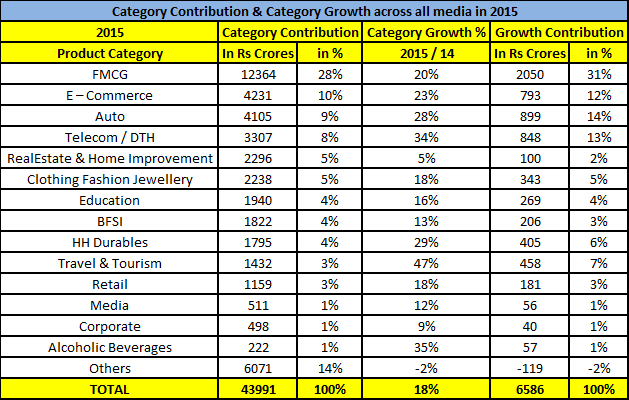
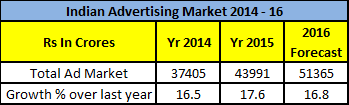
    LY growth of 16.5%. This growth is 4 percentage pointshigher than our mid-year projections of 13.8%. The Indian Media Industry is BOOMING, like never before. It is interesting to note that it took 5 years (2008 – 13) for Industry to add Rs10586 crores,moving up from Rs21520 crores to Rs32106croresbut only 2 years (2013-15) to add Rs11885 crores to reach Rs43991crores. With this growth, India finally earned the distinction of being the fastest growing Advertising market in the world.



    In terms of absolute numbers, the Indian advertising industry has increased by Rs.6,586crores to touch Rs. 43,991crores in 2015. The categories who have contributed most to the overall growth in 2015 are FMCG, E-commerce,Autoand Telecom/DTH. FMCG continues to be the most dominant sector with a 28% share of the total Indian advertising industry followed by E-commerce (10%) & then Auto (9%). Contrary to the general perception that it is E-commerce that has taken the media market by storm, it is good old FMCG that has contributed more than Rs 2050 Crores to the overall growth. E-commerce came a distancefourth with a contribution to the overall growth of Rs793 Crores. E-commerce, though has become the second largest category, a distant second, but second, after FMCG
     

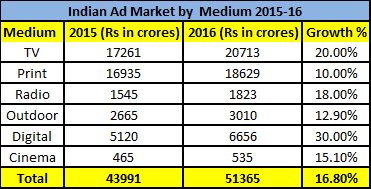
    2. TV has grown by a whopping 22% to reach Rs. 17,261crores and is on track with our mid-year projections of 21% growth. With close to 40% share, television continues to be  the largest contributor to the advertising pie. In terms of absolute numbers, TV advertising has grown by Rs. 3,103crores
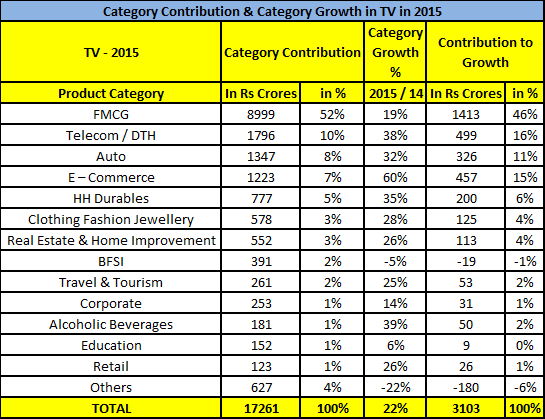
     

    • The main categories who have fuelled the overall growth ofRs 3103crores in 2015 are FMCG (Rs1413crores), Telecom/DTH (Rs499crores), E-commerce(Rs 457crores ) and Auto (Rs 326crores)
    • E-commerce category grew dramatically by 60% to reach Rs 1223crores. However in absolute terms it contributes only 7% to overall TV market
    • 2015’s biggest cricketing event ICC Cricket world Cup contributed approxRs 500 crores tothe overall growth. IPL had another successful year and netted almost Rs 1000 crores in 2015
    • In terms of category contribution, the pecking order remains the same with a marginal 2%agepoints shift in contribution from FMCG to E-commerce.FMCG however, continues to rule the roost contributing 52% share of total TV spends (down from last year’s 54%), followed by Telecom / DTH (10%) & Auto (8%).
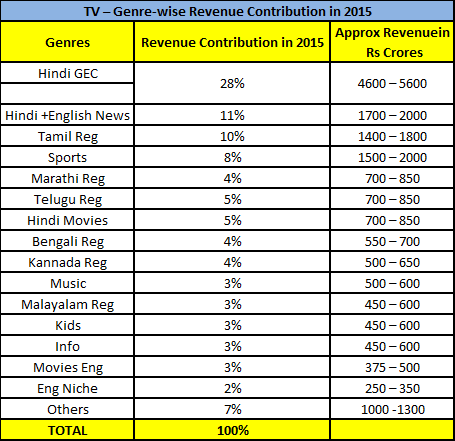
    • Looking at genres, within Television, Hindi GEC contributes nearly 28% of the overall TV revenue and continues to remain the leader of the pack. In terms of growth, Hindi GEC, Sports and South regional show substantial increase.


    • With all networks selling HD channels separately for regular as well impact properties, revenue from HD channels has grown dramatically in 2015 although the base is very small still.
    • The impact of TRAI’s 10+2 ruling seems to be on the wane, with many channels having telecast more than 12 mins/hr of FCT. This has also been confirmed by TRAI in their latest press release. This increase in FCT has also been a major contributing factor to the dramatic increase of 22% in the TV Advertising Market.


    3. Print has also grownsubstantially, by as much as 11% (compared to our forecast of 5.3 %) to reach Rs. 16,935crores and continues to be the second highest contributor after TV to the total advertising pie, with a share close to 39%. While dailies increased by 12% in 2015 over 2014, magazines as a medium failed to gain advertiser interest and has seen anegative growth of 3% in 2015. Nearly 70%, of Print’s growth of Rs 1661 crores is accounted by just 3 categories-Ecommerce (Rs 398 crores), FMCG (Rs393crores)and Auto (Rs360 crores). Another 22% is accounted by Education (Rs 224crores) and HH durables (Rs 144crores) to the overall growth.
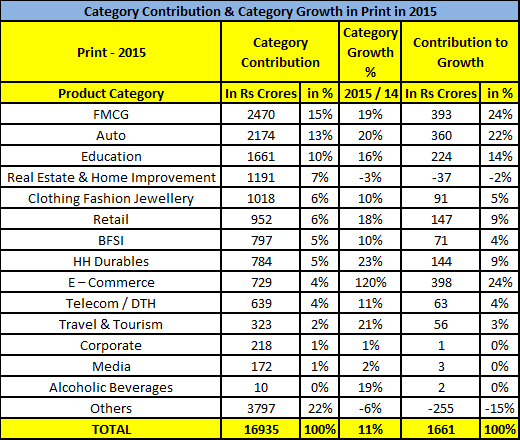


    In terms of category contribution, the decision of many publishing houses to follow a differential pricing for FMCG has begun to bear results and now FMCG is also the largest contributor to the Print Pie, with a contribution of 15%. Automobiles is second largest contributor at 13%, followed by Education (10%). Also whilst in contribution E-commerce comes way down, it shows the highest growth of 120%.


    While only 4 categories account for 75% of Television advertising, it takes as many as 10 categories to contribute the same to print advertising demonstrating that print is less vulnerable to any category degrowth.


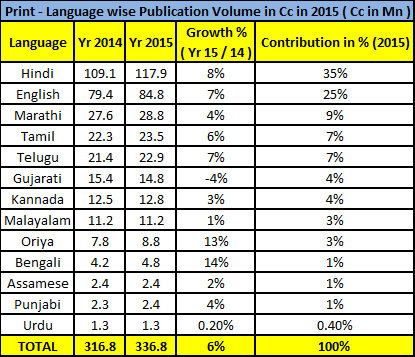
    In terms of Volume Cc among dailies, Hindi publications continue to be ahead of English Dailies. Hindi publications contribute 35% of the total volume while English publications contribute 25 %.In our estimates, though in terms of growth of volume Ccboth English& Hindi publication have grown at same rate of 7 – 8%.  Telugu publications also grown at the same rate.Bengali & Oriya publicationsshows the highest increase of 13 – 14% but Gujarati publications show a decline of 4%.


    4. Digital – At 29%, growth in digital media is in line with our earlier expectation. Digital advertising market now crosses the Rs. 5000 crore mark.


    Though the absolute spends on Search have increased, its share of the digital pie has gone down due to the fact that video, social and mobile display have grown at a faster rate last year. Desktop display growth has also further slowed down, as mobile is the all –pervasive platform of choice today.


    While E-commerce players are by far the biggest spenders on digital, spends are skewed towards Search and Social with Mobile as a key platform. The uplift in Video comes from the fact that more and more FMCG players are using the digital space to reach out to their audiences to support their television campaigns.


    5. Radio has grown by 20% in 2015 to become aRs1545 croremarket and has maintained its share of the total Advertising pie at 3.5%.In terms of absolute numbers, Radio advertising has grown by Rs. 260 crores.


    E-commerce advertisers have emerged as one of the main contributors to the growth followed by Automobiles category. Revenue from Ecommerce players in facthas almost doubled in 2015 on Radio on account of various offer-based tactical campaigns. Automobile category has grown by more than 36% on radio in 2015 on the back of new launches across segments.
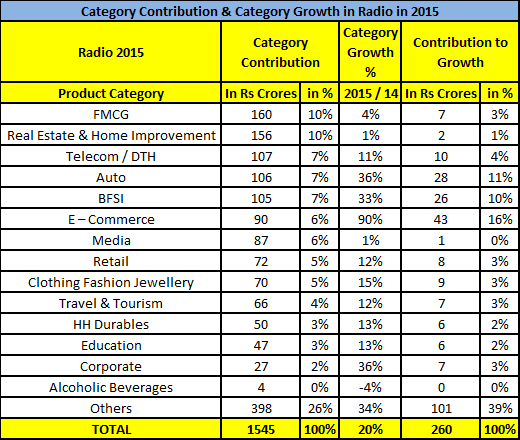


    In terms of category contribution, Real Estate &FMCG sector continue to lead the pack contributing to 10% each of total Radio spends followed by Telecom / DTH& Auto sector (both at 7%).E-commerce now shows up as a major contributor at 6%.


    The growth has come on the back of higher inventory sold across stations.


    6. OOH –Our OOH estimates now include Digital OOH & Malls which are growing quite rapidly and hence we have re-cast OOH revenue figures for last 3 years when this sub segment began to emerge. Digital OOH & Malls revenue are estimated at Rs 300 crores in 2015 (Digital OOH & Malls netted additional 100 Crores in 2014 & 50 crores in 2013). The OOH market has grown by  14%, in 2015. Transit media though grew by 13%.


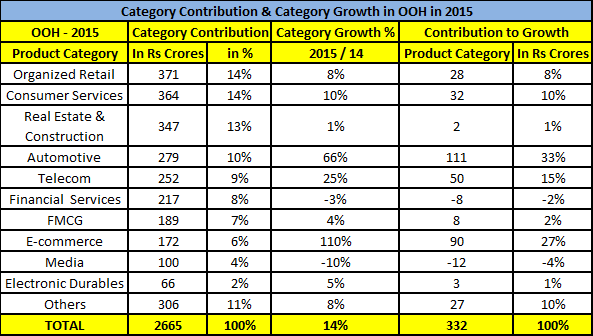
    In terms of absolute numbers, OOH advertising is now a respectable Rs 2665 crores market.  Retail, Real Estate & Automotive continue to be thetop 3 categories in terms of contribution.


    Highest growth was in E-Commerce category (110%) followed by Automotive (66%), both together, contributing 60% of the overall growth. The usual big spenders- TV Channels, Banks, Print Media, Mutual Funds etc reduced their OOH spends in 2015.


    FMCG which is the largest contributor to TV, Print & Radio does not use OOH substantially except perhaps HUL, therefore FMCG contribution to OOH is only 7%


    In terms of city wise spread, Mumbai continues its lead as a major contributor (22%) followed by Delhi (19%). Bangalore replaces Kolkata as the number 3 city with a contribution of (10%).


    OOH has maintained its contribution to the total media pie, at 6%.


    7. Cinema

    We recognize that we have under-reported cinema advertising in our earlier estimates. Cinema advertising from various government agencies and many local / retail advertisersusing static slides are  a substantial contributor and growing quite rapidly. Therefore we have included spends by these advertisers for this year and also in our estimates of previous years.


    This has led Cinema to grow by 21% and now contributes 1% to the total advertising pie with total revenue of Rs. 465 crores in 2015. The multiplex boom in smaller towns, digitization of single screens, and substantially increased activity on marketing of movies (both Bollywood & Hollywood)has created interest around the medium thathas attracted new advertisers.


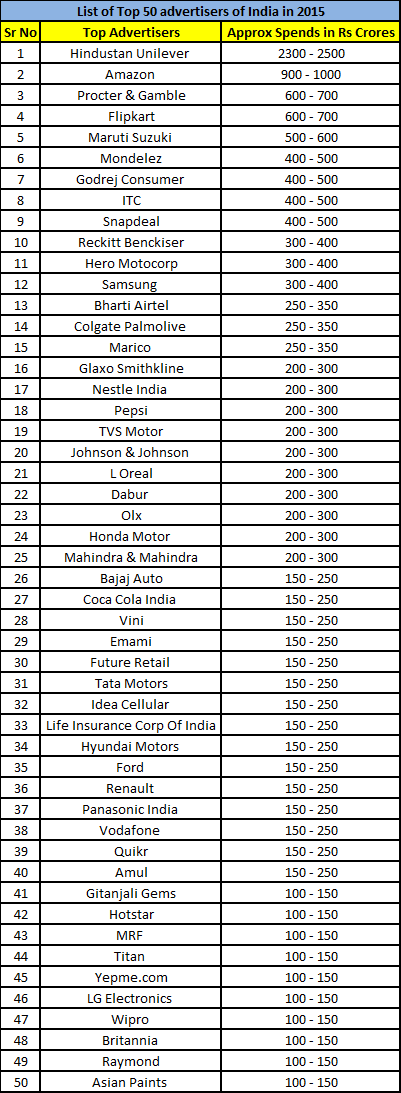
    8. Top Advertisers of India.This year in response to many requests from the advertising & media professionals, we are releasing approximate spends of top 50 advertisers of India for the year 2015.


    Advertising continues to be a game of the big boys. Top 50 advertisers account for 36% of the advertising market. This number is significant considering that there are over 2 lakhs advertisers in Print and over 12000 advertisers in TV. Top 10 advertisers account for as much as 17% of the total market and contribute to 47% of the total 50 list. By the time you reach rank 50, you are down from 2300 – 2500 crores to a 100 – 150 crores. A note of caution, some advertisers who in our list  rank between 50 – 60 may well be in reality in the top 50 list or vice-versa.


    HUL continues to lead the pack with  spends of about Rs. 2500 crores followed by Amazon India, Procter& Gamble,  Flipkart,Maruti Suzuki, Mondelez, Godrej,ITC, Snapdeal and Reckitt who has spends  between 400 – 1000 crores and who make up our  Top Ten list.


    We may mention that many Madison clients feature in this list but we hasten to add that we have not used confidential information that we are privy to in arriving at this list. The list has been arrived at using a standard structured process.


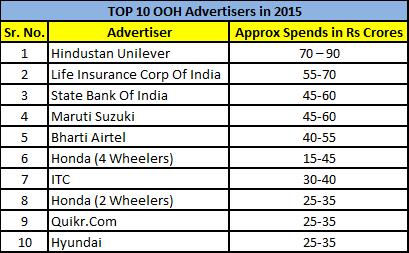
    HUL also leads the pack of top advertisers in OOH media for the year 2015


    2016 Forecast

    Our prognosis for 2016 is that it is going to be yet another GOOD YEAR for Media. In arriving at the numbers we are conditioned by the fact that the Indian economy has become the fastest growing economy of the world; our GDP growth rate at 7%+ is the envy of the western world, now  looking at India in new light; our BJP govt tells us that it has made a number of structural interventions to prepare the economy for high growth and continues to remind us that they are strongly focused on stimulating the country’s economic growth for which pro- business policies are essential; at the same time not ignoring subsidies for the poor, which should also add to purchasing power of Rural India  and finally Commodity prices including that of Oil  are likely to remain soft throughout 2016. Although Indian businesses have expressed concern that all the positive actions taken by the Govt. have not resulted in growth on the ground, we feel that India Inc. remains very optimistic about India’s future and they will once again invest heavily in advertising to protect and gain market share of their brands and also launch   a number of new brands and variants and ecommerce platforms and apps to capture the imagination and meet the requirements of modern India.


    All this will help the advertising market cross the Rs. 50,000 croremark.


    1. We expect the market to grow by more than Rs. 7300 crores to reach a total size of Rs. 51365 crores, which represents a growth of 16.8% over 2015.  India will also retain the distinction of being fastest growing advertising market in the world for the second consecutive year.


    On the supply side a big contributor of this growth will be the ICC Cricket T20 World Cup and the busy schedule of India Cricket for next 6 months. TV will continue as the largest contributor to the overall advertising pie with a share of 40% gaining a further one percentage point. Share of digital spends will increase to a respectable 13% of the overall advertising pie.


    2. TV: Paradoxically, as India races to have 500 million users on the Net, we expect TV, most Brands’ all-time favourite medium to grow by another Rs 3450 crores or 20% in 2016 to reach a total figure of Rs. 20,713 crores.


    Factors that will lead to this high growth are:

    • Organic growth coming from  the largest contributor to TV Market, FMCG.
    • Entry of new Chinese manufacturers that will enter India specially in Electronics and Mobile Handsets like Vivo, Xiomi, Le-Eco and many others.
    • Big bang launch of Reliance 4G services Jio anytime soon, and the defensive efforts of existing telecom operators.
    •  30 new car and 25 new two wheeler launches expected in the Auto industry.
    • Continued emergence of new E-commerce advertisers, covering more and more categories and new services.
    • Election campaigns of  Political parties, given that 5 State assembly elections in Tamil Nadu, West Bengal, Assam, Pondicherry  & Kerala are scheduled in  2016.


    New channel launches from existing networks will increase inventory supply to absorb this growth, as also the inevitable rate increases.


    3. Print: We expect the Print advertising market to grow by a further 10% in 2016, mainly from dailies, taking the total print market close to Rs. 18,600 crores. Most of this growth will come from language publications and new editions by regional publishers that will attract new Retail advertisers.


    Other factors contributing to growth of Print advertising market are likely to be:

    • Election campaign in the 5 States heading for Assembly Elections this year
    • Organic growth  from various  Print loyalists  like  Auto, Durables and Education.
    • Big Bang launches, using Front page jackets  by new Mobile apps and stream of tactical offers by Ecommerce  and Retail companies
    • Multiple launches across both 4-wheelers and 2-wheelers from all leading auto companies


    4.       Digital

    We expect Digital to gain momentum and grow by about 30% in 2016 to reach close to Rs 6,650 crores. Search spends are likely to stabilize and Desktop Display would see a further downward trend in terms of share of pie.


    Programmatic Buying has seen some traction in 2015; this is likely to get further strengthened in 2016. With more  users on mobile, spends will be strongly focused on this platform; and whether it is Search, Social or Video, about 80% of all ad impressions will be delivered on the mobile device.


    As the reach of digital crosses 400mn, digital will start coming into its own; some advertisers will begin to use it  as a reach and awareness building medium; it will, however, not lose its importance as a ‘conversion’ or ‘performance’ medium and as a strong support medium to TV.


    FMCG, telecom, consumer durables, real estate, apparel and BFSI will continue to be growth drivers; E-Commerce will remain the backbone of the industry.


    5. Radio: We expect Radio to grow by 18% in 2016 taking the total Radio Advertising market close to Rs. 1,800 crores


    Factors contributing to this growth will be:

    • Election campaigns in the 5 States heading for Assembly Elections this year.
    • Multiple launches across both 4-wheelers and 2-wheelers from all leading auto companies
    • Many new radio stations emerging  after winning bids in the recently held Phase 3 auctions.

    6. Outdoor: We expect Outdoor to grow by 13% in 2016  taking the total Outdoor Advertising Market to more than Rs. 3000 crores.

    Many of the factors outlined for Print and Radio will also be responsible for driving the growth of Outdoor. We see also a higher adoption of Digital and Technology and greater usage of Transit Media at Airports and Metros .


    7. Cinema: We expect cinema to grow by 15% in 2016 taking the total Cinema Advertising revenue to Rs. 535 crores.  Digitisation of single screens, presence of multiplex screens in tier-II and III towns & increasing popularity of Hollywood & Regional films in India are expected to fuel the  growth of Cinema advertising.


    In conclusion, 2016 promises to be yet another high growth year for the Indian advertising market. Perhaps no market anywhere in the world has grown consistently across last 3 years to achieve a growth of 60 %from 2013 to 2016.In the previous 3 years from 2010 – 2013, the growth has only been 28%.


    Paradoxically the market enablers are growing at a faster rate than the markets they hope to stimulate. Not many categories in the past 3 years would have grown by 60%.


    A sure sign that India Inc. has confidence in India’s future.


    Source: Madison World