Author: mxmadmin

  • [PR] Crisis makes the adrenalin flow: Prema Sagar

    Video and Text By Shruti Pushkarna


    She launched her firm, Genesis in November 1992 with just one client and one colleague, and today it has grown into one of India’s most trusted communications firms in the country. In 2005, Genesis merged with Burson-Marsteller, the gold standard in public relations, to become Genesis Burson-Marsteller. Prema Sagar, Principal and Founder of Genesis Burson-Marsteller spoke to MxM India about the growth of Genesis, issues that the industry faces today and where India stands in the international PR domain today. She also feels that all PR is now actually ‘digital PR’ and integrated communication is the way forward.


    Prior to setting up Genesis PR, Prema was the Editor-Publisher of Genesis – The City Guide, a travel magazine, and co-founder of Genesis Printers. An alumna of the Frank Jefkins Institute, UK, Prema has played a leadership role in the industry as the Founding President of the Public Relations Consultants Association of India, Council Member for India of the International Public Relations Association and member of the global Board of Management of the International Communication Consultancies Organization.


    Part 1:
    [youtube width=”400″ height=”200″]http://www.youtube.com/watch?v=yIhL1PNatp0[/youtube]
    Part 2:
    [youtube width=”400″ height=”200″]http://www.youtube.com/watch?v=wy7bzvz87LI[/youtube]

    Q: Tell us a little bit about the growth story of Genesis, especially post the BM partnership.

    Genesis started in November 1992 and many years later there was an inquiry from Burson Marsteller about partnering with them. I always admired Burson Marsteller and particularly Harold Burson, so when they called us we got into an affiliation. And it was for several years that we were affiliated with them and then finally came the big question about whether they could acquire a percentage of Genesis. I was very clear about one thing, that if we have to do a sellout of the company, it had to be either 100 percent or 0. I don’t like joint ventures because there is confusion about who runs the company and who makes the decisions, and so that happened seven years ago when they took the acquisition route with Genesis. Since the last two years we are 100 percent Burson Marsteller.


    Q: Did you ever think that Genesis could lose its identity given BM’s larger than life presence?

    Not so far.


    Q: Genesis started 2012 on a high note; what are the key focus areas set for the year going forward?

    Going forward is really about specialization which is something I started a year ago. Deep specialization, whether it’s corporate responsibility, whether it’s consumer marketing, whether it’s telecom and technology, whether it’s corporate and financial, and the new area is going to be healthcare. The fact is that people want expertise, general advice doesn’t work across different businesses. And instead of having one leader in this organization, in these last two years we have created 20. The idea is to create 40 in this year. So it is about creating far more leaders who have not only the expertise and depth but they have the leadership skills and you give them the space to grow.


    Q: Given the growing clout of digital media, how does Genesis plan to integrate digital media into its campaigns? Do you think integrated communications is the way forward?

    Everybody around the world is struggling with it. It’s very clear that you cannot do PR without digital, so it is really ‘Digital PR’. So when you look at any campaign, for example in the West, 50 percent is digital part and 50 percent is the traditional media. If we look at it here in India, everyday it’s growing. It started with consumer technology where it was a definitive requirement in the campaign plan. So it’s just rolled into the PR campaign just like how from print, television became popular and now digital is popular. I think there is a lot of focus required in digital in India. There are not enough experts, there are a lot of people running all over the place but if you want to see the impact of what digital is doing, there is a journey to be made.


    Q: How critical do you think it is to have a strong central body to represent and voice the needs of the PR industry as a whole?

    I set up Public Relations Consultants Association in India (PRCAI). I think there is a leadership need where we need to get people from Asia Pacific, not necessarily from the globe but have far more interaction of what’s happening in different markets. A lot more needs to happen on a thought leadership status, that is a long journey that needs to be done. I think a lot of it is very tactical right now and I think the body needs to take it to the next level.


    Q: What’s your view on international agencies entering the Indian market increasingly?

    They are already here, they are all here, in whatever form or fashion and a lot of them are even very small. One of the international competitors who asked me that what my advice to them was when I was at the World Economic Forum last year, I said to them take one, build it brick by brick. Don’t try and do everything in one go and hire people and run after clients, you have to show value, it’s a service and that is still my advice.


    Q: Where do you think the Indian PR industry stands today in the international arena?

    It’s very interesting that yesterday we met a very big multinational company, and they rung me up this morning and said that we are confused because everyone who has presented, has presented fabulous stuff and we didn’t know that the PR industry in India was so advanced. I was worried in one way thinking that I was way ahead but on the other hand, I was very proud that somebody had to say that about India.


    Q: How big a challenge is attracting talent into the business?

    Talent is moving too fast particularly in the middle level. I think a lot of people come here to learn and when they reach the middle level, a lot of the corporates pick up the middle level people and without further training, they are corporate communications heads. It doesn’t matter because at the end of the day it is happening to every industry in India and it’s the same story internationally. So we have our own GBM School and we keep training and looking at developing future leaders. I don’t think we should worry, I think we should invest in people, in team bonding, in leadership skills, those areas definitely need us to make that investment in them.


    Q: What are the other challenges that face the industry today?

    I think it’s all going well, I won’t worry too much. We just need to stick to ‘ethical’ influencing because influencing is part of life. We all influence each other in one way or the other and I think doing it the ethical route is what we need to stick to. We are at the threshold of announcing Public Affairs Forum of India. I think this association should make that difference now in India for the future about ethical influencing. So those are the challenges, and I think that’s always the challenge in any service business, to stay the course in terms of ethical influencing.


    Q: BM is primarily known for its crisis management and political lobbying. How critical do you think is crisis PR? Also, what are your views on lobbying?

    We love the issues in crisis because it takes us away from the day to day campaign planning and execution, issues in crisis makes the adrenal flow. And we really do feel that we made a difference and that’s the challenge, whether we helped in a positive way or not. On lobbying, it’s a part of life. As CEOs say it’s not just a lobbyist, the CEO is also lobbying. Within politics there is lobbying, within the corporate world there is lobbying. Everybody is lobbying for something or the other and I think we need to confront that. It’s a part of life, it’s nothing sleazy, it’s just a word from the dictionary, it’s interpretation of how you are doing lobbying.


    Q: There are some who believe that the PR industry itself needs a bit of PR, given all the bad publicity it’s received: Niira Radia, the Times of India management saying Medianet is a result of PR folks bribing journalists etc.?

    These things happen in the service industry particularly. On Niira, who knows what was right or wrong, how much is the truth, what is not the truth, all of those things are going to never be known. But having said that it is good that all of this is coming out because I think India is in that gold rush stage and the fact that journalists are bringing these things out in the open, is really a good thing. If it didn’t happen, we would have gone the wrong way, and civil society is putting the pressure and it will change, change for the better.


    Q: Is measurement a good thing to talk about, but difficult to implement?

    Not at all, because if you meet Aseem Sood of Impact who does the measurement and research analysis, there is a way in which it can be measured. And that too a third party has to do the measurement, you can’t measure yourself. There are agreed parameters with the client, and we have something called the Service Quality Index which is put out to the clients. What they have to do is, to assess the team for the results that they deliver. And this measurement and analysis provides absolute results, so you can see whether you have achieved what you set out to achieve. You have to set a measurable goal, only then can you evaluate whether you met that goal or you didn’t meet that goal.


    Q: What’s your view on PR awards? Did Genesis participate in them?

    We try and participate, we have not been very active on that front but going forward, we are definitely going to participate more. I think it’s a good thing to have. I need to just see on what basis do the juries evaluate, is it just a discussion or the parameters are very stringent. It would be good to tie up with some of the international awards, and to learn from what they are doing and how they are doing it. I was on the jury of PRWeek Awards and I know the stringency with which they select the winners. I do believe that even they are not perfect but we certainly have a journey to make and we should develop much more stringent parameters.

     

  • Debrief: IPL: Chalta hai

    By Anil Thakraney


    Television is abuzz with the oncoming IPL 5 nautanki. And there are a zillion commercials on the air. Before I discuss the ads, can’t help but state that I detest this tournament. I always have and I always will. IPL adds little value to Indian cricket, but deducts a lot. Having got that off my chest, let’s get to the task at hand.


    The idea this time is pretty obvious: IPL brings the entire family together. There is no fresh consumer insight out here, the world and its father already knows that apart from the men in the house, aunties, bhabhies, toddlers and Moti, the dog, also like to watch this tamasha. With no sensational insight, it’s then left to the execution to hold the fort.


    [youtube width=”400″ height=”200″]http://www.youtube.com/watch?v=UXQsIgN_530[/youtube]

    I watched a few films, and must say that in general, the creative fails to shine. There is a little humour, a little emotion, a little slice of life, but on the whole the campaign stays in the average zone. Having said that, one particular commercial did appeal to me, and I found it quite funny. And so that’s the commercial I am linking out here. Also, because I am in a good mood today, I shall rate the entire campaign based on this one ad. It’s about two gents having to bond when they have absolutely nothing in common with each other, and are on a totally different trip. Good one. Haven’t we all been stuck in such situations? Yep, in such a scenario, despite all its shortcomings, indeed the IPL becomes god-sent!


    Rating: (On a scale of 1 to 5): 3. Humour not exploited enough.


  • [MJR] In which Justice Katju tells it like it is. Again

    By Ranjona Banerji


    Press Council of Indian chairman Markandey Katju has been one of the most vocal holders of this post, losing no opportunity to stand up for the media when required and to castigate it at other times. The trivialization of news remains a key issue with him and he has questioned once again whether our obsession with Sachin Tendulkar’s 100th century was justified. Interestingly, Tendulkar himself questioned it, pointing out that in the four matches when he got his 99th 100, no one mentioned it at all!


    Katju, speaking at the convocation ceremony of the Bharatiya Vidya Bhavan in New Delhi (“over the weekend” says The Hindu in Monday’s paper) however saved his best for last, taking on Anna Hazare and his methods. While making it clear that corruption is a mega issue and that is why Hazare’s movement gained so much support, he questioned Hazare’s methods. “What is the rationale of the thinking of Anna Hazare? With due respect, I could not find any scientific ideas. These shoutings will not do anything.”


    Katju is a man who calls a spade a spade. Much as he rubbed most of the media the wrong way, there is perhaps some merit in taking some of his criticisms seriously. Is Aishwarya Rai’s pregnancy really front page news? Did the world end with Rahul Dravid’s retirement from cricket? There’s no point getting defensive here and saying, “The media has every right to choose its own stories”. Quite right it does. But does that mean that the media never makes mistakes? Or indeed, can one deny the dumbing down of the media in terms of choice of stories and understanding of news?


    **


    Talking about getting defensive, the editor in chief of this site Pradyuman Maheshwari faced some defensive posturing on the media’s role in the Norway-Bhattacharya child custody case on NDTV “over the weekend”. The anchor Sunetra Chaudhury, journalist Rashmi Saxena and former diplomat MK Bhadhrakumar staunchly held that the media had done no wrong. It was only when Maheshwari pointed out that no fact-checking had been done by the media and that the other side of the story was not presented – “a basic trait in journalism” – that the bluster of the others died down a bit and it was accepted that the media could have done more.


    Arrogance is all very well, but stupidity is just that.


    **


    This lack of perspective in the television media, especially when it comes to the armed forces, is equally appalling. It has the narrow-focused ability to only see every problem from the side of the armed forces. Yet surely we have seen, more so in recent times, highly ranked officers involved in the most reprehensible acts of corruption. In the current allegations made by chief of army staff VK Singh that he was offered a bribe by a former Lt-general, surely it would be better to get a few more facts on the case before having hissy fits in favour of every soldier ever accused of anything at prime time? At the very least it would be interesting to see if TV can seriously question what seems to be an obsession with attention as far as VK Singh is concerned. Also, at the risk of facing a firing squad at dawn, I would suggest that the media would be better served if it stopped treating the armed forces like a collection of overly-principled martyrs eschewing payment for their cause and just treat them with customary scepticism.


    **


    In an aside, how about TV channels hire some people with better spelling skills for their written portions? All morning on Monday I read about a “defemation vase” filed by Arun Jaitley against somebody. Of course, there are no bigger teasers than those little ticker tape thingies that run across the screen which promise so much and deliver so little.


    Twitter: @ranjona


  • Continuing the WorldSpace legacy @ Timbre

    By A Correspondent


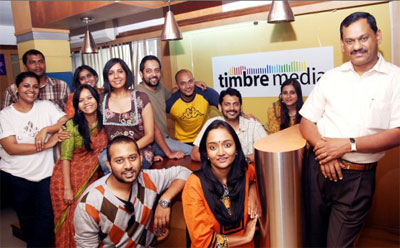
    The year 2012 has already begun with a series of announcements of radio on the web and other digital platforms. PlanetRadiocity.com for instance has launched a new genre – IndiPop Radio on their Web Radio station in March, 2012, and a Bengaluru based internet radio company- Venturenet Partners will be launching a premium model internet audio service- Radiowalla in April 2012. Formed in 2010 by former employees of WorldSpace India, Timbre Media is also slated to announce its internet radio station – Timbre Radio. All these players not only aim to provide innovative but, differentiated content and world class radio programming to their listeners, all through the power of audio.


    Besides the internet, Timbre Media plans to exploit the potential of the audio medium across digital platforms including mobile and DTH Television. On the mobile front, the Bengaluru based Timbre Media has already aligned with Vodafone India to offer listeners multiple music genre radio stations across the country. Listeners will have to pay Rs. 30 per month for 300 minutes of free usage. However this mobile radio service is not available in Andra Pradesh, Gujarat, Himachal Pradesh and Kolkata. Saregama India Pvt Ltd. which has acquired 10 per cent stake in Timbre Media provides the company (Timbre Media) with access to their music database.


    Timbre Media offers customised radio content for multiple broadcast platforms. It has four studios in Bengaluru and two studios in Mumbai among other studios in different parts of the country. In conversation with MxMIndia, M Sebastian, Co- founder and CEO, Timbre Media spoke about business model of Timbre Media, his break-even plan, the trends to watch out for, on traditional FM radio and much more.


    Q: Can you share with us how Timbre Media was formed? And what was the thought process behind the launch?

    Timbre Media was formed in 2010 by the erstwhile employees of WorldSpace India, to continue the legacy of world class radio programming that we provided through WorldSpace to our listeners.


    Q: What is the team size? Timbre Media is currently headquartered in Bangalore… Will you be setting up offices in other parts of the country too? When?

    We are a team of around 80 people, spread across different Indian cities.


    Q: Timbre Media specializes in programming radio contents for corporate entities, FM stations etc… Can you throw some light on the USP of Timbre Media? Also are you in talks with any FM station for radio content?

    Timbre Media has the unique advantage of a talent pool that introduced subscription based radio service in India and popularized the concept of genre based radio programming in our country. Our content is different, rich and compelling. We have learnt a lot about the expectations and aspirations of our target customers in the last 10 years of our association with WorldSpace Satellite Radio and its elite customers who valued quality and variety.

    We are in discussions with potential customers in every vertical that we are operating in.


    Q: What is the business model of Timbre Media? Is it advertising-led or a subscription model?

    Our business model is based on our philosophy that is to provide customized content that is different, rich and compelling and monetize the same in the best possible manner. It could be advertisement- or subscription-based depending on the vertical and the ecosystem we are operating in.


    Q: How many channels are in the offing? Which genres will you be offering? Will news also be part of it?

    We can’t say at this moment how many and what types of channels we will be offering. As I said, it is a function of the vertical and the prevailing ecosystem. We are focusing on providing customized content solutions to various customers and it could vary from one to the other. We are not averse to a particular type of programming or platform.


    Q: When are these channels scheduled to launch? Will it be only through mobile or will one be able to access them on the internet and DTH as well?

    We are not averse to any programming or platform. We are interested in utilizing our experience and expertise to meet the aspirations of the end user by using every available opportunity and monetizing the same to ensure the growth of Timbre Media.


    Q: Whom do you consider as competition?

    As such I do not think there is anyone who has the same experience and expertise that we have, and provide the same products and services that we offer.


    Q: How has 2012 welcomed Timbre Media? What are your growth plans?

    We have made considerable progress in the last two years. Thank God and the committed and passionate team that Timbre have, we have done extremely well compared to most of the start-up enterprises. We want to be a unique media enterprise that touches every customer who values quality audio content through all possible platforms and devices in the next 5 years.


    Q: Any specific trends you see in the Indian radio industry, particularly in the internet and mobile space?

    Radio industry is growing, and listeners are appreciating quality content for which they are willing to pay. The technology and platforms are enhancing the ecosystem every day and enabling the consumer to get what he wants, in the way he wants at the time he wants.


    Q: Also, should traditional radio begin to worry with your entry?

    There is sufficient space for everyone to co-exist and grow. Rather than worrying, we need to identify areas of partnerships that lead to mutual benefit and faster growth and work towards realizing the full potential of the audio medium.


  • [PR Channel] Sports PR: A new wave of specialization

    By Neha Mathur Rastogi


    For long I have had a strong belief that specialization is the only way to create true value in the often undervalued world of Public Relations in India.


    There are agencies which have gone down this route in more sound sectors like IT, Financial and even Pharmaceutical PR. But few have treaded the path of Sports. Sports PR is a qualified specialization by the virtue of the nature of work involved. You need to be spontaneous, think and write on your toes and work with a very passionate set of media, sportsmen and women as well as the all-important cog in the wheel – the corporate sponsors. Each dimension presents you with a unique challenge.


    It is common knowledge now that in the past few years, India has slowly become a global hub for sports, moving beyond conventional cricket to the recent Commonwealth Games, Hockey World Cup, F1 and several golf events being held here of international repute.


    Each of these initiatives has been made possible due to a surge in corporate support to sports. No longer is corporate sponsorship in India considered as a mere philanthropic exercise. There is a direct linkage of these associations with the brand communications strategy and how it can be best leveraged.


    The advent of such high involvement of corporates with sports has given an impetus to a latent demand in the PR industry for a specialised approach to sports. It is also great for the sporting talent in the country who also benefit from professional help in communicating more effectively with the media. We have in the past and present worked with the likes of Narain Karthikeyan and Ronjan Sodhi who are extremely talented sportsmen but needed the right kind of media exposure to be able to generate the deserved awareness about their sport and performance.


    The key in sports PR is to strike the right balance between meeting media’s expectations of receiving quality material on the sport and sportspersons, and to ensure the corporate involvement is sustained since media presence is pretty much the key measure of success.


    Sports PR is also extremely challenging since we need to always ensure the media exposure of a sportsman or woman is beneficial to them and does not in fact interfere with performance and practice.


    Having worked with media across sectors; I have also noticed a unique quality in sports media. They are all extremely passionate about the sport they cover. It is quite common for many of them to have a real background of playing the particular sport they are covering. This makes our job even tougher, since we need to understand the technicalities of each sport we represent before presenting it further to the media.


    Initially this proved to be a challenge for a person like me who has not physically played any sport at all! But the key was to learn from observation and a lot from the media and their style of writing itself. The adrenaline one feels while playing any sport pretty much rubs off on the PR around it as well.


    We need to write content in real time as the result of a day’s event is announced. There is always a Plan A, B and C basis the results and performances of the day and then it needs to be implemented from the word go.


    Our experience with reputed global organisations like Laureus and FIH has given us a taste of how international organisations have been setting standards in how one should optimise performance in sports PR. Working with Laureus in particular has been a great learning experience where a large part of their campaign revolves around generating media votes for the coveted Laureus World Sports Awards. Here the traditional PR assignment (though the word ‘traditional’ does not exist in the world of Sports PR) assumes the role of being similar to a political campaign where we meet media across different regions and sports and bring them on board to vote for their favourite sports personalities across the globe. The entire exercise culminates at the grand Laureus World Sports Awards ceremony where we accompany a group of select Indian journalists to be part of the most prestigious sports awards in the world. In the past, Laureus had a peripheral presence in India. But since the last few years they have upped their stake in the country and the exercise conducted by us is a big part of it.


    One may question a specialisation in sports PR on grounds of sustainability and it being a more project or event driven model. There is some truth in this, where my company has also borne the challenge of seasonality in the world of sports. It takes a lot to convince any sports property or association of the benefits of long term and sustained communication instead of a burst purely around the culmination event.


    Some brands, however, have discovered the benefits of this including the Women’s Golf Association of India, who have one key event at the end of the year but have decided to invest in PR for the association and Indian women golfers across the year which then builds up towards the Women’s Open. The media by then has enough exposure and interest in an otherwise niche area of reportage.


    The other way we have sustained our presence in the area is via strategic partnership with reputed sports agencies and associations which work with several events and sports personalities across the year.


    To conclude, sports PR is fast emerging as a beneficial specialisation for us to have honed over the past few critical years of the growth of the sports industry. There is tremendous potential and power in what PR can truly do to add value to sports in India. Beyond commercial success, the credibility attached to a job well done in sports PR is what keeps us going.


    Neha Mathur Rastogi is Founder & CEO of WordsWork.


  • MxMIndia is hiring – journalists & sales professionals

    MxMIndia is hiring journalists and sales professionals in New Delhi and Mumbai.

    Journalists (correspondents): ideally a year in trade or business media

    Sales: ideally worked for at least two years in the ad sales team of a trade or business media


    Although we are looking at hiring experienced professionals, bright freshers and entry-level professionals are also welcome to apply.

    Email editor@mxmindia.com (for Correspondents)  and sales@mxmindia.com (for Sales)


  • The Anchor: 6 must-have traits for entrepreneurs

    By Vijay Singh


    There is a newfound zeal these days for being an entrepreneur, and a number of folks are chucking away the securities & comforts of “salary on the 1st” and venturing into the unknown.


    Entrepreneurs are the best thing that can happen to a society, economy and country. Entrepreneurs create value out of nothing, create opportunities and fuel overall growth, and they need to be deeply respected for it.


    However being an entrepreneur is the toughest job in the world. There are no cushions; no soft landings and the failure rates are very high.


    In an environment where most won’t make it, while luck might play a huge role, there are other traits that I believe an entrepreneur must have to break through:


    #1 Imagination: A good entrepreneur sees not just the big picture but well beyond the picture. He / she needs to imagine ideas that will create solutions to obvious and everyday problems.


    #2 Foolishness: Now made famous by Mr Jobs’ speech, foolishness is a virtue that is a must have, to pursue a dream that others don’t see, understand or give a damn about.


    #3 Stubbornness: An entrepreneur lives in a lonely and often unkind world – especially in the early years. There are, more that you need, armchair advisors and critiques that would question the validity everything starting from the macro business environment, to the business model, to scalability, to ability, to sustainability. The entrepreneur needs to stay the course with persistence.


    #4 Willingness to evolve: While staying the course, it is important to learn from mistakes and spot opportunities along the way and evolve into a better idea. It is my view, however, that one should stay true to the original & pure DNA of the idea and not drift at every opportunity (or failure) that pops up, as there would be plenty of both.


    #5 Team: As an entrepreneur one you get into every aspect of the business, however, to do justice to the organization that you are going to create bring in specialized talent for specific roles and ensure they are better than you at that task.


    #6 Passion for the idea:  Take up your entrepreneurial journey for the right reasons – the reason being absolute belief and passion for the idea that you have imagined. If one feels deep down that the passion has started to drain, that is the green light to quit and maybe take up a lucrative 9-to-5 assignment.


    Not everyone has the mental toughness required to face up the uncertainties and challenges associated with a start-up; however, it is my belief that everyone with a real passion for an idea will acquire that toughness over time and they should jump in.


    Professionally let me assure you there is nothing more fulfilling that to create something of value – out of nothing.


    Vijay Singh is the CEO & Managing Director, AaramShop, and can be followed on Twitter @vijaysingh.


  • Maruti Suzuki will not shut down car production at Gurgaon

    By A Correspondent


    During a media interaction, Maruti Suzuki’s top management had announced plans to set up a diesel engine manufacturing plant in Gurgaon. Some sections of the media had taken this to mean that Maruti Suzuki would shut down production of cars in the Gurgaon plant and shift car-making to Gujarat. The company has clarified that there is no plan to stop production of cars in the Gurgaon plant, and car-making operations at the Gurgaon plant will continue.


    A statement from Maruti Suzuki said, “The company will reduce the number of cars produced at the Gurgaon plant and make available space for expanding the engine manufacturing capacity, including a new diesel engine plant. The company will continue to increase production at Manesar, where a third plant with an annual capacity of 2.50 lakh units is coming up. Once the capacity in Manesar is fully utilized, the company plans to set up a new facility in Gujarat. Together, the facilities at all three locations – Gurgaon, Manesar and Gujarat – will be used by the company to manufacture vehicles to meet market demand.”


  • Kannadada Kotyadhipathi betters KBC in first week

    By Tuhina Anand


    If one were to go by the first week numbers of Kannadada Kotyadhipathi or KBC in Kannada which debut on Suvarna Channel then surely the show has made an impression. Launched on March 12, the show has opened with a TVR of 7.32 (Source – TAM, CS 4+ Years) in the Karnataka Market. The average TVR for the show in its first week is 7.66 (Wk 11) which is better than the latest version of Kaun Banega Crorepati which opened at 5.24 TVR in top 3 metros (Mumbai, Delhi and Kolkata) and 4.5 TVR (Source :TAM) in its first week in the HSM market. The show Kannadada Kotyadhipathi in its initial week also became the No.1 show in Karnataka.


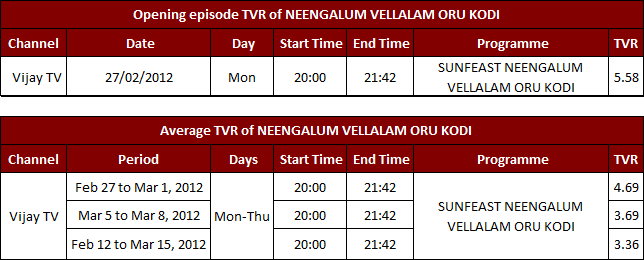
    In fact its counterpart, Neengalum Vellalam Oru Kodi which made its debut on Star Vijay managed a TVR of 5.58 on its opening day and since then has been on a decline with average TVR from Feb 27 to March 1 being 4.69, 3.69 (March 5-8) and 3.36 (Feb 12-March 15).


    Puneeth Rajkumar who comes from the first family of Kannada cinema is hosting Kannadada Kotyadhipathi whereas Suriya is hosting Neengalum Vellalam Oru Kodi.


    Anup Chandrasekharan, Business Head Suvarna Channel commented, “We are very happy with the initial response of Kannadada Kotyadhipathi, we have got a lot of positive feedback about the show from our viewers. This show is also made us the leader in week day prime time. We hope we are able to sustain the initial ratings.”


    On its comparison with Hindi KBC he added, “It is not correct to compare the two shows in terms of ratings as they belong to different markets, KBC is analyzed in the Hindi Speaking Markets (HSM) & Kotyadhipathi is analyzed in the Karnataka Market.”


    In the past, KBC was aired in Bhojpuri on Mahuaa TV as Ke Bani Crorepati with Shatrughan Sinha as its host and in Bengali as Ke Hobey Banglar Kotipoti hosted by Sourav Ganguly on Mahuaa Bangla. Both the shows did not garner much in terms of numbers. Bangla KBC averaged TVR of 2.29 (period June 6 to August 12, 2011), the Bhojpuri version saw an average TVR of just 0.45 (period June 6 to August 12, 2011). (Data source TAM).


    So it remains to be seen if KBC in Kannada will do the magic and retain its high ratings in the weeks to come.


    Source: TAM Peoplemeter System
    TG: CS 4+ yrs
    Market: Karnataka
    Period: Wk 11: Mar 11 to 17, 2012


    Source: TAM Peoplemeter System
    TG: CS 4+ yrs
    Market: Tamil Nadu
    Period: Wk 9 to 11: Feb 26 to Mar 17, 2012


  • The New Boss Gets Set


    By Kala Vijayraghavan & Lijee Philip


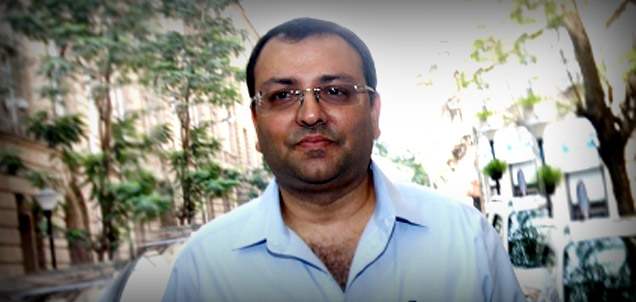
    In the second week of March, Cyrus Mistry, Ratan Tata, Ralph Speth and a few members of the senior management of Tata Motors dropped by at the factories of Jaguar Land Rover (JLR) in the West Midlands in the United Kingdom.


    The visit of the chairman-designate and the current chairman of the $83-billion Tata Group along with the CEO of JLR coincided with the Geneva Auto Show at which Mistry and Tata had unveiled a concept compact car called Megapixel.


    With sales at JLR up 35-40% in the past couple of months and with the success of the XF and XJ range, Messrs Mistry, Tata and the top brass discussed a plan to launch more products in the sporty space, said a person familiar with the matter.


    He added that Cyrus felt the Jaguar brand needed to re-associate itself with the image of speed and performance, something it seemed to be moving away from. Also discussed were plans for common engine development between Tata Motors and JLR, sharing of technology and also of human resources. It’s been a busy four months for 43-year-old Mr Mistry since he was appointed deputy chairman of Tata Sons, the promoter of all key Tata companies.


    The visit to JLR was just one of the many trips to group company offices and manufacturing plants. At the time of his appointment, the group, which has over 100 companies, had issued a statement saying Mr Mistry “will work with Ratan N Tata over the next year and take over from him when Tata retires in December 2012”.


    Mr Mistry has been doing exactly that, with his agenda including meetings with key ministers and top officials of states in which the Tatas do business.


    Unassuming Attitude Wins over Bombay House

    Mr Mistry has also been meeting the top brass – as well as employees – of virtually every company in the group, including global operations. One of the few allowances Mr Mistry makes for himself whenever he is in town is an occasional brunch out – not at a fancy restaurant at the group’s famed luxury hotel Taj but at a quaint Parsi eatery at Colaba in South Mumbai called Paradise.


    “He tries to visit the place once a week to eat his favourite chutney sandwich and, occasionally, dhansak (a Parsi meat and curry speciality),” said a person familiar with Mr Mistry’s schedule. It’s this unassuming attitude that has helped Mr Mistry win over most of the senior executives within Bombay House, the headquarters of the Tata Group.


    “His induction into the group has been quite painless,” said the head of a Tata consumer products company. Mr Mistry met CEOs who made presentations to him on what their company stands for, says the head of one Tata company on the condition of anonymity. He adds that Mr Mistry has an eye for detail.


    “The best part about him is that he is extremely approachable; and he has brought in the much-need freshness of youth and, at the same time, a composed and mature way of learning and questioning,” points out another CEO of a Tata Group company.


    Messrs Mistry and Tata were unavailable for comment, and a spokesperson for the group did not respond to an email. Mr Mistry is understood to have held review meetings with the heads of small, relatively less successful companies within the group such as Nelco, Tata Bearings, Telcon and Tata Ceramics.


    The options for such entities are either to exit (particularly if they are non-scalable) or merge them into other group companies, said a person with direct knowledge of the matter. “At the end of the day, the Tata Group will have fewer companies than it does now,” added this person.


    Such restructuring measures won’t happen immediately. There are unlikely to be any big bang changes once Mr Mistry formally takes over in December 2012, top officials said. But the direction has been set – Messrs Mistry and Tata are finalising a plan for consolidation of various businesses with the focus on profitability and scalability.


    “He is unlikely to rock the boat before getting the steering in his hands. But it would be wrong to assume there will be no changes. The organisation leadership needs changes and Mr Mistry is well aware of that. But it would be more evolutionary than revolutionary,” said a top group official.


    Another senior group official said Mr Mistry has discussed the possibility of adopting a model that was practised by Mr Ratan Tata’s predecessor, the late Mr JRD Tata, in which some companies had their own chairmen. Mr Ratan Tata is currently the chairman of all flagship companies.


    During JRD’s regime – and for a few years thereafter – Mr Russi Mody was chairman & managing director of Tata Steel, Mr Darbari Seth of Tata Chemicals and Mr Ajit Kerkar of Indian Hotels.


    While such a move has its risks – creation of power centres being the main one – group insiders say Mr Mistry is of the view that professionals with talent and potential should be offered a comprehensive career plan within organisations; and such a plan should also provide an opportunity for an MD to reach the post of chairman.


    Mr Mistry is also spending time on succession planning. He is in favour of encouraging cross-fertilisation of group talent before hiring from outside for top positions. “Cyrus will not be a carbon copy of Ratan Tata. He has to take the business to the next inflection point.


    Several of the governance codes formed in a sheltered economy within the group need to be updated,” says Mr Unni Krishnan, managing director, Brand Finance India. “He will also have to bring in coherence in terms of handling businesses that are run outside India and which are growing fast,” he adds.


    Agrees a senior group official: “The challenges faced by Ratan Tata were different and the times were different. Cyrus inherits a largely global group and, with it, a different set of challenges, especially of managing a disparate organisation in a volatile business environment.”


    One critical element of Mr Mistry’s induction – which Tata is particularly keen on and personally involved in – is connecting with bureaucrats and ministry officials at every possible level. The focus is to expand Mr Mistry’s horizons beyond business, said a senior group official.


    And if Mr Tata is making a special effort on this front, it may be because a chink in the group’s armoury has been in managing relationships with political leaders, said a person familiar with the matter. During the past four months, Mr Mistry has met the likes of Gujarat Chief Minister Mr Narendra Modi, Jharkhand CM mr Arjun Munda, Commerce & Industry Minister Mr Anand Sharma and Prime Minister Dr Manmohan Singh (as part of an industry delegation).


    Mr Mistry has also been given the mandate to reinforce the Tata culture – one that is steeped in doing good – within group companies. A couple of weeks ago, the deputy chairman was by Mr Tata’s side when he inaugurated Harvard Business School’s first classroom in the country at one of the properties of group company Indian Hotels.


    Two years ago, the chairman had granted $50 million to Harvard. “It would seem natural for Tata to want to make this sort of commitment of personal time (for the classroom) during Mistry’s induction,” says Mr Rohit Bansal, CEO and co-founder, Hammurabi & Solomon Consulting, who was present when the classroom was inaugurated.


    Source:The Economic Times

    Copyright © 2012, Bennett, Coleman & Co. Ltd. All Rights Reserved


    Photograph: Fotocorp


  • Omnicom & Interpublic Group join hands for Chevrolet

    By A Correspondent


    Omnicom Group and Interpublic Group have come together to form the first joint venture between two global advertising giants to handle creative duties for General Motors’ Chevrolet brand across the world.


    The equal joint venture, ‘Commonwealth’, will combine San Francisco-based Goodby, Silverstein & Partners of Omnicom and New York-based McCann Erickson Worldwide of Interpublic Group.


    “Commonwealth will be based here in Detroit, and its only focus will be on strengthening and growing Chevrolet into an iconic global brand,” GM Vice-President and Global Chief Marketing Officer Joel Ewanick said in a press release issued late Tuesday night.


    The agency will have a global board of eight, including Prasoon Joshi, executive chairman & CEO, McCann Worldgroup, India, and president, South Asia. Jeff Goodby will serve as the creative chairman of Commonwealth while Washington Olivetto and Linus Karlsson will be among the board members.


    “It’s unprecedented and I am excited to be a part of it,” Joshi said. “GM will benefit from such a collaboration of great minds,” he added. GM said the agency’s appointment, combined with the recent selection of Carat as its agency for media planning and buying operations, is part of efforts to drive efficiencies.


    “These agency consolidations are expected to create about $2 billion in savings over the next five years,” Ewanick said. While agency companies have been teaming up to service business on a global scale, such co-operation is unusual for bagging new business.


    Source:The Economic Times

    Copyright © 2012, Bennett, Coleman & Co. Ltd. All Rights Reserved


  • [95 Days to D-Day] No negotiation on deadline: MIB

    By Shruti Pushkarna


    Once again the government of India maintained its hard stand on the issue of digitization. Speaking at a FICCI organized seminar, ‘India going Digital: An Industry Interaction with Stakeholders’, Additional Secretary, Ministry of Information & Broadcasting, Rajiv Takru, made it very clear that the June 30th deadline is not subject to any negotiation. Addressing all stakeholders, the LCOs, MSOs and the broadcasters, Mr Takru said, “All analog will be switched off from July 1. The June 30th deadline is not negotiable at all. So all stakeholders should pace up and brace the change.”


    The seminar on digitization was organized by FICCI in New Delhi in partnership with the government of India. Participating in the event were all stakeholders, from local cable operators (LCOs), to multi-system operators (MSOs) as well as broadcasters. The seminar was organized to address issues faced by various stakeholders in the run up to the switch over from analog to digital.


    Mr Takru started off by saying that there are several rumours in the market that he would like to belie. The first being the unavailability of set top boxes (STBs). He said, “In Delhi there is a requirement of around 33 lakh STBs out of which 7 to 8 lakh STBs are already installed. And around 28 lakh STBs have already been ordered for and they are at various points in delivery. So whoever tells you that there are not enough STBs, is all false.” Secondly, he said there is a lot of talk about the sunset date being extended, he said that the deadline was absolutely sacrosanct and all industry stakeholders will have to follow it as an order. However, he admitted that the task that lay ahead is not easy but knowing the weaknesses of analog, this seems to be the best way forward for all. Mr Takru said that digitization is good for everyone and especially for the consumer. He said, “Digitization is in the larger interest of the consumer and if it hurts a few then so be it. This initiative is not being undertaken to promote any particular business interest, it is a larger step in the move towards digital.”


    Also addressing the gathering was Ms Supriya Sahu, Joint Secretary (Broadvast & Policy), Ministry of Information & Broadcasting. Sharing some numbers with the audience Ms Sahu said, “There are 33 lakh cable TV homes and around 5000 cable operators. There are 5 national MSOs and several independent MSOs. The task ahead is difficult and we need to especially reach out to the migrant workers and slum dwellers.” She also said that the government was doing its bit by running ads on radio and TV for consumer awareness. A toll free number has been set up for all kinds of queries on the matter, and the ministry also has a Facebook page where issues can be addressed. However, she urged the LCOs to get into the act now. She said, “You need to start contacting all your consumers to pass on the message because time is very limited.” She assured all stakeholders that although the rules are still being framed by the ministry, once out, they will only ease the process of transition for everyone involved. She said that there were no substantial changes that the ministry is going to make to the existing framework for the benefit of all stakeholders.


    Despite all assurances of support from the government representatives, the industry stakeholders seemed unconvinced. Ministry representatives invited questions for discussion from the audience and it was evident from the several points raised at the forum that there were varied levels of discomfort among the stakeholders. While some were hoping that there will be an extension to the sunset date, some hoped that there will be subsidies in sight. But putting all doubts to rest, Mr Takru said, “There will be no free STBs provided for by the government, just like there is no such thing as free lunch. There are no subsidies being contemplated by the government at this point.” He said however, the service providers are putting their services out in the market with heavy amount of subsidy built in, like the cost of a set top box is already subsidized.”


    A concern was voiced by a local cable operator with regards to the quality of STBs. He said, “Often there are issues with the set top box provided by the MSO and once the customer buys the STB, he/she is stuck with it. Since the LCO is the link between the end user and the MSO, what does the LCO do if the consumer wants to return the STB and get another one?” Addressing his query Mr Takru said, “The government is devising a scheme where a customer can return a STB he/she has purchased. The refund guidelines etc. are being worked upon by the ministry. The LCO can also return the STB to the MSO and get a refund in return.”


    Addressing a concern over the tariff for channels, Mr Takru said that TRAI will soon notify the tariffs which will apply to all, including the LCO, MSO, broadcaster as well as the customer. On repeated complaints over lack of availability of STBs from the MSOs’ end, Mr Takru told several LCOs present that they were free to change their MSO if the MSO refused to provide them with required STBs. But he also urged the cable operators to cooperate with the MSOs in the switch over process.


    The seminar was followed by a press conference by the ministry officials. Addressing the media, Mr Takru said, “The discussion with the stakeholders was very interesting and we managed to address several concerns of all the stakeholders.” The Additional Secretary reiterated for the media that there were more than required STBs available in the market and the deadline was non-negotiable. Speaking of the tariff for channels, Mr Takru said, “We don’t expect the tariff structure to rise or to go beyond what it is today.” He also said that consumer awareness initiatives are being undertaken by the ministry, which has already put up radio jingles on AIR FM Gold and Rainbow. Two TV spots will be on air soon on all national and private channels. The IBF and NBA are also carrying tickers as an initiative to raise consumer awareness on the subject.


    Mr Takru concluded by saying that this process might leave a few unhappy but because it is being done in the larger public interest, the government is forced to ignore certain concerns being voiced by a smaller group. He said that digitization will empower the customer who will now have the ‘choice’ to watch what he/she desires to watch unlike the present day scenario when the customer is dependent on what is offered by the cable operator.