Author: mxmadmin

  • [MJR] The missing case of espelling & grammaria

    By Ranjona Banerji


    Everydays when I reads a newspapers I am realising that espelling and grammaria are mostly presence in their absent. Many has been noticing these trend for many year but mainly its still annoying. Solution are not being found but thats because effort are not being maid.


    How to be telling peoples in newspapers for examples that “lesser” is being a qualitative comparison and not quantitative. You cannots pays lesser moneys for somethings unless what you means is that the currency you is using is less important or valuable than the normal one. You cans however be a lesser speller than others


    Why be spelling “minuscule” as “miniscule”? It is not related to a short skirt. Why say “path-breaking” when you are meaning “ground-breaking” – why would you be breaking up a path?

    Why be putting a question mark after “How the West was won”. It is not a question. Blames are being put for all these on computer and young peoples who are not taughts English in schools. Then great writer Chetan Bhagats is saying what is the grammarian and espellings so greats anyways. Even great actor John Abrahams is saying anyways and hintings he not going to get more darker and will become more fairer. That is the why the prime ministers will one day be sayings in newspapers headlines “Anyways I doesn’t care abouts Mamata Banerjee. Akhilesh Yadav is lesser troubles”.


    I wills then be looking for the longer rope and the more tall fan for small hangings and other purpose.


  • The Mindshare Mantra for the Digital Age


    By Johnson Napier & Insiyah Rangwala


    With a new global CEO at the helm and a host of other reshuffling activity on the talent front, the most recent being the appointment of Greg Brooks as Global Marketing Director, it’s been a busy 2011 & 12 for Mindshare Worldwide. But organizational changes are just one aspect of the overall vision that the global media and marketing behemoth has charted out as it prepares to confront new challenges that the future will inevitably throw up.


    In India for a one-day seminar titled Mindshare-Brand Equity Compass 2012, Marco Rimini, Leader, Business Planning, Mindshare Worldwide opened up to MxMIndia on how his agency is preparing to deal with the digital tide that is expected to sweep the sector off its feet, on the agency’s plans for India and emerging markets, and his mantras for surviving the slowdown blues. Excerpts:


    Q: What is the moment of truth facing media agencies today where the medium of digital is concerned? How is Mindshare Worldwide gearing itself to face the medium for the challenges that it will throw up tomorrow?

    The world is seeing a digital revolution and everything changes as a result of that. It will be important for organizations to get their balance right in the way they approach the medium of digital. As for Mindshare, first of all, it is about making sure that we have people who understand that we have information we share between people who understand the medium of digital. Also, the fact that we have to deal with technology ourselves.


    Q: As one moves across markets from the US to Europe to Asia Pacific, what are some of the new digital trends that have sprung up in the recent past?

    The most important thing is the amount of time people spend online and that differs by market and by region. And so obviously, the amount of time you spend online marketing to them changes remarkably by region as well. So in some markets, we are already seeing a 30-40 per cent spend by sectors such as financial services and telecom, going towards digital. Countries which are leading that race include the US and the UK.


    Q: Asia Pacific is being touted as the region that’ll churn out highest growth numbers where the medium of digital is concerned. What are your views around this thought?

    I think where digital is concerned, the Asia Pacific market is ahead because they can leapfrog ahead of the US and UK and because they have less infrastructure issues. For example, where wireless is concerned the Asia Pacific markets can leapfrog ahead because they don’t have to go through the cable revolution.


    Q: But despite the decibels and the glory, why are adspend figures around the medium still abysmally low? Do you see the low growth as an opportunity or a challenge for the sector to deal with?

    I definitely see it as an opportunity for both marketers and agencies to get it right, but to ensure that you go ahead you have to make sure you get your today and tomorrow also right. But I am positive of seeing healthy numbers being posted as we move forward.


    Q: What are the growth numbers that you anticipate for the medium in 2012?

    I think we will see an immaculate growth coming from the medium and it will differ across sectors. It is observed that sectors which sell online spend the most on online. Also, the sectors in which the advice is given the most online spend the most online. So you’ll see cars, telecom, retail, etc all have become very big spenders whereas you see less fast growth in the FMCG space.


    Q: Which are the categories that will drive online growth in 2012?

    I think it’s the ones that have a better online distribution presence; online distribution and online services will be the ones that will drive the growth. Examples include retail, banking, telecoms and cars. These are the top four high-probability sectors that I can think of.


    Q: Going forward, can we expect a renewed focus on some of the emerging markets for Mindshare Worldwide?

    There won’t be any renewed focus on any of our markets – we have always been strong in Asia and we expect Asia to continue to be strong for us. Also, within Asia we expect markets like Indonesia to drive substantial growth for us. If there is anything new it will be growth in Latin America and Africa.


    Q: Mindshare India has seen some reshuffling in the recent past where a host of people have been promoted and new talent inducted too. Globally too, there have been a few key appointments as well. What more can we look forward to on the talent front?

    Nick Emery has taken over as the global CEO for us and we wish Dominic Proctor well in his role as Group M in-charge now. Nick comes from a planning and strategy background and I think he is going to make sure that we all drive the company strategically and also do our marketing right. In fact we have just announced a new global marketing director for Mindshare Worldwide – Greg Brooks. Greg is coming from C Squared which was the organizer of the Festival of Media and also publishers of M&M magazine. So Greg is a digital maven; a digital consultant who used to be a digital journalist and his job will be to market Mindshare in this new digital age.


    Q: Has the much-spoken about slowdown impacted growth at Mindshare?

    I’ve heard a lot about this in the last 24 hours since I have been here but I have to tell you that if you come from Europe all of you here are being far more pessimistic; 6-7 percent growth is still very good and I am sure this will only be a very short-term slowdown in India and growth will continue to come. At the end of the day 6-7 percent is a very significant amount to stand by.


    As for Mindshare, we expect it to grow more or less with the average growth rate of the economy. The target for us is to grow as per the relevant economic conditions; so we say that our target in Europe is to beat the economic growth that gets registered.


    Q: What is the number you are looking at?

    We only set targets at the WPP level and I’m afraid you will have to look at their targets rather than ours. Obviously the growth in Asia Pacific is higher than Europe and we expect the growth to continue to be high. Logically, Asia Pacific is a very important region for us. Also, recently Latin America has also become an important region for us.


    Q: It was interesting to see representatives from P&G grace the panel for a Mindshare event. Worried about how Unilever will react to this?

    (Laughs) I didn’t choose the panel, Vikram Sakhuja did. But we are very proud to work for Unilever and hope that we continue to do so.


    Q: The team in India seems to be busy behind the Unilever pitch with hectic travel and meetings being the order of the day. Would you delve on what’s the current status of the pitch?

    We are all very engaged in the pitch; we knew it was going to happen and look forward to doing it. We hope to continue working with them as they have been one of our founding clients and through JWT and Ogilvy before that — we have worked with Unilever for over 100 years so we hope to continue our association with them.


    Q: What are the sentiments amongst your clients where advertising budgets are concerned?

    I think in 2008-2009, you saw dramatic cutbacks but in the last 18 months or so we have seen clients being more confident about their spending decisions. As we know, some clients are spending right in the middle of recession. So I don’t see so much of restraint from the client’s end. I think the point here is that the financial community is more nervous than the client community — it’s a government issue and not a corporate issue that’s facing us this time. In 2008-09, it was more of a corporate issue.


    Q: What will be your single largest agenda for 2012?

    The focus will be on people – there’s a lot of talent out there especially in Asia. We have to make sure we get our fair share. It’s a work-in-progress; it’s always a work-in-progress.

     

  • Sandeep Sharma joins RK Swamy Media Group

    By A Correspondent


    The R K Swamy Media Group has appointed Sandeep Sharma, former head of sales and marketing at Times Global Broadcasting, as President. Mr Chintamani Rao, who held the position until earlier this week, is likely to move to another role within the group.


    Confirming the development, a spokesperson for the RK Swamy/Hansa group indicated that Mr Sharma joined the organization on Monday, March 26.


    Speaking to MxMIndia, Mr Sharma said he’s looking forward to leading the four companies under him – Media Direction, Hansa Media Services, Digital Direction and Hansa Outdoor and Hansa Media – to newer heights. “I have a great team working with me and we hope to grow in a big way,” he said, that his first priority to familiarize himself with all aspects of the group’s businesses.


    Mr Shama, a chemical engineer from IIT Bombay, has an MBA from the NMIMS, Mumbai. In a career spanning 22 years, he has worked with Times Global Broadcasting (as Senior VP – Sales and Marketing), at Star India (as VP – Sales and Business Head) and Lowe Lintas (VP, Unit Head).


  • Anil Thakraney: Ready for long copy?

    By Anil Thakraney


    It’s quite well known that ever since television boomed in India, and ever since the Hindi heartland boys took control of the ad world, the press ad has been dead. No one cares about it, often not even the client. It’s now treated as a support medium which must coldly state the facts, and no more. It is also widely (and incorrectly) believed that people don’t read any more, that they have become video junkies, therefore the copy must be kept as crisp as possible.


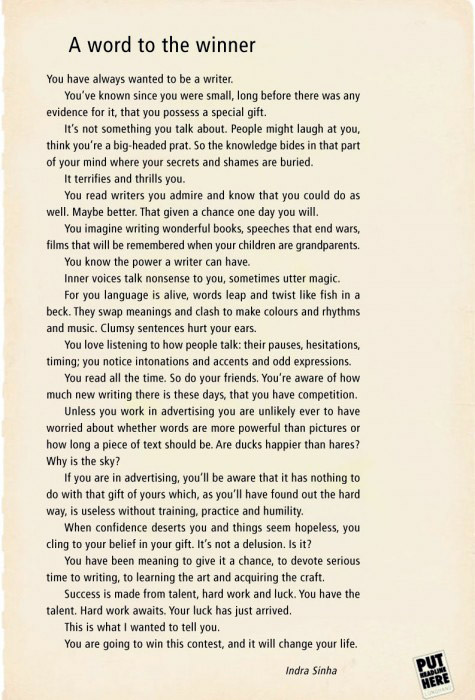
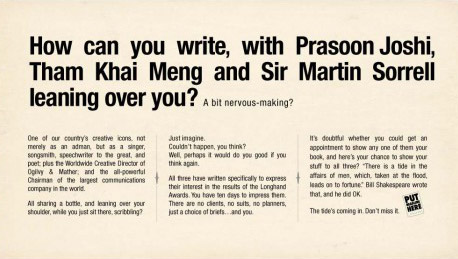
    With the advent of social media, the last nail in the coffin of the press ad got hammered in. Forget penning long prose, writers today don’t even know how to spell simple words. These are days of “Hiya gr8 2 c u!” In such a gloomy scenario, there emerges a ray of hope. A copywriter has taken the trouble to try and revive the art of writing long copy, and he has come up with a cool idea. Bodhisatwa Dasgupta of Ogilvy & Mather has announced a contest called: ‘Longhand’. Which invites contestants to write long copy ads. And win instant recognition.


    What makes things even more exciting is that the entries will be judged by legendary copywriters like Indra Sinha and Neil French. (Below are their posters encouraging writers to participate in the contest.) Moreover, the product briefs sound pretty enticing. One is for a whisky brand called ‘Gambler’, which is sold in little sachets.


    Full marks to Dasgupta for trying to do his bit. At least there’s someone out there who’s kept the faith. So get cracking and craft out that lilting prose. And prove to everyone that Indian ad world writers can still write. And can communicate without murdering the Queen’s language.


    All the best!


    To enter, you can join this Facebook page:
    http://www.facebook.com/putheadlinehere


    And here’s the link to the contest:
    http://putheadlinehere.blogspot.in/2012/03/faq-briefs.html


    Indra Sinha Neil French


  • Digital is the way forward for Zee

    By Rishi Vora


    The future is definitely Digital, and Zee Group has its sights set firmly on it. In addition to its recent launch of Ditto TV, the broadcast major has been fairly active in the digital space to promote properties such as Dance India Dance 3 (DID) and Punar Vivah.


    The channel has also taken a new and different step to enhance consumer interaction. It has introduced ‘free voting’ for contestants (where the viewer is asked to give a ‘missed call’ to his favourite contestant) as against the industry norm of pay-per-message.


    To further intensify its focus on Digital, Zee has now unveiled a WAP site and a mobile application that connect with DID fans on the go.


    The WAP site has interactive features which enable fans to interact with the contestants and judges and allows them to vote by a click of a button apart from a few other interactive features.


    MxM India spoke to Marketing Head Akash Chawla about these and other digital initiatives.


    Q: This whole focus on Digital… is this something that will take Zee a step ahead of competition?

    That is what we expect to do. We hope to be ahead of the competition with regard to this particular thing. From our perspective we’re not looking at how competition is doing on this front, because our entire objective is to be very close to the consumer. There are times when we do it by being on the ground and there are times when we do it by actually going to their homes. In the age of interactivity it is apt that we use digital media to the best. And that is exactly what we’re looking to do.


    Q: Does this take away anything from the way you use traditional media?

    The one mantra which we’re going after is driving conversations with the customers. So, even when we’re using the traditional media – a print ad for example – the attempt is to make it more interactive. Any my belief is that you can also use traditional media to drive a lot of audience on your social network.

    I’m not saying that traditional media is something we won’t do, but our attempt will be to drive more conversations through our communication.


    Q: You’ve been fairly active on social media and that seems to be a big thrust going forward as well. But there is a saying that social media is a double-edge sword and that it could well turn out to be harmful to a brand like yours.

    It is too soon to say that. In the case of iconic brands or sectors such as automobiles you can see a sizeable community. In the GEC space we’re just beginning to do that. So our first objective is to build a sizeable community. Once you get a sizeable community then how to use that is the second objective. Traditional media will irrespectively be required as social media in India is growing.


    Q: This missed-call concept which you’ve introduced for DID is something very different altogether. How did you come up with a concept like that?

    At Zee, we’ve been doing talent hunts such as Sa Re Ga Ma and DID. When we started this interactivity thing in 2005 with Sa Re Ga Ma Pa Challenge, we used to get a lot of votes. If we sit down and draw a trend, votes have actually gone down over a period of five to seven years. Most of the formats today are interactive in terms of asking for votes. Second, the credibility aspect. Consumers have come up to us and said that it is just a revenue making mechanism because the SMSes are charged higher than the normal SMSes. Frankly, as a broadcaster, for us, at this particular time, it is more about building the brand salience than the small amount of revenue that’ gets generated through votes.


    Q: That revenue – is it that small enough to be left out?

    It’s a tradeoff. Tomorrow we may not be able to do it for all our reality shows, but at the end of the day if it is about a brand like DID – from the consumer’s perspective, credibility is of primary essence. And whatever brings us that credibility is something we would want to go in for.


    Q: Is this a beginning of a new trend in broadcast?

    You cannot do this for everything. It is not a model that can be followed by all brands. There are certain attributes of DID in terms of how many people were connecting with it, in terms of it being a brand which is already known and the kind of credibility it has at this juncture…


    So I don’t think it’s a concept that’ll fit all brands. How many more people will start following us on that? We don’t know. But we did try this again for another show, Punar Vivah. We decided to apply that to the show because as a concept it applies to a segment where we could afford to be more interactive and it gave us phenomenal results.


    Q: Does a show like Punar Vivah attract a lot of traction on social media?

    Actually if you go to our Facebook fanpage, Punar Vivah is one of the topics that is heavily discussed. You’re right that you cannot do things on social media blindly. And I’m worried about that. If something is successful people will start using it as a formula. The aspect we’re following for Punar Vivah is very different. We’re doing Punar Vivah symposiums across 18 cities of India, where every week we have a couple of symposiums which includes a psychotherapist, a marriage counsellor and one reputed NGO of that particular city or state. We also have people on the panel who have gone through the remarriage process, our viewers and media.


    Our attempt is to bring this so-called taboo topic out of the closet. You may do with social media with a particular level. But, we feel for Punar Vivah that is the one that is actually more relevant than just social media. So yes, you’re right. Social media has to be used keeping the segment that you’re chasing in mind.


    Q: You’re at No 3. Neck-and-neck with your nearest competitor. Where next?

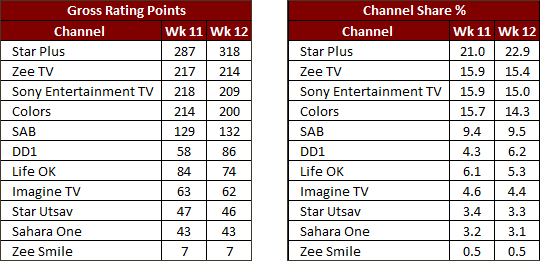
    No 1 next. It was a matter of 1 GRP with Sony last week.


    How long for No 1?

    (Smiles) I told you three months ago that we will be No 2 in three months. We’ve become No 2 in three months.


  • RAMcheck: More surprises for FM players

    By A Correspondent


    TAM Media’s Radio Audience Measurement (RAM) – which covers four key metros, Mumbai,Delhi, Kolkata and Bengaluru – released its latest radio listenership figures for Wk 4 to Wk7 (Last two weeks of January 2012 and first two weeks of February 2012).


    According to the latest RAM data, for listeners of 12 years of age and above, all places of listening, and according to radio channel shares,RadioCity, Radio Mirchi, Fever FM, Big FM, Red FM, Radio One, Oye! FM were some of the top FM stations in the big four metros.


    Mumbai:

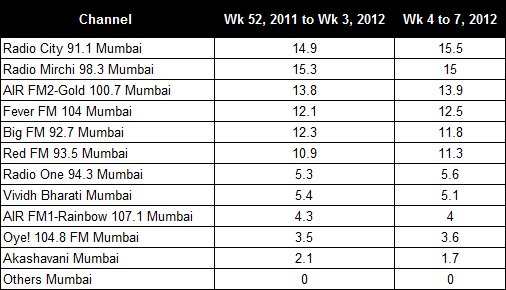
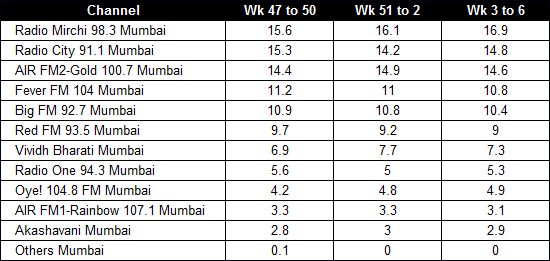
    Radio City surged ahead of Radio Mirchi as the most popular FM station in the city with 15.5 per cent channel share from Wk 4 to Wk7, 2012 whereas Radio Mirchi’s channel share stood at 15 per cent. Ranked three is AIR FM2 Gold which more or less remained unchanged in listenership share from wk 4 to 7, 2012 as against Wk 52, 2011 to Wk 3, 2012. As compared to Wk 52, 2011 to Wk 3, 2012, six FM stations witnessed growth in their listenership share in Wk 4 to Wk 7, 2012 namely, Radio City, Fever FM, Red FM, Radio One, Oye! FM and AIR FM2 Gold.


    Source : RAM

    Market: MUMBAI

    Demographic: All People 12+ Filter Demographic: None

    Statistic: Share %

    Daypart: Sun – Sat 12:00 AM – 12:00 AM

    Place of Listening: All


    Delhi:

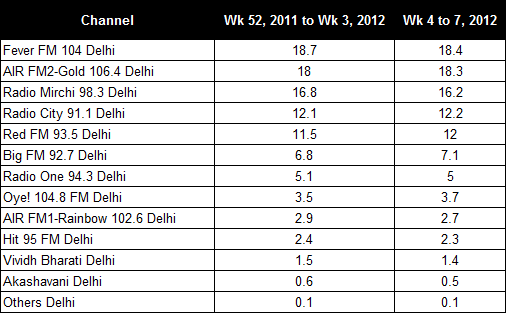
    Fever FM once again manages to retain its leadership position inDelhi, its nearest rival in Delhi is Radio Mirchi, if the government owned AIR FM2 Gold is excluded. According to figures for Wk4 to Wk 7, 2012, AIR FM2 Gold is close behind Fever FM for the top spot. What remains to be seen is whether or not Fever FM is able to retain its leadership position inDelhi.


    The Wk4 to Wk 7, 2012 RAM numbers reveals that in comparison to Wk 52, 2011 to Wk 3, 2012 only five FM stations witnessed any growth in the Delhi market. The FM stations to have seen growth in their listenership shares are Radio City, Big FM, Red FM, Oye! FM and AIR FM2 Gold.

    The other FM stations in the Delhi market are Radio One, Hit FM, AIR FM1 Rainbow, Vividh Bharathi and Akashavani Delhi.


    Market: DELHI

    Demographic: All People 12+ Filter Demographic: None

    Statistic: Share %

    Daypart: Sun – Sat 12:00 AM – 12:00 AM

    Place of Listening: All


    Bengaluru:

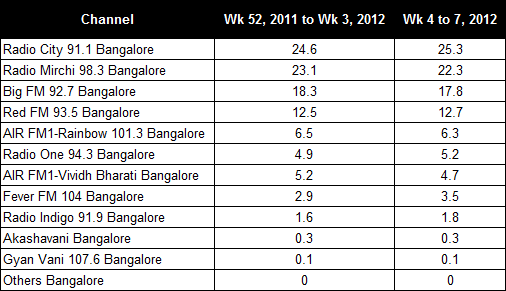
    In Bengaluru too, Radio City continues maintain its numero uno position, the FM station has managed further grow its listenership share in Wk 4 to Wk 7, 2012 as against Wk 52, 2011 to Wk 3, 2012. The second most popular FM station in Bengaluru is Radio Mirchi followed by Big FM and Red FM, ranked third and fourth respectively. Ranked fifth is AIR FM1 Rainbow and Radio One is ranked sixth. The five of the eleven FM stations in the Bengaluru market which witnessed growth in listenership share areRadioCity, Red FM, Radio One, Fever FM and Radio Indigo.


    Market: BENGALURU

    Demographic: All People 12+ Filter Demographic: None

    Statistic: Share %

    Daypart: Sun – Sat 12:00 AM – 12:00 AM

    Place of Listening: All


    Kolkata:

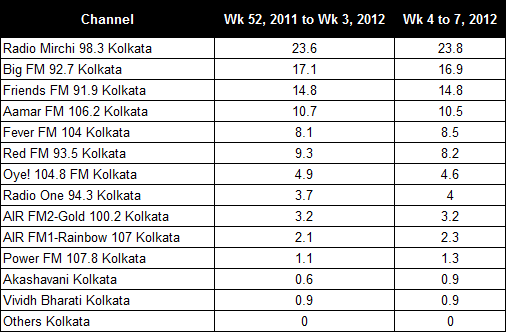
    Radio Mirchi has not only maintained its leadership position in the city, but has also witnessed some growth according to the Wk4 to Wk 7, 2012 RAM data as against Wk 52, 2011 to Wk3, 2012. Kolkata is the only RAM market to have seen no change in atleast the top three rankings. Radio Mirchi, Big FM and Friends FM continue to be the top three FM stations in the city. Ranked four is Aamar FM, followed by Fever FM, Red FM and Oye! FM. Of the thirteen FM stations in Kolkata, six FM stations in the city have witnessed growth in their listenership shares: Radio Mirchi, Fever FM, Radio One, Power FM and AIR FM1 Rainbow. Although Friends FM remained stagnant in its listenership share, nevertheless it is comfortably placed at number three. The other FM stations in the Kolkata market include Radio One, Power FM, AIR FM1 Rainbow, AIR FM2 Gold, Akashavani Kolkata and Vividh Bharati.


    Market: KOLKATA

    Demographic: All People 12+ Filter Demographic: None

    Statistic: Share %

    Daypart: Sun – Sat 12:00 AM – 12:00 AM

    Place of Listening: All


  • RAMcheck: What women listen to…

    By A Correspondent


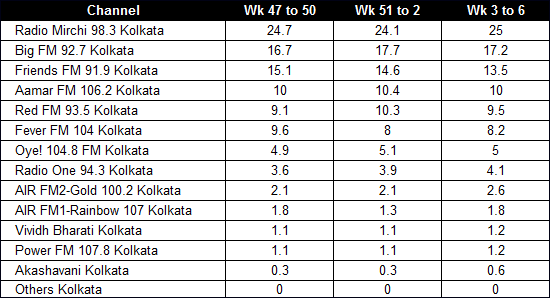
    Which are the most popular FM stations among women? MxMIndia shifts focus on women listenership trends in the four RAM (Radio Audience Measurement) – Mumbai, Delhi, Bengaluru and Kolkata. The data consists of women who are 12 years of age and above, all places of listening from WK 47, 2011 to WK 6, 2012. The most popular FM stations among women in the four metros are Radio Mirchi, Radio City, Big FM, Red FM and Fever FM.


    Delhi:

    Fever FM is the most popular FM station among Delhi women listeners, followed by Radio Mirchi, AIR FM2 Gold, Red FM and Radio City – the top five FM stations for women in Delhi. The listenership share of Fever FM has in fact moved slightly higher on Wk 3 to Wk 6 as compared to Wk 47 to Wk 50. The top five FM stations in the city have managed to sustain their listenership rankings from wk 47 to 50, 2011 to Wk 3 to 6, 2012. The other FM stations in the city are Big FM, Radio One, Oye! FM, Hit FM, AIR FM1 Rainbow, Vividh Bharati and Akashvani.


    Mumbai:

    For the women listeners in the commercial capital, Radio Mirchi is the numero uno FM station, at least in terms of station share. Radio City is the second most popular FM station among the women listeners of Mumbai followed by AIR FM2 Gold which is ranked three. The other two FM stations in the top five category are Fever FM and Big FM, which are ranked four and five respectively. While these top five radio stations have received a double digit listenership share, the other FM stations in the city are Red FM, Radio One, Oye! FM, Vividh Bharati, AIR FM1 Rainbow and Akashvani.


    Bengaluru:

    The Bengaluru women listen to Radio City the most. Radio City has maintained its leadership position among women listeners from Wk 47 to Wk 50, 2011 to Wk 3 to Wk 6, 2012. Ranked second is Radio Mirchi followed by Big FM, the third most popular FM station of the city. Ranked four and five are Red FM and AIR FM1 Rainbow. The top four FM stations have infact witnessed their share per cent in double digits. The other FM stations in the Bengaluru market are Radio One, Fever FM, Radio Indigo, AIR FM1 Vividh Bharati, Akashvani and Gyan Vani.


    Kolkata:

    Radio Mirchi is clearly the most popular FM station for Kolkata women. The FM station has maintained a significant lead in the city with 25 per cent of the market share as on Wk 3 to Wk6, 2012. Its nearest rival in Kolkata is Big FM with a share of 17.2 per cent followed by Friends FM with 13.5 per cent of the share. Aamar FM and Red FM are ranked four and five with a share of 10 per cent and 9.5 per cent respectively. The other FM stations in the city are Fever FM, Oye! FM, Radio One, Power FM, AIR FM2 Gold, AIR FM1 Rainbow, Vividh Bharati, and Akashvani.


  • RAMcheck: No changes in top rankings in four metros

    By A Correspondent


    On Friday, January 6, 2012, Radio Audience Measurement (RAM) – which covers four key metros, Mumbai, Delhi, Kolkata and Bengaluru – released its latest radio listenership figures for Wk 43-46 (last two weeks of October and 1st two weeks of November 2011) Vs Wk 47-50 (Last two weeks of November and 1st week of December 2011).


    According to the latest RAM data, for listeners of 12 years and above, and according to radio channel shares, Radio City, Radio Mirchi, Big FM, Red FM, Fever FM, Radio One, Oye! FM were some of the top FM stations in the big four metros.


    Mumbai:

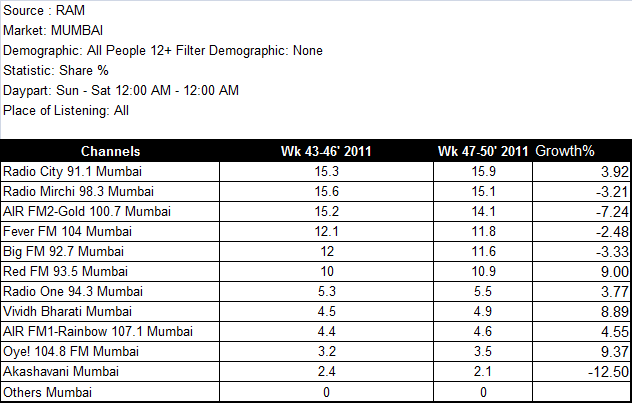
    In Mumbai,Radio City further strengthened its leadership position in Wk 47-50 as against Wk 43-46 with a growth of 3.92 per cent in its channel shares. Radio Mirchi was rated the second most popular FM station in terms of channel shares followed by AIR FM2 Gold, Fever FM, Big FM, Red FM and Radio One. The other clusters of FM stations in the city are Oye! FM, Vividh Bharati, AIR FM1 Rainbow and Akashavani Mumbai.


    Besides Radio City, Red FM, Radio One, Oye! FM, AIR FM1 Rainbow, Vividh Bharati and Akashavani Mumbai are the only radio stations to have shown growth.


    Delhi:

    Most radio stations inDelhiwitnessed growth in the channel shares in Wk 47-50 as against Wk 43-46. AIR FM2 Gold emerged as the number one FM station inDelhi, its channel share however remained stagnant. Fever FM slipped to the number two position in Wk 47-50 after its channel share saw a decline as compared to Wk 43-46. Fever FM and AIR FM1 Rainbow were the only two FM stations inDelhito have seen a decline in channel shares on Wk 47-50 as against Wk 43-46.


    Radio Mirchi was the third most popular FM station followed by Red FM, Radio City, Big FM, Radio One, and Oye! FM. The other clusters of radio stations inDelhiinclude AIR FM1 Rainbow, Hit FM, Vividh Bharati and Akashavani Delhi.


    Bengaluru:

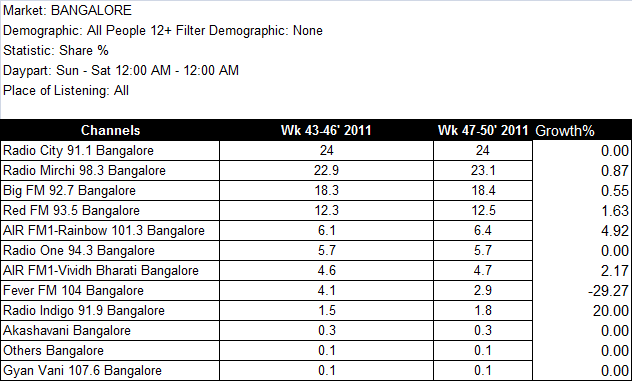
    There was no change in the station rankings in Bengaluru.Radio City continued to lead Bengaluru followed by Radio Mirchi and Big FM. While Radio City showed neither growth nor decline in its channel share, Radio Mirchi and Big FM saw marginal growth. Fever FM, however, was the only FM station that showed decline in its channel shares.


    Kolkata:

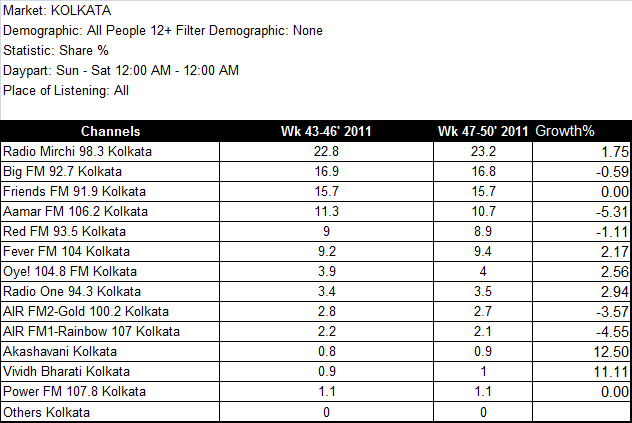
    Kolkata too saw no change in its station rankings. Radio Mirchi, Big FM, Friends FM, Aamar FM and Red FM were the top five FM stations in Kolkata in terms of their channel shares. Radio Mirchi, the most popular FM station in Kolkata has further strengthened its leadership position with a growth of 1.75 per cent in channel shares in Wk 47-50 as compared to Wk 43-46.


    While Radio Mirchi’s nearest rival in Kolkata, Big FM came a distant second with a slight decline of 0.59 per cent in terms of its channel share, the third most popular FM station in Kolkata, Friends FM remained stagnant. Besides Radio Mirchi, Fever FM, Oye! FM and Radio One were the only private FM stations in Kolkata to have witnessed growth in channel shares.


  • RAMcheck: Most popular FM stations heard out of home

    By A Correspondent


    Unlike our regular RAMcheck reports which didn’t differentiate between any places of listening, this time MxMIndia decided to concentrate exclusively on radio channels’ out of home (OOH) listenership. According to RAM (Radio Audience Measurement), the OOH listeners include listenership in cars, at work and other out of home places. TAM Media’s Radio Audience Measurement from week 40-43, 2011 to week 52- 3, 2012 reveals the most popular FM radio station out of home. RAM is currently present in four metros – Mumbai, Delhi, Bengaluru and Kolkata.


    Mumbai:

    According to the RAM data for OOH listenership, the top five FM stations for Mumbaikars are Radio Mirchi, Big FM, Radio City, Fever FM and Red FM, excluding the government-owned AIR FM2 Gold. The radio stations, from week 40- 43, 2011 to week 52 to 3, 2012, have not seen much variation in their channel shares.


    Delhi:

    In Delhi AIR FM2 Gold is the most popular FM station followed by Fever FM, a strong number two in OOH listenership share. While the number one and two slots have a clear position in OOH listenership, there is no clear winner for the number three position. There is a close fight for number three position between Radio Mirchi, Radio City and Red FM. However in Wk 52′ 2011 to Wk 3′ 2012, both Radio Mirchi and Red FM received 12.4 per cent station share whereas Radio City received a station share of 11.1 per cent. The other FM stations in the Delhi market include Big FM, Radio One, Oye!FM, Hit FM, AIR FM1 Rainbow, Vividh Bharati and Akashavani Delhi.


    Bengaluru:

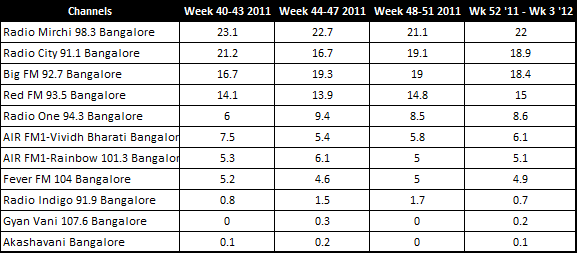
    Radio Mirchi is the number one FM station in Bengaluru followed by Radio City, Big FM, Red FM and Radio One. Between Wk 40- 43, 2011 to Wk 52, 2011-Wk 3, 2012 the radio channel share for Radio Mirchi was at its peak in Wk 40 -43, 2011 with a share of 23.1 per cent. Radio City, the second most popular FM station in OOH listenership, was also at its peak in wk 40 – 43, 2011 with 21.2 per cent share. However in week 52, 2011 – Week 3, 2012 the station share for Radio Mirchi dropped to 22 per cent whereas Radio City’s share was 18.9 per cent. The other clusters of FM stations in Bengaluru are Fever FM, Radio Indigo, AIR FM1, Vividh Bharati, AIR FM1 Rainbow, Gyan Vani and Akashavani Bengaluru.


    Kolkata:

    Kolkata has a clear number one and number two FM stations in Friends FM and Radio Mirchi. Ranked third is Red FM. The gap between the top three FM stations is significant. While Friends FM received a market share of 23.4 per cent in Wk 52, 2011 – Wk 3, 2012, the same week saw Radio Mirchi receive just 18.3 per cent market share and Red FM receive 12.4 per cent share. The other clusters of FM stations in Kolkata are Fever FM, Aamar FM, Air FM2 Gold, Oye! FM, AIR FM1, Rainbow, Radio One, Power FM, Akashavani and Vividh Bharati Kolkata.


  • TAM NCT Data Wk 11 ’12


    Source: News Content Track – A service of TAM Media Research Pvt. Ltd
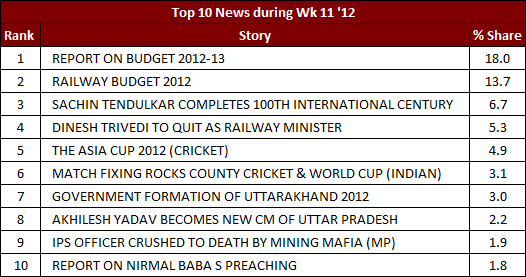
    Channels: Aaj Tak, CNN IBN, Headlines Today, IBN 7, India TV, NDTV 24/7, NDTV India, Star News, Times Now, News 24 & Zee News
    Period: Week 11 – Mar 11 to March 17, 2012
    Note : Analysis is based on the Telecast duration


    About TAM Media Research


    TAM is a joint venture between Nielsen Company & Kantar Media Research. Besides measuring TV Viewership, TAM also monitors Advertising Expenditure of Television, Print & Radio through its division AdEx India. Since 2004, it extended its presence in the PR Measurement & Analysis space for Corporate/Marketing Clients by setting up a separate division Eikona PR Measurement.


    In 2007, the joint venture introduced RAM (Radio Audio Measurement) service to track Radio Listenership for the Indian Radio Broadcast Industry. In year 2009, TAM launched a division, called TAM Sports that specializes in monitoring Sports Sponsorship ROI.


    TAM Media Research’s objective is to fuel media insights that will drive the growth of the Indian Media Industry.

  • TAM data Top 10 programmes on HGEC – Wk 12 ’12


    Source: TAM Peoplemeter System
    TG: CS 4+ yrs
    Market: Hindi Speaking Market
    Period: Wk 12: Mar 18 to 24, 2012


    About TAM Media Research


    TAM is a joint venture between Nielsen Company & Kantar Media Research. Besides measuring TV Viewership, TAM also monitors Advertising Expenditure of Television, Print & Radio through its division AdEx India. Since 2004, it extended its presence in the PR Measurement & Analysis space for Corporate/Marketing Clients by setting up a separate division Eikona PR Measurement.


    In 2007, the joint venture introduced RAM (Radio Audio Measurement) service to track Radio Listenership for the Indian Radio Broadcast Industry. In year 2009, TAM launched a division, called TAM Sports that specializes in monitoring Sports Sponsorship ROI.


    TAM Media Research’s objective is to fuel media insights that will drive the growth of the Indian Media Industry.

  • TAM Data (GRPs Channel shares of HGECs)- Wk 12 ’12


    Source: TAM Peoplemeter System
    TG: CS 4+ yrs
    Market: HSM
    Period: Wk 11: Mar 11 to Mar 17, 2012
    Period: Wk 12: Mar 18 to Mar 24, 2012


    About TAM Media Research


    TAM is a joint venture between Nielsen Company & Kantar Media Research. Besides measuring TV Viewership, TAM also monitors Advertising Expenditure of Television, Print & Radio through its division AdEx India. Since 2004, it extended its presence in the PR Measurement & Analysis space for Corporate/Marketing Clients by setting up a separate division Eikona PR Measurement.


    In 2007, the joint venture introduced RAM (Radio Audio Measurement) service to track Radio Listenership for the Indian Radio Broadcast Industry. In year 2009, TAM launched a division, called TAM Sports that specializes in monitoring Sports Sponsorship ROI.


    TAM Media Research’s objective is to fuel media insights that will drive the growth of the Indian Media Industry.