Author: mxmadmin

  • Starcom win Novartis worldwide, Caratlane in India

    By A Correspondent


    Novartis has awarded Starcom with its $600million global media account, reports Advertising Age. The review apparently started earlier this year.


    On Tuesday, the Starcom India spokesperson said the offices here weren’t aware of the win. Novartis, the AdAge report adds, is one of the 100 largest advertisers in the world.


    Meanwhile, what the India office did inform MxMIndia was about being awarded the mandate by Caratlane.com, an online portal offering a selection of diamonds and diamond jewellery. Starcom will handle all the media investments for Caratlane.com from its Chennai office.


    Confirming the appointment, Narendra Alambara, Vice President, Starcom Worldwide, Chennai said, “We are extremely happy to partner with the pioneers of online diamond jewellery business. Caratlane.com has a superior business model that ensures quality of the product, with better prices for the consumer. Their decision to work with us will help them accelerate visibility. Starcom’s solid research and strong consumer data will help Cartlane.com achieve higher business returns and become a name to be reckoned with in the diamond jewellery business.”


    Caratlane.com is one of the first and few online businesses that offer a range of diamonds and diamond jewellery. They also have offline operations and diamonds are available at select stores. The diamonds have a Jaipur quality stamp and the automated manufacturing system and quality control processes ensure that jewellery is made exactly to specifications. This is especially to ensure trust and uniform quality as the customers buy a piece of jewellery based on specifications rather than look-and-feel.


    As to whether the India office will also handle Novartis, guess one will have to watch.

  • Star’s Vijay TV hopes to win big with Tamil KBC, nets superstar Suriya as host


    By Tuhina Anand


    Star India’s Vijay TV is looking at its next leap with its biggest property Neengalum Vellalam Oru Kodi or Kaun Banega Crorepati in Tamil, to be hosted by superstar Suriya. In fact, this is touted as the biggest property ever not just for Vijay TV but for the Tamil television industry too. The channel is pinning its hope on the show to weave its magic and catapult Vijay TV to garner good numbers. If one looks at the channel share, the scenario among Tamil entertainment channel is that Sun TV leads and relies mainly on its fiction whereas KTV, the movie channel from the Sun TV network is clearly at number two though at times on really rare occasion may be toppled by Vijay TV. Then there is Sun Music and Kalaignar TV which again was positioned as rival to Sun TV placed somewhere in between. However, in this entire number game one thing to keep in mind is that the gap between the leader and the second channel is huge and not easy to bridge.


    For Vijay TV to come up with KBC which is a popular game show and has been played across 116 countries in 83 languages in the past 13 years is definitely a big move. Six years ago, Sun TV had introduced a show with a format similar to KBC, with Sarath Kumar, which had not fared well and could not go beyond its first season. However, much has changed in the Tamil GEC since then and Vijay TV has been the one that has experimented with talent-based reality shows earlier and given audience a taste of non-fiction shows. Now this time with Suriya who makes his television debut and is much revered by the Tamil audience, they definitely have an ace. Also the show is being produced by Big Synergy, the producers of KBC in Hindi, thus ensuring the same high quality in production, sound and sets.


    Bridging the gap

    K Sriram, General Manager, Vijay TV said, “This by far is the biggest investment by any South Indian channel as we have bought the rights from the original to bring out KBC in Tamil. We are looking at bridging the gap with the leader with this property. The treatment of the show is fantastic and it’s a superior product offering to the Tamil audience. We have also tied up with ITC’s Sunfeast as the presenting sponsor.” This year KBC 5 saw all the big brands riding on it and Sriram says that even though the format has its limitations when it comes to getting brands on board, but they along with Synergy are working out ways to provide greater value to brands on the show.”


    The show will be launched in February 2012 and Vijay TV is leaving no stone unturned to capture the minds of its audience. It is breaking a high-decibel campaign starting today (December 21) inviting people to participate in the show which will then be followed by a highly visible 360-degree campaign that will continue till the show debuts on TV. The show will air Monday to Thursday from 8-9.30 pm. The tone of the show will be similar to what Sony has done this year to give voice to unsung heroes and bring out stories from people who have financial constraints but emerge winners on the show, thus the prize money of Rs 1 crore gives wings to their dreams. Sairam however adds that the participants will be a careful mix, thus providing equal opportunity to all.


    The launch of KBC will also see simultaneous launch of the two biggest fiction shows on Vijay TV to ensure audience stickiness post-KBC.


    Vijay TV’s tryst with reality

    Narendra Alambara, Vice President, Starcom Chennai is of the opinion that KBC being a knowledge based show will pull in Tamil audience initially but the real task for Vijay TV will be to sustain viewers once the novelty value of popular host, new show and winners fades. Giving his take on why Vijay TV is probably the best channel to showcase KBC, he said, “The channel has had winners in the past in its talent based reality shows so in that sense it’s in the DNA of Vijay TV as Sun is seen more tuned to fiction.” He added, “Within trade circles KBC has been received well. I think interest will pick up among viewers once the promotion starts. Vijay TV has invested in producing superior quality shows and the quality of KBC will determine the channel’s position as an option for quality programming.”


    John Britto, Business Manager, Mindshare, explained, “The buzz on KBC is positive and this should have a positive impact on Vijay TV. As it is the biggest property and will be marketed well, the brands will be keen to get on it.”


    Giving an insight on why KBC should work this time even though in its earlier avatar it didn’t in TN, he said, “The awareness level this time is much more and the anchor Suriya has a great following. Even earlier, Vijay TV has adapted Koffee with Karan, Laughter Challenge and Talent competition with success.”


    KBC in other regional languages

    It’s not just Vijay TV which is gearing up for KBC in Tamil but there is also Suvarna which is readying for launch of KBC in Kannada with superstar Puneet Rajkumar. KBC had made its debut in Bhojpuri on Mahuaa TV as Ke Bani Crorepati with Shatrughan Sinha as its host and in Bengali as Ke Hobey Banglar Kotipoti hosted by Sourav Ganguly on Mahuaa Bangla. While the Bangla KBC averaged TVR of 2.29 (period June 6 to August 12, 2011), the Bhojpuri version saw an average TVR of just 0.45 (period June 6 to August 12, 2011). (Data source TAM).

    With Suriya as host and Big Synergy ensuring that production and programming standards are standards, Sriram is hopeful of the Tamil KBC delivering rich dividends: not just for the programme, but for the channel too.

  • Newswatch by Madan Sabnavis: In media showbiz, real figures take a backseat

    By Madan Sabnavis


    Media is not unlike showbiz. Everybody wants to be a part of the action and the media is the vehicle to fame. Given the intense competition, it is but natural that every newspaper wants to be one up and every television channel would like to be the first to flash breaking news. Suddenly, even a standard release from the government becomes breaking news for the first channel that flashes the story. From politics to economics, it is the same story.


    The economic travails that we are facing today have grabbed headlines as well as eyeballs, thanks to the media, which is a powerful tool for conveying an idea, as we have witnessed in 2011.


    The media’s main focus has been on the policymakers and critics, which added zing to otherwise insipid developments. It is not thatIndiais crawling this year. Growth is reasonable, inflation is high, though not unusual as we have had such patterns in the past and the entire hullabaloo on exchange rate is again not really happening for the first time. But all this has come to the fore due to incessant media attention, and in a way, has gotten exaggerated. How fair has this exposure been?


    The interesting fact here has been the prevalence of the same basic laws of economics – demand and supply of such views in the media industry. TV channels have hours dedicated to business and economy. As every economic indicator is supposed to affect the stock market, it merits fixed hours of discussion. There are time spaces to fill in with views which get in the big names. This has led to constant interactions with government officials, policy makers, bureaucrats, ex-bureaucrats, economists, CEOs, CFOs, journalists, academicians, journalists, and so on.


    More importantly everybody wants the top names in the field, though the rather amusing outcome is that we have the same set of 10-20 experts in each of the fields who circulate the same, standard views.


    There is, in a way, nothing really wrong here, but there may have been a tendency to over-react at times as we have started viewing every economic detail on a realtime basis.


    Today, economic data in India comes with lags. There is a two-week lag for wholesale prices, a month for exports, consumer prices and industrial data. The lag becomes almost a quarter for GDP numbers. To top it all, there are revisions which can be quite horrendous, since the experts look like having contradicted themselves as they comment based on the information provided at that particular point of time. Now the broader question is whether we should believe such data.


    Why do we want to minutely dissect such high frequency data when we know that there will be changes subsequently? This is important because all such data and interpretations invariably affect stock market and investment decisions. If all experts say that interest rates will rise, then individuals will shift to bank deposits, just like how mutual funds may become attractive in case the majority view is that the economy is on track and booming.


    With a tendency for over-exposure and the willingness or over-enthusiasm of experts to come online, there may have been a situation of overstating cases. Generally speaking, theory will say that economies do not function in one week or month, but on a cumulative basis during a year. This being the case, in the past we have been looking only at cumulative numbers.


    But today if one channel looks at month-over-month numbers, all have to do it to stay in the race. This means forcing the speakers to comment or give their forecasts which they have to do once they are on the phone or on camera.


    This has led to a proliferation in the numbers being given on each and every economic indicator by the same person in a short span of time, say one month. When queried on reactions to a dismal number, which is actually a tautological question, the answer has to be that the person is dismayed or surprised or shocked or concerned. But actually, they may not really know why the number turned out to be abysmal.


    The official stance always talks of recoveries in the rest of the year while the corporates will always paint a doomsday picture when interest rates have risen. This, in turn, can drive an opinion.


    Things have hence been magnified throughout the media on account of relatively higher frequency of economic releases which still are subject to revisions.


    Unfortunately there has been a tendency for single numbers to be blown up and the complete picture obfuscated to drive home a point. We have not really had any novel solutions offered in this plethora of debates.


    Let us see some of them: We need to have reforms. But did we not have a good economic picture without these reforms in the past? We need to lower interest rates to help industry. Is industry the only sector driving the economy and is this the only constituency that matters? We should stop predatory competition fromChinawhich affects us. But if the product is an import going into your product, would the stance be the same? There is policy paralysis. But this cannot be a solution when the world is going through a slowdown and everyone has to adjust.


    Surprisingly, we do not hear western critics saying that there is policy paralysis in the Eurozone which is holding back growth – there as it is understood that all crisis situations take time to resolve as there are various constituencies involved.


    How then does one evaluate the performance of the media in bringing to the fore the economic crisis that we are living with? There is a plethora of views, with few interpretations. The viewer or reader has to make a choice and often times, by virtue of selection of the commentators or experts, ends up getting confused.


    As the media invariably represents a single view in a market economy, it has helped to bring to the fore the issues, though admittedly, government action is based on a larger public concerns and hence has remained susceptible to media bashing.


    We have not really had workable solutions coming forth in these discussions. But, nonetheless it has helped to stoke a lot of debate and create awareness of issues which hitherto would have been confined to only a certain section of people. To this extent, it is a job well done. What about the experts who keep giving their views relentlessly on the same lines? To quote Oscar Wilde, to be in it is merely a bore. But to be out of it is simply a tragedy. It’s showbiz after all.


    Madan Sabnavis is Chief Economist, CARE Ratings. The views expressed are personal.

  • Naming No Names: We don’t need no ad breaks

    By Gouri Dange


    Is there a name for some of us viewers-listeners-readers who simply cannot be bludgeoned into buying products by the advertising industry? While we do go out and buy stuff, and in that sense are consumers, we have grown an internal lock-out mechanism which makes us utterly impervious to advertising of any sort- inyourface repetitive ads, subliminal ones, funny-clever ones, oh-so-Indian mange more kind of stuff, manipulative tear-jerking advertising… none of it seems to stick to us. It’s as if we are Teflon-coated, and all attempts to grab our eyeballs and sing into our ears and play our hearts and seduce our souls simply slide away unregistered in our psyches.


    It’s probably genetic, and then again it is probably a defence mechanism that we developed in response to the relentless persuasion that we have been subjected to over the last some years. Ads in newspapers and magazines that come to us with the cover page in the form of some fussy pull-out, fold-in, pop-up flappy strips and straps? They don’t stand a chance. We simply tear off that part, so that we can read without the hindrance of this piece of persuasion.


    As for ads on TV, some of us have channel-switching or snack-fixing or loo-going or quick phone-calling down to a fine art. This way, we don’t have to watch the ad world pretending to be oh-so-concerned for our skins, our hearts, our safety, our kids’ education, our old age security and yadayadayada while reaching out to pick our pockets.


    Of course, the crafty fellows now have synchronized ad breaks, so if you switch channels, you can avoid being told what oil to buy, but you will have to watch happy families choosing wall paints. And on a bad day, the same ad will be playing simultaneously on three channels, so the message is ominously clear – you can run, but you can’t hide. Well then we always have the option to sprint into the kitchen, fix ourselves a drinky, make bhurji (no, not 1.59 minute noodles) and be back in our seats just as the movie or programme is back on air. I love it.


    My least favourite ads are the ones in which children are recruited to sell stuff; for some of us, this borders on child-labour/porn in frilly clothing. And when those come on, I mute the TV and exit the room for that loo break and can abandon a programme or a movie if it all gets too much.


    Making ourselves ad-proof has become such a way of life, that sometimes I can be sitting right there, right through a serious attack of advertisements on my TV, and will not be able to recall what product an ad was for, 10 seconds later. Absolutely not a clue, if we’re asked. Zilch, nada, negative, illay, nahi. And if we’re asked what brand of soap-oil-rice-sauce-atta-insurance we use, a researcher would again draw a blank. Nothing. Yes we do eat that stuff, but we simply buy stuff in rotation, and are more likely to buy things that don’t shout ‘pick me, take me, buy me, use me’ or make seductive sounds from the store shelves. So giving us the come-hither doesn’t work too well for a product.


    And if we’re sold something that we liked for the first time, but was less than good the second time, we’ll dump it without a second thought or a backward glance. We don’t know the concept of fidelity, faith and loyalty when it comes to stuff that has to be bought and used. We buy what works for us, and will stop buying it when it doesn’t.


    Nostalgia doesn’t work on us either when it comes to advertising, so anything that tries to evoke some decade we’re supposed to be all gooey-eyed about, we will simply yawn and go to the loo.


    How do we make consumer choices when it comes to buying larger things like cars and computers and such-like? I call my friend Bonnie (everyone should have a Bonnie). Because he knows about these things. And he knows what works for me; he puts himself in my shoes, and gives me advice. He is himself ad-proof! He too only ever buys things that have shown that they work, rather than things that strut on television and preen in print. He ruthlessly throws out goods and services that don’t deliver on promises and rarely gives them a second chance.


    And no, this is not an advertisement for Bonnie. Go find your own Bonnie.


    Naming no Names is the mid-week column where novelist, columnist and counsellor Gouri Dange presents her tongue-in-cheek view of our world.

  • Online retailer Fetise nets $5mn live on ET Now show

    By Sudhir Syal


    In a deal that was sealed on television, early-stage investment firm SeedFund has committed to taking a minority stake in online men’s apparel retailer Fetise.com


    The fund has committed to invest $5 million in the Mumbai-based company after a pitch made on Super Angels, a television series on the ‘Starting Up’ show broadcast by ET Now. (ET Now is part of the Times Group, which also publishes The Economic Times).


    The show provides a platform for start-ups to make pitches to Angel Investors. And even before the show’s finale scheduled for March 2012, it has seen a start-up already raise capital on the show. Mahesh Murthy, one of the Super Angels on the show, is a co-founder of Seed Fund.


    Fetise.com was also one of the shortlisted start-ups at the Proto. in, an industry event for startups that took place at Chennai in July this year.


    The startup was founded in March 2011 by Chetan Bafna, Abhishek Shah, Somya Tambi and Subir Ghosh, college-mates who met at the ICFAI Business School in Gurgaon. In nine months, the start-up is clocking over 500 transactions per day at a revenue run-rate of Rs 2-2.5 crore per month.


    Mr Mahesh Murthy, Managing Partner of the Seed Fund, said: “What attracted us to Fetise was a clear focus on Men’s Apparel, very often we see start-ups in the e-commerce space who want to sell everything, but here they’ve picked a category and built a large product line.”


    Fetise.com’s product line includes men’s apparel, footwear and accessories, which has helped the company rack up average billing amount of Rs 1,500. Mr Anand Lunia, Executive Director of the Seed-Fund, who worked closely on the deal said, “Men’s fashion is a large category and the margins in this business also makes this vertical of e-commerce far more profitable than some of the others, we are looking closely at other private labels start-up within the space.”


    Fetise.com has two warehouses and is planning to open more over the next 6-12 months. Mr Chetan Bafna of Fetise.com said, “Our fundraising process started six months ago on Super Angels, and we’re overjoyed that the fundraising has closed on the TV platform too.”


    The next phase of Super Angels will be beginning in January 2012 with 10 start-ups making a bid to follow Fetise and raise funds successfully on the platform. Super Angels is a part of Starting Up which plays out every Tuesday at 11 pm, Saturday at 9 pm and Sunday at 10 am.


    Source:The Economic Times

    Copyright © 2011, Bennett, Coleman & Co. Ltd. All Rights Reserved

  • Video Report: Chaining the modem, gagging the router

    By Shruti Pushkarna


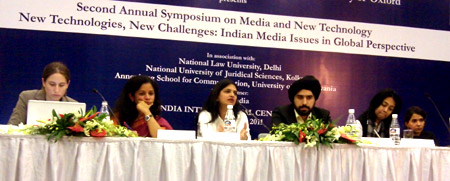
    The second annual symposium on ‘Media and New Technology – New Technologies, New Challenges: Indian Media Issues in Global Perspective’ hosted by Star India in New Delhi, on December 19th and 20th, set the ground for exploring international and comparative perspectives on the current media regulation debate and the role of information in the society in the times to come.


    The symposium, an initiative of Oxford University’s Programme in Comparative Media Law & Policy (PCMLP), in cooperation with its academic partners – the National Law University-Delhi, the National University of Juridical Sciences-Kolkata, and the Annenberg School for Communication at the University of Pennsylvania, brought together the diverse views of academics, bureaucrats, policymakers, industry leaders, civil society and legal experts to discuss such issues as law and responsibilities of self-regulation of media entities, regulation of the Internet, and emerging technologies in the context of freedom of information, privacy, and freedom of expression.


    Setting the tone of the two-day seminar, in his opening address, Uday Kumar Varma, Secretary, Ministry of Information & Broadcasting announced the government’s roadmap both for digitization and content regulation.


    Some of the other key speakers who addressed the participants at this symposium included Mark Stephens, Former Legal Advisor for Wikileaks; Osama Abu-Dehays, Head of Legal Affairs, Al Jazeera; Arvind Rajagopal, Professor of Media, Culture and Communication, NYU; Blair Levin, Communications & Society Fellow, Aspen Institute; Siddharth Varadarajan, Editor at The Hindu; Siddharth Narrain, Alternative Law Forum, Bangalore; Manoj Mitta, Senior Editor at The Times of India; Sevanti Ninan, Founder of TheHoot.com; and Monroe Price, Director, Center for Global Communication Studies, University of Pennsylvania.


    From trends in media regulation over the past year to the changing role of regulators, to the number of new challenges posed by evolving technology to media companies and the lawyers who represent them, a flurry of viewpoints were exchanged in the extensive debates.


    Deepak Jacob, EVP & General Counsel – Legal & Regulatory Affairs, Star India said, “I think this debate keeps the entire discussion and controversy around media regulation, it keeps it on the boil. You get different viewpoints, you get the contra viewpoint, you get the ‘for regulation’ viewpoint. So I think it’s healthy to keep this debate alive.”


    Panelists from different disciplines added to the flavour and scope of discussions. Nicole Stremlau, Coordinator, Programme in Comparative Media Law and Policy, University of Oxford said, “We tried to bring together the different research streams that are active here in India. So we brought together academics from universities, researchers from think tanks, as well as others working in the industry. So we very much tried to have a discussion across disciplines and across institutions. On the one hand, we had anthropologists, sociologists talking about the vast changes in the media policy and media regulation in India and on the other hand we also had a legal stream. So we had emerging lawyers discussing some of the pressing legal issues here and how they do research on these issues.”


    Is self-regulation possible?

    Following the recent controversy on content regulation sparked by Telecom Minister Kapil Sibal, interesting points on self-regulation of the media came up during the course of discussions. While Blair Levin, Communications & Society Fellow, Aspen Institute thought that it’s important to look at the particular issue to determine whether there is a need for the govt to step in or whether the industry can regulate itself, Deepak Jacob, EVP & General Counsel – Legal & Regulatory Affairs, Star India felt that the implementation of the self-regulatory mechanism is the biggest challenge. He said, “That’s always going to be a challenge, to educate, to make people aware of how self-regulation is the best way forward. I think that’s going to be the biggest challenge because people really intuitively don’t believe in self-regulation. They always believe that the govt has a huge role to play and should be censoring content.” Deepak Jacob also added that people are reading too much into Kapil Sibal’s move.


    [youtube width=”400″ height=”200″]http://www.youtube.com/watch?v=bOJ_EOHawOI[/youtube]

    Deepak Jacob of Star India on challenges of self-regulation


    ‘Informal censorship is happening’

    Another interesting point was made by Chinmayi Arun, Assistant Professor, National University of Jurisdical Sciences, Kolkata who feels that there is state-driven censorship taking place at an informal level. She said, “When we discuss censorship or interception of data, basically govt influence of information online, we tend to think of it in formal terms, that has the government officially asked for a certain amount of information, has the government officially asked certain sites to block a certain kind of information. But there’s actually a vast amount of blocking and interception that may possibly be done through informal mechanisms. And I think that perhaps this is one of those informal mechanisms surfacing.”


    [youtube width=”400″ height=”200″]http://www.youtube.com/watch?v=tmNH3tZgPJc[/youtube]

    Prof Chinmayi Arun on state-driven censorship


    Speed, affordability… and freedom?

    Talking of broadband access and the debate around filtering content, Blair Levin, Communications & Society Fellow, Aspen Institute agreed that the issue does get trickier with the nature of broadband but particularly in India, he said, “The debate is in a very early stage, in part because there is so little broadband, and in part frankly because the wireless technology, that’s going to be the necessary tool to bring broadband to most people in India, really is very early on in the game. It is only now that we have the kind of technology that can deliver real broadband speeds over wireless platforms. And really only now that the costs of the devices have come down to a level where a number of people can afford them.”


    Citing his personal experience with working on the National Broadband Plan in the US, Mr Levin stated that the situation and the challenges in India are very different from that in the US. He said, “In India, the great challenge is how do you get, first the underlying infrastructure in a number of places. Though I would say that infrastructure ought to be much more wireless than wired but then there is really the challenge of how do you make sure it’s a productive infrastructure? It’s a similar challenge in the US but the details are quite different.”


    [youtube width=”400″ height=”200″]http://www.youtube.com/watch?v=wdQDkQQaU2E[/youtube]

    The debate on whether the govt can filter or block content in both broadcast and broadband mediums, Mr Levin feels, will continue, as it has for the past so many decades, but he hopes that “the government here, as well as elsewhere, can get the balance right”.


    Dr Blair Levin on the debate in India on filtering content

  • The Anchor: 6 wishes for Santa from the advertising industry

    By Arvind Sharma


    #1 A year of bountiful growth for the economy: We really need Santa’s intervention on this. Only if the economy is good will clients put money into new launches. And support their current businesses with confidence. And help the advertising industry thrive.


    #2 Many dozen outstanding campaigns across categories: These become tougher to sell in a tight economy, which I anticipate.


    #3 Hundreds of high-quality young people joining the industry next year: Talented young people are the lifeblood of our industry. We need lots of them.


    #4 Emergence of a real alternative to cricket:  There is just too much of cricket. Audience interest in it is flagging, and so are returns from it.


    #5 Penetration of high-speed broadband internet across the length and breadth of the country: After the cellphone revolution, this can be the next big driver of growth for the country and the advertising industry.


    #6 Many more global campaigns out of India: Global recognition for Indian advertising talent has been growing. This should now convert into India becoming a major centre that MNC clients regularly look to for their global campaigns.


    Arvind Sharma is the Chairman of India Subcontinent at Leo Burnett.

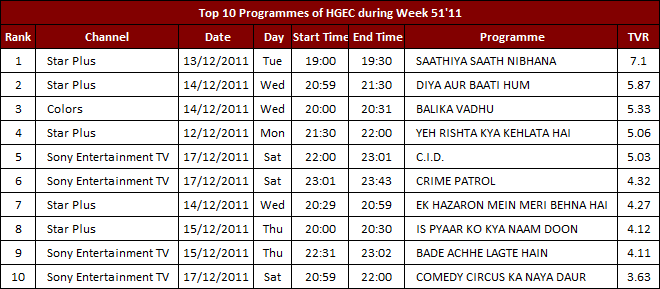
  • TAM data Top 10 programmes on HGEC – Wk 51 ’11

    Source: TAM Peoplemeter System
    TG: CS 4+ yrs
    Market: Hindi Speaking Market
    Period: Wk 51 (Dec 11 to Dec 17) 2011


    About TAM Media Research


    TAM is a joint venture between Nielsen Company & Kantar Media Research. Besides measuring TV Viewership, TAM also monitors Advertising Expenditure of Television, Print & Radio through its division AdEx India. Since 2004, it extended its presence in the PR Measurement & Analysis space for Corporate/Marketing Clients by setting up a separate division Eikona PR Measurement.


    In 2007, the joint venture introduced RAM (Radio Audio Measurement) service to track Radio Listenership for the Indian Radio Broadcast Industry. In year 2009, TAM launched a division, called TAM Sports that specializes in monitoring Sports Sponsorship ROI.


    TAM Media Research’s objective is to fuel media insights that will drive the growth of the Indian Media Industry.

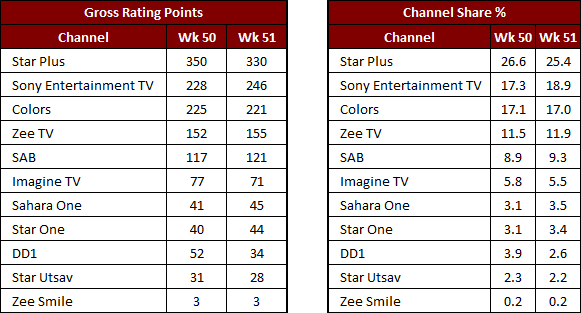
  • GRP Channel shares of HGECs- Wk 51 ’11

    Source: TAM Peoplemeter System
    TG: CS 4+ yrs
    Market: HSM
    Period: Wk 50: Dec 4 to Dec 10, 2011
    Period: Wk 51: Dec 11 to Dec 17, 2011

    About TAM Media Research


    TAM is a joint venture between Nielsen Company & Kantar Media Research. Besides measuring TV Viewership, TAM also monitors Advertising Expenditure of Television, Print & Radio through its division AdEx India. Since 2004, it extended its presence in the PR Measurement & Analysis space for Corporate/Marketing Clients by setting up a separate division Eikona PR Measurement.


    In 2007, the joint venture introduced RAM (Radio Audio Measurement) service to track Radio Listenership for the Indian Radio Broadcast Industry. In year 2009, TAM launched a division, called TAM Sports that specializes in monitoring Sports Sponsorship ROI.


    TAM Media Research’s objective is to fuel media insights that will drive the growth of the Indian Media Industry.

  • Dharker & Aiyar face the heat for speaking their mind

    By Ranjona Banerji


    One of the differences between the spoken and written word in journalism has been highlighted in the discussions about Anna Hazare and the Lokpal Bill. Senior journalist Anil Dharker called Hazare a man of “limited intellectual abilities” on Times Now on Monday night. The panel around him exploded with outrage, with anchor Arnab Goswami reacting with his best display of inner sadness, magnanimously offering Dharker a chance to “retract” his statement. Dharker refused. Goswami made it clear that Times Now did not endorse Dharker’s views and was not in favour of personal remarks.


    Oddly, Goswami was not so upset when Ashok Pandit told Hamida Naeem that she “looked like a terrorist”. Clearly, being a terrorist is less offensive than being stupid.
    Now Mani Shankar Aiyar is in the dock on social media sites for saying on CNN-IBN, “We made a huge mistake in converting this Team Anna into a Frankenstein’s monster. Now they have had their say, we have thought about it… It is my job as a Parliamentarian to legislate. I had plenty of time to legislate and I hope that we get through this Lokpal Bill and can tell Team Anna to go back to flogging drunkards in Ralegaon Siddhi.”


    Had Dharker and Aiyar written the same words in articles or columns, the anger would have been slight. There is something about hearing such sentiments which seems to arouse us, while we can read much worse with perfect equanimity. Perhaps that is why all our panel discussions on Indian television disintegrate so fast into vulgar slanging matches.


    **


    I was at a panel discussion on paid news organised by Moneylife Foundation on Tuesday, together with journalists Smruti Koppikar and Dyanada Deshpande, with Geeta Seshu. It is sad to see the amount of despair and cynicism, but it is also clear that something has to be done. Better watchdogs, more resistance to management pressure, more public disclosures were some of the suggestions made. Ideas are welcome on what can and needs to be done.


    For those who have missed it, try and watch Umesh Aggarwal’s documentary Brokering News. Also, go to the Press Council website and read the report on paid news - attempts were made to suppress it by owners of media houses and the report is up with a disclaimer!


    Perhaps Press Council chairman Markandey Katju, in between his deliberations on who should get the next Bharat Ratna, should take on owners and managements?

  • Prasoon Joshi is Jury Prez of Press Lotus @ Adfest 2012

    By A Correspondent


    Prasoon Joshi, executive chairman and CEO, McCann WorldgroupIndiais joining ADFEST’s all star line-up of jury presidents in 2012, overseeing the Press Lotus jury panel.


    As Regional ECD for McCann Erickson (Asia Pacific), Mr Joshi is one of the region’s most powerful advertising creatives. He was recently mandated with the leadership of McCann Erickson’s worldwide Creative Council, making him the most influential creative executive in the network.


    “I was jury president for Film some years ago at ADFEST, and today the quest for excellence remains intact. ADFEST is one of the oldest advertising communication festivals, which understands and appreciates the unique cultural fabric of Asia. It has experimented and has tried to reinvent itself and stay relevant in these changing times,” said Mr Joshi.


    Winner of more than 400 national and international awards, Mr Joshi also won the prestigious National Award by the President of India for his socially impactful work in 2009.


    “It is an honour to have Mr Joshi oversee the Press Lotus juries at ADFEST 2012. He is not just a phenomenal talent – he’s one of India’s most powerful creative executives, and we are humbled to have him accept our invitation to attend next year’s Festival,” said Jimmy Lam, president, ADFEST.


    The Times of India recently cited Mr Joshi amongst the nation’s Top 60 icons; while Business Today named him as one of the Top 21 Business Leaders who will shape India in the 21st century.


    With a postgraduate in Physics, Mr Joshi is also a prolific poet, feature film song and scriptwriter.

  • Debrief: The one-upmanship trick

    By Anil Thakraney


    It’s raining smart phones in the market. And they need smart ads to get noticed. Well, Samsung has found a Smart Alec way to achieve that for its new brand, Galaxy Y.


    The phone, as you can imagine, is targetted at the tech-savvy youth. And the core idea is that the smart phone helps the kids ‘fix’ their seniors/elders. In one ad, a suit stops his luxury car and asks some youngsters for directions to a place. But he makes the fatal mistake of addressing them as ‘kids’, and this energizes one of the spunky girls to show some attitude with her hot new phone. As she challenges the ‘uncle’ with: Aapke paas nahin hai kya? Similarly in the other ad, an angsty boss gets put in his place by a junior who plays around with his funky Galaxy.


    [youtube width=”400″ height=”200″]http://www.youtube.com/watch?v=DXTlU2kLjyg[/youtube]
    [youtube width=”400″ height=”200″]http://www.youtube.com/watch?v=SMUSdYSa3Qs[/youtube]

    Not a bad idea. The challenge ‘Aapke paas nahin hai kya?’ makes the owner of the phone feel superior, and this trick should appeal to kids who are forever looking to outwit their seniors, to go one-up on them. In that sense the insight is relevant and the idea campaignable. Should work.


    However, where the commercials falter a bit is in the execution. The treatment lacks finesse, it looks sophomoric. And the humour could have been stronger, they need wittier situations. Nothing that can’t be fixed.


    Rating: (On a scale of 1 to 5): 2.5. Good thought, but needs stylish play.