Author: mxmadmin

  • India is a long-term play for us: Sukanti Ghosh, APCO

    By Johnson Napier


    In a day and age where PR agencies are grappling with each other in offering services with a differentiated touch, US-based APCO Worldwide has its own unique formula of approaching the Indian communications space. Far from being referred to as a PR agency, the firm would rather let each of its verticals, be it corporate advisory, government affairs or civil, act as individual competitors versus the other full-time agencies in the space.


    Entrusted with the task of bringing a differentiated tactic to the market is Sukanti Ghosh, MD, India for APCO, who has donned several communication hats across the sectors of radio, advertising, and banking & financial services. In conversation with Johnson Napier of MxM India, Ghosh elaborates on the tremendous scope for agencies to make it big in India and how government relations & public affairs would be a large space to reckon with in the years to come. Excerpts:


    In a largely blurred communications space where agencies try to play the differentiating game very cleverly, how would you categorise APCO Worldwide as an agency in India?

    If you look at the Indian communications industry, it is at the various stages of maturity; it’s along a continuum. So on one hand, we have a lot of the commoditised services in India, and frankly speaking, there is no bottom to that pit – there is always another mom-and-pop agency who will offer a service at a cheaper rate – and there is another end of the spectrum that is highly evolved, extremely mature and as good as any other global market. So it depends on which end of the market you want to play in. APCO, nowhere in the world, really plays in the commoditised end of the communications industry. So like there are many Indias within India, similarly, there are many communication industries within the communication industry. It occupies and lives in various forms of maturity. You have to decide which slice of the market you want to play in.


    So what is it about APCO in India that you would say is different?

    What has defined APCO since I have joined is that we are very clear about the market that we want to play in. APCO looks at communications very differently. If you are aware of the Venn diagram that we studied in school (three intertwined circles), we typically turn around and say, if you look at the three circles – one is business strategy of any company, the other is public perception or civil society and the third is government regulations – there is an interplay between the three and whenever there is an interplay between the three that is where we are the strongest.

    So to begin with, if you remove the government element and look at the other two elements of business strategy and civil that is where you get marketing communications. Frankly, that’s not an area where we are the strongest and that is not an area that we would want to play in. Then if you take out the part of civil society, and look at the interplay of government and business only then that’s where you get the issues that keep arising every day.

    Today if you look at India and where we are as a country, civil society and the voice of civil society is here to stay and it will only become stronger going forward. Again, that is not an area where we want to play.

    We are very clear that at the outset, we are US FCPA (Foreign Corrupt Practices Act) compliant, we are UK Bribery Act compliant; we believe in ethical representation and in the sphere of ethical representation, we are the single largest ethically-owned firm in the US, and also the eleventh largest around the world and that’s where we want to grow.

    If you look at the third element, where if you remove out business and look at the interplay between government and the people, that’s where public awareness advertising from the government arises. Again, if you look at the government and business, that’s where you have a number of government initiatives to try and rope in business, that’s where we are again strong. An example is the vibrant Gujarat campaign that won few awards despite being pitted against some brilliant campaigns from around the world. So that’s going to be our focus at this point in time.

    Do we really see ourselves as a marketing communications agency – perhaps not. That’s not an area we want to focus on. We would want to focus on selective areas of communications in the broader sense and do well in that.


    How would you analyse the performance of your core businesses in India?

    Globally, we are a market leader in public affairs, we are a market leader in STG (service to government) practices and we hope to replicate that model out here in India. It would be fair to say that we have got off to a very good start in India. We have more than doubled our revenues from the year before, we are working with some of the finest Fortune 500 companies in India, we are fortunate to have worked with the government of Gujarat and are seriously looking at growing business in that space. Also, even as we speak we are working with several companies, advising them on public-private partnerships; helping them work alongside the government because we believe the Indian government is at a stage where it is more than ready to look at and listen to global leaders to hasten the pace of progress in this country. That is something unique because most companies that have come into India have a misconception with regard to the government and the way it works.


    While it seems to be a merry-making affair for you in the government and public affairs space in India, it is not the case with other players who appear apprehensive of making it big into this space. Then there are also allegations of red tape and corruption. Your comments?

    Frankly, in the last sixteen months, we have never faced a single problem working with the government. Part of it is misconception and part of it is reality, but the fact is that it is only when a company wants to take a shortcut that the problem arises. The government has very clearly defined processes and companies need to understand and work the processes. The fact is that India is a long term play; so you’ve got to work here to stay and proceed accordingly.

    We also help companies in understanding policies and regulations. The latest example being the FDI norms in retail being discussed lately. So the output does not have to be limited to the media; there are cases where you will work with the media and that is only right, but it does not have to be limited to only the media.


    Increasing number of multinationals are evincing interest in India while India continues to look up to the outside world for encouragement. What are the trends that you foresee currently on that front?

    There are a couple of things happening on that front. If you look at the STG space – I am referring to outward investment as well – there are a couple of things being observed. One is the government bodies or the economic development boards, are today trying to woo Indian companies and get Indian companies to invest in their markets. If you look at the policies space, there are so many Bills that are being talked about, there are so many changes in terms of legislative reforms and these are throwing up hundred different opportunities for companies. So that in itself is humongous.

    Globally, if you look at APCO, we focus on a number of areas and those are the areas that we will continue to focus on. We focus a lot on energy and renewable energy, on telecom, on food & consumer products…we are probably the single largest player in the healthcare space. So we would be bringing and developing a number of these practices in India.


    How is APCO Worldwide performing outside of India? Also, what are your plans for India outside the two metros that you are already present in?

    Apart from Washington, US, which is our largest office around the world and 2-3 regional offices, our London office has a few odd people, Dubai has 40-odd people, Brussels has 40-odd people, and all the other offices are around 20-odd people in operations.

    In India we see ourselves moving to three offices by next year, we see ourselves adding one more office in the south besides Mumbai and Delhi. We would grow to be about 50 people soon.

    If you see recent industry reports that classify firms from small, medium and large, I think without trying too much in the span of one year, we are very much already in the middle. We are very confident of growing very quickly into the so-called large segment very soon.


    How would you rate the fee structure that agencies command in India? There are allegations of it being under-par compared to other countries?

    We are expensive and our clients know that we are expensive. Clients know that they will get firms for half the cost but they come to us for the quality and value that we deliver; they don’t come to us for the fees that we charge. In certain parts of the business we compete with the big four, in certain parts of the business we compete with law firms, with the communications industry, and so on but the fact is that we have never had an issue with fees. It is made out to be an issue primarily because you are on the wrong end of the value chain. So you won’t see our people running around with press releases, issuing statements or chasing people.


    Do you largely agree with the claim that the PR industry in India is largely unorganised?

    I thing the PR agencies have brought it on themselves because they have become so tactical at the bottom end of the spectrum that there is always a cheaper option. And when you are at that level, you would never command a premium and it will always be unorganised. But does that mean that there is no organised side of the business, of course there is. The thing is, India is a large country and is big enough for everybody. Even the largest PR agency is India is around about 40 crores or so, according to Holmes report. This despite them being very big in the communications space and having a large clientele. So you can imagine the opportunity that exists in the communications space.


    What is the emphasis that you lay on digital?

    Globally, we are very big in the digital space. We have a unit called APCO Online, a pureplay social media unit that has won more than 300 awards across the world. So those are resources that we would be bringing to India. So it’s one of the units that we would be looking at very closely in 2012.


    Given your diverse presence across industries, who would you cite as competition?

    I can’t name any one firm. In corporate advisory we compete with management consulting firms, in the public affairs space we compete with some of the large law firms; there are very few communication agencies that are doing serious public affairs work. The thing about APCO that strikes me the most is the number of clients who have been with us in upwards of ten years and also the number of people who have been with us average around 10-15 years. So it’s largely a firm that is relationship-led; it is largely a firm that is culturally very strong and frankly speaking, you either fit into the culture or you don’t.


    Is the current economic scenario casting its toll on the industry?

    We grew at a rate of 6.9 per cent in the last quarter which was the slowest in the last 8-9 quarters, but the fact is, how many countries have grown by that per cent around the world? We may be going through a bit of a rough patch, but we will get out of it eventually. Is it a period of concern for us, I guess not. I think there are austerity measures that have been undertaken and there is a note of caution everywhere.


    What are the imminent challenges facing the industry?

    There are two big challenges that face the PR industry, the first being the PR industry itself. The second being people. The skill gap that we keep talking about for other sectors is very real for our sector as well. The trend internationally is that people are very focused when it comes to taking selective career paths and so they go ahead and specialize in that from the beginning. That’s not what is happening here. In India, it is still an emerging profession and with all emerging professions there is a period of instability but there will be a shakeup. We need to elevate the status of the industry. Unless we get PR out of being just press releases into being something a lot more sophisticated and holistic, we will not get the right people.


    What are the trends you foresee for the industry, and for APCO, in 2012?

    For 2012, I see fierce competition and a certain degree of consolidation taking place. I foresee a lot of foreign companies coming to India and a lot of Indian firms willing to sell out. As for us, we are fiercely independent and we prefer to remain that way.
  • IRS 2011Q3. Digital growth bestest. Cinema, Radio decline

    By A Correspondent

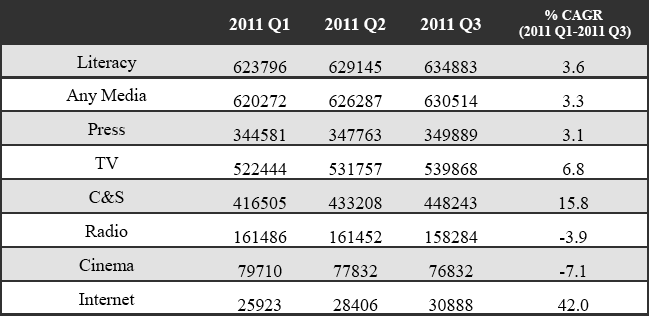
    As per the Indian Readership Survey (IRS) 2011 Q3 data, Cable & Satellite (C&S) and Internet are the two sectors which have shown the maximum growth in total reach. Radio, on the other hand, showed negative growth of 3.9 per cent CAGR with numbers declining from 161.45 million to 158.28 million. Internet, the fastest growing sector, recorded a growth of 42 per cent CAGR with the reach going up from 28.41 million in Q2 to 30.89 million in Q3.

    The total reach of the television media has also gone up by 6.8 per cent CAGR to 539.87 million in Q3 from 531.76 million in Q2 making it the third fastest growing sector.


    The Cable & Satellite (C&S) sector recorded a growth of 15.8 per cent, the only other sector to record double digit growth. C&S total reach is up at 448.24 million in Q3 compared to 433.21 million in Q2 2011. Cinema also recorded negative growth of 7 per cent with reach declining from 77.83 million in Q2 2011 to 76.83 million in Q3.


    All figures are in Average Issue Readership. Like media buyers, MxMIndia only endorses Average Issue Readership as the currency for readership measurement. Please note that these are only topline figures which have officially been supplied to the media. Sensible buying and planning happens when more data is available.


  • IRS 2011Q3: Dainik Jagran rules yet again

    The numbers from the latest round of the Indian Readership Survey are out as the Media Research Users Council and Hansa Research announced the findings of the third quarter of 2011.


    Dainik Jagran rules amongst all daily newspapers in the country while Vanita is the Magazine #1


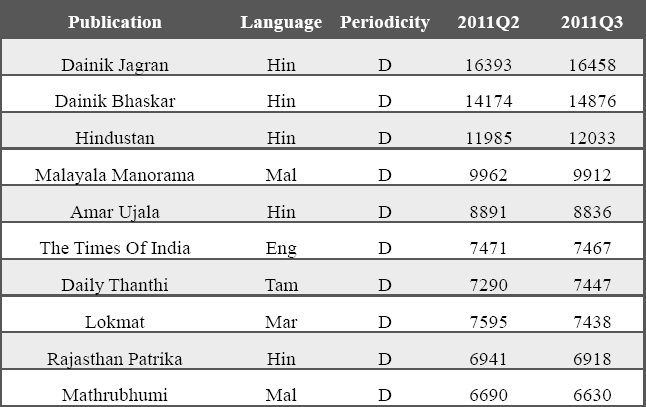
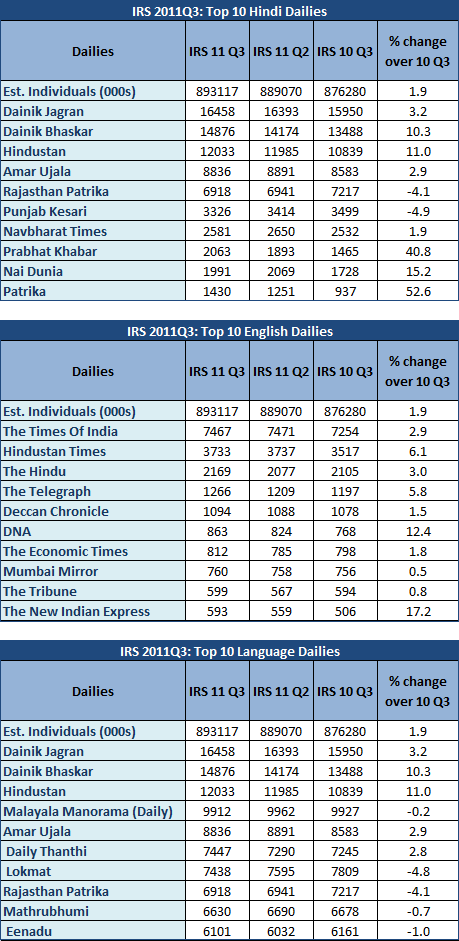
    Top 10 Publications

    (AIR numbers; All figures in 000s)


    Top 10 Publications

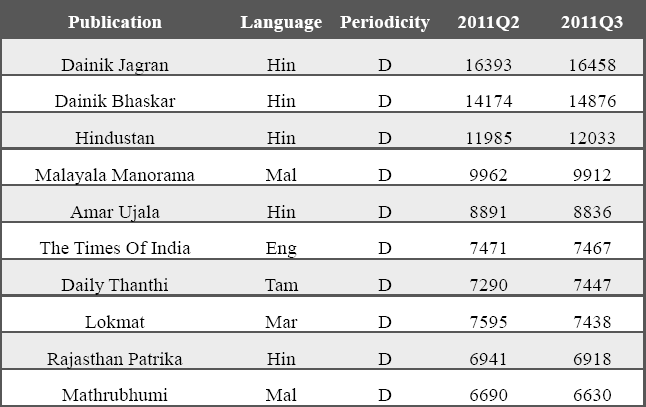
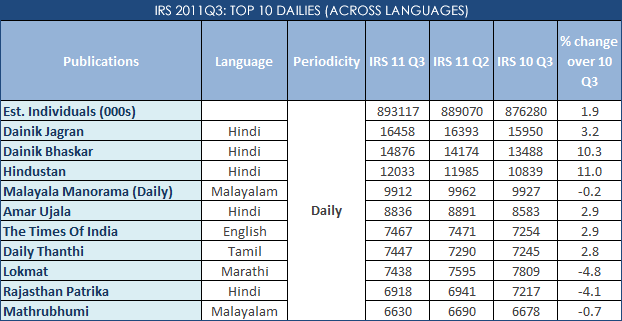
    There is no change in the rankings of the various publications among the Top 10 in terms of Average Issue Readership (AIR). The Top 3 slots are taken by Hindi dailies. Dainik Jagran rules with 16,458,000 followed by Dainik Bhaskar which is at 14,876,000. Hindustan is at No. 3 with 12,033,000. Malayala Manorama is at No. 4 at 9,91,2000 while Amar Ujala is the fifth with an average issue readership of 8,836,000. The Times of India, the only English newspaper in the Top 10, with an average readership of 7,467,000, is in the sixth position.


    The others in the Top 10 publications are: Daily Thanthi with 7,447,000, Lokmat with 7,438,000, Rajasthan Patrika with 6,918,000 and Mathrubhumi at 6,630,000. If you compare IRS 2011 Q3 with IRS 2011 Q2 then the top three dailies namely, Dainik Jagran, Dainik Bhaskar and Hindustan, and Daily Thanthi saw growth in their Average Issue Readership (AIR), whereas Malayala Manorama, Amar Ujala, Lokmat, Times of India, Rajasthan Patrika and Mathrubhumi, on the other hand, witnessed slight drop in their AIR.


    Top 10 Dailies

    (AIR numbers; All figues in 000s)


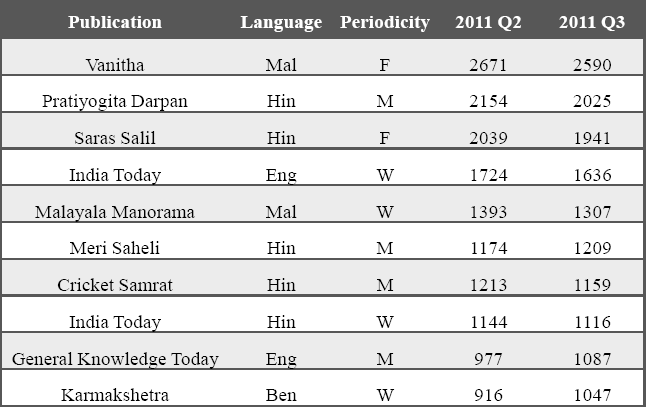
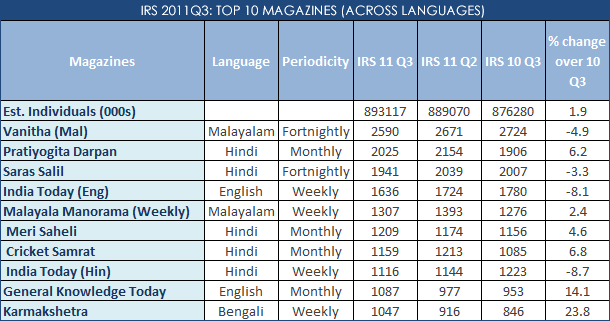
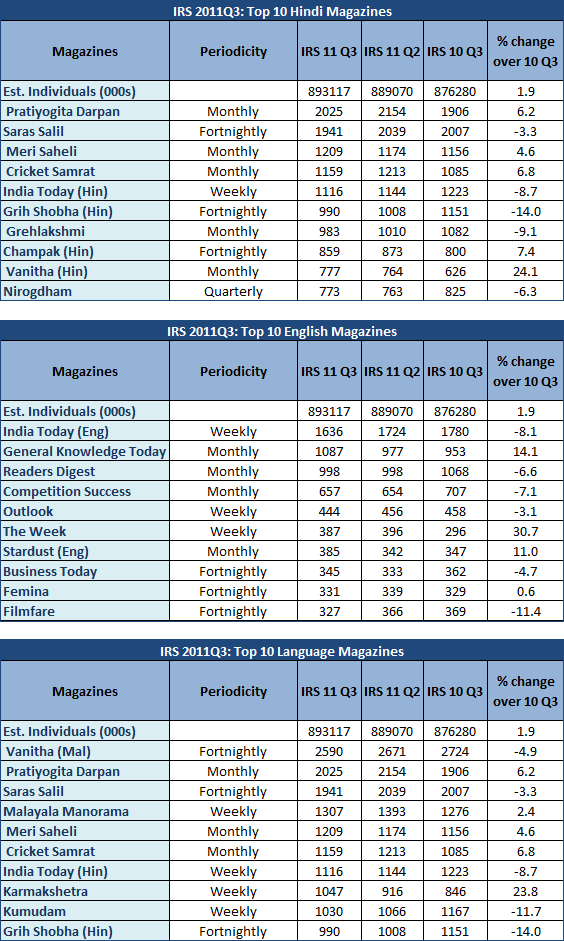
    Top 10 Magazines

    (AIR numbers; All figures in 000s)


    Vanitha continues to be the most read magazine,  followed by Pratiyogita Darpan, both have witnessed a slight decline in their AIR figures. Meri Saheli, General Knowledge Today and Karmakshetra are the only magazines in the top 10 to have witnessed any growth in their AIR.

  • Palasa now creative partners with KG Beverages


    Sandeep Bomble
    Nitin Gupta

    By Shubhangi Mehta


    Palasa has managed to win the creative mandates for KG Beverages, RESTLESS and BUZZ. Along with creative mandates, Palasa will also be involved in the packaging and marketing of both the products.


    RESTLESS is an action drink which will be competing with the likes of Red Bull and Cloud 9. KG Beverages will also be launching range of carbonated drinks like Lemon Clear drink,Orange, Green Apple Cola and Jeera Masala. BUZZ is premix alcoholic beverage which will be available in three exciting flavours.


    Sandeep Bomble, founder, director, Palasa, said: “We have been associated with KG beverages since 8 years and we have created this product range together. Many others wanted to be a part of it but no one else could win it, as it is our baby”.


    Nitin Gupta, CEO/founder, said: “I have worked with Sandeep for almost eight years for SYKZ and having seen his work, there was no question of calling other agencies to pitch. Sandeep’s work has always impressed me and we are already quite happy with whatever they are doing for the brand.”


  • Claims, counter-claims rule IRS again


    By A Correspondent


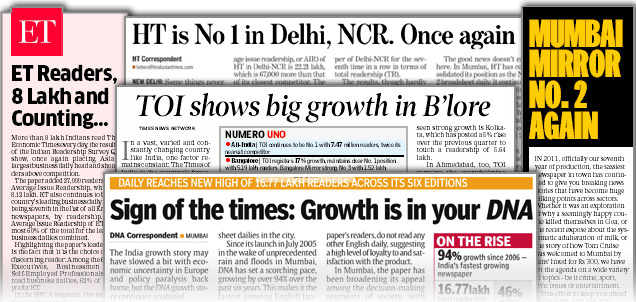
    It’s ironic. Mumbai is where most of the biggie media agencies exist. Some of the largest spenders are headquartered here. Still, publications pull out all stops to make crazy claims.


    Okay, they aren’t incorrect and the initiated amongst them can obviously see through the claims, but those who don’t – the lay reader, the young homemaker or the senior citizen who is not in the know – is sure to wonder what the truth. And if he/she subscribes to more than one paper, we are sure there will be some confusion.


    Obviously, the belief is that the reader is an ass. But this is a policy that can backfire terribly.


    But the confusion in a city like Mumbai is thanks to the two types of data that MRUC throws up in its IRSes – Average Issue Readership (AIR) and Total Readership (TR). Publications put up the data which throws them in better light. Also, newspaper X is a compact (tabloid- like-sized) newspaper while Y is a broadsheet. So one may be the #2 overall, another may be #2 broadsheet. Z may be #2 by TR and Y may be #2 by AIR.


    Fact is AIR is the accepted currency and there is a section which believes that a newspaper that comes free with another paper shouldn’t be taken for review. But there is a section which says that if a newspaper is able to attract revenues separately, that’s decidedly the best yardstick for the product’s utility. Perceived or otherwise.


    Sadly, the conferences which the Market Research Users Council and Hansa Research Group would conduct to release every round of the Indian Readership Survey have been done away with. The detailed dump is no longer handed out to the trade media. All of this charade of X, Y, Z could’ve been avoided had we got city and region-wise numbers from the MRUC (or via Hansa), but that’s not to be.


    Let’s look at the tables in detail (that we have based on the toplines publicly available).


    There’s no need of words. The growth or degrowth percentages tell the story. Some spectacular successes. Others not so.

  • Ad Strat: TVS Scooty Pep + – Go Babelicious

    Anil Thomas, ECD, McCann Ericksson


    Name of the Campaign/Ad:  TVS Scooty Pep + – Go Babelicious


    The Brief: Shift the battle beyond machine superiority in the minds of young women.


    Research insights:

    Since it was a collection of bikes with bright, bold colours, we tried to answer what makes girls go crazy about these bright but almost child-like colours and we stumbled upon the insight that as much as girls want to grow up into young women of substance there are also moments when they instead revel in their adolescence.

    Often this leads to a behaviour that is seen as immature by others but enjoyed by girls. Take for instance the popularity of characters like Hello Kitty and Hanna Montana, Baby-G watches, the use of shocking nail paint colours such as yellow or using bright coloured handbags.

    So to make this collection a fun and fashionable one, we decided we should legitimize this immature behaviour amongst girls and let them celebrate being that way. That’s how the creative brief “Lovably immature” was born.


    The thought process behind the creative:

    We saw an opportunity, with this collection, of going beyond the mobility factor, a look at the bold colours on offer and we wondered if we could position this collection as a fashion accessory. Yes, the bike helps you get there, but getting there looking absolutely babelicious doesn’t hurt either! So what others might find as shocking, the babelicious girl finds perfectly innocent and natural – be it a behaviour or the choice of bold striking colours for a scooter.

    Hence, the importance of spontaneity and effervescence in the characters who think it’s okay to create a ruckus so that she could get past a barricade or the simple act of wearing lipstick in the middle of the road.


    Media vehicles chosen:

    To truly make the Go Babelicious attitude into a rallying cry, a movement and a sub-culture of sorts, we had to explain what Go Babelicious meant, and then amplify it in the most vivid manner, which we did on TV, Print, YouTube, college campuses and so on.

    Our TG was an influencer/trendsetter among her peer group, and not a follower.

    Therefore, like any good fashion brand, we also targeted the places and the media our influencer TG would go for; fashion magazines like Cosmopolitan, English movie channels like HBO.


    [youtube width=”400″ height=”200″]http://www.youtube.com/watch?v=KKVxd6cOBN0[/youtube]
    [youtube width=”400″ height=”200″]http://www.youtube.com/watch?v=7qvTdkx20AY[/youtube]


    Key issues kept in mind while executing the ad:

    It was a tight rope walk. The most important point kept in mind during execution was to keep the communication in the lovable zone and to ensure it doesn’t cross the lines.


    Does the treatment do justice to the brief?

    The idea was to get Scooty Pep+ to own the lovably immature behaviour, just like how successful fashion brands own a philosophy or an attitude, by manifesting it through an attitude statement.

    The TVCs were about girls doing crazy, fun things and getting away with it scot-free because of the manner in which it was done, be it exasperating the traffic cop into letting her go through despite the oncoming VIP convoy or just wanting to do her make-up using the window of a car beside her at the traffic signal as a mirror, without worrying about its effect on the driver.

    In this case, we manifested “lovably immature” through the attitude statement of “Go Babelicious” which was a rallying cry to all the girls to let out their adolescent, crazy side without inhibition.


    What according to you is the differentiating factor about the ad?

    We knew that other marketers were selling scooterettes on the basis of power and performance. In effect, they were speaking to the entire market as if it comprised of

    100% male consumers. CC, BHP and mileage were the main conversations happening in a market in which 40% of the users were young girls/women in the age group 18-24 years.

    Clearly this TG did not understand the technology aspects of a scooterette and beyond a point didn’t care about it either. The first decision we took was to ensure that we would communicate with women like they were women, and not pretend that they were men!


    Market and client feedback:

    The campaign arrested a steep decline in sales of -27% and went on to achieve a 25% growth in the same year. Despite a competitive functional benefit, the brand parameters improved. Single woman’s perceptions and intender’s consideration scores of brand Scooty registered an upswing.

    In short we succeeded in shifting the battle to fulfilling emotional need states. Making consumers not just buy us but fall in love with us.


  • How HC took the wind out of our channels’ sails

    By Ranjona Banerji


    The Bombay High Court sort of took the wind out of the sails of not just the Anna Hazare movement, but also our excitable TV channels. Suddenly, their high-pitched pro-Hazare campaigns had to deal with a court questioning the motives of this save-India hysteria.


    The best way out was to just sidestep the issue, so Times Now went further into the reservation issue, plus an interview with Justice JS Verma who supports it, Headlines Today dwelt on the court a bit but concentrated on the now-tedious arguments between India Against Corruption activists and others, NDTV interviewed Arvind Kejriwal and so on.


    The newspapers, however, did not restrain themselves, except perhaps The Times of India, whose headline on Saturday was a staid: “Allowing agitation may be akin to meddling with House affairs: HC”. Compare this with Hindustan Times: “After HC snub, Anna blames team” or The Telegraph,Calcutta: “Team Anna gets a lesson in democracy” or Deccan Chronicle,Hyderabad: “Team Anna earns sharp rebuke from Bombay High Court”. Mid-Day, surprisingly, did not have it on the front page. It was, after all, a Mumbai story.


    The Bombay High Court indeed pointed out that it could not grant concessions to the movement as it was not convinced that this was a people’s movement and an endorsement by the court would be tantamount to the judiciary interfering with Parliamentary procedure.


    The judges said, “How is country’s interest involved? We are a democratic set up. We have elected a government. Wouldn’t your agitation interfere in the functioning of Parliament? The bill will be debated in Parliament where our elected representatives will plead our case.”


    Mani Shankar Aiyar was quick to point out that the point made by the court was too sophisticated for Anna Hazare’s followers to understand! Interestingly, Anna Hazare and his followers were sensible enough to refrain from attacking the court for being anti-people or anti-democracy.


    The flip-flop on accepting donations by Anna Hazare (first no and now that they need the money, yes) was also downplayed by The Times of India but not by others.


    Hindustan Times also carries a story about how an anti-Jan Lokpal agitation is now going on at Mumbai’s Azad Maidan, with activists, celebrities and journalists taking part. Perhaps this is democracy at work? Agitations against agitations?


    * * *

    Three edit pages pieces were well worth reading on Saturday morning. Jay Panda, MP, argued cogently for small “tweaks” in our current Parliamentary system to make it more up-to-date, while dismissing arguments for a change to the presidential system in The Times of India.


    Ramchandra Guha, historian, talked about how exasperated he has been in 2011 by Anna Hazare and his followers, the BJP and the government in Hindustan Times.


    And the piece de resistance was by Shekhar Gupta, editor of Indian Express, on the caste dynamics in corruption cases inIndia. He makes a compelling argument for the way in which the system is loaded against lower castes and religious minorities, in corruption and criminal cases – with examples. He also points out that our upper castes and classes are the most prejudiced section of society.


    Thought-provoking and definitely a must-read.


  • The power of Public Relations: Ajay Kakar

    By Ajay Kakar


    As a marketer, we have many communication tools to capitalise on for the advantage of our brands and our business. To me, these ‘weapons’ (advertising, direct marketing, public relations et al) are very akin to a Swiss army knife; you can use any or all of these weapons, depending on the task at hand.


    But in my many years at the agency end, with stints in direct marketing, advertising and public relations, and now as a client, I have found “PR” to be the least understood, appreciated and under-leveraged communication weapon – by both the marketing and (believe it or not) agency fraternities in India. And most surprisingly, the PR fraternity too.


    As a long standing convert and staunch believer in this discipline, let me share with you my 20-year-old association with the PR discipline and the reasons why I believe that it is arguably the most powerful communications arrow in a marketer’s quiver. Also the reasons why I believe that the discipline has yet not got its full dues.


    So here’s the story of my tryst with public relations, or, if I may so say, the story of public relations in India, over the last two decades.


    PR, in fact, changed my life!


    PR is actually the exotic siren who first tempted me to leave my career in accounting and audit, to venture into the (for me) unfamiliar and untrodden path of communications.


    In 1991, I came across an interview in the Business India, with a person called Steve Lyons (I still remember the name!), who was then the head of a company called ‘Ogilvy PR’ in Singapore.  Believe it or not, until then I had never even thought of the advertising world, or even heard of “Ogilvy”.


    The article impressed me so much that I immediately searched out the agency’s address and cold-called the then-MD of Ogilvy and Mather, India, Mr. Mani Aiyer, hoping for a break in his PR unit.


    Hearing my motivation for joining PR, he tried to temper my new found passion, but having gauged me as a person who was not going to be swayed easily, he had me meet the head of Ogilvy PR in India. And that meeting shattered all my dreams and illusions.


    In 1991, PR, in India was nothing more than “Press Relations” – getting media coverage…lots of it…at any cost.


    Dejected, I decided not to pursue this temptress. And when I went back to Mr. Aiyer to thank him for his time, he actually offered me a job in advertising. Needless to say, he made a passionate pitch that swept me off my feet. And on May 2, 2001, I became an employee of Ogilvy & Mather (though not Ogilvy Public Relations).


    But fate was not going to let me off the hook, so easily.


    In 2003 I was invited to take on an additional mandate at Ogilvy, as the country head of Ogilvy Public Relations, in India. Before the end of 2004, I was the president of the industry body, Public Relations Consultants Association of India. And in 2005 I had switched over to the other side, the client side, where I became an active user of PR.


    And today, as 2011 comes to an end and 2012 draws near…


    Two decades have passed, but ‘PR’ remains mere press relations – in the minds of the practitioners – be they the PR professionals, or their user base.  Of course there may be a few exceptions. But these are far and apart. “PR = press relations” is all that we care to believe. Unless….

    In moments of need, even atheists are tempted to remember God. …. “Forgive me father, for I have sinned”. And when brands have ‘sinned’ or find themselves in a tight spot, they have reached out for public relations and found this discipline to be a saviour.


    As an example, just remember the days when colas were synonymous with pesticide and you will know what I am referring to.


    But back to any ordinary day….

    At Ogilvy, I recollect instances when I presented a Rs5 crore estimate to a client for an advertising campaign (do remember that in the mid-90s this was a princely sum) and got an instant sign off. And then when I wore my PR hat and asked for a Rs5,000 pm hike in fee from the same client (do remember that even in the mid-90s, this was a meagre sum), the client would wear a thinking hat, but refuse to lift his pen to sign on the dotted line…and finally it used to boil down to… “But you guys make so much from us on advertising. So why do you need to be paid, for PR!”


    These instances would leave indelible marks of pain on my professional pride. But looking back at all such instances, I realised that I had to ‘forgive them, for they knew not what they did’. Because they knew not what PR is and what role PR can play in their lives and the lives of their brands.


    So it was the number of clips that we were measured by. Else, the column centimetres of editorial coverage. Or the rupee value of the editorial coverage. Or the coverage we got (or did not) for the client’s son’s sports day. Media coverage. Media coverage. Media coverage.


    This was and still is a malaise that ails the PR industry inIndia. And some parts of the world.


    What is PR? What are the key deliverables one should expect? How should the impact of PR be measured? How would you like to substantiate your proposed fee or fee hike?

    Ask 5 practitioners this question and in all probability you will get atleast 6 (different) responses. So as a client, how do I value or respect a ‘good thing’ when I don’t even know what it is! Or how to measure it!


    This has been a burning need for the industry to rally around and define and ‘standardise’ expectations, industry-wide definitions and measures. But two decades later, the questions remain the same. And there is yet no answer. No understanding. No empathy.


    So while the PR industry keeps asking “why are we paid peanuts”, the user industry keeps answering “because we (think we) are getting monkeys”. This never ending coffee-toffee debate needs a closure. Soon. And I do appeal to the industry to claim their rightful place under the sun. At the earliest. By first addressing the basics. The questions that we cannot wish away. And then, of course, delivering on them.


    Until then, it is to our collective disadvantage that PR is considered a mere commodity. And we are seen as under cutting each other to win mandates. These mandates are soon lost, when the client is not in a position to evaluate or measure our success. Or the lack of it.


    The client base of the public relations industry is increasing by the day (there will never ever be a shortage of clients). But the number of satisfied clients? The number of clients making use of, and benefiting from PR in all its glory? Who is counting!  And therefore it hurts the believers, when India wins a PR Lion at Cannes. Because it has been won by an ad agency! Not a PR agency.


    So is there mere gloom and doom in the PR industry? Not at all!


    There are various case studies where PR has hit the bull’s eye and demonstrated it’s true potential and power. Let’s visit some of these and take inspiration from them.


    Today’s exceptions, tomorrow’s rule…

    It would be right to cite a few examples here that could redefine the way PR is perceived.

    We all know of John Travolta as an actor, singer, dancer but do you know that he is also a licensed pilot? So when Qantas, the airline from ‘down under’Australia, wanted to reach out to as a relevant airline for European markets, they actually got John Travolta to fly their planes to these destinations. The kind of coverage that this exercise got in local as well as world media was mind-boggling. So Qantas used this “a facet of John that you did not know”, to express “a facet of Qantas that you did not know”.


    Cadbury’s was hit by a crisis – the worm infestation case – that nearly threatened the very existence of the brand in India, as mothers questioned their generations of trust in Cadbury’s chocolates. At Ogilvy PR I had the opportunity to partner this iconic brand and their leadership team on the exercise that is now a case study for Cadbury’s, worlwide.

    Customers. Channel. Influencers. Regulators. Government. Employees…all these key stakeholders had to be reached out to, repeatedly and regularly. And the media was only one of the bridges to reach out to them. It was “public” relations at play. And not mere ‘press’ relations.

    Today Cadburys keeps scaling greater highs. It not only won back the trust of a nation. But also its loyal customer base and their sales graph. And this incident appears to be a distant dream. But in those days, every day appeared to be like a never ending nightmare.

    As an agency and team, we had the opportunity to get into the hearts and minds of the senior management team on an ‘online real time’ basis. Every day. For weeks.


    Gillette is another company that has realised and capitalised on the power of PR, year after year. You will remember their W.A.L.S (Women Against Lazy Stubble) campaign. And now the Shavesutra campaign.  Their movement has resulted in 12.2 million Indians casting their vote for a clean shave. It also led to rise in sales and popularity of the product and also bagged numerous awards…their sales going up by 500 per cent, market share up by 400 per cent, an entry in the Guinness book of records…and over $ 2.5 million worth of free media coverage.


    The Body Shop is another classic example of a brand that has enjoyed the favours of PR. No advertising. And still, it’s a global brand with very strong bondings with its consumers, as an eco friendly company.


    Or, the mother of all “PR” campaigns… Mahatma Gandhi’s freedom struggle. He influenced an entire nation to realise the power of self rule… and got ‘results’ in the form of India’s Independence.


    So, while PR is about press relations, it is also about influencing the influencer. It’s about creating credibility and about credible ways of influencing people to act. It is not only about journalists but about customers, employees, shareholders, channel partners and other key stakeholder’s perceptions management. It is a weapon that can do wonders in not only the brand’s good times, but more so in the bad times too. It can give business solutions and tangible results.


    So if you ask me, PR is about ‘Public’ and not ‘Press’ relations. It is about ideas that influence and engage my ‘public’ and something that has a multiplier effect. The credible way. And my belief is that if you capture the right essence of PR, you will not need to chase the media. The media will come chasing you.


    From a client’s perspective, if my PR agency helps me achieve my KRAs in a simpler, cheaper and faster way, then why will I not chase you? If as clients, we earn a fixed and variable salary, then why shouldn’t my PR agency also be assessed and remunerated that way? And that the variable component should be based on tangible results.  My belief is that this is one industry where the potential of an agency’s variable earnings outstripping the fixed component is very high.


    If PR can demonstrate how it can help me increase my profits, customer base and revenues, in short help me achieve  my KRAs, then forget peanuts, I weigh them in “gold”.


    Towards this destination, two points to ponder:

    • We need talent that can deliver on this potential. Talent that can claim to be a “strategic counsel”. Talent that only handles the number of clients it can give the requisite attention to.  Today, when it comes to advertising, we can even put faces to the next generation of the industry.
    • There is so much (though still inadequate) talent. But when it comes to the PR industry? I am sure that we have many unsung heroes – be they agencies, professionals or success stories. Can the PR industry do its own PR, so that we all have role models that inspire us and we aspire to emulate?


    Ajay Kakar is CMO – Financial Services, Aditya Birla Group


  • Anil Thakraney: An open letter to the PM

    By Anil Thakraney


    Dear MMS,


    You complain that India Inc’s negative comments are disappointing. You are apparently displeased about what the suits have to say about your government. That the UPA’s policies are quite depressing for business in India.


    Well, Sirji, the industry leaders have every reason to feel disheartened and negative about theIndiastory. If at all, I would say they are being pretty mild and cautious in their observations, because they can’t afford to upset the assorted politicians and bureaucrats in your team. Backlash from an upset government can be rather hurtful.


    Before you sulk over their comments, let’s examine your own track record since UPA-2 came to power: In the last one year alone, fuel prices have spiralled out of control, sending the economy for a toss and making the inflation figures go through the roof.


    As if that was not bad enough, the rupee is getting weaker by the day, and has now hit an all-time low. What is particularly pathetic, is that all this is happening under the leadership of a man touted as a master economist.


    I am not going to discuss the crashing infrastructure in the metros (many firang suits are known to take a sharp U-turn the moment they emerge from the Mumbai airport) because it’s too damn depressing. But I must point out that the multiple financial scams under your rule have not just tarnished the nation’s image, they have made India a highly suspect destination for business.


    In fact, the Anna Hazare campaign has made India look like a global clown on the world stage. And by the way, your complete mishandling of the Anna team hasn’t helped matters at all.


    And oh, just what happened with the FDI in multi-brand retail idea? You did not have the skills and means to push it through. At the very first sign of protest from the opposition leaders you ducked for cover. How encouraging is that for India Inc? It doesn’t end here. Your various ministers are often at war with each other, and as a leader you seem to have no control over their bickering.


    Sir, it’s a long list of gripes, and frankly I don’t want to put out the laundry list and destroy the New Year festive mood. But let me just say this: Instead of feeling bad, you should be thrilled that despite your government’s abysmal performance and dubious policies, many business leaders continue to be bullish on India.


    Thank them rather than complain. Happy New Year!


    * * *


    PS: Fantastic presentation at the BAFTA by acclaimed screenplay writer Charlie Kaufman. Totally from the heart, and an eye-opener. A must watch not just for those in the movie business but for all creative people.


    Link: http://video.bafta.org/services/player/bcpid1089742060001?bckey=AQ~~,AAAABxWZS7k~,uLPjGIDNpTm4SaHbu0n1-QlyJhJ3l3ls&bctid=1314090439001

  • Imran Khan to endorse MTS in Rs10 crore deal

    By Ratna Bhushan & Gulveen Aulakh


    Telecom service provider MTS India has roped in Bollywood actor Imran Khan as its brand ambassador for two years. The 10-crore deal makes the Delhi Belly star the latest one to join a long list of celebrities, including Shah Rukh Khan, Abhishek Bachchan and MS Dhoni, endorsing telecom service companies. While it’s the first time that Sistema Shyam TeleServices’ brand has taken the celebrity plunge, Imran already endorses Coke and Levi’s jeans.


    MTS India spokesman and celebrity management firm, Kwan Entertainment, which doesn’t manage Khan but helped him striking this deal, declined to comment.


    “Imran will promote MTS through mass media, online and below-the-line promotional activities. He will also be part of Red Energy, a youth-centric online activity for the brand,” an official directly involved with the developments said.


    While the 2G scam has not deterred telecom firms from wooing celebrity endorsers, it has impacted their ad spends. Eight of the country’s top 10 TV advertisers during January-September this year were consumer goods makers. Idea Cellular was the only telecom firm in the ranking, according to the media research firm TAM.


    The telecom sector has been facing tough times with raging controversy on 2G spectrum allocation, rock-bottom tariffs, sliding average revenue per user, thinning margins and falling profits. High interest costs, banks shying away from lending and 3G roaming agreements being disputed by the government add to the sector’s problems.


    Approval and introduction of the new telecom policy that would have allowed liberal merger and acquisition norms and helped in consolidation of the sector, has been pushed back by nearly half a year. This may further add to telcos’ woes.


    Source: The Economic Times

    Copyright © 2011, Bennett, Coleman & Co. Ltd. All Rights Reserved

  • Small regional brands get modern retail push

    By Sagar Malviya


    Small and regional brands are tying up with retail giants to push their merchandise, as middle-class Indians shift from mom-and-pop stores to the comfort and variety of modern retail.


    The latest to join the bandwagon is ayurvedic products maker Baidyanath Ayurved Bhawan. The 95-year-old company has tied-up with Future Supply Chain Solutions, the logistics arm of retail giant Future Group to widen its consumer base and boost its position in the health products segment where it competes with Dabur and Emami. The Kolkata-based company will use Future Supply Chain’s network to sell its ayurvedic medicines, tonics, hair oils and toothpastes in more than 2,000 outlets in the country.


    Future Supply Chain serves several large retailers besides the parent group’s Big Bazaar.


    “More than just sales, modern trade gives a very high visibility that’s important to us. Also, it’s an easy way to break into newer markets without investing substantially in distribution,” said Ameve Sharma, president of the over 350-crore Baidyanath.


    This strategy is not only giving smaller brands a pan-India presence, but also helping them reap dividends. Within a year, the share of organised retail in total sales of brands such as Wagh Bakri tea, Super-Max shaving products, Nilon’s pickles, Dukes biscuits, NR Group’s Ripples fragrances has risen from near zero to about 15%.


    “Due to consumers moving and settling across geographies within the country, we are able to support small and regional brands get national footprint and also where relevant communities stay,” said Devendra Chawla, president of FMCG and food at Future Group. “For several small vendor partners, setting up distribution networks can mean lot of resources and costs. Modern trade is the quickest route to market in relevant markets,” he added.


    The move is also partly driven by the need to be where the competition is. “You have to be where your competitors are,” said Ravi Chandra, general manager, sales and marketing at Super-Max Personal Care, which earned 2% of sales from modern trade from just 0.2% a year earlier. “We have heightened our focus on modern trade as our product portfolio matched the target consumers of these stores,” Mr Chandra added.


    Nilon’s, the country’s largest pickle brand that was available in some 100 stores two years ago, is now available in 400 stores.


    “We were hardly present earlier in Mumbai and Tamil Nadu. We realise that the future in big cities is through large outlets,” said Nilon CEO Rajheev Agrawal. The company has seen sales from modern retail rise from 7% to 15%. Future Supply Chains, which works with 20 such clients, has added half of its clients over the past one year.


    “No distributor has an all-India presence, and that’s where we come in. We also take care of shelf and merchandise management,” saidAnshuman Singh,MDand CEO of Future Supply.


    However, firms say that jump-starting sales has its own problems. The margin for modern trade is higher than that of general trade, and small brands end up paying about 10% more than their bigger counterparts. But they are not complaining. “The fallout of margins is basically on the return on investments calculations and large stores are increasingly giving higher throughput,” said Mr Chandra.


    Also, these firms are getting into premium products, which need the platform of modern trade. For instance, Baidyanath is entering soaps and shampoos while Wagh Bakri Tea is focusing on tea bags and instant tea.


    This trade route has another plus: when a retailer expands, it carries the product with it. “Retailers have almost doubled their stores. This means more sales of our products,” said Anik Mukherjea, chief business creator (fragrances) in NR group, the Mysore-based maker of Cycle Agarbattis and Ripples.


    Source: The Economic Times

    Copyright © 2011, Bennett, Coleman & Co. Ltd. All Rights Reserved

  • Independents rule adland in 2011


    By Shubhangi Mehta


    Looking at 2011 and how well the independent agencies have performed this year, it can be said that this has been the year of independence for the independents who have managed to attract some big ticket clients.


    Law & Kenneth has excelled this year in terms of business wins, Anil Nair, CEO and Managing Partner, Law & Kenneth, said: “As an independent agency, we have everything and give appropriate solutions to our brand. Our services are not restricted to just creative campaigns for a brand. We can offer all that a bigger agency can do. The advantage that we have over them is that we focus on the task in hand without any bias. Bigger agencies need larger income, hence the client has to spend big. For us honesty and integrity are high currencies, hence we have the courage to call a spade, spade.”


    Most of the independent agencies these days let their work talk for them. Ideas@work won the creative mandates for Big Rock, Gelusil, Rustomji and managed seven awards at Goafest.


    Saints & Warriors and Scarecrow have done equally well and bagged some good businesses. Ditto with Creativeland Asia which has excelled.


    Mahesh Chauhan, Salt Brand Solutions, said: “In my opinion 2011 can actually be known as the year of independence for smaller agencies. Larger agencies offer infrastructure, whereas we, as independents, go to a client and say we’ll work for them, which a bigger agency cannot do. We partner with our clients and this has motivated the transition. As for me, working as a founder of an independent agency means being a player of the team and not the captain.”


    SALT has won the creative mandates for Kaya Skin Clinic, BSE and Big RTL this year.


    Early this year ‘Hum mein hai hero’ came across as a clutter breaker. Similarly Pepsi ‘Change the Game’ and the Airtel’s latest ‘Har friend Zaroori hota hai’ have made one feel that there is a change in the thought process of the client as well.


    Happy Creative, a creative boutique, managed to cull out a name for itself in terms of awards and has done some great work for Flipkart.


    Rahul Kansal, CMO, Bennett & Coleman, said: “As a client, we are looking for less of strategy and more of creative input, hence we want to deal directly with the creative person who is more readily available in smaller/independent agencies. We no longer want to work with middlemen. Second, if we are comfortable working with a particular individual, then we prefer working with him, it doesn’t really matter if it his own startup.”


    Agnello Dias, Taproot India said: “This year has been reasonably good for independent agencies. Clients are looking for a fresher take, hence they are moving towards agencies who can give them personalised service as they have lesser work.”


    It can be said that when we sell something, even if it is an idea, there has to be a personal touch. And that’s exactly what these boutique agencies are offering to their client. Right from suggesting a brand name to designing and packaging, a lot of these agencies are providing services beyond the creation of a brand communication for a brand.


    Sandeep Bomble, founder director, Palasa said: “The business we won this year was Iball mobile phones, Housefull Furniture and Rawwar Fashion. We also won 3 Goafest awards last year for different categories like Best Packaging, Best Art Direction and Best Direct Marketing Event. One-to-one client interaction, cost effective and lesser process driven are the primary reasons for survival of independent agencies. The people working in the agencies will come and go, but in a small set up, the head that drives remains forever. Which is why, a client enjoys personalised attention without losing out on quality in the long run”.


    The bigger agencies have always been big, but it is a striking fad to see that creativity more than anything is getting the utmost importance in India, just like it is in other countries.


    What we can figure out from the views of the experts is that in the end, it isn’t about being big or small, instead it’s more about being ingenious and impeccable.