Author: mxmadmin

  • NDTV 24×7 now available in UK on Virgin

    By Akash Raha


    NDTV Group’s premier English news channel NDTV 24×7 is now also available on Virgin Media in the UK. With this, NDTV 24×7 becomes Asia’s first and only news channel to be a part of Virgin’s base pack along with other leading international news channels. NDTV 24×7 will now be reaching out to an additional 3 million plus households.


    Speaking on the occasion, NDTV’s Head – Network Distribution and Affiliate Sales, Rahul Sood, said, “With this launch on Virgin, NDTV 24×7 is now available across a large majority of TV viewing homes across the UK. It helps us further penetrate the UK market and reach out to all those viewers who have a deeper commercial and cultural interest in the news and stories from the sub-continent.”


    NDTV 24×7 is available on channel # 621 on Virgin Media’s base. It is also available on Sky and is the only news channel fromIndia which is now being beamed into 75 countries across the world.


    Cindy Rose, Executive Director, Digital Entertainment, Virgin Media, said, “We have been working extremely hard this year to deliver a sterling line-up of channels, and adding NDTV 24×7 is one of those initiatives. We are very pleased to have them on board and 2012 promises to be an even more exciting year as we will be launching revolutionary new products and services, reinforcing Virgin Media as the most innovative and pioneering digital home entertainment provider in the market.”


    What they think


    Reacting to the development, Surbhi C Murthy, Associate Vice President, Allied Media, said, “I am sure this move is likely to get NDTV more viewership and also more Indian and international advertisers who want to be seen in UK market.UK has a lot of Indian population and reaching out to them certainly makes sense, both for Indian and international advertisers.”


    There is also the question whether the content will be specifically be curated for the UK market or will the same content being shown inIndia, be telecast in UK. And if it is, will the UK audience of Indian origin be interested?


    Dinesh Vyas, Business Head, MEC, said advertising would not be significantly bolstered with the move. “Certainly they will like to have viewers across the world. The US and UK has a substantial populations of NRI and immigrants. But as far as media planners and buyers are concerned, I don’t think this will make much difference. They will not be necessarily excited about this expansion. If they want reach in the UK market, I am sure they will look across the length and breadth of all the media vehicles that are available. That said, expansion in all forms is good and it’s going to pay off for the NDTV group in the long run.”


  • Ad Strat: Max Weekends – chillout time

    Priya Pardiwalla, Vice president and senior creative director and Steven Mathais, Associate vice-president and senior creative director, JWT.


    Name of the Campaign/Ad: Max Weekends


    The Brief: Showcase that Set Max has the best collection of Bollywood blockbusters and the best way to spend weekends is, at home watching Max


    Research insights:

    A sizeable chunk of the Indian public is so tired after work that by the time the weekend arrives, they would rather stay at home and enjoy the weekends with family than venture out to crowded malls and other public spaces.


    [youtube width=”400″ height=”250″]http://www.youtube.com/watch?v=TiP5h7-awpE[/youtube]

    Thought process behind the creative:

    Tap into popular perceptions that certain people like policemen, cricketers and models have a very cushy life and their jobs are rather ‘easy’ or ‘glamorous’ to perform. And then demonstrate how things are not as they appear. And the way to recharge and bounce back is by chilling over the weekend and watching Max Weekends.


    Media vehicles chosen:

    TV and limited outdoor in upcountry markets.


    Key issues kept in mind while executing the ad:

    While the situations are based on real insights and experiences, the treatment is humorous and over the top.


    Does the treatment do justice to the brief:

    Max is an entertainment channel for the whole family so the commercials too need to be as engaging and entertaining as the movies showcased and should appeal to all concerned.


    What is the differentiating factor about the ad:

    The fresh factor is that ads show professions generally perceived to be very easy, glamorous and cushy and the irony and truth behind them. The spin on this insight is what creates the differentiation!


  • Anil Thakraney: Treating the fan like shit

    By Anil Thakraney


    Everyone’s talking about Rahul Dravid’s speech at the Bradman Oration. It is sharp and insightful. And it proves that the man is not just a great batsman, he’s got a thinking brain when it comes to the sport. Jammy makes many pertinent points about the dangers to cricket, but one that caught my attention was on disrespecting the fan. Quite coincidentally, I had alluded to this in an earlier post.


    Dravid warns that not thinking about the fan is one of the reasons for the fast-diminishing crowds at Indian stadia. And how this portends very badly for the future of the game. He is right, of course, and I believe it’s TV that is busy slaying the goose that lays the golden eggs. Because the BCCI earns almost all its revenues from television rights, they have paid scant attention to the stadia. The last time I made the mistake of going for a one-day match, it turned out to be such an awful experience, I swore never go back, even if someone paid me a whole lot of money to do so. Stinking, dirty toilets. Crowd mismanagement. Shortage of drinking water. Very uncomfortable seats. It was like the organizers were saying to me: “Who asked you to come here, you idiot? Go home and watch.”


    Dravid categorically states that it is no fun for the players either. That it is depressing playing in front of empty stadia. Really hope the BCCI is listening to him and takes urgent measures to sort this out. If they won’t take the rest of us seriously, surely they must pay close attention to what the experienced cricketer has to say. He can’t be wrong.


    [youtube width=”400″ height=”200″]http://www.youtube.com/watch?v=qr4bK63WxXY[/youtube]Here’s the link to Dravid’s speech if you haven’t watched it yet. In addition to his views, the suits must pay attention to his style. Dravid makes very serious points, but he doesn’t bore the audience. Something to learn from here for those who speak at seminars. Boring speakers who never fail to put us to sleep. (One of the main reasons I politely decline invitations to seminars.)


    ***


    PS: Completely wacko ad from BurgerKing,Russia. It’s over-the-top and bizarre, perhaps an indication of the desperation caused by their declining market share. But you have to say one thing: At least they’ve made the burger the hero!


  • dummy post

    December 16th is Johann Wilhelm Ritter’s birthday. Ritter was a German scientist who invented one of the first dry pile galvanic batteries.

    • Early batteries used electrodes dipped in an acid solution where the energy is produced through oxidation reactions. A dry pile uses just enough moisture to function and did not have the dangers of spilling acid solutions.
    • Ritter’s pile used alternating pieces of silver and zinc foil separated by pieces of paper.Ritter was also responsible for the discovery of the ultraviolet region of the electromagnetic spectrum. While investigating the discoloration of silver salt crystals exposed to sunlight, he discovered there was a part of sunlight beyond the violet range responsible for the discoloration.
    • He initially called this part of the light spectrum ‘de-oxidizing rays’ because of their chemical reactivity.
  • When Indian TV woke up late

    By Ranjona Banerji


    What is news? What has happened or what you think your viewers/readers want to know about. All the news that’s fit to print is the motto of The New York Tines but does that make any sense to our TV channels? As news broke of the death of North Korean dictator Kim Jong Il – first on Al Jazeera on Monday morning. As BBC and CNN interrupted their regular bulletins, Al Jazeera had already put together a package. In India however news was divided between Anna Hazare’s latest plans, the whereabouts of Pakistani something-or-the-other Veena Malik and something about Rahul Dravid which I did not waste time on. It took at least half an hour for Indian TV to wake up to “breaking news”.


    “Dumbing down” as a concept is most insulting to those it is aimed at – readers and viewers of the news. It implies that they are too stupid to understand events and can only digest a tasty amalgam of entertainment news and whatever can be dramatised and sensationalised. Yet, one would assume that a change of diet with truly “breaking news” should occasionally be alternated with pap, so that the system does not become incapable of dealing with change.


    **


    Meanwhile, Anna Hazare and his antics continue to keep the media busy. As he hops all over the country, the camera follow. We understand that the biggest showdown of all is about to take place in Mumbai on December 27 when more people than were at Ramlila Maidan will apparate themselves in solidarity. Sorry to use Harry Potter jargon, but it sounds a bit like that to me.


    My maths teachers convinced me long ago that I had little understanding of this magical subject and it has largely remained a mystery to me. But even I can extrapolate that 100,000 people is a mere drop in the ocean when compared to India’s population of 1.2 billion. However, TV and newspapers continue to assure us that Anna Hazare represents all the people of India and when we express doubt, they bring on Kiran Bedi who can shout it at us till we retire hurt.


    **


    Time Magazine’s award of the ‘Person of the Year’ to ‘The Protestor’ was a masterful stroke. Indeed it has been, from Tunisia, Egypt, Yeman, Libya and Syria right up to the Occupy Wall Street movement. In a sense, India Against Corruption activists also fall into this category, but CNN-IBN, showing a slight shortfall of imagination, gave their award to Anna Hazare. Is this stating the obvious or acknowledging the Indian propensity to create icons and god-like figures out of thin air? Or even worse, an example of TV’s need to legitimise its own news choices?


    **


    In happier news, Sunday supplements were full of ways to celebrate the party season, what to eat, what to buy and what to gift. Gingerbread houses and other such delights took the mind away from the hurly-burly right to where it matters – the stomach. Or was it the wallet?

  • Don 2 marketing on overdrive


    By Tuhina Anand


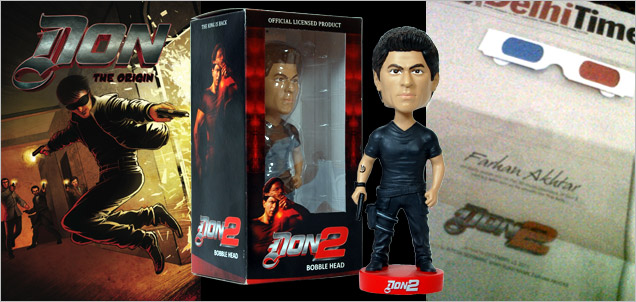
    It’s another SRK release on December 23 and the marketing team for Don 2 is on its feet to get the maximum audience thronging the cinemas to watch the magic of King Khan. The December 19 edition of Bombay, Delhi and Bangalore Times carried a front-page invitation from Farhan Akhtar for the 3D music premiere of the movie on Google +Hangout – with a pair of 3D glasses encouraging people to watch Don 2’s videos in 3D on YouTube. The strategy is to attract audiences as the movie is being released in 2D as well as 3D.


    Priti Shahani, Chief Strategy Officer, Reliance Entertainment, said, “The TOI innovation is a tactical move. For us the strategy for Don 2 has been to partner with marketers and media that reach out to large numbers. We have looked at all platforms that would give us visibility so while our partnership might not be as grand as RaOne, it should reach a large platform.” Don 2 has associated with platform partners and media partners including Sakal, Lokmat and Amar Ujala to reach beyond metros.


    The Don 2 marketing may not be ubiquitous as the blitzkrieg for RaOne, but as Vishal Ramchandani, the Marketing Manager of Excel Entertainment puts it, it has been consistent and concentrated, and peaking at the right time with the movie release slated for this week.


    The marketing effort has been 360-degree including even a comic launch published by Om Books. The comic is on the origin of Don and fills in details on the making of Don, thus acting as a prequel to the sequel. Mr Ramchandani also said that on December 23, two sets of games will be launched, made in collaboration with Gameshastra. These games are compatible on PS3, iPad and Android platforms and are basically shooter games where the player gets to be the Don. The social media presence is taken care of with the Facebook game.


    Mr Ramchandani said, “We have looked at various innovative and interactive ways to connect with the audience. While SRK is a big name, these marketing bursts ensure in keeping the excitement alive. When tickets today are priced around Rs 300-350 in the first week of the launch, there is a need to create urgency to get people to the theatre and these activities help in doing that.”


    Besides the comic and games, there is also a tie-up with Microsoft India where the contest promotes ‘Meet the Don in Berlin’ on various platforms. There is a spin to the Don on the city tours where the hunt is for a Don from each city. This is a positive take on the search for Don. Last week eight cities were toured and more city tours are slated.


    The makers are also relying on the highly popular Don ‘sayings’ and marketing it in a big way. ‘The Don says…’ have been popularized on the 360-degree platform.  These dialogues have also been showcased at cinemas halls and even washrooms, thus trying to catch more eyeballs.


    In terms of merchandise, one can see T-shirts, bobbleheads and Think Tank board games. There are also a few brands present in the movie, though Mr Ramchandani vouches that these associations are not just for the sake of it but is in sync with flow of the story or, as he puts it, “requirement of the script”. Though a number could not be put on the marketing spend, it is estimated to be running into single-digit crores.  Trade pundits suggest that any big ticket movie spends at least Rs 7-8 crore on advertising and marketing.


    Explaining the reason behind marketing even an SRK release, who is a big brand himself, and the need to be promoted aggressively, Ms Shahani said, “Today, the reality is that the shelf life of a movie at best is around 8 weeks and the audience window is even shorter and shrinking. To capture the mind, a brand like SRK helps where like in this movie he stepped out 10 days ago to promote and the impact has been instantaneous. Owning the minds of the audience is impossible today and that’s where marketing and SRK helps.”

  • The Anchor: 6 wishes for Santa Claus from the radio industry

    By Monica Nayyar Patnaik


    #1 No ambiguity in FM Phase III:

    There has to be absolute clarity on phase III, and it must happen soon because every time there has been a delay for some or the other reason. I also hope the number of bidders is high and that it is easy for everyone in the industry to pitch in.


    #2 Music and copyright issue resolved:

    There is still a question mark on music royalty and copyright issues. It must be sorted out soon, not just with one or two major players, but with other players as well, big and small.


    #3 Ad pie of radio should increase:

    Radio is a mass medium, we are reaching out to a lot many people and now with mobile phones the FM radio penetration has only grown further.


    #4 Better technology:

    We need to be very clear on the technical aspect in terms of frequencies; it would be helpful for the listeners in getting a variety of niche programming and so on.


    #5 Improved listenership survey:

    It is very important for the entire radio industry. RAM is present in only four metros today, it must be extended to other cities as well.


    #6 More talent:

    Better training, their awareness running on air, behind the scenes in production. We need to give more opportunities to the production and technical talent pool as there is a lot of scope with more channels and frequencies coming in.


    Monica Nayyar Patnaik is Joint Managing Director, Eastern Media Limited.

  • Curb online voices? No way, Mr Sibal

    By Akash Raha


    Telecom and Information Technology Minister Kapil Sibal stirred up a hornets’ nest when he recommended censorship of online content. Both freedom of expression and the new world of social media came into focus, with several organizations hosting forums on the issue, such as the Foundation for Media Professionals’ panel discussion on December 19 in New Delhi, titled ‘The new puppeteers: Curbing Social Media’.


    The media has come down heavily on Mr Sibal’s suggestion that pre-screening or pre-censorship should be carried out to keep a check on the content of social media platforms. Anuradha Raman, Associate Editor, Outlook said that the government is still following the age-old programme codes set for Doordarshan and All India Radio which were formulated in 1982, and which are constantly used to rattle today’s media. She said that if the government wants to wall up websites and dot.com, why not bring it under a code through legislative sanctions rather than arbitrary discrimination? She said that the current system of censorship of media lacks accountability and there is a need for parliamentary representation to spell out these codes properly.


    Lawrence Liang, a lawyer from Centre for Internet and Society, said it is important that the freedom of speech and expression has to be extended to the terrain of internet rights. The issue of National Security has been brought out repeatedly and it is fine to keep it in mind but not at the cost of free speech and freedom of expression. The government is hereby performing a quasi-judicial role. Moreover, there is lack of transparency in the internet censorship proposal, and today, the work of censorship is being outsourced. He pointed out that the only place where pre-censorship exists is in the case of cinema.


    Saikat Dutta, Delhi Bureau Chief, DNA, said, “In the name of national security the government is increasing its surveillance footprint.” This has led to the growth of what he called the business of surveillance, which is today a multi-billion-dollar industry. The more the government wants to spread its ambit on surveillance, the more companies selling surveillance services will benefit. He went on to say that these days the government is coming down upon several sites and blocking them and if a site is blocked, no one will ever know what happened. There is no information on why something is blocked.


    Narayan Madhavan, a senior columnist from Hindustan Times said, “The right of free speech is a constitutional right and not a government-given one. Freedom should be a rule and not an exception. The government is not the state, it is only an arm of the state temporarily given the right by the people.” He added that National Security has become a more fashionable word to use for censorship and that while it is essential, but it should not be used to curb freedom. In a tweet earlier he had written, “Twitter is the new parliament and Facebook is the new café.” He observed that social media is an interactive media and pre-censorship sounds like an act of desperation or lack of technological knowledge.


    Government has the right to monitor social media just as we can monitor the government by RTI, but there has to be accountability involved. He added that we are culturally an open society and the government cannot put a lid on this. The rights vested by the constitution should not be blocked by a few in the government. This attempted curb should not be seen as a curb only on social media but on media as a whole. It is important to understand when we talk about censorship on social media that the content owners are those who post. Facebook therefore acts as a printer and not as a publisher.


    Sheela Bhatt from Rediff.com noted that there are still a lot of taboos against the digital medium and the online world, which needs to change quickly. The cause is lack of knowledge about the online space. She started off by condemning the censorship which Mr Sibal talks about, and dwelt on the issue of social media, its powers and nuances. She gave the example of the India Against Corruption page on Facebook and how it became a powerful tool to stand against corruption. She said that the government does not appreciate the form of media which is the internet, and such a mindset is regressive and hampers growth.


    Nikhil Pahwa of Medianama said that the censorship that we are discussing is already prevalent. The problem is that we don’t know why a certain site is blocked. National Security is a “nice and easy” way to serve political agendas. He said, “For example, if my site is blocked, I don’t know why it is blocked, who blocked it or how to unblock it… all it says at times is, this site is being blocked on request from DoT… We don’t know who gives the order for blocking and unblocking and there is no transparency.” He said that IT and surveillance rules under the garb of National Security needs to be fought as it threatens democracy.


    Prabir Purkayastha from Delhi Science Forum observed that there are serious problems for any new technology and the same is the case with the internet and social media. “For example, the boundaries of private speech and broadcast are diminishing in the world of social media. What earlier used to be broadcast, now with the internet has become multi-cast. Private censorship is what the government wants right now and it’s not like the one China practices. For China they have a hammer and for them everything else is a nail. But the Indian government is being clever here. It’s like the government is providing safe harbour to those who accept everything that the government is saying and for everyone else, it’s a lost battle. And it’s not social media versus traditional media any more, as what is traditional media is already on social media. The power of surveillance is more pervasive than ever before. The issue is that the government is checking you 24 hours a day, where you are and what you are doing and snooping into your conversations in the name of national security. Today, the new and the old media have to understand that they are not different, and work together to protect themselves.”


    Mishi Choudhary, Executive Director, SFLC.in, observed, “Taking offence on other people’s behalf has never been as fashionable as it is today,” and censorship has become the new name to protect this. The positive aspects of social media are ignored when there was a tsunami and an earthquake. What really bothered the government is the Arab spring and the revolution in Iran and the Anna Hazare movement.”


    Shubham Vij of Kafila.org said that pre-censorship of information is not feasible and possible in the current scheme of things and it is only a matter of time before the government realizes this too.
  • Accel Partners invests in digital media firm Trivone

    By Biswarup Gooptu


    Marquee venture capital firm Accel Partners, announced on Wednesday that it has invested an undisclosed amount in a round of Series A funding in Bangalore-based digital media and content firm Trivone Digital Services.


    The investment will be used to fund Trivone’s working capital requirements as well as pushing growth through the inorganic route in the months ahead, according to a press statement released by the VC firm.


    “Trivone, given the media and Content expertise of the team, is well set to build a best in class Digital Media Company”, Mahendran Balachandran, partner, Accel India, said.


    Trivone, which has been looking to grow through the acquisition route, had acquired the management rights for the three information technology portals – Techtree.com, ChannelTimes.com and CXOToday.com – from media conglomerate UTV in May earlier in the year.


    “We are delighted to have Accel Partners on board and look forward to working closely with them as we chart out a growth path for ourselves,” Subu Subramanyan, chief executive, Trivone, said.


    The Trivone investment is the second such investment for Accel Partners in December, following its $1 million (Rs 5 crore) investment in SaaS-based social customer support start-up Freshdesk.


    The VC firm, which has also backed global Internet majors such as Facebook and Groupon, announced in November that it had raised a $155 million fund focused on seed and early-stage investments in India  Its investments in India include, Kaatizone, Babyoye.com (Nest Childcare Services Private Limited), Exclusively.in, Flipkart, Probe Equity Research Pvt Ltd, LetsBuy.com, among others.


    Source:The Economic Times

    Copyright © 2011, Bennett, Coleman & Co. Ltd. All Rights Reserved

  • Mukesh Ambani in talks to buy Network 18: WSJ

    Mukesh Ambani, the chairman of Reliance Industries, India’s biggest conglomerate, is in talks to buy Network 18, the television and internet company, the Wall Street Journal said quoting people familiar with the situation.


    Ambani, the paper said, has been in talks with Network 18 founder and controlling shareholder Raghav Bahl on the issue.


    “The talks may yet lead to nothing. It also isn’t clear what the value of Ambani’s investment would be and whether he is operating on behalf of Reliance Industries or whether he would put his own cash into a deal. Network18 Media and Investments, the holding company for the conglomerate, has annual revenue of about $300 million but isn’t profitable,” said the paper.


    A spokesperson for Reliance Industries told ET that the report is not true. Speculation has been growing in recent weeks about possible takeovers and consolidation in the Indian television and media space as ad industry revenue shrinks due to the slowdown and costs remain stubbornly high.


    Mukesh Ambani and Reliance Industries have been linked to several transactions not just in media and entertainment but also in other industries after RIL surprised everybody by buying a small stake in EIH, the hotel company that runs the Oberoi group of hotels last year.


    RIL has more than Rs 60,000 crore in cash and cash equivalents on its balance sheet and it is widely expected to buy some assets in its core businesses and outside.


    Source:The Economic Times

    Copyright © 2011, Bennett, Coleman & Co. Ltd. All Rights Reserved

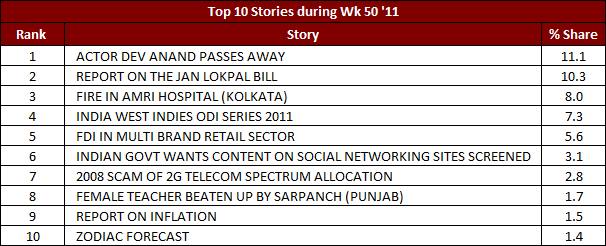
  • NCT Data Wk 50 ’11

    Source: News Content Track – A service of TAM Media Research Pvt. Ltd

    Channels: Aaj Tak, CNN IBN, Headlines Today, IBN 7, India TV, NDTV 24/7, NDTV India, Star News, Times Now, News 24 & Zee News

    Period: Wk 50 – Dec 4 to Dec 10, 2011

    Note : Analysis is based on the Telecast duration


    About TAM Media Research


    TAM is a joint venture between Nielsen Company & Kantar Media Research. Besides measuring TV Viewership, TAM also monitors Advertising Expenditure of Television, Print & Radio through its division AdEx India. Since 2004, it extended its presence in the PR Measurement & Analysis space for Corporate/Marketing Clients by setting up a separate division Eikona PR Measurement.


    In 2007, the joint venture introduced RAM (Radio Audio Measurement) service to track Radio Listenership for the Indian Radio Broadcast Industry. In year 2009, TAM launched a division, called TAM Sports that specializes in monitoring Sports Sponsorship ROI.


    TAM Media Research’s objective is to fuel media insights that will drive the growth of the Indian Media Industry.

  • Anil Thakraney: Doesn’t SRK get it?

    By Anil Thakraney


    Oh no! Don 2 (it actually should be Don 3, because the earlier Don was a rip-off of the original Bachchan film) is all set to hit the cinemas and we will have to sit back and ‘enjoy’ Shahrukh Khan’s nautanki, as he shuttles from one TV studio to another, desperately hawking the flick. He just did ditto for Ra.One and pakaoed the hell out of everyone. The popular Twitter joke at the time was: The only thing left for SRK to do is to insert breaks during the film’s screening, so that he can plug it!


    Did the media hero’s 360-degree effort for Ra.One save the film? Despite all those tall claims on initial collections (which would have happened even if Khan didn’t do the studio rounds… his name anyway gets lots of folks interested), the film was dissed by all and sundry and reportedly lost some money. So what is the use of all this mad self marketing?


    Now, while I can understand the producers wanting to promote the film – even planting those cheap 3D glasses inside newspapers is okay to a point – Shahrukh must understand that his continuous presence in the media is going to hurt his charisma in the long run. How much of the star can we take? In fact, I gave Ra.One a quiet miss because the last thing I wanted after his full-on blast in the media was more Shahrukh Khan. Sure, the content-starved TV channels will welcome him with open arms. Because it gives them a chance to talk about all issues unconnected with the film, including SRK’s opinions on how to end communalism in this nation, and how to send a man to Uranus (okay, I made the last one up). But what good does all that fluff talk do for the film’s fortunes?


    Dear SRK and all the other stars: Guys, spend all this moolah and energy on creating sparkling content. Two, zealously protect the mystique around your own image. And three, leave the TV studios to the netas and to Mr Suhel Seth.


    ***


    PS: I sincerely hope Anna’s Jan Lokpal bill gets passed in toto by the government. Not because I believe it will end corruption, but because I don’t want Team Anna doing their number from Mumbai. The traffic is already a mess out here, and we just can’t handle another frenzied public spectacle.