Author: mxmadmin

  • Indrani Sen: Media Trends & Predictions 2022

    Indrani SenBy Indrani Sen


    Last week, Kantar released its report on Media Trends & Predictions across the world. The report talks about five important trends in 2022, “Video steaming: A complex and ever-evolving market”, “Remodeling the commercial internet: How will successful advertisers and media owners navigate through such radical changes”, “A different approach to data”, “Performance media and marketing: An expanding playground for brands” and finally “Life in a pandemic: And what it means now for brands and media”.


    John McCarthy, Strategic Content Director of the Media Division of Kantar, has said in the foreword: “This year, we’ve tightened our focus to examine five key themes, creating a report that mixes the most notable trends with evidence-guided predictions and insightful thought leadership.” Like the previous years, the report is an excellent mix of knowledge sharing interspersed with comments from senior executives of Kantar across the world tactically indicating how Kantar can help advertisers and media owners to navigate each area with their expertise.


    Video steaming: A complex and ever-evolving market

    The findings of Kantar’s TGI Global Quick View study of consumers in 25 markets shows that over half of internet-connected consumers claimed to have used over the last four weeks either Pay TV or video streaming services. Almost two-thirds of such consumers (65%) claimed they watch two or more hours of paid-for streamed content daily. As predicted in Kantar’s report for 2021, the influence of aggregators is continuing to increase and no sign of subscription fatigue is in sight giving broadcasters and platform operators new found confidence. Kantar’s SportsScope data shows a strong upswing in fan attitudes towards the most prominent streaming platforms for sport (and e-sports) over the last 12 months, particularly among younger age groups. Kantar predicts that the subscription model for SVOD will be gradually losing its power to drive long-term growth, broadcasters may get an upper hand as more audience research data are available for VOD content, content will continue to be the king and will hold the key to higher consumer engagement.


    Remodeling the commercial internet: How will successful advertisers and media owners navigate through such radical changes

    Over the last three decades, tracking cookies have played a crucial role to help the growth of the online advertising market. Google felt that the use of cookies had been pushed beyond their limits, both technologically and ethically and had planned to end the use of cookies by early 2022. However, earlier this year Google announced that the retirement of the cookies would be delayed by two years and would be a gradual process. Kantar has found through their research that majority of publishers are concerned about the inability to track online media via cookies and more than half of advertisers (59%) are concerned about the inability to track online media via cookies. The tech giants are yet to find a viable technology for replacing cookies, though everyone is experimenting. Kantar has predicted that end of the era of cookies will mark the beginning of an end for uncontrolled tech giants’ explosions, no single solution will be able to replace cookies and the panel -based data may get a new lease of life.


    A different approach to data

    Trends in 2021 has shown “marketers are continuing to allocate increasing proportions of their budgets to digital media. Growth in e-commerce and online video is fuelling digital advertising to take a forecast 58% share of the global advertising market in 2021, up from 48% in 2019.” In the survey done by Kantar 65% of marketers said consumer preference is now comfortably the biggest factor influencing media decisions. Kantar predicts that data on competitive intelligence will be a defining factor, brands will look for more first-party data enrichment for unlocking the power of their own data for building better relationships with consumers and data based behavioural planning with attitudinal overlays will be used more by brands.


    The survey done by Kantar shows the top-ranked challenges faced by brands globally and the gaps in the current data available to the marketers.


    Performance media and marketing: An expanding playground for brands

    The report comments “The pandemic witnessed many brands turning to performance-based strategies to survive, but after stunning growth comes a host of challenges – in worlds both real and invented”. As the pandemic continued, the world saw a growth in performance media as brands switched their advertising tactics under global work from home and stay at home orders. The growth of social commerce has been a notable trend for 2021 and Kantar’s survey has shown that 61% of online consumers are likely to purchase from social media platforms in future. Kantar has predicted that growth and sophistication of performance media will empower advertisers and their agency partners to boost efficiency for their campaigns supported by emerging measurement solutions. Kantar further indicated “The metaverse – a collective virtual shared space – will have implications online and in performance media as 5G expands and community-focused businesses, such as Facebook – which aims to hire 10,000 people to build its own metaverse – make serious investments in associated technologies”.


    Life in a pandemic: And what it means now for brands and media

    Kantar’s Covid-19 Barometer reveals, for example, just how far e-commerce has become embedded in our lives and similar effects which pandemic had on consumers across the world. After the initial shock of 2020, in spite of a presence of Covid-19across the world, many markets (including India) are on their way to recovery. Kantar’s Brand Z data for 2021 shows that the ‘building blocks’ of strong brands have held true throughout the pandemic, reflected in an advertising growth which is stronger than expected. Kantar predicts the brands that invest – in data, insight, people and marketing – will flourish beyond the rest, TV will continue to be the preferred backbone media channel of many brand campaigns and 2022 which promises to be a bumper year for sports will aid in the overall recovery of advertising investments.


    Kantar’s ad receptivity studies since 2001 has shown that consumers are generally much less positive about ads in online channels. This posed a dilemma for the marketers though the pandemic has accelerated the growth of online in every aspect of life including consumption of media. Kantar concludes by proclaiming that “The challenges of the pandemic will pale into insignificance against what unchecked climate change could unleash… Media plans will no longer just be about reach, frequency and driving results. The carbon footprint will be just as important”.


  • Indrani Sen: Valentine’s Day Spreads Riding on Media Wings

    Indrani SenBy Indrani Sen


    Today is Valentine’s Day. Inspite of the clash of the concept of Valentine’s Day with our conservative religious traditions, which have been fueled in recent years with the rise of Hindutva, we find media and brands encouraging people to celebrate the day by showing their love for each other. The vigilance of the keepers of the Hindutva seems to be matched equally, if not by a better degree by the aggression of media bent on utilising the opportunity of doing brisk business on the occasion of the Valentine’s Day.


    Valentine’s Day, which is popular across the world, has its origin as a Christian Feast Day in honour of Saint Valentine. There are many legends associated with Saint Valentine, who died (or was executed) on February 14 in 269 AD in Rome. The Feast Day was established by Pope Gelasius in AD 496. Apparently, the day got associated with romantic love during the 14th and 15th century and gradually grew into an occasion for celebrating universal love by the 18th century in England. In modern times, it stands as an interesting example of cultural capitalism which has spread across the world riding on mass media and ably supported by marketers/ advertisers and their agencies.


    Very recently the concept of Valentine’s week is being promoted by giving a name to each of the day preceding the Valentine’s Day in that week and creating more opportunities for marketing and advertising (https://www.ndtv.com/india-news/valentines-week-from-roses-to-promises-everything-you-need-to-know-about-valentines-day-2751803). This concept is yet to catch on in India where it would be very difficult to promote Hug Day (February 12) and Kiss Day (February 13), but I am sure that chocolate manufacturers and toy manufactures would live to promote the Chocolate Day (February 9) and Teddy Day (February 10). The Rose Day (February 7) also holds promises for doing brisk business for flower sellers, but as it is not an organised industry, they may not be able to utilise the opportunity to its full extent, unless e-retailing comes to their rescue.


    The concept of Valentine’s Day has been promoted in India more by the national and regional TV channels who have made it an integral part of their content than by advertisement related to the concept. Each and every general entertainment (GEC) channels, be it in Hindi or in regional languages, plan to have special programmes on the Valentine’s Day as an integrated part of story in one of the serials running on the channel. The same is promoted on all channels owned by the TV Network and if it is a part of the marketing campaign of the TV channel, then the special programme on Valentine’s Day is advertised across other media, newspapers, FM Radio and hoardings. The viewers across tier II, tier III cities and even in smaller towns and rural areas, thus get educated about the celebration of love on the Valentine’s Day.


    The movie channels organise special screening of age-old romantic movies round the clock on the Valentine’s Day. This day is also considered to be a good day for launching a romantic movie online. The news channels try to do special features and grab every opportunity of broadcasting a news related to the Valentine’s Day celebrations. On the whole, Indian TV industry invests a lot of time, energy and money to promote the Valentine’s Day. There is no ready analysis of the ADEX available to assess if their efforts are being rewarded by the advertisers.


    The print industry, particularly the newspapers, do not have much opportunity for promoting the Valentine’s Day through their regular content. If Valentine’s Day falls on a Saturday or Sunday, then we find articles on the same in their weekend supplements. Years back, in the late eighties and early nineties, many English newspapers used to carry special supplements of classified ads where people could book space for sending Valentine’s Day messages to their loved ones. That practice has become obsolete now.


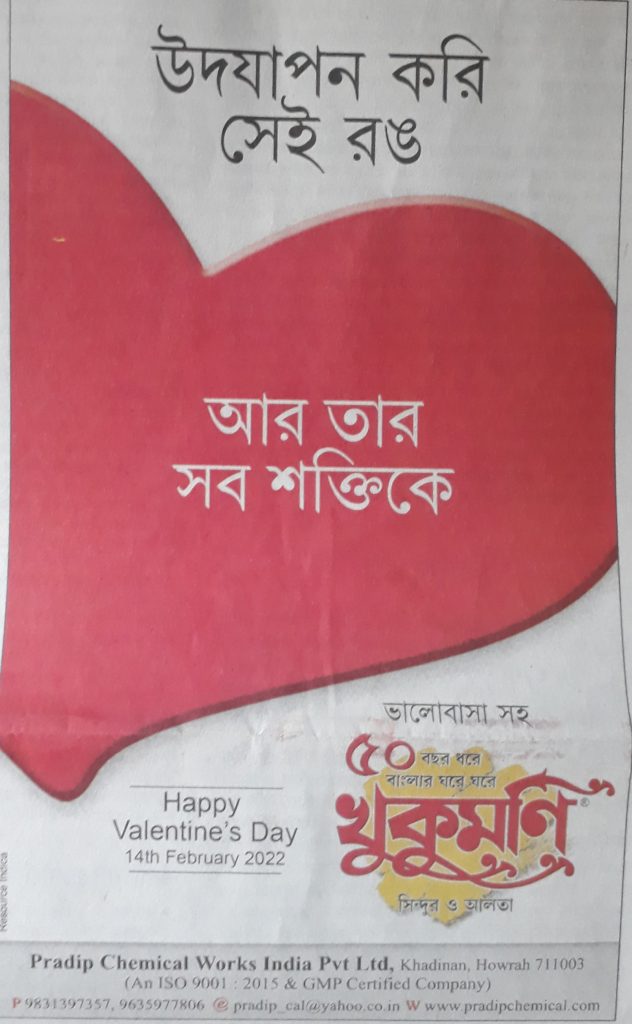
    Still, we find special Valentine’s Day advertisements in newspapers, usually from medium and small size manufacturers. This morning (Feb 14), I was surprised to find an advertisement in Bengali of “Khukumoni Sindur” in Ei Samoy, Kolkata, indicating that the concept has been integrated into our traditional symbol of marriage. The ad has a headline which when translated into English reads ‘Celebrating that colour’ meaning the red colour of sindoor, followed by the copy inside the heart which says “and all its power”. The brand signs off with just two words “With love Khukumoni Sindoor”.


    FM Radio also utilises the Valentine’s Day for holding sponsored programmes on various channels. It is also quite common to find activation programmes by FM stations in malls, etc. on this day.


    On the whole, traditional media in India is ensuring that Valentine’s Day becomes a day for celebrating love across the country. Needles to mention that their activities are supported by advertisers, some of whom also create special advertisement based on the Valentine’s Day theme.


  • Indrani Sen: Monopolising the Metaverse

    Indrani SenBy Indrani Sen


    Seventeen years after he launched Facebook from his university dorm in 2004, Mark Zuckerberg announced in a virtual press conference on October 29, 2021, a change of the corporate name of the company from Facebook Inc. to Meta Platforms Inc. which is being referred in short as Meta.


    A recent Amul topical ad on the ‘Meta’ change

    As explained by Zuckerberg, internet technology has moved on and the corporate name Facebook no longer fits in with the future vision of the company which is being built around the metaverse. “Over time, I hope that we are seen as a metaverse company and I want to anchor our work and our identity on what we’re building towards,” Zuckerberg said.


    The rebranding of the company name would align better with the objectives of the company at this stage when it plans to broaden its reach beyond social media into areas like virtual reality (VR). The various social media platforms owned by the social media giant, i.e. Facebook, WhatsApp and Instagram would continue to retain their individual names and brand identities under the corporate branding of “Meta”.


    The metaverse a virtual-reality space in which users can interact, meet and play with a computer-generated environment and other users using virtual reality glasses, smartphone apps and other devices. The word “metaverse” has been coined from the two words “meta” and “universe”. Loosely defined, it is an extensive 3D online world where people interact via various “digital avatars.” The word meta is generally used as an adjective or as a prefix to a name, often indicating a change or a transformation or a great futuristic idea. Example of uses of metaverses, in some limited form, can already be found on platforms like VR Chat or video games like Second Life.


    Current development on use of metaverse is centred on addressing the technological limitations with modern virtual and augmented reality devices as well as expanding the use of metaverse spaces beyond business to retail applications, entertainment and education. Many digital technology organisations as well as entertainment and social media companies are investing in metaverse-related research and development for future usage.


    The metaverse in many ways is still a speculative future iteration of the Internet part of shared virtual reality, to be used in social media and other applications. The metaverse in a broader sense may not only refer to virtual worlds operated by social media companies but the entire spectrum of augmented reality across the world wide web.


    Critics of the metaverse are arguing that as a speculative concept it is overhyped. Same concept is being used as a part of public relation campaigns by organisations having vested interests. Privacy of user’s information and user’s addiction to platforms are concerns within the metaverse, as already found in the current challenges being faced by the social media and video game industries across the world.


    Mark Zuckerberg’s announcement to change Facebook’s name to Meta has caused a massive uproar in Israel as the word “meta” sounds like the Hebrew word for “dead”. There is also a news that a US-based Meta Company is contemplating to sue Facebook Inc. for Infringing on its it’s company name. Meta was founded by Menon Gribetz, then a student of Colombia University in 2013. Though the company met with some initial success, it had to declare itself as insolvent after its primary lender foreclosed in January 2019. It is doubtful if they have the financial strength to launch a legal battle against Zuckerberg’s company. A Berlin based migraine app developed by Newsenselab M-Sense Magazine has given a backhanded compliment to Facebook who seemingly has been inspired by the logo design of the e-magazine. It is unlikely that Facebook was aware about the existence of that app or its logo and the similarity id the logo design is most likely a creative coincidence which at times happen in the advertising industry.


    The change in the company name is an extremely clever move by Zuckerberg which can help his company to monopolise “the metaverse” space, though many other companies will be using such technologies and operating in the same space in near future. To a lay internet user, Meta Platforms inc. would appear as the original provider of metaverse technology and therefore would have an edge over many of their future competitors.  Meta Platforms Inc. would not be able to monopolise the metaverse, but the name of the company would surely create an illusion of a monopoly.


  • Indrani Sen: Is Indian Media Audience Research Going Backward?

    Indrani SenBy Indrani Sen


    Media Audience Research in India for the traditional media has definitely not moved forward over since the onset of Covid-19. The Indian National Readership Survey was last published for Q4 2019, MRUC’s contract with Nielsen ended along with it. In November 2019, a request for proposal (RFP) for conducting IRS was made by MRUC from various market research agencies for continuing with the study, but it appears now that no progress has been made in that direction over the last two years.


    In July 2020, MRUC had officially suspended IRS 2020 and had decided to return the money paid by the shareholders for that purpose. There has already been a two-year gap in the print audience research, which is likely to be extended further as MRUC has not yet selected a research agency for conducting IRS, let alone finding a solution for conducting the fieldwork in the new normal. I came across a news item on October 31, 2021 which indicated that MRUC is starting from scratch by inviting fresh proposals (https://www.allaboutnewspapers.com/mruc-inviting-research-partners-to-conduct-indian-readership-survey-irs/).


    BARC, which has been continuing during the pandemic with its regular TV measurement research through peoplemeters, also took a few backward steps with criticisms about its methodology and the silent death of its Digital Media Measurement Programme, Ekam, before it had a chance to be tested before implementation. In 2016, BARC announced with a lot of fanfare its intention of measuring digital media viewership and after a few months in 2017 tied up with Nielsen for two years in order to develop a neutral and independent cross-platform measurement solution.


    The contract with Nielsen ended in early 2019 with BARC officials unofficially commenting that it would develop its own digital measurement solution. After Nilsen’s exit, various advertisers started expressing doubts about BARC’s intention and capability for doing the cross-media research with TV and digital media. In October, 2019 Partha Dasgupta, then CEO of BARC resigned from BARC and the plan for Ekam, which was largely his brainchild, also got buried.


    After a year, in October 2020, Mumbai Police began investigating a possible tampering of TRP data by certain news channels. The entire episode made a severe dent in the reputation of BARC as a fair audience research agency. The case is yet to be resolved. Following this incident, in November 2020, Ministry of I&B set up an expert committee to review the guidelines for TV Rating agencies. The committee submitted its report to the MIB in January, 2021, however, the ministry is yet to make any announcement about the findings or any proposed new guidelines for TV Rating agencies.


    In October 2020, BARC Board announced the suspension of audience estimates and ratings for a period of three months after requesting its technical committee to review and augment the standards and methodology of measuring, estimating and reporting the TV Ratings data. The suspension has got extended beyond three months showing hardly any effect on the advertising revenue of the news channels. In September 2021, NBF (News Broadcasters Federation) again appealed to BARC for resuming the release of News Channels’ ratings, which however were not released before the festive season of 2021 (https://www.livemint.com/opinion/columns/the-curious-case-of-missing-tv-news-channel-ratings-11631127883629.html).


    Meantime, comScore continues to conduct independent audience research for digital media in India and Google and Meta (earlier Facebook) continue to provide the industry with their own analytics about digital audience. Nielsen and Kantar, two of the large international market research agency networks operating in India have announced their capabilities in conducting cross-media research. Earlier in 2021 https://www.printpower.eu/insight/cross-media/ wrote “The World Federation of Advertisers (WFA) is spearheading a global ‘North Star’ initiative to standardise cross-media measurement through a panel and census framework that will help the industry get a greater understanding of reach and frequency. Such valuable multi-channel insights could prevent billions of dollars being wasted and improve customer experience through avoiding excessive ad frequency.”


    The same article also reported about the contract for the first world-wide total cross-media solutions project across TV, digital, radio and published media being awarded jointly to Kantar and Ipsos working in partnership with National Media Onderzoek (NMO) in the Netherlands. The article commented “This ground-breaking cross-measurement solution will deliver the building blocks for cross-media planning, allowing advertisers to better understand their consumers, improve the targeting of brand messages, determine how media triggers consumer purchase decisions and maximise ROI.”


    It is a pity that in India, where initiatives about media audience research were taken as early as in late 1960s with the first National Readership Survey (NRS) by ORG published in 1970 followed by second NRS in 1978 jointly by ORG and IMRB, the third NRS in 1983-84 by IMRB and the fourth NRS in 1990 jointly by IMRB and MARG before Indian Readership Survey (IRS) by MRUC began its journey, has failed to go forward in this field. It is high time that the advertisers and the agencies take a stock of the situation and take corrective measures for ensuring the way forward for conducting cross-media audience research.


    Indrani Sen is a veteran advertising professional and a media specialist. She is now an academic, and writes on MxMIndia every Monday. Her views here are personal


  • Indrani Sen: Does the growth of messaging apps & social media apps open up new opportunities for Indian marketers?

    Indrani SenBy Indrani Sen


    In 2020. during the early months of the setting in of the pandemic, the entire world saw an accelerated adoption of mobile messaging apps as people wanted to stay connected with family and friends and the number of users across the world grew by 14 per cent. Indian consumers also joined in the race. In 2021, according to an article published in www.emarketers.com last week, there will be a deceleration in growth with the rate of growth falling down to 6.1% from 14%. However, introduction of interactive features, new applications of video callings for payments, etc. will continue to attract people to the messaging platforms.


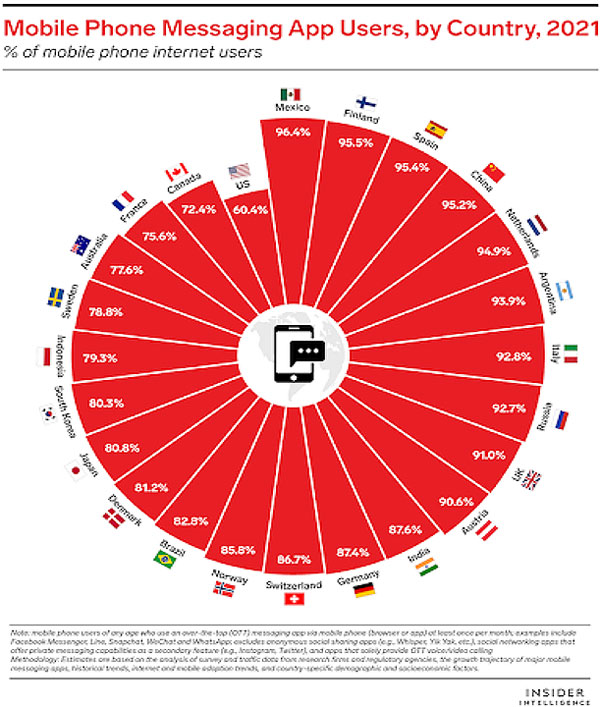
    The same report (https://www.emarketer.com/content/sizing-mobile-messaging-app-opportunity-marketers?ecid=NL1009 ) had an interesting chart showing the comparison of various countries across the world in terms of usage of mobile phone messaging apps, which I am sharing here.


    As shown in the above chart, India has 87.4% mobile phone messaging apps users presenting a good opportunity to the marketers in our country. It is not among the top ten countries which have 90% + mobile phone messaging apps users, but leads the next group of countries having 75% + mobile phone apps users. The report warns that due to the controversial privacy policy of WhatsApp, the growth of the same has been declining in most of the countries including India. Similarly, Facebook’s Messenger is also expected to decline in 2021 in many countries including India, which posted the strongest growth for Messenger in 2020. Still the overall estimates for users of messaging apps across countries are now at a far higher level than what was estimated before Covid-19 struck the world.


    We saw another report last week from App Annie which reported that India is the top market globally in terms of downloading of social apps across iOS and Google Play in the first half (H1) of 2021. As per their report, Asia is the largest region for downloads of social apps in Hi2021 having a 60% share of the global market. However, in terms of consumer spends through social apps, India is in the 17th position in a list of top 20 countries.


    So, the marketing companies in India may still not be able to utilise fruitfully the growing numbers of users of messaging apps as well as social media apps. It seems that while brand awareness can be promoted through the apps, but Indian consumers are still not ready to spend money through the apps in spite of the assurance given through the interactive apps. Still, it is undeniable that the pandemic has given a big push to the usage of both messaging and social media apps in India and has opened windows of new opportunities for digital marketing.


  • Indrani Sen: A Review of Vivo IPL 2021 Phase II

    Indrani SenBy Indrani Sen


    Star and Disney India has really played their hands very well and have managed to retain most of the sponsors and advertisers who onboarded the event initially for Phase II of the tournament currently being played in the UAE.  When the tournament got indefinitely suspended in May 2021 due to onslaught of the pandemic among the players and supporting members, the broadcaster reacted very quickly in a customer-friendly manner.


    Star and Disney India, who had sold almost the entire inventory in advance, assured all advertisers that the first right to continue with the sponsorship or advertising  deals at the negotiated rate would be given to all committed customers as and when the second phase of the tournament takes place. The broadcaster also indicated that no penalty would be charged to the advertisers who might want to withdraw from their earlier commitments due to their marketing requirements not matching with the revised schedule of the tournament.


    When BCCI declared that the second phase of IPL 2021 would be played in the UAE from mid- September, a majority of the original advertisers chose to honour their earlier commitments. Star and Disney India announced in the first week of September that 95% of the advertising inventory of Phase II were already sold with most of the original sponsors, i.e. Dream 11, Phone Pe, Coca Cola, Byju’s, AMFI, Amazon, Asian Paints, Cred, ITC Foods, Kamala Pasand, Mondelez and Upstox staying with the tournament.


    A few sponsors like Vodafone-Idea, Frooti, Garnier etc. have withdrawn from their sponsorship contracts. Against that scenario, new sponsorship deals have been struck with Jio, L’Oréal and Ajio, etc. for the remaining matches. It appears that the broadcaster will close the season with a record revenue collection exceeding their earlier expectation of Rs. 3,200 crore. With the qualifier and the final matches enjoying higher spot advertising rates, the second phase of IPL is expected to earn higher revenue than that of the first phase.


    As per the available BARC data, the Star India Network is cruising comfortably to breach the 400 million viewers’ mark on TV for successive fourth year. Till Match #35, the cumulative reach of the tournament has generated 380 million viewers. The trend is better than the past three years and the aggregated number of cumulative viewers at this stage are higher than what it was in the last three IPL series. The fan following of the tournament has been growing year on year which is reflected in the viewership data for the first 26 matches of 2021 showing that higher cumulative reach of the tournament than that of last year. As per BARC data, the reach of the first 26 matches in IPL 2021 was 352 million, against 349 million for IPL 2020.

    The strategy of regionalisation, whereby the tournament gets telecast in eight different languages for reaching out to viewers across different states has really helped the broadcaster to grow the viewership of the tournament. Introduction of additional customised match-feeds have started catering to specific consumer segments. The customer segmentation strategy has been further enforced with a light-hearted take of the matches presented by stand-up comedians and guest commentators on Disney + Hotstar.  Side by side introduction of other programmes like Byju’s Cricket Live, Cricket Countdown and Game Plan have ensured a total coverage of the tournament.


    To sum up, it can be said that Star and Disney India have broken new grounds in television programming while promoting the property of IPL across our multi-lingual country which will be taught as an unique media marketing case history in academic textbooks for next few years.


  • Indrani Sen: Writings on the TV Wall

    By Indrani Sen


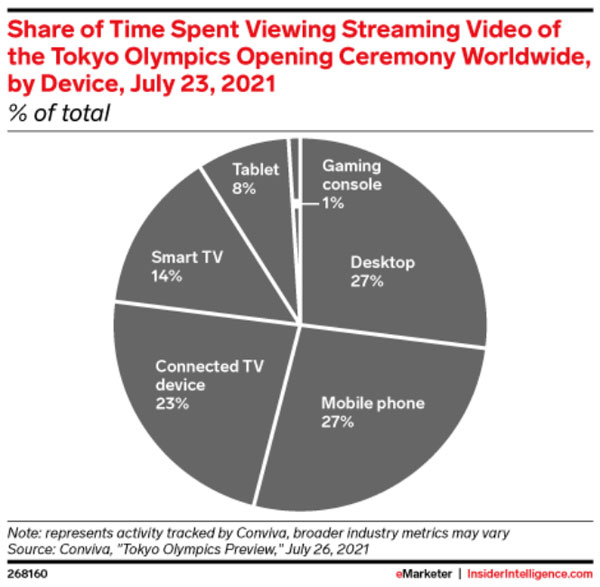
    Indrani SenSara Lebow wrote in an article published on August 16, 2021 in www.emarketer.com that around the world over 60% of the Tokyo Olympic opening ceremony streaming time occurred on non-TV devices (https://www.emarketer.com/content/olympic-opening-ceremony-streaming-time-non-tv-devices?ecid=NL1001) In fact, desktop computers and mobile phones between them captured a combined share of 54% of viewing time.


    In developed countries today, TV is largely viewed as a declining medium. It is estimated that time spent on TV will continue to decline while time spent on digital video will increase over this decade.


    www.emarketers.com has recently reported that in US, the measurement agency Nielsen has been having issues with the Media Rating Council (MRC) and may soon lose its accreditation. An MRC review found that Nielsen underestimated viewers in the crucial 18-49 age group by 2 to 6% in February 2021. During the pandemic, Nielsen took a decision to not send their technicians to Nielsen family homes which apparently has caused further damage to its reporting standard.


    There is a lot of speculations in US market that if Nielsen loses the prestigious contract of TV ratings measurement, then it may be a blessing in disguise for the TV industry. The move of ousting Nielsen may usher in alternative TV measurement methods with potential for upending the existing business models and advertising structures of network television in the US. Such a move may be able to arrest the downward trend in TV viewing and bring back lost advertisers to the medium.


    In India, our TV industry is still in a comfortable situation where it will take long time before we start viewing it as a declining medium. However, it would be good to keep a close watch over the developments in the US market and learn about the changing business structure and introduce the same marketing practices in India without waiting for the declining trends.


  • Indrani Sen: Effects of Suspension of IPL 2021

    Indrani SenBy Indrani Sen


    The last one week advertising and marketing industry has been buzzing with speculations on the consequences of suspension of IPL 2021. Star Disney has been very prompt in offering possible solutions to sponsors and advertisers. As per the contracts, all IPL ad deals are non-cancellable, but as a special case if the sponsors and advertisers do not want to continue with the existing deals, the broadcaster has offered to cancel the deals from their end and allow their clients to negotiate fresh deals for the remaining IPL tournament as and when it gets rescheduled. Alternatively, the clients can keep the existing deals in abeyance and utilise the balance as and when BCCI finds a new window for scheduling the rest of the matches and a new venue for holding the same. The sponsors and advertisers will pay on pro rata basis for 29 matches which have taken place of the scheduled 60 matches.


    It is too early to get a feedback on the decisions of the sponsors and the advertisers. My guess is that most sponsors will stay with the existing deals as investment in IPL 2021 is a part of their long-term marketing and advertising strategy. Some of the advertisers who have peak seasons during summer months or have some immediate growth targets, may consider the other option. However, one thing is certain that cancelling the existing deals and renegotiating later will cost the advertisers more for purchase of similar time over the TV and OTT platforms. Strategically by offering an option of cancellation, Star Disney has probably ensured that most of the existing IPL deals continue with them.


    It is being estimated that BCCI and the franchise teams will collectively suffer a loss of INR 2500 to 3000 crore if IPL is cancelled totally. If it is rescheduled later, the loss will be considerably less, but the additional cost of the logistics of arranging the matches outside India will reduce the profit margin and will shrink BCCI’s central revenue pull available for sharing with the eight teams.


    The biggest losers would be the ancillary industries who were directly or indirectly associated with the IPL tournament, e.g., ground management, hotels providing bio-bubbles, travel, production, agencies providing on ground display, etc. Even if the tournament is rescheduled abroad, there would not be any scope of recovering their financial loss, which admittedly is on a much lesser scale than the tournament revenue, but is a very high percentage of their annual income.


    The situation is also complicated with the advertising and media agencies. Most of them will suffer a loss of projected revenue during the first half of 2021 due to suspension of the tournament. Their clients will insist on renegotiating the deals with them and will try to reduce the commission or fees. It will be difficult to find suitable programme/ content for rescheduling the advertising campaigns and to achieve the target reach required for achieving the sales objectives during the first half of 2021. However, all the leaders of the industry have agreed unanimously that postponing the tournament was the right decision under the current COVID situation in the country.


    What about the consumers, the viewers who make IPL the big blockbuster event? The day after BCCI announced their decision of postponing the 14th edition of IPL and rescheduling it at a later time outside India, The Indian Institute of Human Brands (IIHB) and the Rediffusion Consumer Lab (or Red Lab) announced findings of a survey indicating that the cancellation of the tournament may be a blessing in disguise for the advertisers during the rapidly spreading second wave of the pandemic in India.


    IIHB and Red Lab conducted a small survey among 482 consumers (271 males & 211 females) over three weeks (April 17 & 18, April 24 & 25 and May 1 & 2) to judge change in their attitude, if any, towards IPL as the second wave of the pandemic continued to increase across the country. The questions mainly concentrated on three broad areas (1) the appropriateness of holding IPL in India this year (Should the IPL have been played at all this year? Given the pandemic, should the IPL have been played overseas again?); (2) the respondents intensity of watching IPL (Are you watching more/less/same of the IPL as last year? Do you think watching IPL every evening provides an escape from all the pain, grief and death all around? IPL were to be cancelled; would you miss the game?) and (3) the respondents recall of ads and celebrities and effects on brands (Do you remember ads and celebrities from the IPL telecast? Given the current mood, do the ads on IPL attract you? Would you buy the brands being sold?).


    Over the three weeks, the number of respondents not available or not contactable decreased steadily. The positive sentiment towards conducting IPL in 2021 also decreased from 81% to 58% over three weeks and the number of people agreeing that IPL should have been played outside India went up. There was a 33% drop over the three weeks in the positive answer to the question “Do you think watching IPL every evening provides an escape from all the pain, grief and death all around?” Percentage of people watching less of IPL 14 compared to IPL 13 also went up over the three weeks. The recall of advertisements as well as celebrities were very good across the three weeks, but the intention of buying the brands dropped from 84% to 52% over the three weeks.


    IIHB and Red Lab concluded that the sensibilities of the consumer were getting hurt with the cricket extravaganza continuing during the pandemic and there was a growing discontent with IPL 2021.  It appears that continuing with the tournament in India might have got the sponsors and advertisers the desired exposures but would not have translated the same to desired consumer spends on the brands. The partial or total lockdown imposed by many state authorities will also contribute to the dip in sales.


    It is very difficult to take any guess at this stage about the condition of the pandemic in our country in September when a window is available for rescheduling the IPL. We do not know when the current second wave will end and what will be the final death tolls, if there will be a third wave of the pandemic in September as predicted by many medical practitioners and health experts. Only one thing is certain, we will overcome this coronavirus one day.


  • Indrani Sen: End of the Dark Days: 2021 Midyear Adspends Forecast by GroupM

    Indrani SenBy Indrani Sen


    A week back, GroupM released their Midyear Report on This Year Next Year (TYNY) for 2021, predicting that in 2021 Indian Advertising Industry will not only overcome the degrowth of last year, but also will record almost 2% additional growth.  The Midyear TYNY predicts that India Inc’s investment on advertising will grow by 23.2% during 2021 calendar year and will touch 89,123 crores at the end of the year. The growth in advertising expenditure will come from FMCG, e-Commerce, Auto, Retail, Telecom and Durables categories.


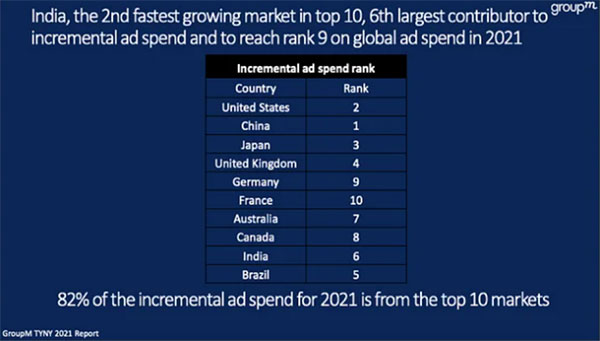
    India’s rank in the Top 10 fastest growing advertising markets globally had gone down one notch in 2020 to number 10 from number 9 in 2019. It is expected that as the 2nd fastest growing market among the top 10 countries, India will regain the 9th rank in 2021. GroupM predicts 82% of the global advertising spends will come from top 10 markets in 2021 and India will be the 6th largest contributor to incremental ad spends among the top ten markets as shown in the chart below:


    Source: GroupM TYNY 2021 Midyear Report


    In 2021, Indian advertising expenditure is estimated to grow at a rate (23.2%) which is more than double of the expected growth rate (10%) of global advertising expenditure. India will be in the same bracket with UK, China and Brazil where advertising expenditures are also expected to grow by 20% plus. The Midyear forecast for global advertising expenditure is 19% higher than their forecast made by GroupM for 2021 in December, 2020. As per the Midyear Report globally, digital advertising expenditure is expected to grow by 26% as against 15% and TV is expected to grow by 9.3% as against 7.8% predicted in TYNY last December. GroupM has cited the following factors as the catalysts of the higher growth rates: (1) faster than expected expansions of app ecosystems; (2) rapid small business formation activities and (3) the growing role of cross-border media marketplaces.


    Focussing back to India, of the estimated total advertising expenditure of 15,000 crores of incremental spends in 2021, 40% will be contributed by digital and the share of digital in the total advertising expenditure will be 35%. TV will account for around 45% share and the non- TV and Digital media will have a share of 20%.


    The website www.businessworld.in has shared an article on June 21, 2021 which says “With states easing lockdown curbs due to declining number of COVID-19 cases, there are immediate indications of improvement in economic activity as companies are hopeful of better performance in the next 6 to 12 months, according to a survey.” The TYNY Midyear report for 2021 is highly encouraging with an assurance of better days for the Indian Advertising Industry. It seems though the pandemic may not disappear from our lives in 2021, the dark shadow of the pandemic will be lifted from our advertising Industry.


  • Indrani Sen: TV penetration in urban India: Is there any room to grow?

    Indrani SenBy Indrani Sen

    On April 15, 2021, Broadcast Audience Research Council released the “TV Universe Estimate 2020” indicating that “TV UE 2020 has been developed by computing the Linear growth of TV Households and TV Individuals from Broadcast India (BI) Studies conducted in 2016 and 2018 at geographic and demographic levels. The distribution of the TV population by NCCS was taken from the most recent Indian Readership Survey (IRS).” The field work could not be conducted in 2020 due to the pandemic and BARC had a plan to conduct a large-scale establishment survey as a part of Broadcast India (BI) 2021. However, the current second wave of the pandemic raging all over the country will cause a delay in the implementation of that plan.

    As per TV UE 2020, out of an estimated 300 million households in India, 210 million are TV owning households, of which 91 million (43%) are in urban areas and 119 million (57%) are in rural area. From 2018 to 2020, the number of total households owning TV has grown from 197 million to 210 million (by 6.6%); urban households owning TV has grown from 87.8 million to 91 million (by 4%) where as the number of rural households owning TV has grown from 108.9 million to 119.2 million (by 9%). Over the last 10 days TV industry has been celebrating the increase in TV penetration during the COVID infected period which accelerated the growth of digital media in India.

    Against the national average of 6.6% growth, the growth in the number of TV owning households in the HSM area has been 8%. As far the distribution platforms are concerned, share of DD Free Dish has grown from 13% (2018) to 19% (2020) which has largely driven the higher growth of TV households in the HSM area. South India, with higher TV penetration than rest of the country, has shown 5% growth which is less than the national average.

    While it is quite acceptable that the total number of households has increased from 248 million in 2011 to 300 million in 2020, the question arises how much scope is there for TV penetration to grow in urban area? As per the 2011 Census, there was 248 million households in India with an urban: rural share of 31%: 69%. 91 million, the number of TV owning households in urban area in 2020 accounts for 30.3 % of 300 million, the total estimated households in India and 98% of urban households (31% of 300 million= 93 million) leaving very little scope for further growth of TV penetration.

    Here, we need to ask, going by the three-tier definition of urban as used by Census, what will be the urban-rural split of households in 2021 Census? Should we reconsider the definition of urban introduced in 1951? In reality, what percentage of our population lives now in villages and what percentage lives in towns?

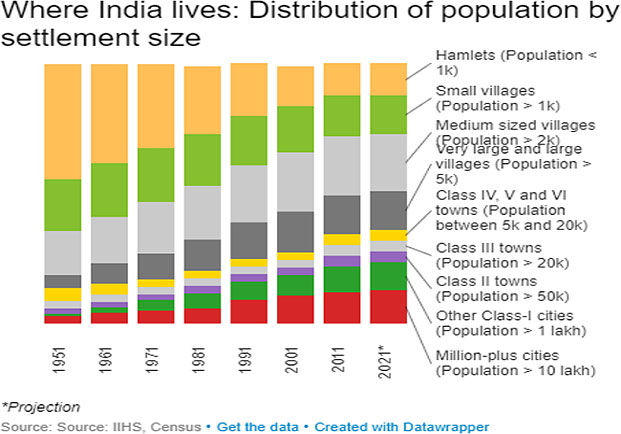
    An article by Ajay Sreevatsan in the www.livemint.com which was updated on September 16, 2017, analysed the possible reasons why actual share of urban areas should be higher than the official Census statistics. The chart given below has been taken from that article, which after arguing strongly in favour of higher rate of urbanisation, concluded with “…how much of India is urban, and how much of it is rural is as much a question of politics as it is of economics.” (https://www.livemint.com/Politics/4UjtdRPRikhpo8vAE0V4hK/How-much-of-India-is-actually-urban.html).


    Source: www.livemint.com

    Recent government policy documents have argued that the share of urban households could be 37%-38% depending on the infrastructure developments and other parameters. Even if we make a moderate estimate that the urban: rural split will be 35%: 65% in the 2021 Census, we will still have 105 million urban households out of estimated 300 million total households, leaving a 14 million headroom for growth in TV penetration. However, TV industry needs to recognise that TV penetration in urban India is close to saturation point in the higher NCCS categories and need to make their future plans accordingly.


  • Indrani Sen: Booming Digital Advertising

    By Indrani Sen


    Zenith, the RoI Agency of Publicis Media, released its Business Intelligence – Video Entertainment report across ten key global markets in last week. The report has predicted that India will see higher growth in adspends on OTT than on TV during the next two years of this decade. In FY21, adspends on TV will grow by 4% while on adspends, OTT will grow by 24% and in FY22 ad spends will see 9% increase on TV against 34% increase on OTT.


    While the Zenith report talks about future, the Advertising Report on Digital – Part 1 – July-Sept ’20 also published last week by TAM India analyses the immediate past. Based on AdEx data, the TAM India report confirms the accelerated growth of digital advertising during the lockdown and the post-lockdown period. There was a small negative growth in May, but during the unlocking period, the growth regained its momentum from June and went on increasing steadily.


    Source: TAM India


    The highlights of the report covering Jul-Sept’20 show that ad insertions per day increased by 32% during Jul-Sept’20. Among the top 10 categories, e-com and gaming had the highest growth. Five of the Top 10 categories with positive growth came from services sector. Amazon India was the leading advertiser and its brand www.amazon.in topped the brands list. Top 10 advertisers and brands had respectively 21% and 19% share in the total digital ad insertions.

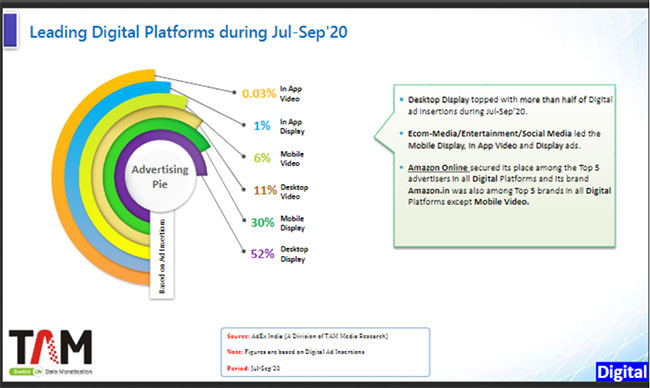
    In spite of the rise in smartphone users, among digital platforms, Desktop Display topped with more than 50% share of the total digital ad insertions. YouTube topped the list of publishers with 15% share of digital advertising, while all other publishers has 85% share. advertising on digital platforms.


    The next chart shows the share of the digital advertising pie by different platforms. Mobile Display and Mobile Video had respectively 30% and 6% share while Desktop Display and Desktop Video had respectively 52% and 11% share. Here Desktop includes Laptops also.


    Source: TAM India


    The findings on most utilised methods of transactions show that Ad Network was the most preferred mode of transactions (45%), followed by Direct (20%), Programmatic (17%) and others (19%). Though only 17% of the transactions were done through Programmatic, among other methods, the share of Programmatic/Ad Network (13%) and Programmatic-Direct (5%) indicate that programmatic buying has been making a steady progress in the transactions of digital advertising.


    Source: TAM India


    An analysis of creative types used for digital advertising during Jul-Sept’20 shows that Banners had a share of 45%, followed by HTML5 (40%) and Video (17%). Among the top 5 categories comprising of E-Com/ Entertainment/ Social Media, E-Com Online Shopping, E-Com Gaming, Corporate IT and Life Insurance. E-Com Gaming had the highest rate of growth during Jul-Sept’20. A total of 316 advertisers across 40 categories advertising 510 brands accounted for 80% of the total as insertions. The balance 20% was spread across many advertisers and brands who all wanted to board the band wagon of digital advertising. The total count showed 20,500+ advertisers across 480+ categories with 24,100+ brands participating in digital advertising during the period Jul-Sept’20!


    This report has given us a comprehensive understanding of the rapidly growing digital advertising. We will be eagerly looking forward to the next editions of Digital Advertising Report by TAM India in order to follow the progress of the digital media during the pandemic hit 2020 and beyond.


  • Indrani Sen: Online Gaming: The New Claimant for Share of Advertising Rupee

    Indrani SenBy Indrani Sen


    Last week, the advertising and marketing industry got an overwhelming exposure to online gaming through the “e4m Game On: Gaming Summit” over two days and the report “Everyone’s Gaming Among Us – Mobile Gaming through the Pandemic and Beyond” released by InMobi simultaneously. The highlights of the report show (i) 45% of Indian mobile users got introduced to gaming during the pandemic, (ii) women constitute 43% of the gamers in India, (iii) 60% of gamers is in below 25 years age group, while 12 % is in the age group of 25-44 and 28% is in the age group of over 45 years and (iv) Indian gamers interact 2.6x times more with the video ads shown in gaming apps than in other apps.

    The FICCI EY Report on Media & Entertainment (M&E) Sector “The era of consumer A.R.T.:  Acquisition | Retention | Transaction” was released in March 2020 before the pandemic hit our economy in a big way. We saw in that report that online gaming continued as the fastest growing segment with 39.8% growth in 2019 over 2018, riding on the back of transaction-based games, mainly fantasy sports, and a 31% growth in online gamers. The InMobi report findings indicate that the online gaming growth during pandemic has sky rocketed during the pandemic and it would not only continue to be the fastest growing segment, but also reflect a huge growth in the number of online gamers in the next FICCI EY report on the M&E sector.

    In the e4m ‘Game On: Gaming Summit’, various speakers dwelled on the benefits of advertising through online gaming apps over the two days. On the first day, in the first panel discussion on “Gaming: The New Media for Marketers”, panellists spoke about how the use of gamification can enhance consumer engagement for a brand apart from traditional advertising.  In the second panel discussion on ‘Decoding the Online Gaming Market in India’, one of the panellists, Naman Jhawar, Senior Vice President, Strategy and Operations, MPL said “This industry is going to create a lot more opportunities on the brand monetization side as well. That is something that is already happening whether it is live sports or on the online gaming platforms and this branding is going to scale up.” Another panellist Dinesh Sharma, Business Head, Commercial PC, and Smartphone, System Business Group, ASUS India, said “One of the key trends that we are seeing is that when the pandemic occurred people wanted to connect emotionally and gaming became a perfect platform to get together virtually. E-sports is trending in a manner and will become as big as cricket.”

    On the second day of the Ssummit, GroupM Business Head, Entertainment, Sports & Live Events Vinit Karnik shared some revealing statistics that in last ten years the number of Indian gamers has grown by 14 times and currently they spend on an average 22 hours per week watching e-sports content and playing online games. He emphasized “Brands need to ride the e-sports bandwagon very early to reap the benefits. Today is the time for brands to evaluate various opportunities and how can one relate to this target audience and look at building brand affinity with them over time.”

    Rajesh Pantina, Director of Marketing, Asia Pacific, InMobi, also spoke at the e4m Game On: Gaming Summit and shared the findings of the InMobi report highlighting the facts that online gaming is not just a young man’s game, gamers are well distributed across India (South 29%, North 27%, West 22%, East 22%) and ad recall is high amongst Indian online gamers. He explained that programmatic sampling was used for running the survey and generating responses from 1000 plus Indian consumers using smartphones across 30 cities from tier I, II, and III. The sample was targeted and weighed to represent of India’s smartphone population and the survey was conducted between February 9 and 16, 2021. The most interesting insight shared by Pantina was on the consumption of various forms of digital entertainment “People are treating gaming as a part of their entertainment bucket, which comprises also of OTT video and music but then gaming started to own that entire entertainment and relaxation genre, and it’s probably the newest face of entertainment.”

    We are definitely going to see more participation by various brands in online gaming which can be either through gamification of their communication or through sponsorships and placement of advertisements in online gaming platforms and apps. In the new entertainment bucket of consumers, online gaming has an edge as it is an interactive platform while OTT and music are both passive platforms. Online gaming, therefore has the potential for claiming a higher share of consumer engagement, particularly from India’s growing youth segment. In conclusion, I feel we are going to see online gaming not only competing with OTT video and music, but also with social media in future. A day may come when family and friends will make appointments to meet digitally for watching or playing games instead of having a chat on social media.