Author: mxmadmin

  • Indrani Sen: Exploring remedies for two burning topics stalking our industry

    By Indrani Sen


    The last 12 days have been very eventful for our industry on one hand about Mumbai Police reporting a TRP scam involving TV channels and on the other hand about social media vandalism related to the Tanishq commercial based on the story of an interfaith marriage. The first issue is still under investigation, but based on initial available evidence, BARC decided to suspend reporting the TRPs for news channels for three months.


    The second issue has seen more decisive and quick actions and let us look at that first: The uproar by a section of netizens over their different social media handles protesting against the interfaith marriage story shown in the Tanishq commercial, things took an ugly turn with some of the Tanishq executives getting threatened on their Linkedin accounts, call for boycott of all Tata products, etc. The share of Titan, the holding company of Tanishq fell by 2.18%, the Tanishq shops all across the country with crores of jewellery stocks became venerable to attacks by social miscreants and Tanishq withdrew the commercial and issued a statement on a sad note “… This film has stimulated divergent and severe reactions, contrary to its very objectives. We are deeply saddened with the inadvertent stirring of emotions and withdraw this film keeping in mind the hurt sentiments and wellbeing of our employees, partners and store staff.” Contrary to what some people believe, the company did not tender an apology for producing the commercial.


    Our social media users were divided in two camps on Facebook and other social media handles right from the beginning and after the commercial was withdrawn, a counter campaign has started protesting against the withdrawal. However, what has been most gratifying is the spontaneous sharing of personal stories by many couples with interfaith marriages. It has also been extremely reassuring that the industry at large has come together and IAA, AAAI, ISA, TCA etc. have issued statements condemning the social vandalism and supporting Tanishq. But the incident has raised a few very serious questions about rules and regulations required for user generated content in Facebook and other social media platforms.


    Do we really need to control user driven content on social media?  Today with the help of artificial intelligence it should be possible to hit a warning button before individual users’ posts multiply into a hate movement and leads to online vandalism. However, such a move may also boomerang if it stops all social movements for good causes generated through user generated posts. As we have seen in case of the Tanishq commercial, there is always two sides of a coin with each side believing it is on the right side! However, we need to know if posts are getting generated by genuine users or by fake users. We understand social media marketers have adopted the concept of buzz marketing and instead of appointing real time online buzz marketers, they take the easy way out by creating fake social media accounts. Our Advertising and Marketing Industry should take initiative to interact with the owners of social media platforms for stopping this practice and ensure that anyone posting on social media is a genuine user. Users should be stopped from owning multiple accounts on social media platforms even at the cost of the platforms losing number of users.


    The second incident about the TRP scam has kept our TV news channels, media agencies, advertisers and BARC (Broadcast Audience Research Council) and the investigative agencies busy ever since the news was published on October 8, 2020. The process began with Mumbai Police Commissioner announcing in a press conference on October 8 about a FIR against few TV channels and has been going on since then with claims and counter claims and legal suits being filed in Delhi and Mumbai.  The story has got a lot of coverage in mainstream newspapers where it hit front pages news and was covered through multiple stories on each day. Couple of newspapers also took the trouble of educating their readers on definition of  TRP, the methodology of the audience research, how BARC collects and processes TV viewing data, etc. Industry websites have been carrying multiple stories and interviews with industry stalwarts for last few days. We have also carried number of stories including two write-ups by MxMIndia’s Pradyuman Maheshwari.


    I shall not repeat the narratives of the second incident which have already been posted in www.mxmindia.com. This is not the first time that we are facing complaints on TRP related issues and this will not be the last time unless the industry introduces severe measures for the offenders.    The various industry bodies need to review the problem and take very stern measure for stopping such malpractices in future.  My suggestion is if a representative of any TV channel is found guilty of tampering with generation or collection of TRP data, then that channel should be barred from the BARC roaster of TV channels for a period of three to five years, long enough to be able to make a negative impact on their advertising business.


    If the owner or any other top executive of the TV channel is proved to be a party in any such devious practice, then he or she or the channel would have to pay heavy fines to TRAI/ BARC for the misconduct. Failure to pay the fines may result in the TV Channel losing its rights for uploading and downloading for a specific period. The TV channels would have to create legally bound strong employment contracts ensuring that they are able to partially recover the loss of business from the errant employees who may be instigated by a competitive channel tor indulging in illegal activity. To sum up, unless the industry bodies as well as TRAI review and redesign the rules for punishing malpractices related to TV ratings, we would never be able to have a robust audience measurement system in spite of all the technological advancements.


     Indrani Sen is a veteran mediaperson and now an academic. She writes on MxMIndia on most Mondays. Her views here are personal



  • Indrani Sen: Reincarnation of Media Sales

    By Indrani Sen


    The pandemic has affected media revenues adversely, but at the same time approach to media sales have undergone a sea change. Most of the media houses who used to have separate sales team for selling traditional media and digital media have integrated them to a seamless force. Digital media marketing has become much more data driven and focussed on interpretation of data. In fact, approach to media selling has started encroaching into the territory of media planning.

    Last week, on August 13, 2020, I received two interesting mailers “Your Cheat Sheet for Streaming Trends” from Jio Saavan and “Introducing HT AdWorks – Personalised Media Consultation and Discounted Ad Prices across Mediums” from HT Media Ltd. The Jio Saavan mailer showed a very creative way of pushing their brand for digital media campaigns based on their research findings and HT Media cleverly introduced packages for their media brands across different verticals under the guise of media consultancy.

    The first mailer from Jio Saavan was based on the findings of their Digital Audio Playbook for a New Reality”. Interesting charts showed highlights from the research along with cues for digital audio panning, eg. 520% growth in throwback hits with a suggested cue for spreading good vibes through narratives that provide an escape from life. The mailer also included an invite for a free downloading for the Playbook. For some time various digital media platforms have started offering content solutions to the advertisers along with media buying deals, the Jio Saavan offer goes beyond creative solutions to the domain of providing interpretation of research and strategic solutions. Using research as a strategic tool for planning was the forte of media agencies, now that is being challenged by digital media marketing.

    HT Media’s mailer on ‘HT Adworks’ with a tagline of ‘Grow your business’ invited registration for a free digital event for better understanding of their membership based program for cost effective and personalised media plans. The link provided in the mailer opens up https://www.htadworks.com/ with registration facility for two digital events in Delhi and Bangaluru, a write up about the programme and a facility to download an e-brochure on HT Adworks. As shown below, the benefits of the programme, advertised on the website, cover all the aspects of media planning and buying across Print, Radio and Digital verticals where HT Media brands are present.


    The digital events by HT AdWorks focus on Delhi and Bengaluru which indicates that the programme has been designed for small and medium scale advertisers. However, some of the large advertisers may also be interested in participating in HT Adworks. The question which comes up automatically is if the budget allotted to HT media brands through this channel will remain a part of the overall media budget routed through media agencies or will be routed through HT Adworks directly for getting the ‘exclusive discounts’?

    Long back, in the days of fixed 15% agency commission, media sales used to dictate their terms to the agencies. In the digital age, we are seeing a reincarnation of media sales with media houses bypassing the role of media agencies by offering the advertisers all the functions of the media agencies along with exclusive discounts. We have been witnessing vertical as well as diagonal expansion by all traditional media houses over the last three decades along with consolidations and mergers in the media business. Most of the large media houses now have multiple brands in their stable under traditional as well as digital verticals. A spread of media sales practice like HT AdWorks can play havoc with the business of media agencies.


  • Indrani Sen on D K Bose: Caring, Passionate, Awesome

    By Indrani Sen


    Ad industry veteran Dwipal Kumar Bose, known as DK expired suddenly due to a huge heart attack on early morning of October 9. Bose was 76 years’ old and had over 50 years of experience in the industry across Media Planning, Social & Rural Marketing and Advocacy Research.
     

    After graduating from Elphinstone College in Mumbai, he started his career with S.H. Benson, the parent company of Ogilvy. He rose in ranks while working in Mumbai and Kolkata offices of Ogilvy (O&M) during the 70s and early 80s and joined HTA (JWT) Delhi as Media Director in 1984. He shifted from media to social and rural marketing first as head of Thompson Social, India’s first Social Communication Agency and subsequently worked with RK Swamy BBDO and Ogilvy Outreach. In this time, Bose trained many Media Planners and Social and Rural Marketing Executives, who later attained important posts in the industry. After his retirement from the industry, Bose has been working as an advisor and strategist in the area of Behavioural Change Communication in the area of health and primary education. His LinkedIn profile described him as “Margdarshak and advisor on Rural and Social Marketing”. He was a Founder Trustee for Centre of Advocacy Research for 20 tears and was awarded with the Lifetime achievement award from Rural Marketing Association of India.

    Bose taught at IIMC as visiting faculty for many years and currently was associated with IIM Lucknow and Kozhikode and Jamia Milia University as visiting faculty. Early this year, he published his autobiography “Life Unstoppable: Making Challenges Work for you” as an e-book on amazon. Bose loved travelling to interior India and to the small towns and villages of Himalayas and he breathed his last during his sleep at McLeod Ganj surrounded by the hills he loved. Bose will be remembered among his friends and associates for his caring nature, his passion for learning and teaching and his awesome energy.

  • Indrani Sen: The Refreshing Breeze from “Dakshin”

    By Indrani Sen


    The shadow of gloom cast by Covid-19 on our newspaper industry has not yet shifted and most of our newspapers are still struggling to revive their circulation, readership and revenue. During June and first half of July, I have come across very few articles on Indian print/ newspapers and all of them either had a negative connotation or provided  an advisory for revival of the sector. An article published in www.scroll.in  on June 25, 2020, related to the unique last mile delivery system of Indian newspapers, illustrates the negativity syndrome (https://scroll.in/article/964158/hard-times-after-the-lockdown-a-newspaper-vendor-in-mumbai-is-losing-clients-to-online-media) and an article published in www.policybazar.org on June 23 is an example of an advisory issued to the print industry at large (https://www.policycircle.org/economy/industry/change-or-perish-indian-newspapers-stare-at-a-crisis-of-their-own-making/).


    The press release on TAM AdEx report published last week treated print and eadio like Corona-positive patients and avoided touching the trends in the AdEx.  Against such a backdrop, during this regime of Coronavirus, it was really refreshing to listen to the speakers of the webinar ‘Go Dakshin: Print Emerging Stronger Post COVID 19 organised by Exchange4media on July 7, 2020. The webinar panel had representation of publishers covering all southern states and was ably moderated by Kishan Kumar Shyamalan, VP, Wavemakers. He began the webinar by commenting that print in South India is different in many ways for their counter parts in North, West and East India and requested the panellists to share their experiences during the lockdown and post lockdown.

    KRP Reddy, Director Advertising & Sales, Sakshi Group opened the panel discussion admitting that they lost 25% circulation in urban areas during April after the lockdown, but in rural areas their circulation was not affected. After unlocking, they have recovered in smaller towns and now are working harder to regain their lost circulation in large cities. Suresh Balakrishna, Chief Revenue Officer, The Hindu Group, agreed by saying that Hindu is still under pressure in large towns. He reiterated that April was really bad. It was like “holding on to a hand break of a car coming to a screeching halt”. In May, Hindu had revived 89% of its circulation in Tamil Nadu and Kerala and 75% in Andhra, Telengana and Karnataka. Balakrishna added that being relevant and being agile helped The Hindu Group to navigate this critical period successfully. The magazines Sportsstar and Frontline were converted to digital magazines during the lockdown and did not stop publishing.

    Verghese Chandy, VP Marketing & Advertising Sales, Malayala Manoroma Group said they were better prepared to deal with the crisis after experiencing other health crisis and multiple floods in the past. In the early days of the pandemic, they managed to convince their people that hard copies of newspapers do not carry the virus and lost a very small percentage of their circulation during the lockdown. Circulation revenue helped Malayala Manoroma Group to survive when advertising dried up during the period of lockdown. Abhinav Khare, CEO, Asianet said that Kannada Prabha took a hit initially in April and had 18% de-growth, but started recovering from May and the trend is continuing in June. Eshwar N, CMO, Casagrand said he is one of the biggest spenders on Print in Tamil Nadu and Kerala and were one of the first to start advertising their real estate projects after lockdown. Their advertisements got a good response comparable with pre-Covid time.

    In response to the question of the moderator Shyamalan “How can Print re-emerge now?” Balakrishna said 10 years ago, when the realisation began that digital is here to stay and Hindu began its digital journey, the pandemic has fast-tracked the process. The Hindu Group had collapsed its traditional and digital sales team into one seamless team and the editorial team had also evolved digitally. Their pricing policies had changed over the time and all their digital offerings were behind the pay wall by the time pandemic hit. The economics of the business had started changing for them and COVID 19 just fast tracked the transition. Reddy, however felt that traditional Print is still considered to be most credible and would continue to grow in next decade.

    Chandy felt both the traditional and digital formats of newspapers will co-exist and grow for some time and readers can choose the format they like to read. He argued that the pandemic exposed the shallowness of the digital media and the legacy media re-emerged as the more trusted one. He gave a couple of post lockdown examples of readers’ response to ads from the automobile and film industry in print to support his arguments.  Khare said traditional print would need to make their formats more interesting to attract younger readers who have started reading news digitally. Balakrishna gave the example of “Singapore Straight” and said that cover prices would increase and become hard and balance between advertising and circulation revenue would be restored. He argued that readers would gradually get used to paying for digital content. The webinar ended with the participants requesting advertising agencies to support Print during this period of Covid-19.


  • Indrani Sen: Global Media Gloom

    By Indrani Sen


    We are all feeing the fallout of the Covid-19 crisis in our lives and livelihoods. According to a report by World Economic Forum, global poverty is expected to increase for the first time since the 1998 Asian Financial Crisis and unemployment rates are going to increase across developed as well as developing countries of the world.  No business sector is immune to the effects of the pandemic, but Media & Entertainment (M&E) Industry is among the few sectors which are likely to be affected more.

    We have not yet seen any report on how the Indian M&E Industry has fared during the first two quarters of the current year by the agencies who regularly publish such reports annually.  There was a report “Media and entertainment post Covid-19: The best and worst of times” released by KPMG in April, 2020 which touched on the broad trends. Brand Equity reported in an article published on May 12, 2020 about the predictions by Crisil, the global analytics company, predicting a 16% decline in the revenue of Indian M&E Industry in FY 2021 (https://brandequity.economictimes.indiatimes.com/news/media/media-entertainment-sector-revenue-could-take-16-pc-hit-in-fy21-crisil/75687403).


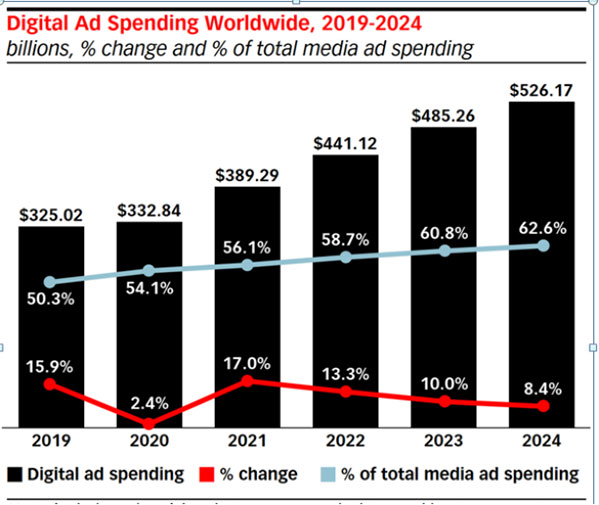
    While we wait patiently for mid-year reviews from FICCI-EY, KPMG, Group M, Pitch-Madison, etc, let us take a quick look at what has been happening around the globe. I read three reports in www.emarketer.com during last week and would like to share a few findings with our readers. On July 6, 2020, an update on Global Digital Ad Spending Q2 2020 was published which highlighted that “…every market we cover will experience a decline in ad spending except China. Google will see its first ever contraction in digital ad revenues, as search advertising will struggle compared with display….Overall ad spending will decline by 4.9% worldwide this year, a significant drop from last year’s 6.3% growth and from our pre-pandemic 2020 forecast of 7.0% growth” (https://www.emarketer.com/content/global-digital-ad-spending-update-q2-2020).


    Source: eMarketer, June 2020

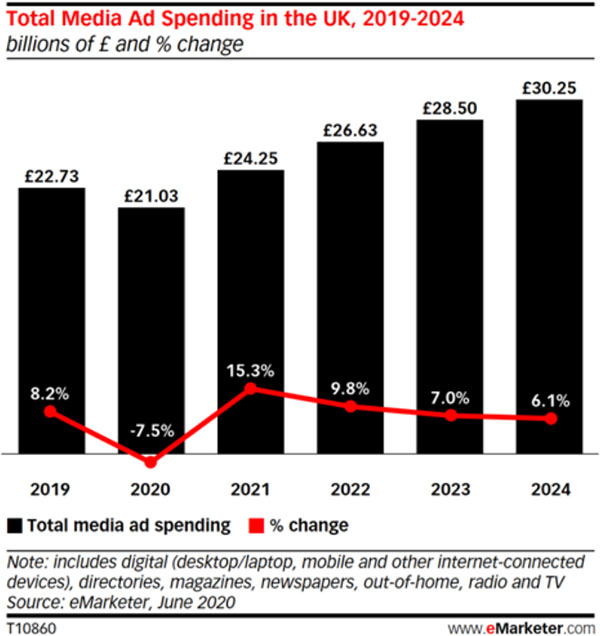
    On July 8, 2020, there  was an article on UK predicting sharp declines across traditional media will drag total ad spend down by 7.5% in 20202 (https://www.emarketer.com/content/uk-sharp-declines-across-traditional-media-will-drag-total-ad-spend-down-by-7-5-2020?ecid=NL1009). The report also predicted recovery of the media industry in 2021 with a healthy growth rate of 15.3%.

    On the same day, there was another article on US, predicting a substantial fall in TV Upfront ad spending in the 2020-2021. “US upfront TV ad spending will decline 1.4% in the 2019-2020 season to $20.28 billion, and drop a substantial 27.1% in the 2020-2021 season to $14.78 billion….”( https://www.emarketer.com/content/tv-upfront-ad-spending-will-fall-5-5-billion-2020-2021-season?ecid=NL1009). The UK economy is officially in a recession and there is a Huge uncertainty about investment in advertising by most advertisers.

    It would have been wonderful if similar reports could have been generated for Indian media industry showing the advertising revenue of the first two quarters, January to March, 2020 and April to June 2020. In absence of such information, we can use the above global trends in making some estimates about the Indian Media industry.  It can be safely said that we are also going to see a decline not just in the growth rate, but also in the size of our media industry across traditional and digital platforms.


  • Indrani Sen: TikTok Ticks Fast in India during Lockdown

    By Indrani Sen


    Sensor Tower, a US-based app analytics firm has estimated that between March 25 and April 10, 2020, Zoom, TikTok and Aarogya Setu topped the list of apps downloaded by the Indians during the first two weeks of lockdown. The statistics was published in ThePrint in their article on India’s favourite apps in Lockdown (https://theprint.in/tech/indias-favourite-apps-in-lockdown-zoom-tiktok-and-aarogya-setu/406709/) on April 22, 2020.

    As corporate India was suddenly forced to work from home, it is not surprising that Zoom, the video conferencing app became India’s most downloaded app during March 25 to April 10, 2020. It is also understandable that Aarogya Setu, the mobile app developed and promoted heavily by the Government of India, connecting people with the healthcare facilities as well as Government advisories in the fight against COVID 19, was the third most downloaded app. TikTok, which was a close second to Zoom, reaffirmed the addiction which Indians have developed for the app ever since its launch in 2017.

    TikTok by definition is just an app where users post their short videos, but in practice it has turned the small screen to a stage for mini reality shows where people compete and crave for attention, for instant celebrity status, for a different life than their mundane existence or simply for emotional release from day to day monotony in social media. It has taken the imagination of Indians fed by song and dance sequences and fantasy of Bollywood movies by storm. For Indian youth TikTok is not just a time pass, it offers them an outlet for their hidden creativity combined with a career option and scope of financial success.

    TikTok was launched in 2017 by its parent company, the Chinese media business ByteDance for iOS and Android operating systems in markets outside China. ByteDance acquired Musical.ly, a social-media platform for sharing music videos, for $1 billion and merged it with TikTok on August 2, 2018 and TikTok downloads started surging ahead from that time.

    Some parents and politicians in India think the content of TikTok is inappropriate for children. On April3, 2019, the Madras High Court after hearing an IPL asked the Government of India to ban the app. Accordingly, Ministry of Electronics and Information Technology ordered Google and Apple app stores to remove the TikTok app. However, the ban was reversed by court order in a subsequent court case on April 24, 2019 and the TikTok app returned on app stores.

    A year back in May 2019, India was already topping the list of top ten countries using TikTok apps in the world (http://routenote.com/blog/top-10-countries-with-the-largest-number-of-tiktok-users/) showing three times more number of users than USA.

    Top 10 TikTok Users as on May, 2019

    Rank Country TikTok Users (mn)
    1 India 119.3
    2  USA 39.6
    3 Turkey 28.4
    4 Russia 24.3
    5 Mexico 19.7
    6 Brazil 18.4
    7 Pakistan 11.8
    8 Saudi Arabia 9.7
    9 France 9.1
    10  Germany 8.8

    Source: http://routenote.com


    By the end of 2019, TikTok shocked even the Netizens when it achieved the number one position in terms of worldwide downloads hitting 1.5 billion downloads and beating Facebook. India had almost 44 per cent share of the 1.5 billion downloads and again topped the list. It is estimated that at the end of 2019 there were more than 200 million TikTok users in India making India TikTok’s biggest global market.

    On January 28, 2020, www.thehindubusinessline.com carried a story “TikTok targeting INR100 crore revenue in India by September 2020” (https://www.thehindubusinessline.com/info-tech/tiktok-targeting-100-crore-revenue-in-india-by-september-2020/article30673050.ece). The TikTok management was hoping to ride on their new ad formats for brands, including in-feed videos, branded effects such as AR filers and branded lens, hashtag challenges, etc. for realising their business target.

    It would be interesting to see if TikTok still manages to achieve its business target in 2020 when all traditional and non-traditional media are anticipating loss of ad revenue due to the prolonged lockdown to fight Covid-19 19 in India. There is no doubt that even if TikTok suffers a setback, it will recover faster than traditional media.

  • Indrani Sen: FM Radio in an Existential Crisis

    By Indrani Sen


    Covid-19 has enforced an existential crisis on FM Radio Industry in India. The industry is totally dependent on advertising and ground events-related activities tied up with social media deals as their sources of revenue. All ground events came to a sudden halt after the attack of coronavirus and advertising expenditures dried up as sales took a nose drive. The economic slowdown of last financial year had already impacted the FM Radio industry in FY20 and there was a fall in the revenues of all major companies operating in the segment. According to FICCI EY Report on Indian M&E Industry 2020, revenues of FM Radio Industry grew 5% in the first half of 2019, but fell by18 % in the second half.


    Due to the decrease in advertising support thanks to lack of business activities during COVID19 followed by the national lockdown, FM Radio industry revenue fell by 80% in April, 2020 and 90% in May 2020 compared to last year. It is estimated that during the first two months of FY21 (April and May) the industry has suffered loss of INR 200 crores and by September, 2020 the loss will mount up to INR 600 crores. The unpaid past dues of DAVP and MSMEs has added to the financial crisis of the various companies owning different brands of FM Radio.


    Association of Radio Operators of India (AROI) approached the Ministry of Information and Broadcasting in March, 2020 with a concrete proposal asking for immediate short term financial support and long term changes in policies. AROI asked the Government for moratorium in license fees and other charges, waiver on interest for delayed payment for a period of one year, clearance of dues from DAVP pending for more than a year and restoration of Government advertising on FM radio channels.  MIB has so far allowed only three months’ extension of licence fees payment without interest which hardly offers any financial relief and is in fact a very small concession offered by the Government who has in the past ripped good financial benefits through auctioning of private FM stations and continue to earn annual revenues from the industry.


    How has the FM radio industry been dealing with the pandemic in their content? Most of the stations stepped up their programming for educating their listeners about the virus and safety measures and various ways of dealing with home quarantine. Government policies stopped them from making their own local news, but they carried health bulletins from various hospitals and other local government organisations free of cost. A large portion of their content shifted from entertainment to information. Red FM and Magic FM launched a programme “Care Karona” on their channels encouraging their listeners to become facilitators of correct information by educating their maids, drivers and everyone who is in direct contact with people to contain the ripple effect of virus. My FM from the Bhaskar Group introduced a programme “Real Ya Na Real”for busting fake news. Radio City, Mumbai raised donation off INR 8 lakh through their programme “Dabbewale Ka Dabba Bharo” for helping Mumbai’s dabbawalas affected by the lockdown. A recent article in The Print (https://theprint.in/features/how-fm-radio-spread-positivity-and-created-a-sense-of-community-during-the-lockdown/437111/) has praised the way FM Radio spread positivity and created community feeling during the lockdown.


    What about the listenership of FM radio during Covid-19?  As per the Indian Readership Survey, listenership of radio remained stable across the last three studies at 20%. Urban radio listeners are almost twice (28%) the size of rural listeners (15%) base (listened during last 1 month). However, the findings most likely relate to total radio listeners (AIR channels as well as Private FM Radio channels) and no separate estimate is available regarding the contribution of the Public and Private radio channels in the radio listenership. There has been a lot of speculation during the pandemic about the listenership of FM Radio going down during the lockdown as people could not listen to their car radios and at home had to compete with TV and Digital Media for attention.


    A recent article in www.moneycontrol.com  referred to a research done by AZ Research during the lockdown showing daily listenership of Radio has gone up during the Pandemic. “Radio is one of the very few mediums that are currently offering you new and fresh content. That has helped increase the listenership for radio by three million to 51 million listens a day post-lockdown, according to a study by AZ research.” (https://www.moneycontrol.com/news/trends/entertainment/coronavirus-impact-more-people-listen-to-it-now-but-radio-is-still-struggling-5232061.html)


    The online version of Deccan Heard referred to the same study done by AZ Research in details in an article published on April 9, 2020 ( https://www.deccanherald.com/national/coronavirus-lockdown-radio-listenership-increases-by-23-per-cent-study-823395.html) “The study, commissioned by the Association of Radio Operators for India (AROI), also said radio industry has witnessed a  listenership of 51 million people, which is nearly as much as television’s reach of 56 million and social media’s reach of 57 million.” AZ Research conducted the study across a sample size of 3,300 people across India in selected cities having FM Radio channels and found that 82% people have been tuning in to radio during the lockdown period.  As per the study, FM radio has a credibility score of 6.27, second only to the internet which is at 6.44, while TV has a score of 5.74.


    As per the Pitch Madison Advertising Report (PMAR) 2020, the Top 5 categories of Radio ADEX in 2019 were Real Estate, FMCG, BFSI, Auto and Telecom accounting for only 39% of the total while in case of TV   the top five categories contributed to 78% of the total ADEX.  FMCG accounted for only 9% of Radio ADEX as against 49% of TV Adex. As we gradually unlock the lockdown and our economy limps back to “new normal”, advertising of various goods and services have started reappearing in TV and Print. The advertisers should try to consciously support FM Radio Industry by allotting a small part of their investment to the medium; my assessment is they would not be disappointed with the return on their investment.


  • Indrani Sen: The Window of Mobile Payment

    By Indrani Sen


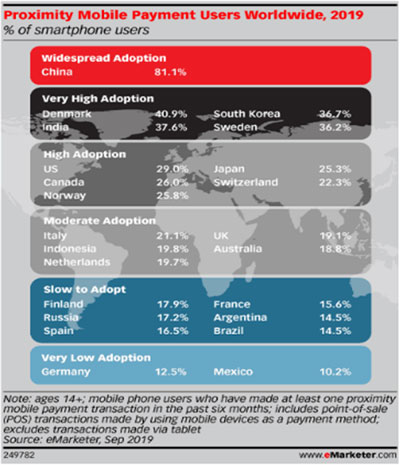
    An article in www.emarketer on January 21, 2020 shared a chart of the proximity mobile payments users of different countries showing that in 2019 India featured in the “very high category” bucket in terms of adoption of mobile payments along with Denmark, Sweden and South Korea.

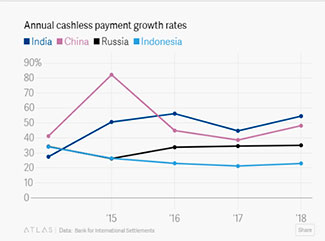
    While, India still has to go a long way before catching up China’s rate of penetration among smartphone users—81.1%, there are other evidences which show that the rate of growth of cashless payments in India has been faster than that of China during the period 2015- 2018 as shown in the chart below on the left (https://qz.com/india/1746910/cashless-payments-growing-faster-in-india-than-almost-anywhere-else/).


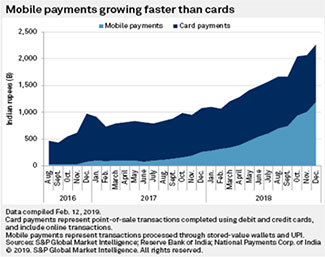
    In an article on May 9, 2019, SP Global Market Intelligence showed that during 2016 to 2018 mobile payments in India has been growing at a faster rate than card payments as shown in the above chart on the right (https://www.spglobal.com/marketintelligence/en/news-insights/blog/mobile-payment-apps-driving-fintech-frenzy-in-india). Wall Street Journal affirmed the growth of mobile payments in India in their article tiled Cash May Be King in India, but Google Is Prince of Mobile Payments on September 19, 2019 showing how millions of Indian mobile users were using Google Pay to pay for their transactions.

    In another article Will India’s payments ever be fully mobile? published on September 23, 2019 Edd Gent wrote “But while that expansion sounds impressive, industry consensus is that digital payments still only account for 10 to 15 per cent of all retail merchant transactions, says Vijay Mani, partner at Deloitte India, with mobile predicted to play second fiddle to cards, at least in terms of value.” He further argued that “only a quarter of Indians own a smartphone with the capabilities to use banking apps and popular payment services such as PayTM, Google Pay and PhonePe, though with 40 per cent of Indians under the age of 18, the percentage of adults using them is likely to be considerably higher” (https://www.raconteur.net/finance/mobile-payments-systems-india).

    Global Advisory KPMG published an highly informative report in August last year Fintech India- Powering mobile transactions covering Indian Mobile payment ecosystem in the backdrop of global mobile payments ecosystem, key learning and  major challenges. The report claims that digital payments in India are growing at a CAGR of 12.7 per cent in the number of non-cash transactions through mobile phones (https://assets.kpmg/content/dam/kpmg/in/pdf/2019/08/Fintech-in-India%E2%80%93Powering-mobile-payments.pdf).

    The window of mobile payment is a reality which advertising and marketing industry cannot afford to ignore. The FMCG industry particularly needs to explore the opportunities of communicating with their customers through this window as an extension of their mobile advertising. KPMG report listed the emerging business services provided by Mobile Payment Service Providers (MPSPs) as Financial Services, Mobile Marketplaces, Utility & Bill Payments, Payment Containers and Government Enablers and there can be innovative opportunities of associating with some of these services as well as mobile wallets.

    In the report, KPMG had given recommendations for transforming India into a leading payment ecosystem to all the stake holders, the Government, financial institutions, regulators and merchants. In the Union Budget announced on February 1, 2020 the only consideration given to digital payment is the Government’s Aadhaar-enabled payments system which is subject to various other financial arrangements and security considerations. The wish list of the digital industry, particularly related to incentives for digital payments has not been considered. It seems that the Government has put its vision of Digital India on a back burner and has definitely not considered the recommendations made by KPMG and other such advisory bodies.


  • Indrani Sen: Will Ekam get a new lease of life in this New Year?

    By Indrani Sen


    In 2016, television viewership measurement body Broadcast Audience Research Council (BARC) India announced plans to measure digital viewership and going beyond audience measurement of broadcast media. In April 2017, BARC launched its plan of providing the industry with a single platform for all measurement products, across TV and digital through “Ekam” in a phased roll-out over 18-24 months. Partho Dasgupta, then CEO of BARC India, detailed out the five products which were designed based on specific needs of the industry: Ekam Pulse, Ekam Beam, Ekam Stream, Ekam Ad-Scan and Ekam Integra.

    To recap the memories of readers, Ekam Pulse, the first product to be rolled out, is for measuring video ad campaigns while Ekam Beam will be measuring linear broadcast that is viewed on a digital device and Ekam Stream will be measuring both non-linear and pure play digital video content. Ekam Ad-Scan, as its name suggests, will give an overview of digital ads in India from different perspectives and Ekam Integra will provide the industry with independent audience numbers enabling calculations of reach and frequency. BARC also announced that its TV data will be integrated with Digital Video data with the help of Single-Source and Digital Booster panels.

    A month later in May, 2017 BARC announced that Nielsen India will be its primary digital measurement partner. Nielsen will develop India-specific adaptations for digital measurement based on its global experience. We did not see any publicity of Ekam from the side of BARC for some time, but had assumed in good faith that BARC would deliver as promised based on their tack records of TV audience measurement. In June, 2018 when Economic Times reported that BARC’s digital measurement system would get delayed by one year, ), we did not comprehend all the complications which BARC was encountering in the process of developing Ekam. ( https://economictimes.indiatimes.com/industry/services/advertising/barcs-digital-measurement-system-to-get-delayed-by-another-year/articleshow/64759655.cms?from=mdr )

    The above report quoted Nakul Chopra, then Chairman of BARC: “The new General Data Protection Regulation (GDPR) that came into effect in the European Union from May 2018 has sparked similar discussions around privacy issues in other countries as well… Our government has appointed the Srikrishna Committee. These developments have implications for the content ratings that will be part of Ekam. We need to be sure that the entire Ekam piece is compliant with the prevailing and likely data protection norms. So, while we are still pushing for an earliest possible launch, we are currently recalibrating our plans in light of these new developments.”

    The Srikrishna Committee submitted its report along with the draft of Data Protection Bill in September, 2018. Based on the Committee’s recommendations “The Personal Data Protection Bill 2019” was tabled by the Minister of Electronic and Information Technology in Parliament on  11December , 2019 and was immediately sent for further analysis by a Joint Parliamentary Committee. Under the present political climate in our country which is causing frequent black out of internet in select areas, it would not be surprising if the PDP Bill 2019 gets lapsed before it gets a chance to be registered as an Act.

    But the real reason of the delay in the process of launching Ekam is not compliance or lack of compliance with regulations of Personal Data Protection. In late 2018 there were rumours in the market that Nielsen had not been able to provide a suitable solution acceptable to all stakeholders. There was a very low key announcement in May, 2019 that BARC is evolving its own mechanism for digital audience measurement as its association with Nielsen has come to an end. Obviously, this was a major setback to the entire process as BARC might have to start developing the system from the scratch unless it has developed a parallel system on its own.

    Apart from the technology of digital measurement, BARC has also has to resolve another serious issues of participation by Google and Facebook in their measurement survey. Though BARC has not made any official announcement, yet by now it is widely known in the industry that Google has refused to participate in the digital measurement survey proposed by BARC by citing their global policies related to third party measurement of their content and data privacy agreement with their users. The Indian digital video content producers/ OTT platform owners are willing to participate provided BARC gets Google and Facebook included in the survey. It has become a real Catch 22 situation with no immediate solution in sight.

    In January 2019, BARC exhorted Telecom Regulatory Authority of India (TRAI) to “empower” it to be the uniform measurer of audience and other data related to TV, and OTT and digital platforms.    (https://www.indiantelevision.com/television/tv-channels/viewership/barc-india-exhorts-trai-to-empower-it-as-digital-measurer-190114) It was a smart move to counter competitors like Comscore, etc. who enjoy patronage of Google. However, till date TRAI has not responded to BARC’s petition.

    During January and February 2019, www.bestmediainfo.com carried a few provocative articles by Niraj Sharma exploring the reasons behind the delay in Ekam. The articles speculated on the lack of support Ekam was getting from ISA and why Google was not cooperating with BARC and allowing them to measure both ad and content viewership on their platforms. While I do not agree with all the points made by Sharma, I concede that if ISA as a body could take an uniform stand, then Google might have to reconsider their decision regarding participation in Ekam. Both Google and Facebook consider India to be an important market for their future growth and value the business which they get from Indian advertising industry.

    The question which BARC needs to address now is how to revive and kickstart Ekam in 2020. Apart from the technological needs, there seems to be the need of a master negotiator for solving the participation issues with Google and Facebook. BARC can simplify their offerings for doing a survey of only ads across all digital media platforms followed by a survey of digital contents minus Google and Facebook content. Will Sunil Lulla, the new CEO of BARC, find a solution acceptable to all the stakeholders? If Ekam cannot be revived during this year, then probably it will be shelved forever which will be not only a wastage of financial resources and time, but also a setback for media research in India.


  • Indrani Sen: Millennial Mothers & Media

    By Indrani Sen


    I was intrigued when Femina announced its report on “Millennial Working Women 2020” last week. But my excitement died quickly when I found that its “extensive quantitative research” was conducted among 1500+ English-speaking millennial working mothers belonging to SEC A in the Top 10 metro cities.

    The sample represents a miniscule segment of millennial working mothers of India which is further affirmed by the finding that “85% of these millennial mothers hardly cooked or never did so at home.” Even with the luxury of being able to afford domestic help, most housewives in SEC A still have to cook when the maid is either on leave or simply absconds. As health and nutrition conscious mothers of young children, they are not expected to depend on ordering food from outside. So, this is a surprising finding.

    A large number of these upper class millennial working mothers have acknowledged that their spouses help them not only in taking care of the children, but also with the domestic work though the nature of the work has not been detailed in the report available for downloading. It is understandable that their children are first priority for these mothers and for maintaining perfect work life balance they enjoy harmonious relationship with their parents and in-laws. It is however surprising to note that “at a professional level they receive a lot of support, strength and motivation from their respective managers and peers at the workplace” when we know about the cut throat competitiveness across professions.

    Most of these women feel that “good looks do matter” and ensure that they get good nutrition for themselves. They are all addicted to online shopping as “the easiest way for them to indulge in some me time is to shop online.” Last year in a report “Trend-setting millennials: Redefining the consumer story” released by Deloitte India and lobby group Retailers Association of India, we saw that millennials still preferred offline retail modes and were gradually shifting towards the online mode based on the aspects of  convenience and options (https://rls.net.in/wp-content/uploads/2018/02/Trendsetting-Millenials_RAI-Deloitte.pdf). Perhaps the shift has already happened among this particular target group.


    When it comes to media habits of these millennial working women, they are consuming contents mostly on TV (97%), Facebook (91%) and newspapers (85%). Newspapers score much above magazines (38%) as a source of content. However, in nuclear families almost half the millennial working mothers source their content from magazines.


    Whats App messages play a significant role in their life by providing them with information about current local news as well as the latest happenings in the world with 66% of all the mothers sourcing content from the messaging app. They consume movies and video content through YouTube, OTT platforms (37%) and Facebook videos. 20% of them also listen to radio for entertainment.

    “According to a Morgan Stanley report of April 2017, India will have 410 million millennials, who will spend $330 billion annually, by 2020. That’s more than the total population of the US, and more than the total number of millennials (400 million) that China has today. Naturally, every brand owner wants a slice of this pie” quoted www.livemint.com in June, 2018. Femina conducted their research with the objective of getting a better understanding of a section of the millennial consumers, the life of millennial working mothers, but the report available for downloading lacks in providing in-depth understanding of their lifestyle and does not offer meaningful insights to their media habits.


    Indrani Sen is a veteran adperson and now a full-time educator. She writes for MxMIndia on most Mondays. Her views here are personal.


  • Indrani Sen: Measuring OOH media in India: A plight or a challenge?

    Indrani Sen

    By Indrani Sen


    In the Neons OOH Conference & Awards 2019 held in Gurugram last week, the issue of monitoring OOH in India and developing an OOH AdEx again came to the limelight. The panellists from marketing organisations and OOH industry expressed concern about the lack of OOH measurement and agreed on the need for generating data for OOH to align with ROI in the medium.

    OOH Industry took a big step towards the end of 2017 when in collaboration with AAAI (Advertising Agencies Association of India), IOAA (Indian Outdoor Advertising Association) circulated a standard set of procedures (SOP) to OOH owners and marketers and advertising/ media agencies. Any report related to the success or failure of implementation of the SOP has not been reported during the following year 2018. It is unlikely that in the highly fragmented outdoor industry, such voluntary standardisation of operating procedures has happened during just one year.

    Can IOAA along with AAAI work out a similar SOP for OOH measurability so that leading outdoor agencies who have independently invested in outdoor measurement system, follow a common methodology and matrix for measurement? This will enable the industry to compare or combine the results available from different sources. There is also lack of sharing of knowledge of the measurements carried out by individual outdoor agencies, which needs to be addressed.

    TV AdEx system was the precursor of TV Audience Measurement in India; similarly it is believed that we need an OOH AdEx before developing the OOH Audience Measurement System. There is also need for a OOH Census or a baseline survey for creating the sampling framework for the OOH Measurement System. The industry also need to decide if the OOH AdEx as well as OOH Audience Measurement Model will be confined to only urban India or alternatively, should it be confined only to “India”, leaving out “Bharat”? These are some of the issues which will have to be debated by the Technical Committee appointed for AdEx as well as OOH Audience Measurement System.

    The first serious attempt for a syndicated outdoor research happened in 2009 when under the guidance of MRUC, Hansa Research conducted Indian Outdoor Survey (IOS) in Mumbai. MRUC had plans for rolling out the research in other cities subsequently which never saw the light of the day due to lack of funding. Subsequently, IOAA tried to revive the project along with MRUC, but was not able to generate the required financial support from the OOH industry in India. No market research organisation took the risk of investing in outdoor research on a large scale though couple of them have developed models for assessing the ROI of a particular client’s outdoor campaign. The issue of monitoring and measuring OOH in India has remained as a plight for years with no one coming forward to develop a workable solution.

    It came as a pleasant surprise when few weeks back, I read about Display Metrics India’s (a start up company in data analytics) plan for unveiling a roadmap for OOH metrics development in India. In an event held in Mumbai on January 17, 2019 Display Metrics announced that in association with Czech Out-of-Home Displays (MOD) for the Indian OOH industry in association with IOAA (http://www.media4growth.com/ooh-news/display-metrics-india-unveils-ooh-metrics-development-roadmap-3467). It was extremely reassuring to find that a group of young entrepreneurs taking up the challenge of developing OOH metrics in India. It was equally disappointing to note that there was no participation by Display Metrics India in the panel discussions or any mention of their venture by the industry stalwarts participating and debating various issues at the panel discussions at the 9th NEONS OOH Conference.

    It appeared from the above report that IOAA has lent their support to the venture of developing OOH metrics in India proposed by Display Metrics India. IOAA is an established entity with easy access to other industry bodies like AAAI, ISA and MRUC. The ball is therefore in their court to promote the venture of Display Metrics India across various industry forums. After all, it is rare to find a group of young entrepreneurs ready to take up the challenge of monitoring Indian OOH media and creating a metrics for measurement. It would be a real pity if such a venture is met with premature death.


  • Jaideep Shergill: Will ‘acquihire’ work for A&M

    By Jaideep Shergill


    Carrying on from where I left off the last time I was on a roll with my columns about acquisitions in the marketing communications industry; the virtues or the lack thereof, I thought I would dwell on the one possible model which makes most sense in the otherwise failing effort of larger groups to acquire and bolt on firms to their already ballooning and meaningless business models.


    In some senses, one of the “stepchildren” of the acquisition process tends to be the acquihire approach which as the proper definition goes, essentially means: buy out (a company) primarily for the skills and expertise of its staff, rather than for its products or services.


    Most articles about the tech sector seem to indicate that acquihiring has become increasingly common in the venture capital backed start ups. In recent years, Facebook has beenthe largest performer of acquihiring or talent acquisitions. Twitter, Yahoo! and Google rank alongside Facebook as similarly major users of talent acquisitions.


    Despite this, the obvious reason this model tends to be missed out(in the marketing services industry) is largely because this is the one model which doesn’t allow the buyer to boast of large deal values and the seller to brag about the millions the promoters made for themselves. Plus, this is also one of the easiest ways to do a deal and easy means not good to the men in suits who run the marketing communications industry! To top things off, these “talent deals” don’t make the headlines across the press often and hence gets pushed to the background.


    While the tech sector has still demonstrated that the acquihire model works, our very own marketing/advertising industry has a long way to go to make this model work.


    At a base level, acquihiring is not a classical acquisition because the acquirer is only interested in a pool of talent which allows them to gain an edge over the competition in a specific area, i.e., if I own a strong creative firm and want to get a strong digital team on board to bring more cutting edge work to my clients, or I own a traditional PR firm and I need specific skillsets in social media or content creation then in either of these examples, I would look for a small and nimble team and hire them outright. Now this team may or may not be a firm in itself but a small group of extremely talented folks residing at a competing shop and I need to bring them on board for a fair value (beyond what they get paid currently) and empower them to run this new/allied function within my existing set up. Simple explanation of how this really works!


    The acquihire model works beautifully because its simple and efficient and quick and has no strings attached. If one is acquihiring an entire firm, usually these are boutiques and don’t have the dead weight of egos and other attachment’s and hence these deals work much faster and benefit both sides immensely.


    It’s important to remember the following:

    1. The talent coming in via an acquihire process needs to be integrated well into the parent firm
    2. The talent mustbe treated as equal and not “step children”
    3. The talent need to be given time to perform and deliver


    For the talent, getting “acquihired”, its important to remember:

    1. You are joining a firm because the vision aligns with your career trajectory
    2. You will get the resources you need to excel and shine creatively which is otherwise hard to do if you run your own boutique
    3. You will be absolved of all the painful operations and administrative hassles and can focus on doing great work


    Specifically speaking for India, I personally believe there are only that many ways for us all to create the right demand for best in class talent in an industry in which the quality of talent has been circumspect in recent years and acquihiring may be one such quick and efficient way to do this. However, will the egos of the men in black suits allow this? Only time will tell…