
Author: mxmadmin

  • Das ka Dum with Dr Bhaskar Das | We have not produced marketers for Bharat, Nestle India chief Suresh Narayanan has said in an interview. Do you agree?

    Bhaskar DasWe thought it would be good to check on the views of our Wizard with Words on this issue. So here’s Dr Bhaskar Das in the May 17 edition of Das ka Dum. Read on…


    If you wish to access the archives, please go to the Das Ka Dum tab on the website’s top navigation bar or click here: https://www.mxmindia.com/category/columns/das-ka-dum/


    Q. We have not produced marketers for Bharat, Nestle India chief Suresh Narayanan has said in an interview. Do you agree?


    A. I agree largely with the observation. There might be exceptions but the present pedagogical format in management schools for managers/ marketers has a certain elitism or dependence on western case studies. More often than not, it is difficult to expose students for all unique cultural mores of india which change after every 150 km (even if it’s perceived to be a stretched imagination). It can be learnt only by walking the path of Tier 2/3/4 cities and get ethnographically en-cultured in specific market characteristics and consumer behaviour.


  • The Script Room creates campaign for Paper Boat

    By Our Staff


    Swing, beverage brand from Paper Boat, has launched a new summer campaign called ‘Best Between Friends’, conceptualised and created by The Script Room. The campaign celebrates the evolving relationship between mothers and daughters and their growing friendship, which has replaced the more traditional, authoritative parental roles of yesteryears.


    Commenting on the campaign, Neeraj Kakkar, Co-founder and CEO of Paper Boat, said: “Swing’s latest summer campaign, ‘Best Between Friends’, delves deep into the evolving psyche of the contemporary mother. This campaign salutes her earnest endeavours to foster a bond of friendship with her child, a departure from the more traditional, authoritative parental roles of yesteryears. Working with Ramsam and The Script Room has always been an enriching and rewarding experience. Their insightful understanding of our brand often surpasses our own, bringing fresh and creative dimensions to the forefront.”


    Speaking about the partnership, Ramsam (Rajesh Ramaswamy), Co-Founder, The Script Room, added: “With the mother brand ‘PaperBoat’ having now established a strong position with memories, it was a challenging and exciting task to define a new space for their offering ‘Swing’. It’s a brand that has been intuitive and personal, and the brand team has always managed to bring out the best from creative. The idea was to keep it simple and authentic. We’re hoping that this fresh take on the evolving relationships of mother and child will find a deep connect with young mothers, our primary audience. And we’re very excited to see the reactions to this interpretation of ‘Dil Chahta hai’ in this new context. We’re hoping that whoever watches it ends up smiling.”


  • Axis My India & GetafixM Partner join hands

    By Our Staff


    Axis My India consumer data intelligence company announced a partnership with Bharat Rajamani, Co-Founder & CEO at GetafixM – a full services marketing and media firm to build a Consumer Insights led Business Consulting Practice. Keeping consumers at the heart of the process, the partnership aims to resolve brands pressing business problems by identifying and bridging the gap between consumer and product needs.


    Axis My India, which is a Harvard Business School case study, has a physical presence across India and can mobilize engagement with over 190 million Indian households, brings forth its consumer data intelligence and large-scale research capabilities to this partnership. Bharat Rajamani aims to bring forth a strong filter and present the data to the business and marketing teams in a manner which would have a positive impact on their business growth.


    Commenting on the partnership, Pradeep Gupta, Chairman & MD of Axis My India said: “We are pleased to partner with Bharat Rajamani, a distinguished business leader with a rich and diverse leadership experience across EY and KPMG and a trusted business advisor. We are confident that with Bharat’s consulting experience of over two decades and his unique ability to solve complex business challenges, we will be able to provide our clients with a steady and truthful representation of facts, insights, and trends across 700+ districts in India. The practice aims to enable consulting with real time data, multi-phase approach of guiding brands on new product development, growth and help them measure real valuation and demand of a product based on consumers current need and future market potential. Our work doesn’t stop at the strategy stage, we will also help brands in constant monitoring and execution of these growth plans and keep a measure of the overall impact. With our combined strengths, I am highly optimistic about our success.”


    Added Bharat Rajamani, Co-Founder & CEO at GetafixM: “In today’s era some of the key impediments for business growth are knowledge of diverse customer needs, business intelligence, competitor mapping, keeping the brand culture intact. To truly understand the needs and preferences of consumers, it is imperative to invest more resources and change our approach to business & marketing strategy. We want to bridge the industry need of good quality data by being a strong filter and present the data to the Business and Marketing teams in a way they see a great value in the process and outcome for their business growth. Our partnership with Axis My India, a trusted and established leader in consumer data intelligence, gives us the confidence to provide valuable and accurate insights to business and marketing leaders. We look forward to working together.”


  • Dentsu appoints Prerna Mehrotra as Chief Client Officer

    By Our Staff


    Dentsu announces the appointment of Prerna Mehrotra as Chief Client Officer, Dentsu APAC, expanding her current remit as CEO, Media, APAC. In this newly created role for the region, Prerna will focus on designing and delivering an elevated client experience across Dentsu’s services in creative, media, and customer experience management (CXM).


    Rob Gilby, CEO APAC, Dentsu, said: “Prerna joined dentsu in 2016 as our Head of Investment and has continued to show her star quality, working across divisions and clients. This appointment is a huge testament to Prerna’s tenacity and growth mindset. She consistently demonstrates outstanding leadership and understanding of the changing client and consumer landscape, innovating products and services to capitalize on new opportunities for growth. I look forward to working closely with her in her new capacity and a critical new role for the APAC region.”


    Added Yusuke Kasahara, CEO, Solutions APAC: “Prerna continues to elevate the culture of client-centricity across the network, ensuring we put forward the best of our talent and capabilities to deliver outstanding business solutions for our clients. She brings a strong point of view and critical thought leadership across business and marketing strategy to deliver growth for our clients and I’m delighted she has taken on her next challenge within Dentsu.”


  • Six Degrees BCW chosen as AOR for Niva Bupa

    By Our Staff


    Six Degrees BCW, part of BCW India Group, a leading public relations and communications group in India, has been chosen by Niva Bupa, a health insurance provider, as its communications agency of record (AOR).


    Six Degrees BCW will leverage its media connections and experience working with financial institutions and insurance companies to help Niva Bupa achieve majority share of voice in the industry.


    Said Nimish Agrawal, Senior Vice President and Head of Marketing, Niva Bupa: “We are thrilled to partner with Six Degrees BCW to expand the reach of our brand story and make our comprehensive health insurance solutions available to more customers.This collaboration is an important step towards achieving our vision of becoming the leading health insurer in India, and we are confident that Six Degrees BCW’s expertise and focused approach will help us achieve that goal.”


    Added Vandana Sandhir, India Lead, Six Degrees BCW: “We are delighted to partner with Niva Bupa in its journey towards becoming India’s most admired health insurance company.We look forward to applying our earned-plus approach and understanding of the rapidly evolving insurance and financial services industry to help Niva Bupa achieve their communications objectives.”


  • Three Percent Collective appoints Amit Bidholia as Business Head

    By Our Staff


    Three Percent Collective, a Bengaluru-based Digital Marketing Agency backed by Malabar Group’s IMC, has appointed Amit Bidholia as the Business Head. Based out of Delhi, he will be spearheading the agency’s growth and client’s retention.


    Said Pradeep Singh, Cofounder, Three Percent Collective: “Amit is joining us at a time when Three Percent is at an inflection point in its journey. Amit’s experience in digital marketing will be an asset as we continue to grow. We are confident that his skills will only help us to grow faster.”


    Commenting on Amit’s appointment, CTP Ummer Kutty, Executive Director, IMC added: “Amit’s rich experience will further add to the momentum for the Agency’s growth story and will definitely add value to the joint venture we have.”


  • Surrogate Advertising: You can’t do a damn about it!


    By Sanjeev Kotnala


    Sanjeev KotnalaIt will not be wrong to say that Surrogate advertising is as old as advertising. Surrogate advertising is the practice of indirectly promoting a particular product, brand, or service by advertising another product or brand of similar behaviour or name. Often used for restricted and banned categories like alcohol, tobacco or prescription drugs. It is a common strategy used by companies to promote these restricted products.

    Past attempts have not been able to affect surrogate advertising. Why expect a magic wand act from ASCI? I know my friends and me in advertising and marketing have strong views about it, and few have even voiced their opinion publicly. It has been a classic case of a gap between expectations raised through guidelines with a strong stance against it and the actual experience. It has been a let-down by the celebrities and their advisors, who were expected to have enough understanding of the subject.


    The Surrogate Advertising Ecosystem

    The ecosystem of surrogate advertising has five prime suspects. The manufacturer and marketer of the product – the beneficiary. The advertising/ marketing/ creative agency that crafts and develops communication. The research agencies help find the insight and trigger point the surrogate product could use. Government bodies are expected to monitor surrogate advertising. The industry (advertising) self-regulation body like ASCI and, ultimately, the user, consumer and customer complete the stakeholders.


    Manufacturer/ Marketers  and Surrogate Advertising

    It is futile to expect the manufacturer and marketer to act honestly and transparently and not indulge in surrogate advertising, as that is the business that earns revenue.

    After all, brand managers and the marketing department are tasked to create and maintain the brand image of the surrogate product that aligns and reminds of the desired brand attributes and the associations with the main product. They ensure the surrogate advertising campaign positively contributes to the overall brand equity and does not dilute or damage the brand’s reputation. They actively monitor consumer feedback and sentiments and take necessary actions to address any issues or concerns. Brand managers are responsible for protecting and enhancing the brand equity of the surrogate and the main product.


    Advertising Agencies and Surrogate Advertising

    On the other hand, it will be tough to accept that the advertising/ creative/ media/ research agencies are unaware that they are working on a surrogate brand. They are in the thick and thin of it. They work from understanding the product and surrogate business objective, developing a creative strategy that effectively promotes the surrogate product while indirectly strongly associating and reminding the audience of the restricted product. Making it engaging and compelling. They craft messages and images that convey the desired brand image associated with the prime product while staying within legal and ethical boundaries, avoiding violations. They identify the most suitable media channels for the surrogate media plan, which addresses the primary product audience. And they analyse the outcome to fine-tune the next round of creative and media work.

    They could not be doing this blindly.

    The agencies can always claim that the product they work on is a legitimate revenue-earning brand well accepted and available in the market. And the discussion is over.

    In the current market situation expecting a decision based on Morality and the Ethicality of their decision is invalid.


    Research Agencies and Surrogate Advertising

    The surrogate product’s decision to communicate around it is primarily a result of market research and consumer insights. Research helps track market trends, competitor activities, and consumer behaviour to stay ahead. Additionally, surrogate advertising monitors the impact and association of surrogates on the leading brand.


    Self-Regulation

    Self-regulation is expected to be critical in stopping or at least minimising surrogate advertising. It asks for voluntary compliance and adherence to ethical guidelines and industry standards by advertising agencies, brands, and other stakeholders without external regulatory intervention. In India, ASCI is the agency that fulfils this role.

    Self-regulatory bodies and industry associations establish a code of conduct addressing surrogate advertising. In India, though we have rules for advertising banned/restricted product categories- the surrogate is governed by guidelines. The self-regulatory body has a simple, user-friendly complaint registration and resolution setup. They investigate complaints, verify violations, and guide the brands to take corrective action.

    The self-monitoring and whistleblowing/ reporting the violation is a regular practice but to no impact. It will have no impact till a self-regulatory body can impose fines, stop repeat offender advertising, blacklist and stop associated celebrities from associating with any new product and be able to influence/ guide / direct the media to not run the offending surrogate advertising. Alas, they can do nothing.

    Surrogate advertising exists as the guidelines are toothless. And the advertising agencies and brands are not committed to following these responsible advertising practices. The training programmes and awareness campaigns or sharing best practices to educate industry professionals about the ethical and legal implications of surrogate advertising does nothing.

    Self-regulation is no solution till external regulatory bodies step in with stricter regulations and enforcement mechanisms.


    The Public Knows Everything

    This is the X-factor. The banned, restricted product categories draw two kinds of reactions. One is the user who loves it; the other hates it and wants surrogate advertising to stop. A vigilant consumer base that actively notices and highlights surrogate advertising is no solution.

    Maybe public awareness development is possible where the main and the surrogate product is boycotted. When you read the statement, you know how foolish it is to think of it. However, it seems to be one of the possibilities.

    Let us be honest. None of us will stop pouring a Johnny Walker or Chivas because there is surrogate advertising. Or stop watching IPL because Gavaskar and others participate in surrogate advertising. We have not stopped watching movies and shows of SRK, Ajay Devgan and Akshay Kumar because they acted as brand ambassadors for a surrogate product.


    Net-Net

    To effectively stop surrogate advertising, a combination of measures involving regulatory actions, industry initiatives, and consumer awareness are necessary. A self-regulating body can’t do much.

    Collaboration among all the stakeholders, like the government, regulators, industry associations, advertising agencies, and consumer advocacy groups, is vital to foster a collective effort to combat surrogate advertising. Theoretically, stakeholders can work together to develop and implement effective strategies, share best practices, and coordinate enforcement actions. (LOL)

    One needs stronger government rules to explicitly address surrogate advertising practices, defining surrogate advertising in context to current practices and establishing strong monetary and other comprehensive and enforceable. Penalties for non-compliance. The Regulatory bodies must have resources and authority to monitor and investigate and take swift action enforcing fines, warnings, suspension of licenses, or other punitive measures.


    Add-on

    Here’s a suggestion that may be tough to implement but is a simple one. It can go a long way in curbing surrogate advertising. Ban using the same name and design elements by any product/ brand/ service that is used by a banned/ restricted category. So. there would have been no Kingfisher Airlines, Kamla Pasand Zeliachi, Kesar Elaichi masala, soda, bottled water, glassware, CDs, cups. Or the Keep Walking campaign which anyone can say is selling, not walking, but Johnny talking.


    Sanjeev Kotnala is a senior business strategist and educator. He writes on MxMIndia on Wednesdays. His views here are personal.

     

  • The Karnataka results and after…


    By Ranjona Banerji


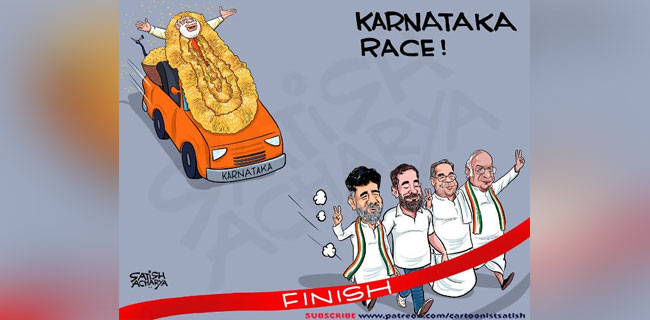
    Ranjona BanerjiThe defeat of the incumbent BJP government in the Karnataka assembly elections had the predictable effect on our captive TV channels. Some pretended to be happy that their expensive exit polls had got it more or less correct. Others switched to the UP local body elections, because mayors in UP are more important that chief ministers in some southern state, especially when the BJP wins. Others could not contain their sorrow that not only had the BJP lost but the dreaded Congress had won.

    I can hear the murmurs: oh, but many TV wallahs were equally upset when the Congress won in the past, all a “durbar-dynasty” clan, now smarting because the great King Emperor is triumphant and so on.

    Let’s accept that all political formulations have some support within the media.

    The question we now face is of degrees.

    Never before has the mass media been as captivated by one political regime.

    Never before has the mass media covered up transgressions and failures by a government as it does now.

    Never before has the mass media spread sectarian hatred to suit the political dispensation has it does now.

    The dangers are real. Citations from the past may make some commentators feel they’re being “objective” but in fact they are doing the opposite; they’re enabling fascism.

    And the extent of the entitlement that fascist forces feel was evident when India Today invited BJP IT Cell chief Amit Malviya to discuss the election results. The BJP was understandably upset at the way Karnataka voted. After all, the entire might of the BJP had descended on the state. Narendra Modi and Amit Shah had held several rallies and road shows. The media had promoted every marigold petal showered on Modi with as much enthusiasm had it had ignored Rahul Gandhi’s Bharat Jodo Yatra.

    Malviya’s meltdown on TV which included a massive personal attack on TV anchor Rajdeep Sardesai underlined why promoting sectarian, divisive political ideologies on the pretext of being “objective” can be counter-productive. But because TV has imposed on itself this A versus B format of entertainment and propaganda, it has not just lost journalism but lost itself.

    Many Indians continue to watch TV and take this sort of stuff seriously. They get indoctrinated and radicalised.

    TV knows this and continues with it.

    Recently two people were apprehended on suspicion of playing Hitler’s speeches on an Austrian train’s intercom system. The “freedom of speech” argument used by bigots and fascists is specious. There are limits on hate speech. Adolf Hitler is one limit, and with good reason.

    https://edition.cnn.com/2023/05/15/europe/austria-hitler-loudspeakers-train-intl/index.html#:~:text=Passengers%20on%20an%20Austrian%20train,several%20passengers% 20on%20the%20train.

    But India’s TV channels are unable to make such distinctions. I cannot imagine that Malviya will be avoided, let alone banned. He is likely to continue to be a treasured guest on most of these Leni Riefenstahl channels.

    Meanwhile, I will remind you that there are important reasons why the BJP lost Karnataka, from its Hindu majoritarianism to its Islamophobic policies and its lack of a proper economic growth model. Much like in the rest of India.

    I can guarantee you however that the majority of our mainstream media will now focus on lobbying within the Congress Party to become chief minister of Karnataka.

    The reasons are obvious.

    It will be interesting to see though how many channels get outraged with the United States and call for diplomatic action against them for this report about increasing attacks on religious minorities against India. Narendra Modi is due on a state visit to the US in June, the first in nine years.

    https://preview.state.gov/reports/2022-report-on-international-religious-freedom/india/

    O my.


    Ranjona Banerji is a senior journalist and commentator. She writes on MxMIndia on Tuesdays and Fridays. Her views here are personal.


  • Creative Abby shortlist announced

    By Our Staff


    ABBY One Show Awards 2023 attracted a total of 2282 entries this year as compared to 2007 entries last year.  Out of these a total of 736 entries have made it to the Final Round of metal and merit voting. The number of entries making it to the final round is around 32 percent indicating tough One Show global norms for earning metals.


    This year 181 companies entered the Creative ABBY 2023 out of which a total of 110 companies were shortlisted after the first 2 rounds.


    Among the Advertising agencies whose work has been shortlisted in alphabetical order are BBH, Cheil Worldwide, Cog Culture, Crayons, Creativeland Asia, Enormous, FCB India, Grey Group, Havas Worldwide, Law and Kenneth Saatchi, Leo Burnett, Manja Brand Works, McCann Worldgroup, MullenLowe Lintas, Publicis Health, Scarecrow M&C Saatchi, Sideways, TBWA, Tribes, VMLY&R Wunderman Thompson.


    The full list of companies shortlisted is in the table attached.


    Among the Digital companies whose work has been shortlisted in alphabetical order are Atom Network, BC Web Wise, Blink Digital, Centrick, Digitas India, Flibbr Consulting, FCB Kinnect, Gozoop, Grapes Digital, ibs Fulcro, Interactive Avenues, L S Digital, PivotRoots Digital, 22feet Tribal, Schbang, SoCheers, Sociowash Media, Social Panga, Wirality Media.


    Other digital companies shortlisted can be seen in the table attached.


    Media companies whose entries in Creative have been shortlisted are Havas Media, Laqshya Media, Madison World, Mindshare, White Rivers Media.


    Broadcast companies whose entries in Creative Abby have been shortlisted are Culver Max, Disney Broadcasting, NGC Network, Star India, TV18 Broadcast & Pictures, Viacom18 Media, Zee Entertainment.


    Publishing companies whose entries in Creative Abby have been shortlisted are ABP, Bennett Coleman & Co., Dainik Jagran, Dainik Bhaskar, HT Media, Hindustan Times, Hindustan Media Venture, Jagran Prakashan, The Hindu Group, Sangbad Pratidin.


    The Design companies shortlisted in alphabetical order are Alok Nanda Communications, Brandmovers, Cog Culture, The Honest illustrations, Hyphen Communications, Open Strategy and Design, Tree Design, Sharpener.


    The video craft companies whose work is shortlisted are Bang Bang Films, Belief Films, Breathless Films, Chrome Pictures, Cutaway Films, Footloose Films, Future East, Good Morning Films, Hungry Films, K Silent, Kitchen Video, Little Lamb Films, Perfect Ten Films, Pick Films, Prodigious, Script Room, Superfly Films, Thinkpot.

    Creative Abbys shortlist report

  • Ayushmann Khurrana promotes health tech start-up

    By Our Staff


    Dentsu Creative India has partnered with Orange Health Labs, a health-tech start-up, to launch the brand’s first-ever 360-degree campaign. Ayushmann Khurrana is the brand ambassador for Orange Health Labs. Through the campaign, Orange Health Labs highlights its unique offerings, which include home sample collection, rapid 2.5-hour testing, elimination of batch testing, and 100% accurate results.


    Speaking about the campaign, Dhruv Gupta & Tarun Bhambra, Founders, Orange Health Labs said: “Orange Health Labs was founded to enable the convenience of on-demand at-home collections and ensure report accuracy for consumers. This campaign is an attempt to raise awareness that you can now get both, only with Orange Health. We are excited to have Ayushmann as our brand ambassador, as he represents modern and logical choices through his work.”


    Indrajeet Mookerjee, President – South and West, Dentsu Creative India added: “In the backdrop of the pandemic, the healthcare industry became saturated with players, making it hard for consumers to make a choice. Our challenge was to devise a sharp and witty campaign to cut through the clutter and highlight Orange Health Labs’ core propositions of speed and accuracy.”


  • PAFI announces new office bearers for 2024

    By Our Staff


    Public Affairs Forum of India (PAFI), the professional resource for public affairs practitioners in the country, announced its new office bearers for the year 2023-24.


    Vice President of PAFI for 2022-23, Vinita Sethi, took over as the President of PAFI for 2023-24 with immediate effect from Virat Bhatia, who completed his tenure as the President of PAFI for 2022-23.


    Deepshikha Dharmaraj, Chief Executive Officer of BCW India Group is the new Vice President of PAFI. Chetan Krishnaswamy, India Public Policy, Amazon India is the new Secretary, and Medha Girotra, Vice President, Public Policy, South Asia, Mastercard India Services Pvt Ltd is the new Treasurer.


    Vinita Sethi, the incoming President of PAFI and Senior Vice President & Chief Public Affairs at the Apollo Hospitals Group, said: “It is a privilege to take over as the second woman President of PAFI. Seeing more women in the leadership team of PAFI this year is terrific. There wouldn’t be a better time to be in Public Affairs as we navigate major global shifts and impacts in today’s inter-connected world by regularly engaging with policymakers and peers in India and abroad. At PAFI, we have been deepening capacity building in the public affairs domain through sharing experiences and navigating critical shifts in policymaking by engaging with the central and state governments and think tanks and aligning with other external stakeholders. Our focus has been on new paradigms of governance, growth and development. The other office bearers and I will continue our dialogue and outreach with stakeholders in the government and businesses across sectors. We will continue to strengthen cross-sectoral collaborations, innovate and build new policy-dialogue platforms to support the government’s efforts towards accelerating the country’s economic growth and overall development.”


  • ASCI tables Annual Complaints Report 2022-23

    By Our Staff


    The Advertising Standards Council of India (ASCI) released its annual complaints report for 2022-23 which contains several startling observations, especially those pertaining to advertising in the digital space. During the period, ASCI reviewed 7,928 advertisements across different media, including print, digital and television. ASCI has stepped up its scrutiny of ads nearly 2 folds over the last 2 years. TV and print advertisers continued to be highly compliant at 94%, however the overall compliance is lower at 81% due to digital. Hence, digital ads emerged not just as a leading violator, with 75% of ads processed being from the digital space, but also as the least compliant. This raises serious concerns about the safety of consumers in the online space.


    As per the report, the real-money gaming industry surpassed the education sector to emerge as the most violative sector, moving from fifth to first place. An astounding number (92%) of gaming advertisements reviewed by ASCI for FY 2022–23 did not adhere to the guidelines for real money gaming and failed to inform consumers about the risks of financial loss and addiction. The sector also gained the dubious distinction of being the least complaint, with only 50% of ads being modified voluntarily after they have been called out. It may be remembered that ASCI had released its guidelines for the Real-Money gaming sector in December 2020, and the Ministry of Information and Broadcasting had thereafter released an advisory asking all parties to comply with the guidelines.


    The report also revealed a sharp increase in the number of misleading ads featuring celebrities. ASCI processed 503 such ads, as opposed to 55 the previous year, a growth of 803%. In 97% of these ads, the celebrities failed to provide evidence of due diligence as mandated by the Consumer Protection Act. This again is a serious issue as ads featuring celebrities have a high impact on consumers.


    In addition, influencer violations stood at 26%, with 2,039 complaints being processed against them. Categories, including personal care, food and beverage and fashion and lifestyle, topped the list of influencer-related violations.


    ASCI’s adoption of artificial-intelligence-based tracking has bolstered its ability to scrutinise digital media effectively, despite challenges such as the pace of advertising and the sheer number of ads to be processed. This goes to show that the self-regulatory organisation remains steadfast in its commitment to promote responsible advertising practices and protect consumer rights.


    The ASCI Annual Complaints Report serves as a wake-up call to advertisers, platforms, and regulators, urging them to join forces and create a secure environment and foster trust among consumers.


    NS Rajan, Chairman, ASCI, observed: “The digital advertising landscape is truly challenging us all and ASCI is no exception. Stepping up our surveillance through AI based tools and a robust complaint management system has ensured that ASCI is keeping pace with this dynamic environment. Updating our codes to reflect newer consumer concerns makes sure the ASCI codes remain contemporary. We will continue to act as the conscience keeper of the Indian ad industry with transparency and future-facing expertise.”


    Manisha Kapoor, CEO and Secretary General, ASCI, added: “The complaints analysis for 2022–23 clearly shows that the digital medium is leading in terms of violative ads. This raises significant concerns around online consumer safety and trust. Advertisers, content creators and platforms must come together to address this issue on an urgent basis to protect consumer interests. In addition, the sharp increase in the number of violative gaming ads needs serious attention from the industry.”