Author: mxmadmin

  • Das ka Dum with Dr Bhaskar Das | The government is set to auction FM radio stations and get more Tier 2 and 3 stations on board. Should our big media companies be excited?

    Bhaskar DasIs radio a profitable media to be in? Read what Dr Bhaskar Das has to say in the February 21 edition of Das ka Dum. Read on…


    If you wish to access the archives, please go to the Das Ka Dum tab on the website’s top navigation bar or click here: https://www.mxmindia.com/category/columns/das-ka-dum/


    Q. The government is set to auction FM radio stations and get more Tier 2 and 3 stations on board. Should the big media companies be excited?


    A. I guess so, provided the to-be-auctioned stations allow for niche genres to be introduced. This would provide marketers and advertising agencies to plan for not only different geographical market but also for psychographic market in the form of tastes and preferences of the target audience.


    Radio, as a reminder medium and for penetrating local markets in Tier-3/4 markets , would provide an opportunity to advertisers (both local and national advertisers) to further expand their addressable market. Good for consumers also. So, there are enough reasons to be excited for all stakeholders.


  • Ranjona Banerji: Essence of being a journalist is to be full of disbelief

    By Ranjona Banerji


    Ranjona BanerjiMany very senior journalists who’ve down the rounds a few times will tell you that they are great admirers of Atal Bihari Vajpayee, the founder of the Bharatiya Janata Party. That he was a gentleman with a great sense of humour and so on.

    None of them, strangely, find it in themselves to compare this ideal prime minister to the one we have today. Within the BJP, the comparison is always to Indira Gandhi – we are better than her, even if we emulate the worst of her – and then, the attempt is always to denigrate Jawaharlal Nehru.

    But Vajpayee as Prime Minister and party founder has vanished from the discourse, even though he was Prime Minister three times, for varying amounts of time (13 days, 13 months, full term).

    Rather it is liberal “dissenters” to Narendra Modi’s brilliance who bring up Vajpayee’s “raj dharma” admonition to Modi during the Gujarat 2002 riots.

    (And evil anti-nationals like me who immediately remind these liberals of Vajpayee’s subsequent question: who burnt the train. Thus putting into perspective the remark of Vajpayee wearing a mask to fool liberals.)

    Anyway, I digress.

    My question to these very senior journalists is this: did the Vajpayee government, in your reckoning, do anything worthwhile at all, and was any of it better than Modi’s remarkable achievements?

    I seem to remember that the Vajpayee government was very big on building roads. The Golden Quadrilateral, it was called? I have travelled on the leg from Ahmedabad to Baroda. It was very good. Why is that never mentioned? Why do you give PM Modi the credit for every road built in India? As PM, he was also into diplomatic initiatives in the neighbourhood. He also spoke at international fora.

    During the Janata government of 1977 to 1980, Vajpayee was foreign minister. There was great admiration then of his speech in Hindi at the United Nations. People talked about it for years afterwards. But ever since Modi came to power, even these admirers seem to have forgotten it.

    They carry on with the Modi Modi chorus, blame the Congress for never building a single road or making a single speech and by doing so, help the BJP to wipe out Vajpayee’s legacy.

    Why Vajpayee’s legacy has to be wiped out, by the BJP, its supporters, with the help of these very senior journalists who are all admirers of Vajpayee, is an intriguing question.

    Anyone have the answer?

    Did Vajpayee exist and did he belong to the BJP?

    Or have we had uninterrupted Congress rule since 1947, until Modi won an election in 2014?

    Intriguing…

    **

    Those of us in the media think we know how our fellow journalists can be influenced and manipulated and some can be easily bought. But this deep investigation by Forbidden Stories brings home just how insidious and powerful the disinformation business has become.

    The revelations after the collapse of Cambridge Analytica were at one level, the Pegasus stories at another. Here you have the story of the mysterious “Jorge” and the massive disinformation business that he claims to run.

    https://forbiddenstories.org/story-killers/team-jorge-disinformation/

    The RW universe (or eco-system as they call themselves) revel in conspiracy theories and rumours of the “deep state”.

    The sad reality is that they are often themselves the “deep state”, adept at propaganda, manipulation, mind-bending and misinformation.

    And from our very senior journalists to greedy little upstarts, almost no one who is willing to suspend disbelief is immune to their pull.

    And yet, the essence of being a journalist is to be full of disbelief.

    Ah well.


    Ranjona Banerji is a senior journalist and commentator. She writes on MxMIndia on Tuesdays and Fridays. Her views here are personal


  • Annalect India opens new office in Mumbai

    By Our Staff


    Annalect India, an Omnicom Media Group company, announces the launch of its new office in Mumbai. This is to further its commitment to building new capabilities.


    Zaid Al Rashid, Executive Vice President, Global Digital Operations at Omnicom Group said: “Omnicom Group is committed to investing and growing our global delivery capabilities. India is a country where we will continue to expand our services in the near future. The opening of our new experiential hub in Mumbai is an example of that.”


    Speaking on the occasion, Vishal Srivastava, Chief Executive Officer, Annalect India added: “I’m extremely delighted to have launched our new office in Mumbai. The Global leaders and I have always been certain: to keep expanding our footprint across India and synergize the gamut of talent within our network. The Mumbai office will further support us in delivering timely and actionable insights to Omnicom agencies and clients through globally integrated processes, powered by best-in-class tools and technology. We continue to evolve and envision becoming an employer of choice for aspiring professionals.”


  • One year War against Ukraine: Role of Russian Media


    By James Rodgers


    The media war that has accompanied Russia’s invasion of Ukraine has shown how important a part of 21st-century conflict journalism is, and also demonstrated the power authoritarian regimes possess to restrict reporting – even in the age of smartphones and social media.

    In a move that echoed the draconian censorship laws of earlier ages, the Russian government declared its media war just days after it invaded its neighbour. New legislation meant journalists risked jail if they refused to follow dutifully the official line that the war was “a special military operation”, and not a war at all.

    As the BBC director general, Tim Davie, said at the time, the legislation “appears to criminalise the process of independent journalism”. The BBC temporarily suspended its reporting from Russia, presumably while it sought to establish the real extent of the risk to its reporters.

    Eventually, they resumed their work, with Steve Rosenberg and his colleagues bringing to international audiences stories such as that of Denis Skopin, a university lecturer in St Petersburg, sacked for his protest against the war. For The Guardian, Andrew Roth has also reported on anti-war activism, including the quiet defiance of those who mourn Ukrainian victims of the Kremlin’s war machine.

    Many others, though, left – often when their editors felt it no longer safe for them to stay – and are yet to return.


    Echoes of 1920s Bolshevik ban

    What is in effect a ban on independent journalism may be seen as a kind of compliment: a testament to the power that reporters have to challenge the Kremlin’s justification for making war.

    Combined with the inaccessibility of many international news websites and social media platforms since the start of the war, the effect is that reliable reporting from Russia is more restricted than at any time since before the era of reform and openness that characterised the late Soviet period.

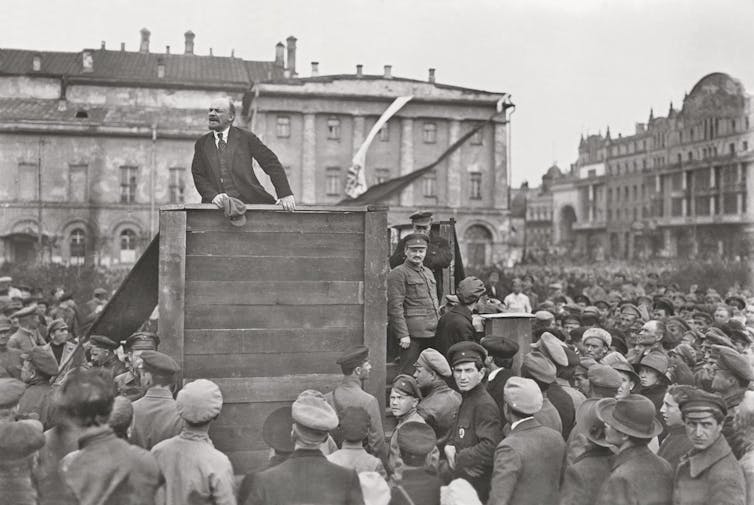
    Lenin gives a speech for the Red Army in front of the Bolshoi Theater in Moscow in 1920. On the right of the picture are Lev Trotsky and Lev Kamenev.Controlling the message: Lenin was well aware of the power of the press as a tool of state control.


    In fact, the situation today bears comparison with that of a century ago, when the fledgling Bolshevik government had banned international correspondents from Russia on the basis that their governments and newspapers had supported the wrong – the counterrevolutionary, “White” – side in the civil war. Then, as now by some correspondents, events in Russia were reported from Riga in neighbouring Latvia.

    With the threats of punishment and prison, Russia’s approach to the media war has been crude – and also, in some respects, as explained below, effective.


    Zelensky: consummate media performer

    In others, much less so. Ukraine’s president, Volodymyr Zelensky, has shown great skill – and presumably drawn on his previous acting career –in using modern media and formats (his second world war “Victory Day” video, in which he drew parallels aimed at a Russian audience, between the second world war inflicted by Nazism and the invasion of his country, being a great example).


    Zelensky’s surefooted and engaging media appearances have contrasted with videos of Putin that have prompted British tabloid speculation both about his health, and whether he is using actors in some of his TV appearances.


    How Russia uses military and media in wartime

    But if Ukraine is winning the war for western public opinion, Russia seems to be successfully shoring up public support at home.

    This has been a long process. I visited Russia in 2019, for the fifth anniversary of the 2014 annexation of Crimea, and was struck by the prevalence of militaristic imagery and sentiment – not only in the news media, but in murals overlooking the streets of Moscow and other cities I visited.

    This combination of media and militarism has been an indispensable, integral, part of Russia’s use of war in international relations in the Putin era, as my co-author, Dr Alexander Lanoszka, and I argued in our 2021 paper: Russia’s rising military and communication power: From Chechnya to Crimea.

    The Kremlin’s biggest success has been placing 20th-century controls on 21st-century media. Yes, these can be circumvented. Russia is a highly technologically literate society (think how many incidents of hacking are blamed on Russians) and those who want to read news from the west can do so if they put in a little effort.

    But many do not seem bothered to try. As Rosenberg discovered in a report for the BBC from Belgorod, not far from the Russian border with Ukraine, on February 10, official messaging seems largely to be taken at face value. “The west has always wanted to destroy Russia,” one resident of the city told him.

    This is the stage which, 12 months since Russia’s large-scale invasion (Ukrainians will rightly point out that the war itself really began in 2014), the media war has reached. The rapid victory the Kremlin seems originally to have envisaged not having happened, the war has now been reframed – on the basis not only of Putin-approved versions of history, but also deliveries of western weapons to Ukraine – as a conflict between Russia and the west.


    What next for the media war

    Ukraine will need to keep international news organisations engaged. Zelensky’s speech in London on February 8 – that appeared so greatly to inspire the British parliamentarians who heard it – had to be on television and social media to have the desired impact, and for the visual gesture of handing over an airman’s helmet to make the desired impression.

    There is one western policy that should change in the next stage of the media war, though I have little hope it will. The EU and the UK were wrong to ban Sputnik and RT. It gave them credit for greater reach and influence than they ever enjoyed. It allowed them the chance to masquerade – however absurdly – as martyrs for free speech. Western audiences need to see what Russian audiences are being told. In a media war, as in any war, the more you know of your enemy, the better.


    As Vladislav Zubok, a professor of international history at the LSE, told me recently:

    We still find even at the worst moments of the Cold War journalists talking to each other and acting as intermediaries. These people met. These people had a dialogue. Not any more.

    That should change. One day this war will end, and the US, UK, EU and others will have to forge a new relationship with Russia. It is unlikely to be one of friendship – but even one accepting distance, division and discord can better be managed by the kind of dialogue of which journalism can be the starting point.

    This level of mutual understanding must not be yet another casualty of this media war. Let journalists do their jobs.The Conversation


    James Rodgers  is a Reader in International Journalism, City, University of London. This article is republished from The Conversation under a Creative Commons license. Read the original article.

  • Blackcoffee.media names Russell Pinto as Business Head

    By Our Staff


    Blackcoffee
    Blackcoffee

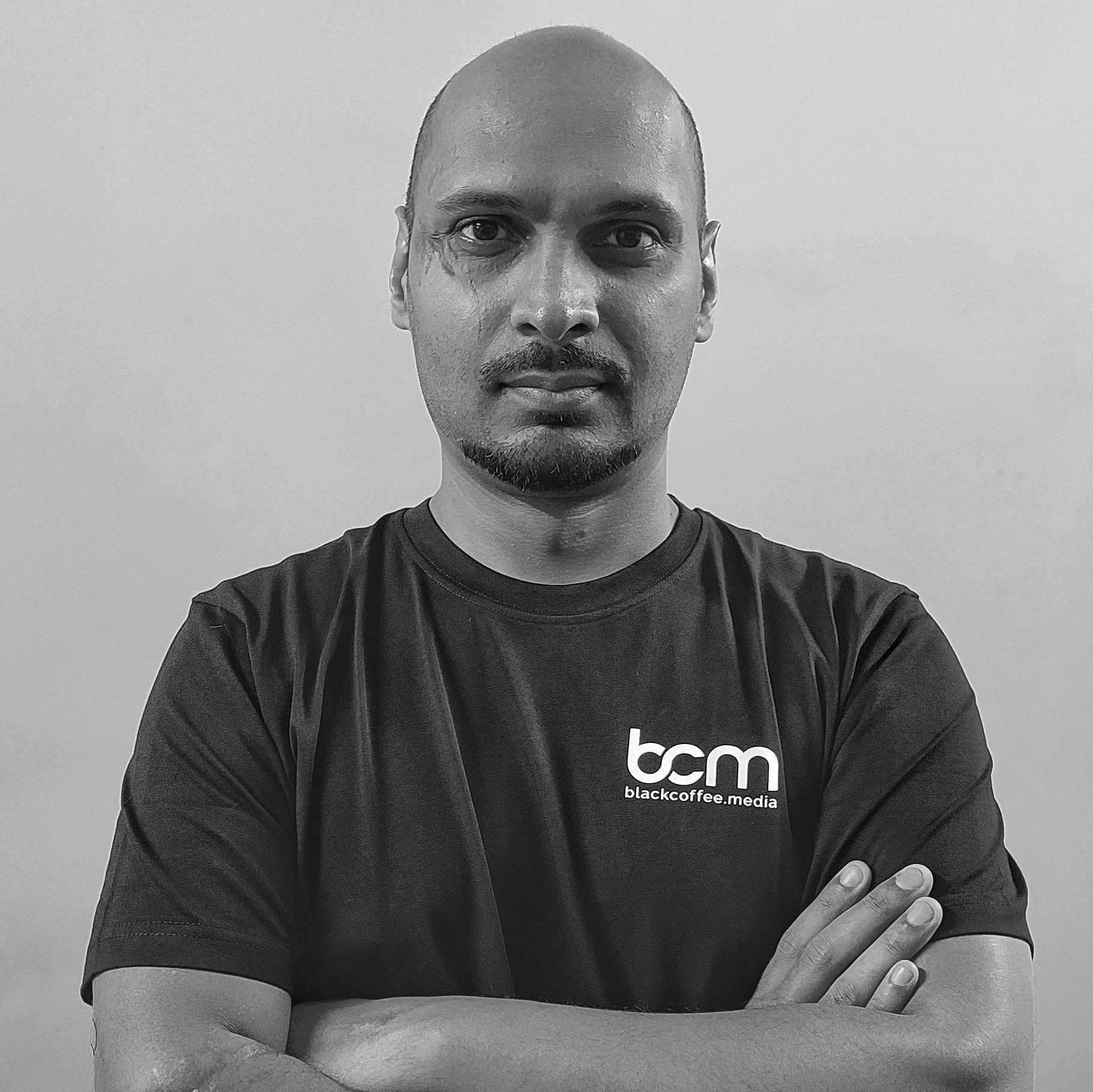
    Blackcoffee.media, a growth marketing and solutions company appoints Russell Pinto as their Business Head.


    At Blackcoffee.media, Pinto’s will impart his expertise and facilitate the strengthening of the team across all departments, thereby positioning the company to effectively serve larger brand clients.


    Welcoming Russell on board, Kirtan Mankad, Co-Founder, Blackcoffee.media, said: “We are confident that Russell’s leadership will enable the company to reach new milestones in delivering exceptional solutions and services to our clients. He is a seasoned professional with a wealth of experience and passion for success, and I am sure his deep understanding of the industry will be a valuable asset to our company and drive our growth to newer heights.”


  • Famous Innovations & Absolut Glassware roll out activation campaign

    By Our Staff


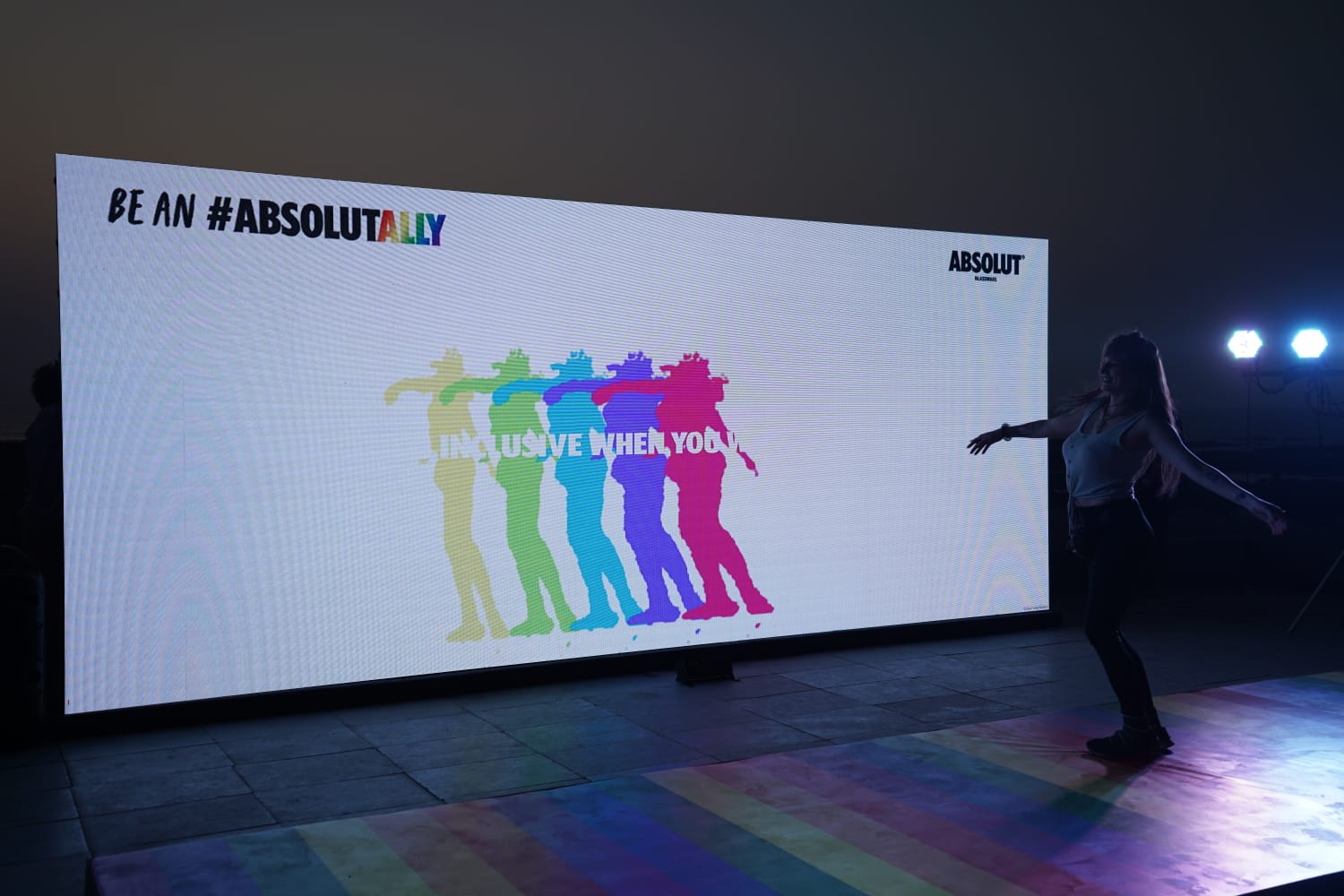
    Famous Innovations creative agency has partnered with Absolut Glassware and Laqshya Media Group to launch an on-ground activation that aims to create an inclusive world. The campaign encourages allyship and aims to foster a safe space for members of the queer community.


    Melvin Jacob, Creative Head, Famous Innovations, Bangalore, said: “The idea was inspired by the shared vision of Famous Innovations and Absolut Glassware that creativity has the power to change the world. When we conceptualized this idea, we wanted to create a safe space for members of the LGBTQIA+ community, where they can explore their own identity and be themselves. The key was to promote allyship everywhere – and encourage support for the members of the community. Small yet brave steps that anyone can take to aid this crucial movement of inclusivity.”


    Added Florian Sallabery, Group Head, International Brands, Pernod Ricard India: “If this campaign helps at least one person feel more supported and comfortable with who he/she/they are, then we meet our objective.”


  • Das ka Dum with Dr Bhaskar Das | Marketers with digital and strategy skills are in high demand, notes LinkedIn. So would you recommend just a digital marketing course as against a two-year MBA?

    Bhaskar DasThis is a must-read response as it comes from an industry veteran who has successfully reinvented himself and launched into the digital world. Here’s Dr Bhaskar Das has to say in the February 22 edition of Das ka Dum. Read on…


    If you wish to access the archives, please go to the Das Ka Dum tab on the website’s top navigation bar or click here: https://www.mxmindia.com/category/columns/das-ka-dum/


    Q. Marketers with digital and strategy skills are in high demand, notes LinkedIn. So would you recommend just a digital marketing course as against a two-year MBA?


    A. Yes, candidates with adroitness in STEM are more in demand as skills in decoding and problem-solving through data analysis are the need of the hour for all business functions, especially marketing area.


    It is not enough to do a digital marketing course. One needs to have an understanding of management of business from all its facets including functional specialisations. Incidentally, all MBA curriculum include digital marketing as an integral part of the pedagogy. A sole digital marketing course would be useful for those who had done MBA a few years back when data-led algorithm hadn’t dominated business consciousness to the current extent. So for upskilling to future proof oneself, literacy in digital marketing, AI, ML, ChatGPT , Blockchain, Metaverse are an imperative for an ongoing successful career.


  • Madhuri Dixit roped in as Brand Ambassador for Illusion Dental Lab

    By Our Staff


    Illusion Dental Lab has roped in ace Bollywood actress Madhuri Dixit Nene as the brand ambassador for Illusion Zirconia. Illusion Zirconia, the newest brand from the house of Illusion Dental Lab is formulated to primarily focus on Zirconia Crowns and Bridges.


    Speaking about the appointment of the brand ambassador, Sameer Merchant, CEO of Illusion Aligners & Illusion Dental Lab, said: “We are acknowledged as one of the top pioneers and innovators in the dental sector and have always presented our consumers with long-term, consistent smile solutions. Therefore, we have introduced Illusion Zirconia to raise awareness among consumers about Zirconia crowns and bridges for dental treatments. We are excited to have Madhuri Dixit Nene as the face of the brand Illusion Zirconia. As adults require a dental crown and bridge treatment more than children or teenagers, the choice of Madhuri Dixit Nene as the brand ambassador for Illusion Zirconia was based on relatability, recall and relevance. She defines the same tangent of thoughts of carrying unmatched beauty with a long-sustained career in the industry. Madhuri is a perfect testament to the Illusion Zirconia’s tagline “Beauty Bhi Mazbooti Bhi.”


  • IIFL Finance launches campaign

    By Our Staff


    Retail-focussed non-banking financial company IIFL Finance has launched ‘Sapna Aapka Loan Hamara Campaign’ with Tamannaah Bhatia as part of its pan-India marketing outreach. IIFL aims to reach 350 million+ consumers with it offerings over the next six months through the campaign and improve its leadership position in gold loan, home loan, business loan and microfinance loan segments.


    The marketing film, directed by filmmaker Himashu Tiwari, is running across TV, digital, cinema, Radio and print media among others. It is aimed at unbanked and underbanked segment of customers with growing credit needs.


    Commenting on the brand film launch, Manav Verma, Chief Marketing Officer at IIFL said: “We believe in the power of small entrepreneurs in running Indian economy. All they need is credit at the right time, which IIFL Finance understands the best. ‘Seedhi Baat’ or ‘straight talk’ is the underlying theme of all our business dealings and brand philosophy.”


    Here is the link to the film

    https://www.youtube.com/watch?v=dM8JGiH0P7U

  • Ogilvy creates new campaign for Amazon

    By Our Staff


    Amazon India urges people to rethink the range of products that could be purchased from Amazon.in by asking “Aaj Kya Khareeda?” in its new campaign, created by Ogilvy India. This is to amplify the width of selection which is one of Amazon’s strengths, where the focus is on driving awareness around everyday products. It reminds customers that Amazon is a one-stop-shop for all their needs, not just the occasional, one-off needs but frequent, daily ones as well.


    The campaign comprises of four films on TV and digital along with several multi touchpoint activations on Outdoor, influencers etc. All the films have been directed by Aarti Desai of Caffeine Films and conceptualized by Ogilvy India.


    Speaking about the campaign, Neville Shah, Senior Executive Creative Director, Ogilvy said: “There is so much excitement when we get something in a box at home. But is it just as exciting, if it’s regular everyday things? Maybe not as much. The stories rely on the charming anticlimax, to remind people that Amazon.in has simple everyday things. Exciting. Perhaps just as much.”


    Added  Ravi Desai, Director, Mass, and Brand Marketing – Amazon India: “Our new campaign ‘Aaj Kya Khareeda’ reinforces Amazon as an everyday shopping destination that caters to daily requirements and needs of our customers. We want to simplify our customers life and be the shopping partner that helps you buy products from a wide selection spread across numerous categories, get reliable delivery and customer care, thus leading to a delightful shopping experience.”


  • Should Banks & Payment Platforms collectively address safe transactions?


    By Sanjeev Kotnala


    Sanjeev KotnalaEvery day there is a story of a digital payment scam. One fails to understand how even literate and well-aware people are conned. The fault is not with banks and digital payment platforms, which constantly try to educate consumers on the does and don’ts of digital- online payments.


    One marvels at the agility and innovative schemes the scammers run to trap the gullible public. The fraudsters are fast learners, innovative and agile in redefining their work processes. The scammers have a new technique, a new trap and a new story every day to trap their victims. They know that ten can be potentially trapped for every cautious person they encounter.


    On the other hand, the basic precautions while making a digital-online payment have not changed much. But, it seems that people learn only when they or people near and dear to them are targeted and scammed.


    The banks keep on talking about wanting to create a secure financial network. Still, the onus should be on the users: who needs to be alert while using the platforms to make digital payment and purchases.


    Collective Corroborative Effort Is Needed

    Maybe, there is a need for collective, collaborative, synchronised efforts from all banks and payment gateways. Maybe, the different messaging strategy used by the banks and payment gateway is confusing. These messages need high frequency and cross media utilisation across Radio, Print, TV, Digital and even outdoor. And print and TV can work wonderfully well for the communication.

    Do you agree that a collective simple communication drives like Pulse Polio, where every bank and payment gateway contributes, will lead to better communication effectiveness or should they individually address the problem.


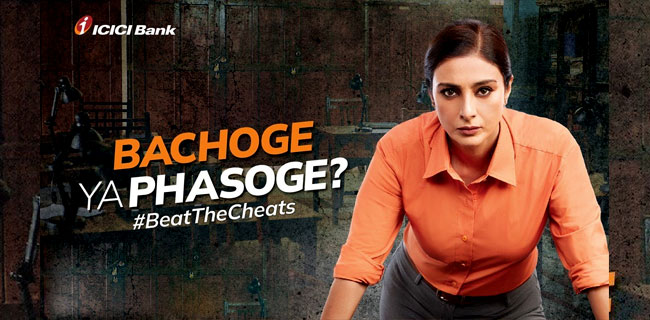
    ICICI BANK #BeatTheCheats

    ICICI Bank and ICICI Foundation have been doing some good work communicating these simple rules. They have treated the scammers as an organised set-up with training and showing how they trap the victim. Think the communication works.

    UPI PIN is only needed for making the payment, not for receiving payment. Never share your UPI PIN with anyone.


    Never scan unknown QR Codes. QR Code is scanned for making payment and not for receiving payment or refund. Beware of fraud lottery scams and messages that tell you – you have won and send you a link for payment. Remember, if it’s too good to be true, it probably is! Never trust calls/SMS claiming you won a lottery. Never click on unknown links. Never share your PIN/OTP with anyone. Let’s #Beatthecheats.


    RBI Bank And Digital Safety

    RBI has been at the forefront of customer digital safety education and communication. It has used various media options and created simple communication series. And its shorts are directly shareable across social media platforms. Like every other bank, it has films pushing digital safety and not sharing banking financial information. And they has used day-to-day situations like a badminton court and a restaurant to further make the point. It even has a Rap Song to propagate the message. The bank has heavily invested on Digital interaction on the subject and used print to communicate the message.


    OTHER BANKS

    HDFC Smartbuy even shares tips on how to get the best out of online shopping and safe Digital Payment. They have a series of ads showing possible Scam schemes like Holiday and how the victim is trapped.


    Axis Bank  plays the same or similar points in their communication on Phone pe Chori. RBL bank also shows the scamming process, including the KYC update scam, and how an alert customer can be safe.


    THE SCAM STORIES.

    There are many stories that scammers weave to trap their victims. For example- pre-payment advance for buying an item on sale by the victim, including a deal on platforms like OLX. Lottery win information and need for the pre=conditional registration fee. Hacking into customers’ WhatsApp or Facebook accounts and sending messages to the contacts, asking for money. Using Facebook hack of open account visuals and then using them as sextortion. Massage parlour booking sextortion case. Selling consumer durables or properties at a very attractive price. Multiple bookings at Airbnb or Homestays or even low-cost, out-of-the-world priced holidays and many more.


    HELPLINE 1930

    As per the Ministry of Home Affairs (MHA), more than 1,40,000 UPI fraudulent activities were reported on the National Cybercrime Reporting Portal (NCRP) during Q1 and Q2 2022. RBI says that UPI transactions increased by 1200% in the fiscal year ending September 2022. This massive increase has also made UPI fraud account for a reasonably high number of cyber frauds in the country.


    There is a definitive need to educate the public on Cyber Crime Helpline – 1930 and the site www.cybercrime.gov.in. They must be told – what to do when they fall for the scam. What information is needed to pursue the case, and what they should do.


    NET-NET

    There is much more that banks and digital payment platforms need to do regarding customer awareness and safety tips for financial transactions. And the onus for safety should also be on the customers. One has to be aware of and follow the safety tips that banks and payment platforms regularly share. Maybe, they should contribute funds, and a collective communication drive should be strategised and implemented for better effectiveness and efficiency.


    ~ ~


    How To Ensure Safe Digital Payment Transaction. ( Source SBI and ICICI Bank)

    • ATM/Debit/Credit Card is the key to your bank. Do not hand over your card to anyone else for use.

    • Never write the PIN anywhere.

    • Never share your financial information when requested over the phone or by e-mail.

    • Do not seek help from strangers in ATM/ Branch; instead, approach any bank official.

    • While withdrawing cash from an ATM or entering it during any transaction, like shops and airport lounges- make sure nobody is standing behind you. Always cover the keypad with your fingers.

    • No bank will use e-mail or call you to ask for your PIN, password or other confidential account information.

    • Do not give your phone to strangers to send SMS or make calls. If they are in an emergency, send the SMS yourself or dial the number yourself.

    • Try using unique and complex passwords and change passwords frequently. Strong passwords/ Biometric permission should be enabled on your phones/laptops/tablets.

    • Try using biometric authentication wherever feasible.

    • Do not download any unknown app suggested by strangers.

    • Try keeping your Mobile PIN and UPI PIN different and random.

    • Do not respond to any unknown UPI requests. Report suspicious requests

    • Never disclose, store or write down your user ID, passwords or PIN

    • Disable the ‘Auto Save’ or ‘Remember’ function in your device to avoid storing the user ID and passwords.

    • Always remember that a PIN is needed only for transferring amounts, not for receiving.

    • Instantly disable UPI service on your account if any transaction has happened without you doing it.

    • On the internet- Always look for “https” in the address bar of the bank’s website.

    • Avoid performing online banking transactions in public places using open Wi-Fi networks. Always log out and close the browser when you finish your work.

    • Do not share your personal/financial information on any social media platform.

    • Manage your debit card transactions through Online Banking.

    • Set a limit for card transactions at e-commerce platforms, POS and ATM both for domestic and international transactions

    • Always download apps through official stores. Monitor permission is given for critical apps on mobile and keep track of unnecessary and unused apps

     

  • ABP to unveil second edition of ‘Ideas of India’ Summit

    By Our Staff


    ABP Network is set to launch its second edition of ‘Ideas of India’ Summit from February 24-25 in Mumbai. The theme for this year’s edition is Naya India: Looking Inward, Reaching Out. The summit brings together on one stage: one platform, the brightest minds cutting across sectors from within and beyond the borders of the country.


    ABP Network CEO Avinash Pandey said: “The inaugural edition of ABP Network’s ‘Ideas of India, in 2022, turned out to be a huge success, not just in terms of how many people watched it, across our network, but more importantly what the forum meant as an intellectual exchange of diverse ideas. It was evident to me that this was an idea that was worth sticking with, because ABP Ideas of India event is not just a summit, it is a platform that represents and extends the pluralism that is the ethos of India. A true democracy, like India, is a grand idea built on the churning of a million smaller ones, pulling and pushing together as a single unit. I am happy to announce that with ABP Network’s ‘Ideas of India Summit 2023’, this is officially now an annual platform of that churning of ideas, that will contribute to the defining of tomorrow’s India. The 2023 summit is all about the making of a Naya India as we look inward while reaching out to the world.”


    The 2-day event, in Mumbai, this year will primarily address the question – Where does India stand at this moment in history, with its burgeoning economy successfully tackling the energy divisions of yet another war in Europe, with a post pandemic recalibrating world looking up to her as a global leader and a whole new generation of Indians impatient to lead across sectors? The speaker list of thought leaders, business icons, cultural ambassadors, and politicians addressing this vital question is long and varied. It extends from Liz Truss, the former Prime Minister of UK to Indian Chief Ministers like Arvind Kejriwal, Bhagwant Mann and Eknath Shinde; From novelist and champion of environment Amitav Ghosh to tech and business innovation icon N.R Narayana Murthy; from internationally acclaimed academician and author Mahmood Mamdani to the highly amiable Union Minister of Road Transport Nitin Gadkari or the Central Minister in-charge of ensuring connectivity, be it Railways or IT, Ashwini Vaishnaw. The world of arts and cinema will have yesteryear heartthrobs like Zeenat Aman and Asha Parekh as well as a social messaging movie superstar like Ayushmann Khurrana. Ideas of guts and grit of a fighting women will be shared by Vinesh Phogat, Ashwini Nachappa, Jwala Gutta, Joshna Chinappa while education path breakers like ‘Khan Sir’ and ‘NV Sir’ will talk about a young India gaining useful knowledge. International film directors Mira Nair and Shekhar Kapur will be there as will be the versatile actor, Manoj Bajpayee; Devdutt Pattanaik will bring alive the myths of the past as someone like Lucky Ali makes the connection between music and words.  From celebrity chef Vikas Khanna sharing ingredients of his cooking mantra to young political heavy weights Poonam Mahajan, K Kavitha, Priyanka Chaturvedi and Raghav Chadha expounding on their individual political party’s recipe for the elections ahead, the summit is all set to deliberate the paths to a vibrant destiny for a new India.


    ABP Ideas of India 2023, with 40 odd sessions and more than 60 speakers, is designed to be an intense and thought-provoking experience that celebrates the strengths that make Naya India the nation that it is as the country reaches out to take its rightful place in the world of tomorrow. ABP Ideas of India Summit 2023 will be available for viewing, on both days of 24th and 25th February, across all the different digital and broadcast platforms of the entire ABP Network.