Author: mxmadmin

  • Sebamed launches campaign for its personal care brand

    By Our Staff


    Sebamed, a German personal care brand, launched yet another campaign #UmeedNahiSach for its beauty and personal care portfolio.


    The campaign reiterates Sebamed’s commitment towards educating and empowering consumers with right information about their skin and hair concerns, and showcases why Sebamed products backed with pH 5.5 benefits are efficacious in solving their issues.


    Commenting on the same Shashi Ranjan, Country Head, Sebamed said: “We are committed towards creating a new paradigm in the beauty and personal care segment keeping customers at the core. Over the years we have built a passionate team, that works on bold idea and solves real customer issues. Through #UmeedNahiSach campaign, Sebamed reiterates its commitment towards integrity in communication and urges consumers to switch to Sebamed range of Skin and Hair care products that really works. I am sure this will resonate well with our audience.”


    Added Suyash Khabya, Creative Head, The Womb: “Sebamed doesn’t beat around the bush. It talks straight, it talks honest, and it talks the truth. Sebamed is a challenger brand and will keep questioning the status quo. That’s the tone we have maintained for the brand. Through this campaign “Umeed Nahi Sach”, our attempt is to show the honest mirror to consumers by helping them choose the right products for ‘true’ real results. We’ve incorporated the sound of the shankh in the end which sonically signifies that Sebamed stands for Truth and Truth always wins!”


  • India TV hosts ‘Samvad Budget Conclave 2023’

    By Our Staff


    India TV organised a day-long “Samvad Budget Conclave 2023” on February 3 in New Delhi. Top ministers from Prime Minister Narendra Modi’s government and senior leaders from the Opposition parties attended the conclave to put forth their views on the Union Budget 2023.


    Finance Minister Nirmala Sitharaman, and a team of experts and analysts provided insights and analysis on the Union Budget. Economists, along with income tax and capital market experts, were in session.


    Said Ritu Dhawan, Managing Director- India TV: “Our goal was to make the contours of the Union Budget accessible and understandable to the audience, enabling them to make informed decisions and hold the government accountable for its financial decisions.  An informed and engaged citizenry is crucial in a civil society, and this will surely promote transparency and good governance.”


  • Ogilvy ties up with Kila Raipur Rural Olympics

    By Our Staff


    Ogilvy India has rolled out a host of activities at the 83rd edition of Kila Raipur Rural Olympics for its client brands such as Omnigel, Limca Sportz, Fevicol and Kotex.  This is part of Ogilvy’s rural focussed work rooted in culture.


    With more reach and growth being the single-minded agenda for all marketers, a recent study conducted by the NCAER, rural India, highlights the opportunity of targeting 720 million consumers across 627,000 villages.


    Initiated in 1933, the Kila Raipur Rural Olympics is annually held in the winters around early February. The event takes place at the Grewal Sports Stadium in Kila Raipur village.


    The organising team was looking for meaningful partnerships with brands that could work with their teams to enrich as well as create a delightful experience of the games. Ogilvy’s branded content & activation wing set up a small core unit at Kila Raipur in September 2022 to work with the local team and identify areas where brands could play a role.


  • India Today-Business Today Budget Roundtable

    By Our Staff


    India Today- Business Today is hosting a Budget roundtable today.


    It will feature Union Finance Minister Nirmala Sitharaman along with other senior Union Ministers like Nitin Gadkari Minister of Road Transport and highways, Piyush Goyal Minster of Commerce & Industry, Consumer Affairs, Food and Public Distribution and Textiles, Ashwini Vaishnaw, Minister of Railways, Communications, and Electronics and Information Technology. They will present their views on the discussion The Effective Model for Growth in Times of Global Recession.


    BT Editors Sourav Majumdar, Siddharth Zarabi, Udayan Mukherjee, Aabha Bakaya and News Director of India Today and Aaj Tak and the Executive Director of Business Today, Rahul Kanwal will conduct the sessions.


  • Upclose with Urban Bharat


    With apologies to none at all


    By Vikas Mehta


    Vikas MehtaI call my column with apologies to none. But this time, I begin with an apology. This column is actually a mish mash of many things. State of the economy, inflation, urban Bharat consumer, children as consumers… you get the picture.


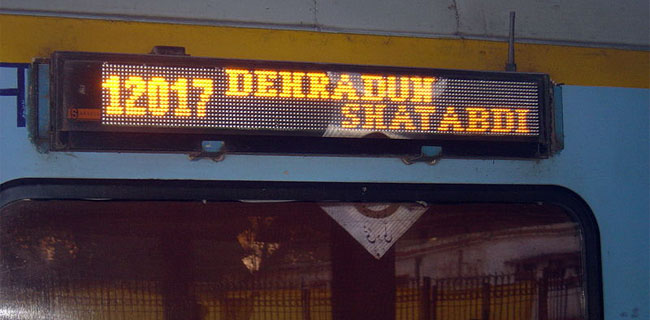
    What prompted me to write this blog was two trips that I have made in the past 2-3 weeks, between Dehradun and Delhi & back. By road in a bus and by train.


    I have always believed that marketers must travel by train to understand the Indian consumer and this could not have been more true than in the recent trips of mine. I travelled in a Volvo, in Shatabdi and in Jan Shatabdi too. So, let’s dive in.


    While travelling in the comfort of a Volvo which does Delhi to Dehradun, a distance of around 250 kms in 4-4:30 hours non-stop, thanks to expressways and toll roads, I entered into a conversation with an economics student who was in his final year.  He had bought some packaged namkeen and was pretty sore about the price increase of these in the past year. Being a economics student he was throwing around the word inflation like free popcorn. I couldn’t stop myself from asking him the reason for inflation. He immediately threw demand supply curve at me saying how supply has been constrained due to lockdown and shortage of raw materials and oil due to the Russia Ukraine war.


    But, India has actually benefited by the war in terms of crude oil prices. We are buying record quantity from Russia almost about 10% of our need, compared to less than 1% pre war. That’s why fuel prices in India have remained constant for almost a year now. I countered.


    That left him stumped. Like a typical Indian student who understood his theory, the practical aspect of his understanding was not upto the mark.


    And what about the demand, I asked him. After all those lock downs and production sector taking a hit, rise in unemployment in sectors like tourism and hospitality, now also in IT, how has the demand increased, I enquired.


    By now, he was totally confused. But to give credit to him, he wanted to know. I patiently explained to him how subsidies and dole outs that governments all over the world, including India, gave out, left people with unexpected money which they could not spend, then. So, when the pandemic subsided all that money created an unprecedented demand which the lockdown induced supply constraints, specially in China, could not meet upto. In India it was not just the food subsidies that was given to almost 80 crore people, which still continues to be given, but also sectors like government employees, who had no pay cuts, IT, who did brisk business and more, that were laden with money, which then resulted into a booming demand. Imagine, even a daily wage earner, if he was spending 2000 rupees a month on food, he was now spending only about 20% of that. Rest, even he splurged in his own little way.


    And this point was proven in my Jan Shatabdi train trip. I was sitting in the ordinary chair car (ok, I confess. I did want AC but it was not available), and a family of four travelling from Ghaziabad to Meerut was buying popcorn, chips, peanut packs with abandon. I got into conversation with them. The man was not too keen to talk about what he does but suffice to say that he had no fixed job and the family was recipient of government food largesse. And he was not alone. From what I could see, the IRCTC vendors were making hay. Except tea and soft drinks, almost nothing was available for less than Rs 50, yet the vendors were selling like crazy. I spoke to a vendor during the journey and he said that the revenue from selling packaged food has definitely gone up from pre Covid days. Inspite of price hike, everyone was buying more according to him.


    I spoke to the family at length. The wife seemed very upset with food prices. Edible oil, masalas, dals, flour, milk, bread, even vegetables she argued were getting more expensive. Hearing her rant two three more people joined in. They were all sailing in the same boat and were very thankful for the subsidised ration they were getting. It was very clear why the government is reluctant to roll back the subsidies. Specially now, with inflation at its peak and elections due in 9 state assemblies.


    But how can they afford to buy packaged food like chips etc was my natural query. It’s part of the household budget, I was informed. I refused to accept or believe it. But they were adamant. 3-4 chip packets (local, cheaper ones) a week, Kurkure or namkeen bhujiya, or cheeselings etc was part of buying pattern. And it was children that drove it. Pester power at play. The children in turn were under peer pressure. It was a buying behaviour cycle which seem to have burdened the lower income strata too.


    I asked questions about health and insurance too. The belief was simple. If all these packaged goods were unhealthy, they would have been banned. Why are Americans also eating them if these are unhealthy, chirped a father with a toddler in his arms. Everyone nodded sagely and I quickly moved onto the question of medical costs and insurance.


    All prefer to go to government hospitals as they are cheap, even if it meant having to take a day off from work as these places are crowded. More crowded than before, I was told, as private doctors have raised their fees by more than 50-60%. And they had no insurance because they saw it as one, a regular payment which they were not sure of and two, a waste of money if nothing happened to them. I was relieved when one disputed the second point saying it was not a waste but safety as chances of ill fate was high (exact words translated into English). But he too was worried if he can afford to pay regularly as required.


    This was a very different view than what I encountered while talking to a “businessman” in Shatabdi. He had bought not just LIC policy but had also bought a family health policy from his LIC agent for United India Mediclaim. 5 lakhs for a family of four he told me proudly. “We were lucky that Covid did not impact my family” he said. “But I have seen what happened to some families and I have learnt a lesson.” This guy was from NCR region and I could see the Urban India and Urban Bharat divide here.


    On all the trips I was not surprised at seeing kids, from four years and above, engrossed with games on mobiles. The parents were not bothered and in fact were relieved that the children were not being a nuisance. Unfortunately, it looked like that snack food and mobile phones had taken up child rearing duties even in the lower strata household. Almost all children had realised that tantrum and pester power could get them either the mobile phone or their favourite snack.


    But what was definitely a revelation to me was the smartphone ownership. The wife’s smart phone was usually shared by the children. Even on the journeys all children using the mobiles were using the mother’s smart phone. The father was busy with his own. Gender discrimination?


    The economics student had been very bullish about the stock market. And he had mentioned to me that he will be investing in the Adani Enterprises FPO. Unfortunately, that conversation was more than two weeks ago. And a lot has changed in the two weeks. Maybe, I need another road/train trip to understand what’s the Urban Bharat take on all this Adani vs Hindenburg issue. The Urban India take we see on social media. So, anyone game to join me?
     

  • Das ka Dum with Dr Bhaskar Das | Without context to anything, what does it say about journalists if they turn a blind eye to inefficiencies that are finally spotted by international researchers?

    Bhaskar DasThe question is self-explanatory, so let’s hear it from Dr Bhaskar Das in the February 7 edition of Das ka Dum. Read on…


    If you wish to access the archives, please go to the Das Ka Dum tab on the website’s top navigation bar or click here: https://www.mxmindia.com/category/columns/das-ka-dum/


    Q. Without context to anything, what does it say about journalists if they turn a blind eye to inefficiencies that are finally spotted by international researchers?


    A. It’s not a fair comparison as you are comparing apple with oranges. The two sets of professionals have different skillsets. Journalists break so many unique stories, daily, which are never covered by international agencies. Besides, international researchers have wider access to global data lakes, including other imponderables as consideration sets (I have no visibility to that and hence for me it’s not fair to comment on a subject that is foreign to me). So the expertise of the two groups, as mentioned in your question, are unique in their respective space.


  • Ranjona Banerji: If a “news” channel quacks and walks like a duck, is a duck?

    By Ranjona Banerji


    Ranjona BanerjiA question you hear frequently after the Adani story broke is: “what was the Indian media doing”.
    This is often from people who think Wion is a credible news source.

    Of course, I should not blame such people.

    It’s hardly their fault. They assume that if a “news” channel quacks and walks like a duck. it is a duck. When in fact, it is a cuckoo in the nest.

    Now I’m mixing my metaphors, so I’ll exit fast from this line of description.

    But the question actually is, which media do you mean?

    In the link here, veteran journalist Paranjoy Guha Thakurta talks to The Telegraph about the price he paid for writing about the Adani Group. He was not just slapped with cases, and stopped from writing about the group but also lost his job as editor of the prestigious Economic and Political Weekly (EPW).

    https://www.telegraphindia.com/business/adani-row-journalist-mentioned-in-hindenburg-report-speaks-up/cid/1914774

    As he says in the interview, Guha-Thakurta first wrote about the Adani Group in 2015.

    This from The Scroll lists why the Adani Group targeted Guha-Thakurta.

    https://scroll.in/article/984639/why-has-the-adani-group-singled-out-journalist-paranjoy-guha-thakurta

    Also in The Telegraph is this column from Mukul Kesavan. In his gentle style, Kesavan lays bare the extreme cowardice of the mainstream Indian media when it came to the Adani Group. A lesson if you like in how the Indian media practices what is clearly not journalism but is just a form of public relations:

    https://www.telegraphindia.com/opinion/dented-hubris-on-the-hindenburg-adani-saga/cid/1914412

    The fact that LIC’s investment in the Adani Group was open to question is not new.

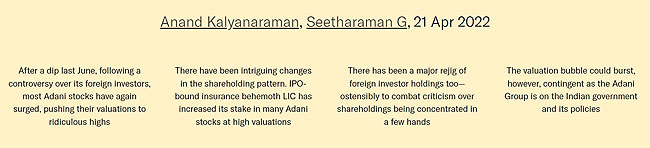
    For those who do not subscribe to The Ken, a screen shot of an analysis from the news site in April 2022 shows that there have been rumblings and doubts for some time now.

    This portion is especially significant: “The valuation bubble could burst, however, contingent as the Adani Group is on the Indian government and its policies.”


    https://the-ken.com/story/the-confounding-rise-and-rise-of-adani-stocks/

    Last December, an analysis on Yahoo.com also looked at Adani’s rise, with a mention of the group’s closeness to Prime Minister Narendra Modi. It examines how now just LIC but “the man on the street” can be affected by an Adani collapse.

    https://finance.yahoo.com/news/india-adani-group-growing-too-072700680.html?guccounter=1&guce_referrer=aHR0cHM6Ly93d3cuZ29vZ2xlLmNvbS8&guce_referrer_sig=AQAAAGqj4fvq6I9jaNImmroNfZCr-BIy4yt-OmVker3O8INFygfkp_Z-w7q3FKeprmCv9oTakkZ4KJkiBuP8W4j3U-UfIp1AkiG69zyhw5_4RSAeqyCub9mU7UD-Angqbgfu2nqwUYcnwieo-8F2iKj7VsLShyGc5LmQWoz0W4_vsf2F

    It all depends on what you consider a news source, and in some cases, when you read the news. This link from 2013 talks of India Inc’s “debt bomb” and Adani is mentioned quite casually:

    https://economictimes.indiatimes.com/news/economy/finance/sunday-et-india-inc-sitting-on-debt-bomb-why-the-health-of-large-corporates-should-worry-us-all/articleshow/22035355.cms?from=mdr

    In case you missed it, please check the news source, The Sunday Economic Times and the year is 2013.

    This link from The Wire is a very useful compilation of how the media has covered the Adani Group over the years.

    https://thewire.in/business/adani-rise-reading-list

    The problem therefore remains that the most popular “news” sources are not news sources at all. They are dispensers of fake news, misinformation, of hatred and sectarian division, and of propaganda and party or government publicity.

    A conversation between a member of the public and an anchor of Leading Britain’s Conversation (LBC) comes to mind here. The member of the public said that she voted for Brexit because of what she read in the Daily Mail. Although she read the Guardian, she did not always understand what she read there. And while she did not always agree with the Daily Mail, it spoke her language. She therefore bought into the pro-Brexit propaganda. Added to that was the fact that more credible news sources were hidden behind paywalls while the Daily Mail was easily accessible.

    This situation can easily be transposed onto the Indian media environment. The noisiest and more accessible “news” sources are the most despicable.

    We cannot really blame the reader or the viewer. We have done it.


    Ranjona Banerji is a senior journalist and commentator. She writes on MxMIndia on Tuesdays and Fridays. Her views here are personal.


  • FoxyMoron appoints Vivek Das as CEO

    By Our Staff


    Zoo Media Network’s flagship creative and digital agency FoxyMoron has appointed Vivek Das as its CEO. His role will be to build an inclusive and world class digital team capable of delivering outcomes focused digital solutions to clients. He will report to Pratik Gupta and Suveer Bajaj, founding partners of Zoo Media and FoxyMoron.


    Said Pratik Gupta, Co-Founder of Zoo Media & FoxyMoron: “Having known Vivek professionally for a long time we’re delighted to finally have him amongst us. While his professional credentials speak for themselves, what drove us to him was the alignment of vision and values. Our vision of building a data obsessed and customer experience focussed agency will come to the fore under his leadership. His ability to build process focused, high performing teams makes me excited for the future of FoxyMoron.”


  • Ayatiworks bags digital mandate for Mantovanibenne

    By Our Staff


    Ayatiworks, a Chennai-based digital marketing agency has recently won the digital marketing mandate for Mantovanibenne, or the MBI brand, that manufactures heavy machinery and equipment for the building, recycling, demolition and earth-moving industries based in Italy.


    Ayatiworks will work on enhancing the overall brand presence of MBI Group across the web and social media channels. As part of the mandate, the agency will be responsible for creative content creation and data-led social media campaigns.


    Said Upendran Narendran founder of AyatiWorks: “This year, we’re all prepared to implement, disrupt, and drive campaigns for the brand to help it soar to new heights. We want to assist them in developing greater success stories and stronger connections with their audience through our holistic approach. We are confident of leveraging best-in-class strategies to make MBI stay ahead in a highly competitive market. We would follow the approach of generating impactful conversations for the brand and take their presence to the next level.”


    Talking about the association, Jacopo Mantovani, Sales and marketing head of MBI added: “We are delighted to have Ayatiworks onboard. We will have a long association with the agency that led our digital presence across the channels. We are certain that the agency is aligned with the brand’s vision and we look forward to exciting things that the agency brings to the table.”


  • Edelweiss General Insurance is now Zuno General Insurance

    By Our Staff


    Edelweiss General Insurance has announced its new identity as Zuno General Insurance Limited (Zuno GI). Zuno GI is a new age digital insurer with an aspiration to reimagine and redefine Insurance to make it easy, friendly, and transparent. It is built on the premise that any kind of general insurance should be simple, easy, and straightforward.


    Along with the new identity, the company has launched a consumer study titled ‘Usage Based Insurance: Decoding Awareness, Perception and Behaviour’. The study was done to understand Millennial and GenZ’s awareness, understanding and consideration for UBI. Zuno General Insurance has been in the fore fronting the concept of usage-based insurance (UBI) in India for almost three years now.


    Speaking at the launch, Shanai Ghosh, MD & CEO, Zuno General Insurance, said: “Zuno GI is all about reimagining Insurance to make it easy, transparent, and friendly using three pillars of customer experience, innovation, and digital delivery platforms. We will always listen to our customers and offer them smart, simple solutions in the most convenient and hassle-free way. We put this aim to action with the UBI report where we sought to assess the understanding and perception of UBI among young, mobile savvy Indian customers. The findings have been extremely insightful and has validated our conviction about the potential of UBI in India, encouraging us to continue investing in this category that we pioneered in 2020.”


  • Porus Khareghat joins Cutting Crew Studios

    By Our Staff


    Porus Khareghat, former head of the Ogilvy Films Division, has joined Cutting Crew Studio as a Business & Creative Consultant.


    Notes a communique: “He has also had a successful stint directing ad campaigns for brands like Pidilite, Tata Motors, American Express, IPL – Lucknow Super Giants, and Nexus Malls among many others. Khareghat is also an avid photographer & has had the privilege to photograph the GOAT Messi for Tata Motors as the brand ambassador. These pictures went on to cover buildings in humongous displays.”


  • Das ka Dum with Dr Bhaskar Das | Yet another year of no Indian Readership Survey for print. But no one seems to be complaining? A case of ‘who cares?’?

    Bhaskar DasBy now you know how much we love to ask this question. But isn’t it crazy that while the world goes ballistic about television ratings, no one really cares about those for print. Let’s hear it from Dr Bhaskar Das in the February 8 edition of Das ka Dum. Read on…


    If you wish to access the archives, please go to the Das Ka Dum tab on the website’s top navigation bar or click here: https://www.mxmindia.com/category/columns/das-ka-dum/


    Q. Yet another year of no Indian Readership Survey for print. But no one seems to be complaining? A case of ‘who cares?’?


    A. One should not question the wisdom (read ROI) of marketers/ media buying agencies when they invest in a media format and vehicle. In case of print, it’s easier to evaluate it as there is a pecking order of leader vehicles in each market and due to nature of various categories of business generation, empiricism plays a significant role in media vehicle selection. Anyway, these days when amplification of marketing/ brand messages are generally done in an omnichannel format, the probability of loss of impact of a message is not dependent on one format of delivery.


    This is not to suggest that data isn’t important. I am sure there are some genuine constraints for reintroduction of a data regime for print, and some day it would happen. But the scope of complaint is less due to the nature of the medium.