By Ranjona Banerji
 A question you hear frequently after the Adani story broke is: “what was the Indian media doing”.
This is often from people who think Wion is a credible news source.
Of course, I should not blame such people.
It’s hardly their fault. They assume that if a “news” channel quacks and walks like a duck. it is a duck. When in fact, it is a cuckoo in the nest.
Now I’m mixing my metaphors, so I’ll exit fast from this line of description.
But the question actually is, which media do you mean?
In the link here, veteran journalist Paranjoy Guha Thakurta talks to The Telegraph about the price he paid for writing about the Adani Group. He was not just slapped with cases, and stopped from writing about the group but also lost his job as editor of the prestigious Economic and Political Weekly (EPW).
https://www.telegraphindia.com/business/adani-row-journalist-mentioned-in-hindenburg-report-speaks-up/cid/1914774
As he says in the interview, Guha-Thakurta first wrote about the Adani Group in 2015.
This from The Scroll lists why the Adani Group targeted Guha-Thakurta.
https://scroll.in/article/984639/why-has-the-adani-group-singled-out-journalist-paranjoy-guha-thakurta
Also in The Telegraph is this column from Mukul Kesavan. In his gentle style, Kesavan lays bare the extreme cowardice of the mainstream Indian media when it came to the Adani Group. A lesson if you like in how the Indian media practices what is clearly not journalism but is just a form of public relations:
https://www.telegraphindia.com/opinion/dented-hubris-on-the-hindenburg-adani-saga/cid/1914412
The fact that LIC’s investment in the Adani Group was open to question is not new.
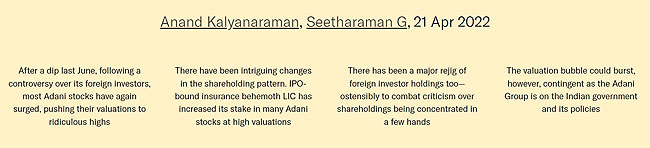
For those who do not subscribe to The Ken, a screen shot of an analysis from the news site in April 2022 shows that there have been rumblings and doubts for some time now.
This portion is especially significant: “The valuation bubble could burst, however, contingent as the Adani Group is on the Indian government and its policies.”
https://the-ken.com/story/the-confounding-rise-and-rise-of-adani-stocks/
Last December, an analysis on Yahoo.com also looked at Adani’s rise, with a mention of the group’s closeness to Prime Minister Narendra Modi. It examines how now just LIC but “the man on the street” can be affected by an Adani collapse.
https://finance.yahoo.com/news/india-adani-group-growing-too-072700680.html?guccounter=1&guce_referrer=aHR0cHM6Ly93d3cuZ29vZ2xlLmNvbS8&guce_referrer_sig=AQAAAGqj4fvq6I9jaNImmroNfZCr-BIy4yt-OmVker3O8INFygfkp_Z-w7q3FKeprmCv9oTakkZ4KJkiBuP8W4j3U-UfIp1AkiG69zyhw5_4RSAeqyCub9mU7UD-Angqbgfu2nqwUYcnwieo-8F2iKj7VsLShyGc5LmQWoz0W4_vsf2F
It all depends on what you consider a news source, and in some cases, when you read the news. This link from 2013 talks of India Inc’s “debt bomb” and Adani is mentioned quite casually:
https://economictimes.indiatimes.com/news/economy/finance/sunday-et-india-inc-sitting-on-debt-bomb-why-the-health-of-large-corporates-should-worry-us-all/articleshow/22035355.cms?from=mdr
In case you missed it, please check the news source, The Sunday Economic Times and the year is 2013.
This link from The Wire is a very useful compilation of how the media has covered the Adani Group over the years.
https://thewire.in/business/adani-rise-reading-list
The problem therefore remains that the most popular “news” sources are not news sources at all. They are dispensers of fake news, misinformation, of hatred and sectarian division, and of propaganda and party or government publicity.
A conversation between a member of the public and an anchor of Leading Britain’s Conversation (LBC) comes to mind here. The member of the public said that she voted for Brexit because of what she read in the Daily Mail. Although she read the Guardian, she did not always understand what she read there. And while she did not always agree with the Daily Mail, it spoke her language. She therefore bought into the pro-Brexit propaganda. Added to that was the fact that more credible news sources were hidden behind paywalls while the Daily Mail was easily accessible.
This situation can easily be transposed onto the Indian media environment. The noisiest and more accessible “news” sources are the most despicable.
We cannot really blame the reader or the viewer. We have done it.
Ranjona Banerji is a senior journalist and commentator. She writes on MxMIndia on Tuesdays and Fridays. Her views here are personal.