Author: mxmadmin

  • Anil Thakraney: Buck up, lazy HR!

    By Anil Thakraney


    I have worked in a few organizations in my career, and across the board if there’s one department I have been left disappointed with, it’s HR. Somehow I never really felt a need for these people. And the failing, I realize, is not of the function itself but the way it seems to be practised, and naturally I speak from my own experiences.


    I have always found the HR personnel to be the reactive sort; their presence only gets noticed when there’s a problem. When someone needs to be hired/fired (and that’s essentially paperwork) or when there’s indiscipline in the organization, ranging from regular employee absenteeism to sexual harassment issues. And this aspect too mainly involves lip service and paperwork from HR… all the actions/decisions are usually taken by the line manager or the CEO. And therefore I have always wondered why we need these guys at all.


    I think HR personnel aren’t being held accountable in organizations, and perhaps this is what leads to their laidback behaviour. Although I am not an HR guru, here are a few key functions where I think they can become very useful to an organization, if they play a proactive role:


    • Keeping a regular, sharp eye on star performers in other organizations, so that they can provide leads to department heads even if the latter haven’t asked for fresh recruits.
    • Bonding with employees from down to top, rather than from top to bottom. So that employees across all levels can confide in them. And by the time the HR team meets the department head, they can share relevant employee information with the managers. Most HR heads I worked with will first meet me, and ask silly questions like: “How’s the morale in your department? Hope all well?”
    • Coming up with useful, scientific and insightful ways in which a department can be structured better to maximize staff resources. Most HR heads have no interest in even going down this path. Either they are too lazy or don’t want to risk upsetting department heads.
    • Drafting innovative and smart employee rewards/motivation schemes. Sending out cold birthday cards is so yesterday. And a cop-out.
    • And of course, formulating kickass employee loyalty schemes and organizing fantastic training programmes. Usually both these chores are left to the line managers to figure out.


    [youtube width=”380″ height=”230″]http://www.youtube.com/watch?v=uCKgCkubGc0[/youtube]

    Net net: Lots of value additions can be provided by the HR people. But they aren’t. And this can’t be allowed to go on. At some point, organization heads will need to crack the whip. I don’t need a heavily paid HR Vice Prez to meet me once a year and ask me if I am okay. I can do without those homilies, thank you very much.


    ***


    PS: Ahaha! Totally love this ad. It’s so simple and so funny. Especially the spunky ol’ lady. Too cute.


  • N Ram to call it a day at Hindu

    By a Correspondent


    It is learnt from sources close to the development that N Ram, Editor-in-Chief of The Hindu, Business Line, Frontline and Sportstar has informed via a letter (a copy of which is with MxMIndia) to the Board of Directors, Kasturi & Sons Ltd his decision to step down. His last day at work would be January 19, 2012. He has spent eight years in his role as Editor-in-Chief. However, he will continue as full time director at Kasturi & Sons Ltd.


    He has also suggested that the Board may pass the necessary resolutions declaring, with effect from January 19, 2012, Mr Siddharth Varadarajan, who is the Editor of The Hindu to take responsibility as the Editor of The Hindu (inclusive of the annual publications, The Hindu Survey Of Indian Industry; The Hindu Survey Of Indian Agriculture; and The Hindu Survey Of the Environment). He will be responsible for selection of news under the PRB Act. Mr D Sampathkumar, the Editor of Business Line, Mr R Vijayasankar, Editor of Frontline and Mr Nirmal Shekar, the Editor of Sportstar have been named as the respective editors of their newspapers and magazines and will be also responsible for selection of news under the PRB Act.


    The letter also states that since Mr Ram will also cease to being the publisher of the above mentioned titles, the board may pass resolution to name Mr K Balaji, the MD at KSL as the publisher and printer. This will be an interim role until the group gets a CEO who will take over these roles as applicable.


  • Law & Kenneth bags eBay’s creative pitch

    By Shubhangi Mehta


    Law & Kenneth has bagged the eBay India business. The online shopping and auctions portal had called for a pitch a few weeks back and several agencies participated in the process. Mr Anil Nair, CEO and managing partner, Law & Kenneth while acknowledging the news to MxM said: “We at Law & Kenneth are super excited to have been chosen to work with eBay, which is a pioneer in the global e-com market.” A source close to the development indicated that the annual media spends for the year would be around Rs35 crore.


    In the past, Wieden + Kennedy had handled the creative mandate for this account. The agency had won the business in September 2009. Though the company has utilised the traditional media route to expand its market in the past, it has taken to online marketing from 2010.


    It remains to be seen how Law & Kenneth will take eBay’s communication forward in 2012 across traditional and new media platforms.


  • Rahul Thappa is back @ Mindshare

    By Akash Raha


    After his stint at Mail Today, Rahul Thappa has once again joined Mindshare. Mr Thappa will be working at Mindshare as Leader – Client Leadership, South Asia, reporting directly to Mindshare CEO Ravi Rao.


    In his last stint with Mail Today, the compact Delhi daily which is a joint venture between India Today Group and Associated Newspapers (ANL), publisher of Daily Mail, UK, he was the COO of the organization. He had joined the newspaper in May 2011, taking over from the then-COO, Mr Suresh Balakrishnan.


    Mr Thappa’s earlier stints include working as the Managing Director at Mindshare Malaysia; Business Director, Entertainment Sports & Partnerships at Group M Malaysia; Business Director at Mindshare Malaysia; and Planning & Buying Director, Team Unilever at Mindshare, Malaysia.


    MxM had received no official confirmation from Mindshare at the time of this report.


  • BIG CBS goes balle-balle with Spark Punjabi

    By A Correspondent


    The BIG CBS, a Reliance Broadcast Network and CBS Studios International complement JV, on Tuesday announced the launch of its fourth channel, Spark Punjabi, marking its foray in regional television.


    The BIG CBS has already launched three channels – BIG CBS Prime, BIG CBS Love and BIG CBS Spark. The JV is the number one English entertainment network in the country.


    Spark Punjabi, a category creator, is positioned as the first international Punjabi channel. It will be launched on January 14. Targeting the 15+ audience, the channel will feature the best of CBS content, dubbed in Punjabi, giving local audiences immediate access to world class entertainment.


    The channel will be available across Punjab, Haryana,Chandigarhand Himachal Pradesh (PHCHP) region. The channel will be distributed on digital and analog platforms, with an extensive reach of over 6mn+ C&S households in the region.


    Spark Punjabi will air the latest seasons of international shows such as jerry Springer, Hawaii Five-O,America’s Next Top Model, Masked Warriors – an international wrestling format, amongst others, dubbed in Punjabi. The channel will also feature a judicious mix of Punjabi music, international dubbed movies and local programming in Punjabi.


    The PHCHP is one of the richest regions and boasts of a strong base of affluent consumers. With 78 per cent TV penetration and 88 per cent C&S penetration, coupled with limited local language entertainment options, the market offers a good business opportunity. The Rs1,200 crore advertising pie also creates an exciting opportunity for this platform.


    With Reliance Broadcast Network Ltd’s (RBNL) existing leading radio brand 92.7 BIG FM, reaching 22 cities in the region and its OOH arm, BIG Street’s 3000+ ambient media options across the markets, Spark Punjabi will offer marketers an integrated media opportunity like none other in the region.


    The channel will be supported by an integrated marketing plan leveraging multi-media. Added to this will be the media muscle of the entire Reliance Group.


    Tarun Katial, CEO, Reliance Broadcast Network Ltd. said: “India’s booming regional television industry with limited regional entertainment options is an opportunity that we are leveraging. With our robust radio network in place, Spark Punjabi will allow a more integrated offering to marketers, while presenting audiences with the best television entertainment.”


    Armando Nuñez, President, CBS Studios International said: “The move into the regional market perfectly complements our existing bouquet of channels in India, utilizing existing programming resources customized to the Punjabi market and backed by Reliance’s great media assets in the region.”


  • Inext, the youth-centric newspaper launches its website

    By Akash Raha


    Inext, the youth-centric newspaper launched its website on January 3, and is currently running the campaign ‘Iktara’. MxM got in touch with Alok Sanwal, COO and Project Head, Inext to know more.


    Speaking about the response of the advertisers towards the newly launched site, Mr Sanwal said: “In less than seven days of the launch of inextlive.com, we have received tremendous response from the business fraternity. We are receiving a lot of offers for grabbing a space on this youth hangout portal. We are, however, looking for advertisers that espouse youth-centric sentiments and resonate with Inext’s business philosophy.”


    To complement the launch of the online campaign, ‘Iktara’, which gives a platform to local folk singers to perform and make it big, was launched recently. According to Inext, the campaign has done very well in the first week. The audience has responded positively and the site has received many recorded CDs and DVDs, the best of which will be showcased on the site.


    Inext is now trying to focus on the resurgence of folk tradition inIndiaand capitalize on it in order to build a successful consumer connect in the four states it is present in - Uttar Pradesh, Uttaranchal,Biharand Jharkhand.


    Inext had an expansive campaign, with radio, digital and print initiatives, to promote their newly launched site. While Radio Mantra has been giving them radio coverage, Mudra Max and Vermillion have handled their digital and print initiatives respectively.


    Inext, the compact daily, primarily focuses on youth and is published by Jagaran Prakashan Ltd. Currently, it is available in 12 cities across four states. The paper and its newly launched website targets youths in mini metros in the age group of 13-25.


  • Gouri Dange: TV, that exhausting hyper child

    By Gouri Dange


    Someone once said: the best intelligence test is what we do with our leisure. Oh well. I watched television recently for long hours, and now I am in a dilemma. Chicken and egg kind of dilemma. Does my watching television as leisure activity signal my lack of intelligence or did the telly reach out and extinguish my intelligence, whatever little there was of it?


    Because now I’m walking around in a daze of altered reality. For instance, I can’t watch a bird on a tree any more and relax into the moment because, fresh from my TV-watching stint, I’m expecting it to look up and chirp and trill: “Back after this leeetle break” or “Kahin pe mat jaiyega, milte hain break ke baad!” And if earlier I could identify this bird, now I dully wonder if it’s a Crested Shahrukh, or Huffing Arnav or a Rambling Rajdeep or a Ballistic Barkha or some such. I’m also looking at the bottom of my window, searching for those meaningless headlines, or daft messages from viewers (prime example: “All da politishens shud b deported b4 this country can b clean”) crawling right-to-left while the main frame has the bird doing its thing.


    This is because watching television has forced me to function in the jargon, the time-slots, the sound-bites and the visual constructs of TV-land. The overwhelming features of TV seem to be advertisements repeated till you are seriously sick, promos of other programmes, and a hundred other interruptions to the programme that you want to watch. I have whined piteously about this before, but I have to say it again. Somewhere along the way TV has taken away your dignified right not to be shouted at, not to be interrupted, and not to be told-sold the same thing again and again, all in the span of half an hour. I mean, even the heart-in-the-right place ads asking youngsters to vote… even those are repeated so heavily that instead of taking their advice and voting, those youngsters that these ads are meant for are likely to run out for a drink.


    Only on TV. No other medium is that presumptuous. Imagine a newspaper trying to chop up a report or a feature with a print ad popping up in the reader’s eyes at every other paragraph – would you not immediately throw such a publication away, stop subscribing to it, or keep it only to wrap dirty things in? If newspapers can have ads bunched in the Classifieds or specific pages, where those interested can go and browse, while the rest of us can avoid having things sold to us, then why not TV? Guys, bunch your ads at the beginning or end of the program so there is a chance that people will go look at them.


    Interestingly, after 26/11 (which marked a high point in hysterical reporting), news channels, especially the English ones, have cultivated a more sober, quieter tone. Less like children having a blue fit and more like adults having a conversation. All much more sophisticated and ‘responsible’ sounding than the pre and during 26/11 manic hysteria that they were all free to luxuriate in. Something has happened. While these channels and their star yellers did at that time behave as if anyone criticizing them for the way they covered the attacks and aftermath was committing high treason, they seem to have realized that they need to come down off their high and sober up. How this was change effected overnight is an interesting speculation. Lobotomy? Daily dose of tranquilizers? Homeopathic meds in the water supply? Or perhaps a crash course in voice correction and modulation to look and sound less like avenging ghouls and more like humans. But this chatty thing too is all part of the act of ‘acting out’ the news. My grandfather, when TV first came to India, was appalled to see newsreaders smiling at the end of the newscast. He thought it was terribly forward and insolent of them to smile at viewers. Deliver us the news and disappear, was how he and people of his generation liked it. What would he make of all the banter and bonhomie act of the newsgivers today, I wonder.


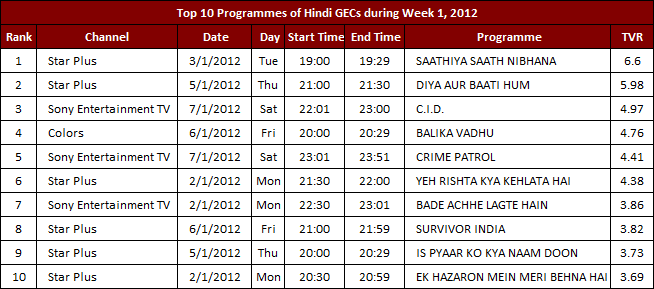
  • TAM data Top 10 programmes on HGEC – Wk 1 ’12

    Source: TAM Peoplemeter System
    TG: CS 4+ yrs
    Market: Hindi Speaking Market
    Period: Wk 1 (Jan 1 to Jan 7) 2012


    About TAM Media Research


    TAM is a joint venture between Nielsen Company & Kantar Media Research. Besides measuring TV Viewership, TAM also monitors Advertising Expenditure of Television, Print & Radio through its division AdEx India. Since 2004, it extended its presence in the PR Measurement & Analysis space for Corporate/Marketing Clients by setting up a separate division Eikona PR Measurement.


    In 2007, the joint venture introduced RAM (Radio Audio Measurement) service to track Radio Listenership for the Indian Radio Broadcast Industry. In year 2009, TAM launched a division, called TAM Sports that specializes in monitoring Sports Sponsorship ROI.


    TAM Media Research’s objective is to fuel media insights that will drive the growth of the Indian Media Industry.

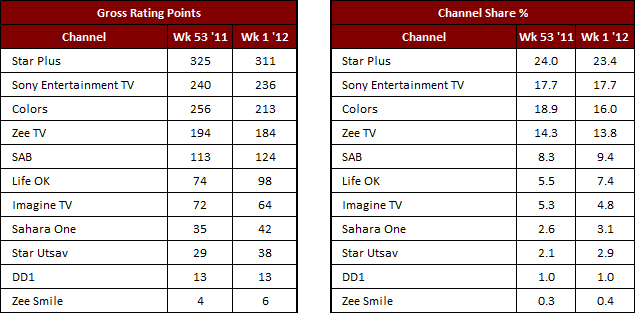
  • TAM Data (GRPs, Channel shares of HGECs)- Wk 1 ’12

    Source: TAM Peoplemeter System
    TG: CS 4+ yrs
    Market: HSM
    Period: Wk 53: Dec 25 to Dec 31, 2011
    Period: Wk 1: Jan 1 to Jan 7, 2012


    About TAM Media Research


    TAM is a joint venture between Nielsen Company & Kantar Media Research. Besides measuring TV Viewership, TAM also monitors Advertising Expenditure of Television, Print & Radio through its division AdEx India. Since 2004, it extended its presence in the PR Measurement & Analysis space for Corporate/Marketing Clients by setting up a separate division Eikona PR Measurement.


    In 2007, the joint venture introduced RAM (Radio Audio Measurement) service to track Radio Listenership for the Indian Radio Broadcast Industry. In year 2009, TAM launched a division, called TAM Sports that specializes in monitoring Sports Sponsorship ROI.


    TAM Media Research’s objective is to fuel media insights that will drive the growth of the Indian Media Industry.


  • Mumbai papers go aggro on civic issues

    By Ranjona Banerji


    The municipal elections due in Mumbai next month are being treated almost like assembly elections. For weeks now, Mumbai newspapers have been giving readers details of the projects undertaken, completed, unfinished, citizens’ grouses, movements and expectations. apart from a ward by ward breakdown of performance by the incumbent Shiv Sena-Bharatiya Janata Party alliance, details about new political formations and many citizens’ groups have also been provided, analysed and assessed.


    There can be no doubt that this election to the biggest and richest municipal corporation in the country is been seen as a litmus test for the state and general elections. The Congress and Nationalist Congress Party, after some hissing and spitting, have decided on their seat-sharing and are apparently well-prepared to take on the incumbents.


    Is there anything to choose between the papers? as is its wont and reach, The Times of India has gone for a carpet-bombing strategy. The Hindustan Times has gone for the focused approach, concentrating on particular issues. Mid-Day has also looked issues as well as the political twists and turns. Saamna, the Shiv Sena mouthpiece, has looked to attack Raj Thackeray’s Maharashtra Navnirman Sena, which has certainly eaten into its own constituency.


    This is the sort of coverage that Mumbai newspapers are very good at and indeed have taught a lesson or two to other city editions about how to go in-depth into local issues.


    Interestingly, the anti-corruption movement led by anna Hazare has not jumped into the fray. Yet, most problems which people have with government non-performance and bribery are at the local and municipal levels. Your Member of Parliament cannot get you constant water supply or smooth roads or garbage disposal.


    **


    The last six or eight months saw the media looking at internal issues, most specifically the anti-corruption movement and its fallout. But with the suspension of the Lokpal Bill, geopolitics and the neighbourhood have both resurfaced. India’s military capabilities and strategy vis-a-vis China are back on the edit pages and the turmoil in Pakistan is also getting attention. TV channels, predisposed to sensationalism, have concentrated more on former military dictator Pervez Musharraf’s decision to return to Pakistan. The run-up to the US presidential election, however, is yet to find much space in the Indian media.


    **


    another Test series is due to begin and it will be a good test to see how much hysteria can be generated from a good or bad performance by India.


  • FMCGs make hay as noodles, soft-drinks etc drive growth in rural India

    By Samidha Sharma


    Noodles, macaronis and soft-drinks made rapid inroads into the rural markets driving up growth in the fast moving consumer goods (FMCG) industry – 10% by volume and 12% by value – in the first ten months of 2011. The consumption story for most part of last year dispelled slowdown fears as Indian rural households piped urban counterparts in growth sweepstakes , said market research agency IMRB. Rural India had clocked a negative volume growth during 2010 (here volume growth is the increase in sales clocked over last year while value growth is volume growth plus price hikes).


    The urban FMCG market, on the other hand, grew 4% by volume and 7% in value and was led by categories such as ready-to-eat mixes, deodorants , breakfast cereals and soups. Growth for personal care products such as toilet soaps, shampoos and household products stagnated compared to last year, while F&B space saw a healthy growth. The IMRB survey is conducted across 30 product categories.


    Sector analysts said the F&B market witnessed hectic action in rural India with players like ITC and Hindustan Unilever (HUL) leveraging their distribution muscle to push products in this category. ITC’s Sunfeast noodles and HUL’s Knorr brand of soups have been able to penetrate the hinterland leading to increase in the category reach.


    “In the F&B market we are seeing the share of rural markets grow. Packaged fruit juices have traditionally been a very urban market product, but with growing health awareness among rural consumers, we are witnessing a marked growth in demand. To cater to this demand, Dabur has already expanded the distribution footprint for juices to cover smaller cities,” said Mr George Angelo, executive director – sales , Dabur India, maker of Vatika shampoo and Real fruit juice. The FMCG biggie saw its personal, oral care and health supplements report strong growth in the rural markets.


    While the low-penetrated products in the F&B space witnessed good growth, detergents , washing soaps stagnated volume wise. “Due to lower rural reach household care categories such as floor cleaners , household insecticides are showing faster growth. But foods especially staples such as cooking maida, atta/wheat which are driving the growth in volumes,” said Mr Manoj Menon , group business director at IMRB International. In the urban market emerging categories , noodles, macaroni, vermicelli grew 20% in terms of volume, while ready-to-cook mix products saw a whopping 64% growth and soups grew by 20%. In the personal care category , which largely remained stagnant in the urban market, deodorants saw a 31% growth.


    There have been some concerns over consumer spending with price hikes being taken across the board by FMCG companies to offset the impact of rising input costs.


    “Because of healthy disposable income growth and lower absolute spends on FMCG products it hasn’t impacted the consumption yet, however if there is uncertainty around income growth risks of downtrading exist,” said Mr Gautam Duggad, an analyst at domestic brokerage firm Prabhudas Lilladher.


    Most industry players said they haven’t seen any palpable signs of downtrading yet. “Directionally there is no slowdown in the market but there could be some cut back in the next few quarters on discretionary items by consumers. The impact will be felt in the top-end product categories and non-essentials ,” said Mr Saugata Gupta, CEO, Consumer Products at FMCG major Marico.


    Source:The Economic Times

    Copyright © 2012, Bennett, Coleman & Co. Ltd. All Rights Reserved


  • @GroupM: M Suku to join ESP, Mindshare restructures

    By A Correspondent


    It’s change time at Group M too. The media major’s Mindshare arm had announced a series of changes on Wednesday , the leading media agency of the country, announced on Wednesday a series of management changes and key appointments to strengthen the company and position it for long-term success.


    In what may not necessarily be a related development, MxMIndia learns that veteran media specialist Mr Suku Murti who is currently with Aidem Ventures is also moving to Group M. Mr Suku has been with GroupM in the past, having set up Broadmind which later transformed to the entertainment, sports and promotions practice (GroupM ESP). He headed ESP for the entire Asia Pacific region. Mr Suku has worked with Unilever, Colgate, Lintas, JWT, ABCL, Eenadu other than Group M and Aidem.


    Mr Suku will continue to be associated with Aidem for a few months even as his association with Group M ESP begins.


    Meanwhile, the rest of the restructuring news @ Mindshare: Mr M Parthasarathy or MAPS currently the Leader-Business Planning will head the Client Leadership team. Mr Alok Sinha will now oversee Strategy, enabling ‘no-line’ thinking across India. Mr Sandeep Pandey will spearhead Consulting & Intelligence which involves analytics and modelling for better ROMI (Return on Marketing investment). Ms Anita Karnik will continue to handle Branded Entertainment and Activation. Messrs Jai Lala and Ashok Lalla will continue in their current roles managing Exchange and Digital.


    Speaking on the restructuring, Mr Ravi Rao, Leader – Mindshare South Asia said in a communique: “With this infusion of senior talent and expertise, I am looking forward to beginning the year with the Mindshare mantra: Original thinking that brings in thought leadership, innovation that aids in brand growth. Fueled by great ideas, intelligence and analytics, the focus will be on growing our existing clients behind a strong strategy and thrust in digital. We have competent teams and the changes will ensure continuity in each role, while enabling us to broaden our team’s experience and capabilities – something that will be important as we continue to drive new business and grow our market share.”


    The new appointments also include Mr Rahul Thappa (as reported by MxMIndia on Wednesday), who has come in to manage North and rest of Mindshare South Asia. He has been entrusted with business operations in Pakistan,Sri Lanka and Bangladesh.