Author: mxmadmin

  • Pepsi and IndiGo’s unique football surprise for air travellers

    By A Correspondent


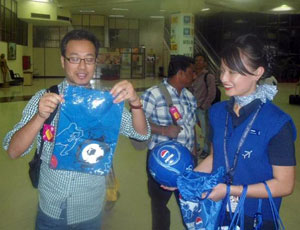
    As part of their ongoing football campaign, Pepsi partnered with IndiGo to Change the Game when they surprised hundreds of IndiGo passengers with a Pepsi Change the Game Football Kit across six airports in the country.


    Over 1,500 passengers who travelled by IndiGo during a certain time on a day received an extra football bag along with their checked-in baggage. This activity was organized at the Bangalore, Mumbai, Hyderabad, Kolkata, Goa and Bhubaneswar airports. Passengers across the airports were delighted with the extra travel kit by Pepsi and IndiGo which included a cool bag, football, t-shirt and a sipper.


    Talking about the initiative, Homi Battiwalla, Category Director – Colas, Hydration & Mango Based Beverages, PepsiCo India said: “Pepsi, as a brand, is known for creating clutter breaking campaigns. Our latest football campaign stands for all this and more. From irreverent TVCs to engaging online activities to an amateur tournament – Pepsi T20 Football, we are changing the game of football. We are delighted to have associated with IndiGo Airlines to create this surprise, which showed that you need not be a fan to indulge in some football fun.”


    Expressing his delight, Aditya Ghosh, President, IndiGo said: “We are happy to collaborate with Pepsi to collectively leverage their Change the Game campaign through this unique initiative. For us, the idea of surprising 6E passengers at six busiest airports with football kits was indeed an experience. Our endeavour is to provide the best-in-class experience to all our customers and execution of this initiative was to make their flying experience memorable. We hope our passengers enjoyed this surprise package.”


    This is Pepsi’s first football campaign in the country that was launched by an irreverent TVC starring actor Ranbir Kapoor, which set the tone for the real action. It was followed by a unique grassroots initiative, Pepsi T20 Football. It’s a revolutionary new format for amateurs, which combines the excitement of T20 cricket with the spirit of football. Organized in a unique metallic cage, the initiative was organized in major Indian cities including Chennai, Bengaluru, Kolkata, Mumbai, Lucknow, Ludhiana and Delhi.


    A total of 8-teams, including 1 winning team from each city and 1 wild card entry will compete to emerge as ‘Game Changers’. They will then get the opportunity to be coached by Didier Drogba before they face the Indian Cricket Stars for a game of Pepsi T20 Football at the Grand Finale.


    The campaign is supported by a 360-degree approach including on-air, outdoor & on-ground initiatives; special edition packaging featuring and digital engagement programmes.


  • The 6.5% GDP growth and the economic mess: What does this mean for the media?

    Ashish Pherwani

    By A Correspondent


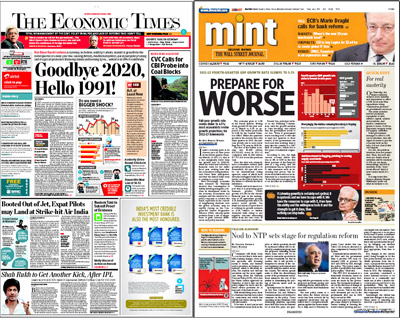
    The front pages of the business papers express shock. With reason. The 5.3 percent GDP growth rate for the fourth quarter of 2011-12 is the lowest since 2003 and the full-year growth of 2011-12 of 6.5% is lower than the 6.7% of 2008-09.


    So what does this mean for the media? Should we press the panic button? When asked whether the GDP growth numbers and the prevailing economic situation in the country will impact the media, Ashish Pherwani, Associate Director, Ernst & Young said: ” I think it’s normally the other way round. The media is at least one quarter ahead in terms of the impact. So it’s been a couple of quarters since media effective rate has been falling or has stayed flat, volume growth has also not been great. So that’s like an early warning signal which comes always a quarter before actual numbers start going down at a national level. To answer the question more specifically, media has already reacted to it so hopefully there won’t be any further reactions.”


    MxMIndia spoke to some mediapersons and economists for hints on the shape of things to come. While many are still hoping that it will not impact them, those who have experienced 2008-09 believe there is no need to panic as the government is now seized of the situation. Big ticket announcements will not get stalled, so if there’s a new show that is going to be announced on a GEC or a rejig expected on a channel or a newspaper, that will continue. And must continue.


    However, there will be caution everywhere. Media entities depending much on real estate and the financial sector need to be alert, but with the government sure to act to improve things, there is a feeling that the crunch (from the realty sector) will not last beyond six months as the government will prop it up.


    Meanwhile, the sentiments will indeed be weak. And marketers known to splurge will take a backseat as stakeholders will be more demanding.


  • Vehrnon Ibrahim moves on from Oye!

    By A Correspondent


    After a stint of a little more than two years with Oye! FM as the National Programming Head, Vehrnon Ibrahim has decided to call it quits. While his next destination is not known, it is more or less clear that Mr Ibrahim will continue in the radio industry.


    Although it is not known who would replace Mr Ibrahim as the National Programming Head, it is learnt that Mr Virag Mishra, the National Content Head at Oye! FM has taken over the mantle for now.


    Speaking to MxMIndia, Mr Ibrahim said: “I am leaving behind one of the best teams I have ever had. I know that Oye! FM will continue to grow from strength to strength and will one day be the number one FM radio station under the guidance of Virag Mishra, National Content Head. I wish them all the best for the future.”


    “I am looking forward to my new assignments in the radio field which is very exciting and challenging” he added.


    At Oye! FM Mr Ibrahim reported to Mr Joy Chakraborty, CEO, TV Today Network. His last working day at Oye! FM was on May 31. Prior to Oye! FM, Mr Ibrahim was the Vice President at Radio One for two years; before his stint at Radio One, Mr Ibrahim was the National Programming Director at Red FM where he worked for seven long years.


  • Comment: Jehangir Pocha on Media’s new Moguls

    By Invitation


    By Jehangir S Pocha


    Among all the transformations taking place in media, here’s the crucial one – the media baron is being replaced by the media conglomerate.


    Corporations are buying news properties once owned by individual proprietors at a rapid pace. Expectedly, media mavens and professionals are crowding conferences to express their angst: Are these oligarchs becoming media’s new moguls only to protect their empires and project their interests? Will they interfere every time a story is done on their favourite babu, minister or party?


    But this holier-than-thou approach that automatically assumes a media baron is better for journalism than a media conglomerate is as reactionary as it is wrong.


    A corporation owning a news property can be expected to slant or kill a story inimical to its core interests.  But those are few and far between.


    After all, how many core interests can a corporation have? On the other hand, many media barons have been notoriously whimsical, politicized, opinioned and ideological, slanting almost every story almost every day, and killing (or overlooking or underplaying) almost every story out of sync with their ideology, views or interests.


    In all democracies, the most slanted and ideological journalism has always been driven by media barons, from William Randolph Hearst, to Ramnath Goenka, Thaksin Shinawatra, Rupert Murdoch, Silvio Berlusconi, Michael Bloomberg and others.


    Their news properties have openly, sometimes shamelessly, displayed their biases.  Compare Murdoch’s Fox News with its corporate-owned competitors, NBC News (owned by General Electric), CBS (owned by Westinghouse), ABC (owned by Disney) and CNN (owned briefly by AOL). Which is most slanted? Which is most protective of vested interests? Which would any unbiased media professional rather work for?


    Yes, a media corporation might protect its pet politicians and restrain its news properties from covering its other businesses fairly. But many media barons do the same. Some appear to have more pet politicians than any corporation. In fact, often the “other business” of media barons is politics (consider Berlusconi, Thaksin, and Bloomberg).


    When it comes to coverage of oneself, it is India’s media barons who have constructed the self-serving maxim that “media mustn’t cover media”, leaving them free of all public scrutiny. That’s what’s allowed some of these tycoons to injure Indian media and dupe their viewer/reader by introducing poisonous practices like “paid news” and “private treaties”.


    It is highly unlikely that any media conglomerate would allow such practices precisely because of the fear of public scrutiny that publicly-listed and/or publicly known corporations naturally have. Companies run by professionals and overseen by a board of directors that includes independents and representatives from government-owned institutions are generally forced to put in place the systems and standards needed to run a business right.  Media barons exempt from oversight rarely do so.  This is why Murdoch’s newspapers spy on people and others don’t.


    This doesn’t mean concerns over how corporations will manage their new media enterprises can be ignored.


    As Indian media comes of age it must codify its journalistic standards and rigorously implement them through an independent body akin to Britain’s Media Standards Trust. Such a body should give India’s journalists protections, such as the legal right not to disclose a source, and freedom from prior restraint (attempts to prevent publishing/airing of an opinion/idea/story before it is published/aired).


    Every news organization must also be required to have an independent Ombudsman charged with ensuring fair and balanced coverage.  At the same time, this Ombudsman and/or the standards authority should also ensure journalists and news outfits respect the rights and reputations of others (anti-defamation), separate news from views, eschew ‘paid news’ and private treaties, protect national security, public order, and public health, and prevent incitement to hostility, violence or discrimination.


    Stringent regulations that prevent any monopolistic control of news are also essential to any democracy. To some extent, digital technologies and social media already ensure this. A smart line on Twitter or great video on YouTube can become more influential than an op-ed in the Times of India. But the government must still work to ensure there are enough voices in the media and that no one voice dominates the national discourse.


    Corporations enter (and sometimes dominate) the media business because it is highly capital-intensive. So, one effective way to maintain a plurality of views in news is to keep entry barriers and operating costs in the business low. For example, existing distortions in media policy, such as exorbitant “carriage fees” that benefit the well-heeled and hurt small news operations must be ended. Banks must be encouraged to lend to smaller media companies, capital requirements in the industry should be eased and more journalism schools built to develop a larger talent pool. Building stronger news-related services, like more text and video wire services, freelancer organizations, and shared news infrastructure, would also help newer and smaller players. Lastly, the government must pass laws to separate carriage from content, and control media cross-holdings.


    Ultimately, every kind of media owner – the government, individual, the public trust and the corporation – comes with pros and cons. India knows well the short-comings of the first three.  We will now discover the dangers of the fourth.  But as long as all four kinds of news organizations are allowed to exist and flourish – and are subjected to firm and fair regulation and oversight – the news media in India will remain strong and vibrant.


    Jehangir Pocha is CEO, INX News.

    The views expressed here are the writer’s and not necessarily those of MxMIndia.


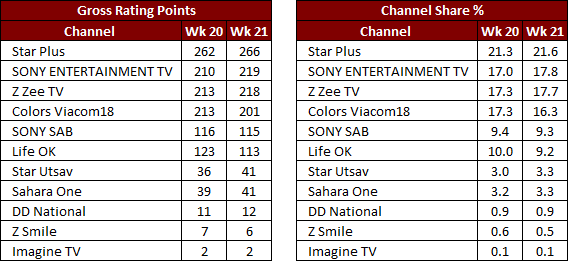
  • TAM Data (GRPs Channel shares of HGECs)- Wk 21 ’12


    Source: TAM Media Research
    TG: CS 4+ yrs
    Market: HSM
    Period: Wk 20: May 13 to May 19, 2012
    Period: Wk 21: May 20 to May 26, 2012


    About TAM Media Research

    TAM is a joint venture between Nielsen Company & Kantar Media Research. Besides measuring TV Viewership, TAM also monitors Advertising Expenditure of Television, Print & Radio through its division AdEx India. Since 2004, it extended its presence in the PR Measurement & Analysis space for Corporate/Marketing Clients by setting up a separate division Eikona PR Measurement.


    In 2007, the joint venture introduced RAM (Radio Audio Measurement) service to track Radio Listenership for the Indian Radio Broadcast Industry. In year 2009, TAM launched a division, called TAM Sports that specializes in monitoring Sports Sponsorship ROI.


    TAM Media Research’s objective is to fuel media insights that will drive the growth of the Indian Media Industry.

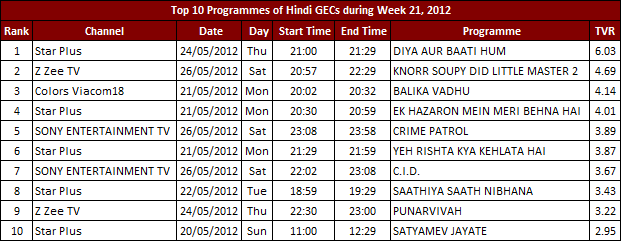
  • TAM data Top 10 programmes on HGEC – Wk 21 ’12


    Source: TAM Media Research
    TG: CS 4+ yrs
    Market: Hindi Speaking Market
    Period: Wk 21: May 20 to May 26, 2012


    About TAM Media Research

    TAM is a joint venture between Nielsen Company & Kantar Media Research. Besides measuring TV Viewership, TAM also monitors Advertising Expenditure of Television, Print & Radio through its division AdEx India. Since 2004, it extended its presence in the PR Measurement & Analysis space for Corporate/Marketing Clients by setting up a separate division Eikona PR Measurement.


    In 2007, the joint venture introduced RAM (Radio Audio Measurement) service to track Radio Listenership for the Indian Radio Broadcast Industry. In year 2009, TAM launched a division, called TAM Sports that specializes in monitoring Sports Sponsorship ROI.


    TAM Media Research’s objective is to fuel media insights that will drive the growth of the Indian Media Industry.

  • Fm y’day: Deepak Lamba quits Bloomberg UTV

    By A Correspondent (updated)


    Bloomberg UTV business head Deepak Lamba has put in his papers. Mr Lamba is reported to be serving notice and he will be at the channel till end-April, sources close to the development informed MxMIndia.


    Mr Lamba, has been business head of the channel since January 2010, and earlier reported to Mr M K Anand and more recently to the Board said to be comprising two representatives from Reliance, one from UTV and a fourth from Bloomberg.


    MxMIndia has learnt that a replacement for Mr Lamba has not been named. Before joining Bloomberg UTV, he was Director – Viacom Brand Solutions and worked with MTV India for five years.


    Mr Lamba is reported to be moving to a larger role in a larger conglomerate, sources tell us.


  • The Anchor: Dinyar Contractor on 10 reasons why the digitization deadline is a mighty challenge

    By Dinyar Contractor


    1. At the FICCI- I&B ministry meet that was held a week ago in Mumbai, barely 40 days before the analogue sunset date, the I&B officials said that they had reviewed digitization in Mumbai the previous day so their report was immediate and current and they confirmed that 33 per cent of the homes in Mumbai already have set-top boxes. I would like to turn that around factually and say that 67 per cent of the homes did not have digital boxes even 40 days before the sunset. So it is pretty much an impossible task that 67 per cent will get it within 40 days.


    2. Let’s look at Chennai. Arasu Cable has confirmed that they don’t have set-top boxes. In fact, a day after the FICCI meet, Arasu had asked its cable operators to log in to the Arasu site and send in their estimates of how many boxes will be required. Arasu will then put together these estimates and float a tender which means they would then start asking for people to give prices for boxes. So for the boxes coming in is way over the horizon for Chennai.


    3. Incidentally, there is a lead time just for a component of a set-top box in the world market today of four months. That means if you order your box today and the manufacturer orders the component, it will be four months before the manufacturer gets the component. What that means is that the box will not be manufactured and it will definitely not reach you before five months. Therefore, if at all there is a postponement, it doesn’t make sense to have any postponement which is earlier than Jan 1, even six months is really cutting it fine.


    4. There is a major national level MSO who candidly admitted to me that their HD boxes have landed but they don’t have the funds to clear them. The government had promised 74 per cent FDI as part of the digitization effort but the government has not implemented this and therefore, MSOs have not been able to tap foreign investors. So without enabling funds, the government has put this clause out which does not make any sense.


    5. We are talking of a sunset date 30 days from now. So for instance, I as a cable operator go to somebody’s home and I say please take the set-top box. And they say, sure I’ll take it but what is it going to cost me? And I say I don’t know what it is going to cost you because the government hasn’t declared the rate. Now as a customer I would not accept the box.


    6. On May 28, the TRAI put up all the analog pay channel tariffs. There is a Supreme Court judgment which says that broadcasters cannot charge more than 42 per cent of the analog pay channel rates for digital. So 42 per cent is the ceiling, however that 42 per cent is completely irrelevant since broadcasters are providing pay channels to DTH platforms at something between 10 to 15 per cent. So from May 28, the ball has started rolling where negotiations have been opened between broadcasters and MSOs to work out some figure for their pay channels that will be somewhere between 10 and 42 per cent. So there is a huge spread in the rates between 10 and 42 per cent, these negotiations are obviously not going to quick and easy. I don’t see these negotiations culminating in three weeks or a month.


    7. There was a Parliamentary Committee report which was released and tabled in the Lok Sabha a few days ago where the Committee says that this entire thing should be delayed by at least six months. I see this as the first stone thrown by the government to ripple the waters and start talking of a delay.


    8. The TRAI suddenly declared that every digital headend must deliver 500 channels. Incidentally, a major portion of the set-top boxes already deployed are incapable of doing 500 channels. This is again a fact that is not adequately ventilated. They can typically do 350 channels, less than 400 channels. It means that they have to take out may be 2 million of the boxes that have already been seeded and throw them away. Where is the money going to come from? We are not even realistic about what is going on.


    9. In Kolkata, don’t forget there is Mamata Banerjee who might rake up the issue against digitization depending on the political capital it might have.


    10. Here you have a sunset clause where the government has not enabled anything, they have only been talking of a sunset but they have not done anything to facilitate and to enable the sunset. The delay has nothing to do with the MSOs or the cable industry, it is simply completely chaotic unplanned deputation of the law or total lack of enabling a systematic process in which digitization could have been introduced.


    Dinyar Contractor is Editor and Executive Publisher, Satellite and Cable TV Magazine (www.scatmag.com)


  • First on MxM! Deepak Lamba joins BCCL as President

    By A Correspondent


    Deepak Lamba who had moved on from Bloomberg UTV as business head in end-April has joined Bennett, Coleman and Company Limited as President.


    Although Mr Lamba was not available for comment and nor has it officially been announced at BCCL, MxMIndia learns that he has joined BCCL today. He is likely to be heading a few new ventures that the group proposes to enter.


    Mr Lamba was business head of Bloomberg UTV from January 2010 to April 2012 and prior to that was Director – Viacom Brand Solutions and worked with MTV India for five years.


  • Creative agencies have allowed themselves to be dumbed down: Vikram Sakhuja


    By Anil Thakraney


    Vikram Sakhuja heads GroupM, India’s largest media buying conglomerate. In a long and animated discussion, the ace number cruncher shares with us insights from the Indian media industry. As well as his own organization’s approach to the various challenges staring at the media business.


    Fifty-year-old Sakhuja is an IIT/IIM grad, and he did a number of years in marketing before he shifted to the world of media in 2001, when he signed up as Managing Director of Mindshare Fulcrum. During our meet, I could see that the outspoken GroupM boss is extremely passionate about his work, and is someone who could get easily agitated over provocative questions. Thankfully, we had a smooth run. Guess it’s all thanks to Yoga which Sakhuja has recently taken up. 🙂


    You were a hard-core marketing man at one point. What prompted the switch to media?

    I believe in taking the career as it goes, and taking decisions at different points of time. Let me take you through my career graph to explain this. After IIM, Calcutta, I was pretty clear I wanted to get into the marketing side of things. So I joined P&G and did eight years there. When I joined them, Richardson Hindustan Limited (RHL) was becoming Procter & Gamble (P&G). So when I started out, the company had RHL values and very quickly the organization got Procterised.


    And you were not happy with that?

    I was happy with that, but Procter believed in the system of specialization. So the guy who gets into sales, stays in sales. The guy who gets into advertising, sticks to advertising. I was in research and they extended that to marketing services. I learnt a lot there, but later on I wanted to move to brand management and P&G wasn’t allowing me that. And I didn’t want my epitaph to read ‘Marketing Researcher’. So I moved to Coca-Cola which was more flexible in these areas. Out there I managed the entire brand portfolio. That worked very well for 5 years. I was reporting to Sanjeev Gupta in those days, and he was handling both, marketing and bottling. And later he went on to take up a bigger job. So they got Shripad (Nadkarni) to head marketing, and I felt my job would get undermined a little bit. And so I left to join Star TV.


    And you lasted there for just one year.

    It was a mistake. I call it jawaani ki bhool. Peter (Mukerjea) said they wanted to start a strategic marketing function there, and it would include marketing of the creative product as well as on-air marketing, which is where the bulk of the spending goes. But it didn’t pan out like that because the programming department had a territorial interest in the programming piece. So it became very clear to me this was going to be an off-air game, and that didn’t have too many legs. And I left Star without a job. Later, Ranjan Kapur introduced me to Andre Nair (this is year 2001) who was looking for people to start Mindshare in India. We had a drink and one thing led to another. I felt a little trepidation in the beginning because I perceived ad agencies to be a little unprofessional. But later I thought about it rationally and it made sense. And so here I am.


    There are large media shops under the GroupM umbrella. How do you manage to give personal attention to each one?

    I am running GroupM, I am not running Mindshare or Maxus. There are capable people running those. I am a management by objectives kind of a person. One aspect of my deliverable is Profit & Loss, there’s no getting away from it. I have told my guys we should get growth from our existing clients. We should have the source credibility to go to them and manage 100% of their marketing investments. That is the agenda I drive. Then, I have to create an eco system for technology, talent and on how to do things better. The scope of service has actually dumbed down, clients are paying peanuts and they are getting monkeys. So I go and tell my clients if they want the right kind of talent and want to get the value out of it, then this is how it works.


    I suppose you operate more as a coach than as a player.

    Do I meet clients? Yes, I do. Am I directly involved in the day to day plans? No, I am not. Unilever is our biggest client. So every year at least one or two deals I will sit in on. Also for other clients. I love to be there for the sheer passion of it.


    What is Sir Martin Sorrell’s brief to you?

    Martin is pretty hands-on in most of the businesses. I rely on him more for counsel. I whet my new plans with him. For example, I went to him with the idea of celeb endorsements. And he felt it wouldn’t work, but asked us to try it anyway. And it didn’t work. Then there was a time we were offered some sweat equity in the IPL Deccan Chargers team. I took it up to Martin and he didn’t think it was a good idea, because he didn’t know the nature of the animal. But he’s brilliant, he is one of the few guys who understands our business, he wants to get in deeper.


    What is your stand on the shift from the commission system to the fixed fee system for media agencies?

    I definitely support the fee system. Though I would prefer a balance of commission and fee. Because in a growing economy you win with commissions. But when spends are not looking good at all, as is the case this year, fee bails you out. In principle, however, I like the fee system.


    How are the clients reacting to it?

    The people who take their marketing seriously believe in the fee system in letter and spirit. The top notch companies like Unilever, Ford, Pepsi, etc, totally get this. I believe clients should pay us Cost + for service, and a factor of that for the value we are able to demonstrate.


    What qualities do you look for in a media buyer in today’s time?

    You must understand that in our organization we don’t just buy media. I would like to believe that our agencies are actually driving the marketing agenda, probably more than the creative agencies. Most of the creative agencies have allowed themselves to be dumbed down, most of them are only interpreting briefs in a TV commercial format. They are only driven by the tactical creative idea rather than a long term view of the brand. All these wonderful creative minds should spend a little time thinking brand stewardship. Out here, we want people who can think account planning and communications. People who can understand the brand, the consumer, and then have the ability to unlock all the media solutions. So the media person needs to understand content, activation, digital, conventional media, and then he has to see how all this comes together.


    Key challenges ahead for media agencies?

    The clichéd one of course is that the commissions we earn are not allowing us to invest in the best talent. But we have to all individually work ourselves, show value and then ask for stuff. The other challenge is in the digital space. The erstwhile DNA of the media companies excluded digital. I believe integrated media planning is the way to go. This is distinct from multimedia planning, which had the TV plan, print plan, radio plan, etc, all working in silos. But with the increasingly multi media environment, the key is integrated planning. And digital is allowing that seamlessness even more. We have embraced this some time back.


    And yet, the media buying business, after the unbundling, has got totally commoditized. Shashi Sinha said to me the media planner has become a zombie.

    I was the first guy to bring the AOR into the country. So you can blame me for the disintegration of the full service agency. (Laughs) I would say each of our agencies has its own planning way. Maxus has something called ‘Relationship Media’, MEC has got ‘Navigator’, and so on. Each of them talks the consumer journey. They talk much more about the communication challenge. I am actually finding the plans looking more different now than they were earlier. So I disagree with my dear friend Shashi Sinha. Maybe I am not cynical. The planner is alive and kicking. It’s in fact the most exciting time to be in the media because of the large amount of fragmentation and the large amount of media choices.


    You did a stint with television. Do you foresee threats to this medium in the near future?

    Yes. The problem with TV today is that it has become a media game of the value of the inventory. At the end of the day, there are only about four million commercial GRPs being broadcast every year at an all India level. And that’s growing at 2 or 3% per year. This is the market for TV eyeballs. So like it or not, you have to extract value out of this. Today, at last count, we have 500 or 600 channels, and it’s getting fragmented. If an Imagine TV dies, someone else will pick up ratings. And if someone else launches, there’s further fragmentation. So the problem is that the same money is chasing some eyeballs. Until the new ratings system comes up and there’s a tectonic shift, you are talking about a metastable equilibrium. Now if the value has to go up, either you have to deliver more reach, or you have to deliver some associated imagery or sponsorships or incremental value.


    When do you expect the shake-out to happen in television?

    We’ve been expecting a shake-out since 1996. I guess some people seem to be having deeper pockets. I am not a finance guy so I don’t know how it works. But I can’t imagine many of them are making money.


    Think the IPL is losing some of its sheen?

    No. The ratings this year were a tad higher than the last year. But for all practical purposes, have held on to last year’s levels. It has stabilized at about 5 rating points. In fact, this year was the best year primarily because of the games, which went down to the wire.


    And it’s a good investment for team owners?

    For them it’s going to be a slow burn. You have do it sensibly, like the KKR franchise does, and I think they make money. Whereas a large number of other people don’t make money. It’s about how you manage the entire franchise.


    There’s a perception that you guys are not passing on bulk rates you get from the media to your clients.

    We have something called the WPP Compliance. And we take it very, very seriously. So we are making sure that we do everything as per our contract with each client. In letter and spirit. We are definitely not holding back anything which is due to a client. We have a media owner invoice and it’s backed by an agency invoice. If the clients want to audit us, they are most welcome to do so. We are a global leader in this space doing global deals, we won’t mess around with something where there’s a breach of trust involved. We can’t afford that.


    Perhaps this was one of the reasons Reckitt Benckiser came up with the idea of agencies paying to pitch, and compensating them in case of a drop in ratings.

    They invited us to pitch and we asked them if they were being ridiculous. We turned them down. If somebody has an obscene point of view, I cannot subscribe to it.


    And yet, some agencies pitched for that account. Isn’t the industry united in these things?

    I thought we were united on that but obviously we weren’t. What do I say now?


    You’ve done many years in this business. Ever thought of starting out on your own?

    The thought has crossed my mind but I didn’t pursue it. I am not a very entrepreneurial guy. My philosophy is: Don’t fix it unless it’s broken.


    Does the lack of adequate talent in the media industry frustrate you? Is it a constant battle to find the right people?

    Yes, it is. But we have to be able to pay right to get the right talent. And for that we have to work our own internal financial structures. The level at which we work, there’s only so much we can afford to pay people at the entry level.


    Is there corruption in this business? There are allegations of planners taking money and other favours.

    One hears about these things from time to time. There is an opportunity for something like this, and clearly we have to plug it. This is where I believe organization culture is very important. If conversations in an organization involving integrity are strong, then the one or two people who entertain these thoughts will find themselves in a very uncomfortable situation.


    Have you ever fired people from your company because of this?

    Oh yes, I have.


    I saw a Youtube video of yours where you mention something about getting stressed out at work.

    I tend to be very animated and passionate, and I do get worked up. But I have been doing Yoga and stuff like that. And that’s helped. I have also started taking it a bit easier now, we have a good team. And at the end of the day, tension lene ka nahin, dene ka! (Laughs.)



  • Poonam Pandey for Anna movement?

    Ranjona Banerji

    By Ranjona Banerji


    Urgently required: new media managers for the Anna Hazare movement against corruption. Applicants must have prior experience in rebuilding lost reputations, soothing over internal fissures, creating mass hysteria and taking the Internet by storm. No bar on people who have fudged a few travel bills or Income Tax returns here and there. However, no one with any links to the Congress Party need apply. RSS and other “social organisations” are permissible. Chances of yoga gurus being admitted is at this moment ambivalent.


    Okay, they haven’t put out such an ad, but they might do sometime in the future. Because Anna Hazare, Prashant Bhushan, Arvind Kejriwal, Kiran Bedi and Baba Ramdev are back on TV screens, desperate to get back some of what they lost when the movement fizzled out in Mumbai the last time.


    Oh, all those heady weeks of being on prime time TV night after night. Imagine the fun, rushing to buy new outfits, putting all that makeup on, practising your best self-righteous pursed lips pose in front of the mirror for hours, bristling with sanctimonious rage when anyone questioned you, trying to hide your contemptuous laughter when anyone had another point of view – where had it all gone?


    Sadly, in spite of their best efforts, it doesn’t appear to be coming back in the same force. What the media giveth the media taketh away. Often without any sense or pattern. One day, you’re god’s answer to India’s problems, the next day your own problems are headline news. Instead of focusing on the wicked prime minister, the media is looking at fights between Ramdev and Kejriwal – don’t they know that Kejriwal is a diabetic and that’s why he had to leave the stage on Sunday after being rebuked by Ramdev? Diabetics, it is well-known, don’t like to be crossed. Especially if their name is Kejriwal. Or even, Arvind.


    The need for help is glaring because according to wicked media reports, Kiran Bedi even wants Poonam Pandey, the starlet (actually I don’t know if she ever “starred” in anything) who took off all her clothes after the KKR victory as she had promised, to join the movement. The mind boggles. Apparently, Pandey’s many twitter followers were Bedi’s reason, not supposedly Pandey’s shapely derriere which she revealed to the world. Barack Obama and Ashton Kutcher also have millions of followers. Bedi can approach them next. And, Sunny Leone, porn star turned Bollywood hopeful, must be feeling quite bad.


    Even more tragically, a do-gooding film star has jumped into the fray, tackling social issues plaguing our nation. (Not corruption yet). Once this film star was on the movement’s side. Now he seems to be stealing all the limelight.


    Yes, that ad is badly needed.


  • TAM to cross 10,000 Peoplemeter mark soon

    By Meghna Sharma


    In a country like India with numerous channels on air and where television watching is an obsession, it is vital for broadcasters and advertisers to know how well the channels and the various programmes on them fare. TAM, a joint venture between AC Nielson Research Services (Nielsen Company) & Kantar Market Research, was mandated by the broadcast and advertising industry to do exactly that. Over the last decade-and-a-half, TAM has been optimizing coverage of the growing TV audience across the country by increasing breadth (expanding to cover larger number of new markets) and depth (enable deeper level of analysis in existing data markets).


    By the year end, the TAM Media Research plans to increase its sample size by nearly 2000 households. The present expansion is in alignment with the above thought process and is an attempt to bring insights on audience engagement with TV Content. “The current Indian broadcast landscape is dotted with some very different and complex influencing factors like the need to dive deep into untapped semi-urban/rural markets and the upcoming mandate of digitization,” says LV Krishnan, CEO, TAM Media Research.


    He adds, “With digitization, we are already seeing increase in not only the channels entering the distribution pipe but also audiences trailing more content across newer genre of channels. As the long tail of unique content channels explode in 100% digital markets (Phase I being the Metros), TAM will be enhancing the sample size in these digital markets (Metros) to throw more light into audience consumption of these unique content channels. This enhancement will benefit micro targeting of viewer groups for not only broadcasters with their content but also advertisers interested in specific audience groups for their brand communication.”


    Keeping this in mind, TAM will be taking a few steps. The first initiative being taken is to increase the panel size in Mumbai, Delhi, Kolkata, Chennai, Bengaluru and Hyderabad totalling 650 homes. This will increase the SEC AB sample size in these metros by around 60%. All additional 650 homes will be recruited among C&S SEC AB homes.


    But that’s not all. As part of the initiative, TAM will expand in the less than class I India markets too. In the annual January 2012 establish report, the fastest growth for digital TV platform continued to be from less than Class I towns (with population of less than one lakh) and semi-rural markets in the Hindi belt markets. “This affirmed our hunch of the need to beef up representation in the semi-rural markets. Since 2009, we have been covering Maharashtra in the ‘Less than Class I’ geographic stratum. To this stratum, we are now adding seven more states: Gujarat, Madhya Pradesh, Punjab, Haryana, Himachal Pradesh, Rajasthan and UP. These will be reported as individual states except for Punjab, Haryana, Himachal Pradesh which will, as usual, be reported together as PHCHP,” adds Mr Krishnan. The increasing the sampling across these five new markets will be 1110.


    With this expansion, TAM will practically complete covering the entire urban stratum for the Hindi Speaking Market group. This also means that TAM will now cross the 10,000 Peoplemeter deployment mark and will be add 63 more towns to the existing base number of (162) sample towns with this expansion. Now, it will cover 225 towns.


    However, there are some who feel that an increase of a sample size of 2000 is not enough. “From the current sample size of around 8000, an increase of around 2000 more does brings up the number, but considering the size of the country it’s not an ideal number to know the ‘correct’ pulse of the viewers,” feels Anamika Mehta, COO, Lodestar UM.


    Agreeing with her, Tarun Katial, CEO, Reliance Broadcast Network Ltd., adds, “With the current sample size, it is very difficult to map the evolving choice of consumers. And right now TAM does not represent the digitalized packages. Therefore, until and unless it is done universally it won’t be able to ‘help’ like it should be. I would want TAM to look at their international counterparts to learn from them how they tackle the issues.”


    Even Sunil Lulla, MD and CEO at Times Television Network believes it’s high time that TAM woke up and smelled the coffee. “We are delighted that finally the industry pressure has worked. Many broadcasters, including us, have been telling TAM about various issues which affect our rating process. So, we hope that this increase in sample size, though small but relevant, will benefit and mark a beginning of improvement and swift growth of the system.”


    There are many who feel that the move by the TV audience measuring firm should be welcomed and shouldn’t be criticized. “We should understand what a tedious process it is. And over the years, TAM has been working to help the industry. TAM has been working with the over 8000 sample size for years now, so we should give them credit for increasing it. This move will not only increase the household numbers but also increase the cities which will make the sample more robust,” points out Anilkumar Sathiraju, Mudra Max Media, Head – South. As proposed, TAM has started preparing to implement both the initiatives in the full swing. Both the data cuts are targeted to be made available starting January 2013.


    Mr Sathiraju adds, “However, there is no denying the fact that over 10,000 sample size for a country with over one billion population isn’t correct. And I hope and wish that this will lead to a quicker growth in the next level of the phase. It is a challenge and hopefully won’t take years.”


    Mr Krishnan is of the view that the measures initiated will benefit broadcast. “Over the last three years, in our annual baseline (Establishment) study we conduct and release in Week 1 of January, we are witnessing a tremendous growth of Cable & Satellite TV and Digital TV platform penetration. This growth is fuelled by the growing aspiration to engage in multiple Content – Entertainment & Information, that these platforms are providing on a simple TV screen. In the Jan 2012 report, the fastest growth for Digital TV platform has come from less than Class I towns (with population of less than 100,000) and Semi Rural markets in the Hindi belt markets. Once access and engagement with multiple content happens, it is pertinent to measure the behaviour to help broadcasters, in particular, the regional language broadcasters for aligning content to these audiences. It also satisfies advertisers and nedia agencies needs as their need to target brand communications to consumers in these markets become a reality. Also, these new markets from TAM will give you a closer picture to the Rural India’s TV consumption habits in the Hindi heartland.”


    Meanwhile, with the imminent digitization in the four Metros, Mr Krishnan explains that in a market in Mumbai and  Delhi, with already 25% of the TAM panel and market digitized, his team and he are seeing new patterns of viewing settling in. “More viewers are glued to genres of their choice and landing straight on their favourite stations. Time spent with TV and within specific genres are increasing too. This will mean that there is enough scope for more channels to either get launched within the existing genres or new genres with Unique Content will launched soon in the new 100% digital era (given that creating access to the Content will be easy!). Tier packages will get formed and purchased by the potential viewers, thus sub-segmenting the audiences into more fractions! To capture these new behaviour trends, TAM is increasing the metro samples by almost 60% and in markets like Mumbai and Delhi, TAM is almost doubling the sample!! This will help broadcasters and bdvertisers to not only understand audience content consumption patterns but also target their programming and brand communications very well.”


    So what next? The preparation to implement both the initiatives is in “full swing”. Both data cuts will be made available starting January 2013.Also, with an eye to aid the understanding of the digitization progress, TAM has initiated The TAM DASES (DAS Estimation Study) : A study focused on the Phase 1 markets (as notified by the I&B Ministry for DAS implementation). Wait for it!