By Kunal Sinha
 Over the long years of my advertising career, I never passed up the opportunity to teach. To pass on my own rich and varied learnings to future generations of planners, researchers, creatives, account and brand managers is an elixir that I simply enjoying partaking ever so often.
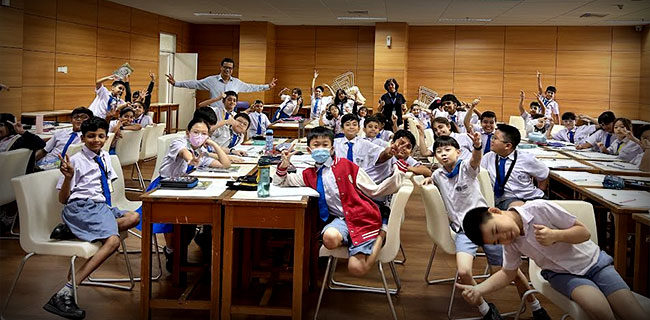
Usually, I receive invitations to deliver a guest lecture, sometimes teach a full course, at the post-graduate level. So last week, when a request to teach popped up on a WhatsApp Indian execs group in Jakarta, I was quick to raise my hand. Like the front-benchers in the Grade Four class whom I was about to teach the basics of advertising.
Having run a creative writing programme for primary school students during the pandemic, I had a sense of how I wanted to run the hour-long session. I needed to involve them from the very beginning. Having put two offspring through IB education, there was one principle that just had to be followed: stoke the spirit of inquiry and make the learners think on their feet. Hell ya! Don’t today’s 9-10-year-olds know how to do that?
Within the first 10 minutes of the class, they had not only told me about their favourite brands but pretty much taken us all through their customer journeys. They pointed out that 90% of ads sucked, a lot of them were misleading, and yet they enjoyed watching and remembered ads that entertained them. They hated it when they could not skip ads on YouTube, or their Instagram scrolling was interrupted by real estate ads.
I had deliberately chosen many ads that featured kids. The old Hutch Boy and Dog ad. A McDonalds Ramadan ad featuring a warm, fuzzy story about a father and son. A funny ad from a Nissan car dealership that showed a conversation between two kids and a car salesman. Truecaller ads which showed spammers/ scammers as wolves in sheep’s clothing. And the Volvo Trucks Epic Split featuring Van Damme, who no one recognized even as his split evoked gasps and they wanted to watch it again. You know the one I’m talking about right?
I had the most enjoyable hour I could have with my pants on.
Everyone in marketing and advertising and digital and branding and market research … must go out and pass on what you’ve learned to kids. There are plenty of reasons to teach, and I list five here.
1. Primary school kids, high school kids, BFA and BA and BBA students, those doing their PG in business or data science – it is the only way to get future generations interested in a career in the creative arts, a career in smart selling. Go ahead and inspire them.
2. Every class can be thought of as an ideation session, or a human lab. You will get instant, unfiltered responses to your concepts. The younger the students, the more they question you – if you design your class that way. Behave like a learner, not a guru (even if LinkedIn has anointed you as one).
3. Each example you show should not be to prove your point. Rather it should get the classroom to relate it to their own life experience, their likes and hates and come up with their own examples. The shared experience becomes a valuable lesson, for the teacher as well as the student.
4. Teaching is the best way to hone your presentation skills and your stage presence. It prepares you for the unexpected. It builds confidence – so the earlier in your career you get into it, the better it is. With agencies spending practically nothing anymore on building such skills, volunteer guest sessions at your alma mater.
5. It opens windows to the future. You understand what the interests, priorities, dreams of the next generation are. Whether they want to change the world in middle-school, or join the rat race while doing their MBAs. Do they view tomorrow as full of opportunity or conflict?
Wasn’t a song written by Graham Nash 53 years ago so prescient?
Teach your children well
Feed them on your dreams
The one they pick’s the one you’ll know by
Don’t you ever ask them why
If they told you, you would cry
So just look at them and sigh
And know they love you.
Kunal Sinha is Group Chief Strategy Officer at M&C Saatchi Indonesia, and the author of seven books on creativity, travel, rural marketing and China.