Tag: Kunal Sinha

  • Is Personalisation depriving us of Shared Experience?

    Is Personalisation depriving us of Shared Experience?

    Kunal SinhaThe other day, a fellow advertising practitioner/ commentator, after being invited to an awards judging, remarked that they had never seen many of the entry campaigns.

    Which raised a question: were they scam ads, or were they so sharply targeted and personalised that only the few thousand, best profile-matched prospects had watched them?

    In a class of English majors, students were asked to write an essay on what worried them, other than the violence they see globally, and environmental issues. A common refrain among the students was this:

    ‘Compared with any other generation, GenZ creators have a much greater ability to create and publish their work, artists are more free to share and bypass hassle-laden middlemen, and small businesses can take birth online with ease. In essence, this means there is more of everything, which is good. However, as a consequence, there are far fewer shared experiences among our generation’.

    What that means is that there is unlimited segmentation in every market, and infinitely more consumer options.

    What that also results in is that we are no longer watching the same late-night shows on weekends. I could talk about the latest Netflix show I’m watching, and no one on the room would have heard about it. We have hyper-tailored Spotify playlists, we don’t listen to the same DJs on radio. There are popstars topping the charts and their names mean nothing to most people.

    Targeted marketing is putting people inside lonely silos.

    Of course, one might argue that with the infinite amount of content and experiences out there, personalisation helps filter through the noise and presents only the information and entertainment that is of interest to us, reduces user effort and enriches online experiences.

    But even with that, how long do you spend pressing the remote before you finally choose your Netflix fix for the night?

    Before hyper-personalised content, the shared experience of consuming the same news, game or even ads helped create a sense of community. Our worldview was shaped by reading and watching and experiencing the same stories, and people were more united as a result.

    With much of their world experience being siloed, reaching them through their earbuds as they sit alone on their couch, it is no small wonder that GenZ feels isolated and disconnected. Even as they scroll through their Insta and TikTok, they are starting to notice the lack of new and interesting material in their feed.

    Content fatigue due to over-personalisation isn’t limited to social media. Research on recommendation systems tells us that Amazon users are noticing stale and boring product offerings in the ‘Recommended for You’ section of the e-commerce platform. Order Argan Oil once, and the algorithm will suggest you buy it two years later.

    For all the brouhaha around NikeiD some time back, the truth is – standard edition adidas Sambas and Stan Smiths and Chuck Taylors remain the biggest sellers. We all, Rishi Sunak included, are wearing the same sneakers as a shared experience. When we wear the same shoes, it brings us closer to walking in each others’ shoes.

    On the other hand, when we customise our sneakers, we might achieve ‘self-expression’, but it comes at the cost of sharing something with our congregation.

    When we congregate, we share values, behaviours and attitudes. It makes us feel welcomed, connected to others who are like us, and part of something bigger.

    The good news …

    The young are rediscovering the value of community. They are forming book clubs and film clubs, on social media and IRL. And joining the Swifties.

    New sports like padel and pickleball are bringing them out of their dens and on to the court; they are going cycling and running.

    Could we see a marketing future where meaning is created through shared experiences, rather than personalisation? After all, isn’t a crowd far more valuable than an individual?

    Kunal Sinha is Chief Knowledge Officer at Ampersand Advisory, based in Kuala Lumpur, Malaysia. He is the author of several books including The Future of India’s Rural Markets and Raw – Pervasive Creativity in Asia. He writes for MxMIndia every other Monday. His views here are personal.
  • Kunal Sinha: Rekindling interest in Books

    Kunal SinhaMalaysia boasts one of the world’s highest literacy rates. However, a 2016 report found that among Malaysians who read regularly, just 3 percent picked up a book.

    Those that are reading are not reading enough – with less than three hours a week spent on, a far cry from reading habits among citizens in India who allocate over 10 hours a week, reading while Thais and Chinese nationals spend between eight to nine hours a week.

    That is beginning to change.

    There is a newfound enthusiasm, thanks to a community of booklovers making relatable content on BookTok, the huge book club that has sprung up on social media and content platform TikTok.

    By making entertaining videos centred on the books they read, BookTokers have created an inventive way of discussing, reviewing, and recommending books that have revolutionised the literary and publishing communities.

    In Malaysia, #BookTok Malaysia has raked in 173.4 million followers as of May this year, showing that the reading culture in Malaysia is still alive. #BookTok Malaysia is not merely focussed on bookselling alone, as it also leverages the social platform to review books in the market with a casual and enjoyable approach.

    Now Kuala Lumpur and other towns are experiencing a resurgence of bricks-and-mortar bookshops. Independent sellers are betting that the pandemic-era pickup in reading will sustain and translate into in-store sales. They are finding ways to boost physical retail, from befriending customers and stocking niche paperbacks to opening cafes and curating the shelves of boutique hotels.

    Revenue in the books market, estimated at USD122.20m in 2024, is expected to grow to USD 128 mn by 2029.

    “There has been a substantial increase in the number of people attending the Kuala Lumpur International Book Fair (KLIBF), which attracted 1.3 million visitors in 2022 and grew to 1.6 million last year,” says Malaysian Booksellers Association president Thong Yuet Sheng.

    The stores are designed to lure customers in. Each has a different, eclectic design: one is housed in an old cinema complex; another has an ice-cream bar; and many are in malls, a popular weekend destination guaranteed to bring foot traffic.

    A couple of weeks ago, Sandeep Joseph, founder and CEO of the agency I work with, took me along to the sprawling Tsutaya Books in Bukit Jalil.

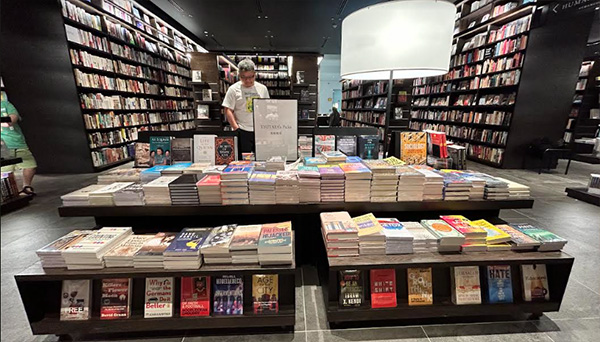
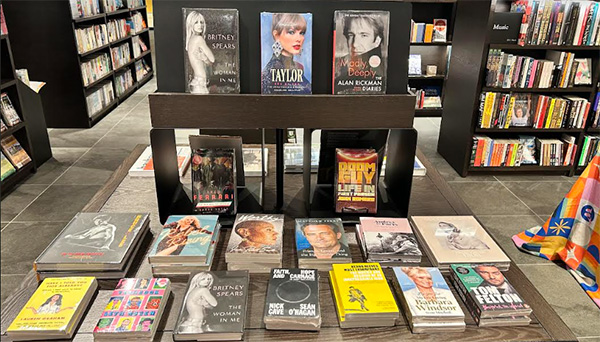
    With soft lighting, cozy reading areas, and a distinctly Japanese ambience, Tsutaya has all the ingredients to become the hotspot in Kuala Lumpur, with 31,000sq feet (2,880sq m) of space comprising the bookstore, with more than 264,000 books, a wide range of stationery, art and gifts (local and Japanese brand selection) on display, and a café. The books are well organised by topic, with each boasting a pretty exhaustive collection.


    The store is futuristic and modern. Mirrors make the visitor feel as if they are surrounded on all sides by books. The colours used for the interior decoration is wooden with warm accents which makes it look refreshing and aesthetic. With its large space, there are many interest zones where customers can feel comfortable browsing around. The photography section features lomo cameras and vintage B&W prints. Collections of whimsical posters and stationery by local artist collectives populate display islands – every month, the bookstore hosts a new artist, whose creations you can touch, feel and savour, not just scroll through.

    There are also areas for relaxing such as the lounge area or reading area which give off a therapeutic ambiance (with a fantastic view in front of the fountain and solo space). Jazz background music allows you to escape from reality for a while.

    Tsutaya Books’ service quality determines the impression made on customers. It goes one step beyond simple customer service by helping customers find the book that is on their mind, or has been recommended by an influencer they follow. Each concierge has extensive knowledge about his or her subject area, and he or she holds in-depth conversations with customers to recommend products based on their interest.

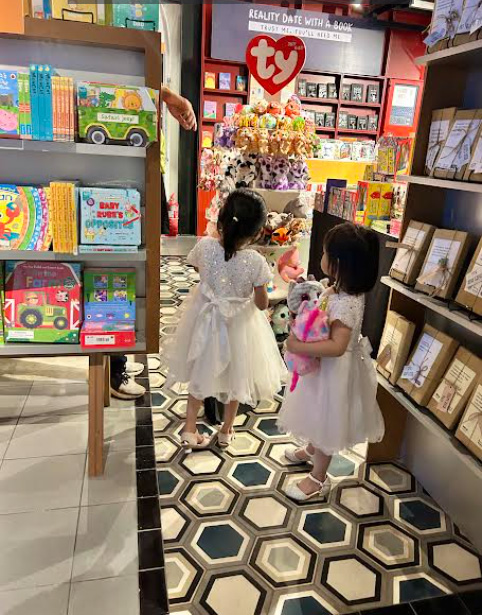
    BookXcess has gone from eight shops before the pandemic to 19 in July 2022. Their store in Ipoh is housed in an old building, spread over two floors and overlooks a garden. I saw little girls in pink getting excited with fluffy bags and picture books, while older shoppers posed in the anime section. I picked up a new copy of William Bernstein’s ‘Masters of the Word’ for less than Rs. 400.

    It’s not just chains that are bouncing back.

    Independent seller Monsoon Books opened in 2021 in Petaling Jaya and caters to Malaysia’s Chinese-speaking population. Around two-thirds of its books are in Chinese. The selection is diverse and tends toward the highbrow. Readers can purchase a treatise on Beethoven’s piano sonatas or the latest issue of Malaysian indie magazine Process.

    “People come to our shop and say, ‘Wow, I never expected to see these kinds of books in a Malaysian bookshop,’” says store manager Gan Han Lin.

    The former schoolteacher left his job to run Monsoon. He hired a local designer to build shelves and a clean, cozy interior. Visitors can relax and read inside or buy a drink at the cafe downstairs to enjoy on the plant-filled balcony and have their “me time”.

    Ng Kok Heong, a retired timber salesman who invested in Monsoon as a passion project says, “We want to establish a little bit of a niche market. If you go into the big chain bookshops you’ll see that most of the shelf is all books about wealth management and how to make money. We don’t want to sell those books. It’s not about simply making money; it’s about enriching your own thinking, your life and your mind through knowledge.”

    As an engineering student in Melbourne, Nazir Harith Fadzilah amassed a huge collection of books and wanted to bring his favourites back to Malaysia. In 2006, he opened independent bookshop Tintabudi in Kuala Lumpur and began selling from his personal library, alongside publishers he discovered at book festivals.

    Nazir has expanded Tintabudi’s business model, publishing a local author’s poetry collection and collaborating with the Kloe Hotel to curate their “room to read,” one of five culture-themed suites on offer at the venue. Some Kloe guests have become Tintabudi patrons.

    Started by accountant Rachel Ang as Malaysia’s largest online second-hand bookstore, Books n Bobs now has a lovely brick-and-mortar bookstore at GMBB, a shopping centre in Bukit Bintang, Kuala Lumpur. The mission of the shop, according to Ang, is to help avid readers find old books that they can’t find elsewhere, such as those that are out of print or certain special editions.

    She began purchasing titles that were in demand, no longer only focussing on only those she had a preference for.

    Readers are not only able to purchase books from them, but can also sell or donate pre-loved books right at the store in GMBB. Books n Bobs carries about 27,000 titles online and 2,000 titles in the GMBB shop, covering the genres of mystery, romance and science fiction.

    Part of their profits go to RUMAH K.I.D.S, a children’s shelter for abandoned and abused kids.

    What was the last time you spent a weekend hanging out at a bookstore?

    Kunal Sinha is Chief Knowledge Officer at Ampersand Advisory, based in Kuala Lumpur, Malaysia. He is the author of several books including The Future of India’s Rural Markets and Raw – Pervasive Creativity in Asia. He writes for MxMIndia every other Monday. His views here are personal.
  • Kunal Sinha: How Forgetful Are We?

    Kunal SinhaQuite so, and there is data to prove it.


    Every year, Uber publishes its Lost and Found Index. It is a snapshot of the most commonly forgotten items in its rides.


    Over the last year, objects including mobile phones, bags, wallets and clothing topped the list of items left behind in Ubers across India. These were followed by utility items such water bottles, keys, and accessories such as spectacles and jewellery. Passengers also forgot unique things such as a ukulele instrument, a coin collection, prasad from temples and a hair trimmer. They also left behind important documents such as passports, bank and business papers.


    Powered by insights and data, Uber’s Lost and Found Index aims to educate riders in a fun yet informative manner about in-app options available to them at the tap of a button, in case they lose or forget something in their Uber ride during a trip.

    So which cities were the most forgetful?


    Delhi took the title of the most forgetful city in the country for the second consecutive year, and Mumbai retained its second spot. Bengaluru reclaimed its third place from Hyderabad, which slipped to fourth as residents became more watchful about their belongings. Rounding off the top five most forgetful cities in the country is Pune.


    Analysing the data, Uber was able to connect the trends. We are most likely to forget our belongings in an Uber on Saturdays.

    Most riders tend to forget blue-coloured items the most in Ubers, followed by red and pink. So the next time you hop on to an Uber, try carrying items that are green or purple or yellow. You are less likely to leave it behind. In the US, red-coloured items are most commonly left behind. What gives?

    Evenings make us most forgetful, with most items left behind around 7pm. Aren’t we all frazzled towards the end of our working days to remember what all we were carrying?


    Apple device users were most forgetful during the year gone by. Android users rejoice! The most common item to be lost, anywhere, is a smartphone. A typical user may touch it 2,617  times every single day so it is highly surprisingly so many of these go missing.


    The feeling of panic and stress associated with losing a mobile phone has become so common that is has been given its own name, nomophobia.

    The festive days around Diwali were when people were most forgetful last year. Goddess Lakshmi grants us such bounty that we don’t mind leaving some behind for others. Like, in a cab.


    So it all adds up. Across Ubers and Olas and trains and flights. At restaurants, in the gym.


    The average person loses more than 3,000 items in their lifetime.


    Forgetfulness is something that we’ve had to accept as a way of life. Just because you are forever losing things, doesn’t mean that you are losing your mind.


    We keep saying that we live in the age of information overload. Forgetting serves us well. It tunes out useless information so we can focus on the relevant. Without it, neither anger at a slight nor the pain of grief would fade; feelings of love and attraction would not either, making it impossible to move on from relationships. Remembering build us, and forgetting chisels away the excess, shaping the way we see ourselves and our world. Maybe we really didn’t need what we left behind in the Uber.


    Broadly speaking, there are two explanations for why we keep lose all this stuff – one scientific, the other psychoanalytic.


    According to the scientific account, losing things represents a failure of recollection or a failure of attention: either we can’t retrieve a memory (of where we set down our wallet, say) or we didn’t encode one in the first place.


    According to the psychoanalytic account, conversely, losing things represents a success. It is a deliberate sabotage of our rational mind by our subliminal desires. In ‘The Psychopathology of Everyday Life’, Freud describes “the unconscious dexterity with which an object is mislaid on account of hidden but powerful motives,” including “the low estimation in which the lost object is held, or a secret antipathy towards it or towards the person that it came from.”


    No wonder losing things, even trivial things, can be so upsetting.


    Regardless of what goes missing, loss puts us in our place; it confronts us with lack of order and loss of control and the fleeting nature of existence.


    One of the characteristics of modern age is how much we need to remember. Passwords, birthdays, anniversaries, due dates for insurance payments and bills …

    Andrew Budson, neurologist and author of ‘Why We Forget and How to Remember Better: The Science Behind Memory’, has a few tips on improving our memory.

    “There’s nothing wrong with outsourcing your memory or using memory aids,” he says. “Anybody who wants to remember a shopping list or an appointment that’s coming up, write it down, put it in your phone or a planner; use reminders and calendars. I offload my memory as much as possible. I have all my passwords written down in a secure digital place. I use calendars, planners, and lists. In terms of trying to remember things better, day to day, I work at trying to be present and pay attention to what I’m doing and trying to multitask less”.

    Aah, that last one is sage advice. As busy executives, many of us take pride in ‘multi-tasking’. Alas, it also sets us up for forgetting, simple because we are not paying attention to the many things we claim to be doing. It can be humbling to admit that we haven’t been attentive. It is also one of the keys to experiencing improvement.

    Good luck on your next ride!


    Kunal Sinha is a senior strategy and foresights executive based in Kuala Lumpur, Malaysia. He is the author of several books including The Future of India’s Rural Markets and Raw – Pervasive Creativity in Asia. He writes for MxMIndia every other Monday. His views here are personal.

  • THE NRI SENTIMENT

    THE NRI SENTIMENT

    Kunal SinhaAbout one month after the election results were announced and the new government took charge, what do non-resident Indians feel, and what are their expectations?

    I spoke to several senior executives in Indonesia and China about their wishlist from the new government.


    Political participation and cooperation

    NRIs seek greater inclusion in the political process. They expect the right to vote in Indian elections without having to be physically present in India, ensuring their voices are heard even from abroad. However, only about 118,000 NRIs registered to vote in the Lok Sabha 2024 elections, out of which 12,000 were eligible voters, predominantly from Kerala.

    The logistical challenges of traveling back to India to vote means many NRIs cannot participate directly in the electoral process. Additionally, they desire representation in legislative bodies or advisory councils, allowing them to voice their concerns and interests directly. Engagement in policy-making processes that affect the diaspora is also crucial, as it ensures that their unique perspectives and needs are considered in the governance of India.

    Poonam Sagar, Founder of Indoindians, Jakarta says, “OCI/PIO are said to have all rights as an Indian citizen except to vote & own agricultural land – however in reality there are many differences in policies, paperwork and taxation.”

    Soumen Biswas, Founder, Smartfactory4u, Shanghai, says, “Since moving to China in 2006, I’ve seen India’s global reputation soar during Modi’s tenure. As an NRI, I would be thrilled to see India-China relations improve even more rapidly.” According to many Indian business folk resident in China, the potential for India China trade is immense, and mutually beneficial as the balance of world power tilts eastwards.


    Business and Investment

    In fiscal year 2023- 24, the Indian diaspora, scattered across the globe, set a record by sending more than $100 billion in remittances to their families back home in India. This figure not only surpassed the previous milestone but also emphasised the key role of the Indian diaspora in India’s financial inflows.

    It’s worth noting that these remittances exceeded the combined net Foreign Direct Investment level and portfolio investment amounting to $54 billion. The scale at which Indians received their remittances in 2023 even exceeded the GDP of 11 countries recorded in 2022.

    While NRIs have been repatriating such large sums back to India, they find it almost impossible to raise funds for their own ventures overseas.

    Bipin Mishra, Founder and CEO, Ketitik.com, makes an appeal to policymakers in India. “As an Indian national running a startup in Indonesia, we would love if grants and support provided by Government of India is passed to us as well.  It has become very difficult for Indians to invest in Non Indian startups, if an exemption can be made for Indians to invest in Indian-owned foreign based start-ups, it will be a great”.

    Sagar would like the government to ease the repatriation of money from NRE accounts to NRIs, as well as make it easier for NRIs to invest in various financial schemes in India. “NRI’s need to maintain an active Indian phone number to manage their bank accounts etc in India – despite the advances in technology, this is still an issue. Aadhar card is required for most transactions in India, but it is difficult to get for NRI’s who have been overseas for many years and for OCI/PIO. Also, property sale TDS should be at par with resident Indians; after all NRI’s are also Indian citizens,” she explained.


    Connectivity and fostering cultural ties

    In December 2019, India and China were connected through 539 direct passenger flights. Now there are none.

    IndiGo and Air India had operated flights to China while Air China, China Southern Airlines, and China Eastern Airlines, had connected Beijing, Shanghai, and Guangzhou to Indian cities.

    The two countries suspended these flights during the Covid-19 pandemic and subsequent border clashes in June 2020. Flights have not resumed four years on. In the absence of direct flights, travelers between India and China must rely on connecting flights through third countries, such as Hong Kong, Bangkok, and Singapore. The detour adds time and cost.

    The lack of direct flights between the two nations poses major challenges for hundreds of Indians who study in China as well as the families of many Indians, including businessmen, who began to work in China after travel restrictions were lifted by both countries in 2022.

    Low levels of air connectivity are also a hindrance to trade and tourism between India and Indonesia. The island nation’s Hindu heritage can be leveraged for enhancing traffic into India, and much more can be done to promote various Indian destinations amongst the Indonesian population. “Tourism in India is underdeveloped while it has a massive potential. With safety measures and promotions, I would love to have more of my Indonesian friends travel and marvel at India,” says Mishra.


    Personal and family

    Many NRIs maintain close ties with their home country, and eventually wish to return. They expect the government to make that return smooth and hassle free. Sagar would like to see an enhanced duty-free allowance upon transfer of residence, and an increase in health insurance coverage. There also needs to be opportunities for NRI children to participate in national level entrance exams through satellite examination points at the Indian embassy in different countries.

    Biswas says: “Religious and communal harmony is the most important for Indians living in India. However, it gets more crucial for Indian expats. It has the ability to impact their survival in some parts of the world. Hence. I hope that the government continues to ensure that religious harmony remains intact.”

    He added: “I wish to see the government put significant effort into improving civic sense in our society. Great nations are built on the foundation of responsible and thoughtful citizens. Promoting civic awareness through social media, educational videos, and campaigns at transport hubs, schools, and workplaces can foster a more conscientious and responsible society, helping to build a stronger nation.”


    Kunal Sinha is a senior strategy and foresights executive based in Kuala Lumpur, Malaysia. He is the author of several books including The Future of India’s Rural Markets and Raw – Pervasive Creativity in Asia. He writes for MxMIndia every other Monday. His views here are personal.


  • Virtual Influencers: Hit or Miss?

    Virtual Influencers: Hit or Miss?

    Kunal SinhaIf you looked at recent CMO surveys and panel discussions lately, artificial intelligence (AI) and influencer marketing are on top of the agenda. 81% of US marketers say that influencer marketers is an essential part of their social media strategy; 77% of Indian marketers are confident in their agency’s capability to effectively manage influencer campaigns[1]. At the same time, 81% marketers say that AI has had a positive impact on their work[2]; and over three quarters of Indian marketers (78%) say they are ready to embrace AI[3].

    What happens when you combine the two? We get virtual influencers. Even though human influencers still vastly outnumber virtual influencers, the latter have caught the fancy of marketers and agencies and are becoming increasingly common.

    52% of U.S. social media users already follow a virtual influencer, and that percentage is higher in India at 58%[4].

    Global brands including Prada, Cartier, Disney, Puma, Nike, and Tiffany use virtual influencers to promote their products.

    Lil Miquela is a pioneer in the virtual influencer space. Describing herself as a 19-year-old robot living in LA, she has 2.6 million followers on Instagram https://www.instagram.com/lilmiquela/?hl=en

    and 3.5 million followers on TikTok https://www.tiktok.com/@lilmiquela?lang=en

    Managed by creative agency Brud, she has featured in brand partnerships with Prada, Calvin Klein and BMW, earning a spot on TIME magazine list of 25 Most Influential People on the Internet.

    Fashion brand Myntra created the virtual influencer Maya, incorporated her into the studio section of the Myntra app, where she doles out fashion advice apart from advocating mental health, inclusivity and body positivity. ‘Based out of Bangalore, and a student’, she has a follower base of 178K already, and endorses brands like L’Oreal.

    https://www.instagram.com/maya_unlimited/?hl=en

    Kyra or Kyraonig was created by Himanshu Goel, launched in Jan 2022, and enjoys a following of 243000 on Instagram https://www.instagram.com/kyraonig/?hl=en.

    She has has been prominent in the music and entertainment industries, endorsing various brands such as Amazon Prime Video, boat, MG, Titan EyeX and John Jacobs.

    Within two years, it is expected that  marketers will dedicate 30% of their celebrity and influencer marketing spends to virtual influencers[5].

    What should they keep in mind, as they embrace this opportunity?


    Virtual influencers give you control over content

    Brands that want to get across a certain message or have a specific point to make through their influencer partnership have a higher level of control over content with virtual influencers. Being able to control what an influencer posts can be appealing to some brands with a very specific message to share.

    Youth entertainment channel MTV collaborated with DDB Mudra to develop India’s first virtual rapper ‘BotHard’ to draw attention to its property, MTV Hustle 2.0. The bot was brought to life with the GPT3 platform and was specially trained to find rhyme structures of popular rappers. This collaboration inspired the creation of over 350,000 rap videos, with the show racking up 2 billion views across social platforms. This represented a nine-fold growth over the previous season. By creating a virtual influencer in-house provided the brand with greater control, agility, intellectual property ownership, and brand differentiation.


    Adaptability

    Virtual influencers don’t age, can speak multiple languages and can be made to travel to any place. This level of adaptability and flexibility allows brands to potentially use one virtual influencer for campaigns in different regions instead of identifying and engaging different influencers in various markets.

    British fashion house Ralph & Russo, successfully used a virtual influencer to launch its 2020–2021 couture collection. The company designed Hauli, a tall Black virtual model. Her name was derived from the Swahili words for strength and power.


    The campaign featured her posing at the Taj Mahal, the Great Wall of China, and other wonders of the world, location where conducting a photo shoot with a human influencer would be difficult (and expensive). The combination of an African influencer and a global context contributed massively to the campaign’s success. The promotion achieved 19.4 million views worldwide, with the brand estimating the value of the media exposure at $65.1 million.


    Brand safety and reputation

    While virtual influencers may seem to be a safer bet than real-life influencers, they’re not completely immune to controversy.

    Humans don’t fully understand how these systems work or make decisions, which poses a huge challenge for marketers and agencies. In the absence of clarity, is difficult for brands to predict how these virtual influencers might be accepted. Granted AI’s cool factor, marketers should be careful about diving in headfirst to avoid unfavourable PR.

    Earlier this year, automaker Mahindra launched an AI-generated influencer named Ava, which was designed to showcase the team’s journey in the ABB FIA Formula E World Championship, and towards a more sustainable future for the planet. Mahindra’s team used GenAI tools like Midjourney and Leonardo AI to create its new ambassador, saying ‘Having Ava, an influencer that is strongly associated with us and documents our journey, but with a broader appeal to help promote our core values as an organisation, is a project we’re hugely excited about.’

    Eva’s Instagram account @avabeyondreality described itself as a “Sustainable Tech Queen & Racing Rebel Robot”, with the goal of fueling inclusion through AI innovation. It documented the virtual influencer’s life through 11 posts, the first of which dated back to 8 December 2023.

    The launch of Eva was met with backlash from fans and media alike on social media. Many argued that the team should have hired a human ambassador rather than a virtual influencer.  Devin Altieri, a PR consultant in motorsport, wrote on X:  “Mahindra creating an AI team ambassador that is a woman instead of simply hiring one real, actual woman to fill that role is so incredibly messed up”. Alanis King, an auto journalist added: “I’m not an AI expert, but everything I see is about enormous energy use. Isn’t it weird to call this a ‘Sustainable Tech Champ’?”

    Faced with such strongly negative response, particularly from experts, Mahindra abandoned the project and deleted Eva’s Instagram account.


    Fuel fans and consumers’ desire for novelty.

    With some brand ambassadors and influencers, some brands find value in stability and longevity. We know how Tiger Woods’s association with Nike lasted 27 years.

    On social media era, on the other hand, many consumers crave something new and different, and find brands that rely on familiar celebrities as stale or uninteresting.

    As they scroll social media quickly, it requires something unusual to make them pause.

    Research shows that one reason consumers follow virtual influencers is that they are unexpected and previously unknown. Although betting on a virtual influencer may require a leap of faith, marketers should realize that human influencers may be perceived as overexposed or past their prime.

    Traditional influencer marketing can be expensive, particularly when collaborating with celebrities or industry experts. On the other hand, virtual influencers are a cost-efficient and scalable option, requiring less time and resources. While the initial investment in creating a virtual influencer can be significant, the long-term benefits far surpass the costs.


    Kunal Sinha is a senior strategy and foresights executive based in Jakarta, Indonesia. He is the author of several books including The Future of India’s Rural Markets and Raw – Pervasive Creativity in Asia. He writes for MxMIndia every other Monday. His views here are personal.

    ________

    [1] https://www.ey.com/en_in/media-entertainment/how-influencer-marketing-is-impacting-brands-in-india

    [2] https://sproutsocial.com/insights/index/

    [3] https://www.campaignasia.com/article/47-marketers-in-india-believe-ai-will-make-them-more-productive-linkedin-report/491903

    [4] Influencer Marketing Factory Report

    [5] Gartner global forecast, 2024

  • So which brands have caught Election Fever?

    So which brands have caught Election Fever?

    Photograph of first-time voters in Jaipur from the ECI.gov.in website

    Kunal SinhaWe are in the middle of a frenetic, high voltage election campaign in India. Of particular interest to political parties and brands alike is the sentiment of first-time voters.

    With only 18 million out of eligible 49 million first-time voters having registered to vote, the Election Commission has roped in brands to reach out to their fans and followers. In Bihar, which has the country’s largest number of young people, only 17% have registered to vote. In Delhi, the centre of political action, the figure is 21%, while in Uttar Pradesh, it is 23%.

    So how are brands getting to be a part of the feverish campaigning?

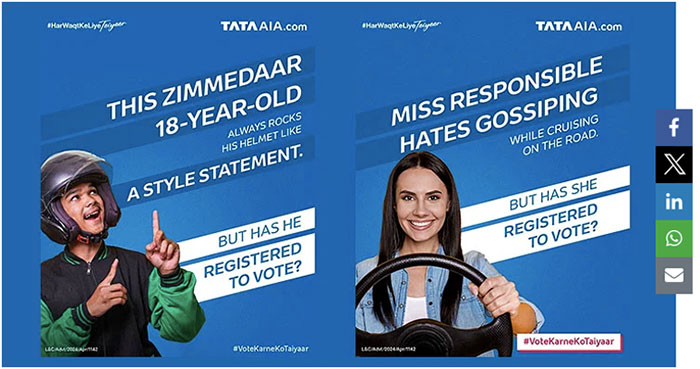
    Insurance brand Tata AIA launched a social media campaign titled #VoteKarneKoTaiyaar, encouraging young Indians, particularly first-time voters, to immediately register themselves to vote and then go ahead and vote on election day. The election campaign integrates the brand’s core idea of ‘taiyaari’ (readiness), with its tagline being ‘Har Waqt Ke Liye Taiyaar’.

    Booking platform BookMyShow’s campaign underlines the importance of voting as a fundamental duty of every responsible citizen, especially the youth. With the tagline ‘Aaj Picture Nahi, Bigger Picture Dekho’, its campaign urges citizens to focus on the larger picture of nation-building by exercising their right to vote on their respective election days.

    The film deploys a uniquely-weaved narrative and clever word play, keeping viewers that unaware of the purpose of the campaign until it is revealed in the end. The story aims to connect with viewers across the country, inspire civic engagement and demographic participation.

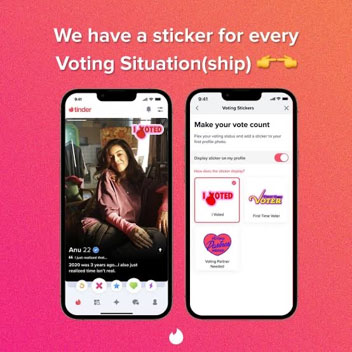
    Can political participation be a desirable feature on your profile? Dating app Tinder seems to think so. It has added special stickers to its app that users can add to their profiles. These stickers are about voting, like voting partner needed, first-time voter, and I voted. Collaborated with Yuvaa, an Indian youth media organisation, and Mark Your Presence, an organisation that helps young people learn about voting, Tinder’s campaign started running from April 18 and will be on till May 15, 2024, with its users in India being able to see special cards in the app with information and tips about voting.

    Bangur Cement’s election-themed campaign featured Bollywood actor and MP Sunny Deol.
    The campaign, with the tagline Vote Solid, Desh Solid, carries the message about how important each person’s vote is for making the country stronger. There’s a brand connect as well: just like using strong cement helps build a sturdy home, voting solidly helps build a strong nation. With low voter turnout observed in the first two phases of the election, the campaign has pivoted to ask voters to take the pledge ‘Vote Ka Vachan’, saying ‘Chutti baad mein manao, pehle vote kar aao’.

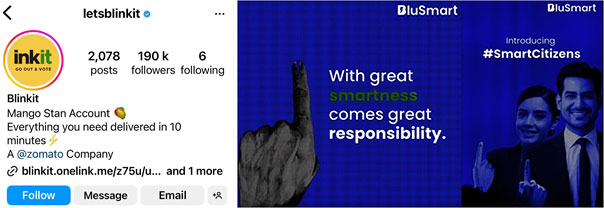
    Delivery service BlinkIt dropped the first two letters from its logo, as it encourages voters to go out and vote.

    BluSmart, an Indian electric vehicle (EV) ride-hailing service and EV charging infrastructure network, launched a campaign called #SmartCitizen. Their effort, focused on their key markets in Delhi, Gurugram and Bengaluru, is to tell people how important it is to vote and how much of a difference one vote can make. BluSmart is giving a special badge to riders who vote to encourage everyone to get involved in voting.

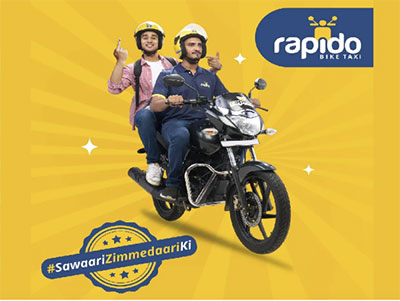
    Across different states, rideshare company Rapido has collaborated with the State Election Commissions to offer free bike-taxi rides to voters cities like Shillong, Nagpur, Asansol, Siliguri, Durgapur and Kolkata, running a campaign ‘Sawaari Zimmedari ki’.
    Apart from these direct appeals to vote, brands are also having some fun at the expense of politicians.

    Colgate Salt toothpaste‘s campaign ‘No Card, No Darr’ promotes oral hygiene alongside civic responsibility, with a dash of humour. The ad depicts a politician who is scared of sitting on the chair in front of him, much to his party workers’ surprise: it’s the one kursi which even politicians are scared of. That’s because he views it as a dentist chair because of he is suffering from toothache.

    The rising temperature, both politically and weather-wise, has presented some brands the opportunity to showcase their cooling-down creds.

    Innerwear brand Technosport tells us the secret of how a politician keeps his cool even while campaigning in the heat.

    Electrical appliances brand Novamax also uses the platform of elections to depict the intense heat experienced during election season.

    The brand’s tagline, ‘Ek Hei Naam Gunje Ga Jab Chalegi Hawa,’ aims to connect with consumers and emphasize the relief provided by Novamax Air Coolers in combating summer heat.

    With about four weeks remaining in the general election season, how many more brands will get consumers to vote – for them, and for the nation?

    Kunal Sinha is a senior strategy and foresights executive based in Jakarta, Indonesia. He is the author of several books including The Future of India’s Rural Markets and Raw – Pervasive Creativity in Asia. He writes for MxMIndia every other Monday. His views here are personal.

  • Confronting the Crisis of Credibility & Trust

    Confronting the Crisis of Credibility & Trust

    Kunal SinhaOnce again, a brand that is a household name has let its users down. Except that the duplicity is remarkable.


    A recent report released by Swiss NGO Public Eye and the International Baby Food Action Network (IBFAN) revealed stark differences in the sugar content of Nestle’s baby products across various nations.


    The investigation, which evaluated around 150 baby products from different countries, alleges that Nestle’s products in South Asian (including India), African and Latin American markets contain significantly higher sugar levels than those in Europe. Brands like Cerelac and Nido contained more sugar by as much as 2.7 gm per serving in India and 5 gm in Thailand– compared to developed nations in the West.


    The medical evidence against sugar is clear. Added sugars should not be given to infants, toddlers or very young children because they don’t need it. They get their sugar from natural sources and lactose in their mother’s milk for the first 24 months of their lives. There is a risk that infants will become addicted to sugary foods, which will impact their health from an early age.


    But the same Nestlé’s India operation was ranked joint first in the second India Access to Nutrition Spotlight Index 2020. The index is purported to be an independent national assessment to measure the contribution of India’s largest food and beverage manufacturers toward meeting the health and nutrition needs of Indian consumers.


    In its citation, the ranking states that some of Nestlé India’s strengths include its overall nutrition governance and management systems that are comprehensive with a clear accountability structure, its pledge to reduce fat, salt and sugar in its products, its commitment to address the affordability of its nutritious products and its responsible marketing policies.


    Would you trust the Access to Nutrition Index?


    In Indonesia, Aqua, a bottled water brand made by French consumer goods giant Danone, recently topped a new ranking of Indonesia’s biggest plastic polluters.


    Sungai Watch, a Bali-based environmental non-profit that deploys river barriers all over Indonesia to stop plastic debris from leaking into the ocean, studied the trash they had collected. The non-profit audited 537,189 pieces of rubbish collected from 268 river barriers in Bali and East Java last year, and published the data in its 2023 Impact Report.


    It found Aqua-branded single-use water bottles to be by far the most commonly littered items, followed by products made by Indonesian consumer goods firms Wings Group and Indofood.


    Now, Aqua was the first Indonesian company to be certified by B Lab, a London-headquartered certification scheme which rewards “beneficial corporations”, or B Corps, based on their social and environmental impact. Aqua attained B Corp status in 2018 and was re-certified in 2021. How reliable and authentic would that certification be, in the light of the Sungai Watch report, especially since B Lab has faced scrutiny in recent months for helping companies greenwash their record?


    Trust is ever so important to us

    Trust is a major determinant in all aspects of our life. We seek it in our families, in our neighbourhoods, in our workplace, in the sporting field. Trust is never absolute but is based on situations, memories, experience, contract, perception, emotions.


    From personal relationships, to trade and commerce, politics, society, everything is based on trust.


    Trust is a brain’s neural response based on certain stimuli, both internal as well as external as well as certain mnemonic associations developed over years. Trust is vital to any transaction. Without trust there can be no relationship, institution or nation.


    The impact of trust goes deep. Gartner studies suggest that 81% of customer are not willing to engage with business or make purchases from brands they do not trust. What’s more, 89% of customers say they would end their relationship with a brand if it violates their trust. According to PwC’s 2023 Trust Survey, 92% of business leaders, 92% of consumers and 94% of employees agree that organisations have a responsibility to manage that trust.


    How did we lose trust?

    By definition, trust is as human and messy as the very humans who earn it or lose it. Today, there’s a gaping chasm of societal trust – a “trust deficit,” defined as when there is more distrust than trust between two or more people.


    One would have thought that the Information Age and the widespread rise of different media would eliminate some of this trust deficit. In truth, it has only amplified the problem. Personal agenda, partisanship and bias have clouded dissemination of news and information.


    Opinion has become interchangeable with fact. Fake news, manipulated information (aural, written or video) and coloured views are so common that it is difficult to decipher the real from the unreal. Trust deficit in media explores the lower depths every minute.


    According to futurist Alvin Toffler, “We are increasing the sophistication of deception faster than the technology of verification. The consequence of that is the end of truth. The dark side of the information technology explosion is that it will breed a population that believes nothing, and perhaps even more dangerous, a population ready to believe only one ‘truth’ fanatically and willing to kill for it.”


    Brands and mistrust

    In today’s consumer landscape, trust has become a precious commodity. Scepticism and cynicism are on the rise, leading to a decline in consumer trust across industries. From data breaches to misleading advertising, consumers have become increasingly wary of brands and their intentions. The prevalence of fake reviews is a real problem in the retail world and has further eroded consumer trust. High-profile data breaches and privacy scandals have shaken consumer confidence. Instances where personal data has been mishandled, misused or compromised have resulted in a loss of trust in brands across various sectors.


    Trust is lowest among Gen Z consumers, among whom only 28% trust the brands they do business with. A study from Deloitte shows that consumer trust in a brand can decline by as much as 144% when a customer believes a company is using AI.


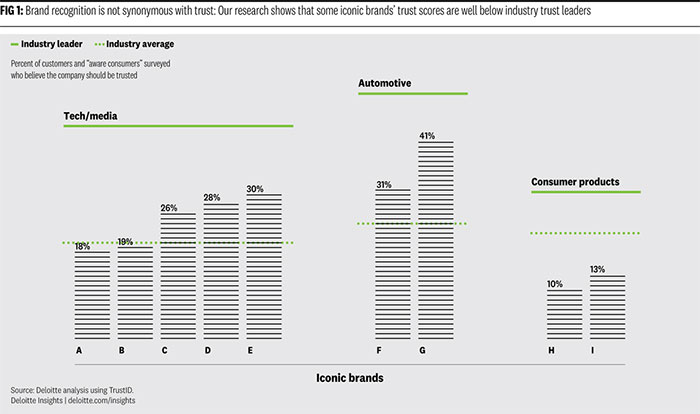
    But iconic brands like Aqua and Nestle regularly show up in annual, high-level trust surveys. While it seems intuitive that large, long-dominant brands with the most customers would also be the most trusted, a study found that many household-name brands fell below benchmark trust scores in many industries (figure 1)—indicating that brand recognition is not synonymous with trust.


    Consumers say that brands’ attempts to engage with them often go wrong when they lack relevance (76 percent) or authenticity (51 percent).


    Regaining brand trust

    While the erosion of trust in recent years presents challenges, brands can regain confidence by prioritizing transparency, authenticity and accountability.


    The need for trust is on the rise. Globally, 71% of people say that it is more important to trust the brands they buy/use today than in the past. (Edelman Trust Barometer 2023).


    By valuing customer privacy, being transparent in communications and practices, aligning with genuine social causes, and consistently delivering quality and value, brands can rebuild trust and establish lasting relationships with consumers. In the era of distrust, brands that proactively address these issues will stand out as beacons of trust, gaining a competitive edge and fostering loyalty in the hearts and minds of their customers.


    But most importantly, they need to be reminded that consumer is not a moron. They are babies who deserve care, not addiction, a plastic-free world, not beaches and playgrounds littered with bottles.


    Kunal Sinha is a senior strategy and foresights executive based in Jakarta, Indonesia. He is the author of several books including The Future of India’s Rural Markets and Raw – Pervasive Creativity in Asia. He writes for MxMIndia every other Monday. His views here are personal.

  • The Distraction Economy

    The Distraction Economy

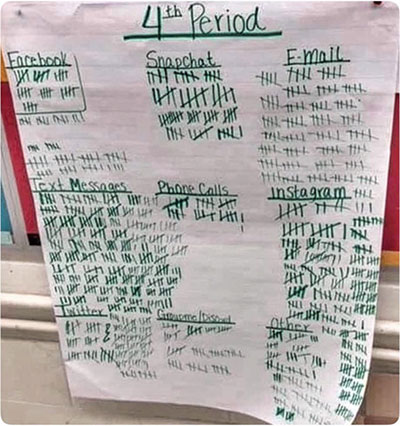
    Kunal SinhaIn a revealing experiment, American teacher Mary Garza asked her pupils to leave their phones on loud while they were in class. An unusual request, yes, but she wanted to show them something.

    Every time a phone notification went off, the pupil would then have to put a mark under the correct category for what the notification was for. The result was eye-opening.


    In the space of one class that is roughly an hour long, her students received a combined total of over 1,000 notifications from Facebook, Snapchat, Twitter, text, email, calls and other social media platforms. That’s a notification coming in every 2.5 seconds.

    So every 2.5 seconds one person in class was being distracted by their phone, which obviously has a huge impact on their attention levels – and education.


    A few months ago, I sat in a presentation to a marketing director in Jakarta. Her boss, the country manager, popped his head in and informed us that he had to finish appraisals that evening. Now, they had fixed the meeting time and date. The marketing head had their laptop open throughout our presentation; we realised that they were doing their appraisal on WhatsApp while sitting in the meeting. Were they paying attention? Absolutely not.


    I have known CEOs who bring three screens to meetings, boasting they’re multi-tasking. Globally, managers especially struggle to maintain focus, with 683 hours lost to distraction annually. In fact, managers lost more than 100 additional hours of productive time compared to other roles, which averaged 553 hours lost each year – driven in large part by unproductive meetings and administrative tasks. Put another way: lost focus costs companies $37,000 per manager, compared to $21,000 for other roles.


    So, while marketing gurus harp on how we’re in the Attention Economy, I’d like to posit that what tech, marketing and entertainment are building is the Distraction Economy.


    Infinite scrolling and dopamine

    Today, the fastest growing sector of the culture economy is distraction. You can call it scrolling or swiping or wasting time or whatever you want. It’s neither art nor entertainment, just ceaseless activity.

    The key is that each stimulus only lasts a few seconds, and must be repeated.

    It has already become a huge business, and will soon be larger than arts and entertainment combined. Everything is getting turned into TikTok, an aptly named platform for a business based on stimuli that must be repeated after only a few ticks of the clock.

    TikTok has made a fortune by filling our screens with fast-paced scrolling video. And now Facebook—once a place to connect with family and friends—imitates it. As does Instagram, YouTube, and everybody else trying to get rich on social media. So long, Granny, hello Reels.


    The advent of infinite scrolling has marked a significant shift in how we consume content. When you watch a video on YouTube, the next video loads immediately. Netflix starts the next episode of your favourite show right away. Browsing Reddit reveals an endless stream of social media content.

    This is more than just the hot trend of 2024. It’s worrying because it could last forever—because it’s based on body chemistry, not fashion or aesthetics.

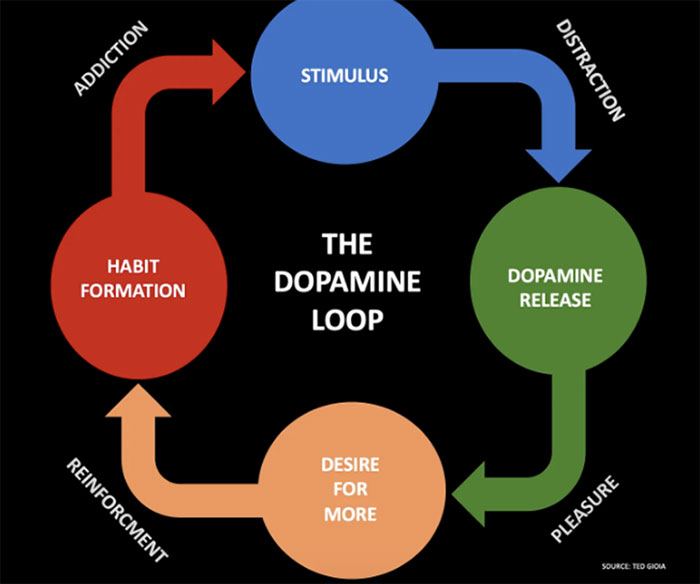
    Our brain rewards these brief bursts of distraction. The neurochemical dopamine is released, and this makes us feel good. So we want to repeat the stimulus.


    It’s human nature to seek predictability and pattern. In their absence, we search for them. So, we pull to refresh. Rewards aren’t guaranteed, and most of the time, we don’t discover anything remarkable. In the same way as we gamble, we continue to refresh in hope of a quick rush of dopamine.

    This is a familiar model for addiction.

    Chart by Ted Gioia

    Although we have endless founts of fun at our fingertips, the data shows that we’re less and less happy, says Dr Anna Lembke, Stanford University professor and a world-leading expert on addiction.

    We’re forever “interrupting ourselves”, as Lembke puts it, for a quick digital hit, meaning we rarely concentrate on taxing tasks for long or get into a creative flow.

    Only now it is getting applied to culture and the creative world – and billions of people. We are unwitting volunteers in the largest social engineering experiment in human history.


    Addicted to drama

    Even ‘distraction’ is just a stepping stone toward the real goal nowadays – which is addiction.

    Instead of movies, social media users get served up an endless sequence of 15-second videos. Instead of symphonies, listeners hear bite-sized melodies, usually accompanied by one of these tiny videos, just enough for a dopamine hit, and no more.

    This is the reason why two-minute episodes of “The Double Life of My Billionaire Husband” have been showing up on your content/ social media feeds lately.

    After exploding as a content format in China, micro-dramas are the latest content trend racking up views everywhere, showing in our feeds as we scroll. Delivered in two-minute episodes that have mostly been adapted from Chinese web novels, the market is already estimated at USD 5 billion.

    Thanks to TikTok, younger audiences gravitate towards bursts of content that adapt to their preferences in real-time. To feed this impatience, apps like ReelShort are creating minute-long, mini-dramas that are part TikTok video, part soap opera.

    ReelShort, owned by California-based Crazy Maple Studio and backed by Beijing-based digital content company COL Group, launched in 2022. And its format, which is already popular in parts of Asia, is taking off worldwide. In 2023, 7m+ people downloaded ReelShort in the US, while worldwide downloads surpassed 24m. It’s hardly alone: a slew of other apps – Sereal+, ShortTV, DramaBox, and FlexTV – are all vying for our short attention spans using the same recipe.

    These short dramas prioritise quick, oversimplified stories of love, wealth, betrayal, and revenge, sometimes featuring mythical creatures like vampires and werewolves. Stories of marrying into a rich family attract men, while stories with a powerful female protagonist in control of her life appeal to women.

    One of the highest-grossing shows on FlexTV is called Mr. Williams! Madame Is Dying. It’s a corny romance story about a love triangle, ultra-rich families, cancer, rebirth, and redemption, and it was adapted from a Chinese web novel that has nearly 1,300 chapters. The original story has been turned into a Chinese short drama, but FlexTV decided to shoot another version in Los Angeles for an international audience.

    The revenue model for these hits (pun intended) is not unlike that of a drug dealer’s.

    Unlike most streaming services, which require subscriptions, Chinese platforms for streaming and web novels use a business model of paying by the episode or chapter.

    Essentially, the first 10 or so episodes are always available for free, but once users are hooked, they need to pay a certain amount to watch each episode. It resembles the micro-transaction mechanism in mobile games, which Chinese companies, like the developer of the global hit Genshin Impact, also perfected. Users can quickly rack up thousands in payments by buying small items in-game here and there.

    FlexTV has a similar tactic. Viewers can pay $5 for 500 in-app coins, which in return unlock about seven episodes. A whole series therefore can cost around $50, but there are also small tasks users can do in the app to earn free rewards, like watching ads, posting about the app on social media, and doing daily check-ins.

    This is the new culture. And its most striking feature is the absence of culture or even mindless entertainment, as both get replaced by compulsive, repetitive activity.

    Are we going to see 2-minute micro-dramas from brands soon?

    —————


    Kunal Sinha is a senior strategy and foresights executive based in Jakarta, Indonesia. He is the author of several books including The Future of India’s Rural Markets and Raw – Pervasive Creativity in Asia. He writes for MxMIndia every other Monday. His views here are personal.


    Reference:

    https://impact.economist.com/new-globalisation/in-search-of-lost-focus-2023/


  • Kunal Sinha: We are What we Eat. So why take our Tummies for Granted?

    Kunal SinhaThe recent scrutiny of McDonald’s in India, following a report that one of its outlets in Maharashtra used substitutes in place of real cheese in burgers and nuggets, has once again brought into sharp focus how consciousness about food safety and ingredients is emerging as an important consideration for consumers.


    The fast-food chain’s quick response and cooperation with regulators has been exemplary.


    However, the challenge that we’re up against is monumental. We are spending more on food. The share of wallet for food for an average Indian household is expected to increase to 35.4% by 2025 from 33.2% in 2005. But the food we eat is increasingly unsafe (https://www.fortuneindia.com/macro/headline-future-of-food-heres-what-indian-consumers-want/106694).


    Four years after the Food Safety and Standards Authority of India (FSSAI) published a state-wise index to spur food safety improvement, 19 out of 20 large states – including Maharashtra, Bihar, Gujarat and Andhra Pradesh – recorded a drop in their 2023 scores from 2019.


    In April 2023, the government released a startling report: Nearly a quarter of food samples tested by regulators during an investigation did not meet India’s food safety standards. The findings came amidst the growing concern amongst consumers about the safety of their food, crackdowns on poor hygiene practices, foodborne illness outbreaks, and even rampant cases of food adulteration.

    Indians suffer an estimated 100 million foodborne illnesses every year, leading to an average of 120,000 deaths. The preventive infrastructure is limited. Food manufacturing and processing facilities often lack the resources to maintain proper hygiene, resulting in contamination and outbreaks of foodborne illnesses.

    Just compare the short videos of food stalls posted on social media – while most vendors preparing food in other countries wear gloves, in India, they use their bare hands to handle and serve the food. In the Mumbai suburb of Goregaon, soon after we’d tried out the shawarmas at a popular food truck, I spotted a garbage truck parked right next to it every evening. That put an end to our patronage.

    Intentional food adulteration is rampantA 2022 review by FSSAI found almost doubling in the detection of food adulteration cases over a period of seven years, from 15% to 28%. As long as manufacturers skirt product registration requirements they are legally obligated to meet, detection will remain a problem. A survey by Tetrapak revealed that one in every three mothers’ mothers were unsure about the safety and quality of food that she gives to her family. The survey also revealed that mothers are most concerned about the freshness and purity of the food they consume as well as the risk of its adulteration. They expressed a clear need to have easy access to better information.

    With consumers being price sensitive, many of the food and beverage manufacturers as well as street vendors India are focused on reducing costs to make their product affordable to the public. As a result, many do not prioritise food safety as a pillar of their business because it prevents them from meeting their profit margins.

    A sharp increase in the demand for animal proteins presents a set of food safety challenges in the form of antimicrobials in feed and compromised hygiene practices at slaughterhouses and street-side retailers.

    But could India be on the precipice of a major cultural shift in food safety in spite of these challenges?


    The huge popularity of Revant Himatsingka aka Foodpharmer’s videos, wherein he highlights the harmful ingredients or incorrect labeling in popular packaged foods (Amul Taaza is not Taaza / Nutella has too much sugar / What is inside Tang), suggests that consumers are taking their blinders off.


    Many people no longer pick food items from the shelf without checking on the nutrient values, calorie count, and ingredients used. Nearly 60% of consumers now say that they check the label when buying packaged foods ((https://foodsafetyworks.com/wp-content/uploads/2023/08/Label_Awareness_Report_FSW.pdf).


    The increased levels of concerns around food safety and how it is produced, packed, processed, and delivered, has led to higher consumption of organic food, which is expected to grow at a CAGR of 21% to reach ₹18,200 crore by 2026 from ₹6,000 crore currently.

    At the supply end, FSSAI has been working with large private companies such as Godrej Agrovet, Godrej Tyson Foods, Suguna Poultry, Grofers, Licious, Venky’s, AOV Agro Foods and Allanasons to ensure safety standards, while promoting the use of gloves, disinfectants and fly nets at streetside shops.

    FSSAI’s Eat Right India programme has successfully trained and deployed more than 1.5 million food safety supervisors to evaluate different establishments.


    Moving forward, the FSSAI plans to certify at least 50% of all known street food vendors and notify the public of their hygiene rating.


    Isn’t it time for a healthy dose of reassurance from F&B and foodservice brands?


    Kunal Sinha is a senior strategy and foresights executive based in Jakarta, Indonesia. He is the author of several books including The Future of India’s Rural Markets and Raw – Pervasive Creativity in Asia. He writes for MxMIndia every other Monday. His views here are personal.


  • Artificial Intelligence: The Road Ahead

    Artificial Intelligence: The Road Ahead

    Kunal SinhaInvestor enthusiasm for artificial intelligence (AI) soared to unprecedented heights last week, fuelled by remarkable performance from chipmaker Nvidia, which propelled stockmarkets across three continents to historic highs. The surge, commencing on Thursday and extending through Friday, saw Nvidia surpass Google’s parent company, Alphabet, to claim the coveted position of the third most valuable company in the US, boasting a market capitalization of $2 trillion, second only to tech giants Microsoft and Apple.

    Nvidia’s significance in the AI landscape cannot be overstated.

    The company produces chips essential for training and operating AI systems, facilitating rapid data processing crucial for applications like chatbots. As demand for such infrastructure skyrockets with major tech players entering the AI arena, and with consumer interest in AI-driven products like ChatGPT and Midjourney surging, Nvidia’s robust performance underscores the thriving demand for AI technology, inevitably attracting the attention of investors.

    The artificial intelligence (AI) boom has raised many questions, not least over safety and the impact on jobs, but there are also concerns that it might be driving unsustainable market exuberance.


    What do consumers think of AI?

    Consumers are still in a wait-and-watch mode with respect to AI, with feelings
of both awe and distrust.

    This is driven by the concern that it could replace
a human they can connect with. The desire for human connection reflects in their channel preferences, too – with most still preferring to interact with human channels over digital, especially for high-stakes tasks like resolving an issue with a bill, and switching to digital for simpler, transactional activities like checking an order status. Human interaction remains a top choice when considering aspects of decision-making, customer support, and returns or cancellations.

    There is also enthusiasm. Around 57% Indian consumers would prefer using Artificial Intelligence (AI) tools rather than to engage in human interaction while looking for products and services online, findings of a recent Adobe survey reveal. Recent research by Qualtrics tells us that 73% of consumers are fine interacting with AI is getting status updates on an order placed; and 48% of people are comfortable interacting with an organisation/ brand’s AI.


    Where are businesses with AI adoption?

    While shoppers try to work out exactly what to think of these technologies, the businesses that move quickly to incorporate AI and new data strategies into their operations will be best poised for success. In the early days of gen AI, it feels a lot like giving a toolbox to every employee and allowing them to experiment with what they could build, and possible gains in productivity and cost. As business use cases become clearer, we should be able to see how brands discover opportunities to drive innovation.

    Offering a consistent and accurate customer support experience is one of the main challenges which businesses face.
This is where businesses in India are still in the early stages of AI deployment.

    Only 15% Indian brands are leveraging generative AI to enhance customer experience (CX) initiatives compared to 18% globally.

    41% of Indian brands are seeing CX as a business priority today.

    87% of Indian brands are prioritizing CX enhancements over other business goals.

    76% of brands already have or will pilot GenAI solutions to support CX.

    Overall, 53% of Indian brands want to improve GenAI capabilities in the next 12 months.


    Bridging the gap between intent and action is going to be a priority in 2024.

    As consumers go from making a purchase to resolving an issue online, the customer journey often breaks down –
with satisfaction 22 % points lower compared 
to making a purchase.

    AI and Customer support

    For companies that get digital support right,
there are significant rewards. One study found customers are 2.7X more likely to return after a positive digital support experience — the highest of any channel and journey studied.

    Marketers must look to AI to empower their frontline teams with the tools, time, and insights to build stronger connections with customers and make that a better experience, too.

    While AI will undoubtedly help businesses make simple, repeatable tasks more efficient – something consumers welcome -
an effective AI strategy is not simply deploying more chatbots and automating tasks.

    Blinkit, the quick commerce platform of Zomato has introduced a new feature called ‘Recipe Rover’ driven by the most popular AI models ChatGPT and Midjourney. Recipe Rover displays multiple recipes related to the food items which the customer searches for in the app. The company also plans to integrate generative AI into product photography, customer support, etc. Zomato’s massive customer database can be effectively deployed to create more customer-friendly features in the future.

    Using data to predict customer needs

    Data will dictate how to best use gen AI – for both customer and business needs. While businesses are still in
the experimental phase, the push to monetize gen AI investments and quantify their value is becoming stronger. Leading that charge are decisions around how to use valuable internal data to maximize the value that generative AI is creating.

    AI’s predictive power enables brands to get ahead of customer needs through analytics of behaviours, interactions and preferences. It identifies subtle shifts that human analysis alone could miss, such as churn risk, service issues, up-sell opportunities or optimal times for engagement.

    These insights allow brands to engage contextually at just the right moments. Inevitably, while booking a flight ticket, the AI nudges me to book travel insurance as well. It makes excellent recommendations for hotels at the destination, often offering up significant discounts.

    Identifying customer needs through prediction is just the first step, though.

    Leading insurance tech company Policybazaar has been using AI tools for fraud detection using an AI-based risk framework that checks for liveliness and avoids deep fakes. It also uses AI tools for motor vehicles inspection where the customer can make a video of the vehicle and upload it while the AI does the damage assessment.

    The company has also developed predictive AI for voice to text conversion which can be used to gather consumer data and be used to assess consumer behaviour.

    Firing up Contextual Personalisation

    Companies that grow faster drive 40% more of their revenue from personalisation, according to a report by McKinsey & Company. But tailoring engagement across channels and customers is enormously difficult. AI systems can take individual customer insights and orchestrate relevant cross-channel personalisation at scale. The result is a tailored, proactive experience for every customer.

    When you think of your best customer experience, you realise that the brand seemed to truly understand and cater to you – personalised engagement is the magic behind this experience. It’s impactful, and it matters. It not only elevates the customer experience but also results in better business growth, because they return and keep ordering.

    An e-commerce platform can use real-time behavioural analysis to recommend products to a user based on their current browsing pattern. When a user looks at sports shoes, the platform can immediately recommend relevant products, such as sports socks or training equipment. This immediate, relevant personalisation improves the user experience, leading to greater engagement and potential conversion.

    With 62% of consumers comfortable booking an airline ticket through AI,

    MakeMyTrip, one of India’s leading travel booking companies has collaborated with Microsoft to use generative AI to introduce voice-assisted booking in Indian languages. It helps users by offering personalized travel recommendations based on their preferences, curating holiday packages and booking them.

    Being mindful of privacy

    While AI offers immense potential, it also brings significant risks if ethics and consumer privacy are neglected. Around 59% Indians do not feel positive about buying from a brand that isn’t transparent about the use of their personal data.

    To maintain ethical integrity, brands must establish clear guidelines for unbiased, transparent and privacy-focused use of customer data. Rigorous testing is essential to eliminate bias in predictive algorithms.

    There are three essential steps that companies can take to find the sweet spot between personalisation and data privacy.

    • Only collect data that’s essential to creating a better customer experience. Begin with the experience you want to deliver and then define the data required to deliver it.
    • Allow your customers to customize their experience. Let them choose how much personalisation they want and how much of their data they are happy sharing.
    • Be transparent about how their data will be used. Once they understand that, they will be more likely to share their data willingly.

    In a nutshell, think of AI as the neighbourhood chacha (uncle) at the kirana (mom- and-pop) store. They have all your weekly transaction data. They know everything about you and your family. And they use that information to give you personalised, unmatched customer service, while maximizing their profit.

    Pretty basic, right?


    Kunal Sinha is a senior strategy and foresights executive based in Jakarta, Indonesia. He is the author of several books including The Future of India’s Rural Markets and Raw – Pervasive Creativity in Asia. He writes for MxMIndia every other Monday. His views here are personal.

  • Beyond romance: Valentine’s Day campaigns across the world

    Beyond romance: Valentine’s Day campaigns across the world

    Kunal SinhaThe path to love is paved with gold. And strewn with flowers.

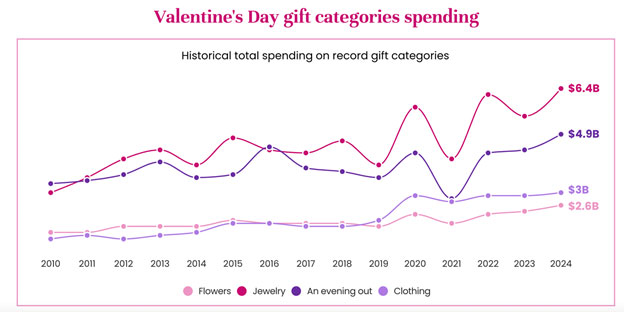
    In the United States, consumers plan to spend $25.8 billion on Valentine’s Day this year – an average of $185.81 per person. A 2023 Assocham report estimates the Indian Valentine’s Day market to be worth ₹25,000 crore, while the flower market around Valentine’s Day is estimated at about ₹500 crore.

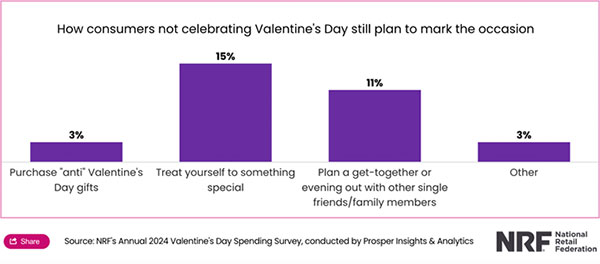
    Source: National Retail Federation, 2024

    While couples spending on jewellery, flowers, clothes and romantic dinners drive the lion’s share of that consumption, non-romantic celebrations are a growing trend across the world.

    A remarkable evolution of the target audience is apparent in the diverse celebrations associated with Valentine’s Day. Celebrations are now about various kinds of relationships, including friendships, family bonds, self-love, and even expressions of love for pets.

    Research amongst ‘non-couples’ reveals that people are spending on themselves – which is only to be expected in this age of self-love, getting together with other unattached friends or family members, or even buying ‘anti-Valentine’ gifts.

    These trends are particularly popular among younger consumers.

    Over half (53%) of 18- to 34-year-olds and 42% of 25- to 34-year-olds not celebrating Valentine’s Day still find a way to mark the occasion.

    Crafting campaigns that embrace this diversity resonates with a broader audience, capturing the essence of love in its myriad forms.

    For young women who mark the occasion by treating themselves or throwing a party with single friends, there’s “Galentine’s Day” gift guides from brands like Macy’s, Kay Jewellers and Walmart

    1-800-Flowers emphasises the importance of celebrating friendship, recognising that Valentine’s Day is not limited to romantic relationships.

    Their ad features a heart-warming scene between two friends, as they reflect on the bond they share and how their friendship has evolved over time. The friends engage in a touching conversation, asking each other meaningful questions about their friendship and the impact it has had on their lives.


    DoorDash Self-Love

    Knowing that most other delivery services would cater to traditional couples, delivery app DoorDash put forth a narrative that gave single women permission to enjoy Valentine’s Day to the same extent that couples would. This meant capitalising on the existing narratives around pleasure, passion, and romance that are always front and centre on Valentine’s Day – and tailoring them to single women.

    Since self-love isn’t new, it was important to have a fresh take. Taking self-love literally, the campaign tapped into the 72% of US adults that believe self-pleasuring is a form of “therapy”, and start a conversation that is weirdly taboo: female self-pleasure. Rooting the conversation in destigmatising female self-pleasure, it used the most iconic Valentine’s gift — a bouquet of red roses. The surprise element: The Self Love Bouquet, a bouquet exclusively on DoorDash made of 11 real roses and one Rose, the bestselling female sex-toy of the last five years. In creating the bouquet, DoorDash was able to deliver $6 million worth of flowers – twice as much as in the previous year to a new demographic – single people who don’t purchase flowers on this holiday, selling the stocks out in four days.

    Watch here: https://www.youtube.com/watch?v=f90ORAVPGSc


    My Muse

    In India, sexual wellness brand, MyMuse challenged love’s most well-known ambassador, Cupid, with its campaign, ‘Modern Love Needs Modern Solutions.’

    With Cupid representing age-old societal norms that represent only one right way to love, MyMuse shows how love and people’s expression of it have changed. So, whether it’s choosing your own path, picking your own traditions (old or new), or choosing to settle down or stay single, MyMuse understands that there is no one-size-fits-all in modern love.

    Proposing that “Modern Love Needs Modern Solutions – Cupid doesn’t get it, MyMuse does, the brand is running a campaign showcasing a well-meaning Cupid, who attempts to bring couples together in the name of love, using age-old tricks. As his attempts are rejected by people who prefer to find love and express it in their own way with the help of MyMuse products, Cupid has a complete meltdown and starts questioning his life’s purpose.

    Watch the series here:

    In addition to the films, MyMuse created a Cupid profile and launched a #cancelcupid campaign on LinkedIn, where it leveraged its employees as brand ambassadors.

    https://www.linkedin.com/posts/mymuse-india_cancelcupid-activity-7158445512885452801-J-cG/

    New forms of celebrating relationships notwithstanding, technology is allowing couples in love to experience Valentine’s Day in fresh ways.


    Gaming romance

    Zynga, the game publishing label owned by Take-Two Interactive, is commemorating the season of love with a variety of delightful Valentine’s Day 2024 festivities throughout its array of games.

    On Farmville, FarmVille 3 – Sweet Nothings, Ginny is brimming with enthusiasm for Valentine’s Day, eager to ensure that everyone on the farm feels cherished and included. She has organized a Valentine’s Phone Booth, where individuals can dial their loved ones and traditionally convey their affection. Participants can even win romantic rewards, contributing to making Valentine’s Day truly unforgettable under Ginny’s thoughtful planning.



    Monster Legends is commemorating Valentine’s Day with an uproarious new Era Saga featuring Lovestruck, a playful creature known for stirring up mischief during this festive period. However, Lovestruck isn’t the sole attraction in this season’s array; they’re also unveiling Shakespearante, a romantically reimagined rendition of one of their  beloved characters.



    Dragon City is staging a series of Valentine’s Day-themed events. Players are invited to gather around the campfire to listen to the twisted tale of the new Storyteller Dragon in Part I of the ‘Enemies to Lovers’ Valentine’s event. Participants can aid the new Hanshock and Gretackle dragons in piecing together this ancient narrative by unlocking storybooks filled with rewards and restoring honour to their families in Part II, ‘Sweet Revenge.’



    Cadbury Dairy Milk Silk – AI Stories

    Cadbury Dairy Milk Silk, the chocolate brand from Mondelez India, plays cupid once again to highlight love stories around us. This year, the brand brings an experience that allows couples to transform everyday moments of love into cinematic experiences, powered by generative AI and filmmaker Zoya Akhtar.

    Consumers can scan the QR code on Cadbury Dairy Milk Silk packs, leading them to a site where they will need to answer some questions that will help in curating their love stories with personalised avatars, which will be featured in the animated movie. The AI converts simple text input from the consumer into lovable character animations featuring the consumer.

    These AI-curated stories will be amplified through strategic media partnerships and personalised content collaborations with leading OTT and music platforms, as well as brand experience zones. Riding on the ultimate goal of making every couple’s Bollywood dream come true, selected videos from the campaign will be featured on the streaming platform Disney+Hotstar, allowing consumers to share their love stories with a wider audience.

    Watch the launch video here: https://www.youtube.com/watch?v=8FMhNiKYdOw


    Bumble

    Bumble, the dating app, is celebrating Lunar New Year and Valentine’s Day in Singapore by launching a new campaign called “Toss Love into the New Year”. The campaign is inspired by the traditional and iconic “Prosperity Toss” or Lo Hei and aims to help Singaporean singles cast out their dating fatigue and manifest a more prosperous love life.

    As part of the campaign, Bumble is giving away a curated exclusive ‘Lo Hei’ pack filled with eight goodies, such as fish ball crackers, Hershey’s kisses chocolates, and salted egg fish skin from Golden Duck. Each goodie represents Bumble’s eight mantras to manifest a prosperous love life, such as “Everything starts with a belief”, “I take control, love will unroll”, “Healing on the inside, beaming on the outside” and “I’m always real, authenticity is the deal”.

    The first 200 users of the app can get the pack on a first-come-first-serve basis. Bumble’s partners in the campaign are Singaporean influencer and content creator Saffron Sharpe and Feng Shui expert and TikTok creator Cliff Tan. Sharpe is featured in a video explaining the meaning of the eight mantras and setting up Bumble’s ‘Lo Hei’ pack. She also provides tips on rearranging one’s personal space to invite love back into their lives.

    Watch here: https://www.youtube.com/watch?v=OniSUjjTiV8

    Something to be inspired by when planning your next Valentine’s Day activation?

    Kunal Sinha is a senior strategy and foresights executive based in Jakarta, Indonesia. He is the author of several books including The Future of India’s Rural Markets and Raw – Pervasive Creativity in Asia. He writes for MxMIndia every other Monday. His views here are personal.

    [1] NRF and Prosper Insights & Analytics, 2024

    [1] https://startuptalky.com/valentines-day-india-economy/

  • Copy that!


    By Kunal Sinha


    Kunal SinhaIn the late 1990s, I visited countless haats across India with my colleagues, understanding the rural residents’ shopping behaviour, helping develop strategies to engage and convince them.


    On those trips, we chanced across a plethora of copycat brands. Funny & Lovely, Fairy & Lovely fairness creams, Polands cream and talcum powder, Dafur and Babur Dant Manjan, Nise and Pearl biscuits. With their limited ability to read the English alphabet, villagers looked at the brand’s logo as the visual ID, because the rest of the packaging was pretty identical to the original brand.


    The makers of these copycat brands were small, local entrepreneurs, riding on the popularity of brands that enjoyed high equity and trust, and out to make a quick buck. They were hard to track down.


    Nearly three decades later, we are witnessing an upsurge of brands that have no qualms about capitalising on the equity of market leaders. The difference: these are brands owned and introduced to the market by well-established, reputable companies.


    One need not travel to a small town or village to find many of these brands. They are available both online and your neighbouring Star Bazaar. Not only that, the placement on the shelf is right next to the original brand. How brazen could that be?
     

    Tata’s Skye range is astonishingly similar to several brands which are leaders in their categories. The coconut oil has the same bottle shape and colour, identical product description as Marico’s Parachute. The mnemonics of coconut palms and half coconut have been integrated into one visual, as opposed to separate for Parachute. Small mercies.


    For its glycerine soap range, Tata Skye turns to HUL’s Pears for inspiration. Again, similar colour schemes – white and green / orange are used, and the soap bar is prominently pictured on the pack. The price? Rs 231 for Pears Aloe Vera vs Rs 117 for the Tata Skye version; Rs 202 for the Pure and Gentle version vs Rs 129 for Tata’s glycerine soap. All these for a pack of three.


    Now imagine a budget-stretched couple in Dum Dum or Govindpuri doing their weekend shopping. For them, there is no better assurance than seeing the words ‘A TATA Product’ emblazoned on the label. With such a significant price benefit, which brand do you think they would pick up?


    Let’s look at another popular brand – Mondelez’s popular Oreo cookies, which became a runaway success in the Indian market since its launch.


    In 2020, Parle, by far a much bigger maker of biscuits and cookies, decided to launch a chocolate-vanilla cream cookie by the brand name FAB!O, with identical packaging. Mondelez took Parle to court, and the latter was forced to withdraw its product from the market.


    That judgment did not deter another leading CPG company – ITC Foods, from creating and selling its own chocolate-cream cookie, Sunfeast Dark Fantasy Vanilla Crème. As it branched out into chocolates, the packaging and advertising for Candyman Fantastik makes no apologies about borrowing from Cadbury’s colour codes.


    So, what’s with this penchant for copying? And does the adoption of these practices by market-leading companies give copying legitimacy?


    Let’s put it down to lazy marketing and short-termism.


    When marketers see a competitor do well, the easiest trick in the world is to say, “Let’s do what makes them successful! There’s already a model in place, and if we adopt it, we’ll be able to make money quickly.”


    According to Sabeer Bhatia, founder of Hotmail, speaking at a Nasscom event, “90 per cent of the innovation industry is copycat in India, there is nothing new.”


    It’s a refrain one keeps hearing in the agency world. The client asking “Can you give me something new, innovative?” Upon being presented a bunch of new ideas, they’ll respond by saying, “Can you show me examples of how this has worked?”


    Google might be phasing out cookies, but in business it is still a cookie-cutter world!


    Kunal Sinha is a senior strategy and foresights executive based in Jakarta, Indonesia. He is the author of several books including The Future of India’s Rural Markets and Raw – Pervasive Creativity in Asia. He writes for MxMIndia every other Monday. His views here are personal.