
By Prabhakar Mundkur
No doubt people’s attention the entire week was focused on Nirav Modi.  While the finance experts tried to unravel the mysteries of the scam and the LOUs, the marketing and advertising experts argued on what would happen to the brand.In retrospect, the diamantaire extraordinaire might have made the mistake of using his personal name as a brand. It has certainly pointed out to marketing experts that brands like Kingfisher, Satyam etc. which also went through a scam were perhaps less affected because the brand name was not connected to the alleged scamster. The Nirav Modi case is different because every time you mentioned “Nirav Modi†the brand name was being dragged through mud. We might have been more forgiving if the owner of the brand was an accused but called John Smith to make a point. That way the Nirav Modi brand could have lived on.
 By Nirav Modi’s own admission in a letter to the PNB Chairman he is reported to have said: “In the anxiety to recover your dues immediately, despite my offer (on February 13, a day before the public announcement, and on February15) your actions have destroyed my brand and the business and have now restricted your ability to recover all the dues leaving a trail of unpaid debts”.
That now leaves one option were Nirav Modi to consider getting into business again. He would need to think of a new brand but where he is only the designer. Unless of course the brand gets suitably exonerated, through legal battles with the CBI and PNB.
Zee’s Social Media Experiment mysonikudi.com
In a world where people still believe that communication has to be hard-hitting and that normally means that you spend a lot of money trying to hammer a message into people’s heads, it was refreshing to see the Zee campaign for mysonikudi.com
They followed the Stimulus-Response approach which evangelised that if you want someone to believe something, you don’t just hammer that message into their heads. So, for example, if I want you to believe that I am a funny man, I don’t show you my certificates in humour and shout at you loudly that I am a funny man. Because you might well not believe me.  Instead I tell you a joke, and then your response is that I am funny.
Mysonikudi followed this approach when they got Gul Panag to tweet about a make-believe website called sonikudi.com which projected itself as a portal which provided customised brides like Wonder Chef’, ‘Bachat Focused’, ‘Agyakari’, ‘Gharelu’, and ‘Sansakari’.
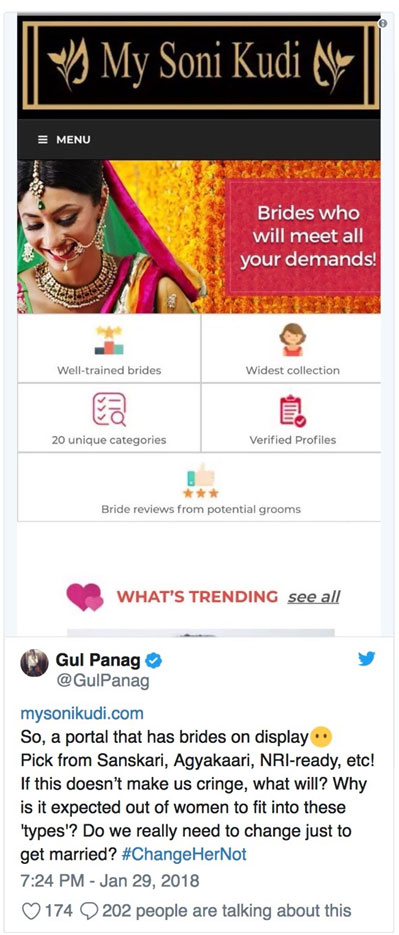
Gul Panag #changehernot hashtag was trending in no time and it drew the ire of the public at large making the campaign a great success. Â The fake website I believe drew over 3000 eager beaver husbands-to-be putting in their preferences for the stereotypical housewives offered on the website.
Yahoo advertises for India
These days in drawing room conversations with my daughter’s friends, they say: “Uncle, we are no longer on Facebook, we are on Instagramâ€. While I am still trying to grope around with a theory that would explain this millennial behaviour they add fuel to the fire by telling me that Facebook is only for older people. That really makes me feel really old. In the last months, I had almost come to the conclusion that Facebook was for old dads and grandads. And that Instagram was for all the young happening people. Of course I thought being an ad guy that this was a clever strategy by Facebook to differentiate between the users of Facebook and Instagram since they own both platforms.
And now there is this campaign called “Live to Love†by Facebook that says all my thinking is wrong. For one its shows young people (read millennials ) and it also shows old people like me. Here are sample commercials for both Neha the young doctor, and Sunny the 58 year old portly businessman.
While the campaign does look like a strategy planner wrote a very detailed brief that eulogised about the target group and the creative just decided to translate it into a film, the campaign does what every mass marketer is known to do. Talk to everybody, both young and old. Which, somehow goes against the the tenets of positioning and targeting. But I guess when you have 217 million users in India and those users are a pretty amorphous lot, you don’t have too many choices.
In any case, the campaign does two jobs: it reassures me that not only old people use Facebook. And it reassures younger people that they need not shun it and go to Instagram. If that is what Mark Zuckerberg wants in this second largest market the campaign perhaps meets the objective.
PrabhakarMundkur is an ad industry veteran who is now a prolific commentator on LinkedIn and his own website – prabhakarmundkur.com. The views here are personal