Category: PRABHAKAR MUNDKUR

  • Prabhakar Mundkur | Bay99: Collective Spaces means Collective Intelligence

    By Prabhakar Mundkur


    Bay99, the new WPP campus in Mumbai, is a wee bit late considering that they have opened the WPP campuses in all the major cities of the world like Amsterdam, Hamburg, Lisbon, London, Madrid, Milan Bogota, Mexico City, Sao Paolo not to mention all the North American cities including New York and Chicago.


    All credit of course for creating a collective space called the WPP Campus must rightfully go its founder Sir Martin Sorrell. Sir Martin had been doggedly pursuing the idea of a horizontal offering for at least ten years now.  Having been a holding group that acquired various pieces of business over the years, Sir Martin abhorred the idea of vertical silos that often became the primary enemy of agency companies, defeating all efforts of consolidation and cooperation.

     

    Technology and the internet have in many ways spoilt us. Because it made us believe that the solution to getting everybody to work together was IT infrastructure, intranets and cloud-based file sharing systems.  But there is nothing better than working out of the same space to create true cooperation and collaboration amongst companies. Collective intelligence is not a problem unfortunately that only technology can fix.


    What might have been the trigger for creating common working spaces for WPP companies? Certainly, on one hand client demands for better consolidation because clients wanted to take advantage of the scale of WPP.  But also, because there is a constant demand for coordination between the different companies and the parent group.  Sorrell once said “WPP’s 205000+ individual brains represent the planets greatest store of marketing services insight, expertise, creativity and experience.”


    So Bay99 represents the collective intelligence of the WPP companies in Mumbai.  The companies of course might have to think a little differently.  For years Ogilvy, JWT, and other agencies in the WPP group saw each other as competition.  Now they might have to see each other as collaborators when they meet each other in the elevator every morning.  Not an easy task but they better get used to it.

     

    WPP Mumbai HQ
    The lounge area at Bay99, the all-new WPP headquarters in Mumbai. Source: Twitter

    Bay99 is an interesting name.  Firstly it brings back memories of Bombay, and of course the 99 for old city dwellers gives an approximate indication of its location.  WPP’s objective has always been to be the anchor tenants on a piece of property. And so, it will be the anchor tenant with Bay99.  Situated within The Orb, a brand-new complex next to the international airport in the Sahar area, the location offers various amenities, including convenient transport and social options. The Orb complex will also offer more than 40 dining and entertainment options within walking distance for staff to enjoy.


    In a first for WPP’s India offices, the co-location will bring together more than 16 companies under one roof, with a space of 380,000 square feet over a 10-year lease.


    Bay99 then will be the best manifestation of the horizontality mantra first made famous by Sorrell.


  • Prabhakar Mundkur: Remembering Alyque


    By Prabhakar Mundkur


    Thou know’st ’tis common; all that lives must die,
    Passing through nature to eternity.

    — Hamlet, William Shakespeare


    When I first met Alyque back in 1976, I felt so exhilarated after meeting him for a musical part in “Man of la Mancha” (the screen version had Peter O’Toole and Sophia Loren )  that I regretted having declined his offer for a part in Jesus Christ Superstar a few years before.  But graduate studies had taken precedence.  He was tall and towering physically, just like his personality and reputation. A slight hunch made him look distinctive. It was the kind of hunch that tall people develop when they are young, when they want to compensate for their height and want to appear a little shorter, to make other people more comfortable.


    I was immediately taken up by this enormous personality and talent.  But talent alone can’t take you places. Alyque was extremely committed to whatever he was doing and for a creative person surprisingly organised.  For example, he would be constantly be making notes during our rehearsals with a small pad that was parked in the small of his back. Whenever he thought of something, he would pull out that note pad and make some furious notes, which he would recall in detail later.

    Like most stars, Alyque created volumes of folklore around him, typical of great personalities.   Even if you never worked in Lintas, any advertising person who worked during that time, would regale you with stories of God (as Alyque was affectionately and appropriately known) and Pope (his secretary whose real name was Jenny Pope).  They were all very funny and you couldn’t help a guffaw after hearing the punchline in the end.

    But it was not just people who worked with him that looked upon him with great respect. I worked at a competitive ad agency and although Alyque was the main competition, I daresay we were all overawed by him.  Seeing him at a pitch, for example made me terribly nervous.  Because in many ways, it was not just his advertising talent and creativity that had to be overcome but his personality and his showmanship.  Clients were equally awed by him. Somehow, I could imagine clients just eating out of his hands while we would go through several iterations of a creative idea until it was too dumb to produce.  I don’t think anyone would dare to argue with his advertising judgment. In fact, I was often asked by clients a rather uncomfortable question, “Who is the equivalent of Alyque in your agency?” I did not have a ready answer in spite of having painstaking pondered over it. In an era when suits became CEOs, after plodding for several years, Alyque proved that it was easy for a creative person to head an agency, something that is more fashionable today. What struck me most about him was that he was a perfectionist.  He was never happy with anything less than the best. Every imperfection made him angry and sometimes it was followed by string of expletives.

    He created many famous campaigns but perhaps some stood out more than others in public memory.  For example, the entire Liril campaign became the most talked about in the 80s and so did the Lalitaji campaign for Surf. Also, the first campaign for Kama Sutra condoms, which made a few waves in an India that was just coming out of the closet at that time and of course Cherry Blossom, Hamara Bajaj and many others.   He once grudgingly admitted that Lalitaji was inspired by his own mother who has a building named after her called Kulsum Terraces, the family home on Walton Road, a sleepy little lane in Colaba.  This was also where we rehearsed most of Alyque’s plays for the Theatre Group in the 70s.

    Alyque belonged truly to the Bombay of yore, so vastly different from the Mumbai we know now. When he spoke about the past, he would recall going to Olympia on Colaba Causeway for a ‘chai’ with Sylvester DaCunha because he was stressed out about something.  It somehow brought back images of an old Bombay flooding to your mind, with a young Alyque and a young Sylvester.

    About ten years ago we met at a party.  He was doing readings from Shakespeare then.  So, I couldn’t but help mention that Shakespeare wrote in Iambic Pentametre which is the same metre that the ‘blues’ is written in. He wouldn’t believe me.  So, I had to tell him that it was not my theory, but I had picked it up from none other than Leonard Bernstein, the famous American composer and musician in his speech on the “History of Jazz”.  Forever curious, Alyque invited me to his home for a demonstration of how Shakespeare could be sung to the blues. He found it remarkable and immediately ended his Shakespeare shows with a famous soliloquy sung to the blues, roping me in to accompany him on the guitar.

    Alyque was not just a star. He was an icon both for the advertising and the theatre industry.  And he showed us all that true creativity and leadership was multi-dimensional. Most people were shattered when they heard the news of his passing away on Saturday. Somehow, he had lulled all of us into thinking he was immortal.


  • Prabhakar Mundkur: What Clients Want

    By Prabhakar Mundkur


    The advertising and communications industry seem to be to shuffling its toes in the search for a new business mission and orientation to meet the demands of a business that has shoved them into obsolescence.


    One of the phrases doing the rounds is reorienting themselves to “what clients want”.  In a sense, the business was always about what clients want, but the day we forgot “what clients need “is what marked the downfall of the ad industry.  Clients wanted separate media. So, we separated it. Clients wanted exclusive agency units for their own business, so we created them.  Often they didn’t know what was good for them.


    We forget that the day we forgot what clients really need we became the servile partners in this business relationship.  When Bill Bernbach wrote the famous Volkswagen campaign, he gave them what the client really needed to make Volkswagen a great car in the USA.  You might think it is a small semantic difference but it is not because it changes the way you look at things.


    And I think that is the crucial difference between agencies and consultants.   Consultants see what clients really need, not only they want. If we just give clients what they want there will never be a sense of expectation and surprise! We will just be a supplier of goods made to specifications. We will never go beyond the ordinary.  We will never push ourselves.  Of course, in my own experience clients don’t really always know what they want either. They wait for us to show them the way.  If we don’t, we have added no value in the relationship.


    In our tearing hurry to reorient ourselves perhaps it is also worth giving a new name for our industry.  We are not agencies or agents, anymore are we?  Or do we still we think we are?  The meaning of agent is “a person who acts on behalf of another person or group”. It somehow seems to suggest that the product has no value added and the compensation will be a commission, something that died in the advertising industry a long time ago.


    The other confusion seems to be on how to define the business.  Is it creative transformation or business transformation or digital transformation as some communication groups are already claiming or is it some other kind of transformation we are seeking for our clients?  I believe WPP has already banned the use of the word digital internally.  Incidentally, is this what clients want? I hope so.  If we won’t really want to use the word digital, well that is fine, but what else do we want to say.


    When Wunderman announced its merger with JWT, I went to the Wunderman website, and found that their case studies looked like ad agency case studies compartmentalized into the 3 terse and all too familiar buckets: Challenge, Work and Results. I thought that is what agencies do. I somehow expected a company that prides itself as competing with the consultancy companies and with data and digital capabilities would present itself differently.  But no, Wunderman was imitating an ad agency. They even present a short video of their work in the case study just like another ad agency.  I was left wondering what consulting, data and digital skills had been involved.  I then went to the JWT website and found it many shades better than Wunderman.


    The industry obviously is in a state of flux and in some ways, it might not be the best time to look at it with a microscope.  But one can’t help wondering where all this is headed.


  • Prabhakar Mundkur: The song “Rishta Wahi. Baat Nayi” from Star Plus has an Earworm

    By Prabhakar Mundkur


    Source : youtube.com


    When I first walked into an advertising agency as a student and long before I actually joined advertising I still remember seeing a placard on a copywriter’s desk which read “Is there a new way of saying ‘new improved’ ?”   I was reminded of that when Star Plus unveiled their new logo which certainly looked like a new improved version of their earlier logo.  And I would say the same thing about the line “Rishta Wahi. Baat Nayi” which said it was ‘new improved’ but being careful not to stray away too far from its current positioning as a channel. That’s how I would describe it in plain English.   If you went to a flighty innovation consultant however, he might describe it as ‘incremental innovation’. As opposed to ‘evolutionary’ or ‘revolutionary’.


    Design agencies have a unique language that only they can use.  It is always flowery, poetic and metaphorical.  One press release I read gave the rationale for the new logo as “the trademark red crystal star with the swoosh, now in gold dust signifying positivity, freshness and celebration of relationships.”


    A star cast created the song itself – composed by Ram Sampath and starring Sunidhi Chauhan and Chaandni RMW.  The promo video featured Alia Bhat.


    The song definitely had an ‘earworm’.  An earworm is defined as a catchy piece of music that continually repeats through a person’s mind after it is no longer playing. So I found myself humming the song soon after.  That’s quite an achievement considering most songs and jingles today are like wallpaper.  You hardly notice them.  Or otherwise they are easily forgettable.


    Vistara: 3 agencies in 3 years

    Source: YouTube


    Yes, admittedly relationships are getting shorter.  Both personal and ad agency relationships. But when Vistara announced their third agency partner in three years as FCB Ulka, it came as a bit of a surprise.  For a brand which launched just 3 years ago they seemed to have not done travelled a lot of air miles, they have also done a fair amount of agency miles.  The brand launched with Ogilvy as its partner, then moved to Lowe in August 2016 and now FCB Ulka.


    Its last commercial ‘Fly the new Feeling’ with Deepika Padukone focused on the inflight experience. After all airline marketers will tell you that ‘inflight’ accounts for more than 80% of your overall experience of an airlines.  There was nothing special about the commercial itself barring the fact that Deepika fans could admire her for a whole minute.


    Somehow the Tatas are not known to change agencies every year.  Which is why it is surprising that Vistara is going through a different agency almost every year of its existence.


    Hopefully it is not an indication of the average time clients spend with their ad agencies and just a small aberration.


    Dhara Oil #ZaraSaBadlav


    Take a guess. Is India made up of more joint families or more nuclear families?  The debate was settled a long time ago with the 2011 Census which recorded over half of India’s households recorded as nuclear. Unfortunately for marketer’s joint families make up just 16% of all households.  And strangely joint families are thriving in urban areas rather than in rural areas. Because migration to urban areas are creating economic pressures that necessitate living in a joint family.


    But marketers and creative advertising people can’t resist the idea of making another traditional commercial featuring a joint family, trying out the hackneyed theme of mothers and mothers-in-law living with their children.  The other marketers and advertisers who read too many American marketing theories are chasing millennials which by one estimate has 400 million people. And 400 million people is a universe not a segment.  So, it is a challenge to find so many commonalities in such a large universe as easily as the American marketers are doing it.


    But Dhara has decided to go traditional by showing that it is perfectly alright for the girl’s parents to live with her and her in-laws. Wow! That is a huge joint family. Nice message. But only if there were more joint families in the India of today or if joint families were an aspirational view of the future to younger targets.


    I am not quite sure that today’s youngsters are imagining the perfect future together as living with their parents.


  • Prabhakar Mundkur: Millennial Mania

    By Prabhakar Mundkur


    Most Indian marketers seem to have been suddenly overcome by millennial mania.  Maybe it is the sheer amount of American marketing literature pervading our ranks that tries to find commonalities in a large and diverse group of people.  Our first chant for India and its young population somehow excluded the word millennial and settled at the ‘youngest population in the world.’ But that has now finally got converted to millennial mania.  Especially since current statistics show that there might be 400 million of this demographic group in our country.  That by any stretch of imagination is not a segment, it is an entire universe.  And close to a third of our overall population.  Never before in our marketing history have we looked at a third of our population as sharing such a huge number of key characteristics.  After all, it would be a miracle to generalize the attitudes of 400 million people with different incomes, locations, education, living standards, attitudes and behavior.


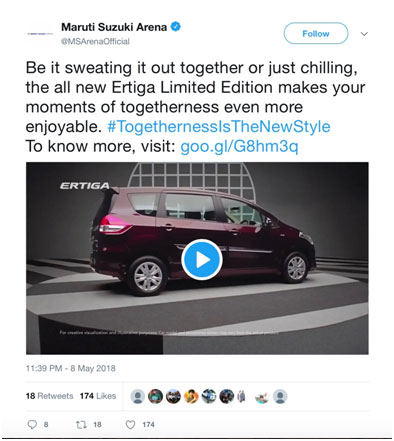
    This has resulted in every marketer trying to attract the so-called ‘millennial’ even for products that earlier might not have been marketed to millennials.  The latest brand to attract my attention was the Maruti Ertiga which I found on twitter.


    By using words like ‘chilling’ no doubt the ad hopes to attract the youth if I may use a less fashionable term.


    And what do millennials do if one were to retrofit the strategy from the creative execution. They chill. They go to the gym.  They go to the office and work sometimes. They have laptops. They go shopping. They get in and out of fashionable clothes all the time. They even go fishing! (I am sure you will agree that’s a rare one for millennials!) They eat together.  They jump together. Hope that sounds like an insightful enough common factor that binds together 400 million millennials in the country.


    Millennials wear denim to work 

    That’s what the new Shopper’s Stop Campaign seems to say.  Maybe we have just hit upon one more deep insight that unifies India’s 400 million millennial population. No wonder I was noticing that all the young BMC workers are wearing denim whilethey repair Mumbai’s roads. Hey, but didn’t this trend start a long time ago?  With non-millennials like Steve Jobs for instance?  But anyway, the trend has just been adopted by Indian millennials who naturally are a little behind the rest of the world, which is understandable.  I believe denims are the uniform of the rebellious. Wait a minute!  Didn’t that American textbook on millennials say that it is the baby boomers who were rebellious?  Millennials are expected to be pro-establishment.  But obviously I am getting confused now.


    I got a few more things about millennials from this commercial. Millennials like to break the glass ceiling and push boundaries.  Wouldn’t you say that is quite a useful insight? Except that I thought everyone likes to break the glass ceiling.


    Hopefully, the viewers of the commercial don’t decide to go and buy Levis or Wrangler or other brands of denim after seeing the commercial.  I am sure there is another hidden quality about the millennials that keeps them glued and loyal to Shopper’s Stop.


    Millennials spray deodorants on their shirts


    If you thought that deodorants were meant to be sprayed on your underarms or on your skin, you are wrong. Not in India.  At first, I thought that Indian men and women were spraying deodorants on their clothes, because they were afraid that deodorants would play tricks with their sweat glands.  But not so. It is a practice encouraged by Indian marketers.  Take this Fogg commercial.


    Certainly, it seems like Fogg has to be sprayed on the shirt rather than on the skin.  Also, it is the shirt that smells nice to the lady in the commercial.  But the ad says nothing about how the man may actually smell were he to take off his shirt.


    That certainly begs two different questions:

    Is it safe to use Indian deodorants/perfumes on the skin or are they meant to be sprayed on your clothes? They say they are body sprays. But perhaps they should say they are shirt sprays.


    Do they work as deodorants or do they work as a perfume?


    Perfumes mask body odour.  Deodorants prevent it.


    Most importantly when you spray your entire shirt with a perfume or deodorant spray, does it stain your clothes?


    And of course, the last question. Are these products only for Indian men?  What are Indian women supposed to do?After all, they are half the millennial population.


  • Prabhakar Mundkur: Not moving people but moving forward with Uber

    By Prabhakar Mundkur


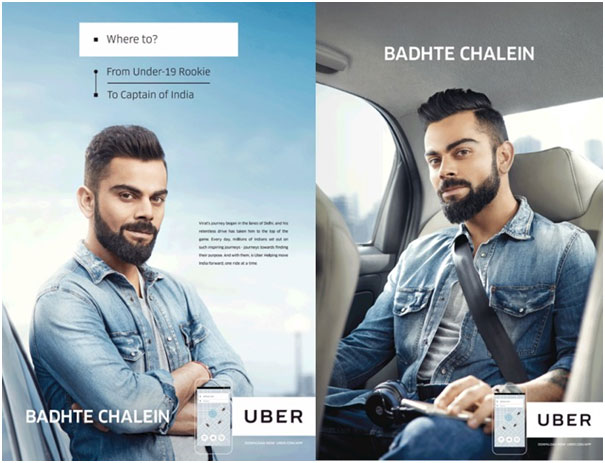
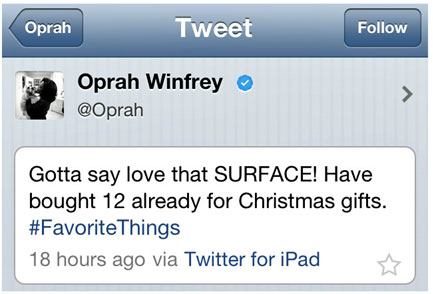
    The most noticeable campaign this week was Uber.  When two full-page ads appear on the cover of the Times of India, you can anticipate a major splash.  Arguments raged on LinkedIn earlier this week whether Virat actually uses Uber. In a more innocent world a few decades ago, we believed that stars actually used the brand they endorsed.  Marketers when questioned gave some hair-brained logic that pretended to be well-researched. They said that there is a ‘willing suspension of disbelief’ amongst consumers.  But social media has changed that.  When a star endorses adevice but the tweet gets sent with another device, consumers know that celebrities are bluffing.


    Karthik S gives two potent examples of how celebrities are cheating on their endorsements in his blog Celebrity Brand Ambassadors and Brand Fidelity.


    The first is of Sania Mirza endorsing One Plus 3T but when you look at her tweet you know it has come from aniphone which is no doubt her device of choice.


    The second example he gives is of Oprah Winfrey endorsing the Surface, but unfortunately you know she is an Apple fan because the tweet was sent out of an Ipad.


    The modern world doesn’t want to believe that celebrities are using the products they endorse.  So, the natural question is why Virat wouldneed to use an Uber, when he would have a fleet of cars and chauffeurs.  And this was the discussion on Linkedin earlier this week.


    So when Sanjay Gupta of Uber announced that Virat uses Uber when he is overseas, it was some consolation that he does use Uber sometimes.  Although what relevance using Uber overseas is to endorsing the brand in India, is quite another debate.


    I quite liked the campaign after watching it a few times, although the poetry that Virat espoused about Uber in the TV commercial neither sounded like him, nor did it sound very sincere.  But the average consumer mightmay well buy it.  When I went to Twitter I found that the hashtag #MovingForward was not very unique, andI found various other non-Uber tweets using it.  It looked like Virat was a spokesperson for the Uber brand wisdom rather than selling the brand.  Although Uber was once upon a time a brand that wasn’t built on advertising, some of its other advertising overseas has been created to elicit a direct action from consumers like signing up for the app. But at least #MovingForward stays close to the global knitting of the brand which is Moving People.


    However, what looked quite sincere was a video I found on YouTube where Virat announces his association with Uber and sounds like Virat and not like someone else.


    Here he sounds honest and sincere, unlike the TV commercial where he has to recite some difficult lines written by a clever copywriter.  The honesty and sincerity with which celebrities endorse brands is an important factor in celebrity-led advertising.


    How much is your award really worth?


    Sometimes giving away an award must go beyond it being a recognition.  There must be a reward.  The Oscar which is plated in 24 carat gold is known to cost $400.  Most other awards are just a giveaway, a notional token to say you won something.  So while you may display them proudly in your office or your home you know they are a worthless piece of metal.


    But the Star TV network seems to have kept this in mind when they designed the Re-imagine Awards that were given away to Swiggy and Fevicol earlier this week.  Also, they seem to have a star-studded jury that included Sir John Hegarty and Piyush Pandey.


    But the most interesting part was how the award was made.  Designed by Peter Layton of London Glass Blowing in Burmendsey, the award itself is a piece of art. Layton uses glass as medium to express art and is putting glass on the world art map.


    In addition there was an all-expenses-paid trip to a major sporting event for  24 members of the top two winning teams. Now that would make the winners really feel they won something of value.


    Maybe a learning for other awards.  Give fewer awards of value rather than hundreds of awards that are worthless metal! 


    Adidas Odds


    It seems like Adidas Odds has been on a winning streak for creative awards around the world for the last two years and its latest recognition came from none other than WARC, when it was shortlisted for the Effective Innovation category.


    Odds was a special edition pair of shoes created by Adidas as a tribute to para-athletes.  It is a pair of shoes with either two lefts or two rights and was first released during the Rio De Janeiro Paralympics in 2016.  It is an outstanding piece of creative developed by Dentsu Taproot that one can watch again and again without getting tired.  That is the true test of great advertising!


  • Prabhakar Mundkur: New Durex campaign struggles with contradictions

    By Prabhakar Mundkur


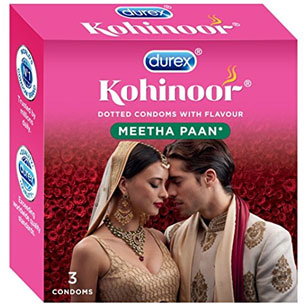
    If you have ever felt a dentist’s glove inside your mouth you know what latex tastes like.  So, one does get the rationale for flavoured condoms for improving the quality of oral sex, even if the flavours might seem a little regressive like kala khatta, and meetha pan.


    But here is the contradiction. Pankaj Duhan, marketing director, RB Health-South Asia told afaqs.com ‘..95 per cent of Indians do not use condoms and we already have a huge population. This is an alarming situation!”If 95% of Indian’s don’t use condoms what is the point of encouraging them to use flavoured condoms for oral sex?  Because oral sex doesn’t make more babies.

     

    The other contradiction I found is that RB says that it is promoting ‘faithful promiscuity’ and yet they have commercials like this one which actually talks about having sex with a stranger.  I thought that it was not socially responsible advertising to be so blatant about promiscuity. Watch this film which is titled “Encounter with a hot stranger”.


    The actual flavoured condom ads I thought were not done tastefully.  But of course you the public can be final jury on this one. If you enjoy sexual innuendos like this one, no doubt RB will be eminently successful.


    You be the judge but I personally found the commercial quite revolting, and I can tell you I am not a prude.


    Horlicks: Much ado about nothing


    When GSK moved their Horlicks brand after 80 years to FCB Ulka mid 2017, it shook up the industry.   One doesn’t see relationships break after 80 years.  It’s like breaking a marriage after 80 years.  There seems little point in doing so.  JWT in its characteristic, quiet style took the blow with dignity and without too much regret.  And now comes the news that Horlicks might be up for sale to finance the GSK buyout of Novartis Nutrition.


    Horlicks has franchise largely in India although it is imported in Australia and New Zealand and is also present in Malaysia and the West Indies.  In the UK, it is a small brand and people drink Horlicks as a night cap.  It is a classic case of an entire category becoming irrelevant, and a lack of category innovation leading to declining sales.  This has affected other food drinks of yesteryears like Complan.


    Once upon a time when nutrition was a problem and milk was inadequate or of low quality in the country, Horlicks played an important role. Parents are no longer open to adding Horlicks to the milk.  They would rather serve their children cereal or muesli. Or just give them plain milk. And nutrition is not as big a concern as it was a few decades ago.


    Suitors to buy the GSK Horlicks brand I believe are many.  The question is what happens to the ad agency FCB Ulka who won this business from JWT with great aplomb last year.  Will the buyer hand over the brand to their trusted agency or carry on with FCB Ulka who has been with Horlicks for just a year now? Alternatively, the buyer could just ask for an agency pitch. Interesting times ahead.


    War of the Babas

    The ayurvedic segment might be hotting up with the launch of the Sri Sri Tattva from Sri Sri Ravishankar.  The commercial however was a bit of a letdown with the hackneyed theme of a ‘just married’ scenario where Sri Sri Tattva products are a wedding gift.  But then it is not advertising that is creating this category, it is the product and the ayurvedic positioning.


    While the expectation was that Sri Sri Tattva might consider premium pricing, the 1 litre desi ghee pack on bigbasket.com showed that Sri Tattva was priced at Rs 530 while Patanjali’s desi ghee was priced at Rs 500.


    It would be interesting to see if the babas might just compete with each other or the MNCs.


    A good brand can take bad advertising


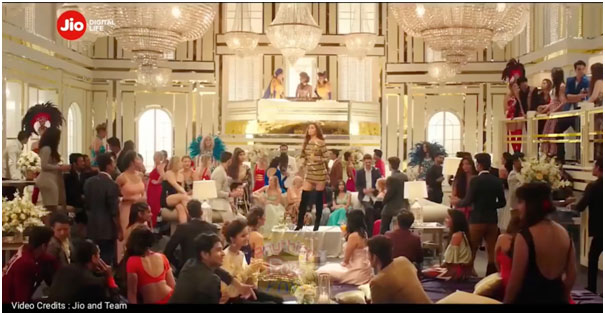
    While Jio has to be admired as an innovator who disrupted the mobile telephony category, its advertising seems to challenge every rule in the book.  One is left with fleeing images of people singing and dancing with well-known Bollywood stars and a sprinkling of East European models. The merriment then ends with a pack shot on Jio Digital Life.  If one were to guess the advertising brief backwards, one would say that someone said “let us be remembered as Dhan Dhana Dhan”. The rest might have been put together by a writer and director of dubious distinction.


    Jio certainly proves one thing. That a good product can survive atrocious advertising.


  • Prabhakar Mundkur: Will Kyoorius upstage the Abbys as an award show?

    By Prabhakar Mundkur


    The Kyoorius Awards have been steadily gaining steam over the years.  Abbys on the other hand has been under a cloud the last many years for plagiarism, scam ads created only for the awards, and a boycott from several agencies that seem to grow year after year.


    Most award shows these days position themselves both as a learning/knowledge forum and an awards night to celebrate the and acknowledge the winners.  Zee Melt, the two-dayprogramme on May 30-31 that precedes the KyooriusAwards night on June 1, promises some of the world’s best speakers from Fernando Machado, Head of Brand Marketing, Burger King to Chuck Porter, Chairman CP+B demonstrating that there will be a lot of knowledge sharing at the event.   But there has been an indifferent demand for these knowledge sessions thus far. Is it our new-found and emergingnationalism that makes us feel superior to everybody else in the world, and our attitude of ‘what do we have to learn from them’? Followed by the oft repeated chorus ‘India is different’.  Or are people just tired of listening to experts on advertising and marketing because there are too many of them, one is not sure.


     

    The jury is selected together with the One Club for Creativity and has the top creatives from across the world.The Kyoorius awards differ from the Abbys in that instead of awarding gold, silver and bronze all winners get a Blue Elephant.


    They jury base their decisions on three criteria:

    – An original and inspiring idea

    – Well executed

    – Relevant to its extent


    The non-profit objective of Kyoorius certainly gives it a ‘halo’ over other awards.  It does seem like they are doing something right.


    RoohAfza goes Retro


    RoohAfza was launched in 1906, by Hakkem Hafiz Abdul Majeed in Ghaziabad. But if you think this is a really old summer drink have a second guess.  Pepsi was launched at least 8 years before RoohAfza in 1898.  And while Pepsi has kept up the challenge of staying contemporary forover a 100 years, Roof Afza seems quite content on revealing its age.  A few years ago, the brand tried to modernize and stay relevant but their latest commercial clearly takes them back into their own past.


    And if the imagery is old fashioned it is supported by the jingle which has lyrics set to the tune of the 1956 classic YehDil Hai Mushkil clearly taking Roof Afzafirmly into the past.


    If their source of business is carbonated drinks the brand has a challenge to appeal to the youth of this country with its old-fashioned imagery.


    Nirma – Still the challenger brand but in a new category

    The debate on brand extensions and whether it will be a failure or success has engaged marketers and academics alike for the last many decades.  The traditional Western model of brand extension theory we all know does not hold. After all which theorist would have said that a shipbuilding brand would produce the one of  world’s most popular car brands in Hyundai.  Or that a well-known consumer durables like LG could also produce a shampoo successfully?

    When Harley Davidson launched apparel and ornaments  the company may have lost focus. In the 1990s, it extended the brand too far. It introduced products like wine coolers, aftershave and perfumes. I guess it’s important to understand that every brand has its stretch limit, even a great cult brand like Harley. For example Harley Davidson found its stretch limit when it introduced a perfume.  For most people the only smells associated with the  Harley brand were sweat and petrol, so I am not surprised the Harley perfume failed.

    Nirma on the other hand, did the wise thing when they entered the cement category.  They knew they could not stretch the Nirma brand indefinitely to cement, which is why they wisely entered with a new company brand  called Nuvocon. In 2016, the Nirma Group acquired the assets of Lafarge, giving them access to the use of their two brand names Duraguard and Concreto.  This year Nuvoco has got ambitious by sponsoring the Royal Challengers Bangalore team for the current IPL.

    Will Nuvoco be able to dislodge the top brands in the cement category like ACC, Ambuja, Binani, Birla and Ultra Tech?  Well, the Nirma group is used to proving themselves as a challenger brand so they might well repeat their earlier success now in the cement category.


  • Prabhakar Mundkur: Shouldn’t Creative Directors Run Award Shows?

    By Prabhakar Mundkur


    When I read about Sonal Dabral’s appointment on the board of the One Club of Creativity, I couldn’t help going to their website to see who the other board members were.  It was no surprise that all the members were creative heads of agencies.  Then I decided to visit the D&AD website. Again, no surprise. All the board members were creative directors.


    Which raises an important question.  Should award shows be run by a bunch of suits?  Who have never written an ad in their entire life?  After all, award shows celebrate creativity so it is natural that the people who run an award show must be creative.So, is relegating creative people for just ‘jury duty’ paying lip service to the creative community?


    I asked one industry friend why suits might be running some award shows.  He said that advertising clubs were a business, and they needed to be run by managers, not creative people.  Now that doesn’t make any sense at all. Considering that most agencies in the country or the significant ones are being run by creative people rather than suits. But there could be another reason why creative people are not as prominent as they should be at local award shows.  That they are not interested in doing anything beyond jury duty and would rather leave all rest of the dirty work for the suits to take care of.  This however begs the question why they are willing to accept prominent positions on the boards of international awards, but not local awards.  Are the local awards too infra dig? Or is there some other problem?


    There could be a third reason why creative people are not given much prominence beyond jury duty in an award show.  This is an old argument where suits and CMOs feel that they contribute equally to the creative process, so it is not out of place for them to be in charge of the awards. This argument is a bit contentious.  CMOs should be heading the marketing award shows or at the most the Effies if they want to be still involved so deeply in advertising industry bodies, and suits should be heading the industry associations which are involved in the business of advertising.  Why are they in prominent positions in the creative award shows?  No clear and convincing answer emerges after examining all the alternative arguments.


    At the end of the day, most award shows need event management skills more than anything else.  No surprise then that the Cannes Lions is run by Ascential Events.  Cannes is a unique business model where 42% of the revenue comes from delegate passes, 41% from award entries, 15% from partnership and digital, and 2% from hotel room booking commissions.A model worth emulating for any award show – where the revenues from award entries and delegate passes is almost equal.


    Commonsense says that in the long term no award show can be really successful without roping in creative people as front runners of an award show.


    What? Yet another self-appointed Industry Body?


    If you can’t beat them, join them.If we didn’t have enough self-appointed industry bodies, whose members largely get self-elected year after year to their positions, we now have one more industry body called FEUD. (Forum for Ethical Use of Data). Formed by media professionals, one is not sure how they would detect the ethical or unethical use of data.  After all, the most qualified technology professionals and data experts were not able to bring to our notice how FB and Cambridge Analytica were exploiting personal data.  The use of data is a complex technological web that takes shrewd tech minds to figure out how data is being misused.  If the Congressional hearings of Mark Zuckerberg are anything to go by, even he didn’t have answers to all the questions posed by the Congressional Committee.


    Also, for an industry body to have teeth, it needs some recognition from the users and collectors of data, and some nod from a government body.  Take the reported misuse of Aadhar data. It is a few sting operations from brave journalists and experts like Ed Snowden who brought to our notice how that data base is potentially being mis-used. Snowden has the unique distinction of both being a computer professional and an ex-CIA employee.


    One would have rather seen a government body say headed by a person of Nandan Nilekani’s stature who understands the business of technology and data, or an industry group like NASSCOM to initiate a body for the ethical use of data. The other option could have been a self-regulatory body formed by companies who are sitting on tons of data, i.e. banks, telecom companies, Facebook and other social media companies and Google which dominates the Indian internet ecosystem. One can’t help wishing that a body like this could have been formed by more solid, powerful and competent authorities on the subject of data.


    Lastly, to enforce ethical use of data, legislation is imperative.  Currently India does not have any express legislation governing data protection or privacy.  The European Union’s GDPR ( General Data Protection Regulation ) which will become effective on May 25 will be one of the most wide-ranging and comprehensive pieces of legislation enacted to protect consumer data.Under GDPR, information such as customer IP addresses and even web cookies will be subject to the same strict security standards as physical addresses and social security numbers.


    Unfortunately, in India the relevant laws on data protection are currently bundled under the Information Technology Act 2000.   There is no doubt the objective of FEUD is honorable, so this space is worth watching with interest.

  • Prabhakar Mundkur: Is Client Service getting Extinct?

    By Prabhakar Mundkur


    Last week, when Mark Pritchard of P&G said“I’d like creatives to account for three quarters of an ad agencies’ resources”,he might have delivered a telling blow to one of the mainstays of the advertising agency – the client service department.  Globally and in India, creatives have been increasingly playing a more important role than any other department in delivering client satisfaction.  This is partly because the end-product of the agency is creative, so it does make sense that they are the crucial part of the delivery system.


    Almost simultaneously, the quality of client service has been in steady decline. Agencies once upon a time, queued up at the IIMs in India in the late ’80s and early ’90s to compete with the global FMCG players and recruited the best young brains in the country at competitive prices with the rest of the industries.  But alas, no more.  I remember that JWT used to take 50-60 new recruits into the system every year.  Decreasing margins and because advertising might have lost its sheen with young MBAs, ad agencies are no longer in demand on campuses today.  So, it is no surprise that the quality of client service is no longer what it used to be.


    But Marc Pritchard’s statements has its faults.  Agencies have for too long tried to mirror the hierarchies of the client’s marketing department.  This means that you need a mirror image of the brand manager, the marketing manager, the marketing director etc. in the ad agency’s client service structure.  And to their credit, client service does a lot of the dirty work on the account that is often invisible but plays its part.  Also, if creatives spend too much time on meetings, as clients often want them to, it is likely they will never have the time to actually do the creative.  In my experience, a number of clients are operationally heavy and often client service does the dirty work ungrudgingly.  But as more and more clients express their reliance on creative, client service might need to find a new reason to justify their presence on the business.


    Either way, the Marc Pritchard statement is a warning bell to client service people all over the world.  They need to redefine their existence and contribution on a client’s business.


    India Tourism and the Land of Yoga

    Incredible India rolled out its latest film positioning the country as the land of yoga.  Didn’t know that?  Surprised?


    I am sure no one in the world really doubts that yoga was born in India although to date it does seem like our most popular export. Unfortunately, in the world of intellectual property rights, India no longer owns yoga.  There are probably more yoga practitioners and yoga classes in the rest of the world than there are in India. With the UN having adopted Yoga Day, and Prime Minister Narendra Modi’s personal effort in promoting yoga, the new film does seem like a bit of wet blanket and the least impressive in the long series of Incredible India ads.


    The film released on March 7, 2018 seems to be languishing at under 10k views on YouTube.  No surprise.


    #AllBeginsWithBlack by Raymond

    This new TVC had everyone complimenting Raymond for their brave gesture of using visually impaired Canadian singer and writer Jugpreet Singh Bajwa as the hero of the film to give his interpretations of black for the new collection of fabrics. Advertising has been using differently abled people in their commercials for a while now.  Bajwa recites some slam poetry which goes like this:‘Black is a like a silence that everyone can feel. When it finally speaks it deafens the world with its powerful words. It’s time to unravel.


    While slam poetry might have a limited audience in India, I found the tone of the commercial very un-Raymond like. But that is perhaps because when I think of Raymond’s brand I think of their signature tune which was Traumerei from Kinderszenen Op 15 by Schumann. Languorous images of an idyllic world.  Beautiful musical phrasing by Schuman. This piece of music was played by radio stations at the end of World War II.  Listen to Horowitz playing it in Moscow to see how it moves you.


    This commercial to me was therefore a departure from Raymond’s brand personality and the harsh tone of both the visuals and the music got me quite disturbed.


    So, while the colour was about black fine fabrics, I felt there was no need to make the commercial like it belonged to the film noir genre. Because film noir is marked by a certain inherent fatalism and pessimism.   But that’s my opinion. Hope the commercial works for Raymond.


  • Prabhakar Mundkur: Ad Agencies no longer need Creative Chiefs!

    Prabhakar Mundkur

    By Prabhakar Mundkur


    Or so it seems if you want to follow in the footsteps of the oldest agency in the world, JWT, which has been in the advertising business for 154 years ever since it first started doing magazine advertising in 1864.


    Tamara Ingram CEO, JWT sent this memo to the agency when Matt Eastwood their global Chief Creative officer resigned earlier this month.  The memo from Tamara which was released by AdWeek went as follows:


    Everyone,


    I’m writing to share the news that Matt Eastwood, Worldwide Chief Creative Officer, has exited J. Walter Thompson to pursue a new adventure. We thank him for his contributions and wish him continued success in his future endeavors.


    We are reimagining the future of the agency. This is a structural decision that will allow us to be more agile, leverage our collective global bench strength and encourage the burgeoning diverse ‘maker culture’ growing within J. Walter Thompson. As such, we have no plans to replace the role.


    Creativity remains at the very core of our business, but today it is an even more collaborative process. It is borderless. It is broadly focused. We are increasingly relying on the people who are closest to making and creating the work. And, we are re-imagining the future of how this shift will be reflected within our organization and our leadership structure.


    The Worldwide Creative Council will evolve to better reflect the needs of the agency. It will continue to be a pivotal part of our organization internally and set standards and practices for how we improve the quality of our work. And, there will be a fluid roster of talented individuals with myriad skill sets.


    Additional strategic changes will include the use of technology to evaluate creative concepts at a much earlier stage. This will allow us to be iterative in real time and to ensure we are evolving our work to be stronger, more innovative and have a greater impact on our clients’ business.


    I am committed to protecting, supporting and developing the creative community and culture within JWT. I am looking forward to sharing more specific information soon. For now, it’s business as usual and we will keep the trains running as we head into Cannes.


    Tam


    What does this mean for the creative community as a whole?  Creatives the world over were enraged and showed their support for Matt.  In addition, JWT proved that it doesn’t really want to be a creative agency which has always been its nemesis.  Considered old, stodgy and uncreative, JWT might well have Commodore J Walter Thompson, the founder of the agency, turning in his grave.


    Coming on the heels of Marc Pritchard saying that he would like to see three quarters of the agency resources to be creative, the move from JWT saying that they are going to eliminate the job of the Chief Creative Officer, comes as a mighty surprise.  That they might want to challenge the current status quoin the advertising industry with planners and client service.


    Plagiarism crosses borders

    Finally, plagiarism has come up in the news because it can now cross borders more easily than people do. So, when Pakistan’s beauty brand Olivia did a complete lift of a Godrej BBlunt TVC of three years ago, India stood aghast. It had implications both for the advertiser and the celebrity in this case who was Kareena Kapoor.


    The Olivia Intence TVC


    The BBlunt TVC from Godrej


    If that were not enough, a MalaikaArora ad that had also plagiarised seems to have popped up.

    I am sure that theblatant attempt to copy something across international borders must have sent the IP lawyer community into a tizzy!


    Consumers are being manipulated not just Governments

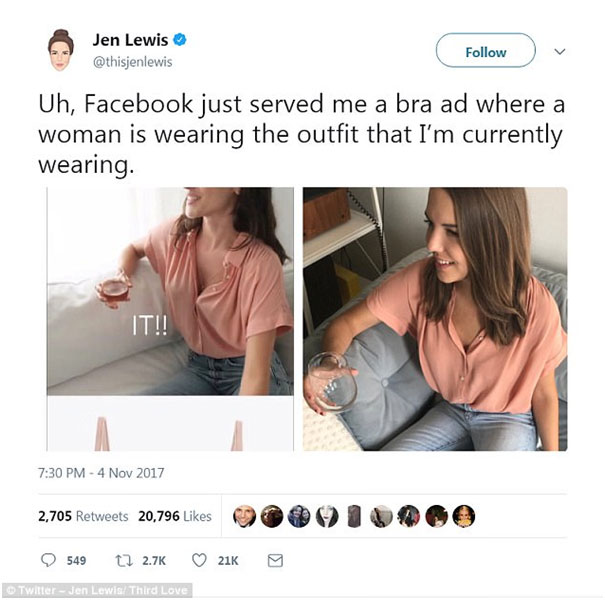
    With the governments of various countries venting their anger at Cambridge Analytica and Facebook for rigging election results in several countries around the world, everyone seems to have forgotten about the poor consumer.  Who has been secretly manipulated by these data thieves.  Some lone voices of consumers have been making these unconscious manipulative tactics from Facebook public on twitter, but I am afraid that in all the din created by the governments, consumers might lose out.  This tweet is a great testimony to how consumers are being manipulated.


    Mobile Manufacturers seem content to be camera replacements


    The new Vivo ad seems to have drawn a lot of attention because Aamir Khan has replaced Ranveer Singh in the advertising.  Marketing experts seem to be excited giving their opinions on how Aamir is good for the brand, others are discussing the pros and cons of using old stars versus young users.


    But the real problem with the Vivo commercial is that it treats the phone as a camera. The ad was reminiscent of the old Kodak and Canon/Nikon ads.


    And here we were busy thinking that the mobile has replaced the computer as a modern computing device that does everything from browse the web to order my Uber, pizza and more.

  • Prabhakar Mundkur: Lighter is not better for Heineken

    Prabhakar Mundkur

    By Prabhakar Mundkur


    While the commercial might have been made in good faith, a recent television commercial for Heineken Lite has a bottle of beer sliding past several black people before coming to rest before a light-skinned woman. The tag line “Sometimes lighter is better’ might have aggravated the point about cultural diversity arousing the wrath of hip hop star Chance the Rapper who took strong objection to the commercial.


    The commercial in the meantime has been pulled off-air.  With the number of commercials over the last year including Pepsi drawing criticism, Grey has done a wise thing.  It has a mandate which says that creative teams working on a campaign must answer the question: “How can we make the idea reflect and respect the world’s diversity?


    Seems like an excellent idea from Grey considering the number of commercials that are constantly going wrong on the subject of cultural diversity.


    Silent Rebellion at Goafest?

    The guest line-up of speakers at this Goafest includes Baba Ramdev as the main speaker raising some eyebrows among advertising professionals.Patanjali is acknowledged as an innovator which disrupted the entire FMCG industry but is also seen as a bit of a pariah as far as its own advertising is concerned.  While Patanjali has risen to be one of the largest advertisers in the country, it has also committed the largest body of misleading advertising work in a very short period of time. Not only that, they have strongly questioned the wisdom of the advertising industry in judging their work as misleading.  Sanjeev Kotnala, writer, trainer and consultant, has been vociferously airing his views about how Baba Ramdev was a bad choice for the role of main speaker at a festival that celebrates creativity.  As an aside, none of the work produced by Patanjali could really classify as ‘creative’ by any standards.


    One argument for inviting Ramdev seems to be that he is an innovator and that there is a lot to learn from him.  But there is a lot to learn from many people who have been classified as offenders. After all who would deny that there is a lot to learn from Vijay Mallya about beer and spirits, a lot to learn about cricket and IPL from Lalit Modi, and a lot to learn about innovative jewelry from Nirav Modi?


    While calling Ramdev as a guest speaker might have been an innocent decision, with the sole objective of wanting to include a crowd-puller, one wonders how it affects the sensibilities of senior advertising chiefs?  At the end of day, every professional in his field must also be his own regulator.  Every industry needs to maintain the professional standards it has imposed on itself.


    Coke launches new Summer Campaign

    Coke seems to have broken the usual mould with its new summer campaign.  It has personalised the packaging of Coke through a co-creation exercise with consumers.


    There are 20 descriptors in 12 languages on various relationships in a new trend which is being labelled micro-segmentation and advocacy.


    Thus far co-creation seemed like a good buzz word to drop in conversations on marketing and advertising.  But Coke might has actually made this come alive as part of their “Share a Coke” campaign which is running globally.


    Good strategy for Coke.


    Alexa goes Wild

    India is currently running a boring, very functional campaign for Alexa and Amazon Echo/Dot and perhaps its defence is that they need to educate Indian audiences on how Alexa works through the Amazon devices.  In the meantime, Ellen DeGeneres revealed a funny and probably slightly dangerous side of Alexa in a lighter vein.


    While it does demonstrate what Alexa can do, it gives us an idea of what might happen were Alexa to know so much about you.


    Certainly a peek into our own future. The age of Artificial Intelligence is nearer than we think.