Manyavar is clearly the darling of celebration wear. But when it featured Alia Bhat in an ad which was forward-looking by suggesting that giving away the girl in marriage or Kanyadaan is sexist and regressive, the ad angered the public. Further, Manywar suggested that the age-old practice must be named Kanyamaan adding fuel to the fire. But no right-thinking individual could deny the patriarchal nature of Indian society.
However, Manyavar has managed to come out of that temporary setback. What with the wedding season reaching its peak in the winter months, the brand could not afford to slow down. So, the new string of commercials features Ranveer Singh.
While the campaign features on the groom (Ranveer as dulha), it also showcases the baaratis who also have to be well-dressed. Manywar has a full range of celebration wear; from exquisite sherwani to Indo-westerns classic kurta jackets to matching accessories. Being a dulha of course means all eyes are on you.
Personally, I felt the commercials lacked a real idea. All it did was captured a realistic wedding situation with the focus on Ranveer. So if Kanyamaan had a strong idea about making a comment on society, these commercials are pure entertainment – music and dance. But they seem to have captured the imagination of the public all the same.
Also, their tag of #ManyvarAaGaya was carried out throughout social media. Influencers on Instagram prompted the dance moves to the same music as the commercials. The copy says
“ Hey grooms and baaratis,
When the beat drops, #DoTheManyavarMove
Show your moves and get ready to set the dance floor on fire, kyunki
@manyavar
#ManyavarAaGaya ”
View this post on Instagram
A post shared by Saorabh Rajnish Choughule (@mesaorabh)
Another Instagram post said:
Listen up grooms and baaratis,
Let’s burn the dance floor and #DoTheManyavarMove
Aap bhi try karo aur dikhao apna swag, kyunki #ManyavarAaGaya
View this post on Instagram
A post shared by Rohan Mehra (@rohanmehraa)
What it has certainly managed to do is create awareness of the approaching wedding season and prompting consumers to be ready for it with their attire.
And while the ads have no real idea, Manyavar has made people forget their angst against the Kanyamaan ad and the brand has moved ahead with their happy string of commercials announcing the wedding season.
‘Brands are like people,’ proclaimed Stephen King the father of account planning.  And like people, brands unfortunately grow old too!  Brands periodically try to stave off the effects of aging through marketing and advertising. But old archetypal brands have something magical about them. They appeal to the masses because they are the lowest common denominator and can talk to anyone in any social or income class, irrespective of class, creed or sex. They are the social glue that brings and keeps people together. They are brands that satisfy, typify and unite all the individuals of one large social tribe. A tribe which is united by common interests, beliefs, habits, languages, culture and customs.
But when brands get old, marketers worry. Their first instinct is to figure out how to make the brand younger. If a brand has become so mass that they are now failing to appeal to a higher income demographic they would like to get them back. The ‘formula’ solution from ad agencies is to show younger, better-to-do people in the commercial. And then hope that the brand acts like a mirror where these new targets can see themselves in the brand. Parle-G is one such archetypal brand. It instantly brings back childhood memories of dunking Parle-G biscuits in chai. Mind you, chai in a ‘cutting’ glass perhaps, rather than chai in a tea cup tea that comes out of a teapot. With the background at best of a Lucknow skyline rather than a Manhattan skyline.
It is not difficult to see what the client’s brief on the new‘You are my Parle-G’ campaign might have been. After all every brand in the country is chasing millennials – it is the new buzzword in marketing. Of course, India is supposed to have over 400 million millennials. That by any stretch of the imagination is not a segment, it is an entire universe!  And god help all those who are trying to typify such an incredibly large audience. Because a school teacher’s twenty-two-year-old son in Jhumri Telaiya might hold very different attitudes to life from a IIM professor’s twenty-two-year-old son living in Ahmedabad!
The new campaign has launched with a string of  very nicely made commercials with people reminiscing about their moments with Parle-G in the past. One couldn’t help feeling that the people portrayed in the commercials somehow seemed more privileged than earlier Parle-G commercials – in fact in one commercial the protagonist was even working overseas. Probably signalling another possible worry about the brand: that as we move up the income chain, usage of Parle-G is likely to drop. And of course the last worry being that children were glad to have a Parle-G but maybe not the man in his twenties (how I hate to say millennial!).
Nostalgia Marketing
Of course, if reminiscing about your past experience of a brand does anything to prompt its present or even future usage is still a question. Quite often the problem with old brands is that nostalgia cantend to remain as nostalgia. One piece of American marketing theory says that the millennial generation, in particular, is longing for the familiar. Largely because the defining cultural motif of our times is to counter the exhaustive pace that technology is forcing on our lives. Millennials, this theory says, are looking for brands that remind them of growing up and that elicit feelings of safety, comfort, and happiness. And that there is a yearning to bring back the “good old days†as they remember them. This kind of marketing logic rests on the fact that people (millennials) are literally buying into the past. The thesis is that if you can show that a brand has been a part of a culture in the past, it shows how relevant it is to the present.
But if a brand is rooted in nostalgia, the question that needs to be asked is how is the brand positioned to evolve?For me the most potent shortcoming of a nostalgia campaign in general is that it makes people remember why they fell in love with the brand, but doesn’t tell us how that love has evolved to the present day.  And that perhaps is the biggest risk of nostalgia marketing.Another problem for aging brands is trying to hit the sweet spot between the mass market and the demographic that the brand is currently missing out on and this is often an elusive task.
So, is nostalgia marketing common for other brands we know?  Almost every brand has had a brush with nostalgia marketing. Coke, Pepsi, Microsoft and many others. Two years ago, Coke even actually remastered its 1971 classic coke commercial created by McCann Erikson for 4k television. At the 2018 Super Bowl a number of brands retreated into the past while playing the nostalgia theme. Here for example is the Pepsi commercial that aired on the Super Bowl which even brought Cindy Crawford back.
Unless it was just a reaction to the backlash they faced with the Kendal Jenner spot they had to ultimately withdraw.
Facebook is really good with nostalgia marketing. It keeps reminding you of pictures that you put on Facebook ten years ago. The term ‘a blast from the past’, is a meme, that uses a new colloquialism that is actually related to nostalgia.
In closing, when you talk about an 80-year-old brand like Parle-G, one is bound to have one’s favourite campaigns for the brand. For me, my personal favourite is a string of commercials created about fifteen years ago. I think these commercials hit the sweet spot for both what Parle-G as a brand stands for.  And without quite saying it explicitly in so many words it implied that Parle-G is Bharat ka Apna biscuit without the elaborate antics of anyone painting their faces with the national flag.
These old commercials reflect in many ways the real India and the real Parle-G in its most genuine context. And while it shows young children in the commercial, we always knew that adults loved Parle-G equally!
But “the times they are a changin’ †as Bob Dylan once said. And the new campaign is well-made and perhaps reflects the new reality for this lovable old Indian brand.
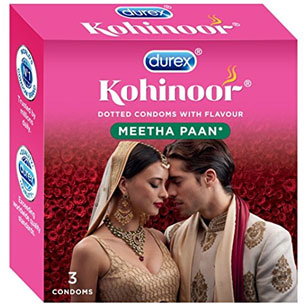
If you have ever felt a dentist’s glove inside your mouth you know what latex tastes like. So, one does get the rationale for flavoured condoms for improving the quality of oral sex, even if the flavours might seem a little regressive like kala khatta, and meetha pan.
But here is the contradiction. Pankaj Duhan, marketing director, RB Health-South Asia told afaqs.com ‘..95 per cent of Indians do not use condoms and we already have a huge population. This is an alarming situation!”If 95% of Indian’s don’t use condoms what is the point of encouraging them to use flavoured condoms for oral sex? Because oral sex doesn’t make more babies.
The other contradiction I found is that RB says that it is promoting ‘faithful promiscuity’ and yet they have commercials like this one which actually talks about having sex with a stranger. I thought that it was not socially responsible advertising to be so blatant about promiscuity. Watch this film which is titled “Encounter with a hot strangerâ€.
The actual flavoured condom ads I thought were not done tastefully. But of course you the public can be final jury on this one. If you enjoy sexual innuendos like this one, no doubt RB will be eminently successful.
You be the judge but I personally found the commercial quite revolting, and I can tell you I am not a prude.
Horlicks: Much ado about nothing
When GSK moved their Horlicks brand after 80 years to FCB Ulka mid 2017, it shook up the industry.   One doesn’t see relationships break after 80 years. It’s like breaking a marriage after 80 years. There seems little point in doing so. JWT in its characteristic, quiet style took the blow with dignity and without too much regret. And now comes the news that Horlicks might be up for sale to finance the GSK buyout of Novartis Nutrition.
Horlicks has franchise largely in India although it is imported in Australia and New Zealand and is also present in Malaysia and the West Indies. In the UK, it is a small brand and people drink Horlicks as a night cap. It is a classic case of an entire category becoming irrelevant, and a lack of category innovation leading to declining sales. This has affected other food drinks of yesteryears like Complan.
Once upon a time when nutrition was a problem and milk was inadequate or of low quality in the country, Horlicks played an important role. Parents are no longer open to adding Horlicks to the milk. They would rather serve their children cereal or muesli. Or just give them plain milk. And nutrition is not as big a concern as it was a few decades ago.
Suitors to buy the GSK Horlicks brand I believe are many. The question is what happens to the ad agency FCB Ulka who won this business from JWT with great aplomb last year. Will the buyer hand over the brand to their trusted agency or carry on with FCB Ulka who has been with Horlicks for just a year now? Alternatively, the buyer could just ask for an agency pitch. Interesting times ahead.
War of the Babas
The ayurvedic segment might be hotting up with the launch of the Sri Sri Tattva from Sri Sri Ravishankar. The commercial however was a bit of a letdown with the hackneyed theme of a ‘just married’ scenario where Sri Sri Tattva products are a wedding gift. But then it is not advertising that is creating this category, it is the product and the ayurvedic positioning.
While the expectation was that Sri Sri Tattva might consider premium pricing, the 1 litre desi ghee pack on bigbasket.com showed that Sri Tattva was priced at Rs 530 while Patanjali’s desi ghee was priced at Rs 500.
It would be interesting to see if the babas might just compete with each other or the MNCs.
A good brand can take bad advertising
Â
Â
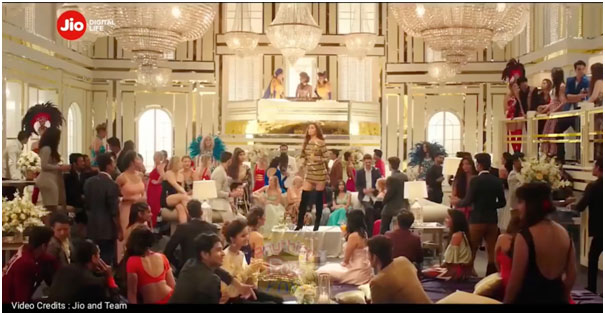
While Jio has to be admired as an innovator who disrupted the mobile telephony category, its advertising seems to challenge every rule in the book. One is left with fleeing images of people singing and dancing with well-known Bollywood stars and a sprinkling of East European models. The merriment then ends with a pack shot on Jio Digital Life. If one were to guess the advertising brief backwards, one would say that someone said “let us be remembered as Dhan Dhana Dhanâ€. The rest might have been put together by a writer and director of dubious distinction.
Jio certainly proves one thing. That a good product can survive atrocious advertising.
Last week, when Mark Pritchard of P&G said“I’d like creatives to account for three quarters of an ad agencies’ resourcesâ€,he might have delivered a telling blow to one of the mainstays of the advertising agency – the client service department. Globally and in India, creatives have been increasingly playing a more important role than any other department in delivering client satisfaction.  This is partly because the end-product of the agency is creative, so it does make sense that they are the crucial part of the delivery system.
Almost simultaneously, the quality of client service has been in steady decline. Agencies once upon a time, queued up at the IIMs in India in the late ’80s and early ’90s to compete with the global FMCG players and recruited the best young brains in the country at competitive prices with the rest of the industries. But alas, no more. I remember that JWT used to take 50-60 new recruits into the system every year. Decreasing margins and because advertising might have lost its sheen with young MBAs, ad agencies are no longer in demand on campuses today. So, it is no surprise that the quality of client service is no longer what it used to be.
But Marc Pritchard’s statements has its faults. Agencies have for too long tried to mirror the hierarchies of the client’s marketing department. This means that you need a mirror image of the brand manager, the marketing manager, the marketing director etc. in the ad agency’s client service structure. And to their credit, client service does a lot of the dirty work on the account that is often invisible but plays its part. Also, if creatives spend too much time on meetings, as clients often want them to, it is likely they will never have the time to actually do the creative. In my experience, a number of clients are operationally heavy and often client service does the dirty work ungrudgingly. But as more and more clients express their reliance on creative, client service might need to find a new reason to justify their presence on the business.
Either way, the Marc Pritchard statement is a warning bell to client service people all over the world. They need to redefine their existence and contribution on a client’s business.
India Tourism and the Land of Yoga
Incredible India rolled out its latest film positioning the country as the land of yoga. Didn’t know that? Surprised?
I am sure no one in the world really doubts that yoga was born in India although to date it does seem like our most popular export. Unfortunately, in the world of intellectual property rights, India no longer owns yoga. There are probably more yoga practitioners and yoga classes in the rest of the world than there are in India. With the UN having adopted Yoga Day, and Prime Minister Narendra Modi’s personal effort in promoting yoga, the new film does seem like a bit of wet blanket and the least impressive in the long series of Incredible India ads.
The film released on March 7, 2018 seems to be languishing at under 10k views on YouTube. No surprise.
#AllBeginsWithBlack by Raymond
This new TVC had everyone complimenting Raymond for their brave gesture of using visually impaired Canadian singer and writer Jugpreet Singh Bajwa as the hero of the film to give his interpretations of black for the new collection of fabrics. Advertising has been using differently abled people in their commercials for a while now. Bajwa recites some slam poetry which goes like this:‘Black is a like a silence that everyone can feel. When it finally speaks it deafens the world with its powerful words. It’s time to unravel.
While slam poetry might have a limited audience in India, I found the tone of the commercial very un-Raymond like. But that is perhaps because when I think of Raymond’s brand I think of their signature tune which was Traumerei from Kinderszenen Op 15 by Schumann. Languorous images of an idyllic world. Beautiful musical phrasing by Schuman. This piece of music was played by radio stations at the end of World War II. Listen to Horowitz playing it in Moscow to see how it moves you.
This commercial to me was therefore a departure from Raymond’s brand personality and the harsh tone of both the visuals and the music got me quite disturbed.
So, while the colour was about black fine fabrics, I felt there was no need to make the commercial like it belonged to the film noir genre. Because film noir is marked by a certain inherent fatalism and pessimism.  But that’s my opinion. Hope the commercial works for Raymond.
Most clients want to do something on International Women’s Day (IWD), because it is a good thing to do and of course in the hope that they might get women to be loyal to their brands. But no one really seems to care what the objectives of the International Women’s Day might be for a given year or the theme that they have chosen for the year. For example, for 2018, the theme was #PushforProgress.  But I am not sure everyone had the theme in mind while creating their advertising.
Reebok for example took the theme of violence against women to make their point.
The commercial has a group of people from different walks of life who are asked to guess what the cause of the bruises on the protagonist’s body is. As high as 85% of the people think that her bruises are the result of physical violence. The commercial ends by asking the viewer to sign a petition to make self-defence mandatory for women in schools and colleges. The commercial portrays how we are conditioned to make assumptions about women. We see a bruised woman and we think she must have been a victim of domestic violence. But actually, she is a martial artist.  I was personally a little confused about what the commercial does for gender parity in general. The Global Gender Gap report looks at four key dimensions to rank 144 countries on their progress on gender parity : Economic Participation and Opportunity, Educational Attainment, Health and Survival, and Political Empowerment.”
So while the Reebok commercial doesn’t directly address any of those dimensions perhaps it tries to break stereo types and biases that are held against women in Indian society, and that too helps in some way considering that India ranks fairly low on gender parity.
The Prega News commercial from Mankind Pharma took a slightly remote and less common occurrence postpartum depression which affects women in the first few months after a child to make their point.
The commercial has an all-male team taking a very understanding view of the female protagonist and trying their best to make life easier for her by extending their full support. But the commercial of course depicts women as weaker than men in the process. So I wasn’t so sure what it does for gender parity. But it does make people aware that women have their delicate moments when men can help by being empathetic. It also portrayed postpartum depression as something normal.
The Usha commercial I thought was unexpectedly refreshing. It took a typical boy meets girl situation to demonstrate that the burden of day to day work can be easily shared equally between men and women if they are understanding and see their roles as equal.
The commercial has the lady confessing that she is not ready for marriage because she can’t do many of the usual things women are expected to do like coffee and noodles, as well as her other idiosyncrasies like not being comfortable with an air-conditioner. Fortunately, her partner to be offers to share the burden equally. The commercial broke down the typical female prototype expected in an arranged marriage.
The Nike commercial released overseas also struck a special chord. Featuring Serena Williams, the ad has a poignant voice over from the tennis champ.
“I’ve never been the right kind of woman. Oversized and overconfident. Too mean if I don’t smile. Too black for my tennis whites. Too motivated for motherhood. But I am proving, time and time again, there’s no wrong way to be a woman.â€
Said Milan Vora, well-known author and writer about the commercial: “ It tackled quite a few key issues in those few words. Body shaming, ‘oversized, over confident’ , the ascribing to what society thinks how you should be. The demeanour, what you should wear ( colours that are even race appropriate… ) It ad takes it on with sass, takes the bull by the horns ‘Too motivated for motherhood.’ That’s the bit that resonates most. People thinking of motherhood in an either/ or context!â€
To sum up, not all the Indian commercials were perhaps on strategy to push for gender equality. But each of them made their contribution by breaking down a particular bias or stereotype that exists in Indian society. If we are to believe the The World Economic Forum’s Global Gender Gap report told us that gender parity is about 200 years away, every little effort from every brand in the country will help us overcome the current state of gender inequality.
No doubt people’s attention the entire week was focused on Nirav Modi.  While the finance experts tried to unravel the mysteries of the scam and the LOUs, the marketing and advertising experts argued on what would happen to the brand.In retrospect, the diamantaire extraordinaire might have made the mistake of using his personal name as a brand. It has certainly pointed out to marketing experts that brands like Kingfisher, Satyam etc. which also went through a scam were perhaps less affected because the brand name was not connected to the alleged scamster. The Nirav Modi case is different because every time you mentioned “Nirav Modi†the brand name was being dragged through mud. We might have been more forgiving if the owner of the brand was an accused but called John Smith to make a point. That way the Nirav Modi brand could have lived on.
By Nirav Modi’s own admission in a letter to the PNB Chairman he is reported to have said: “In the anxiety to recover your dues immediately, despite my offer (on February 13, a day before the public announcement, and on February15) your actions have destroyed my brand and the business and have now restricted your ability to recover all the dues leaving a trail of unpaid debts”.
That now leaves one option were Nirav Modi to consider getting into business again. He would need to think of a new brand but where he is only the designer. Unless of course the brand gets suitably exonerated, through legal battles with the CBI and PNB.
Zee’s Social Media Experiment mysonikudi.com
In a world where people still believe that communication has to be hard-hitting and that normally means that you spend a lot of money trying to hammer a message into people’s heads, it was refreshing to see the Zee campaign for mysonikudi.com
They followed the Stimulus-Response approach which evangelised that if you want someone to believe something, you don’t just hammer that message into their heads. So, for example, if I want you to believe that I am a funny man, I don’t show you my certificates in humour and shout at you loudly that I am a funny man. Because you might well not believe me.  Instead I tell you a joke, and then your response is that I am funny.
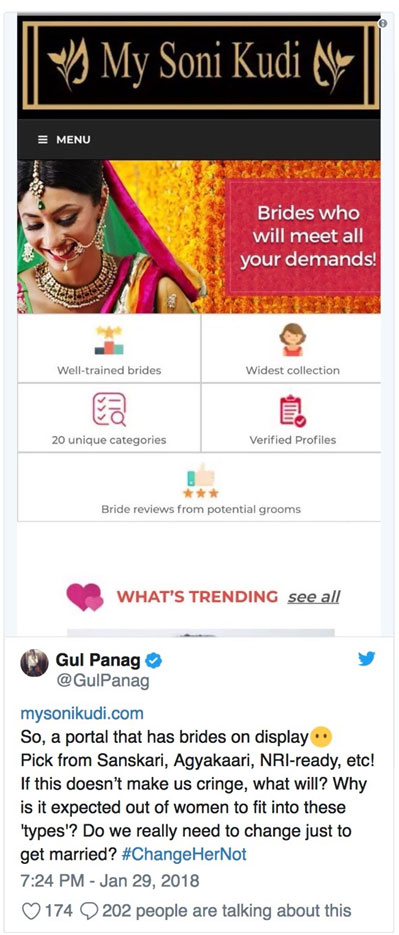
Mysonikudi followed this approach when they got Gul Panag to tweet about a make-believe website called sonikudi.com which projected itself as a portal which provided customised brides like Wonder Chef’, ‘Bachat Focused’, ‘Agyakari’, ‘Gharelu’, and ‘Sansakari’.
Gul Panag #changehernot hashtag was trending in no time and it drew the ire of the public at large making the campaign a great success. Â The fake website I believe drew over 3000 eager beaver husbands-to-be putting in their preferences for the stereotypical housewives offered on the website.
Yahoo advertises for India
These days in drawing room conversations with my daughter’s friends, they say: “Uncle, we are no longer on Facebook, we are on Instagramâ€. While I am still trying to grope around with a theory that would explain this millennial behaviour they add fuel to the fire by telling me that Facebook is only for older people. That really makes me feel really old. In the last months, I had almost come to the conclusion that Facebook was for old dads and grandads. And that Instagram was for all the young happening people. Of course I thought being an ad guy that this was a clever strategy by Facebook to differentiate between the users of Facebook and Instagram since they own both platforms.
And now there is this campaign called “Live to Love†by Facebook that says all my thinking is wrong. For one its shows young people (read millennials ) and it also shows old people like me. Here are sample commercials for both Neha the young doctor, and Sunny the 58 year old portly businessman.
While the campaign does look like a strategy planner wrote a very detailed brief that eulogised about the target group and the creative just decided to translate it into a film, the campaign does what every mass marketer is known to do. Talk to everybody, both young and old. Which, somehow goes against the the tenets of positioning and targeting. But I guess when you have 217 million users in India and those users are a pretty amorphous lot, you don’t have too many choices.
In any case, the campaign does two jobs: it reassures me that not only old people use Facebook. And it reassures younger people that they need not shun it and go to Instagram. If that is what Mark Zuckerberg wants in this second largest market the campaign perhaps meets the objective.
PrabhakarMundkur is an ad industry veteran who is now a prolific commentator on LinkedIn and his own website – prabhakarmundkur.com. The views here are personal
I remember that back in 1996 when I was with JWT South Africa, Burt Manning the then global CEO of JWT made a trip to meet us. In his informal speech at the office pub, he said that he would like to see a day when the traditional ad agency presentation started with a media presentation rather than a creative presentation. If that is not already happening I am sure it will happen soon. So, Mr. Manning might have just predicted the future very early on.
Ever since media and creative separated, it’s the media agency that has made large strides forward.  I was lucky to be working at JWT Shanghai where the second Mindshare in the world was formed in 1998, thanks to Kelly Clark, the now Global CEO of GroupM who entirely supervised the transition. The media agency has embraced digital, activation, events, sponsorships, content distribution, sports and entertainment, and the rest of the integrated marketing puzzle. Making it far more attractive and qualified compared to the creative agency. Whereas the creative agency has remained what it always was… largely the producer of TV commercials and print ads.
The acquisition of a digital agency called Glitch by GroupM may be a signal of where the future lies. After all there is nothing to stop the media agency from also acquiring a creative agency save the obvious conflict at a group level. In fact, acquisition of a creative agency might well bring us full circle to the integrated agency of the future. Today’s media agency has the Big Data, has the client relationships, has the research, is making large investments, unlike the creative agency that is just bumbling along trying hard to survive. I know creative freelancers who already work with GroupM. I am sure it saves GroupM the bother of having to ask their WPP creative agencies for help. And the informality of relationships with these creative shops prevents any obvious conflict of interest at a corporate level.
But the press release did make GroupM look a like a bunch of bean counters. Because the Glitch CEO said they were bringing right-brained thinking to the left-brained GroupM. That is certainly not how GroupM should see itself in the future.
McCann vilified on Social Media
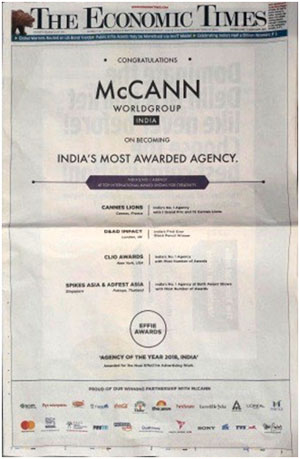
When McCann put a self-congratulatory ad in The Times of India last week, suddenly the professional side of the advertising business woke up almost like Rasputin awakening from his slumber. As the saying goes, professionals typically don’t advertise themselves and professionals generally means chartered accountant, lawyers etc. An old code of conduct says that professionals shouldn’t advertise, but I guess that is long forgotten. After all we see plenty of ads for doctors and clinics these days. When it suits the ad industry folks,they like to think of themselves as professionals. So, the industry took to social media to denigrate McCann. The taunts included the creativity of the ad.
But I am sure it is Prasoon Joshi, the CEO of McCann, who is having the last laugh. In the just released Gunn Report 2017, McCann was named the No 1 agency in India. Leaving behind the likes of Taproot Dentsu, BBDO, Ogilvy, Leo Burnett, L & Saatchi & Saatchi and Weiden+Kennedy.
Advertising catches up with the Indian parent’s obsession for children’s studies
While there may be no formal research to validate this, the Indian’s parent’s obsession with children’s studies is well-known. We are the only country that indulges our children in the extra classes, the private tuitions, and other academic additions to regular school. This either poorly reflects on our education systems, our children or our parents, I am not sure which. But the insight triggered a few commercials both from Mirinda and Horlicks.
What is questionable of course, in spite of trying very hard, is the rather loose connection between the product and exam time which has little to do with each other. The Horlicks claim of ‘emotional nutrition’ remained largely emotional with no real ‘reason why’. But with children’s nutrition categories being threatened by serious pharma companies like Abbott with products like Pediasure, its exam time for Horlicks as well which has seen its market share take a beating in recent years.
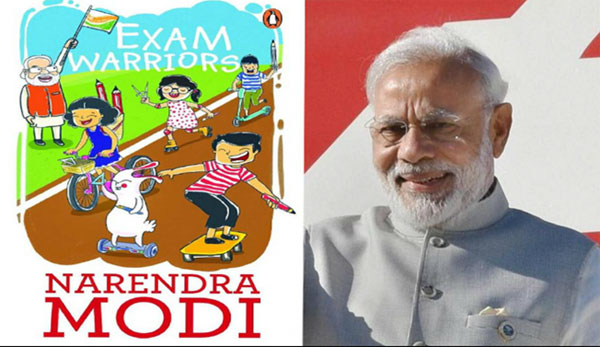
But in balance, advertisers might have hit upon a good thing. After all Prime Minister Narendra Modi is addressing 10 crore students on February 16, on how to deal with the stress of exam time. Besides our PM has also written a book on the subject, which was released on February 3.
It’s time to add Exam Time as another special day along with Valentine’s Day, Mother’s Day and Father’s Day. I am sure the theme will attract more advertisers in 2019.
The Bajaj Dominar 400 has come out with a string of commercials which use the metaphor of the elephant to connote heavy, old technology bikes – the obvious reference is of course Royal Enfield and even Harley to a lesser extent is in the same group, although Harleys typically fall into a more expensive price bracket.
In overseas markets, it is a well-known fact that on any yardstick of performance Japanese bikes outclass a Harley. That is much the same for the Royal Enfield in the Indian market, which at best has only made marginal improvements to the original version of the Royal Enfield that rolled off the production floors in Redditch, Worcestershire, more than half a century ago. No wonder the Royal Enfield websites refer to the motorcycle as a ‘modern classic’. After all, just to take one example it sports a carburetor which is a relic of old technology instead of a fuel injector that is found in modern cars and motorbikes.
But what Bajaj is not accounting for is that the old heavy bikes have very strong ‘genes’ and strong emotional attachment. There is something in every Indian biker that tells him he must own a Royal Enfield at some point of time in his life. And while they may not be fast, not great at picking up speed, or great at handling, there is some undefinable quality about sitting on top of a Royal Enfield that a string of commercials may well find it difficult to overcome. Obviously Royal Enfield is making giant strides in this market, and that’s the reason for this response from Bajaj.
Which brings us to the eternal question on comparative advertising: does it really work?
In a study conducted by Dr Fred Beard, professor of advertising in the Gaylord College of Journalism and Mass Communication at the University of Oklahoma, Dr Beard says “the potential for negative outcomes of [comparative advertising] are a very real possibility when prominent brands choose to go head to head using strictly comparative advertising campaigns.”
Heineken India’s Generation Campaign is a good adaptation of international work
The generation gap and particularly how to appeal to millennials has been every marketers challenge for some time now. When Heineken launched their #OpenYourWorld campaign overseas last year, the premise was to test if two strangers divided by their beliefs ( political and social )can overcome their differences. That seems to have hit the right note amongst consumers abroad.
No wonder then that Heineken considered adapting the same campaign to India but with a twist. Instead of two strangers, the campaign decided to capitalise on the generation gap between parents and children. By finding the gap between how parents think about what their children should be and what children really want to be they have found an interesting idea right in the middle of this gap. The campaign idea expresses the parent’s traditional career expectations of children as a base and then uses interaction between the parent and child  to break down barriers.
By using a comedian to present the unique social experiment, the Indian version adds a layer that perhaps makes the campaign work better. But I wonder if the campaign lags the trend a bit ; Indian parents have been opening up to letting their children choose new age professions for some time now. I see so many parents open to their children becoming musicians, fashion designers, disc jockeysetc, and joining emerging new sectors like media and retail that one hardly comes across the traditional parent forcing his child to become a chartered accountant, engineer or doctor.
That is the only thing I found a trifle jarring about the campaign was the fact that India has passed the stage of being closed to new professions; the world has opened up both for Indians and people around the world.
The Super Bowl Zeitgeist
Jeff Weiner CEO of LinkedIn in a post this week said: “ If Super Bowl commercials are a barometer for the prevailing zeitgeist, interesting to note the number of inspiring, inclusive, and positive messages during this year’s game.â€
Whilst the Super Bowl does seem a very competitive space that brings out the best of brands one of my favourite spots that took me by surprise was the Amazon spot featuring Jeff Bezos for the first time in a commercial.  Various celebrities try and substitute for Alexa who has lost her voice.
The other commercial I really loved was done by Droga 5 for Sprint and capitalised on  Artificial Intelligence and all the TV series we have been fed from Westworld to Extant to real life expressions from Sophia the Robot.
The commercial does an excellent and laughable take-off by portraying hyper-intelligent robots who have discovered that paying twice as much for Verizon isn’t smart. The robots have a good laugh at their creator for being stupid.
The week was full of tributes from all the people who knew and worked with him, including the famous Shelley Lazarus, one-time global CEO of Ogilvy and now Chairman Emeritus, who at one point of time was the only woman amongst seven men in the Advertising Hall of Fame.
I never knew Ranjan personally although I did bump into him a few times in Shunu Sen’s offices at the Levers office at Backbay Reclamation in the early 1990s, when he would dash in from Singapore. We would both be required to present to Levers our latest views on the Lever competition which typically meant P & G and Colgate.
Ranjan Kapur
While I never worked with Ranjan, I did have a competitive perspective on him because Ogilvy and JWT were both vying for Sir Martin Sorrell’s attention after being acquired by WPP – JWT was acquired in 1987 and Ogilvy a little later in 1989. Rumour had it those days that Sir Martin might have overpaid for Ogilvy, although in retrospect I am sure it was a wonderful decision. As one of the Lever agencies, we never considered Ogilvy a serious threat to the Lever business those days. Then came a major storm called Ranjan Kapur.
Since he joined in 1994, he seemed to have led a serious business transformation at the agency (before the word business transformation was to become popular). This included a huge emphasis on its creative product which he believed would lead to both fame and fortune. By 2004, when Ranjan retired from Ogilvy, it was an awesome agency that had not only built itself a great solid reputation but was also sniffing at the heels of JWT which was always considered the #1 in revenue in the country. Without IMRB’s revenue, Ogilvy was already bigger than JWT as I remember it back in 2004, while pouring over the annual reports of both agencies.
Since I observed Mike Khanna, the erstwhile CEO of JWT from close quarters, I knew Mike always thought of Ranjan as a good friend, but he was more than aware of Ranjan also being the formidable competitor. As luck would have it in 2005, I was one of the invitees for an Kolkata Ad Club function along with Ranjan. And I was fortunate enough to catch him and wife Jimi at the airport where our flight had a miserable delay of a few hours. This was my first real meeting with Ranjan and Jimi and I found them a warm and lovable couple. We exchanged notes on a number of things including the quirks of our neighbourhood, since we both stayed at Prabhadevi.
There are some whom you meet and you wonder why fate hadn’t brought you together earlier. Ranjan was one of those people. As tributes pour in from every corner of the country, one can see how much he is being missed.
Patriotic Branding
I don’t think we have ever had a formal study of  patriotic brands in India, although several brands have pledged their patriotism,  but in the US where brands are continuously studied for their degree of Patriotism,  brands like Jeep, Hershey’s, Coke, Levis, Ford, Wal-Mart, Campbell’s and others  have stood out as patriotic brands. An annual research study finds out which brands were most associated with the value of patriotism. Quite often when we say American icon I guess what we are really referring to are patriotic brands. Largely, it has to do with being an American company or really being made in the U.S.A.  In the  2016 research, a national sample of 4,750 consumers, 16 to 65, evaluated 248 brands across a collection of 35 cross-category values. Consumers identified the following brands as leading 2016’s patriotism parade. Percentages indicate brands’ emotional engagement strength for the individual value of patriotism.
Jeep/Disney (98%)
Levi Strauss (96%)
Ralph Lauren (95%)
Ford (94%)
Coca-Cola/Jack Daniels (93%)
In India, Bajaj has always been known for its patriotic branding right from the days of the old Bajaj scooter with “Hamara Bajajâ€. Many brands pledged their patriotism this Republic Day but I thought one brand did it really well. And no prizes for guessing. It was Bajaj with its Invincible Indians ad. It told stories of brave Indians who were serving society at large with the help of their Bajaj motorcycles.
Advertising Ideas are not Intellectual Property?!
Â
Most ideas of any kind today are getting copyrighted both in the arts and the sciences. Create a piece of music and you can copyright it. Create a piece of art and you can copyright it. Create a scientific invention and you can copyright it. Write a great advertising baseline, and consider it given away for free, forever. And be prepared to be forgotten. When Idea Cellular changed its agency from Lowe to BBDO late last year, the industry was left in suspense about what would happen to all the great properties created for Idea including “What an idea, Sirjee†which became a part of colloquial lingo in the country over the years.
So when Shashi Shankar CMO of Idea Cellular recently said “The tagline belongs to the brand; it doesn’t matter who coined itâ€, I can see a copywriter cringing in a corner somewhere, about why he joined a profession where a client can say he doesn’t matter. After all, that is not the tradition. Most people are given credit for the good work they have done on a brand even if they lose the business over a long period of time.
So, did the new work justify the change of agency from Lowe to BBDO. I am not so sure. I thought the new Idea commercial lacked the zing, and the intrusive personality the brand had built up over all these years. Somehow, the new commercials felt like they were for an older, soberer brand, unless it was intentional. In addition, the famous baseline “An idea can change your life†felt like it had been relegated to the background, along with its erstwhile agency. The line preceding the baseline “A video can change your life†felt forced and idealess.
But such is life in advertising. You can slog your butt off for decades on a business and be forgotten forever!

 Manyavar is clearly the darling of celebration wear. But when it featured Alia Bhat in an ad which was forward-looking by suggesting that giving away the girl in marriage or Kanyadaan is sexist and regressive, the ad angered the public. Further, Manywar suggested that the age-old practice must be named Kanyamaan adding fuel to the fire. But no right-thinking individual could deny the patriarchal nature of Indian society.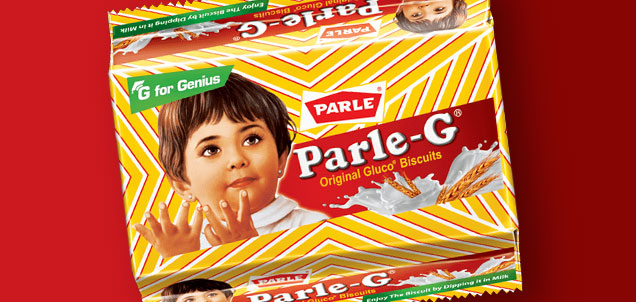
 By Prabhakar Mundkur
 But here is the contradiction. Pankaj Duhan, marketing director, RB Health-South Asia told afaqs.com ‘..95 per cent of Indians do not use condoms and we already have a huge population. This is an alarming situation!”If 95% of Indian’s don’t use condoms what is the point of encouraging them to use flavoured condoms for oral sex? Because oral sex doesn’t make more babies.
 Â
 
 By Nirav Modi’s own admission in a letter to the PNB Chairman he is reported to have said: “In the anxiety to recover your dues immediately, despite my offer (on February 13, a day before the public announcement, and on February15) your actions have destroyed my brand and the business and have now restricted your ability to recover all the dues leaving a trail of unpaid debts”.