Category: PRABSY MUNDKUR

  • Will Media Agencies ‘Kill’ the Creative…?


    By Prabhakar Mundkur

     

    I remember that back in 1996 when I was with JWT South Africa, Burt Manning the then global CEO of JWT made a trip to meet us.  In his informal speech at the office pub, he said that he would like to see a day when the traditional ad agency presentation started with a media presentation rather than a creative presentation.  If that is not already happening I am sure it will happen soon.  So, Mr. Manning might have just predicted the future very early on.


    Ever since media and creative separated, it’s the media agency that has made large strides forward.  I was lucky to be working at JWT Shanghai where the second Mindshare in the world was formed in 1998, thanks to Kelly Clark, the now Global CEO of GroupM who entirely supervised the transition. The media agency has embraced digital, activation, events, sponsorships, content distribution, sports and entertainment, and the rest of the integrated marketing puzzle. Making it far more attractive and qualified compared to the creative agency. Whereas the creative agency has remained what it always was… largely the producer of TV commercials and print ads.


    The acquisition of a digital agency called Glitch by GroupM may be a signal of where the future lies. After all there is nothing to stop the media agency from also acquiring a creative agency save the obvious conflict at a group level.  In fact, acquisition of a creative agency might well bring us full circle to the integrated agency of the future.  Today’s media agency has the Big Data, has the client relationships, has the research, is making large investments, unlike the creative agency that is just bumbling along trying hard to survive. I know creative freelancers who already work with GroupM.  I am sure it saves GroupM the bother of having to ask their WPP creative agencies for help.  And the informality of relationships with these creative shops prevents any obvious conflict of interest at a corporate level.


    But the press release did make GroupM look a like a bunch of bean counters.  Because the Glitch CEO said they were bringing right-brained thinking to the left-brained GroupM.  That is certainly not how GroupM should see itself in the future.


    McCann vilified on Social Media

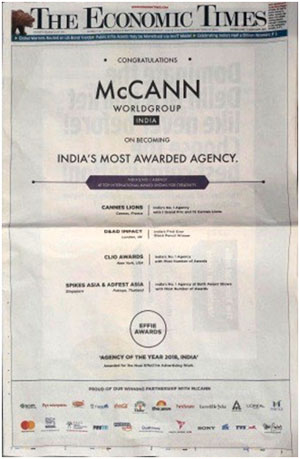
    When McCann put a self-congratulatory ad in The Times of India last week, suddenly the professional side of the advertising business woke up almost like Rasputin awakening from his slumber.  As the saying goes, professionals typically don’t advertise themselves and professionals generally means chartered accountant, lawyers etc. An old code of conduct says that professionals shouldn’t advertise, but I guess that is long forgotten.  After all we see plenty of ads for doctors and clinics these days.  When it suits the ad industry folks,they like to think of themselves as professionals.  So, the industry took to social media to denigrate McCann. The taunts included the creativity of the ad.


    But I am sure it is Prasoon Joshi, the CEO of McCann, who is having the last laugh.  In the just released Gunn Report 2017, McCann was named the No 1 agency in India.  Leaving behind the likes of Taproot Dentsu, BBDO, Ogilvy, Leo Burnett, L & Saatchi & Saatchi and Weiden+Kennedy.


    Advertising catches up with the Indian parent’s obsession for children’s studies

    While there may be no formal research to validate this, the Indian’s parent’s obsession with children’s studies is well-known.  We are the only country that indulges our children in the extra classes, the private tuitions, and other academic additions to regular school.  This either poorly reflects on our education systems, our children or our parents, I am not sure which.  But the insight triggered a few commercials both from Mirinda and Horlicks.


    What is questionable of course, in spite of trying very hard, is the rather loose connection between the product and exam time which has little to do with each other. The Horlicks claim of ‘emotional nutrition’ remained largely emotional with no real ‘reason why’. But with children’s nutrition categories being threatened by serious pharma companies like Abbott with products like Pediasure, its exam time for Horlicks as well which has seen its market share take a beating in recent years.


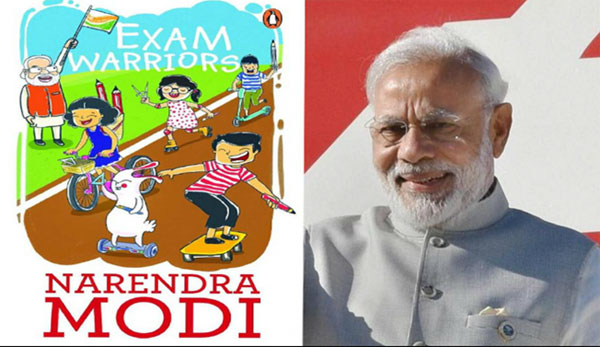
    But in balance, advertisers might have hit upon a good thing. After all Prime Minister Narendra Modi is addressing 10 crore students on February 16, on how to deal with the stress of exam time. Besides our PM has also written a book on the subject, which was released on February 3.


    It’s time to add Exam Time as another special day along with Valentine’s Day, Mother’s Day and Father’s Day.  I am sure the theme will attract more advertisers in 2019.


  • Ad agencies vs Consultancies debate gets real


    By Prabhakar Mundkur


    So far, the debate on advertising versus the consultants was a theoretical one because it was not affecting the Indian market yet in any significant way. Companies like EY, KPMG, and PWC have been very active in digital marketing overseas but this capability was still not very active in India.  But with the launch of Deloitte Digital in India on January 12, the landscape is likely to change.  One will have to wait and see how the launch of Deloitte Digital willaffect  competitionlikrGroupM, Dentsu-Aegis and IPG Mediabrands.  Rakesh Barik – Technology Consulting, Deloitte India told the press, “Unlike existing creative agencies, we understand the business also.  We will help companies digitize their core”.  By implication it does mean that creative agencies don’t understand the business of their clients, something that has been troubling the advertising industry for some time now.  What’s more contrary to popular opinion ,the consultancies have been acquiring  talent in creative, designing and research, making up for their traditional lack of skills in this area.


    Hotstar’s Employer Branding Campaign

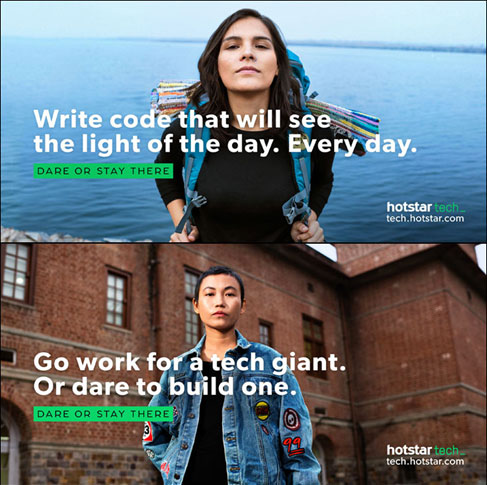
    Hotstar is a live streaming app that lets you watch your favourite shows, movies, sports and live news on-the-go. Most often its funny how we are able to see brands only as consumers of it.  So strong is our consumer perception of brands that often we may not even consider them as employers.  In fact, so strong is the value proposition to consumers that companies have to take a special effort to make a value proposition to its future employees and this is exactly what Hotstar has managed to do in its latest employer branding campaign.  The latest campaign from Hotstar positions it as a tech player to attract the best tech talent, which no doubt has several competitive options in the country today.

    The campaign makes you see Hotstar in a new light.  As a tech company that could offer the youth an interesting challenge.  The ‘Dare or stay there’ baseline is provocative enough for young techies to seriously consider Hotstar.


    Amazon Go 

    No wonder Amazon is being referred to as the ‘tech giant’ these days in the press. It’s no longer just the ‘online store’ or ‘e-commerce giant although its immediate competition might love to see it that way to serve their own purpose.


    With Alexa becoming the preferred personal assistant and taking giant strides forward, Alexa is not just a home assistant but is also taking control of cars (Ford has just adopted Alexa) and our other devices and possessions.


    Amazon now takes the pain out of shopping – no queues and no checkouts in their Seattle store. Just pick what you want from the store and get charged to your Amazon pay card on the way out. That’s the experience that Amazon offers at Amazon Go. The faqs on amazon.com had this to say about Amazon Go.


    What is Amazon Go?

    Amazon Go is a new kind of store with no checkout required. We created the world’s most advanced shopping technology so you never have to wait in line. With our Just Walk Out Shopping experience, simply use the Amazon Go app to enter the store, take I the products you want, and go! No lines, no checkout. (No, seriously.)

    I  liked the commercial because it made the concept of the new store really clear. It was really functional advertising which is a great way to launch a new brand.


    Indian men are not the only ones to touch their junk?

    For a long time now, there has been some public criticism of how Indian men touch their junk. A dermatologist friend of mine explains it away as tropical climate with a lot of heat and dust which could create conditions that justify this despicable Indian habit, especially amongst some classes of people.  But a new TVC from Columbia may imply that the habit is not unique to India.  The Colombian League against cancer has found a hilarious but gross way to make men aware of testicular cancer.


    This is an insight that is waiting to be used in the Indian market.  Everybody is going to identify with it.  In fact, I am wondering why no one has exploited it yet.


  • Do Women’s Day Ads Work for Brands & Women?

    Picture source: https://www.internationalwomensday.com/


    By Prabhakar Mundkur


    Most clients want to do something on International Women’s Day (IWD), because it is a good thing to do and of course in the hope that they might get women to be loyal to their brands.  But no one really seems to care what the objectives of the International Women’s Day might be for a given year or the theme that they have chosen for the year. For example, for 2018, the theme was #PushforProgress.   But I am not sure everyone had the theme in mind while creating their advertising.


    Reebok for example took the theme of violence against women to make their point.


    The commercial has a group of people from different walks of life who are asked to guess what the cause of the bruises on the protagonist’s body is. As high as 85% of the people think that her bruises are the result of physical violence. The commercial ends by asking the viewer to sign a petition to make self-defence mandatory for women in schools and colleges. The commercial portrays how we are conditioned to make assumptions about women. We see a bruised woman and we think she must have been a victim of domestic violence. But actually, she is a martial artist.   I was personally a little confused about what the commercial does for gender parity in general.  The Global Gender Gap report looks at four key dimensions to rank 144 countries on their progress on gender parity :  Economic Participation and Opportunity, Educational Attainment, Health and Survival, and Political Empowerment.”


    So while the Reebok commercial doesn’t directly address any of those dimensions perhaps it tries to break stereo types and biases that are held against women in Indian society, and that too helps in some way considering that India ranks fairly low on gender parity.


    The Prega News commercial from Mankind Pharma took a slightly remote and less common occurrence postpartum depression which affects women in the first few months after a child  to make their point.


    The commercial has an all-male team taking a very understanding view of the female protagonist and trying their best to make life easier for her by extending their full support.  But the commercial of course depicts women as weaker than men in the process.  So I wasn’t so sure what it does for gender parity.  But it does make people aware that women have their delicate moments when men can help by being empathetic. It also portrayed postpartum depression as something normal.


    The Usha commercial I thought was unexpectedly refreshing.  It took a typical boy meets girl situation to demonstrate that the burden of day to day work can be easily shared equally between men and women if they are understanding and see their roles as equal.


    The commercial has the lady confessing that she is not ready for marriage because she can’t do many of the usual things women are expected to do like coffee and noodles, as well as her other idiosyncrasies like not being comfortable with an air-conditioner.  Fortunately, her partner to be offers to share the burden equally.  The commercial broke down the typical female prototype expected in an arranged marriage.


    The Nike commercial released overseas also struck a special chord.  Featuring Serena Williams, the ad has a poignant voice over from the tennis champ.


    “I’ve never been the right kind of woman. Oversized and overconfident. Too mean if I don’t smile. Too black for my tennis whites. Too motivated for motherhood. But I am proving, time and time again, there’s no wrong way to be a woman.”


    https://www.youtube.com/results?search_query=No+wrong+way+to+be+a+woman+Nike+Serena+Williams


    Said Milan Vora, well-known author and writer about the commercial: “ It tackled quite a few key issues in those few words. Body shaming, ‘oversized, over confident’ , the ascribing to what society thinks how you should be. The demeanour, what you should wear ( colours that are even race appropriate… ) It ad takes it on with sass, takes the bull by the horns ‘Too motivated for motherhood.’ That’s the bit that resonates most. People thinking of motherhood in an either/ or context!”


    To sum up, not all the Indian commercials were perhaps on strategy to push for gender equality. But each of them made their contribution by breaking down a particular bias or stereotype that exists in Indian society.  If we are to believe the The World Economic Forum’s Global Gender Gap report told us that gender parity is about 200 years away, every little effort from every brand in the country will help us overcome the current state of gender inequality.


  • Are WPP results a sign of troubled times for the industry?


    By Prabhakar Mundkur


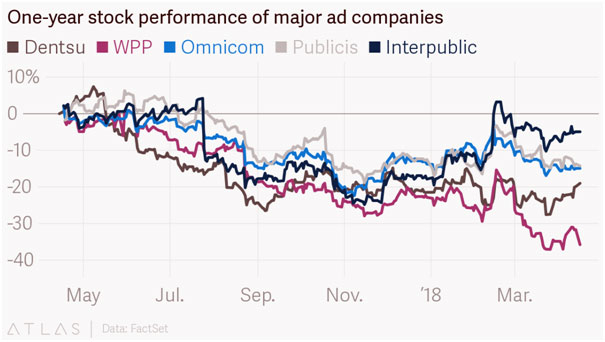
    WPP shares plunged 13 per cent on the London Stock Exchange because 2017 proved to be the worst year since 2009 showing a drop in net sales of 0.9 per cent.


    There seemed no single big reason why the largest communication group was showing weak results.  However, the industry has been under pressure with 84 per cent of the digital investment going to the digital duopoly: Google and Facebook. In addition, large global firms like Unilever had cut spends, while others like P&G were trying to cut out the middle man on media by going directly to the digital publishers.  Mark Pritchard of P&G told the press: ‘If entrepreneurs can buy digital media, why can’t the brand team on Tide, Dawn and Crest be entrepreneurs and do the same?” This might be a backlash of transparency issues that clients are having with agencies and also the suspicion that agencies are pushing more media money into digital because they are earning larger commissions there compared to traditional media.


    Internally, WPP was more than aware that they still function like a few large silos from media, advertising, data and research that don’t talk to each other.  This was reflected in Sir Martin’s statement to the press that they would move away from individual companies to a “to a cohesive global team dedicated to the core purpose of driving growth for clients.”


    While communication conglomerates like Publicis, WPP, Omnicom and Dentu went on an acquisition spree to offer a bouquet of services to clients, true integration amongst these disciplines has continued to be a challenge.


    In addition, the traditional agency model is antiquated, and the traditional agency has failed to come up with something new that can keep up with the times.


    Durex springs a new airy surprise

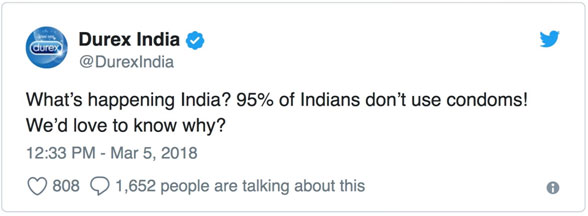
    Reckitt Benckiser is not the most creative client in the world, in fact most of their advertising is downright boring, but Durex seems to always break the mould.  Last year, Durex had surprised us with the Durex Jeans teaser campaign which had led everyone to believe that they could expect a new brand of jeans from Durex only to be presented with a DurexJeans a new condom.


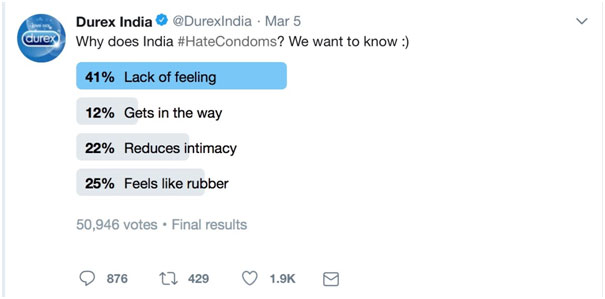
    Earlier this month, Durex went on to ask people on social media their main reasons for not wearing condoms and then presented the results of their research on twitter.


    Durex then went on to launch its new Condom Durex Air.  As its final tweet said: ‘Finally here’s our solution for all condom haters out there.  Presenting to you Durex Air, a condom so thin like it’s not even there. Reach a new level of intimacy and #LoveDurexAir.


    Do we need to thank Nike and Apple for introducing Air into our vocabulary to represent product variants which are thinner and lighter?  Somehow, I never thought a condom might also ride on the Air bandwagon.


    An exam in progressive parenting

    Exam time stress for both Indian parents and children is well known.  So much is the attention given to it that even our Prime Minister addressed students recently on how to cope with exam stress through “Pariksha par charcha” speech which was broadcast to all CBSC schools.  The Prime Minister even published a book called Exam Warriors.


    Bournvita did an interesting twist on exam time with their Exam Sale promo.


    A stall at a local mall had children selling their guitars, cameras and paint brushes for free.  They explained that they were being given away for free because their parents wanted them to focus on their exams. Passersby were surprised and this got an adverse reaction from them about marks and trying for a 90% grade being so important that students had to give up their hobbies.


    The message came through quite clearly that marks is not all that good parents must be looking for when evaluating their children.


    East India Comedy depicts the truth on advertising

    East India Comedy’s recent salvo might be less of a parody and more reflective of how the general content in advertising is depicted.  The video launched on Youtube said:“Introducing a new product to help women match up to all the expectations that society places on them. Ab aapbhi ban saktihain ‘adarshnari’!


    It suggests that women are being pressurised into buying products to become what society wants them to be.


    Maybe there is some truth in that!

  • P&G’s Pritchard continues to walk all over his agencies

    Mark Pritchard at Cannes Lions 2017​


    By Prabhakar Mundkur [updated]


    There seems to be no stopping Mark Pritchard, Chief Brand Officer at Procter & Gamble (P&G).  Almost every week, the man walks all over the advertising industry hammering it into pulp. And the ad industry having lost its spine a few decades ago, is happy to let him walk all over them.


    The latest disruption that he has created in the advertising business is to create a unit where he has pooled the best creative resources of all his agencies into one agency called the People First agency headquartered in New York and headed by Andrea Diquez, CEO of Publicis Group Saatchi and Saatchi.


    I wonder why the three agencies even agreed to do that.  Do they not have any sense of ego?  Or has the revenue that P&G offers them forced them into submission and servility?


    Imagine Prasson, Piyush and Balki sitting in the same agency and producing work for one client.  I am sure the Indians wouldn’t agree to a formula like that?  Or would they?  Is the lure of money and profit too big to show your spine to the world’s largest advertiser?


    One could have forgiven Pritchard if what he proclaims is the new agency model had created something breakthrough and innovative.  But People First seemed to have created just another television commercial like any other agency, when they worked on Tide for the Super Bowl.  The ad failed to move me and I am unlikely to show it at my next public appearance as an example of breakthrough advertising.


    Small Creative shops no threat to Large agencies


    When the first few creative hotshops set up, some industry experts interpreted it as a threat to the large agency setup.  Taproot was a good example of a creative hotshop threatening the large agency like JWT for example when they usurped a part of the Pepsi and Airtel account.


    But now going by experience, the creative hotshop is set up only to dress up the bride.  To create a viable agency, with the sole objective of being acquired by a large group a few years later. And so alas Taproot became a part of Dentsu.


    A slew of other small hotshops followed among them Scarecrow.  Again, like Taproot but to a lesser extent it became a threat to the large agency taking little chunks of MNC and local business from other agencies.  But again, like hotshops before them the sole objective was to create an agency for acquisition.  Scarecrow has been acquired by M&C Saatchi now making it Scarecrow M&C Saatchi.


    Some will remember that M&C Saatchi has not had an illustrious existence in this country.  The agency floated around for a while without making any waves before leaving the country altogether.


    But it seems that with the new acquisition of Scarecrow, M&C Saatchi may have more to benefit from the partnership than Scarecrow. A quick look at the M&C Saatchi global website reveals that its global accounts might have not much leverage in India :Nandos, HBO, Natwest, Lexusetc are unlikely to affect the fortunes of either Scarecrow or M & C Saatchi, significantly.


    But of course, there is an upside as always.  The owners of Scarecrow will become rich and M&C Saatchi can drop one more pin on its global map of offices.  Besides Scarecrow of course can show off an international halo.


    Are India clients likely to work with New York agencies?

    One would have thought that Indian clients would never have considered working with a New York agency for many reasons. Time, distance, understanding of culture, and several other constraints.


    But much is being made of Nadia Chauhan’s appointment of Sagmeister and Walsh the New York-based agency that works on Parle Agro’sFrooti.


    In a new splash all over the Indian trade journals, both Nadia and Jessica Walsh a partner with Sagmeister Walsh raved about each other.


    The commercial itself was a little unimpressive according to me.


    The commercial features Alia Bhatt and is a combination of real life and animation.  As usual and like most Frooti ads the commercial was totally execution oriented and lacked any unique advertising idea for the brand.


    The graphics also reminded me of a style that the agency has developed of using post-modern art with strong graphics which they seem to be doing with all their other brands as well.


    I wonder if this was meant to show the world that Frooti has a New York agency or was the move only to slight its previous agency Creativeland Asia which was the Frooti agency for nine years.


  • Mathman Sorrell quits WPP equation


    By Prabhakar Mundkur


    When Martin Sorrell made a hostile bid for J Walter Thompson (JWT) in 1987, nobody could believe that an ad agency could be the victim of a takeover.  Largely because agencies were held together by loyal clients who could object to new owners if they thought them inappropriate.  JWT at the time was doing badly in financial terms with gross margins of less than 5%, which were perhaps the most embarrassing agency margins in New York.


    Sorrel at the time was confronting a company several times WPP’s size.  Besides while he had been finance chief of Saatchi and Saatchi, a job he quit in 1984, Sorrell had no previous experience of running a firm as large as JWT.  To his credit, the financial turnaround at JWT was quick and methodical.  But we saw some of our favourite people leave the agency, particularly the planners and other intellectuals.  But Sorrell felt that the thinning of the management ranks would do JWT good, and perhaps it did.  In many ways though, it also destroyed the soul of the company as the ‘thinking’ agency.   Who would have thought that this was the beginning of the takeover spree by Sorrell.  Ogilvy was next, although it was rumoured that he may have paid too much for Ogilvy and that it would be his downfall.


    Compared to the $566 million that Sorrell paid for JWT in 1987, Ogilvy was acquired at $864 million in 1989.  Although perhaps a little smaller than JWT, Ogilvy was the agency with a better creative reputation thanks to David Ogilvy, its founder.  With two of the best ad agencies under his belt there was no stopping Sorrell.


    While he was responsible for making the advertising industry more profitable, he might have destroyed the spirit of the industry forever.  The entry of bean counters into the advertising business was not well received those days.  David Ogilvy called him an “odious little shit” who had “never written an advertisement in his life.”  But to Sorrell’s credit, he learnt about the advertising business quite quickly.  When I heard him speak in the ’90s, it was difficult to imagine that Sorrell was a finance man.  He seemed to have grasped the essentials of the advertising business, and was making good sense to clients.


    But internally people at his agencies found him autocratic and dominating.  He took all the decisions leaving none for others.  Not always pleasant, I remember once before presenting to him he told me “your neck is next on the chopping block”.  If this was British humour, I may have missed it.  It certainly wasn’t a pleasant way to start your presentation.


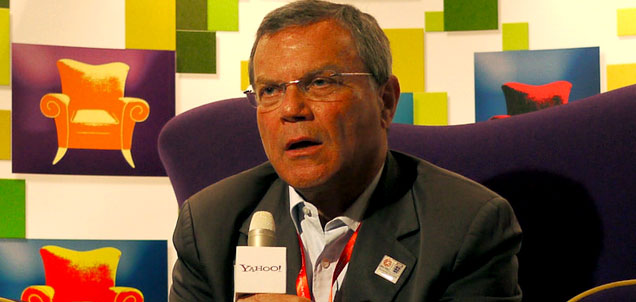
    In his 31 years since he first pitched for JWT, Sorrell has of course transformed the advertising business.  More WPP revenue comes from media, research and data than from the traditional ad agency business something that he was proud of and referred to as the transformation of Madison Avenue from “madmen to mathmen”.  Something that might be real but which has also taken the romance out of the advertising profession.  But to his credit who would have thought that the British could have led an assault on Madison Avenue.  He was not a likeable guy but one has to salute his achievements.


    With Sorrell leaving, speculation must be rife on who will take over.  In my mind the biggest question is whether the successor be a mathman or a madman.  That might make all the difference to how this industry goes into the future.


    Sorrell leaving might be a good lesson for Indian CEOs.  The mighty should step down before they have to.

  • So what do we make of Infosys gobbling up Wongdoody?


    By Prabhakar Mundkur


    Prabhakar Mundkur

    The acquisition of Wongdoody for the Infosys Consulting Group could mean two things:

    1. Infosys is serious about the consulting business which has hitherto been a bit of a weak spot for them.

    2. The threat of the consulting-creative shop is closer back home for the communication groups in general.


    Not surprising. When Salil Parikh took over as CEO, many industry analysts predicted that he would strengthen the Infosys consulting business given his experience in consulting with Capgemini. His other strength was that he had worked in Europe for Capgemini, again a weak spot for Infosys whose primary strength has been the US.

    It did seem certain that Infosys could get more acquisitive and this was something that perhaps Salil Parikh would understand better than anyone else at Infosys. Capgemini’s successful consulting business accounted for 4% of its revenue. In comparison, Infosys has been struggling with the consulting business although they took a view to revive it in 2016. So the acquisition of Wongdoody makes more than good sense. No doubt the sale of Panaya and Skava announced recently will help fund this acquisition. It is indeed a smart move by Infosys to add value to its existing offering.

    The Infosys-Wongdoody combine is yet another emerging threat to the large communication groups like WPP, Omnicom and Publicis who have seen a slew of consulting groups joining the fray to acquire creative and digital capabilities.

    Scott Sorokin, the global head of Infosys’ digital arm is known to have said: “Their creative excellence and reputation for driving engaging digital customer experiences that operate at the intersection of advertising, retail, technology, and design precede them. I’m personally excited to work closely with the Wongdoody team to strengthen our customer experience capabilities and bring new thinking, talent, and innovation to our global clients.” For Wongdoody applying their creativity and design capabilities in new ways with Infosys’s technological capabilities creates a win-win situation for both.

    Large communication groups like WPP had been initially dismissive of the threat from the consultancy business. Sir Martin Sorrell is famously known to have said consultancies can’t buy “culture”. But with the sudden resignation of Sorrell, one looks forward to a new leader at WPP who can push back the emerging consulting threat for communication groups in general. And of course, push back the threat for WPP which has seen its stock price plummet by 35% from its 2015 high.

    But what is happening in the meantime to the advertising agency and the communication groups? Advertising agencies for a long time now have devalued their own services by charging less than they are worth. Add to this the unfair price competition with every agency trying to undercut every other agency. Their current weaknesses have allowed them to let clients disrupt their business model.

    The Chief Disruptor of the agency business model seems to be not the agencies themselves but a client. Mark Pritchard, Chief Brand Officer for P & G, has pooled three of his agencies into one creative agency called People First. Responsible for creating the Tide Super Bowl commercial in 2018 which was certainly not the best Tide commercial to date, it is keeping industry observers busy while they wait in great expectation to see what good comes out of it. But one thing that disruptors like Pritchard seem hell-bent on doing is to disrupt what they call the Mad Men model. Who would have thought that one famous television serial could have created so many demons around us wanting to decimate the quintessential character of the advertising business?

    You may not want to believe it. But to sum up, with all the emerging threats on the communication groups, including clients like Pritchard who want to disrupt their business models, the threat of consulting groups taking over a slice of the business from communication groups might be closer home than we think.


  • The Empire Expectantly Waits…


    By Prabhakar Mundkur


    They are enormously big shoes to fill.  As WPP looks for a successor, one can’t help but speculate on what it will take to step into Sir Martin’s shoes.


    WPP is much larger than we can imagine.  It has 405 ad agencies, PR firms, marketing and media buying agencies that include JWT, Ogilvy, Y&R, Grey, GroupM and Kantar.  With over 200,000 people in the group, it is no mean feat to manage this behemoth.


    WPP is not at its best at this juncture in its history.  Its stock has seen a 35% decline from its high in 2015. It also seems to be declining faster than the other communication groups.


    The search for a successor has been on for the last eight years ever since WPP shareholders put pressure on knowing what would happen to WPP post-Sorrell.  One can only imagine that no candidate came close to be considered as a replacement for Sorrell.


    So what do we expect the ideal candidate would be?


    Commentator on the Global Economy

    Sir Martin has been a commentator on the global economy.  He constantly appeared in the press with his views on it.  He has also had a great perspective of the various regions.  He could talk as competently about Asia and he could about Europe or the US.  He related global events to the world economy.  For example, he had an opinion on how Donald Trump or Brexit would affect the world economy. At Davos this year he held his own on globalisation, capitalism and the ‘America first’ policy.He also had a comment on India and Prime Minister Narendra Modi at the same forum when he said “India has been extremely successful, he’s been extremely successful in changing Brand India, and in changing the actual performance of the Indian economy, but the question is, how does he continue to maintain the progress that he’s initiated? He has elections coming up in 2019, so hopefully, he will get another term, and take Brand India to another level.”


    Believer in Ideas

    Sir Martin was the quintessential entrepreneur. He knew how to start something small and make it big and this is exactly what he did with WPP since he first founded it in 1985.  He was a deal-maker. And master negotiator.  For people who thought he was just a bean counter, in an interview with the Daily Mail in 2014 he is known to have said that ideas are more important than making money.  At other times, he spoke of ambidexterity and that great leaders needed judgment, creativity, intuition and imagination.


    And Sir Martin did have ideas.  Almost all of his acquisitions were based on creating value for this company. His latest bug was “horizontality”. More than aware that the companies within the group were functioning in individual silos, Sir Martin was championing his idea of “horizontality” which he defined as  ‘connected know-how’: a way of working that unites people with diverse skills to deliver seamless solutions for clients”.


    Networker

    Sir Martin was a master networker.  This is what made him successful with WPP clients whom he met regularly all over the world.  Sir Martin was also charming when he wanted to be, and a great conversationalist.  Because he was interested in a wide variety of subjects he could quickly connect with most people.  I remember once introducing him to the Chairman of a company and my five-second brief to him was that the client was ex-MIT and an entrepreneur.  A few minutes later Sir Martin was engaging with the client and speaking about MIT and how he had just visited Boston a few months ago.


    Quick and Decisive

    Sir Martin was famously known for responding to his email on the fly.  Considering the size of WPP, everyone was assured of an immediate response to a query or approval from Sir Martin. Some people would joke about it and say that he perhaps had some people who could respond to the  routine emails and text messages.  He once said  “an imperfect decision on Monday is better than the 100% perfect decision on Friday”.


    The Will to Win

    Sir Martin liked winning and he made it a habit and always gave it all he had.  In a LinkedIn article in 2015 called “ 7 qualities What Will Get You Hired “  he said “ I often plagiarise Bill Shankly, the legendary manager of Liverpool Football Club, who famously said: “Some people think football is a matter of life and death; I can assure them it is much more serious than that.” That’s how I feel about WPP.  He reiterated this feeling in his farewell note to WPP employees a few days ago he said “As a Founder, I can say that WPP is not just a matter of life or death, it was, is and will be more important than that.”


    Industry observers are busy making predictions about whether the successor will be internal or external. Management theory tells us that if someone is 60% ready for the job, promote him and he will grow on the job.


    The problem here is that one can’t see anyone internal or external who is 60% ready to take on Sir Martin’s job. Or at least they don’t seem to be on the horizon as yet.


  • How nervous CMOs nail ad agencies to save their skin


    By Prabhakar Mundkur


    The General Motors diet became famous some years ago as an effective means of slimming down and losing weight, although why it was attributed to a car maker completely alluded me. I later discovered it was an eating plan indeed developed by the car company. In January 2018, Ford Motors announced it would go on a ‘fitness’ initiative that would include slashing spending of up to $14 billion in the next 5 years. Marketing they said would naturally come under the lens along with the current WPP relationship although nothing was confirmed.   Now comes the Ford Motors announcement of a call for an advertising review of a part of their business.  WPP has been a near lifelong partner for Ford Motors first with JWT, and later with GTB a dedicated unit for Ford which was set up to pledge loyalty and allegiance for the account.


    Unfortunately, putting the Ford account under review on the heels of the resignation of Sir Martin Sorrell could not have been more mistimed from WPP’s point of view.   But one wonders if this is a typical kneejerk reaction to the rising pressure on profitability at Ford.  Ford has been reporting underwhelming profits in the last year and the outlook for 2018 looks no better.


    The history of advertising is strewn with examples of clients putting the agency under review whenever there is a sneeze on the business front.  Although the problem might have nothing to do with communication, agencies have been the first to be hit, often unfairly by nervous CMOs trying to save their own skin.


    Ford is the third largest car maker in the world with a global market share of 6.5% after Toyota which is at No 1 with a 9.2% market share and Volkswagen at No 2 with a 7.2 % market share.  But except their Top 5 markets, which includes US, China, UK, Canada and Germany the brand might be under pressure more because of an inappropriate product mix country wise rather than any problem with their communication.


    Xiaomi, the Price Warrior

    Xiaomi overtaking leader Samsung in the last quarter of 2017 as India’s largest mobile might have taken even Samsung by surprise.  The brand now seems to be readying to be a world No 2 globally not a mean feat.


    But this begs the eternal question for marketers.  Are price warriors long term players or are they just destined to be the flavor of the year?  While Xiaomi has definitely disrupted the market the key question that comes to mind is whether Xiaomi is an affordable brand or is it a cheap brand?  And does it have anyother endearing quality in its arsenal beyond price.


    When one looks at their latest commercial with Katrina Kaif it seems to be a pure execution without a long-term brand building idea.


    We have seen many price warriors fail in the past.  A great example is Videocon which managed double digit leadership market shares in its initial phase, but now is a forgotten brand with a staggering debt.


    Unfortunately, after looking at their latest China commercial. I did not find it inspiring either.  So hopefully the brand takes notice that positioning and building brand values is as important as disrupting the market as a price warrior.


    IPL is full of Surrogate Advertising 

    One ex-industry professional with a long-term grudge against the advertising industry has pointed out an accusing finger at the industry’s self-regulatory body for the number of surrogate ads during the IPL.


    Unfortunately, the ball on this seem to lie squarely with the government.  Advertising for extensions of liquor brands is allowed under the Cable and TV Act 1995, and this comes directly under the jurisdiction of the I & B Ministry and the CBFC.


    Any way the accusations of the person in question may have been misplaced. Obviously, he has not done his homework before setting his pen to paper.


    Whither Abbys?

    Now that the Abby fever is over, it does seem that participation at the Abby’s declined severely this year.  Also,there were the usual complaints of not being able to get a drink or dinner without standing in a long queue even though the crowds were smaller this year.  One big disappointment seemed to be that the Master Jury members could not get their own agencies to participate. The award’s organisers seem to think that the reason for the lack of participation is the high cost of entry that is dissuading agencies. Some say that the organising members of the Abbys are the same year after year and new members are not welcomed, which may also be a constraint on the award show.  The flipside of this argument is that not many leaders are willing to come forward to offer their services to help the industry bodies.


    Bill Gates once said, “Your most unhappy customers are your greatest source of learning.” Obviously the trick here is to find out why the non-participating agencies are staying away from the Abbys.


    Unless of course the real reason is the over-inflated egos of the key industry leaders which might be the root of the problem. And there might be no real solution to that one.


  • With Flipkart, will Walmart finally compete with Amazon in online space?


    By Prabhakar Mundkur


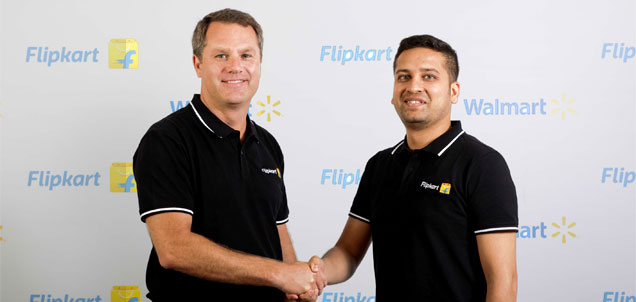
    For a long time now, Amazon has been a pain in the side of Walmart. Largely because Walmart has been the traditional brick-and-mortar retailer, who hasn’t yet made the kind of inroads they would have liked to make in the online space. But they have tried hard, even to the extent of letting you place your orders online so that you can just collect your shopping from the nearest Walmart store. In its first fiscal year after the Jet.com acquisition, Walmart online sales grew 44% to hit $ 11.5 billion. However, in the fourth quarter of 2017, it grew just 23% rattling investors and bringing down their stock price by almost 10%.


    But is Jet a good fit with Walmart? One is not sure. Jet has higher income consumers who are urban in their profile. In fact, analysts have questions about how Walmart will integrate Bonobos and Modcloth, its other online acquisitions into the main brand Walmart. But the challenge for Walmart remains. How can it play catch-up with the world largest online store in the world which is Amazon? And how can it make a dent in what it has identified as its key growth market i.e. China and India? Compared to its other acquisitions Flipkart seems like a perfect fit. And there will be very few integration problems with the brand Walmart.


    The problem is not just the fact that Amazon has a headstart in establishing an online business. There is also the question of the brand Amazon versus the brand Walmart. Younger consumers somehow prefer to shop at Amazon rather than Walmart which has to do with the essential personality of the Amazon brand rather than anything else. Walmart has positioned itself through its tagline ” Save money. Live better”. While this might be true, that is also what Amazon offers without saying it quite so explicitly.


    In this context, the acquisition of Flipkart makes great sense. It gives them a foothold in India, one of their priority growth markets. It gives them growth in online sales, something that has eluded them in spite of their other acquisitions in the online space. And lastly, it positions them as a formidable competitor to Amazon in India, something they have not managed in any other country in the world. So, with the acquisition of Flipkart, they lock horns with Amazon for a piece of India’s growing retail sector. The online sector has always been something of a challenge for Walmart. Doug Chief Executive of Walmart is known to have said ” “We’re learning something new . . . has not been our historic competency.”


    Why Flipkart?


    Source: Walmart

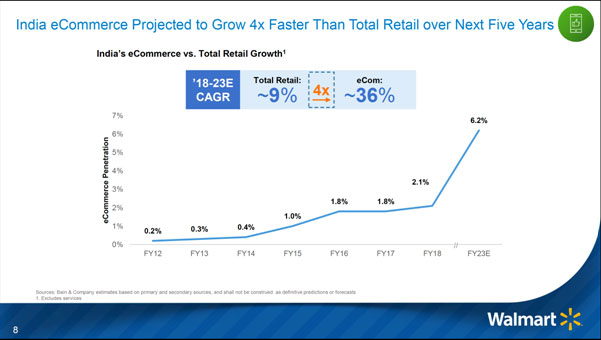
    First of all, India is a growing market with GDP growth rates which are amongst the best in the world. Secondly, India is a young market and has the largest number of millennials and Gen Z accounting for almost 66% of the population. This gives Walmart access to a young market which has hitherto eluded them in the core North American markets of Mexico, Canada, and Central America. India is the second largest internet market in the world and still growing furiously. And lastly, India will have almost 58% smartphone penetration by 2020 easing the way for online sales. And lastly in the future offline retail is likely to show good growth and online retail will be a multiple of offline retail growth. All this makes Flipkart a very attractive proposition.


    Source: Walmart


    Besides being an attractive market the acquisition of Flipkart gives Walmart access to Myntra and Jabong which is India’s leading fashion online destination.


    In many ways, therefore, this seems like a marriage that has been made in heaven.


  • The Pitch Bazaar with 22 ad agencies


    By Prabhakar Mundkur


    When Rediffusion won the State Bank of India mandate, the more staggering news was that Redifffusion had bagged the account of the largest public sector bank in the countryin a pitch with 22 agencies. After all, nowhere in the world would a client ask 22 agencies to pitch for their business.  Nor would any company ask 22 vendors for an RFP.  Calling 22 agencies means that either the client has done no homework, whatsoever in creating a short list through some preliminary desk research. Or it means that there is pressure that percolates from the top to call so many agencies, which might be typical of public sector accounts. After all every senior person in a public sector has a favourite that needs to be included.And this system has dogged the ad agencies for many years. It defeats all the sensibilities of vendor management. Good management practice would dictate not to ask more than five or at the most six vendors to participate. After all, if you called such a large number to participate, common management sense would dictate that the best would stay away.  But not in India and not for a public sector brand perhaps. The tradition has been that everybody throws their hat in hoping that they will hit a lottery.  But for some strange reason, public sector companies seem to follow the ‘more the merrier’ approach when it comes to appointing vendors.


    But this then has been the history of the public sector in India. They have treated their ad agency pitches like a circus.  I have been in public sector pitches where their time management is so atrocious that you are sitting with another three-four agencies, in a common waiting room because as usual either someone has taken more time than what was allowed and not been disqualified or because the entire process started late.  Public sector brands are known not to follow common courtesies and niceties like in the private sector.


    Also, public sector pitches are highly political.  The moment a winner is announced, there is a chorus from the losers that the match has been fixed almost like boxing matches of yore when a winner was announced.The losers are typically smaller agencies which supposedly have a reputation for financial advertising or have public sector experience, whatever that means. Which might have prompted Dinesh Menon, Chief Marketing Officer of SBI to tell the press a few days ago that “There is no such rule that a PSU bank has to work with several agencies.”Of course, there is isn’t.  And no doubt his detractors might be quoting history.  A 2009 press announcementfrom SBI proudly announced 10 agencies would share the then Rs 200 crore advertising account.  And if we found ourselves overawed by the sheer number of 22 agencies participating in a pitch, then 10 agencies sharing an advertising account, takes us from the ridiculous to the sublime. Even the world’s largest advertisers like P & G don’t have 10 ad agencies on their roster.  So, well done SBI for having the guts to challenge the age-old public-sector practice which has been the woe of several ad agencies for the last many decades.  Please now break the next rule and call only 5 agencies for your next pitch whenever it is, in the future. And then do us one last favour. Tell the other public sector companies to follow your good example.


    Are Indian ad men bad losers?


    I was surprised to see an interview with Pratap Bose in afaqs.com this week.  It seemed like he has been required to justify the stellar performance of his agency The Social Street at the recently concluded Abbys. After all the Abbys are supposed to be awards ‘of the people, by the people and for the people.” I was surprised by the tone of the very first question posed to him:

    “Let’s talk about the issues around your Goafest performance. You have been accused of doing pro bono work to win awards. Comment.”Such an accusation from whoever it is, seems to be in very bad taste.  After all, if pro bono creative seems to win awards at the Abbys, that could be a flaw with the award show and not a flaw with the winner. No other agency was prevented from entering pro bono work I am sure.

    You can only come to one conclusion. That in addition to everything else that plagues the ad industry, they seem to be very bad losers as well.


    Is TV finally dying?


    It certainly isn’t in India where everyone’s eyes are glued to the IPL frenzy.  But we have heard for sometime now that digital slowly seems to be taking over consumer’s preferences.  Hard to believe, but true.  And with the recent accusations against digital media of a lack of transparency from the chief slayer of the current ad agency model, Marc Prichard of P&G, one would have thought that the fascination for digital might have waned.  But maybe not so.


    Adidas chief executive Kasper Rorsted told the press that they have turned their back on TV advertising.Rorsted is known to have said: “It’s clear that the younger consumer engages with us predominantly over the mobile device. Digital engagement is key for us – you don’t see any TV advertising anymore.”


    MrRorsted seems to have bitten the bullet instead of just paying lip service by praising the effects of digital like some other global advertisers.  In fact, one particular global FMCG company hasn’t even updated its brand’s Facebook pages of some its brands for months now. And yet they keep evangelising on the power of digital.


  • Does Nostalgia work for Parle-G?


    By Prabhakar Mundkur


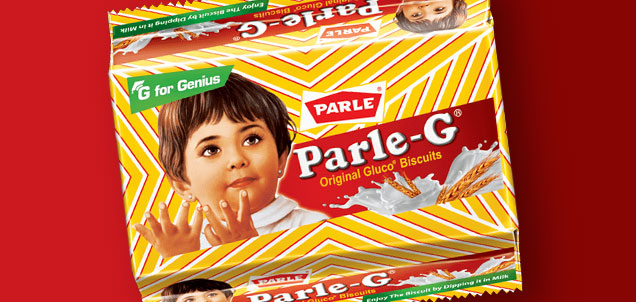
    ‘Brands are like people,’ proclaimed Stephen King the father of account planning.  And like people, brands unfortunately grow old too!  Brands periodically try to stave off the effects of aging through marketing and advertising. But old archetypal brands have something magical about them. They appeal to the masses because they are the lowest common denominator and can talk to anyone in any social or income class, irrespective of class, creed or sex. They are the social glue that brings and keeps people together. They are brands that satisfy, typify and unite all the individuals of one large social tribe. A tribe which is united by common interests, beliefs, habits, languages, culture and customs.


    But when brands get old, marketers worry. Their first instinct is to figure out how to make the brand younger.  If a brand has become so mass that they are now failing to appeal to a higher income demographic they would like to get them back.  The ‘formula’ solution from ad agencies is to show younger, better-to-do people in the commercial.  And then hope that the brand acts like a mirror where these new targets can see themselves in the brand. Parle-G is one such archetypal brand.  It instantly brings back childhood memories of dunking Parle-G biscuits in chai.  Mind you, chai in a ‘cutting’ glass perhaps, rather than chai in a tea cup tea that comes out of a teapot. With the background at best of a Lucknow skyline rather than a Manhattan skyline.


    It is not difficult to see what the client’s brief on the new‘You are my Parle-G’ campaign might have been. After all every brand in the country is chasing millennials – it is the new buzzword in marketing. Of course, India is supposed to have over 400 million millennials. That by any stretch of the imagination is not a segment, it is an entire universe!   And god help all those who are trying to typify such an incredibly large audience.  Because a school teacher’s twenty-two-year-old son in Jhumri Telaiya might hold very different attitudes to life from a IIM professor’s twenty-two-year-old son living in Ahmedabad!


    The new campaign has launched with a string of  very nicely made commercials with people reminiscing about their moments with Parle-G in the past.  One couldn’t help feeling that the people portrayed in the commercials somehow seemed more privileged than earlier Parle-G commercials – in fact in one commercial the protagonist was even working overseas. Probably signalling another possible worry about the brand: that as we move up the income chain, usage of Parle-G is likely to drop.  And of course the last worry being that children were glad to have a Parle-G but maybe not the man in his twenties (how I hate to say millennial!).


    Nostalgia Marketing

    Of course, if reminiscing about your past experience of a brand does anything to prompt its present or even future usage is still a question.  Quite often the problem with old brands is that nostalgia cantend to remain as nostalgia. One piece of American marketing theory says that the millennial generation, in particular, is longing for the familiar. Largely because the defining cultural motif of our times is to counter the exhaustive pace that technology is forcing on our lives. Millennials, this theory says, are looking for brands that remind them of growing up and that elicit feelings of safety, comfort, and happiness. And that there is a yearning to bring back the “good old days” as they remember them. This kind of marketing logic rests on the fact that people (millennials) are literally buying into the past.  The thesis is that if you can show that a brand has been a part of a culture in the past, it shows how relevant it is to the present.


    But if a brand is rooted in nostalgia, the question that needs to be asked is how is the brand positioned to evolve?For me the most potent shortcoming of a nostalgia campaign in general is that it makes people remember why they fell in love with the brand, but doesn’t tell us how that love has evolved to the present day.  And that perhaps is the biggest risk of nostalgia marketing.Another problem for aging brands is trying to hit the sweet spot between the mass market and the demographic that the brand is currently missing out on and this is often an elusive task.


    So, is nostalgia marketing common for other brands we know?  Almost every brand has had a brush with nostalgia marketing. Coke, Pepsi, Microsoft and many others. Two years ago, Coke even actually remastered its 1971 classic coke commercial created by McCann Erikson for 4k television.  At the 2018 Super Bowl a number of brands retreated into the past while playing the nostalgia theme. Here for example is the Pepsi commercial that aired on the Super Bowl which even brought Cindy Crawford back.


    Unless it was just a reaction to the backlash they faced with the Kendal Jenner spot they had to ultimately withdraw.


    Facebook is really good with nostalgia marketing. It keeps reminding you of pictures that you put on Facebook ten years ago.  The term ‘a blast from the past’, is a meme, that uses a new colloquialism that is actually related to nostalgia.


    In closing, when you talk about an 80-year-old brand like Parle-G, one is bound to have one’s favourite campaigns for the brand. For me, my personal favourite is a string of commercials created about fifteen years ago.  I think these commercials hit the sweet spot for both what Parle-G as a brand stands for.  And without quite saying it explicitly in so many words it implied that Parle-G is Bharat ka Apna biscuit without the elaborate antics of anyone painting their faces with the national flag.


    These old commercials reflect in many ways the real India and the real Parle-G in its most genuine context.  And while it shows young children in the commercial, we always knew that adults loved Parle-G equally!


    But “the times they are a changin’ ” as Bob Dylan once said.  And the new campaign is well-made and perhaps reflects the new reality for this lovable old Indian brand.