Tag: YouTube

  • Paritosh Joshi: So you want a job in the Media?

    By Paritosh Joshi


    MBA from a leading business school in the American Midwest, two years with a boutique investment bank in Boston and then this young man lands up for a chat about what he needs to do to get a job in the media.


    It is still easy to think there is a clear demarcation that sets the media apart from the rest of the world. Aamir, Ashton, Arnab and Aishwarya are in the Media. (They don’t even need surnames to identify them). Media people ‘need no introduction’. Us grunts have nothing worth introducing and thus, don’t need to be introduced.


    Or is it so simple?


    There were the Media people but they were few and readily identified as such. M J Akbar dazzled us with his insight in columns for a newspaper he edited. Rajat Sharma put people into the dock, quite literally, as he hosted a talk show. Derek O’Brien got all of us furiously scratching our heads even as he quizzed school kids. Madhuri Dixit sent testosterone levels into orbit merely by counting from 1 to 13. And Lalu had to invoke Sridevi’s cheeks in search of a universally comprehensible metaphor for Bihar’s roads.


    Then Tim Berners-Lee came along and changed everything, although for years after he thought up hypertext in an obscure corner of CERN, we would scarcely have known it.


    By the late 90s, regular blokes discovered that it was possible to find a wider audience for their periodic rants on WWW than they previously could muster around a water cooler or in a cafe. The web log, then portmanteau-ed to weblog and finally truncated to blog was born either in 1995 or 1997 (you can find an interesting history here).


    Then blogger came along in 1999, bang in the heady days of the Dotcom Boom and setting up a blog became Luddite-proof. From the very beginning, the blogging community had a wide range of interests and capability. The largest majority would create an account in an idle moment never to visit it ever again. A few would invest time and effort in their posts and endeavour to reach out to an audience with regular, engaging updates. Remember that these were people operating far away from the conventional notion, but what they were doing was indisputably publishing.


    Everyman had just stormed Fortress Media.


    It began with the written word. Soon enough, authors had found ways of adding pictures to their words. And the web was becoming more clever all the time. It was able to transport not just text but sound and video too. Also, devices to record audio and video had started to shrink in price and size even as they got massively more powerful, thus putting near professional quality sound and image acquisition within reach. Events unfolded at a rapid pace thereafter. Amazon pioneered a lightweight handheld device for reading digital publications. The Kindle was a runaway success and for the first time, books could be self-published by anyone with a good idea and capable penmanship without ever being imprinted onto the dead-tree medium. Soundcloud allowed wannabe speakers, singers and instrumentalists to distribute their art and craft without surrendering themselves to the crafty gnomes of the music industry. Youtube opened doors for every standup comic, ballerina, burlesque queen and cute kitten to show off its talents on glorious Technicolor video.


    But wait, we were talking about an investment banker contemplating a career in the media. So what’s with this long riff about what we now refer to, rather condescendingly I might add, as User Generated Content?


    Well, it wasn’t just individuals that got inspired to start using the all new powers of WWW to talk to their “Audience”. Businesses of every stripe saw the opportunity too. To be rather more honest, what they saw was consumers – happy and irate, sounding off about their brand experiences in these wide open spaces and were left with little choice but to deal, for better or worse, with what they were getting. Surely we’ve all heard the now almost apocryphal story of Coca Cola’s attempt to take down a fan page on Facebook that spectacularly backfired? To the point where they had to pretty much say ‘Let bygones be bygones and let’s be friends’? (Moral: Don’t clobber, co-opt).


    You see what’s happening here. Companies and brands were becoming broadcasters and publishers.


    At no time before in the history of our human civilization has communication across every conventional fence and barrier been so easy, inexpensive and by implication pervasive or ubiquitous. And barring the rare exception, individuals and entities find it more productive to be participants in this endless feast of reason and flow of soul than mere mute spectators. There’s even a taxonomy to describe different levels of involvement with media: Paid media are, as the name suggests, those that you have to buy access to. Earned media are where the media voluntarily carry news or content about you. Finally, owned media are, again as evidenced by the name, those that you own and control. Who doesn’t want earned and owned media?


    And what was it that we were talking about when we began this ramble? Ah, yes. A job in the media.


    I told the young man, he could stop looking. After all, every job- FMCG, Banking, Automobiles, Telecommunication, <insert randomly chosen industry name here> eventually, was going to be a job in the Media.


    Paritosh Joshi was until recently CEO, Star CJ. He has been a marketer, a mediaperson and a key officebearer on industry bodies. He is Strategic Advisor, Ormax Media. He can reached via his Twitter handle @paritoshZero


     

  • Ranjona Banerji: Irritating ads that irritate

    Ranjona Banerji

    By Ranjona Banerji


    Am stepping on a few toes here and other people’s territory but then wothehell. As much news as you watch on TV (or as much TV that you watch, be honest) you’re forced to watch as much advertising as content.


    And sometimes it’s fun (like Hari Sadu and naukri.com) or even the poor chappie who thinks he’s eating chicken, but it turns out to be a doggie. Or Fastrack’s funny series on the risqué side with Genelia D’Souza and Virat Kohli. Or even the Flipkart ads where children play adults.


    But what does one make of Priyanka Chopra squirming about on the ground to a song that does not match the bizarre dance she does as she tells us she hates the “chip chip”. All that happens for Garnier is that most people throw up and switch channels.


    Through the telecast of Wimbledon on Star Sports you get to hear that “amazing Thailand always amazes”. Well, duh, couldn’t they think of another word? Or has someone done Thailand tourism in?


    The Kelloggs ads with that vastly annoying mother who does something as simple as throw a few almonds on a bowl of cereal and pretends she’s invented sliced bread is anodyne as such ads normally are.


    But the winners of the most irritating ads have to be Reliance Foundation and Coca-Cola. Insensitivity seems to rule the Coca-Cola ad in which a group of not very well off (how do I say this politely?) children play cricket in some dusty desert scrub land as a voice over tells us poetically how they have no cricket bat, ball, stumps, the pavilion has no roof and so on and ends some poignant note about how this is not play but the call of the earth or something. Then Sachin Tendulkar with his strange new hairstyle drinks a Coke and says play on. The children and Tendulkar never meet and you get the feeling that the children cannot afford to drink Coca-Cola, certainly not one each.


    And there’s the Reliance Foundation. I’m not getting to the connection with the programme Satyamev Jayate. For one, the ad looks like a copy of the Vedanta ad, which claimed to be saving the lives of various village children with schools and food and making their dreams come true. The ad ran into as many problems as Vedanta does with its mining projects and the company’s attempt to redeem itself with this real or exaggerated NGO social work effort did not work.


    If indeed Nita Ambani is moving into social work, an ad that copies an already discredited ad is surely not the best vehicle. Also, the figures put up for the number of children fed or schooled or clothed is embarrassingly small for a company the size of Reliance. Even worse, Nita Ambani’s look is so carefully crafted that it looks just that. Also makes her ears look unnaturally large.


    Hidden persuasion is fine. But these are attempts at such blatant manipulation that they are not just exploitative, they may not even work.


    For those interested in advertising and how it works, try and catch The Gruen Transfer on the Australia Network or Youtube. Hosted by Australian comic Will Anderson, it is funny, incisive, intelligent and hard-hitting. And did I say funny?


    All right, I’ll watch the news from tomorrow.


  • Hungama Digital to manage Microsoft India’s social media

    By A Correspondent


    Hungama Digital, part of Hungama Digital Media Entertainment Pvt. Ltd., has won the social media mandate for Microsoft India’s corporate brand. Hungama Digital will manage all social media interaction on Facebook, Twitter, YouTube, blogs and other collaborative mediums on digital media.


    Besides the corporate mandate, Hungama Digital will also manage three other businesses for Microsoft India on social media – MSN India, Windows Azure and Microsoft Office.


    Commenting on Hungama Digital’s appointment, Meenu Handa, Director – Corporate Communications, Microsoft Corporation India Pvt. Ltd. said: “Over the last few years, we have invested significantly in social media, and it is today a substantial part of our media mix. To take our social media platforms to the next level of growth, we were looking for a creative and experienced team to support us and have found a passionate and engaged team in Hungama Digital.”


    Speaking on the winning the account, Siddhartha Roy, COO, Hungama Digital Media said: “With the growing number of interactions over digital, especially on social networking sites, this is a great opportunity for the team at Hungama to build Microsoft’s corporate image on the social platform. The team also brings to the table over 13 years of digital marketing experience – over the internet, mobile, and other connected platform, that have resulted in award winning campaigns over the years. We are extremely excited about the business and look forward to a long sustainable relationship with Microsoft India.”


    Currently, Microsoft’s corporate social channels in India include Twitter, Facebook  and YouTube.


  • Comment: Jehangir Pocha on Media’s new Moguls

    By Invitation


    By Jehangir S Pocha


    Among all the transformations taking place in media, here’s the crucial one – the media baron is being replaced by the media conglomerate.


    Corporations are buying news properties once owned by individual proprietors at a rapid pace. Expectedly, media mavens and professionals are crowding conferences to express their angst: Are these oligarchs becoming media’s new moguls only to protect their empires and project their interests? Will they interfere every time a story is done on their favourite babu, minister or party?


    But this holier-than-thou approach that automatically assumes a media baron is better for journalism than a media conglomerate is as reactionary as it is wrong.


    A corporation owning a news property can be expected to slant or kill a story inimical to its core interests.  But those are few and far between.


    After all, how many core interests can a corporation have? On the other hand, many media barons have been notoriously whimsical, politicized, opinioned and ideological, slanting almost every story almost every day, and killing (or overlooking or underplaying) almost every story out of sync with their ideology, views or interests.


    In all democracies, the most slanted and ideological journalism has always been driven by media barons, from William Randolph Hearst, to Ramnath Goenka, Thaksin Shinawatra, Rupert Murdoch, Silvio Berlusconi, Michael Bloomberg and others.


    Their news properties have openly, sometimes shamelessly, displayed their biases.  Compare Murdoch’s Fox News with its corporate-owned competitors, NBC News (owned by General Electric), CBS (owned by Westinghouse), ABC (owned by Disney) and CNN (owned briefly by AOL). Which is most slanted? Which is most protective of vested interests? Which would any unbiased media professional rather work for?


    Yes, a media corporation might protect its pet politicians and restrain its news properties from covering its other businesses fairly. But many media barons do the same. Some appear to have more pet politicians than any corporation. In fact, often the “other business” of media barons is politics (consider Berlusconi, Thaksin, and Bloomberg).


    When it comes to coverage of oneself, it is India’s media barons who have constructed the self-serving maxim that “media mustn’t cover media”, leaving them free of all public scrutiny. That’s what’s allowed some of these tycoons to injure Indian media and dupe their viewer/reader by introducing poisonous practices like “paid news” and “private treaties”.


    It is highly unlikely that any media conglomerate would allow such practices precisely because of the fear of public scrutiny that publicly-listed and/or publicly known corporations naturally have. Companies run by professionals and overseen by a board of directors that includes independents and representatives from government-owned institutions are generally forced to put in place the systems and standards needed to run a business right.  Media barons exempt from oversight rarely do so.  This is why Murdoch’s newspapers spy on people and others don’t.


    This doesn’t mean concerns over how corporations will manage their new media enterprises can be ignored.


    As Indian media comes of age it must codify its journalistic standards and rigorously implement them through an independent body akin to Britain’s Media Standards Trust. Such a body should give India’s journalists protections, such as the legal right not to disclose a source, and freedom from prior restraint (attempts to prevent publishing/airing of an opinion/idea/story before it is published/aired).


    Every news organization must also be required to have an independent Ombudsman charged with ensuring fair and balanced coverage.  At the same time, this Ombudsman and/or the standards authority should also ensure journalists and news outfits respect the rights and reputations of others (anti-defamation), separate news from views, eschew ‘paid news’ and private treaties, protect national security, public order, and public health, and prevent incitement to hostility, violence or discrimination.


    Stringent regulations that prevent any monopolistic control of news are also essential to any democracy. To some extent, digital technologies and social media already ensure this. A smart line on Twitter or great video on YouTube can become more influential than an op-ed in the Times of India. But the government must still work to ensure there are enough voices in the media and that no one voice dominates the national discourse.


    Corporations enter (and sometimes dominate) the media business because it is highly capital-intensive. So, one effective way to maintain a plurality of views in news is to keep entry barriers and operating costs in the business low. For example, existing distortions in media policy, such as exorbitant “carriage fees” that benefit the well-heeled and hurt small news operations must be ended. Banks must be encouraged to lend to smaller media companies, capital requirements in the industry should be eased and more journalism schools built to develop a larger talent pool. Building stronger news-related services, like more text and video wire services, freelancer organizations, and shared news infrastructure, would also help newer and smaller players. Lastly, the government must pass laws to separate carriage from content, and control media cross-holdings.


    Ultimately, every kind of media owner – the government, individual, the public trust and the corporation – comes with pros and cons. India knows well the short-comings of the first three.  We will now discover the dangers of the fourth.  But as long as all four kinds of news organizations are allowed to exist and flourish – and are subjected to firm and fair regulation and oversight – the news media in India will remain strong and vibrant.


    Jehangir Pocha is CEO, INX News.

    The views expressed here are the writer’s and not necessarily those of MxMIndia.


  • IPL 5 online traffic rises by 55%

    By A Correspondent


    Season 2012 of IPL concluded on May 27 with the Kolkata Knight Riders beating Chennai Super Kings to clinch the title for the first time in IPL history. The matches were streamed online by IPL official partner, Times Internet Limited (TIL) in partnership with YouTube. During this season, there was a 55 per cent increase in online viewership. In comparison with 72 million page views in 2011, 113 million page views were generated during this year’s action packed season.


    Showing a strong growth of over 87 per cent from the previous year, the page views for Indiastood at 80 million as compared to 43 million last year. The final match of the tournament generated 7.5 million page views, making it the highest single day viewership during the entire season.

    This year the IPL website offered a slew of features including interactive scorecards, high-definition streaming of IPL matches, DVR features (to rewind during a match), video-on-demand facility, and a ‘Battleground’ section.


    Rishi Khiani, CEO, Times Internet Limited, added, “Premium video content is a key focus area for us at Indiatimes and IPL is the key property as part of this vision. We promised IPL 2012 viewers a highly interactive and engaging cricket viewing experience. The record breaking online viewership numbers and advertiser traction across the season validate our delivery of this promise”.


    Gautam Anand, Director Content Partnership, Google APAC, said: “It’s heartening to see the continuous growth in the viewership of this exciting tournament online from across the globe. This season was extra special with lots of close matches and last ball finishes and we are really glad that we were able to bring all the action live to our audience on YouTube for the third consecutive year.”


  • Apalya TV crosses 11 million viewers on IPL 2012

    By A Correspondent


    The IPL’s fifth season is proving to be good news for mobile TV operators. Apalya Technologies, leader in mobile video, has registered 11 million viewers till now for the IPL 2012. This rise in mobile viewership is close to the numbers garnered by YouTube, which is also registering the same number of viewers on its website.


    Speaking on the increasing viewers for mobile TV, Vamshi Krishna Reddy, Co-founder & CEO, Apalya Technologies said: “We started the tournament with an aim to catch at least 10 million subscribers before IPL 2012 ended and today after 65 matches, we are proud that Apalya Technologies has already crossed its target and registered 11 million viewers who are watching the matches Live on their mobiles. With another 10 odd matches to go, we are sure that we will be able to write many success stories this IPL.”


    He added: “Apalya Technologies is exceeding not only TV, but also online viewership numbers, as compared to mobile viewership with the average minutes of usage per customer being between 17 to 20 minutes per day. Out of these viewers that we have registered till now, at least 70 per cent is coming from the Nokia users. The fact that mobile TV viewership is increasing is a proof in itself that the trends are changing and we are adapting to newer ways of watching TV.”


    With emerging technologies and growing mobile video viewing habits, India records over 200 million video views a month on mobile devices and Apalya is all set to capitalize the opportunity to tap the interest of the youth, allowing them mobile video viewing for various popular events. During the World Cup season in April 2011, Apalya generated 17 TB of streaming and with close to 50 minutes of usage per user for the 6 matches India played. Currently, Apalya powers mobile TV for all the major telecom service providers in India and has also launched its services with leading operators in Sri Lanka & Indonesia.


  • The Anchor: 5 Reasons why Brands get it wrong with the Youth

    By Samyak Chakrabarty


    1. Boxing youth into strict definitions

    In a country as diverse asIndia, one cannot define our youth or predict consumption behaviour by merely categorizing them under conventional economic segmentation or geographies. Our youth is continuously evolving, especially those born after 1988 are still caught in a transitional phase from and into very different eras. It can never be obvious what a SEC A+ 20 year old male inNew Delhiwill purchase just by looking at the size of his wallet or the kind of college he studies in !


    2. Youth don’t wake up thinking about brands

    Just because your brand ambassador maybe Ranbir Kapoor or your communication is ‘cool’ (I hate it when brand managers say this!), one can’t take it for granted that youngsters will always have your brand on their top of mind or will purchase your product. Today, we are more conscious and calculative about what we consume, hence substance is equally as important as packaging. Second, to build loyalty with this generation, the brand has to be equally loyal to them!


    3. Digital is the holy grail

    There was a time when brand managers would pull out their hair trying to figure how to engage youth sustainably. Soon enough,Silicon Valleyanswered their prayers and there landed from ‘the cloud’ Facebook, Twitter and YouTube. But unfortunately, brands take it for granted that just because they are on social media or rather have a million likes/views, theirs is a ‘cool youth brand’. This is not true, these days we ‘view’, ‘like’ or ‘tweet’ about anything and everything that comes into our online space – it has become a function of habit. These numbers cannot be used to measure brand engagement/conversions in pure statistical terms. Just because your brand is now digital, it is not young.


    4. Trying to measure word of mouth

    Indiais perhaps the only country in the world where brand managers ask for a ‘measurement matrix’ for world of mouth campaigns conducted in colleges. I guess they like to show off to their bosses how much they know and meticulous they are. How can one ever measure, record or contain conversations that happen offline? And just because therefore there is no direct ‘ROI’, youth brands in India refuse to run simple WOM campaigns, even though in fact, if rightly administered and structured, the investment can be more profitable then all digital spends put together since most purchases/brand decisions happen through peer references that take place in conversations over chai in the canteen or a beer in the pub – NOT on Facebook.


    5. Today’s Youth is an alien species

    To my final point, brands look at ‘youth’ as a totally alien species, which they are trying to figure and due to that very attitude, all the numbers, insights and ideas start not making sense. I, myself, have written above that those born after 1988 are indeed a totally different than their predecessors but that doesn’t mean that we overcomplicate and give too much importance to the way they think, eat, drink and surf! I guess the simplest thing to do is work on an intelligent, creative and smart campaign without reading too much into youth behaviour because reality is that one will never ever be able to understand how these mindsets function since there is no one point where this transition will end.


    Samyak Chakrabarty is Chief Youth Marketer, DDB Mudra Max


  • ‘Content not big celebs get in numbers’

    By Meghna Sharma


    Ashish Golwalkar

    Zee TV danced its way to the #2 slot amongst Hindi GECs as its Dance India Dance Little Masters (DID L’il Masters) leapfrogged to ratings of 6.2. Commenting on the reason why kiddie reality shows work, Ashish Golwalkar, Non Fiction Head, Zee TV, said: “The kids’ versionsof both Sa Re Ga Ma Pa and DID have done well. Kids bring out the universal emotion that connects with all; and with the holiday season on, the show makes for great television viewing for families. The talent that has auditioned for the show is superlative and watching them makes it aspirational for the kids and emotional for the parents.”


    The network which has various non-fictional shows to its credit believes in focusing on different genres. “We’re the pioneers of shows like Saanp Seedi, Sa Re Ga Ma Pa, Antakshari, Khana Khazana, and others and our non-fiction has always delivered. The feeling that only big celebrities garner high ratings is not true. It’s the content that connects with the audience and that’s what gets in the numbers,” added Mr Golwalkar.


    Akash Chawla

    The channel has done extensive marketing for the show. “Understanding the power of dance as an audio-visual treat, we wanted to promote DID L’il Masters through various audio visual means and hence, strategically focused on television and active online engagement. Through this, the extreme talent, skills, intrigue and the innocent attitude of the kids was highlighted which made the promos entertaining and endearing. The ‘Dance ke baap’ philosophy from the first season was further extended to ‘Yeh Badon Ke Bas Ki Baat Nahin’,” said Akash Chawla, ZEEL – Marketing Head, National Channels.


    Exclusive dance acts were showcased on the DID Youtube channel and also promoted across active social communities of DID 3. Glimpses of the show were integrated into DID 3 and other fiction shows on Zee TV creating high anticipation for the show. Talking about retaining the same ratings for the show in the coming episodes, Mr Golwalkar said: “Due to its nature, the audition episodes always rate higher, but we will try to maintain/sustain these ratings after the Top 16 are announced.”


    The channel also has plans to launch a few more new non-fictional and fictional shows for weekdays and weekend slots. Talk shows being one of the genres which the channel doesn’t mind exploring in the near future. “The television landscape has changed since the first season with more time bands, more shows and varied reality genres,” added Mr Golwalkar.


  • Follow us at F-T-Y-B: Hareesh Tibrewala

    By Hareesh Tibrewala


    While on a business trip to Delhi last week.  I happened to find myself in the midst of a traffic jam (so what’s new?) and while patiently waiting for the car to start crawling, my eyes fell on a large advertising hoarding. It was a well-designed hoarding for a luxury brand with some superlative creatives and the company web URL printed in the lower left hand corner. While everything on this 200 square meter hoarding looked perfect, what triggered my discomfort were four small colourful boxes in the bottom right corner, preceded by the words “Follow us on”.


    The colourful boxes were the single character brand logos for Facebook, Twitter, YouTube and Blogger, and quite obviously the brand manager was trying to invite the reader to engage with the brand on these social networks. What I saw on this billboard is a representation of what one sees in others forms of communication as well. Lots and lots of social networking site logos and lots and lots of URLs. Does this really help?


    Here are my thoughts


    • Simply putting colourful boxes with logos of social networking sites (without the full brand URL eg www.facebook.com/yourbrand) does not add any value to your communication. If at all, it only contributes to promoting the brand value of that social networking site.
    • Putting a half a dozen URLs in a communication serves no purpose either. No one has time to visit a single URL or click on a single link, leave alone click on half a dozen links. When I see a communication which has lots “Follow us on ..” links, frankly it is a bit intimidating
    • Just because you ask someone to “Follow” you is no reason to believe that that person is actually going to follow you.


    So what should be done ?


    • Sure, social networking sites are now the default place where consumers engage with brands. Also the days when consumer went to content are over. Now content has to reach the consumer. Thus continuing the engagement with the consumer, from your bill board onto a social networking site makes all the sense
    • If your brand is present on multiple social networks, choose one where you think you have the best chance of building a community or engaging with the consumer. Promote just this one link. When the consumer reaches this page, you can always provide links to your other social media presence.
    • Display the link in full (www.Youtube.com/yourbrandname). Chance of a brand recall is much higher compared to just saying : Find us on YouTube
    • Finally if you are putting out a link, see if you can build in a strong call to action. Try to answer the question, “why should the consumer follow my link”. And use that answer to trigger a strong call to action.


    Hareesh Tibrewala is Joint CEO, Social Wavelength. You can engage with him socially at linkedin.com/in/hareeshtibrewala


  • Goafest 2012: Net better RoI with online video ads: Lucas Watson

    By A Correspondent


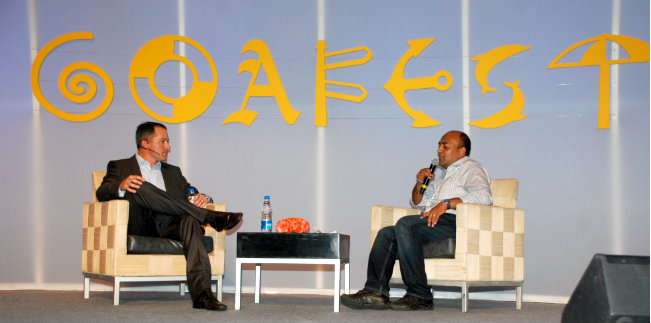
    In just six years since its launch, YouTube has garnered over 8 million users and billions of videos have been uploaded on the site. At Goafest, YouTube demonstrated how consumers can be used to build a brand by conducting a flash mob. Mr Lucas Watson, Global Vice President, YouTube further added to the brand’s insight by sharing his views on how ‘Magical Ideas Come When You Harness the Power of many People’.


    Mr Watson put across his point when he cited how Lady Gaga has built up her brand through a passionate group of fans who have played a vital role in building the Lady Gaga brand. Mr Watson explained that nowadays it has become very easy and inexpensive to build a brand by starting a video advertising campaign online, thanks to the Internet. He said that a brand need not be big to come online and start a video campaign, all it needs is to gain the trust of its consumers. “Start a video advertising campaign online, and you will be surprised to find how people are passionate about participating with the brand they love. The magic of YouTube is available for all as it allows everyone to participate. Besides online video advertising allows a brand to run its advertisement in a cost efficient manner, delivering better RoIs.”


    During the Q&A session moderated by Mr N Rajaram of Airtel, when Mr Watson explained his views on the rapidly changing role of advertising agencies: “Being creative and coming up with new ideas is a skill which not everyone has. So we need creative directors to nurture young talent to build brands. Unlike television, where consumers have a dedicated time slot to watch their favourite programme, in the online world it is the consumers who decide when to watch what and for how long.”


    Talking about if there is scope for co-existence between television and online video, Mr Watson said that there is no win-win situation but, there will be either winners or losers. “Like many industries even we are going through a transformation scenario. There are brands which are afraid to disrupt their way of functioning and there are brands which are keen to reach their consumers in newer forms of media platforms and thus rapidly build their brands. Therefore, I believe there could be some co-existence but, there will also be winners and losers.”


  • Day 1 @ the Dome: ‘Innovation is the magic of Ideas’


    By A Correspondent


    Goafest 2012 kicked off with the lighting of the lamp by the industry dignitaries, Mr Arvind Sharma, Chairman Goafest 2012; Mr Nagesh Alai, President, AAAI; Mr Shashi Sinha and Mr Ambi Parmeswaran, ED and CEO, Mumbai Draftfcb Ulka Advertising. Mr Sharma said that he was thrilled as Goafest 2012 over 3,000 participants, including representatives from Sri Lanka and Bangladesh.


    Mr Parmeswaran said that he was ecstatic about the event this year as there was a restructuring of knowledge sessions. Mr Sinha observed that with more metals and more categories at the awards than last year, more participants, representatives from foreign countries, exciting prices for the audience, Goafest 2012 is aiming to give participants an experience with qualitative improvement every year. And unlike previous years, presentations by speakers were followed by the Q&A sessions moderated by industry veterans.


    The first session, ‘Magical Ideas Come when You Harness the Power of Many People’, commenced with a flash mob from YouTube, taking everyone by surprise and perhaps sending a message that it was one way of using consumers to building your brand.


    Mr Lucas Watson, Global Vice President, YouTube spoke about how passionate consumers can help one build brands and how online videos can help even startups spread awareness and the reach needed in a very cost effective and efficient way. “Just get started online, you don’t have to be a big brand, all you have to do is gain trust among your consumers and you will be surprised how passionate people are to participate in the brands they love. The magic of YouTube is available for all to see, as it allows everyone to participate and that too in a cost efficient manner.”


    The first session was moderated by Mr N Rajaram of Airtel. When asked about the scope of co-existence between television and online videos, Mr Watson said: “Like many industries, we too are going through a transformation. There are brands which are afraid to disrupt their current mode of functioning and there are brands who want to try new and better ways of reaching out to their consumers. So I believe there will be some co-existence, nevertheless there will be winners and losers as well.”


    Gerson da Cunha, stage and film actor, social worker and author dedicated Ad Katha, a book that tracks the history of Indian advertising to the late Bal Mundkur, founder of Ulka. Mr da Cunha gave the audience a glimpse of the Indian advertising right since it started through the present day advertising. He also pointed out that advertising bloomed in India from print media and that in 1991 it even opened doors to the global economy.


    Mr Jonathan Mildenhall, Vice President, Global Advertising Strategy and Content Excellence, Coca-Cola spoke on the use of creativity and content and how Coca-Cola moved from creative excellence to content excellence. He also explained that there is a need to encourage consumers to express their stories and how a brand must move to dynamic storytelling. “A brands story must show that it’s committed to make world a better place. There is a need to converse and not just listen to our consumers but to create inspiration and provocation.”


    In the session moderated by Sanjay Behl, CEO, Reliance Digital, when asked about a marketer’s role in the future and the consequences of negative conversation on a brand, Mr Mildenhall said: “Brands have to be a lot more transparent, if you inspire good conversation, it manages itself and I believe good eventually wins over evil. Brands, therefore, need to rethink the creative story they are telling their consumers. A 30 second media spot is valuable and it should be a gateway for brands to reach higher grounds.”


    Mr Tim Love, CEO, APIMA and Vice Chairman, Omnicom Group spoke about ‘The Magic of Ideas- Our Language Impediment’. He was of the view that innovation is the magic of ideas and that language is a technology. Mr Love also pointed out that as internet penetrates further in India, language communication will be going to new heights.


    The session (all of them held at what’s called the ‘Dome’) on Language Impediment was moderated by Kainaz Guzdar of P&G. When asked for his suggestions on how marketers and advertisers can come up with great ideas on language impediments, Mr Love said that they will have to be more cognizant in language and respect the sensitivity of various people. He also said that ideas are best when communication is from one individual to another.


    Mr Charles Wright, MD of Wolff Olins shared his insights about how consultancies are equally important to creating and building brands. He spoke about how by combining rigour with magic, one can solve complex business problems and how a Wolff Olins experience of branding may be completely different from an advertising agency’s experience despite working on the same product or brand. “In order to build brands that succeed, it is important that one understands what is important to the customers. We are all living in a world of perception but branding is all about changing the way people behave, and simply making promises is not important but, delivering on those promises is far more important.” He added: “Design, as a language, can help change people from hating a particular brand to making them like the brand and then probably even love that brand.”

    Click here to view all Goafest 2012 stories


  • IPL 2012 first week online viewership registers a 56% increase

    By A Correspondent


    Solidifying last year’s stupendous growth during Indian Premier League (IPL), Times Internet Limited (TIL), in partnership with YouTube, is on an upward curve, yet again. In the first week of the tournament, including the opening ceremony, the IPL website has already recorded 13.7 million views, as against 8.8 million views last year. This represents a 56 per cent growth over last year.


    New DelhiandBangalorelead the viewership with 14 per cent each, with Mumbai coming in a close second at 13 percent. This leap reflects the growing trend of watching IPL matches online. This year, the IPL website offers a virtual battleground for fans to fight it out, which got 1.5 million engagements in the first week itself.


    The matches registered the maximum online views on 10th April for the matches between Royal Challengers Bangalore and Kolkata Knight Riders, and between Delhi Daredevils and Chennai Super Kings. The day saw a total of 2.15 million views on the site, which included 0.7 million unique visitors.


    Almost 0.6 million viewers have enjoyed the match action on their mobiles over the last seven days on Apalya mobile TV platform across Airtel, Idea and Vodafone. This is double the traffic registered last year.


    Rishi Khiani, CEO, Times Internet Ltd said: “Last year, we delivered a superior viewing experience and garnered significant audiences. This year, our emphasis is on higher interactivity and our strong social focus has paid off right at the start, becoming a sign of things to come over the season.”


    Praveen Sharma, Head of Media Sales GoogleIndiasaid: “We’re really excited to see the continuous growth in online viewer ship of IPL. This is the third year of our association with live streaming of IPL and the viewership numbers clearly indicate the distributed media consumption pattern of the Indian consumers.”