Tag: YouTube

  • Trinity Gaming launches virtual gaming campaign property

    By Our Staff


    Trinity Gaming India has launched Gamerz Night Live, a virtual gaming campaign property. The campaign has been launched in collaboration with Lenovo, Intel and Youtube, and is focused on developing the Indian creator community.


    Commenting on the success of the IP, Abhishek Aggarwal, Co-founder & CEO, Trinity Gaming India, said: “At Trinity Gaming India, our primary objective has consistently been to furnish creators with a platform conducive to growth and the establishment of a career in gaming. Through Gamerz Night Live, we are presenting unprecedented opportunities for creators nationwide, irrespective of their current size and follower count. The resounding success and positive feedback witnessed this year serve as a testament to the promising trajectory, assuring an even more substantial presence in the gaming landscape for the upcoming year.”


    Speaking about the IP, Anita Kotwani, CEO Media, South Asia, Dentsu and Dentsu Gaming Lead, added: “Gamerz Night Live is the first ever recreational gaming IP where gaming content creators of varied sizes come together and enjoy gaming as a wholesome part of entertainment. Brands like Lenovo & Intel have marked their footprints in the gaming industry by launching gaming centric brands like legion, loq, gaming IdeaPad, Intel Arc, 13th gen processors which are beneficial for the consumers to make, record and consume content. Through Gamerz Night Live Intel & Lenovo get a chance to showcase themselves in front of the relevant audience focusing on the TGs suitable for brands like Lenovo & Intel.”


  • Humans of Bombay launches YouTube show

    By Our Staff


    Humans of Bombay (HOB), the popuar storytelling platform, has launchd a new YouTube talk show titled ‘The Humans of Bombay Show’. The show will feature real-life experiences of individuals from all walks of life across the country. The HOB talkshow features HOB founder Karishma Mehta as the host.


    Talking about the show, Mehta said: “From inspiring stories of women empowerment to powerful stories of love and loss, The Humans of Bombay Show is thought-provoking, inspiring, and full of the human spirit. We are bringing real stories of heroes from across India, stories that will inspire the audience and help us connect on a deeper level.”


  • Not at all Quiet on the OTT Front


    By Shailesh Kapoor


    Shailesh KapoorOver the last three years, it became abundantly clear that streaming (or OTT, as it’s called in India) is the medium of the future in this country, even as other media will continue to co-exist. Linear television always had the numbers. But thanks to a mix of factors, ranging from the pandemic, to ever-reducing data costs, to a nosey TRAI, linear television has barely managed to stay afloat. Pressure on revenues has been felt across the board, and that’s never a good sign.


    Streaming itself is trying to find its sweet spot. Is it a premium paid (SVOD) medium, as all the promotions of well-mounted web-series suggest? Or is it a medium for the ‘masses’, where free (AVOD) content is going to dictate the future? The jury has been out. And the last few weeks have seen their share of action on this front.


    Perhaps the biggest shift in the dynamic has been around the IPL. The 16th edition of the league, which starts March 31, will stream free on JioCinema. That’s a polar opposite to how it was thus far: IPL was a subscription (and hence, revenue) driver for Disney+ Hotstar, not just in India but at a global level too.


    Then, there’s the talk of the largest AVOD player in India outside of YouTube, i.e., MX Player, being up for sale. The content side is going through its continuous evolution. For example, price points for acquiring streaming licences to theatrical releases have not stabilised yet.


    All these are healthy signs, one would think. A growing category is bound to see new ideas, new strategies, and new alignments. And some of these may shape the future of the category. For example, there is little doubt in my mind that IPL’s streaming viewership will outnumber that on linear television this year.


    How did linear television find itself in this situation is a matter of another debate. But it should not have, because it’s still the staple, go-to medium for millions of Indian families every night. But the only way you can fight technology is by building a precise and relevant narrative. The linear TV industry has failed to do that for itself.


    Amidst all the positive action, the talk of censorship of streaming content has started again. This week, the I&B minister advocated censoring “vulgarity”. The genesis of this not-so-veiled threat lies in a Delhi High Court judgment will handling a complaint on TVF’s show College Romance. The state and the judiciary playing moral police can be a major irritant in a category that’s otherwise amid a period of high activity and growth.


    All eyes, hence, are on India’s streaming story, in its second phase, where the category seeks stabilization and re-alignments. And the upcoming IPL will set the ball rolling on that front.


  • Aap Ki Adalat adds sign language interpretation on YT

    By Our Staff


    Rajat Sharma
    Rajat Sharma

    India TV has made its popular show ‘Aap Ki Adalat’ available on YouTube with sign language interpretation for hearing-impaired viewers.


    The new accessibility feature has enabled the hearing-impaired viewers to understand and enjoy the show hosted by veteran journalist Rajat Sharma. The shows stream live and are available on India TV YouTube channel with sign language interpretation to make it easier for hearing-impaired viewers to comprehend the content.


    Ritu Dhawan

    Said Ritu Dhawan, Managing Director, India TV: “As a responsible media organisation, we believe that everyone should have equal access to information and entertainment. The new accessibility features on YouTube have enabled the hearing-impaired viewers to understand and enjoy the show. We hope that this initiative will help break down barriers and create a more inclusive society.”


    India TV is hopeful that the audience will widely appreciate this initiative and eagerly anticipates receiving positive feedback from viewers. The organisation remains dedicated to ensuring its content is available to all.

  • AajTak crosss 50 mn subscribers on YouTube

    By Our Staff


    AajTak has becomes the first news YouTube channel in the world to cross 50 million subscribers, notes a communique, adding: “This record milestone comes just three years after crossing 10 million subscribers in 2019.”


    Kalli Purie, Vice Chairperson, India Today Group, met Gautam Anand, Managing Director of APAC – YouTube, in Singapore to commemorate the special achievement.


    “Thank you so much, YouTube! This is just amazing. The team is already planning its way to 100 million so YouTube had better start designing the next button,” Purie, adding: “Trust has always been the foundation for audience engagement at AajTak. It’s no different with our YouTube channel, but on a much wider scale with hundreds of videos getting uploaded every day. We place equal emphasis on having new audiences discover our channel while ensuring loyal viewers revisit, and invest in figuring out what works on YouTube – whether this is a nuanced understanding of thumbnails or producing hero content frequently.”


    “Constant experimentation with new formats like Shorts and investment into our Community page has really paid off, and consistently breaking stories has helped create a very loyal fanbase,” explained Purie. “Events like the Presidential Elections of 2022, Solar Eclipse and the Cricket World Cup just kept encouraging us to do better and better.”


  • Digit Insurance launches new YouTube series

    By Our Staff


    Go Digit General Insurance, a general insurance company, has released a new series on YouTube named ‘Simply Put’. The series will focus on simplifying complex financial decision making, including insurance, using pop-culture references, memes, data visualizations and more.


    Commenting on the newly-launched YouTube series, Tanya Marwah, Vice President and Head – Brand Marketing, Digit Insurance said: “The ‘Simply Put’ series is one of our latest conquests towards making insurance simple. Tackling inherent biases, doubting the real value of health cover or thinking of insurance through different life stages is something we have all done at some point in time. The series will demystify these complex ideas, albeit through simple and easy-to-understand references, all in a fun narrative that people would hopefully love watching.”


  • ‘61% watch online video content like YouTube/OTT on their mobile/home TV’


    By Our Staff


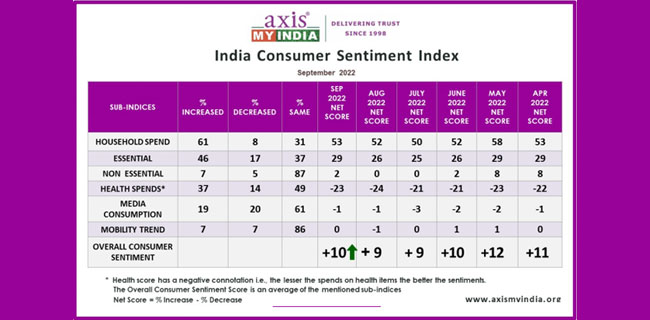
    Axis My India, the consumer data intelligence company, has released its latest findings of the India Consumer Sentiment Index (CSI), a monthly analysis of consumer perception on a wide range of issues. The September 2022 report highlights that 20% are planning to shop more this festive season. On media consumption 61% mentioned that they watch online video content either on their mobiles or connected TV. 32% mentioned that they notice advertising on TV, followed by digital (26%). An interesting observation was on app usage, on an average there are 9 apps on the mobile phone of a smartphone user.


    The September net CSI score, calculated by percentage increase minus percentage decrease in sentiment, is at +10, from +9 last month reflecting an increase/decrease by 1 point


    The sentiment analysis delves into five relevant sub-indices – Overall household spending, spending on essential and non-essential items, spending on healthcare, media consumption habits & mobility trends.


    The survey was carried out via Computer-Aided Telephonic Interviews with a sample size of 10014 people across 32 states and UTs. 68% belonged to rural India, while 32% belonged to urban counterparts. In terms of regional spread, 23% belong to the Northern parts while 24% belong to the Eastern parts of India. Moreover 29% and 23% belonged to Western and Southern parts of India respectively. 59% of the respondents were male, while 41% were female. In terms of the two majority sample groups, 32% reflect the age group of 36YO to 50YO, while 31% reflect the age group of 26YO to 35YO.


    Commenting on the CSI report, Pradeep Gupta, Chairman & MD, Axis My India, said “After compromising past two festive seasons to the pandemic and its related constraints, this year consumers are expected to shop more during festivities. One can witness slight increase in expenses across essential and discretionary products already. Further improvement in mobility sentiments highlights the fact that more and more people are enjoying the stores and malls experience of discovering, shopping and gifting. This sentiment is also extended among the Indian farmers, wherein a significant percentage of 15% intends to buy a brand new tractor in the next one year. This is thus a crucial time for the Indian advertising business as spend are expected to bring a lot more returns than usual. As more and more people (61%) are watching online video content (YouTube/OTT) on their mobile/home TV and thereby noticing ads across TV, online and social media platforms, it is of utmost importance for the media industry to tap the right medium for addressing differentiated consumer needs.


    Key findings:

    • Overall household spending has increased for 61% of families which is the same as last month. The net score which was +52 last month has increased by +1 to +53 this month

    • Consumption of media remains the same as last month, which is 19%. The overall, net score, which is -1, this month, also remains the same

    • Mobility has increased for 7% of the families, reflecting an increase of 1% from last month.

    • Spends on essentials like personal care & household items has increased for 46% of the families which is an increase by 1% from last month. The net score which was at +26 this month has increased by +3 to +29

    • Spends on non-essential & discretionary products like AC, Car, and Refrigerator has increased for 7% of families which reflects an increase by 1% from last month. The net score which was at 0 last month has improved to +2 this month. This could reflect the spirit of festive season approaching.

    • Consumption of health-related items has increased for 37% of the families, which reflects a decrease by 1% from last month. The health score which has a negative connotation i.e., the lesser the spends on health items the better the sentiments, has a net score value of -23, as compared to -24 last month.


    On topics of current national interest:

    • In an attempt to understand consumer’s engagements with mobile apps, the survey discovered that on an average consumers have 9 apps on their smartphones. 16% use minimum of 4-8 apps, through their smartphone and 22% have more than 8 apps. A significant 24% mentioned that they use a feature phone

    • In order to understand in which medium advertisements get noticed more, the survey found out that a majority of 32% notice advertisements on TV, while 26% notice it through online mediums. It also discovered that only 17% notice ads on social media platforms, 15% on Print, 6% on Outdoors and 2% on Radio.

    • The survey further revealed that a majority of 61% watch online video content like YouTube/OTT on their mobile/home TV.

    • Digging deeper into the festive spirit, the survey shows that 20% plan to shop more this festive season compared to last year. However 32% plan to shop the same as last year

    • According to Axis My India Consumer Sentiment Index Survey, 48% of consumers shop/purchase more products during the festive season as compared to rest of the year

    • Exploring farmer’s sentiments towards new tractors, the survey found out that 10% are planning to purchase new tractors in the coming year, while 3% and 2% plan to but within 6 months and 3 months respectively. Also, a significant 86% of farmers don’t own a tractor, because of reasons like smaller land size, renting or affordability.


  • Zelenskyy interview sees R. digital viewership leapfrog

    By Our Staff


    Republic Media Network reports significant traction of its exclusive interview with Ukraine President Volodymyr Zelenskyy las tweek


    The 60-minute interview conducted virually “has propelled crucial global conversations on the ongoing Russia-Ukraine war,” reports the network. On digital, the interview, the network claims, received 600 million estimated impressions within the first 24 hours. Within minutes of the first playout of the live interview of President Zelenskyy to Republic Media Network’s Editor-in-Chief Arnab Goswami, the interview was trending across India, added a release.


    According to a communique, on Youtube, the interview garnered over 20 million impressions in the first day of playout. On YouTube, the interview got over 2.61 million views in less than 20 hours.


    Notes a communique: “With four full playouts over the weekend, and an unstoppable on-going virality on social media, new digital records will continue to be set by Asia’s largest news network, the Republic Media Network.”


    Editor’s Note: Digital viewership doesn’t have any universally accepted third-party credible measurement tools, and even if some good ones exist, there are many reports of these being inorganically boosted. Consequently, MxMIndia, as a policy, does not report on digital measurement claims. However, when we do report on viewership spikes, we are convinced that there was a increase in viewership. However, we wish to assert that the numbers have not been verified by us or a third-party, so we urge our readers to base their decision by verifying these.


  • Netflix India announces competition for emerging filmmakers

    By Our Staff


    Netflix India has announced Take Ten, a short film workshop and competition that aims to discover and support emerging filmmakers from diverse backgrounds in India. As a part of this, 10 filmmakers will be given an opportunity to attend workshops by the best in the creative industry and then to make a fully funded short film with a $10,000 grant. The films will be showcased on Netflix’s India YouTube channel.


    Take Ten is sponsored by the Netflix Fund for Creative Equity, which has dedicated $100 million a year over five years to setting underrepresented communities up for success in the TV and film industries through programs all around the world.


    Said Amy Sawitta Lefevre, Head of External Affairs, APAC, Netflix: “We’re excited to launch ‘Take Ten’ in India – a short film workshop and competition that will open up the chance for aspiring filmmakers from anywhere in India to tell their stories. Supported by Netflix’s Fund for Creative Equity, ‘Take Ten’ shows that great stories can come from anywhere and it creates new opportunities for filmmakers to receive training from some of the best in the industry.”


    Added film critic, author and Film Companion editor, Anupama Chopra, who is leading the programme: “Take Ten is a celebration of storytelling and originality. The workshop and competition aim to be inclusive and showcase the diverse voices behind and in front of the camera in India,” “I hope Take Ten enables artists across India to find their footing and soar.”


  • 9XM launches Loppipops Youtube channel

    By Our Staff


    Music television network 9X Media launched ‘Loppipops’, a kids’ learning channel available on YouTube. The channel will showcase specially designed and curated playlist of kids’ rhymes and videos, presented by duo Bade-Chote and their gang of animated characters.


    Commenting on the launch of Loppipops, Amar Tidke Chief Programming Officer, 9X Media said: “We are delighted to launch Loppipops Kids learning YouTube Channel on the occasion of Children’s Day. Loppipops will captivate the interest of its young audience in a fun and memorable manner. Over the years, Bade Chote and their friends have become iconic house-hold names extending the IP into the kids space was a natural progression with the ever increasing demand for kid’s content. Music is the building block of early learning and as a music network we have over the years experimented in various ways to entertain our audiences through music. The endeavour here is to entertain and make learning fun. The Loppipops gang will engage the kids in Child-safe screen time by providing them with the right edutainment. This should be fun ride for all!”


  • Boom in Long & Short Videos


    By Our Staff


    India’s online video market has seen explosive growth both in terms of users and usage. The video user base has scaled to more than 350 million people growing over 24% over 2018-20, twice as fast as markets such as China and Indonesia. Despite this rapid boom, there exists massive headroom for growth – online video user penetration in India is nearly 60% of Internet users, compared with more than 90% in China, notes a report from Bain & Co. The report covers both the Short Form Video as well as the Long Form Video (including OTT / Streaming) market, and provides in-depth insight into the users, platforms and creators of online videos.


    Online video consumption has exploded over the last few years, with a surge in both users and usage bolstered by prolonged stay-at-home periods, especially during the pandemic. India’s online video user base has scaled to more than 350 million people, growing 24% over 2018 to 2020, nearly twice as fast as markets such as China and Indonesia.


    Usage per active user has also grown dramatically-the daily time spent per active user on online videos has simultaneously grown by 60% to 70% over 2018-20. Majority of time spent on smartphones is on entertainment, primarily watching videos. These are among the findings of a report titled “Online Videos in India- The Long and Short of It”, released by Bain & Company.


    Said Arpan Sheth, partner and global leader of Bain & Company’s Vector Solutions Group: “India has a large digital community, with about 640 million Internet users and 550 million smartphone users which is rapidly growing and spending more time online. Smartphone users spend about 4.8 hours on their devices daily, of which a staggering one hour on average is spent consuming videos. Despite this rapid boom, there exists massive headroom for growth—online video user penetration in India is nearly 60% of Internet users, compared with more than 90% in China.”


    Digital video entertainment consists of short-form videos (SFV) which are between 15 seconds and two minutes, and long-form videos (LFV), which are more than 2 minutes long. Within SFV and LFV segments, content can be further segregated based on who is creating it (user generated vs. professional) and how it is delivered (pre-recorded vs. livestreaming). The lines across these segments are increasingly blurring, as platforms expand their offerings to capture a greater share of consumer time in catering to broader consumer needs and occasions to enhance stickiness. For example, Instagram now has Reels, IGTV, and IG Live.


    YouTube has recently introduced YouTube Shorts in India. In India, the SFV market has taken off over the past two years, growing 3.5 times in user base and 12 times in total time spent by all users on SFV platforms. More than 200 million Indians watched SFVs at least once in 2020, with daily active users spending up to 45 minutes a day on these platforms. However, India’s short video user base has historically been largely men from Tier 2 and smaller towns, but this is evolving quickly, with the medium gaining traction in metros and amongst women. China paved the path for the SFV-market globally, over the past decade. India lags China by three to four years in terms of user penetration as well as usage.


    However, rapidly growing access with cheap and ubiquitous data, easy-to-use platforms, and a high proportion of vernacular content will aid short video scale-up in India. By 2025, three in four Internet users, or 600 million to 650 million Indians, will consume short-form videos, with active users spending upto 55 to 60 minutes per day.


    Added Shyam Unnikrishnan, partner and a leader in Bain & Company’s Consumer Products, Retail, Strategy and Digital practices in India: “The SFV ecosystem which essentially comprises of users, creators and advertisers are key to driving economics for the platform. Brands are increasingly using short video platforms to reach their target customers. New monetisation models, such as video commerce, livestreaming, and in-app purchases, will become increasingly commonplace in the coming years. Players need to invest in developing an advanced, tech-enabled platform to link users, creators, and advertisers and deliver a seamless experience to all.”


    TikTok became the first scale SFV platform in India, with more than 200 million users and 20 million content creators posting at least one video a month. This robust base of creators is key to attracting users. India has more than 50 million users who have created and posted at least one short video. Content creators are active on multiple platforms and are increasingly monetising their follower base through brand collaborations and commerce. All this is giving rise to a robust creator economy—an enabling ecosystem of players helping creators with content creation, monetisation, financing, and business management.


    The Indian SFV market is now occupied by a mix of specialist SFV apps (e.g., Moj, Josh, MX TakaTak, Roposo, Zili) and global social media/video giants (e.g., Instagram Reels, Facebook Reels, YouTube Shorts). Amongst the specialist short video platforms, five platforms-the previously mentioned Moj, MX TakaTak, Josh, Roposo, and Zili-have more than a 100 million downloads each.


    The market, while at scale, is still nascent. Major players are only a little more than a year old. The market could evolve to follow one of the divergent paths of the two mature SFV markets: China and the US. The China short video market is led by specialist platforms, while in the US, social-media-led platforms (led by Instagram Reels) and specialist short video platforms (led by TikTok) co-exist.


    Said Sriwatsan Krishnan, partner and a leader in Bain & Company’s Private Equity and Alternative Investor practice in India: “Market leaders will have to focus on three areas to develop a large, engaged community of users and creators. First and foremost, they will have to make substantial investments in technology to deliver a hyper-personalised experience to users, optimise user interface (through faster app and video load time, etc.), and expand access via vernacular interfaces. Winners will simultaneously focus on creator enablement and lock-in on one side, and creation of scalable monetisation engines on the other. Successful players will need access to large amounts of capital to achieve these goals and deliver on their potential.”


    India’s short-form video (SFV) market offers tremendous potential. Successful players will focus on three areas including tech-enabled hyperpersonalisation, creator enablement and lock-in, and monetisation as they onboard the next wave of users and drive engagement which will require access to large amounts of capital.


    According to Bain & Company, the five major trends that will shape the future of the SFV market in India are;


    Content curation and social-led engagement: Leading players will invest in a robust recommendation algorithm and a superior user interface and user experience to deliver a winning experience.


    Monetisation: Digital advertising will be the first frontier, but platforms will increasingly experiment with alternate commerce and micro-transactions. – Innovations to onboard the next wave of users: SFV platforms are already available in more than 15 languages in India, but a continued explosion of vernacular options is evident.


    Emergence of a robust creator ecosystem: A robust creator economy will emerge. This enabling ecosystem will help creators with content creation tools, training, brand affiliations, financing, and business management.


    – Niche platforms within larger SFV ecosystems: Platform players will emerge, housing a suite of apps which cater to distinct user and content niches. Long-form videos(LFVs) on the other hand, have substantial scale—viewed by 350 million to 400 million users, almost twice as penetrated as SFV. The format has seen substantial growth, with users and usage increasing nearly 1.5 times from 2018 to 2020. Active users today spend more than 2.5 hours per day on long-form content. Covid-19 lockdowns and stay-at-home advisories during the pandemic further propelled these numbers. LFV is poised to grow to 600 million to 650 million users in India by 2025. This growth will be driven by a steady increase in the Internet user base; access to cheaper, faster data; the introduction of more affordable plans, including the advent of freemium models; and a proliferation of content. A strong push on regional and vernacular content will accelerate this even further-85% of content viewed is non-English, and 30% is in languages other than English or Hindi. The LFV market is significantly more mature and crowded than the SFV market. More than 50 LFV platforms (also referred to as ‘over-the-top’ [OTT] platforms) exist in India.


    This crowded landscape includes four broad archetypes of players vying for consumer time including global giants (YouTube, Netflix, Amazon Prime Video, Disney+ Hotstar), platforms by television broadcasters (SonyLIV, ZEE5), specialist Indian platforms (MX Player, Eros Now), and aggregators (JioTV). Content drives differentiation, and it is possible for multiple platforms to co-exist in steady state, as seen in developed markets. Players have opted for different monetisation models that reflect the platform’s core consumer in the income pyramid such as subscription video on demand (SVOD), freemium, ads video on demand (AVOD), and transactional video on demand (TVOD).


    Six trends will shape the LFV space going forward:-


    • Content explosion: Platforms will look to build deeper libraries with increasing original and regional content.

    • Value chain integration: Backward integration by over-the-top (OTT) platforms into content production and forward integration by production houses may become more commonplace

    • Hyper-personalisation: Content curation will become even more sophisticated. Approximately 70% of YouTube watch time globally is already driven by recommendations.

    • Increased monetisation: Platforms will amplify focus on monetisation as the industry matures.

    • Gamification/social engagement: Players will explore social-led engagement to keep users hooked.

    • Content moderation: Platforms will look to invest in content protection tools to prevent piracy and moderate content to comply with regulations.


  • Parents prefer Youtube over OTT platforms for kids : Akatsuki survey

    By Our Staff


    Akatsuki Inc.,  a Japan-based entertainment and technology company looking to expand its kid’s animation footprint in India, recently conducted a survey on ‘What Indian Parents Want From Animated Content For Kids’.


    The survey revealed 69% of Indian parents feel that the Covid-19 wave has increased their child’s content consumption habits leading to a 4-6 hours screen time on an  average. The Top 5 voted content IPs according to the survey are: Cocomelon, Peppa Pig, Shinchan, Doraemon, and Tom &Jerry.


    Said Yuki Kawamura, Head of Business Development and Partnerships, Akatsuki Inc: “We at Akatsuki are committed to bringing joyful and meaningful animation IPs for the growing and underserved kids animation space in India. We want to thoughtfully co-create our content roadmap with on-ground insights and need gaps. This survey is the first step in that direction and findings have strengthened our conviction in the potential of the untapped demand of kids animation in India and synergies with our IPs.”