
Tag: WPP

  • H+K bags LaunchMyCareer mandate

    By Our Staff


    LaunchMyCareer, a career guidance platform, has appointed WPP agency Hill+Knowlton Strategies (H+K) as its official communications agency in India.


    Said Ankur Aggarwal, Co-Founder, LaunchMyCareer: “We are happy to partner with Hill+Knowlton Strategies India as our communications partner to help drive our vision of nurturing young peoples’ skills and aptitudes to provide them age-appropriate exposure to career knowledge. As our strategic partners, we are confident that H+K will be able to leverage support for us amongst our stakeholders through their three decade long strong track record of advising diverse players in the Indian landscape, and their localized expertise in media handling.


    Commenting on the announcement, Abhishek Gulyani, CEO, Hill+Knowlton Strategies India added: “We are thrilled to begin this exciting journey with LaunchMyCareer and look forward to this partnership to manage their strategic communications. Their innovative business model is capable of achieving fast-paced growth in the region and we look forward to further driving their brand value and being an integral part of their development in India.”


  • Contract unveils campaign for Lupin’s Be One energy capsules

    By Our Staff


    Lupin, global pharmaceutical company, unveiled a campaign to launch ‘Be One’ Ayurvedic Energy and Immunity capsules. Conceptualised by Contract Advertising, a part of the Wunderman Thompson Group and member of the WPP network, the film features Hrithik Roshan. The tagli


    This is the thought behind the #BanoKhudSeBehetar campaign launched for Lupin’s Ayurvedic Energy and Immunity capsules.


    Speaking on this, Anil Kaushal, Head OTC Business, Lupin, said: “In today’s highly demanding times, a product like Be One is only increasing in relevance. The consumer today, is looking to constantly better themselves and this is where Be One comes in as a motivator to ensure they have the energy and health needed in this journey.”


    Added Supratik Sengupta, Head of Marketing, Consumer Healthcare, Lupin: “This campaign was born out of the consumer desire of constant improvement by competing with one’s own self as opposed to others. The film acts as a nudge to the audience to challenge themselves and go beyond their comfort zone, while the product plays the role of the dependable partner.”


    Said Sagar Mahabaleshwarkar, Chief Creative Officer, Contract Advertising: “The creative challenge was to tell a story of someone trying to better himself, especially when that someone happened to be Hrithik Roshan. So, we tried to magnify the conflicts that reside within us every day. That was the creative jump off.”


  • Researching Research for a Doodle


    By Sanjeev Kotnala


    Sanjeev KotnalaResearching Research has a poetic touch. No, I was not exploring research for publishing a paper. Blame it on Priya Lobo, CEO, Ormax Compass, Ex-VP MRSI – The Market Research Society of India and India rep on ESOMAR for triggering the thought.


    Last weekend, Priya politely enquired if I was still doodling, and her WhatsApp chat triggered a thought. What about a doodle on a business subject like the mythology and religion doodle series I recently did.


    I am happy that my first reaction was still my typical way; why not. Why not create a doodle on a fascinating subject: ‘Research’. Once I started toying with the idea and visualising, I realised it would not be easy.


    Doodling Research needed some research. So, I asked my friends on social media for their first thoughts, words, images when they heard Research.


    Basic Instinct

    Doodle aside, the reactions covered a spectrum, and I did get a few visual gems. There were few not so funny responses, and I knew it had touched a raw nerve.

    A bunch of housewives having sandwiches and tea- like a kitty party.

    An investigator woke up a housewife, disturbing her afternoon nap after a strenuous morning.

    Field researcher, nose buried in a questionnaire and no eye contact with the respondent.

    Respondents in a focus group, even after not being able to imagine, are prodded yet again by the investigator ‘Phir Bhi Kalpana Kijiyeh’ (still imagine).

    And the best one is from someone who has been there and done that. ‘A couple of tired teenagers sitting on bench filling hundreds of forms to meet their quota’.


    The Usual Suspects

    I realised the researcher and the stakeholder have a lot to do to change the image and to be counted. There was hardly a mention of Heat Map, Non-intrusive Research, Eye-tracking or Neuro cap. Research still predominately meant questionnaires, groups and in-depth interviews.

    No doubt, the usual suspects started popping up. Focus Group, Sample Size, Audience profile. The research formats and types poured in Qualitative, Quantitative, Exploratory, Casual, Applied, Analytical and Case study.


    Research A Creativity Killer

    I was still thinking of the visualisation problem when Ramanujam Sridhar echoed the unspoken industrywide complaint. His tweet read, Research- ‘Kills creativity. tells me what I know. tells me something new. consumer. insight’.

    Why should people feel that it kills creativity? Does Research suffocate creativity? Is there dependence? On one side, the insights fuel creative freedom to explore. On the other side, creative may find research inputs restrictedly suffocating. I always found Research helpful in creative development and an efficiency-effectiveness enhancer.


    Missing Technology And Integrity

    I was still missing and waiting for DATA integrity, confidence limit and confidence itself.

    The next set of responses did add a bit of technology. However, it was the same dish. I-pad and handheld devices based multiple-choice surveys with the geo-tagging. In-depth Zoom call interviews simultaneously translated into different languages. Wow, so much for it.


    Funny Visuals Cues

    A bunch of research initiators and observers came up with fancy visuals. Taking my request very seriously. So, I think I got what I deserved. Someone visualised for me images of a harassed Market Research lady shuffling through her papers with a cassette player lying next to her. Somehow, the researcher is always a woman in all visualisation.

    A few even recounted their horrifying and, at times, embarrassing stories. That I will save for another day.

    However, Priyadarshani Narendra’s description seemed an apt representation.

    A guy in a trench coat with a hat and a large magnifying glass. He is on top of a consumer’s head, which is cut open to reveal the brain’.

    The Wah se Aha tak.


    More Images on Research

    The images, words and thoughts kept pouring in. Primarily guided by respondents personal expectations and experience and the gap therein. One way mirror, collage, cut-outs, cue cards, illustrations, storyboards, concept cards, lots of graphs and charts, product props, packaging, storyboards, clip arts and poor helpless respondents.

    And finally, trickled in Mind tree, Decision tree, Fish Diagram, Wein Diagrams, Data Array, Excel, Matrices and pivot tables.  Then came some serious stuff, which put Research aim, objective and cause in the right light. Insights, Barriers, and Motivators.


    Research Branded By Default

    My respondents were primarily CMPs, planners, marketers, researchers, academicians, and a few management students. Frankly speaking, the first set of associations and images t by people mostly known to me were merely execution led. I can’t say if they were right or wrong, apt or distorted, curated or instantaneous.

    Maybe the research association should consider Researching Research. Perhaps the research organisations have failed to build on awareness and experience. The needle is stuck at questionnaires, focus groups and in-depth interviews. Which for many clients is just a notch above informal consumer feedback.

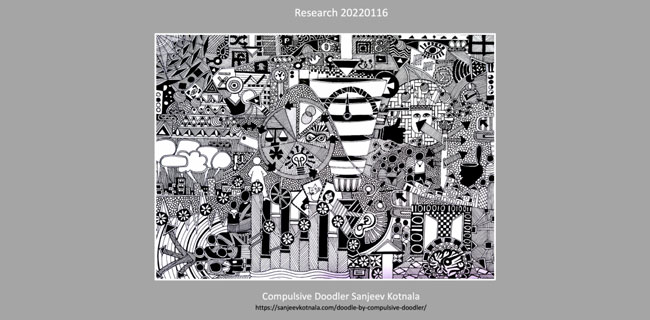
    (see doodle above)


    The PowerPoint link to Research.

    One of the sarcastic comments projected a real-life but maybe not a happy sight.

    ’72 slide PowerPoint deck each with headlined insight’.

    Personally speaking, 72 sides is an understatement. And each slide with headlined insight an overstatement.

    However, we all will agree that research presentations suffer from build-up mania. Every time the presentation is rebooted, the team starts from the obvious- the project initiation. And they do it even with the team that was part of the research process or initiated the project. They do it irrespective of the day, time or audience mix. Typically narrated under the disguise of a recap- it usually takes more time than the insights!


    All is not lost for Research

    ‘Unknown, Insight, Journey, Discover and surprise’ by Dwarika Uniyal echoed my thoughts. The best came from Babita Baruah from WPP. She said; Research- ‘People, Heart, Mind, Dreams, fear and hope’. And finally, I was happy, I got my answer.

    So, this one is not really a classic doodle getting redefined at every stage. This one is a bit structured and for a change well researched. Hopefully unbiased and not skewed. With a high degree of confidence limit, it is an excellent representation- even if I say that myself.  How many things about research could you catch up in the doodle.

    Thanks for replying to my shout for help and sharing initial thoughts, words and images. You can consider yourself co-creator but not co-owner of the final artwork.

    Any suggestion – what topic I can take for the next doodle. Researched or not- is something we can consider at a later date. Open for fresh challenges and assignments. You can see the other doodle by Compulsive doodler here or follow @SanjeevKotnala on Instagram and @S_kotnala on twitter.
     

  • Consumer Attitudes toward Technology


    By Our Staff

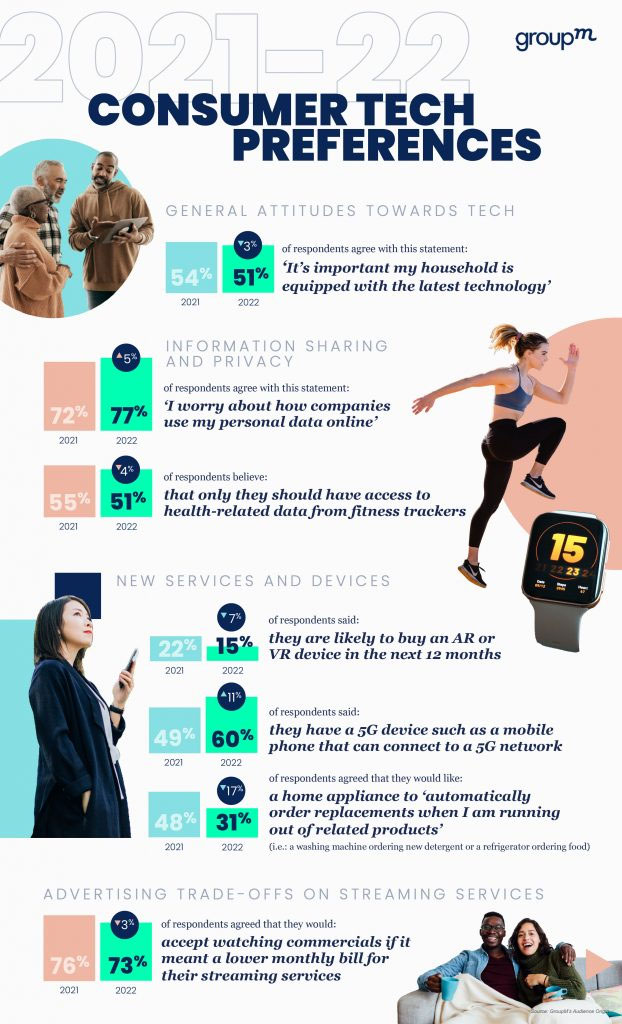
    GroupM, WPP’s media investment group, released its second annual survey on consumer attitudes toward technology in the U.S last week. The results reveal increased concern about sharing personal data, declining interest in buying the latest tech products sooner rather than later, and greater numbers of people confused by technology and its promises overall. Conducted by GroupM’s Audience Origin (formerly LivePanel) in December 2021, this proprietary research surveyed one thousand U.S. consumers on their attitudes toward technology across six general categories: attitudes toward technology, information sharing and privacy, virtual reality-based devices and services, smart appliances, mobile devices and digital services, such as visual search, streaming audio and streaming video.


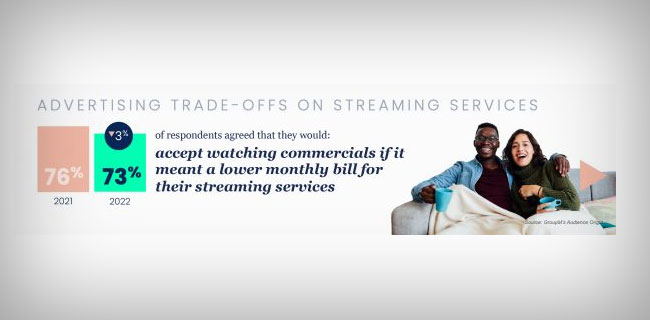
    Survey respondents indicated some material shifts in sentiments around privacy, with greater numbers of people concerned about the use of their data online, fewer willing to share data associated with health trackers or allow smart appliances to automatically refill consumables. Fewer households now believe it is important that they are equipped with the latest technology and greater numbers profess to being confused by new technologies – which we can see in responses to questions regarding VR and AR device access or 5G access – with more saying they will wait until technology becomes cheaper before purchasing devices. Of more direct importance for the advertising industry, a shrinking majority of respondents (73%) said that they would accept having to watch commercials in order to maintain a lower monthly bill for streaming video services versus 76% in last year’s survey.


    These trends reinforce the importance of data privacy to consumers and its implications for marketers—including the need to go above and beyond in securing consent from consumers when collecting or otherwise working with their data-to ensure that consumers experience real benefits from the use of that data and to always be mindful of how third-party data used in campaigns has been aggregated. The results also suggest that marketers could benefit from creating more clarity around how their technology products work and their practical benefits for consumers.


    Finally, the increasing willingness of consumers to pay to avoid advertising in streaming video services reflected in this survey strengthens GroupM’s instinct that, over time, advertising will become a diminishing feature in this channel. This highlights the challenges that marketers will increasingly face in using TV for reach and frequency-based goals in the future: it will be increasingly important for marketers to either more directly manage TV budgets alongside their spending on UGC-based platforms such as YouTube or to look at the use of TV differently, managing budgets for related campaigns more directly alongside those intended for sports, culture, music or other event sponsorships.


    Highlights of the research:

    1. General attitudes toward technology. 51% of respondents agree with this statement: “It’s important my household is equipped with the latest technology” versus 54% in our survey last year. 32% of the population somewhat or completely agreed that new technology “confuses me” in the new survey versus 28% last year. 73% agreed that they “wait until technology becomes cheaper before considering a purchase” versus 69% last year.

    2. Information sharing and privacy.77% of respondents strongly or somewhat agree with the statement “I worry about how companies use my personal data online” in our most recent survey, up from 72% in last year’s survey. 51% of respondents believe that only they should have access to health-related data from fitness trackers. The comparable figure was 55% in last year’s survey. As with last year, only a small share of the population believes that the company that made the device or software should have access (5.4% this year versus 6.9% last year).

    3. New services and devices: VR/AR, 5G and Smart Device-Based Consumables. Virtual or Augmented Reality: 32% of respondents claimed to own a VR or AR device in our most recent survey, with 15% claiming they are likely to buy such a device in the next 12 months. Consumer perceptions of what, exactly, such a device is may not be commonly shared, as last year 39% claimed to own one, with 22% planning to buy one. Looking at 5G devices, 60% of respondents said they have a 5G device such as a mobile phone that can connect to a 5G network, up from 49% last year. Among the 40% of the population without a 5G connected device, more than a third expect to acquire such a device this year. As with VR/AR, consumer understanding of 5G may not fully match the reality of the product, as third-party estimates of shipments of rates of 5G devices in the United States major U.S. carriers imply substantially lower figures. In the world of smart devices, 31% agreed that they would like a home appliance to “automatically order replacements when I am running out of related products” (i.e.: a washing machine ordering new detergent or a refrigerator ordering food). By contrast, the comparable figure was 48% last year. While it is possible the driver of this sentiment change is related to a lack of satisfaction with related products, we also note that this trend is coinciding with greater concerns around privacy illustrated above.

    4. Advertising trade-offs on streaming services. Asked, “If it meant a lower monthly bill for your streaming services, how likely would you accept having to watch commercials?” 73% agreed with this statement in our newest survey versus 76% last year. Access to ad-free or ad-lite subscription services remains high, consistent with data observed through public filings made by the operators of streaming services.


  • TV still accounts nearly half of large marketer budgets…


    By Our Staff


    Earlier this week, GroupM unveiled its global end-of-year forecast of adspends. The WPP advertising clongomerate also publishes its India-specific numbers, so we are not doing a detailed look right now, but here are highlights of the This Year Next Year study, and a special focus on television thereafter.


    Excerpted from the GroupM report:

    The overall industry forecast:

    • 2021 growth: 22.5% (excluding U.S. political advertising), an upward revision from June’s prediction of 19.2%.

    • 2022 growth: 9.7% (excluding U.S. political advertising), an upward revision from June’s prediction of 8.8%.

    • Many underlying trends appear to be disproportionately concentrated in the U.S., the U.K. and China, which together account for approximately 70% of all the industry’s growth, despite making up about 60% of the total market.

    • Looking at the top 10 advertising markets over the next five years, growth should get back to the mid- to high-single digits:

    ° France, Germany, Australia and the U.S. all poised to grow in a range of 4-5% annually, on average, over the next five years.

    ° India, the U.K., Brazil, Canada, Japan and China are forecast to grow between 6-8% annually, on average.


    Here are the major areas considered in detail as we reach the end of 2021:

    Digital advertising: likely end 2021 growing by 30.5%, up from June’s forecast of 26% growth.

    ° Digital advertising accounted for 64.4% of all advertising in 2021, up from 60.5% in 2020.

    ° Alphabet, Meta and Amazon account for 80-90% of the global total.

    • Television advertising:forecasted to grow by 11.7% in 2021, up from June’s estimate of 9.3%. Given 2020’s decline of 13.7%, the industry is not expected to return to 2019 levels until 2023.

    ° Subsequent years will be roughly flat—up 1-2% per year through 2026—for television advertising in most major markets around the world, as the largest advertisers continue to incrementally shift spending.

    ° Overall, Connected TV+ will account for about 10% of total TV advertising in 2022 ($17 billion of a total of $171 billion) and is expected to double by 2026.

    • Audio advertising: Expectations for audio are that it will grow 15.6% in 2021 and 6.4% in 2022. In subsequent years, we assume a reversion to historical trends: largely flat.

    OOH advertising: Outdoor advertising is expected to grow 17.1% in 2021 and 14.9% in 2022. In subsequent years, we assume a reversion to historical trends: mid-single digit growth.


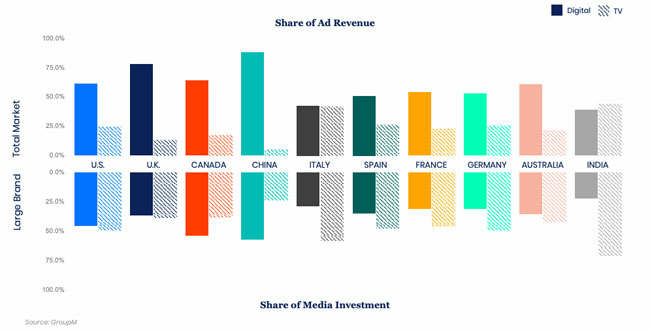
    Now, a superficial read of the data included in This Year, Next Year might leave one with the impression that because 64% of the world’s advertising revenue is generated by digital media and 21% goes to TV, that marketers are allocating 64% of their budgets to digital media and 21% to TV, on average. This would be a mistaken interpretation, because many advertisers—especially small ones and those whose businesses operate entirely online—often allocate all or nearly all of their budgets to digital media while large businesses typically allocate higher shares of their budgets to television.


    For smaller businesses, a high digital skew could occur because digital media’s precision targeting capabilities and automated sales platforms are uniquely capable of absorbing advertising budgets that are measured in hundreds or thousands of dollars. Larger advertisers that spend 100% of their budgets online might typically be doing so because their operations are entirely transactional or direct-to-consumer. For them, too, digital media platforms offer unique advantages connecting a budget for advertising with a tangible near-term outcome and the potential for active “growth hacking” strategies, which can work well, at least up to a certain scale.


    However, the world of media also includes businesses whose marketing goals are set around brand-building. They often do this by associating their products with top-tier video-based content or otherwise focusing on goals that are not most efficiently achieved through digital media. Further, for many, the combined use of different types of media can be synergistic in ways that are difficult to quantify. For example, we can reasonably assume that a strong brand should drive better performance of an e-commerce-focused advertising campaign versus the alternative of having a weak brand, although the factors that can drive a brand to accomplish this outcome can involve uncountable numbers of variables over many years or even decades


    Given our own focus as the world’s largest agency group, servicing larger brands primarily, we wanted to better assess the typical large advertiser media mix. To do this, we looked to GroupM’s own data to find useful illustrations of the ways in which different marketers allocate their budgets around the world. In studying these trends, we primarily focused on two dominant groupings of media, television and digital platforms, and then limited our analysis where possible to a subjectively defined group of large marketers on a like-for-like basis (meaning that we included only the same marketers in each period) within each of our Top 10 markets.


    The most accurate benchmark for large brands to consider is that in a typical large country during 2021, a large brand is allocating 47% of its advertising budget to television, including digital video extensions, and 35% to internet-based media, excluding those digital video extensions. For reference, in 2019, television typically accounted for 48%, while digital media typically accounted for 28%. These figures reflect wide gaps between the shares of revenue that media generates, with the difference driven by the wide range of brands that spend money in a given territory.


    For individual marketers, we recognize that this data may provide useful information about what other marketers are doing. However, the goal should not be to mimic them. Instead, we present this information to help spur questions about the right allocations for your brand. Well-developed media plans account for a marketer’s unique goals, apply some creativity to achieving those goals and consider what worked well for others who faced similar circumstances. It is our hope that the data presented here leads to the creation of more media plans that meet these criteria.


  • The Rise of the Holding company


    By Prabhakar Mundkur


    Prabhakar MundkurWhen WPP won a large part of the Coca-Cola business worth $4 billion, it was an affirmation that the holding company once looked upon as just a holding company that does nothing but inspects individual company, P&Ls had transformed themselves into an integrator of their individual companies.

     

    True integration has eluded the ad agency business for over two decades now, if not more. Sir Martin Sorrell took the lead for integration by pitching for large businesses globally. Mark Read has followed quickly in his footsteps by employing the same methods to win the global Coke business easily one of the top advertisers in the world for a long time.


    Conflict of Interest

    Once upon a time, agencies got bogged down by conflict of interest to handle more than one account in the same category.  This is because the traditional agency was unable to build an effective firewall that convinced clients that conflicting accounts could be handled without a leak of confidential information within the agency. No longer.


    Because holding companies have been able to put together special teams hand-picked from each of their operating companies offering a wide range of disciplines for mainline advertising to digital, to form individual units that handle each conflicting account, it promises a very effective firewall which means that clients are no longer worried about conflict. WPP’s GTB for Ford, Red Fuse for Colgate-Palmolive and now Open X for Coke are just examples of how these specialist units can operate.


    While it may seem like an innovative way to handle clients, the Japanese have been doing this for the last many decades. If you have been to the Dentsu or Hakuhodo buildings in Tokyo, you will notice that there can be as many as three or more automobile accounts being handled by these agencies, with each agency unit being located on a different floor.


    For example, Nissan could be on the 13th floor, Honda on the 17th, Suzuki on the 20th and Toyota on the 25th. The beauty of this structure is that employees working on a particular floor do not have access to any floor but their own therefore providing an effective firewall that ensures confidentiality of the individual account.


    WPP’s Coke win includes creative media and marketing technology business for 200 countries so it is a fully integrated business. I quite liked the Open X name for the WPP unit which handles the Coke integrated business.  Unusual for Coke who has been hesitant to commit themselves to any agency in the past although IPG has had the longest run.  I remember a time when Coke thought that it did not need their creative agency McCann and began flirting with individual Hollywood producers for their commercials.


    It’s a pity that the major new creative platform of Real Magic was launched just two weeks before the WPP announcement.  While I thought that the Real Magic commercial worked well, initial feedback from the gaming community suggests that it has put the brand back by a few years.  Tim Crow sports and eports advisore says, “Gaming is not a divided world. They are a big tribe that doesn’t need Coke’s help to connect with each other because they already are. Games are about fun and the competition brings people together… Coke [came off as] tone deaf about gaming and what it is. They’ve put themselves back years with the gaming community with this globally.”


    It would be interesting to see how WPP takes this theme of Real Magic forward.


  • Mirum launches MarTech Report

    By Our Staff


    Mirum India, in collaboration with Salesforce and WPP, has  launched the ‘Mirum India MarTech Report 2021’, a guide capturing the emerging landscape of MarTech in India. The report is based on a survey administered by Kantar and the final insights are derived from a sample size of 250+ CEOs, and CMOs within industry verticals like BFSI, Retail, FMCG, Auto, Media & Technology.


    Said Arundhati Bhattacharya, Chairperson and CEO – Salesforce India: “In this digital-first world, as customers cling to their pandemic-prompted digital habits, the nature of customer engagement continues to evolve, making well-rounded marketers technologists. Leveraging technology, marketers have effectively been able to hyper-personalise engagement, improve data quality, automate process building trusted relationships. We look forward to supporting organisations as they perform their marketing technology strategies to personalize every moment – all in one platform.”


    Added CVL Srinivas, Country Manager – WPP: “Our clients are increasingly looking at us to help shape their MarTech strategies. Our end-to-end capabilities spanning strategy, media, technology, creative and data put us in a unique position of being able to deliver on this ask. We have brought together the best of WPP led by Mirum along with Kantar and collaborated      with Salesforce to create this rich source of insights.”


    Said Hareesh Tibrewala, Joint CEO – Mirum India: “Marketers are being bullish on using marketing technology for their brands considering the changing marketing dynamics in a data-driven era. With the adoption and acceleration of digitisation, marketing, and technology, MarTech has become quite a preferred tool across mediums. We are foreseeing that MarTech investments will see a rise in marketing Analytics, Performance & Attribution, CDP, and eCommerce sectors. Around 82% and 68% of the respondents from the FMCG industry believe that Sales and CRM respectively count as the top business objectives they wish to achieve using MarTech in the coming three years. With MarTech being a business-led priority for marketers, we are certain that it will be the next big thing.”

     The full report can be accessed here

  • Customer Shastra bags ORM mandate for ITC Foods

    By Our Staff


    Customer Shastra, a startup founded by former WPP Customer Engagement head Anand Shiva, has won the mandate to manage ORM and customer experience endeavours for ITC Foods. The duties outlined focus around ITC Foods’ corporate philosophy of being customer centric.


    Anand SivaSaid Anand Siva, founder of Customer Shastra: “ITC Foods has always been a very forward thinking & innovating company, reimagining and redefining in every sphere – and that’s what excites us at Customer Shastra. It’s inspiring to work with a company that puts customers first, and is obsessive about addressing their needs, and that’s what we will deliver.”


  • Contract Advertising campaigns for Yardley

    By Our Staff


    Yardley has roped in Bollywood actor Kriti Sanon as its brand ambassador for its new campaign conceptualised by Contract Advertising, a part of the Wunderman Thompson Group and member of the WPP network.


    Said Manish Vyas, Business Head of Yardley India: “The brand takes pride in using the finest natural ingredients and exotic flowers from gardens of England across its portfolio. Keeping this in mind, we came up with the campaign thought of ‘nature like freshness’, highlighting what goes into Yardley fragrances that makes them distinct and desirable. As a part of relaunch, Yardley deodorants are now made of 90% naturally derived* ingredients and we are introducing 2 new fusion variants – Scottish Meadows and Spring Blossom. To bring this campaign alive, we partnered with Kriti Sanon, who epitomizes authenticity and is a true inspiration for the woman of today.”


    Added Ayan Chakraborty, General Manager, Contract Mumbai: “There is something magical about fresh flowers and their smell. They have a transformative effect on both mood & confidence. This is what we played up in the narrative since Yardley deodorants have natural floral fragrance that makes you feel fresh and confident.”


  • Kurkure films for two new flavours

    By Our Staff

    Kurkure has launched two new flavours – Out of Control Chaat and ‘Uncensored Tadka.  The TVC film features Kurkure’s brand ambassador, Akshay Kumar, and television actor, Kritika Kamra.

    Said Bhagyashree Navare, Associate Director and Category Head – Kurkure And Cheetos, PepsiCo India: “Kurkure is an iconic, Indian snack brand that continues to lead and disrupt the salty snacks category in India with its distinct product offerings and quirky storytelling. Kurkure has always been about transforming boring ordinary moments to entertaining moments. Our LTO campaign, is based on the insight that when you taste something truly lip smacking different from what you expect, you can react in unpredictable ways, making the situation full of fun and entertainment. With our limited-time, innovative Kurkure Out of Control Chaat and Uncensored Tadka flavours, we want to give consumers more reasons to have ‘masti-bhare’ mischievous moments with their friends & family.”

    Added Ritu Nakra, WPP Lead – PepsiCo Foods at Wunderman Thompson: “Kurkure is all about twists and surprises. When innovative product flavours meet quirky storytelling and Akshay’s brilliant comic timing adds masala – then you know you’re in for a real treat. Watch our new Kurkure commercial and feel the masti of ‘Ab Laga Masala”.


  • UN Women launches Unstereotype Alliance’s India Chapter

    By Our Staff

    The Unstereotype Alliance has aunched the India national chapter with a coalition formed to tackle harmful stereotypes advertising with support from EU funded WeEmpowerAsia Programme. The Alliance will centre its work in India on broadening the representation of women and girls in non-traditional roles in advertising with a focus on women returning to the workforce.

    Convened by UN Women, the United Nations Entity for Gender Equality and Women’s Empowerment, the Unstereotype Alliance is a thought and action platform that seeks to eradicate harmful stereotypes from advertising and media. India is the ninth national chapter to launch worldwide, and the second in Asia.

    The Unstereotype Alliance’s India National Chapter Founding Members include: Hindustan Unilever (Champion), Diageo, WPP, Publicis Groupe, Havas Group, Advertising Standards Council of India (ASCI), Advertising Agencies Association of India (AAAI), The Advertising Club and Samhita Social Ventures.

    Said Phumzile Mlambo-Ngcuka, Executive Director of UN Women: “The launch of the India national chapter is a significant milestone for the Unstereotype Alliance. It shows that the India advertising and media industry is coming together in all its strength and diversity to tackle the harmful stereotypes that hinder progress towards gender equality. This is critical to addressing the drivers of inequality such as violence against women and girls, intergenerational poverty and the lack of women in leadership and decision-making roles. We hope that you will join us in making unstereotyped advertising and content the norm rather than the exception.

    Stereotypes in advertising perpetuate negative social norms and hinder progress of gender equality. Harmful social norms contribute to increased acceptance of gender-based violence, lack of economic decision-making for women and constricted opportunities in the job market. The chapter has defined strategic priorities to address gender stereotypes with a focus on harmful patriarchal traditions and norms to broaden the representation of empowered and autonomous women in private and public life, including in business leadership; and to ensure progressive representation in media and advertising.

    Unstereotype Alliance research into gender equality attitudes shows that there is a clear role not only to remove stereotypes in advertising and media, but to challenge widely-held beliefs and norms in society. Data from the Gender Equality Attitudes study, conducted across 10 countries including India, shows that whilst many Indians recognize the importance of women’s rights, outdated beliefs persist. Specifically:


    Here’s what a host of spokespersons have said:

    Susan Ferguson, Country Representative, UN Women India: “UN Women India is excited to launch the India chapter of the Unstereotype Alliance. I am confident with the support of such committed partners, we will generate a positive and enduring impact in the advertising and media industry and contribute to shaping a gender-equal world.”

    Priya Nair, Executive Director,-Beauty & Personal Care, Hindustan Unilever: “Across the globe, consumers are increasingly expecting brands to take a stand on the issues they care most about – gender stereotype has been one such issue. At HUL, we are committed to driving gender equity, including stepping up of brand programmes, advocacy to challenge the status quo and #unstereotyping advertising. With one billion people using our products every day and even more seeing our advertising, we know we have the power to make a real difference. Various organisations need to come together to bring about this systematic change and set new standards of empowerment and equality. As a founding member of the Unstereotype Alliance, we look forward to supporting UN Women, to drive social change, encourage action, and put an end to gender stereotypes and discrimination”

    CVL Srinivas, Country Head, WPP, India: “WPP is delighted to be a founding member of the Unstereotype Alliance – India Chapter. We look forward to working with the Alliance to bring about positive change to the issue of Gender Equality through the creative use of our skills and the passion of our people in this area.”

    Deepika Warrier, CMO, Diageo India: “Diageo India is proud to be associated with The Unstereotype Alliance – India Chapter, which will work to  accelerate progressive gender portrayal in advertising. Together, we will lead the creation of a framework that encourages increasingly progressive codes with themes ranging from empowerment to celebrating the power and imperfections of womanhood to challenging stereotypes to ultimately moving beyond gender codes. We hope our efforts would contribute to empowering women regardless of their race, class, age, ability, religion, sexuality, language, education etc.”

    Anupriya Acharya, CEO, Publicis Groupe South Asia:  “Publicis Groupe through Viva la difference is a company that celebrates talent, inclusivity and diversity. Our core values and people-first culture synergise seamlessly with the Unstereotype Alliance’s larger mission and objectives and we are pleased to be a part of its India Chapter. Publicis Groupe India looks forward to collaborating with other future-facing companies in building narratives that are progressive, purposeful, gender-equal, human and authentic.”

    Rana Barua, Group CEO, Havas Group India: “We are delighted to be coming on board at a crucial time as a member of the UN Women Unstereotype Alliance as they begin their chapter in India. At Havas Group, we are clear on driving gender diversity and want to bring about a cultural transformation and mindset shift that will encourage many more women leaders in the group. Our alliance with UN Women Unstereotype Alliance will surely help us in this journey.”

    Manish Kapoor, Secretary General, Advertising Standard Council of India: “Positive gender portrayals and depictions in advertising are high on ASCI’s agenda, and we aim to shape this narrative in the coming months through different initiatives. Partnering with the Unstereotype alliance is an important step in this journey. Working together helps synchronise voices of different stakeholders and we are very pleased to be a part of the alliance.”

    Sudhesh Kapoor, Secretary General, AAAI: “We are sure that this Alliance will go a long way in taking down some popularly held myths about genders which are consciously or sub-consciously propagated by popular media and advertising.”

    Namrata Tata, The Advertising Club: “While many organizations are taking initiatives to drive gender diversity & equality, collaboration at an industry level is needed to see the needle movement. As an integral part of the advertising industry ,The Advertising Club believes in driving real change when it comes to the portrayal of gender norms. We are delighted to join The Unstereotype alliance convened by UN women , which aims at removing negative gender stereotypes in Advertising and Media”

    Priya Naik, Founder and CEO, Samhita Social Ventures: “Companies, media and content companies, advertisers, and creative agencies have a social and ethical responsibility to break gender stereotype, as well as the capability to do so on a large scale. I am proud to be a part of the Unstereotype Alliance movement to dismantle traditional gender roles and their related”


  • Quaker launches campaign for oats flavour mix

    By Our Staff

    Quaker has launched a TVC campaign #OneOatsManyTastes Quaker Oats with Flavour Mix. The film has been directed by Bauddhayan Mukherji of Little Lamb Films.

    Said Sonam Vij, Associate Director and Brand Head – Quaker, PepsiCo India: “As one of the leading brands in the category, we at Quaker Oats follow an innovation-first approach and our latest introduction – Quaker Oats with Flavour Mix, is giving consumers a nutritious yet tasty breakfast option. The new TVC depicts the power of oats in a tasty and indulgent way and showcases how consumers can now use any one of the two delicious ‘Homestyle Masala’ and ‘Tangy Tomato’ flavour mix sachets, that come along with their favourite Quaker Oats, to whip up a tasty preparation of their choice. We believe Quaker Oats with Flavour Mix will surely give consumers a delightful experience of enjoying Quaker in a new and flavourful way, every day.”

    Added Ritu Nakra, WPP Lead at Wunderman Thompson, India: “Life today is a race to do more as we want more fun, more experiences and more opportunities. Our appetite for life is huge and the same goes for what’s on our plate too. Consumers are always looking for tasty and nutritious options. That’s why, with the new Quaker Oats with Flavour Mix, we are bringing unique product innovation to your dining table with two delicious new flavours inside every pack. With this tasty flavour mix from Quaker Oats- we are ready for a day full of more!”