Tag: Warc

  • Marketing Trends for 2019


    By A Correspondent

    Warc has released its Marketer’s Toolkit 2019, an annual report outlining the priorities of, and challenges facing, brands in the year ahead and how to address them.

    The report centres on a global survey of more than 800 senior marketing and advertising professionals and dives into the implications of the challenges facing advertising from strategy, technology, and media perspectives.

    “The Toolkit reports of the last two years have been dominated by technology trends; 2019 feels different,” said David Tiltman, WARC’s Head of Content, adding: “It feels like a year of getting the fundamentals right, and using tech where necessary to achieve that end. Brands clearly view ‘experience’ as a form of competitive advantage – and the tech that can help them improve customer experience across channels is being prioritised.”


    Strategy:

    ‘Experience’ will drive the marketing agenda, and shape tech investment The global Marketer’s Toolkit survey and CMO interviews reveal that marketers see improved customer experience – both online and offline – as a key growth lever in addition to a route to strengthening trust in brands. Crucially, the disruption of several categories by direct-to-consumer brands comes up again and again as a concern.

    Almost two thirds (61%) of agencies and 52% of brands cited CX as the most important digital transformation for business in 2019. There is still some way to go, however, as just 15% of brands say their CX is aligned across channels.

    “Always go back to understand the customer,” said Uniqlo China’s CMO, Jalin Wu. “The customer is our need. We are not just presenting ourselves as apparel, we are presenting ourselves as a solution for people to have a better life.”


    Technology:

    Voice is piquing marketers’ interest increasingly, principally in terms of voice search. Just under a third (29%) of brands named voice as a priority for 2019, up 12 percentage points from last year. “Like most big marketers and advertisers, we’re looking at the role of voice and how we can continually make that user experience a whole lot better,” Tourism Australia CMO, Lisa Ronson told WARC.

    In response to the rise of e-commerce, there is also growing interest in payment technology, as more and more brands look to sell more online.

    One of the biggest shifts observed in the report concerns Augmented and Virtual Reality. Just 23% of marketers named the channels as a strategic priority for the year: a drop of 13 percentage points compared to last year’s report.


    Media:

    The overwhelming majority of marketers (79%) expect to increase their online video budgets. Elsewhere search and mobile advertising expect to see continued investment. It is thought that Facebook’s Instagram and Alphabet’s YouTube stand to benefit from this interest. Snapchat meanwhile is expected to see cooling interest from marketers.

    A key winner of the new media landscape is the e-commerce (and soon to be advertising) giant Amazon, toward which 69% of marketers expect to funnel increased spend.


  • Warc report predicts digital OOH spend to reach $14.6bn this year

    By A Correspondent


    Spend on digital out-of-home advertising (DOOH) — i.e. video content and/or digital signs located in high traffic public locations such as high streets, airports, bus shelters, subways and malls — is expected to grow 10.1 per cent each year between 2018 and 2021, accounting for the entirety of growth in the out of home (OOH) market as spend on traditional sites begins to decline from next year.


    Digital’s share of total global OOH adspend is expected to rise to 37.3 per cent — or $14.6bn — this year, up from 34.8 per cent in 2017, 32.4 per cent in 2016 and 22.7 per cent in 2012. The rapid growth of DOOH is driven in part by the higher cost-per-thousand (CPM) the format commands, but also the rising penetration of digital panels and the opportunity to combine data-driven targeting with powerful, dynamic creative.


    It further states that major providers are accelerating investment in digital sites, and this will further fuel growth over the coming years. JCDecaux is building on its existing base of 59,744 digital screens worldwide with the ongoing digitalisation of street furniture in New York, Chicago and London. Clear Channel added 450 new digital screens last year, taking its global total to 14,510, while Lamar intends to add 300 screens in 2019, adding to its existing base of 2,800.


    In terms of markets, adspend figures from the latest AA/Warc Expenditure Report show half of UK’s OOH ad investment is expected to be spent on digital sites this year, equating to £593m ($770m). Magna forecast spend in the US to reach $1.2bn, up from $582m in 2012. The Direct Place-based Advertising Association (DPAA) believes $100m of this will be traded programmatically, up from $65m in 2017.


    In Germany, where Google is exploring DOOH opportunities, spend is expected to reach $285m — 18 per cent of the OOH market and more than double the amount invested two years ago; and in France, the share is forecast to be 11.9 per cent ($183m) this year.


    Data from the Outdoor Advertising Association of America (OAAA) show that digital billboards now account for 21 per cent of all billboards in the country, and research by Nielsen show that approximately 60 per cent of US consumers see a digital billboard each month and 37 per cent see one each week.


    In the UK, DOOH plays a core role in the daily commute, generating £152m in adspend for Transport for London. The power of the medium is such that Global, UK’s largest commercial radio group, recently moved into the DOOH sector by acquiring Exterion, Primesight and Outdoor Plus, gaining 30 per cent in market share.


    A strength of DOOH is the delivery of dynamic creative, using real-time and predictive triggers to ensure the most relevant ad is surfaced to the right people, in the right place, at the right time. The rise of digital screens, particularly on the high street, gives advertisers more choice in where and when their ad is placed, while the creative itself — especially if video — can be powerful.


    Said James McDonald, Data Editor, Warc: “The combined power of digital out of home and mobile location data can be used to add greater targeting capabilities to a broadcast medium, serving programmatically-traded creative by the hour to the right people, in the right place, at the right time. This is an enticing prospect for advertisers looking to leverage digital’s strengths without the risk of ad blocking, fraud, and risk to brand safety.”

  • Marketing with Purpose. And Purposeful


    By A Correspondent


    WARC has released its ‘Effective Use of Brand Purpose Report 2018’ outlining successful key trends when using brand purpose in marketing strategies. Based on an analysis of the winners of the Effective Use of Brand Purpose category of this year’s international WARC Awards, a global search for next-generation marketing effectiveness, the report identifies common themes from marketing initiatives that have successfully embraced a brand purpose and achieved commercial success as well as a benefit for a wider community.


    Said Jury chair, Claudia Willvonseder, Chief Marketing Officer, Ikea: “In 2018 so far, I have heard ‘purpose’ being discussed more often than ‘positioning’ in marketing circles. I expect that, in the future, this year will be seen as the tipping point when purpose went mainstream. Purpose, product and profit have a symbiotic relationship: they work together. There are more than enough studies now available that show how strong, purposeful brands enjoy positive results, not just in terms of profit, but also in terms of positive impact on the world.”


    Following WARC’s analysis of the metadata of the entries, together with an entrants’ survey and contributions from the esteemed judging panel, four key themes have been identified around the Effective Use of Brand Purpose:


    Purpose needs participation

    Some of the top-performing initiatives were designed with people’s participation in mind, including Grand Prix-winner Bodyform/Libresse, which increased its share of voice in the feminine hygiene sector through having its message amplified by a vocal community supporting the brand’s boldness.

    Judge Jo Arden, chief Strategy Office, MullenLowe Group UK says: “The intersection of purpose and participation is a powerful one which has been under-explored. There is a new mood in purpose-driven communications which is more confident, committed and clear-sighted.”


    Exercise caution with ’empowerment’ campaigns

    While campaigns that endeavour to ’empower’ women are undoubtedly prompted by the very best intentions, this route is now becoming well-trodden and differentiation is a challenge. Many judges agreed that female empowerment campaigns are now becoming so common that, in the words of Govind Pandey, CEO, TBWA\India: “Every brand is now trying to do something for women – they all blend into each other.”

    Winning campaigns that took a more original approach included Microsoft’s #MakeWhatsNext in STEM, a plea for US high-school girls to stick with STEM subjects, and Grand Prix-winner Bodyform/Libresse with its #bloodnormal campaign.


    Purpose that demonstrates dual impact

    Purpose marketing is still under attack from many quarters of the industry, so case studies that could demonstrate ‘dual impact’ – a clear commercial benefit as well as a societal benefit – are crucial in proving that brand purpose is a sustainable business strategy.

    “A purpose-led brand should benefit society in a way that is also of commercial benefit to the business,” says judge Dan Izbicki, Founder, Ethos. Winning papers that demonstrated this dual impact included Heineken-owned beer Tecate in Mexico, which grew its brand value and substantially increased calls to an NGO helping victims of domestic abuse.


    TV is a popular channel choice for purpose

    The reach and capacity for emotion offered by TV is still crucial in establishing purposeful campaigns. As judge Jem Fawcus, Owner and Group CEO, Firefish comments: “purpose-led campaigns from brands including Guinness in the UK and Vaseline in the US used TV to pack an emotional punch and, incidentally, listed ’emotion’ as their main creative strategy.”


    While online video and social media played important supporting roles in the media mix, there was no denying that TV remains the preferred channel for brands looking to establish a purposeful position.


  • UK H1 adspend strongest since 2014

    By A Correspondent


    UK adspend rose 6.4 per cent year-on-year to reach £5.6bn in Q2 2018 – the 20th consecutive quarter of market growth. Coupled with an overall adspend rise of 7.2 per cent year-on-year during the first half of 2018, to a total of £11.4bn, this was both the strongest second quarter and first half since 2014.


    This investment, highlighted in Advertising Association/WARC Expenditure Report data, means full-year outlooks for 2018 and 2019 have been upgraded to +6.3 per cent and +4.9 per cent respectively. This would lead to a projected adspend total of over £23.5bn for 2018.


    Overall market growth is being driven by increased spend on online advertising. Internet advertising – inclusive of online revenues for newsbrands, magazine brands, broadcaster video-on-demand and radio station websites – continues to grow at a rapid rate and consequently full-year projection figures have been upgraded by three and a half points to 13.3 per cent growth this year. This would result in over £13bn being spent on online advertising in the UK this year.


    Data show that mobile accounted for over half of search spend for the first time in the second quarter. Further, display formats are also growing strongly – online video attracted half a billion pounds during the three months to end-June.


    The TV market grew ahead of expectations in the second quarter of 2018, with total spend rising 1.9 per cent to £1.2bn. Spot advertising – 89 per cent of the total – rose for the third consecutive quarter, and the 1.4 per cent growth rate was ahead of forecast.


    Said Margot James, Minister for Digital and the Creative Industries: “It’s fantastic to see our world leading advertising sector continuing to flourish. The industry makes a huge contribution to the UK economy, and its international reputation for creative excellence is playing a vital role in helping to bang the drum for Britain abroad.”


    Added Stephen Woodford, Chief Executive at the Advertising Association:

    “Spend on advertising is showing real strength and resilience especially at a time of some uncertainty for UK business. We know advertising has a positive effect on the economy, with £1 spent generating £6 for UK GDP, so it is encouraging to see the strongest Q2 and H1 results since 2014. While we welcome these figures, we are also conscious that our upgraded predictions for 2018 and 2019 depend on getting the right deal from Brexit negotiations and clarity on what the future will look like. We must also ensure that the unique features that have made the UK the global hub for our industry, such as access to the best and brightest creative talent from across the world, are prioritised as we leave the EU.”


    Said James McDonald, Data Editor at WARC: “Growth in online advertising spend continues to exceed our expectations, resulting in the fifth upgrade to our forecasts in as many quarters. Barring any major shock to the system, this trend should continue to play out over the years ahead, lifting total market value in tow.”


    Full-year forecast summary Adspend 2017 (£m) 2017 v 2016 Forecast 2018 Forecast 2019
    % change % change % change
    Internet* 11,553 14.3% 13.3% 9.6%
    of which mobile 5,223 37.3% 27.9% 19.5%
    TV 5,108 -3.2% 1.4% 0.8%
    of which VoD 211 7.1% 10.5% 9.5%
    Direct mail 1,700 -3.1% -4.5% -3.8%
    Out of home 1,144 1.5% 3.3% 3.6%
    National newsbrands 1,033 -5.5% -4.3% -3.3%
    of which digital 275 19.3% 3.5% 6.3%
    Regional newsbrands 887 -13.1% -8.0% -4.1%
    of which digital 212 9.9% 11.4% 9.7%
    Magazine brands 776 -11.5% -8.5% -6.5%
    of which digital 271 -4.0% -1.1% -1.6%
    Radio 679 5.2% 6.8% 5.1%
    of which digital 35 26.3% 25.0% 16.7%
    Cinema 259 2.7% 3.9% 7.0%
    TOTAL UK ADSPEND 22,137 4.3% 6.3% 4.9%
    * Broadcaster VoD, digital revenues for newsbrands and magazine brands, radio station websites and mobile advertising spend are also included within the internet total of £11,553m, so care should be taken to avoid double counting.

    Source: AA/WARC Expenditure Report, November 2018


    At-a-glance media summary – Q2/H1 2018 Q2 2018 v Q2 2017 H1 2018 v H1 2017
    % change % change
    Internet* 14.5% 14.8%
    of which mobile 29.2% 30.4%
    TV 1.9% 3.5%
    of which VoD 9.4% 10.8%
    Direct mail -4.1% -5.0%
    Out of home 1.5% 3.3%
    National newsbrands -7.4% -4.2%
    of which digital 3.6% 3.2%
    Regional newsbrands -9.6% -9.3%
    of which digital 9.7% 14.0%
    Magazine brands -9.0% -8.7%
    of which digital 6.2% 1.1%
    Radio 1.9% 7.1%
    of which digital 20.4% 29.2%
    Cinema -2.4% -7.8%
    TOTAL UK ADSPEND 6.4% 7.2%
    * Broadcaster VoD, digital revenues for newsbrands and magazine brands, radio station websites and mobile advertising spend are also included within the internet total, so care should be taken to avoid double counting.
    Source: AA/WARC Expenditure Report, November 2018


  • WARC’s MENA Strategy Report highlights regional trends

    By A Correspondent


    WARC, the global marketing intelligence service, has released its second MENA Strategy Report, examining trends in marketing strategy in the Middle East and North Africa, with lessons drawn from an analysis of the entries to the WARC Prize for MENA Strategy 2018.


    Said Lucy Aitken, Managing Editor, Case Studies, WARC: “Based on an in-depth analysis of the results of this year’s WARC Prize for MENA Strategy, we are able to put the thinking behind the campaigns into context to establish how the best strategic ideas are responding to consumer needs and growing brands in the Middle East and North Africa.”

    WARC’s MENA Strategy Report 2018 highlights the following key insights and marketing trends in the region:


    This year’s winners demonstrated breakthrough thinking in sectors that are ripe for disruption. Whether it was Grand Prix-winning auto brand Nissan developing a new unit of measurement that was relevant to the region or a food brand encouraging families to be more conscious of waste around Ramadan, the campaigns that were successful showed how changing the conversation can be a powerful strategic statement.


    It is impossible to ignore gender equality as an issue among the winners of this year’s MENA Prize. While many campaigns have aimed to show their support for women, what was different about campaigns such as Nissan’s #SheDrives and Puck’s Cook with Her, was how they also targeted men, encouraging them to take an active role in progress and equality.


    Winning campaigns from local brands showed the power and significance of local insights leading to a strong strategic idea. Two campaigns from Lebanon demonstrated this: one understood and empathised with the country’s slow internet connection, while another tapped into the national pride felt by Lebanese living overseas.


    While the true value of influencers continues to be widely debated across the industry, this year’s winning entries offered some tangible examples of how influencers can be invaluable in brands’ quest for transformation.

  • $66bn in ad sponsorship this year


    By A Correspondent


    Advertisers are expected to spend a combined $66bn on sponsorship this year, though fewer than one in five are confident that they can actually measure the business value return of the sponsorships they undertake.

    These and other key findings are included in the latest monthly Global Ad Trends report focusing on sponsorship compiled by WARC, the international authority on advertising and media effectiveness.

    Sponsorship growth is trending ahead of most paid media, and $66bn is expected to be invested this year – mostly on sports properties

    Brand spend on sponsorship – inclusive of rights but excluding activation – is expected to rise 4.9% to reach $65.8bn worldwide this year. Sponsorship is growing faster than all paid media channels excluding internet formats.

    North America makes up the greatest share of spend (36.8%, or $24.2bn), followed by Europe (26.7% or $17.6bn), Asia-Pacific (25.2% or $16.6bn), Latin America (7.0% or $4.6bn), and then the Middle East & Africa (4.3% or $2.8bn).

    Most of this money is going to sports properties. Among these are the FIFA World Cup in Russia, which is thought to have attracted $1.7bn worth of deals. At a time of fragmentation, sport offers large, engaged, multiscreen audiences: by volume of data, the 2018 FIFA World Cup was the most-streamed sporting event in history. TV is still king for live sporting events, with World Cup matches reaching 44% of the global population via television.

    Sponsorships are principally used to drive brand metrics and reach

    Generating brand awareness is the most important objective for sponsorship campaigns. This mirrors separate WARC research in this year’s WARC 100 that found 61% of successful campaigns counted brand awareness as a core objective. This suggests sponsorship plays the same role as mass-reach media, fitting into the ‘upper-funnel’ of a marketing plan (generating awareness and consideration).

    Sponsors rely on intermediate metrics; true ROI remains a challenge

    Only 19% of sponsorship professionals are confident that they can actually measure the business value return of the sponsorships they undertake. Further, only 37% of practitioners have a standardised process for measuring sponsorship.

    The top two named tools used for evaluation are digital and social media metrics. However, the Association of National Advertisers (ANA) states that social media metrics often provide a “distracting noise” due to their weak relationship to sales.

    Social Media and live events power sponsorship activation

    Social is considered the number one activation channel for sponsorships by 83% of marketers. However, the prevailing sentiment is that authentic engagement of sponsorship, through digital and social activation, remains a challenge.

    Possibly by way of remedy, the share of marketers activating sponsorships through experiential live events has risen to two-thirds (65%) over the last year.

    Summing up, James McDonald, Data Editor, WARC, says: “As brands continue to jostle for a finite amount of consumer attention, the changing way in which media is consumed has led to the fragmentation of audiences. Yet sports generate an engaged, mass audience which sponsors can reach, before amplifying their campaigns via social media and experiential events.

    “Sponsorships facilitate the upper part of the sales funnel – driving brand awareness and consideration – in much the same way as TV. This can present challenges, however, such as the knowledge gap between brand impact and sales impact.”

    Global media analysis: A round-up of sponsorship

    ·  4.9% forecast rise in sponsorship spend this year, outpacing the majority of paid media

    ·  19% of practitioners who say they can confidently measure the ROI of their sponsorship campaigns

    ·  39% of Russia World Cup sponsorship deals originating in Asia

    ·  44% reach of global population for both the FIFA World Cup and Olympic Games

    ·  73% of advertisers stating that brand awareness is the most important objective for sponsorship campaigns

    ·  83% of marketers who use social media to amplify sponsorship campaigns


    Other new key media intelligence on WARC Data

    ·  Advertisers to spend over $20bn on consumer data this year

    ·  Blockchain adoption is low, though over half of advertisers intend to use in future

    ·  Word-of-mouth most popular way to discover new video content

    ·  Over a third of UK adults have access to a connected TV


  • WARC’s Future of Strategy


    By A Correspondent


    WARC, the advertising and media effectiveness specialist, has released the results of its recent worldwide survey of senior strategists, highlighting their challenges and the impact the strategic function is having on the ever-changing marketing landscape.

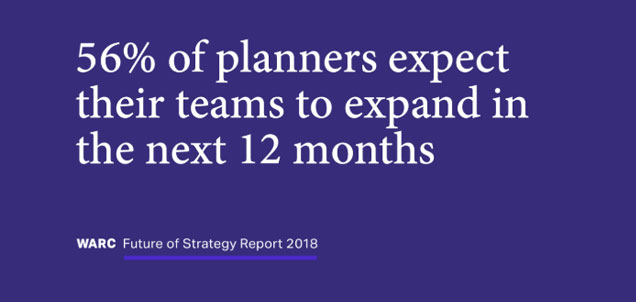
    Based on a survey of more than 500 senior planners and strategists from around the world,WARC’s second The Future of Strategy report provides both quantitative and qualitative data on the current state and future expectations of the industry. Key findings are:


    Strategy teams set to expand as influence grows

    More than half of strategists and planners expect their teams to grow over the next year, in an era when most feel that the influence of planning is growing both within their agency and among clients. Despite this optimism, there is a feeling that planners’ skills are not always being applied most effectively, commonly attributed to the pace of change in the industry, and a client focus on tech rather than sustainable strategy.

    Shekhar Deshpande, Global Planning Director & Strategy Consulting Director, J Walter Thompson, comments: “Senior clients want more strategy, perhaps to help them navigate the current marketing labyrinth, and become better marketers.”
    Budget cuts are threatening the ‘craft skills’ of strategy

    Budget pressures are a clear obstacle for planners and strategists globally. The majority of respondents in all regions say client-side budget cuts are having an impact on strategy teams. This is leading to more short-term thinking by clients. Within agencies, it means lower budgets and planners who no longer feel able to spend time away from their desks.

    Rob Campbell, Chief Strategy Officer, Deutsch, observes: “Fewer and fewer planners spend much time in the real world, preferring to observe it from the comfort of a research report and Google search.”
    Competition for strategic services is growing

    Marketing strategy is no longer just an agency specialism; increasingly strategy is being offered by consultancies, by tech and media firms, or by in-house client teams. That means greater competition for agency planning teams; but it may also mean more varied career opportunities for individual planners.

    Dan Burdett, Chief Marketing Innovation, Officer, EMEA, eBay, raises the question: “In a world where everybody is in some way competing with the guys in Seattle, how do we form coalitions that are going to benefit all of our businesses and help drive the industry forward?”
    Upstream vs downstream remains a crucial divide

    There is a tension between where planners want to be playing – on upstream business problems – and the reality of their day-to-day roles, with, in many cases, limited access to client data and heightened focus on tactical campaign elements. Reflecting the different visions of strategy in the industry and the potential need for reinvention in marketing services, several respondents argue that a link between strategy and execution remains vital.

    Paula Bloodworth, Brand Strategy Director, Wieden + Kennedy, London, comments: “With consumers moving and changing so quickly, we should be more executional in the way we plan and be nimble and flexible and adaptive.”

    Summing, David Tiltman, Head of Content, WARC, says: “WARC’s 2018 Future of Strategy report reveals a discipline in flux. There is generally a feeling of optimism – of greater influence and growing teams. But that is undermined by the impact of client budget cuts and, more broadly, a sense that the planners and strategists are not thriving as they might in current agency structures, at a time when competition for strategic services is growing.”

    A preview of the Future of Strategy report was unveiled during WARC Day at this year’s Cannes Lions International Festival of Creativity in June, with insights shared by senior global strategists. View the highlights video here.

    A sample of the report is available to download here and a free-to- join webinar discussing the findings of The Future of Strategy report will take place mid-August. The full report, including additional data, analysis and exclusive commentaries from senior survey participants, is available to WARC subscribers on warc.com.

  • Newsbrands diversify to plug $28bn financial hole


    Newsbrands’ combined revenue has dipped globally by $27.8bn between 2012 and 2017, with rising income from print circulation and digital advertising not enough to offset a $40.1bn decline in print ad receipts over the period. Publishers are now looking to diversify business models to balance the deficit.


    These and other key findings are included the latest monthly Global Ad Trends report focusing on print and digital publishing compiled by WARC, the international authority on advertising and media effectiveness.


    Print still provides over 90% of newsbrands’ revenue and total income is down $28bn since 2012

    Print (print advertising and print circulation) still accounts for over 90% of newsbrands’ revenue worldwide, though the majority now comes from circulation. Print circulation revenue has grown by around 1.6% each year, rising from $80.4bn in 2012 to an estimated $86.8bn in 2017 (57.5% of the total). Once the main source of income, print advertising now contributes 33.2% towards the bottom line.

    Digital (digital advertising and digital circulation)’s share of newsbrands’ ad income is growing, but is not yet enough to offset print’s decline. Income from digital ads ($10.1bn in 2017, of which $4.7bn is transacted in the US) now provides a further 6.7% and digital subscriptions just 2.6%.


    Most publishers believe their business will diversify to offset the downturn

    A quarter of respondents to a recent WAN-IFRA survey believe that non-traditional revenue sources (i.e. those beyond circulation, subscriptions and advertising) currently account for less than 10% of total income. By 2022, most (21%) believe non-traditional income will contribute between 31% and 40%. Branded content teams (such as Guardian Labs, WSJ Custom Studios and T Brand Studio) are becoming in-house fixtures, and partnerships with content recommendation companies (such as Outbrain and Taboola) are commonplace.


    Facebook offers publishers scale, and risk

    The majority of publishers state that their main business objective when engaging with Facebook is to use the platform as a distributor of content. Targeting new audiences and building brand awareness are also key goals, highlighting the social network’s scale.

    On average, 26.7% of consumers are sharing news stories online, varying from 43.0% in Brazil to 8.0% in Japan last year. But 53% could not remember the name of the newsbrand when referred from social media. Aside from anonymity, publishers have little control over the user’s overall viewing experience, and monetisation of the audience is a significant issue.

    Facebook recently made changes to its news feed algorithm, which de-prioritise video content from third-party media outlets. The move threatens publishers’ “pivot to video”, a strategy which aims to generate more ad income from non-text formats.


    UK newsbrands join forces to offer brands context, safety and scale

    As of last week, advertisers and agencies are now able to buy digital inventory and access audiences across UK newsbrands The Times, The Daily Telegraph, The Sun and The Guardian from a single sales point. The publishers each have an equal stake in revenue generated from an audience roughly on a par with Facebook’s reach in the UK of 35.1m users, according to the latest PAMCo data, and could be a potential indication of the future model for other publishers.

    Summing up, James McDonald, Data Editor, WARC, says: “The data underline the scale of the challenge facing publishers – despite robust consumer interest in their products. The response appears to be to club together to build scale, to emphasise the importance of context and brand safety, and to diversify revenue streams, particularly into native and branded content.”


    Global media analysis: A round-up of print and digital publishing

    ·  1.6% average growth rate in print circulation revenue

    ·  26.7% readers who share news stories on social media

    ·  31.0% US newsbrand ad revenue coming from digital

    ·  34.3% average growth rate in digital subscription revenue

    ·  57.4% consumers who are willing to see advertising in exchange for free news

    ·  90.7% newsbrand revenue derived from print


    Other new key media intelligence on WARC Data

    ·  Short-form TV ads capture 8% to 11% more attention per second than long-form

    ·  YouTube launches ad-free Premium and Music services

    ·  Accounting adjustment results in Amazon’s ad sales doubling to over $2bn

    ·  Aussie VOD revenue to top A$126m this year but linear TV formats decline


    Global Ad Trends is part of WARC Data, a dedicated online service featuring current advertising benchmarks, data points, ad trends and user-generated expanded databases. For more information visit https://www.warc.com/data

  • Mindshare, MediaCom Mumbai in Gunn’s World Top 10 for media excellence


    Gunn Report, the global index of excellence in advertising, has released the results of the 2018 Gunn Media 100, a global ranking of the world’s most awarded and applauded campaigns and companies based on their performance in media competitions around the world.

    Gunn Report, now part of WARC, tracks the winners’ lists of close to 30 of the most important global, regional and national media awards shows to compile Gunn Media 100 – a list of the 100 best campaigns for creativity and innovation in media, along with the best-performing agencies, networks, holding companies, brands, advertisers and countries.

    The highest-ranked campaign in the Gunn Media 100 is McDonald’s ‘Capacity Based McDelivery’ by OMD Singapore. To maintain competitive advantages, McDonald’s promoted its delivery service McDelivery in Singapore in partnership with Google. By integrating McDonald’s first-party data with Google’s hyper-local targeting, they maximised media cost efficiency and managed consumer expectations of delivery time through tailored messages, mapping real-time restaurant data against paid search spends via a live API.

    Said Stephen Li, CEO of OMD APAC: “To have our work for McDonald’s recognised as best of the best globally, is testament to our unwavering commitment and relentless focus on helping our clients’ leading brands continue to cut-through with data-driven creativity. This recognition motivates us to continue our drive in helping brands make better decisions, faster. The ‘Capacity Based McDelivery’ campaign is the perfect example of this in practice, leveraging real-time data to generate fresh growth for a market-leading brand in a highly competitive category. I could not be more proud of this achievement, and all the other great work coming out of OMD Singapore. It only inspires us to continue raising the bar even further still for our clients.”

    In second place is ‘Hungerithm’ by MediaCom Melbourne / Clemenger BBDO, which saw confectionary brand Snickers partner with 7-Eleven stores in Australia to drive sales and increase category share. Snickers says the internet gets angry when it’s hungry. The brand launched ‘Hungerithm’, an algorithm that analysed 14,000 social posts a day and adjusted the price of the chocolate bar accordingly.The angrier the Internet got, the cheaper Snickers became.

    Ranked third is ‘Reword’ for Headspace by Leo Burnett Melbourne / Starcom Melbourne. The Australian youth mental health foundation, successfully tackled cyber bullying by putting in place a social media rewording tool that analyses what users type and uses a red line to strike through abusive phrases.

    Three themes have emerged from the world’s top campaigns for media excellence:

    :: Data is driving fresh media thinking. The top campaign is built around smart use of data. This is a recurring theme in the rankings, as brands look to harness multiple data sources to deliver competitive advantage.

    :: An event-led strategy helps brands stand out. As brands struggle to be heard in a fragmented media landscape, there is a growing focus on ‘events’ such as Super Bowl, US Presidential debates, and Olympics, that can draw a crowd and interest from the press.

    :: Partnerships are central to youth-focused media strategy. Partnerships with organisations or individuals that bring their own reach are now a key element of media strategy, particularly for brands targeting younger demographics.


    MediaCom London claims first place in the Gunn Media 100 agency rankings with four campaigns ranked in the top 100: ‘Best Day Of My Life’ for Shell (#6), ‘Singing Our Way To The Top Of The Box Office’ for Universal Pictures’ Sing (#22), ‘Missing Type’ for NHS Blood & Transplant (#30) and ‘Dark To Light’ for Gucci Guilty (#77=).

    PHD New York is in second place also with four campaigns in the top 100. Their highest ranked campaign (#13) is ‘The Debate Headache’ for GlaxoSmithKline’s Excedrin. Mindshare Mumbai is ranked third with three campaigns making the cut.

    MediaCom is the top-ranked network with eight agencies from around the world – Auckland, Bogota, Dusseldorf, London, Mumbai, Melbourne, Mexico City, New York – contributing to the network’s poll position. PHD Worldwide is in second place and OMD Worldwide, third.

    For the first time Gunn Media 100 has included a ranking of holding companies. WPP tops the leader board, with three of its networks – MediaCom, Mindshare Worldwide and Wavemaker – ranked in the top 10. Omnicom Group and Interpublic Group follow.

    Stephen Allan, Worldwide CEO and Chairman of MediaCom, said: “This is an outstanding achievement, of which I am extremely proud. Every single person throughout the MediaCom network has contributed to our success and has truly embraced our philosophy of Systems Thinking to great effect.

    “I am, of course, delighted that MediaCom UK has also been recognised within the Gunn Media 100 as the top individual agency, which is incredibly well deserved. But none of this would have been possible without our fantastic clients, agency partners and media owners who have collaborated with us to create globally-celebrated campaigns. We are proud to have contributed towards WPP’s achievement of being named the top Holding Company within the same report.”

    CEO of WPP, said: “WPP’s core purpose is to deliver growth for our clients so we are delighted to receive this recognition of our effectiveness in doing so. And congratulations to MediaCom who, as network and agency of the year, have helped us achieve a hat-trick of awards.”

    Nike takes first position as the top brand with four campaigns featured in the top 100, all from the US. McDonald’s is in second place, followed by Snickers and Dove.

    Unilever tops the Advertiser’s ranking by a significant margin. Procter & Gamble is in second place. Both advertisers have six brands featured in the top 100 campaigns. Mars takes third place with five campaigns in the top 100.

    The US dominates the rankings with 30 campaigns in the top 100, 12 of which feature in the top 20. UK is second with 11 campaigns. Australia and India follow. In total, 24 countries are represented.

    The most highly ranked campaigns and companies in Gunn Media 100 are:

    The world’s top 10 campaigns for media excellence

    Rank Campaign title Brand Agency Points
    1

    Capacity Based McDelivery

    McDonald’s OMD Singapore 136.1
    2 Hungerithm Snickers

    MediaCom Melbourne / Clemenger BBDO Melbourne

    131.2


    3 Reword Headspace  Leo Burnett Melbourne / Starcom Melbourne 129.1


    4 Bachelor Of Shaving Gillette MediaCom Mumbai 122.5
    5 Bradshaw Stain Tide Saatchi & Saatchi New York / Hearts & Science New York 106.1


    6 Best Day Of My Life Shell MediaCom London 105.4
    7= Sport Chek – The Fastest Olympic Campaign! Sport Chek Touché PHD! Montreal


    101.3


    7= Bully Ads Canadian Safe School Network Touché PHD! Toronto


    101.3


    9 Yasmin’s Sex-Ed Revolution Yasmin PHD Shanghai 96.7
    10 Like My Addiction Addict’Aide BETC Paris 87.2


    The world’s top 10 best agencies for media excellence

    Rank Agency Location Points
    1 MediaCom London, UK 317.2
    2 PHD New York, USA 249
    3 Mindshare Mumbai, India 235
    4 PHD Shanghai, China 211.4
    5 Mindshare Shanghai, China 197.4
    6 Clemenger BBDO Melbourne, Australia 184
    7 MediaCom Mumbai, India 174.9
    8 Mediaplus Munich, Germany 171.4
    9 Touché PHD! Montreal, Canada 171.3
    10 Starcom Chicago, USA 169.4


    The world’s top 10 agency networks for media excellence

    Rank Agency Network Holding Company Points
    1 MediaCom WPP 1360.6
    2 PHD Worldwide Omnicom Group 1199.5
    3 OMD Worldwide Omnicom Group 1140.8
    4 Mindshare Worldwide WPP 890.2
    5 Starcom PublicisGroupe 761.1
    6 Universal McCann Interpublic Group 731.1
    7 BBDO Worldwide Omnicom Group 546
    8 Wavemaker WPP 526.8
    9 Dentsu Aegis Network Dentsu 482.2
    10 McCann Worldgroup Interpublic Group 447.1


    The world’s top 10 holding companies for media excellence

    Rank Holding Company Points
    1 WPP 3565.4
    2 Omnicom Group 3326.7
    3 Interpublic Group 2131.7
    4 PublicisGroupe 1597.3
    5 Dentsu 540.1
    6 Havas 442
    7 MDC Partners 88.6
    8 Hakuhodo DY Holdings 65.1
    9 Publicis Group 41.4
    10 Accenture 17.1


    The world’s top 10 brands for media excellence

    Rank Brand Sector Points
    1 Nike Clothing & Accessories 297.5
    2 McDonald’s Retail 263.7
    3 Snickers Food 227.9
    4 Dove Toiletries & Cosmetics 204.5
    5 Netflix Media & Publishing 194.5
    6 Shell Business & Industrial 180.8
    7 Samsung Technology & Electronics 136.1
    8 Headspace Non-profit, public sector & education 129.1
    9 Gillette Toiletries & Cosmetics 122.5
    10 US Army Non-profit, public sector & education 107.3


    The world’s top 10 advertisers for media excellence

    Rank Advertiser Points
    1 Unilever 942.7
    2 Procter & Gamble 517.6
    3 Mars 392.8
    4 Nike 283.3
    5 McDonald’s 263.7
    6 PepsiCo 251.4
    7 Anheuser-Busch InBev 217.1
    8 Nestlé 195.7
    9 Netflix 194.5
    10 Royal Dutch Shell 186.5


    The world’s top 10 countries for media excellence

    Rank Country Points
    1 USA 2841.9
    2 UK 1427.5
    3 Australia 871.6
    4 India 854.8
    5 United Arab Emirates 748
    6 Canada 684.1
    7 China 656.8
    8 Singapore 363.2
    9 Brazil 345.3
    10 Germany 337


    Commenting on the results of Gunn Media 100, Emma Wilkie, managing director of Gunn Report, said: “Hot on the heels of the recently published Gunn 100 ranking for creative excellence and the WARC 100 index for effectiveness, the newly launched Gunn Media 100 benchmarks media creativity and innovation as well as highlighting media trends based on an independent global analysis.


    “We’re seeing that the smart use of data, event-led strategies and partnerships that provide new consumer reach are the main themes currently driving the media industry forward offering new and exciting opportunities in the market place.”


    The full Gunn Media 100 rankings – including the world’s top 100 campaigns for media excellence, top 50 agencies, networks, brands, advertisers, countries and top holding companies as well as commentaries, the work and credits – are available by subscription on www.warc.com/gunnreport.


  • Gunn Report announces major changes in format

    By A Correspondent


    Major changes are being introduced to Gunn Report, the global index of creative excellence in advertising, to reflect the way the industry is evolving.


    Gunn Report, which came under ownership of global marketing intelligence company WARC at the end of 2016, will be re-launched next month as part of the integration of Gunn Report into WARC.


    The most significant change will be the introduction of Gunn 100. From this year, the renowned Gunn Report rankings, identifying the most creative ads, agencies and brands based on their performance in creative awards shows around the world, will be produced in alignment with WARC 100 – WARC’s annual rankings of campaigns and companies based on their performance in effectiveness and strategy awards.


    Gunn 100 will consist of a ranking of the 100 best creative ideas in the world, regardless of their communication discipline. This replaces the previous channel-specific rankings of film, print and out of home, digital and ‘all gunns blazing’, to reflect the rise of cross-channel campaign ideas and their success in awards shows.


    The Gunn 100, as well as ranking the world’s top 100 creatively awarded campaigns, will also include the world’s top 50 creative agencies, agency networks, brands, advertisers, countries and top holding companies.


    These listings will continue to be compiled by analysing the results of over 40 of the world’s best global, regional and local creative awards shows. The awards shows tracked will remain confidential to avoid prejudicing entries to competitions.


    A new methodology is also being introduced to calculate the rankings. Points are earned based on the metal of the award: bronze (or equivalent) = 2 points; silver = 4 points; gold = 6 points; Grand Prix = 10 points. The points are weighted according to the rigour and prestige of the competition, determined by a survey of creative leaders on the competitions they prioritise.


    Said Emma Wilkie, managing director of Gunn Report: “This is an exciting new chapter for Gunn Report. The industry and the awards shows have evolved considerably since The Gunn Report was first launched in 1999, and the key changes we are implementing will reflect these industry transformations.”


    Gunn Report 2018 will now be made up of Gunn 100 and WARC 100 (both launching in February) and Gunn Media 100 (launching in March), providing comprehensive, independent, global rankings for creativity, effectiveness and media. Gunn Report will continue to offer valuable research studies, signature features and a creative library of award winning work, available online by subscription.


    Added Wilkie: “We’re particularly delighted with the new Gunn Report offering, which will be a one-stop place to find impartial and trustworthy information on the best creative, effectiveness and media ideas, agencies and brands from around the world.”

  • Global adspend to accelerate in 2018: WARC


    By A Correspondent


    WARC, the international marketing intelligence service, has released its latest monthly Global Ad Trends report digesting up-to-date insights and evidenced thinking from the worldwide advertising industry.


    Focusing on advertising expenditure in 96 markets, this latest Global Ad Trends report includes key trends in spending patterns by media and geography since 2009, a round-up of 2017, as well as full-year projections for 2018.


    Global growth is forecast at 4.7 per cent to a total of US$572bn this year, boosted by the Pyeong Chang Winter Olympics, FIFA World Cup, US mid-term elections and reduced dollar volatility in emerging markets.


    Growth in North America (+5.0 per cent), Asia-Pacific (+6.0 per cent) and Western Europe (+2.6 per cent) is expected to hasten in 2018, while Central and Eastern Europe (+8.4 per cent) and Latin America (+7.0 per cent) will continue to expand at a strong rate. Advertising spend across the Middle East and Africa is expected to dip once more (-4.1 per cent), though at a lesser rate than in previous years.


    Global advertising spend rose 3.0 per cent to US$546bn in 2017, according to new projections based on data for 96 markets. The growth rate in 2017 represents a slowdown from the 3.8 per cent rise recorded in 2016, partially owing to weaker growth in the United States (which accounts for 34 per cent of the value of advertising worldwide).


    The slowdown in the US contributed to an easing in growth across North America as a whole. Adspend in the region rose 3.3 per cent to US$199.6bn in 2017. Growth in the world’s second-largest ad region, Asia-Pacific, also cooled (+4.3 per cent to US$162.8bn in 2017, as growth in Japan (23 per cent of the regional total) was muted by a weaker Yen. The Chinese ad market – which accounts for 41 per cent of Asian and 12 per cent of global advertising spend – expanded by 4.7 per cent to US$66.7bn last year, propelled by rapidly increasing spend on mobile ads.


    Mobile increased its share of global advertising expenditure by an estimated 5.9 percentage points (pp) to 20.6 per cent in 2017, equivalent to US$112bn (up 44.5 per cent year-on-year). Approximately 45 per cent of mobile advertising spend is based in the US, where US$156 dollars per capita is spent on mobile ads.


    Mobile is thought to have been the only media channel to have gained share year-on-year. Estimates indicate that mobile overtook desktop internet for the first time in 2017, as spend on desktop ads was thought to have taken a share of 18.3 per cent (down 1.9pp year-on-year).


    The largest media channel, TV, is estimated to have registered a 1.4pp dip in 2017, taking a share of 36.5 per cent of the global adspend total (US$199.5bn). Print continues to lose share, the channel was down an estimated 2.2pp in 2017 to 12.5 per cent. Since 2009, print has recorded a massive 21.5pp decrease in its share of global adspend, and has lost an average US$11.5bn each year since 2012.


    Out of home’s share dipped by 0.1pp to 5.7 per cent in 2017, while cinema’s share held at 0.7 per cent and radio was down by an estimated 0.2pp to 5.7 per cent.


    James McDonald, Data Editor, WARC, says: “2018 should be a stellar year for global advertising, with ad investment set to grow at its strongest rate since the post recovery years of 2010 and 2011. All global regions, with the exception of the Middle East, are expected to register growth, supported by key quadrennial events – notably the Winter Olympics in South Korea, the FIFA World Cup in Russia and the US mid-term elections.”


    He added, “Mobile is now a key driver of global growth, and was the only channel to gain share of spend in 2017 – it now accounts for one in five ad dollars worldwide. Nevertheless, traditional media still attract 61% of global ad investment, and TV and out of home will be among the main benefactors of increased brand and political campaign spending this year.”

  • Why Brands want a ‘Swachh’ Digital Media


    By A Correspondent


    Digital transparency will be a key challenge for brands in the year ahead concludes WARC, the global marketing intelligence service, in its Toolkit 2018 – a report based on a survey of more than 600 marketing and advertising professionals around the world to obtain their outlook on the coming year. The findings are combined with the latest ideas, research and expert opinion from WARC.


    Led by P&G, brands are putting pressure on the digital media ecosystem to reform and to embrace greater transparency.Issues include the billions of dollars being lost globally to ad fraud; the absence of industry-wide viewability standards; the shortage of impartial, third-party campaign measurement and verification; the rising use of ad-blocking software; and a lack of transparency in the media supply chain.


    Said David Tiltman, Head of Content, WARC: “2018 will be pivotal to the ongoing drive by brands, media owners and the ad tech industry to ‘clean up’ and address the challenges facing digital advertising– viewability, brand safety, measurement, transparency – as they reassert control over media contracts, investments and partnerships, to ensure they are maximising ROI.”


    Added Julia Connaughton, Head of Digital, the 7stars: “With advertisers demanding increased transparency, and agencies and publishers united in a fight against ad fraud, we are entering a period of transition that will have a lasting impact on the future of our industry.”


    Key findings around digital transparency from the Toolkit 2018 survey reveal that:

    :: Both agency (45%) and brand (49%) respondents cited viewability and accurate measurement as the number one industry issue offering cause for concern when drawing up marketing plans for the coming 12 months.

    :: 30% of respondents expect digital spend to be cut if these issues are not resolved.

    :: 51% of brands believe there is now a crisis of trust between brands and media agencies.


    The drive for digital transparency is one of five key challenges highlighted in Toolkit 2018, which also includes a guide to best practice, potential pitfalls and video interviews with industry leaders to help overcome the issues.


    For more information and insights on Toolkit 2018, visit https://www.warc.com/Topics/Toolkit.topic


    PS:

    Interestingly, one of the responses to the survey notes that the “explosive 2016 investigation into rebates and agency contracts by the ANA (Association for National Advertisers) in the US will continue to have ramifications for the media industry in 2018.” Also: “Over half (51%) of brand respondents agree that there remains a crisis of trust between clients and media agencies. This opinion is shared by agency-side colleagues: 52% of those working at media agencies agreed with the statement, as did 57% of respondents from creative agencies.” Enough reason to download the toolkit for more?!